

Getting told you must complete a DUI Risk Reduction course can make everything feel urgent at once. You may be dealing with a court date, questions about your license, calls from work, and the practical problem of how you're supposed to get to a class if you live in Carroll, Douglas, or Paulding County and the closest option feels far away.
That's a common sticking point. Not because the requirement is impossible, but because the process sounds more complicated than it is. If you're looking for clear guidance on West Georgia DUI Risk Reduction, the key is to break it into small steps and handle them in order.
Navigating Your DUI Risk Reduction Requirement
A common West Georgia situation looks like this. Someone in Carrollton, Douglasville, or Dallas gets paperwork from a court or the Georgia Department of Driver Services and sees the same phrase over and over: complete the DUI Alcohol or Drug Use Risk Reduction Program before driving privileges can be restored.
The first reaction is usually confusion. People ask whether this is just a class, whether they need an evaluation too, whether they can do it online, and whether one school counts more than another. Those are reasonable questions, especially when you're trying to fix a license problem quickly.
This requirement isn't just about punishment. Georgia uses the program as an intervention step tied to safer future driving and license reinstatement. In an evaluation of Georgia DUI Courts, graduates had a 9% rearrest rate after four years compared to 24% for offenders in similar counties without the court. That doesn't erase the stress of dealing with a case, but it does show the course is meant to change outcomes, not just check a box.
Practical rule: Treat the course as part of your reinstatement path, not as a side issue. The faster you understand the sequence, the less likely you are to lose time.
For many people, the hardest part is the mix of legal language and daily logistics. You may be asking, "What exactly do I have to do first?" That's the right question.
A calm way to approach it is this:
- Start with the order of steps. The process has a required sequence.
- Focus on approved providers. DDS certification matters.
- Think about transportation early. In West Georgia, travel can become a significant obstacle.
- Keep your paperwork together. Your completion documents will matter later.
Once you understand what the program includes, the whole requirement becomes much easier to manage.
What the Georgia DUI Risk Reduction Program Entails
If you live in Carroll, Douglas, or Paulding County, this requirement can feel bigger than it looks on paper. It is not just about taking a class. It also means fitting the state's rules around work, childcare, court dates, and, for many people in West Georgia, a long drive to an approved provider.
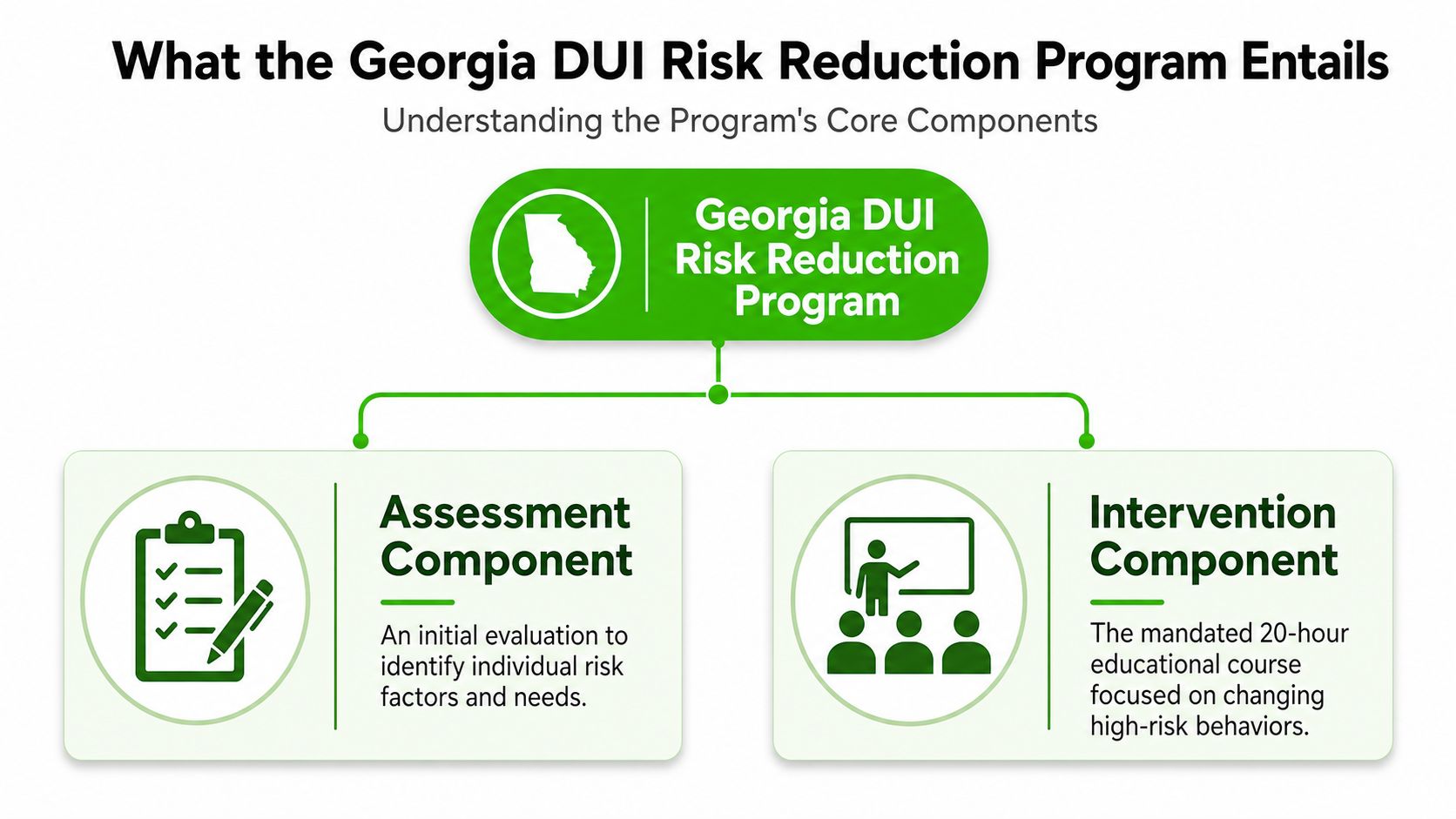
Georgia uses a two-part format, and the order matters. The program starts with an assessment. Then it moves to the class portion. You need both parts completed before you can receive the certificate used for license reinstatement.
The first part is the assessment
The first step is the NEEDS Assessment. This is a standardized screening tool used at the start of the program. It asks a large set of questions about alcohol or drug use patterns and how those patterns relate to driving risk.
A simple way to understand it is this: the assessment is the intake step. The class is the education step. They work together, but they are not interchangeable.
That distinction matters because many participants assume they can sign up for the class first and handle the rest later. Georgia does not allow the program to work that way. The assessment comes first.
The second part is the intervention course
After the assessment, you complete the 20-hour intervention course. Georgia uses the Prime for Life curriculum through DDS-certified providers. If you want a clearer explanation of how the full program is set up, this overview of the Georgia DUI Risk Reduction Program requirements breaks it down.
The course applies in several situations, not only a standard DUI case. It may be required after:
- DUI convictions
- Underage alcohol possession
- Boating Under the Influence
- Drug possession convictions
The price structure is also more straightforward than many people expect. Georgia sets the base program cost statewide, so one approved school generally does not beat another on the required fee itself. What usually changes is the practical side of the experience: how far you need to travel, whether the scheduling fits your job, and how easy it is to complete each step without losing more time.
For West Georgia residents, that practical side matters a lot. A provider that saves repeated trips across county lines can reduce missed work hours, gas costs, and the stress of arranging transportation. That is one reason many people look closely at online-eligible steps and flexible scheduling instead of choosing based on location alone.
Why the structure matters
The program works like a sequence of checkpoints. You clear the assessment first. Then you complete the course. Then the provider can issue the completion paperwork.
Missing that order often causes delays. Understanding the structure early usually saves more time than trying to rush the process later.
Your Step-by-Step Enrollment and Completion Process
Most confusion disappears once you put the requirement into a simple checklist. The sequence matters, and skipping ahead usually creates delays.
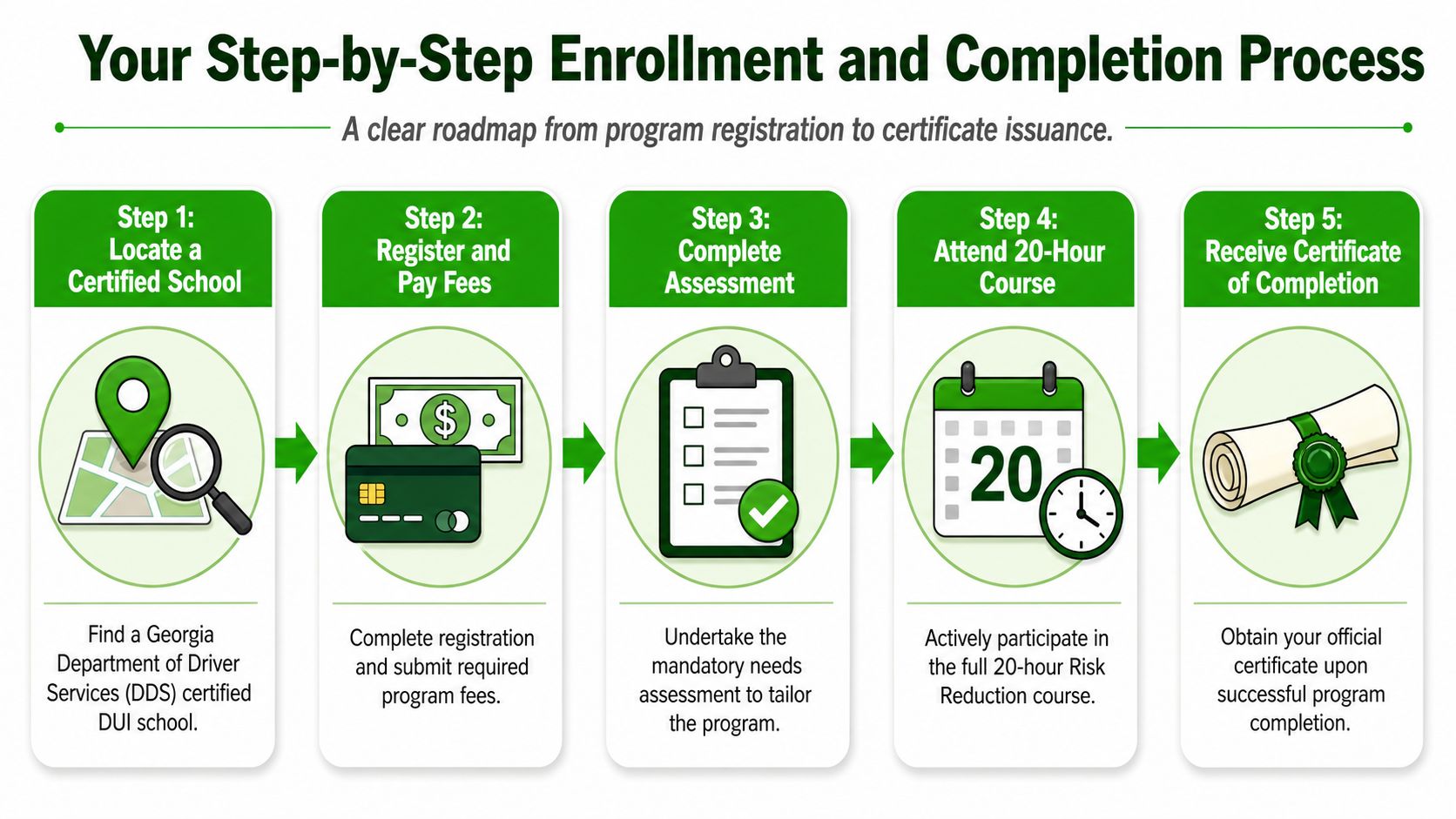
Step one, choose a DDS-certified school
The first step is finding a provider that is properly certified by the Georgia Department of Driver Services. That's true whether you want an online option or an in-person classroom. If the provider isn't DDS-certified, the course won't satisfy the requirement.
A lot of people in West Georgia lose time here because they focus only on location. Location matters, but certification comes first. After that, compare practical issues such as schedule, class format, and how easily you can complete the process around work or family obligations. If you want a broader explanation of Georgia course pricing and provider differences, this overview of driving school costs in Georgia can help with the general overview.
Step two, complete the assessment first
This is the part many people try to rush past. You can't. Georgia's DUI program has a strict two-component structure, and the Assessment Component must be completed first, followed by the 20-hour course. The assessment must be finished before educational instruction can begin, according to the Georgia DDS DUI FAQs.
That means your timeline should look like this:
- Register with a certified provider
- Take the assessment
- Attend the intervention course
- Finish all required hours
- Receive proof of completion
If your class date is approaching and your assessment still isn't done, fix that immediately. Waiting until the last minute is one of the easiest ways to delay completion.
Step three, attend every required hour of the intervention course
The course is not optional in parts. It is a 20-hour intervention requirement, and attendance matters. The state-authorized formats can vary. Georgia law materials describe options such as a 2.5-day weekend, a 2.5-day weekday, or a 5-day morning or night schedule, and participants generally have one year to complete the full course after the initial assessment under the Georgia legislative language governing program delivery.
That scheduling flexibility is especially important if you work in construction, healthcare, retail, or another job with rotating hours.
Step four, receive your certificate of completion
Once you've completed both required parts, the school issues the official certificate of completion. That certificate is what proves you've met this specific program requirement.
Keep a copy where you can find it quickly. If your lawyer, probation officer, local court, or DDS asks for it, you don't want to be searching through old emails or paperwork.
Step five, submit the certificate where your case requires
This final step depends on your situation. Some people need the certificate for a local court. Others need it for DDS license reinstatement. If you're handling a case in a place like Carrollton or Douglasville, make sure you know exactly who must receive it and whether you must submit it yourself or provide it through counsel.
A simple way to stay organized is to make a short document list:
- Your assessment confirmation
- Your class registration details
- Your certificate of completion
- Any court order mentioning evaluations or other conditions
- DDS reinstatement paperwork if applicable
That small habit can save a lot of stress later.
Finding a DUI Risk Reduction Course in West Georgia
For West Georgia residents, the biggest issue often isn't the class itself. It's the travel.
If you live in parts of Carroll, Douglas, Paulding, or nearby rural areas, getting to a DDS-approved school may mean a long drive, taking time off work, arranging childcare, or depending on someone else for a ride. That reality gets overlooked in many discussions about DUI classes. For many West Georgia drivers, travel to approved schools can exceed 50 miles, adding gas and time costs beyond the standard course fee, as noted in this West Georgia access discussion tied to statewide enforcement and education context.
Why the local decision matters
A person living near downtown Douglasville may have a different experience from someone outside Carrollton or in a more rural part of Paulding County. Two people can pay the same state-set fee and still have very different total burdens because one has a short commute and the other loses half a day to driving.
That's why West Georgia DUI Risk Reduction isn't just about compliance. It's also about picking the format that causes the fewest extra problems.
Online and in-person options side by side
| Factor | Online Course | In-Person Classroom |
|---|---|---|
| Travel burden | Lower for many West Georgia residents because you don't have to drive long distances to attend live instruction from home | Higher in many cases if the nearest certified location requires a long drive |
| Schedule fit | Often easier to match with work and family demands when you're trying to avoid extra commute time | Can work well if the class time and location line up with your routine |
| Rural convenience | Helpful for residents outside major corridors who don't want to arrange transportation across counties | May be harder for people in less populated areas |
| Learning environment | Good for people who focus better at home and want fewer logistical hurdles | Good for people who prefer face-to-face classroom interaction |
| Hidden costs | May reduce gas and travel time costs | May add fuel, time, and coordination costs beyond the standard fee |
| Best fit | Busy professionals, parents, and rural residents | People who strongly prefer classroom structure |
Some people still prefer an in-person classroom. That can make sense if you learn better in a physical group setting or if you already travel regularly into a city where a certified school is located. For readers comparing locations in the broader western part of the state, this page on a Columbus-area driving school option may help you think through geography and access.
A good course choice is the one you can complete reliably, on time, and without creating new transportation problems.
Questions to ask before you register
Before you commit, ask yourself:
- How far would I need to travel for each class session?
- Do I have reliable transportation for every required session?
- Would online access remove a major obstacle for me?
- Am I more likely to finish on time in a classroom or from home?
Those are better decision questions than asking which school is "cheapest," because the state-set base fee doesn't change.
How Georgia DUI Schools Offers Complete Support
A DUI-related case often involves more than the 20-hour Risk Reduction course. That's where many people feel overwhelmed. They start with one requirement, then learn they may also need a clinical evaluation, treatment, a victim impact panel, or other court-related steps.
The first point of confusion is usually the assessment. The state-mandated Risk Reduction program includes a 143-question self-assessment designed to identify substance use patterns, and that can trigger the need for a separate Clinical Evaluation by a state-approved evaluator, potentially leading to ASAM Level 1 treatment if dependency is detected, according to this Georgia DUI program and clinical evaluation explanation.

Why bundled support helps
When different requirements are handled by unrelated providers, people end up repeating their story, managing separate schedules, and trying to track multiple sets of paperwork. That can be exhausting when you're already dealing with a court case or reinstatement process.
Using one provider for related services can simplify the process in practical ways:
- Fewer moving parts so you aren't juggling different offices for every requirement
- Clearer scheduling when class dates, evaluations, and follow-up services are coordinated
- Less paperwork confusion because your records stay in one system
- A more consistent experience when staff understand how the pieces fit together
Common services people may need
A complete support model often includes more than just the Risk Reduction class itself.
- Clinical Evaluations: These are separate from the NEEDS Assessment and may be required by a court or recommended based on screening results.
- ASAM Level 1 treatment: Some participants need follow-up counseling or treatment before they can fully satisfy case requirements.
- Victim Impact Panels: Courts sometimes require these in addition to educational or treatment steps.
- Administrative guidance: People often need help understanding what goes to the court, what goes to DDS, and what they should keep for themselves.
The less time you spend figuring out who handles what, the more energy you can spend finishing the requirements correctly.
For someone in West Georgia, especially if travel is already a challenge, coordinated support isn't just convenient. It can make the whole case easier to complete without missed steps.
Frequently Asked Questions About Georgia DUI Classes
A lot of confusion around DUI classes comes from simple logistics. If you live in Carroll, Douglas, or Paulding County, one question often sits underneath all the others: how do I finish this requirement without losing more time, money, and work hours than necessary? These answers focus on the practical parts people usually need to sort out fast.
Is the price the same at every certified school
Yes. Georgia sets the price for the Risk Reduction Program, so the total cost is $360.00 at certified schools. That amount includes both the assessment fee and the class fee.
Can I start the class before I finish the assessment
No. Georgia requires the assessment first. The class cannot begin until that part is completed.
What if I also need a clinical evaluation
That happens in some cases. The Risk Reduction assessment is one requirement, and a clinical evaluation is a separate one. A good way to understand it is to treat the assessment as the starting checkpoint and the clinical evaluation as an added step that may be required by a court or recommended based on your screening results.
Is online West Georgia DUI Risk Reduction accepted
It can be, if the provider is DDS-certified and the course follows Georgia rules. For people in West Georgia, that can make a real difference. It may cut down on long drives, time away from work, and the hassle of coordinating transportation across county lines.
Where do I send my completion certificate
It depends on your situation. Some people need to give it to the court. Others need it for an attorney or as part of DDS reinstatement steps.
If you are not sure, ask before your final class date. That one phone call can prevent delays and help you avoid repeating steps.
If you need a DDS-approved option that works for busy schedules across the state, including West Georgia, explore the Georgia DUI Schools Risk Reduction course.