
A Georgia driver finishes the required Risk Reduction course, receives a DDS-accepted certificate, and assumes the difficult part is over. Months later, a new impaired-driving arrest forces the court, the provider, and the driver to confront an uncomfortable question: did the program work, or did the participant merely complete it?
That question exposes the central problem in process evaluation vs outcome evaluation. A certificate can document that a provider delivered required services. It can't, by itself, prove that a participant changed risky behavior, avoided another offense, or became safer behind the wheel. Georgia DUI programs need both forms of evidence, and they need to keep their conclusions separate.
Why Georgia DUI Programs Need Both Evaluation Types
Consider a representative Georgia driver who completed a 20-hour Risk Reduction Program, received a DDS-accepted certificate, and re-offended within nine months. The certificate answers one administrative question. It shows that the driver completed the required program components. It doesn't answer whether the driver changed drinking patterns, stopped driving while impaired, followed treatment recommendations, or recognized personal risk before getting behind the wheel.
The criminal justice system and the Georgia Department of Driver Services are asking two different questions:
- Did the provider deliver the program as designed?
- Did the program change anything in the participant's life or driving behavior?
The first question belongs to process evaluation. The second belongs to outcome evaluation. Confusing them produces reports that look complete but make claims the evidence can't support.
Georgia's two-component structure
Georgia DDS describes the DUI Alcohol or Drug Use Risk Reduction Program as having two distinct components. The Assessment Component, also called the NEEDS Assessment, evaluates an individual's alcohol and drug use. The Intervention Component is a DDS-approved therapeutic education course focused on alcohol, drug use, and driving. Both must be successfully completed before the provider issues a certificate of completion. Georgia DDS explains the Risk Reduction Program components.
That structure creates clear checkpoints for implementation review. A provider can verify whether the participant completed the assessment, attended the intervention course, received the planned content, and qualified for certification under the applicable requirements.
The structure also creates a separate opportunity to measure results. Evaluators can examine knowledge, risk perception, self-reported driving behavior, treatment engagement, repeat offenses, or other defined outcomes after participation. Those results shouldn't be folded into the certificate record or inferred from attendance.
Practical rule: A certificate proves completion of required services. It doesn't prove safer conduct.
DDS adjudicators primarily need reliable documentation that the required program was completed. Judges and treatment courts may need broader evidence about compliance, engagement, and behavior. Providers protect the credibility of every audience by reporting implementation evidence and results evidence as separate categories.
The rest of this guide applies that diagnostic-versus-results split to Georgia DUI and defensive-driving programs. Process evaluation identifies what happened during delivery and where implementation failed. Outcome evaluation examines what changed afterward and how confidently the provider can connect that change to the intervention.
Defining Process and Outcome Evaluation in Plain Terms
Process evaluation is an audit of delivery. It asks whether the provider served the intended population, followed the approved curriculum, delivered the planned amount of instruction, documented attendance, and completed each required milestone. It may include participation levels, completion rates, staffing, delivery format, instructor adherence, referral timing, and whether the program reached the people it was designed to reach.
Outcome evaluation measures results. It asks whether participants achieved the intended changes after receiving the program. Depending on the program's objectives, that may include improved knowledge, changed risk perception, reduced self-reported impaired or distracted driving, license reinstatement progress, fewer repeat violations, stronger treatment engagement, or changes in clinical symptoms.
The difference between assessment and evaluation matters here. An assessment identifies needs or risk factors at intake. An evaluation tests implementation or results against defined questions. They can inform each other, but they aren't interchangeable.
What the GAO framework establishes
The U.S. Government Accountability Office separates program activities and services delivered from the results of those services. Its evaluation guidance treats participation, completion, staffing, curriculum adherence, and delivery format as process or output evidence. Changes in knowledge, attitudes, behavior, safety performance, or other objectives measured after participation belong to outcome evidence. The GAO evaluation guidance distinguishes process evidence from outcome evidence.
That distinction exposes a common reporting mistake. A provider may report that nearly all enrolled drivers completed a course and then label the completion figure an effectiveness rate. Completion shows exposure to the intervention. It doesn't show that the intervention caused a change in conduct.
A completion measure can still be valuable. A low completion rate may identify transportation barriers, scheduling problems, technology failures, referral friction, or weak follow-up. A high completion rate may show that the provider's delivery system is functioning. Neither result establishes lower recidivism or safer driving without separate outcome data.
The inferential boundary
Process evaluation is primarily diagnostic and improvement-oriented. It tells a provider what was delivered, to whom, under which conditions, and with what operational consistency.
Outcome evaluation is primarily results-oriented and often summative. It tells a provider whether the target population moved in the intended direction. It doesn't automatically establish causality. A participant's improvement may coincide with court supervision, license sanctions, treatment, family pressure, or broader traffic-safety conditions.
The next comparison makes that boundary practical. The issue isn't choosing one evaluation type over the other. The issue is matching the question, data source, timing, and conclusion to the evidence collected.
Side by Side Comparison of Process and Outcome Evaluation
A Georgia Risk Reduction provider should be able to identify the evaluation type behind every reported measure. If the measure comes from the delivery record, it probably describes process. If it requires observation after the program, it probably describes outcome. That simple test prevents providers from presenting administrative completion data as behavioral proof.
Process versus results in practice
| Criterion | Process Evaluation | Outcome Evaluation |
|---|---|---|
| Primary question | Did the provider run the program as designed? | Did the participant achieve the intended change? |
| Data source | Attendance logs, instructor checklists, assessment records, curriculum records, and DS-9900 records | Client follow-up, recidivism tracking, post-program assessments, and DDS reinstatement outcomes |
| Timing relative to delivery | Collected during intake, instruction, referral, and certification | Collected after participation and across defined follow-up periods |
| Who collects it | Provider staff, instructors, clinical supervisors, or compliance personnel | Provider evaluators, clinical staff, courts, DDS-connected systems, or independent researchers |
| Unit of analysis | Session, class, provider, instructor, referral, or participant milestone | Participant, subgroup, offense history, driving behavior, or longer-term outcome |
| Inferential strength | Shows implementation quality and identifies delivery problems | Shows whether outcomes occurred, but alone may not prove the program caused them |
| Common instruments | Attendance records, fidelity checklists, chart review, referral logs, and milestone tracking | Knowledge checks, behavior surveys, clinical rescreens, records review, and recidivism follow-up |
| Reporting audience | Provider leadership, auditors, DDS, clinical supervisors, and compliance reviewers | Courts, treatment courts, probation personnel, program leadership, researchers, and other decision-makers |
Process data is usually faster, internal, and less expensive to collect. Staff can review attendance, instructor documentation, assessment completion, and certificate records while the program is operating. That speed makes process evaluation useful for corrective action. If participants leave before completion, the provider can investigate the cause instead of waiting for an eventual outcome report.
Outcome data is usually slower and more dependent on external access. A provider may need participant consent, follow-up contacts, court records, DDS information, clinical rescreening, or a comparison design. A post-course survey can be collected quickly, but repeat-offense and crash-related outcomes require defined observation periods and reliable records.
The right report doesn't ask one measure to do two jobs. It labels completion as completion and behavior change as behavior change.
What each type cannot prove
Process evaluation can't prove that the curriculum reduced impaired driving. Outcome evaluation can't explain why a result occurred unless the evaluator also knows how the program was delivered.
For example, an unfavorable outcome paired with high implementation fidelity may indicate that the curriculum or theory of change needs revision. An unfavorable outcome paired with poor attendance, incomplete referrals, or inconsistent instruction points first to delivery problems. Both findings matter, but they lead to different decisions.
A defensible provider report therefore includes both categories, defines the denominator for every measure, records the follow-up window, and identifies limitations. It doesn't hide weak results behind strong completion data or blame the curriculum for an intervention that wasn't delivered as designed.
Mapping Evaluation to Georgia's Risk Reduction Components
Georgia's Risk Reduction structure gives providers a practical place to assign evaluation responsibilities. The Assessment Component is an intake and screening process. The Intervention Component is the educational and behavior-change service. Each component generates different evidence, and each audience uses that evidence differently.
Matching the evaluation to the component
The Assessment Component may involve structured tools such as a SASSI, AUDIT, or DAST, depending on the provider's clinical process and applicable requirements. Process evaluation should examine whether staff administered the instrument correctly, scored it consistently, documented the interpretation, and made referrals or recommendations in line with the participant's identified needs.
The Intervention Component, including the applicable Risk Reduction curriculum, is where providers should examine both delivery and results. Process review checks attendance, instructional dosage, content coverage, group facilitation, instructor adherence, and completion of required milestones. Outcome review asks whether the participant demonstrated knowledge gains, lower risk indicators, changed behavioral intentions, treatment engagement, or later reductions in risky driving and repeat offenses.
| Component | Typical Activity | Primary Evaluation Type | Key Data Source | Reporting Audience |
|---|---|---|---|---|
| Assessment Component | NEEDS Assessment and structured alcohol or drug-use screening | Process evaluation at intake, with later outcome follow-up where appropriate | Assessment record, scoring documentation, clinical interpretation, and referral record | DDS, clinical supervisor, court, probation personnel |
| Intervention Component | DDS-approved therapeutic education about alcohol, drug use, and driving | Process evaluation during delivery and outcome evaluation after participation | Attendance, curriculum records, instructor documentation, knowledge checks, follow-up records | DDS, court, treatment court, provider leadership |
| Referral and clinical follow-through | Clinical evaluation, treatment recommendation, or related service | Process evaluation for referral timing and completion, outcome evaluation for engagement and change | Referral log, completion confirmation, clinical follow-up, and rescreening | Court, probation, clinical supervisor, provider |
| Certification | Confirmation that required components were completed | Process evaluation | Assessment completion, intervention completion, and certification record | DDS and court |
The Risk Management course content should be treated as part of the implementation record, not as an automatic behavioral outcome. A provider can document whether the planned content was delivered and whether participants engaged with it. The provider still needs a separate measurement plan to determine whether participants changed afterward.
The regulatory meaning of each record
DDS needs reliable evidence that the program's required components were completed before certification. A court may need that same evidence for sentence compliance, but it may also request information about clinical recommendations, treatment participation, or ongoing supervision.
A clinical supervisor needs a different level of detail. That reviewer may examine whether the screening interpretation supported the referral, whether the participant followed through, and whether later clinical information changed the risk picture. A single completion field can't answer all those questions.
Providers should therefore build the record in layers. First, document what was planned. Next, document what was delivered. Then, measure what changed and identify which conclusions remain uncertain. That sequence respects Georgia's component structure and prevents a process document from being used as an outcome claim.
Why a Completion Certificate Is Not an Outcome
A Risk Reduction certificate is important, but its meaning is narrow. It demonstrates that the participant completed the required program components under the provider's certification process. It doesn't demonstrate that the participant drove less impaired, drank less, changed risk awareness, or avoided a future offense.
The GAO framework separates services delivered from results produced. The CDC takes the same practical position through its evaluation framework, which calls for evaluators to assess context, describe the program, focus the evaluation questions and design, gather credible evidence, support conclusions, and act on findings. The CDC evaluation framework outlines the six-step evaluation cycle and its quality standards.
What outcome evidence requires
A credible outcome evaluation needs more than a final signature. It should define a baseline, identify the outcome, specify when measurement occurs, document the denominator and follow-up rate, and explain whether a comparison or other causal design is available. The evaluator should also distinguish immediate knowledge changes from intermediate behavior changes and longer-term outcomes such as recidivism or crash involvement.
That doesn't mean every Georgia provider must run a complex research trial. It does mean providers should stop calling attendance evidence an effectiveness result. A post-course knowledge check can show immediate learning. A follow-up survey can show reported behavior change. A records-based review can examine repeat offenses. Each measure answers a different question.
The CDC also cautions that outcome evaluation alone can't establish causality. A participant may improve because of court supervision, license sanctions, treatment, family intervention, or other factors. A provider that reports these limitations is more credible than one that presents a certificate as proof of public-safety impact.
Avoiding the proxy trap
Completion is a proxy for exposure, not a direct measure of safety. It can show that a participant attended the required sessions and received the planned curriculum. It can't show that the participant internalized the material or applied it during a later decision to drive.
This distinction resembles the broader question of how to know if therapy works. Attendance and participation matter, but meaningful evaluation also considers whether the client's condition, behavior, or functioning changed over time.
A provider should report certificates accurately:
- Certificate evidence: The participant completed the required assessment and intervention components.
- Learning evidence: The participant's knowledge or risk perception changed on a defined measure.
- Behavior evidence: The participant reported or demonstrated a change in driving or substance-use behavior.
- Long-term evidence: Records or follow-up showed what happened during a defined period after completion.
Those categories should never be merged into a single success rate. A certificate can support license reinstatement or sentence compliance. It can't carry an outcome claim the underlying data never measured.
A Combined Evaluation Approach for Court and DDS Reporting
Consider a representative 34-year-old driver referred after a first DUI. The driver enters Risk Reduction I, completes the clinical Assessment Component, attends the Intervention Component, and approaches the certificate stage. The provider's strongest report will not state that the driver finished. It will show how the program was delivered and what evidence exists about change.
Build the process record first
The process file should document the assessment milestone, attendance, delivered dosage, curriculum fidelity, instructor notes, group facilitation records, and any referral follow-through. If the provider required a clinical evaluation or treatment referral, the file should show when the referral occurred and whether the participant completed the required step.
The provider should also record deviations. A missed session, delayed referral, technology problem, or incomplete assessment isn't just an administrative inconvenience. It may explain why a later outcome is weak or why the participant needs additional intervention.
For DDS, this record supports the certification decision. For a court, it shows whether the participant complied with the ordered program. For a clinical supervisor, it shows whether the service matched the participant's assessed needs.
Add outcome measures without overstating them
The same provider can collect pre- and post-program knowledge checks, an AUDIT rescreen where clinically appropriate, self-reported behavior change, and follow-up information at six and twelve months. Those measures should identify the instrument, measurement date, participant denominator, and missing follow-up information. The CDC action guide for developing evaluation questions and evidence supports this discipline by emphasizing defined indicators, credible evidence, and alignment between questions and intended use.
The provider shouldn't describe a favorable knowledge result as proof that recidivism fell. It should state exactly what the data show. A knowledge gain is an immediate outcome. A self-reported reduction in risky driving is an intermediate outcome. A later offense record is a different outcome with a different measurement burden.
The provider also shouldn't treat a negative result as proof that the course failed without checking implementation. The CRN evaluation process can help clarify how an assessment and its recommendations fit into a broader compliance and intervention record, but the evaluator still needs to distinguish screening, service delivery, and later results.
Reporting standard: Give the court and DDS the completion record they need, then give them outcome evidence with its exact limits.
A combined file protects the provider during an audit because it shows what happened before anyone interprets the result. It also gives the referring court a more defensible basis for compliance findings. The process record answers whether the provider fulfilled its responsibility. The outcome record addresses whether the participant changed, while acknowledging that outside factors may also have influenced the result.
Choosing the Right Evaluation at Each Program Stage
Use a simple decision rule: evaluate delivery while the program is running, and evaluate results after the participant has had time to demonstrate change. That rule sounds obvious, but providers violate it when they wait until certification to review implementation or use the certificate as their only outcome measure.
Apply the rule by stage
At intake, collect process evidence. Confirm that the assessment was administered, scored, interpreted, and documented. Record the participant's referral path and any clinical recommendations. This stage establishes what the provider knew before intervention began.
During implementation, monitor fidelity. Review attendance, punctuality, session completion, curriculum coverage, instructor consistency, delivery format, referral timing, and participant reach. If the program isn't being delivered as planned, correct the problem before it weakens later results.
At mid-program review, investigate friction. A participant who misses sessions may be facing scheduling, transportation, technology, or referral barriers. Treat the missed milestone as a diagnostic signal, not immediate proof that the curriculum is ineffective.
At completion, document the certificate and the conditions supporting it. The record should show completion of both Georgia Risk Reduction components where required. It should also separate completion from knowledge, risk-perception, or behavioral measures collected at the end of the intervention.
Beyond completion, collect outcome evidence across defined follow-up intervals. Use appropriate measures such as self-reported behavior change, documented risk-reduction outcomes, treatment engagement, license-related progress, repeat violations, or recidivism records. Report the baseline, follow-up window, denominator, missing cases, and subgroup differences when the data support those analyses.
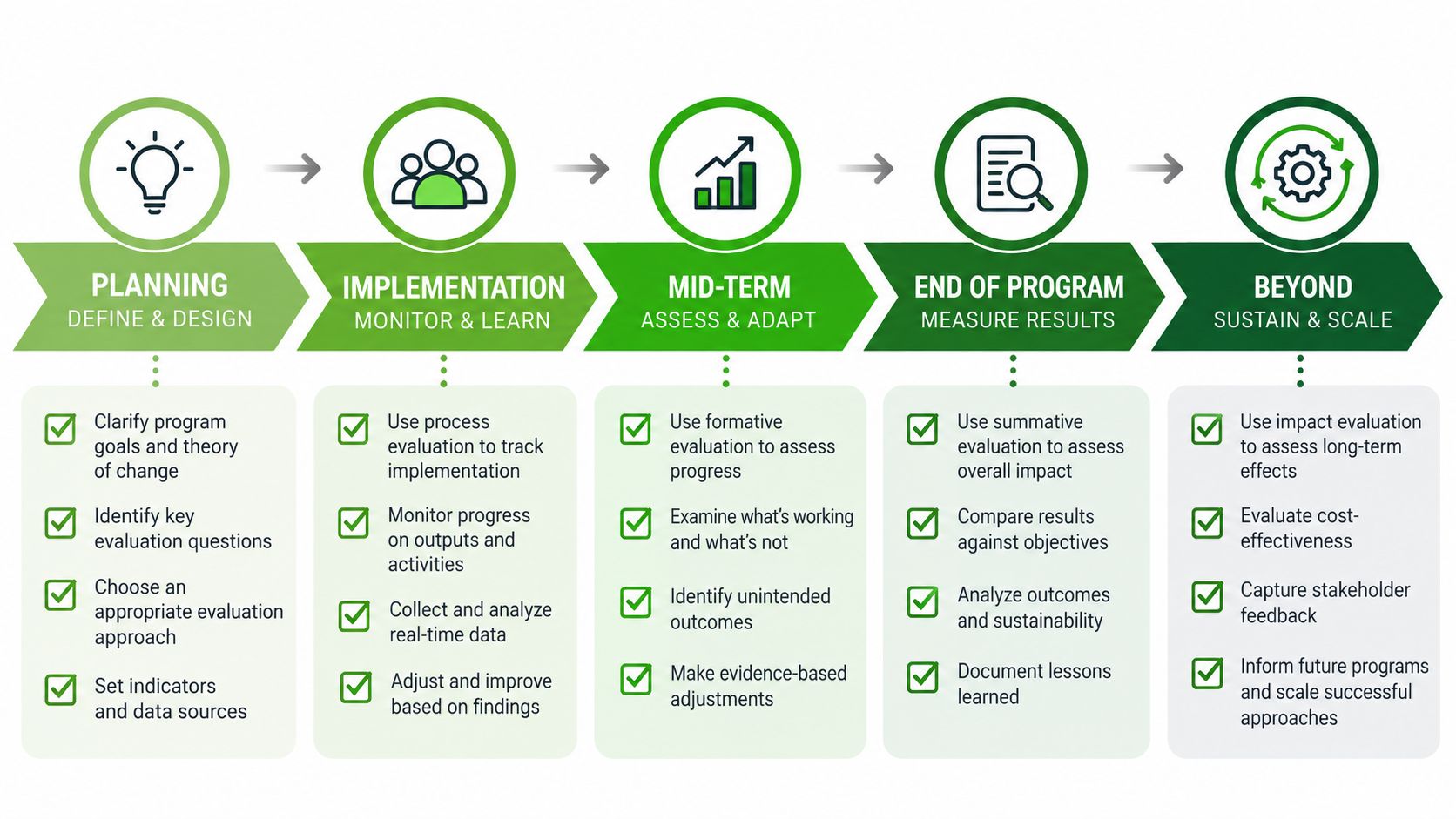
The CDC recommends aligning evaluation questions with the program's development stage and intended use. Its guidance also emphasizes relevance and utility, rigor, independence and objectivity, transparency, and ethics. Those standards matter in court and DDS reporting because favorable findings are not enough. A credible report states what was measured, how it was measured, what the data support, and what remains unknown. CDC guidance on program evaluation and health literacy reinforces the need to distinguish participation and satisfaction from meaningful changes in behavior or broader conditions.
Georgia DUI Schools offers DDS-approved DUI and Risk Reduction education, clinical evaluations, ASAM Level 1 treatment, Victim Impact Panels, and flexible online or classroom options for Georgia drivers. If you need a compliant path from assessment through completion, visit Georgia DUI Schools and choose the service that matches your court, DDS, or license-reinstatement requirement.