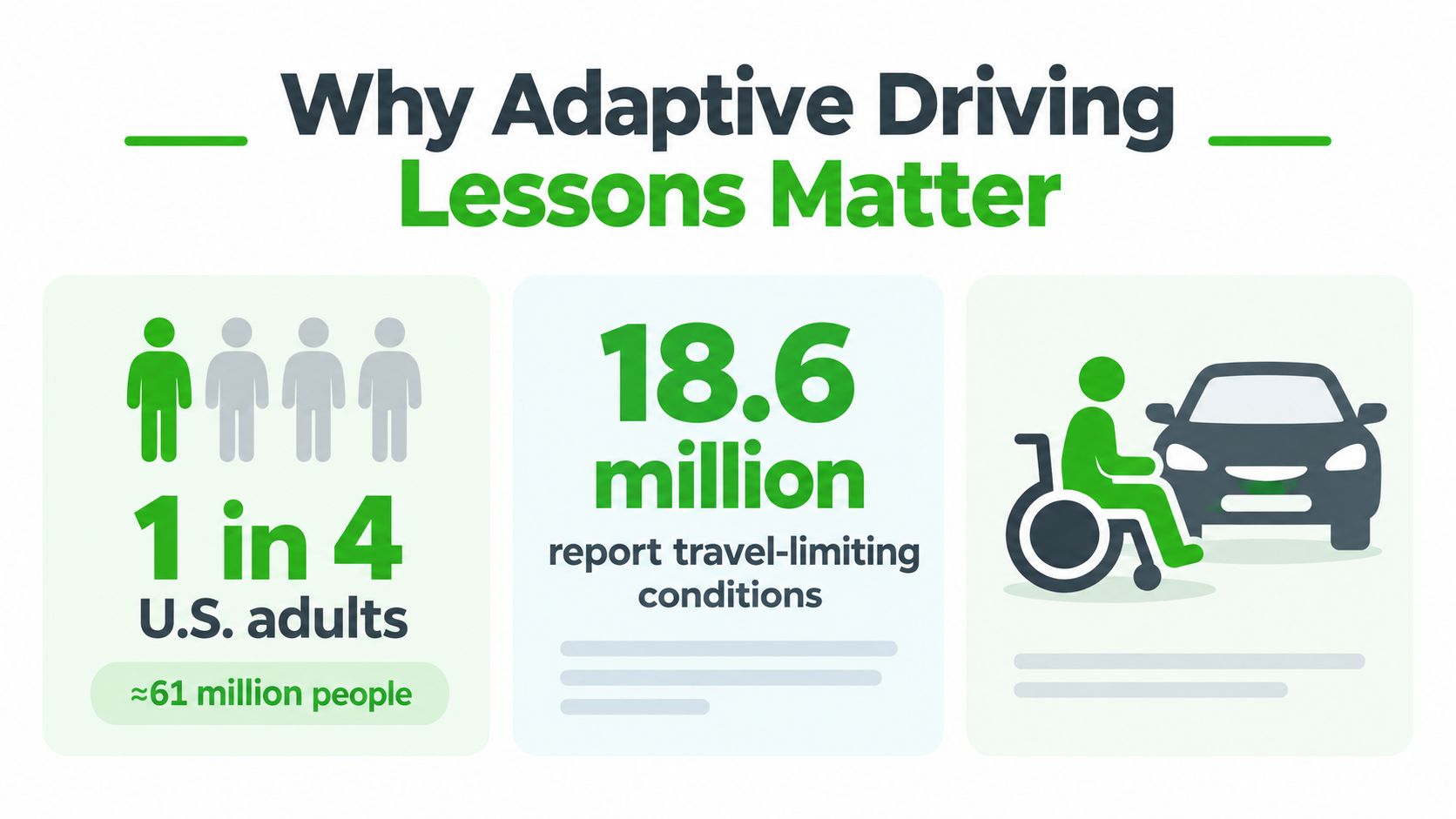
In 2022, 18.6 million Americans aged five and older reported a travel-limiting disability, representing 6.1% of that age group, according to the U.S. Bureau of Transportation Statistics. For adults aged 18 to 64 with disabilities, 40.2% made no trips on the survey day, compared with 21.2% of adults without disabilities, and they averaged 1.7 trips per day instead of 2.3.
Those figures explain why driving lessons for disabled drivers are about more than passing a test. A well-designed program can support access to employment, healthcare, education, family responsibilities, and community life. The right pathway may include medical review, an occupational-therapy driving assessment, equipment trials, specialized instruction, and a carefully planned road test.
Generic lessons often start with the car and the traffic rules. Adaptive training starts with the driver. The instructor needs to understand physical movement, reaction time, vision, cognition, anxiety, assistive technology, and the licensing authority's requirements before recommending a vehicle or lesson plan.
Why Adaptive Driving Lessons Matter
A 5.4 percentage-point increase between 2017 and 2022 in the share of working-age adults with disabilities who drove at least one trip shows progress, but it does not remove the wider mobility gap. The BTS analysis of travel patterns among people with disabilities provides the supporting context. Adaptive driving lessons help turn that broad need into practical preparation for a specific driver.
Disability affects vehicle use in different ways. One learner may have enough leg strength but need modified pedals. Another may control the steering wheel well while relying on hand-operated braking and acceleration. A person recovering from a brain injury may need a quieter route and extra processing time. Someone with a progressive condition may need a plan that can be reviewed as function changes.
Training can cover vehicle-control techniques, transfers, equipment practice, and ways to stay within medical or functional limits. The instructor's job is not to teach traffic rules. It is to help the learner build reliable control, much like fitting a pair of glasses before asking someone to read a road sign.
The first step is functional, not mechanical
Before selecting hand controls or a left-foot accelerator, a qualified professional should assess what the driver can perform consistently and safely. The review may include medical history, transfers, range of motion, reaction time, information processing, and the risk of fatigue during control use.
The equipment choice should come after that assessment. A device that suits one driver may demand too much force from another, interfere with steering, or make emergency manoeuvres difficult. The right adaptation should feel controllable in ordinary traffic and remain usable when the driver is under pressure.
Practical rule: Do not choose an adaptation because it looks familiar. Choose it because the driver can operate it reliably in routine and demanding situations.
Lessons also depend on resources outside the car. Finding an adapted training vehicle, a specialist instructor, an assessment provider, a modification workshop, suitable medical procedures, and an accommodating test centre can require careful coordination. The 2025 comparative accessibility analysis from the Driving Into the Light project notes similar barriers around adapted vehicles and specialist instruction. For many learners, locating the right people and equipment takes as much planning as practising the driving skill.
Matching the Right Training to the Disability
A diagnosis doesn't prescribe a lesson package. The driver's actual abilities, assistive devices, confidence, license class, and intended vehicle determine the training plan.
A 2025 peer-reviewed study of 532 licensed South Korean drivers found that 236 participants, about 44%, required additional driving-rehabilitation training. The study identified driving skill, anxiety or tension, functional effects of disability, the number of assistive devices, sex, and license class among the strongest predictors. Its findings in PLOS ONE support individualized equipment selection, training duration, progressive difficulty, and license-specific planning.
| Learner Profile | Likely Vehicle Adaptation | Lesson Structure | Instructor Specialty |
|---|---|---|---|
| Driver with a lower-limb amputation | Possible left-foot accelerator evaluation, depending on which leg is affected and how the driver transfers | Begin with pedal identification and controlled acceleration, then add braking, turns, and complex traffic | Adaptive equipment assessment and lower-limb control training |
| Driver with spinal cord injury | Hand controls, transfer aids, steering assistance, or other equipment based on strength and trunk stability | Practice transfers, seating position, isolated control movements, and emergency responses before public-road work | Vehicle fitting, hand-control instruction, and fatigue-aware lesson planning |
| Autistic learner | The adaptation may be environmental rather than mechanical, such as predictable controls, reduced sensory load, or a quiet training setting | Use consistent lesson scripting, clear expectations, gradual route changes, and explicit hazard practice | Instructor experienced with communication, sensory needs, and graded exposure |
| Stroke survivor | Possible steering or pedal adaptation, with the final choice based on residual weakness, vision, attention, and spatial judgment | Rebuild scanning, reaction timing, lane position, decision-making, and divided attention gradually | Driver rehabilitation assessment and post-stroke functional training |
Anxiety deserves direct attention. A learner may understand the controls in a parking lot yet freeze when a vehicle approaches from the side. That isn't a reason to abandon training, but it is a reason to adjust the route, reduce task complexity, and practice the difficult decision in smaller steps.
A good instructor also separates equipment failure from skill development. If a control feels unpredictable, the instructor should check its fit, position, resistance, and installation before concluding that the learner can't use it.
Vehicle Modifications You May Train On
Adaptive equipment turns a physical task into a different physical task. The driver still brakes, accelerates, steers, observes, and responds, but the body's route to each action may change.
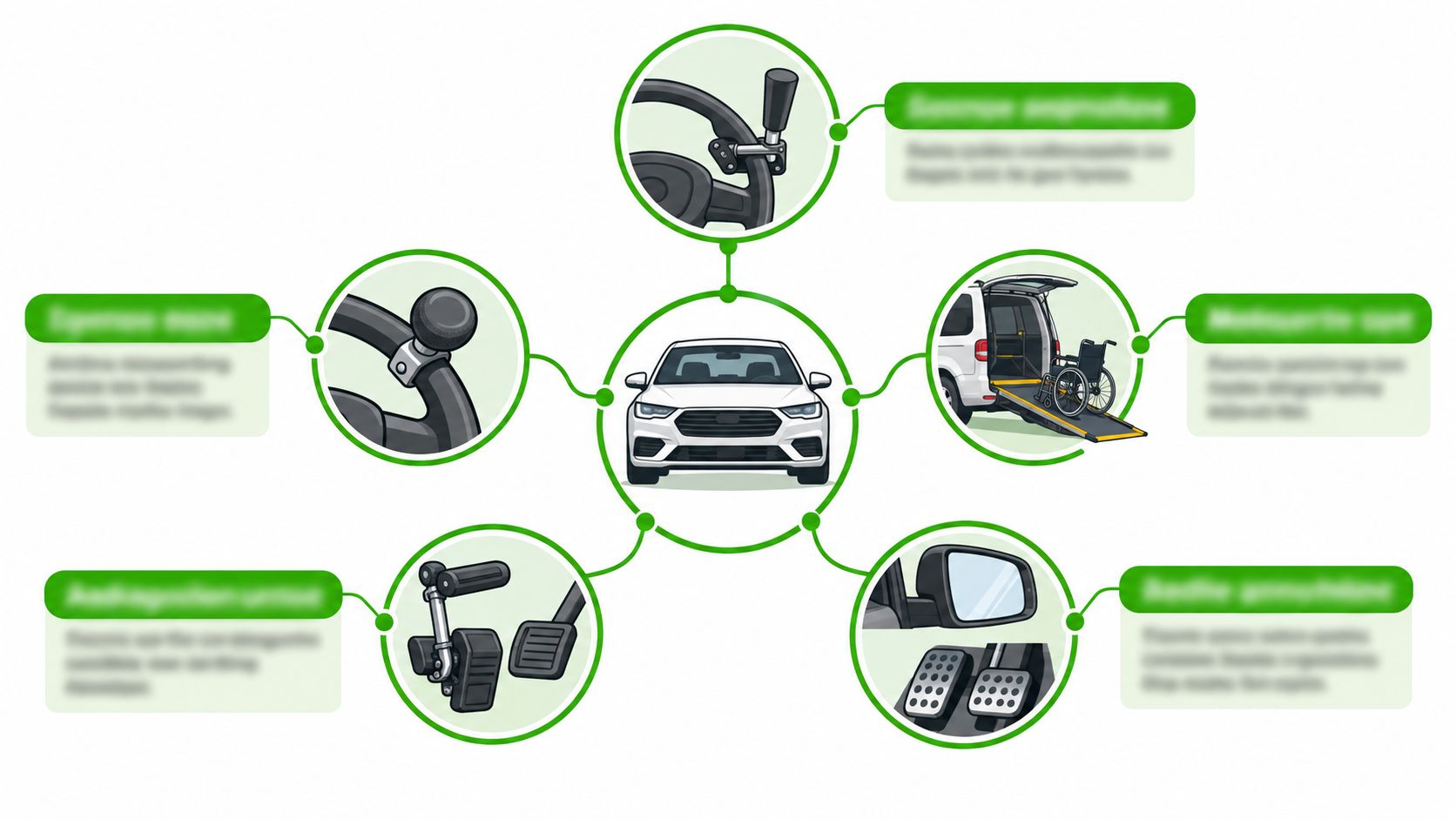
Hand controls commonly place braking and acceleration near the steering column. A push-pull or push-rock design can let a driver control the pedals without using the right foot. Early practice often feels awkward because the hand must learn pressure and movement that the foot previously handled automatically. At low speed, a brake input may feel too sharp or too soft until the learner develops consistent muscle memory.
A spinner knob or tri-pin grip can help a driver turn the wheel with one hand or with limited grip. Someone with reduced upper-body strength may also be assessed for steering assistance. The instructor should watch whether the aid improves control without obstructing airbag safety, signals, or hand repositioning.
Small changes can have large effects
A left-foot accelerator relocates the accelerator pedal so a driver with right-leg weakness or a right-sided amputation can operate it with the left foot. The mechanism may be simpler than a full hand-control system, but the learner still needs to prevent accidental use of the original pedal and develop a consistent foot position.
Other equipment may include:
- Pedal extenders: Useful when a driver can't reach the pedals comfortably. The learner must confirm that the extension doesn't interfere with safe foot placement.
- Electronic gear selectors: These can reduce the force or movement required to select gears. Training should include neutral, park, reverse, and drive checks without looking away from the driving environment.
- Transfer seats: A swivel or transfer aid can make it easier to move between a wheelchair and the driver's seat. The lesson includes securing the wheelchair and checking that the seating position supports control.
- Ramps and wheelchair-loading systems: These address access to the vehicle rather than control operation. They should be practiced until loading and securing equipment becomes a predictable part of every trip.
Vehicle access also connects with travel beyond driving. Someone who uses a power wheelchair may benefit from practical guidance on flying with a power wheelchair, particularly when planning a trip that combines driving, transfers, and air travel.
The best adaptation is the one the driver can use calmly, repeatedly, and safely when conditions become less comfortable.
Finding a Qualified Adaptive Instructor
Two provider types may appear similar in an online search, but they don't offer the same scope.
A state-licensed driving-school instructor with adaptive experience may be suitable for straightforward practice on an already-assessed vehicle. A Certified Driver Rehabilitation Specialist, or CDRS, is generally the better starting point when the driver needs a complex functional assessment, several adaptations, or rehabilitation after an injury or medical event.
| Credential | Training Background | Best Suited For | Verification Source |
|---|---|---|---|
| State-licensed driving instructor with adaptive experience | Driving instruction plus documented experience with a specific adaptation | Practice with hand controls or a left-foot accelerator after the vehicle and controls have been assessed | State licensing authority and the school's records |
| Certified Driver Rehabilitation Specialist | Clinical driving-rehabilitation training and functional assessment experience | Complex disabilities, cognitive or perceptual concerns, multiple devices, and equipment recommendations | ADED directory and provider documentation |
| Equipment manufacturer training | Product-specific instruction for a control system | Learning the operation, adjustment, and limits of a particular product | Manufacturer or authorized installer |
Before booking, ask for the instructor's CDRS credential information, check the relevant listing through the Association for Driver Rehabilitation Specialists directory and resources, and confirm the driving school's state license. If the instructor uses MPS, Sure-Grip, Veigel, or another branded system, ask for evidence of training on that equipment.
You can also review certified driver rehabilitation specialists as part of your provider research. That link shouldn't replace direct verification, because credentials, availability, and service areas can change.
Be cautious if an instructor claims to teach every adaptation without reviewing medical information, refuses a pre-lesson assessment, or suggests a device before observing the driver. A short introductory call can reveal whether the provider understands the disability profile, the intended vehicle, and the licensing goal.
What the Lessons Actually Look Like
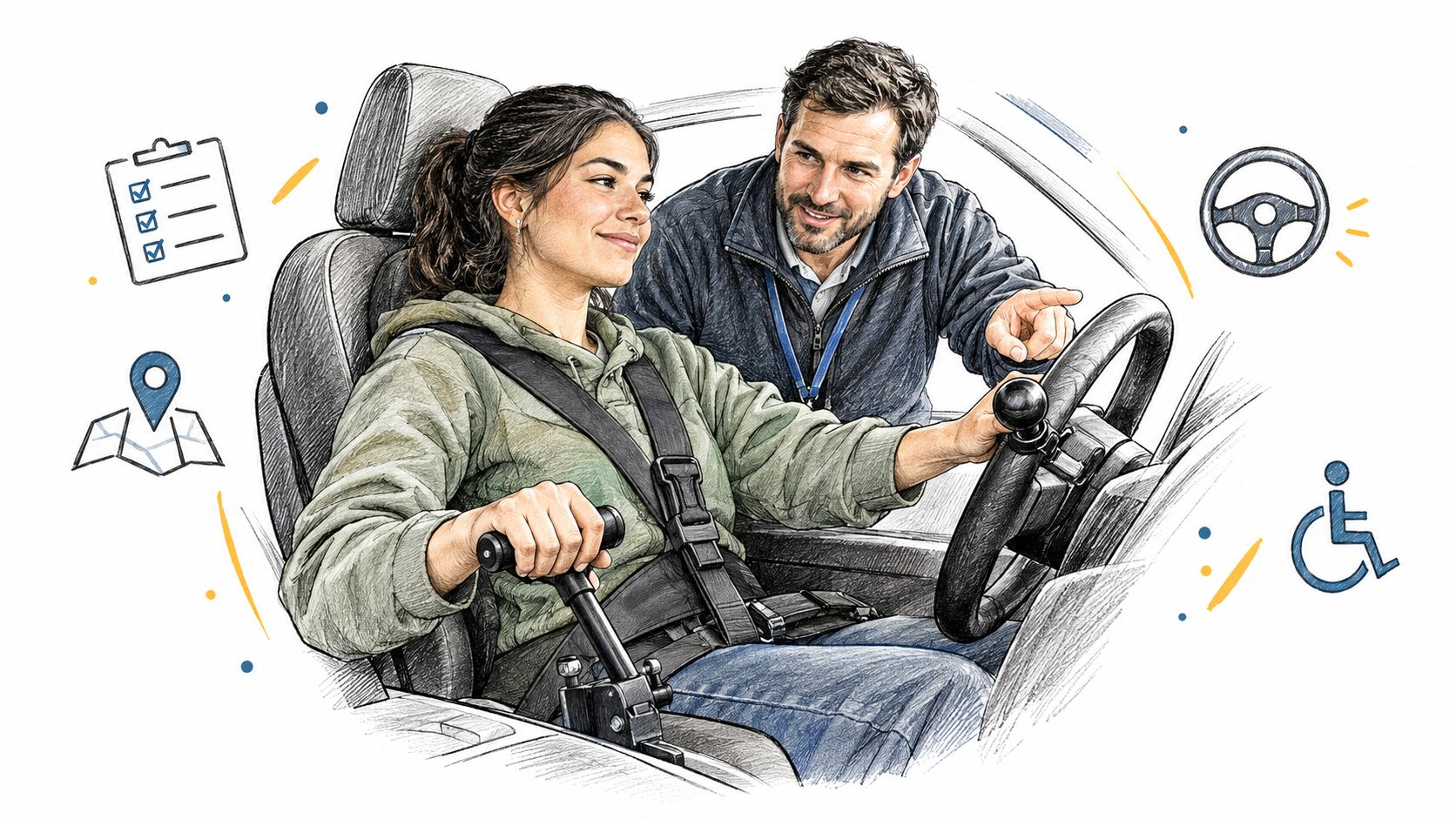
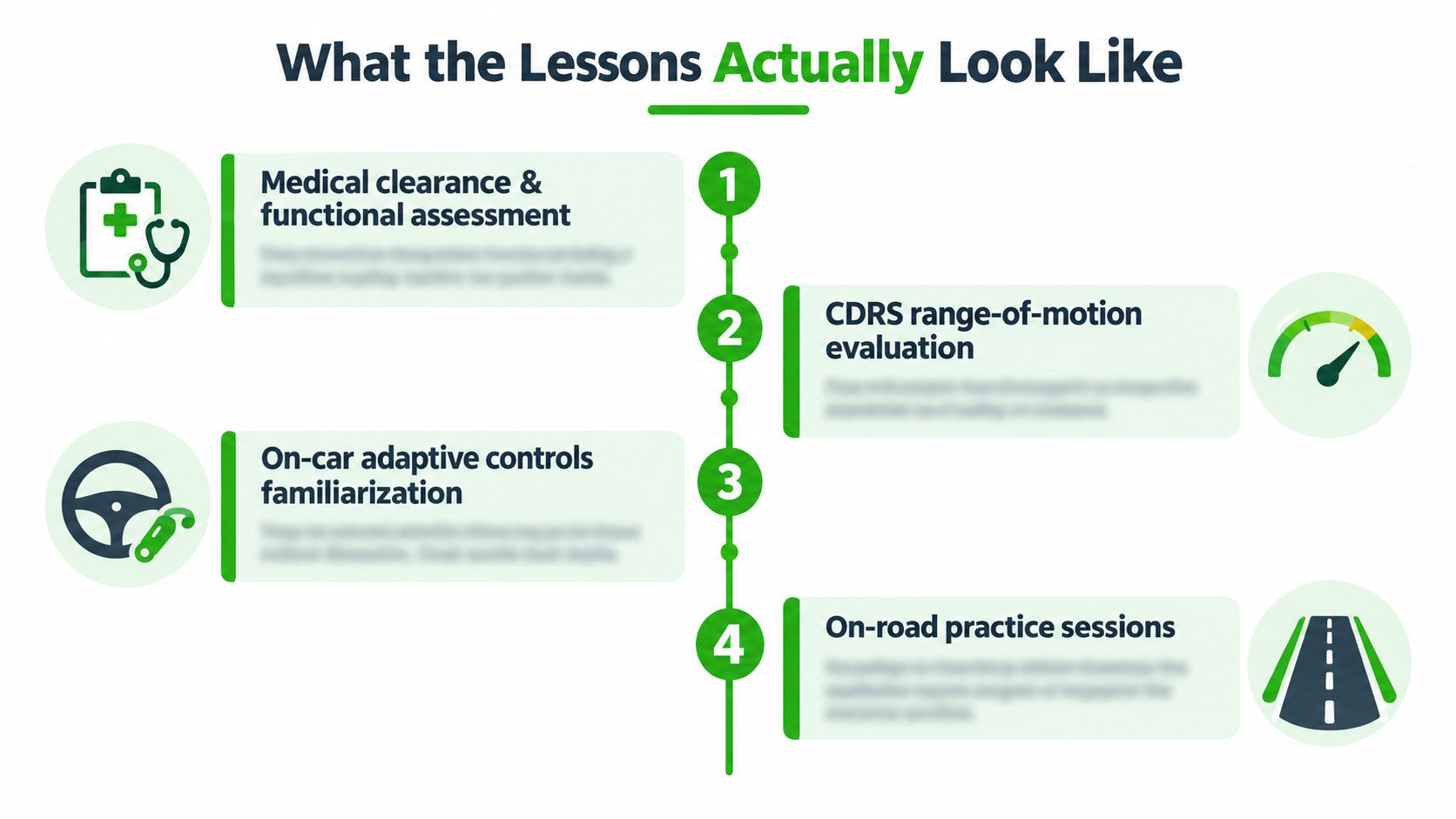
The first appointment may not involve public-road driving. A clinical or functional assessment helps identify range of motion, reaction demands, cognitive processing, vision-related concerns, transfer needs, and the type of equipment that may support safe control.
After that assessment, the learner usually moves to a static fitting. The vehicle remains stationary while the instructor adjusts the seat, mirrors, steering aid, pedal position, and hand controls. At this stage, small errors become visible. A control placed too far away can cause shoulder strain, while a poorly positioned mirror can encourage unsafe head movement.
Practice grows in layers
A typical progression looks like this:
- Stationary familiarization: Identify each control, practice the movement, and learn how to return the hands or feet to a safe neutral position.
- Quiet-area drills: Practice starting, stopping, steering, signalling, reversing, and controlled turns with minimal traffic.
- Graded routes: Add intersections, lane changes, moderate traffic, parking, navigation, and more complex visual demands.
- Road-test preparation: Practice the specific vehicle, controls, documents, restrictions, and maneuvers expected by the licensing authority.
Some programs may use simulation or structured off-road exercises before public-road training. The instructor should increase difficulty only when the learner can repeat the previous task without unsafe hesitation or excessive fatigue.
No universal lesson count applies to every driver. A person with prior driving experience may need a different program from a first-time learner, and a stable physical limitation differs from a changing medical condition. The instructor's report should explain the equipment used, the driver's functional performance, recommended restrictions or modifications, further training needs, and any information the licensing authority requires for the road test.
Hidden Barriers in the Search Process
A learner may find a driving school with an adapted car and still be unable to book useful lessons. The vehicle might be unavailable on the required days, lack enough space for a particular transfer method, or fail to carry the learner's wheelchair safely. Finding a school is only the first match. The instructor, vehicle, controls, and schedule must fit together.
The search becomes more specific with adaptations such as a left-foot accelerator or wheelchair-loading system. A mobility dealer may need to supply or install the equipment, while the instructor coordinates with that dealer before training starts. This is similar to fitting a key to a lock. A technically suitable vehicle may still be the wrong fit for the person using it.
Location adds another barrier. Specialist instructors and adapted vehicles are concentrated in some areas, leaving other learners to travel or wait. The Driving Into the Light comparative accessibility report describes limited availability, geographic concentration, inconsistent medical procedures, and testing sites without suitable vehicles or accommodations.
Ask the test centre early
Contact the test centre before booking the final lessons. Confirm in writing:
- Vehicle requirements: Whether you may use your adapted vehicle or a provider's vehicle.
- Equipment approval: Whether the controls need inspection or documentation before testing.
- Accessibility arrangements: Whether parking, transfer space, and other physical accommodations are available.
- Scheduling process: Whether medical reviews or accommodation requests must be completed before reserving a test.
Costs can include assessment, lessons, vehicle access, equipment trials, transportation, and travel to a distant provider. Request an itemized estimate. Ask which charges may be refundable, eligible for funding, or paid directly to another provider. Keep these answers with any Georgia licensing or compliance paperwork, especially if training must fit around a suspended-license process or a DUI-related Risk Reduction program.
Access planning is part of driver training. A learner cannot complete a safe program if the vehicle, instructor, funding path, and testing arrangement do not line up.
Funding Grants and Insurance Options
Funding usually begins with the question, what is the purpose of the training? A program connected to employment may be considered differently from one focused only on personal transportation. Start with the Georgia Vocational Rehabilitation Agency or the equivalent state agency where you live. Veterans with service-related impairments can also ask the Department of Veterans Affairs about applicable support.
Private foundations, disability organizations, mobility-equipment dealers, and condition-specific programs may offer assistance, but eligibility and availability vary. Medicaid waivers, ABLE accounts, and tax provisions for adaptive equipment may also be relevant, though they don't automatically cover driver training.
| Funding Source | Typical Coverage | Key Limitation |
|---|---|---|
| State vocational rehabilitation agency | May consider evaluation, training, or equipment connected to employment goals | Requires eligibility review and supporting documentation |
| Veterans Affairs programs | May support qualifying service-related mobility needs | Eligibility depends on the veteran's circumstances and program rules |
| Private disability foundations | May assist with equipment or transportation-related needs | Application windows and available funds vary |
| Medicaid waiver programs | May address qualifying community-access or support needs | Driving instruction may fall outside the approved benefit |
| ABLE accounts | May allow eligible account holders to plan for qualified disability expenses | Account rules and qualified expenses must be checked carefully |
Insurance often creates confusion. A medical plan may pay for treatment or an evaluation that establishes functional need, while refusing to cover driving lessons as an educational service. The distinction between medical necessity, equipment, rehabilitation, and licensing preparation should be confirmed in writing.
Prepare a physician statement, functional assessment, equipment recommendation, and itemized quotes. Ask each funder whether it pays the provider directly, reimburses the applicant, or requires prior approval. For broader insurance considerations, review this guide on how driving choices can affect insurance premiums, while remembering that an insurer's rules are separate from a licensing authority's requirements.
Bridging Back to Georgia Licensing and Compliance
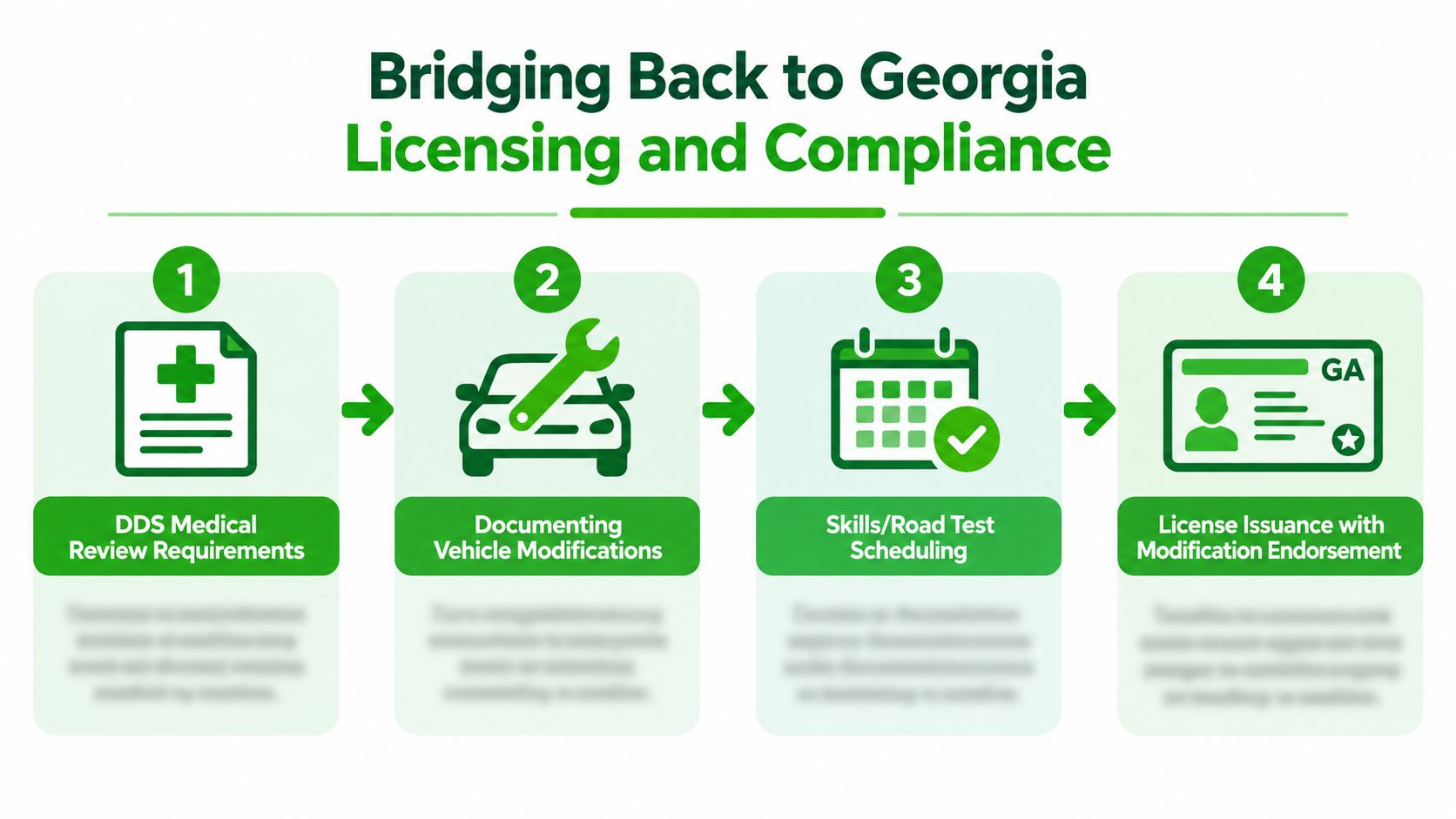
Adaptive driving lessons build practical skill, while Georgia licensing determines whether and how that skill may be used on public roads. A driver may control hand controls confidently and still need DDS medical review, documentation of restrictions or modifications, and a road test conducted under the correct conditions. Treat training and licensing like two connected lanes. They meet at the road test, but each has its own rules.
Ask the Georgia Department of Driver Services which medical forms, physician information, rehabilitation reports, or vehicle documents apply to your situation. A doctor's note may explain your functional needs, but DDS may require its own review before approving an adaptation or recording restrictions on your license.
DUI-related reinstatement has a separate track
A medical issue and a DUI-related suspension can affect the same driver, but adaptive lessons do not replace Georgia's reinstatement requirements. The Georgia DUI Alcohol or Drug Use Risk Reduction Program has two defined components: a standardized screening assessment of alcohol and drug use, and a DDS-approved therapeutic education course covering alcohol, drug use, and driving. The Georgia DDS program description states that only certified driving schools may provide accepted DUI programs.
For a second DUI conviction within five years, Georgia imposes an 18-month license suspension. The first 120 days are a complete hard suspension. Afterward, the driver may qualify to operate with a certified ignition-interlock device installed and maintained for 12 months, together with the required Risk Reduction Program and, where applicable, a clinical evaluation. Review Georgia DDS guidance on second-offense consequences for these conditions.
A department-approved evaluator listed on the registry must perform the clinical evaluation. Georgia rules describe a clinical interview, review of the Risk Reduction screening instrument, and at least one department-approved assessment instrument. Registered evaluators must complete 20 hours of approved substance-abuse continuing education every two years, according to the Georgia administrative rules.
A habitual-violator declaration can follow a third conviction within five years for listed offenses, including DUI, homicide by vehicle, hit-and-run, or racing. DDS materials describe a generally five-year license revocation, with possible eligibility for a probationary license after two years, subject to additional requirements. Check the Georgia Driver's Manual for current eligibility details.
Before booking, call DDS at the number on your medical review letter. Confirm which forms must be submitted before you schedule the road test with adaptive controls, then keep the written instructions with your reinstatement records.
Georgia DUI Schools provides Georgia DDS-approved DUI/Risk Reduction and defensive driving education, clinical evaluations, ASAM Level 1 treatment, and Victim Impact Panels. Visit Georgia DUI Schools to review course options for reinstatement or court requirements.