

The folder on your passenger seat holds a citation from a stop near the Perimeter, a court date in Athens, and a line from the clerk that says "evaluation required." You've told yourself it's two questions. How much do you drink, and when did you last have one.
Then you sit down, and the person across the desk asks when you last slept well, what's in your medicine cabinet, whether anyone in your family has been treated for addiction, and how many times in the past year you had five or more drinks in a single day. It feels less like a quiz and more like a conversation nobody prepared you for.
That's because a drug and alcohol evaluation isn't a breath test with extra paperwork. It's a structured history that turns your answers into a clinical impression and a service recommendation. The questions exist to keep one bad night from being mistaken for a disorder, and to keep a real disorder from being missed because nobody asked.
Question Domains Evaluators Actually Use
For a driver from Smyrna charged after a stop near the Perimeter, the evaluation may cover more than alcohol use. The questions are organized around several areas, each helping the evaluator understand a different part of the person's history and risk.
| Domain | Typical questions | What it clarifies | What one answer cannot do |
|---|---|---|---|
| Alcohol pattern | How often, typical amount, and heavy days of 5+ drinks for men or 4+ for women in the past year | Exposure and binge pattern | Diagnose a disorder |
| Other substances | Each drug class, route, last use, typical and maximum use | Substance-specific risk, including prescription misuse | Replace a clinical interview |
| Control and change | Cravings, cutting down, and unsuccessful attempts to stop | Impaired control versus occasional use | Equal automatic treatment |
| Physical effects | Blackouts, tolerance, withdrawal, overdose | Severity and safety risk | Prove use from a negative lab test |
| Hazardous use | Driving, work, and other risky situations | Harm already occurring | Set the court penalty by itself |
| History and health | Prior treatment, medications, mental health, medical conditions, family history | Context for the ASAM recommendation | Override the whole record |
Alcohol use is explored in more detail than a single total. An evaluator may ask how often you drink, how much you usually have on a drinking day, and how many times in the past year you had five or more drinks in a day if you are a man, or four or more if you are a woman. The National Institute on Alcohol Abuse and Alcoholism uses that heavy-drinking-day threshold in its single-item screen.
Why One Yes Doesn't Settle Anything
A brief screen can identify possible risk, but it cannot establish a diagnosis on its own. A review of the screening evidence published by the National Institute on Alcohol Abuse and Alcoholism reports sensitivity of 0.73 to 0.88 and specificity of 0.74 to 1.00 for the NIAAA single item in adult studies. The full AUDIT, scored at the conventional cutoff of 8 or higher, shows sensitivity of 0.38 to 0.73 and specificity of 0.89 to 0.97.
Sensitivity describes how often a question identifies people who do have unhealthy alcohol use. Specificity describes how often it correctly excludes people who do not. Those measures show why an answer is a starting point, not a verdict. Follow-up questions help place it in context.
A direct disclosure of heavy drinking, for example, does not automatically mean a person has a substance use disorder or will receive a harsher penalty. The evaluator considers the whole history and documents a clinical impression and an ASAM level of service. One answer is only one part of that record.
The Drug Questions Come Later and by Class
Alcohol is only one area of the interview. The TAPS Tool, which NIDA lists among its validated screening instruments, asks about the past 90 days across alcohol, prescription medications, and other drugs, then assigns a risk level for each substance class. Prescription misuse is considered separately from street drugs because taking a prescribed medicine as directed and using someone else's medication are different circumstances.
The evaluator may ask when you last used a substance, how you took it, your typical and maximum use, and whether you experienced an overdose or cravings. These details add context that a laboratory result cannot provide. A negative test by itself does not explain a person's pattern, circumstances, or history.
History and Health Add Context
Questions about prior treatment, medications, mental health, medical conditions, and family history help clarify what else may affect the recommendation. For instance, medication use can matter when an evaluator is trying to understand a reported effect, while previous treatment may add context to a person's current account. These details inform the assessment; no single item replaces the full history.
Preparation rule: Use the domains as a map of topics to think through before the appointment, not as a script to rehearse. If you are unsure about a date or amount, say so rather than guessing. Reviewing patient history taking samples can also help you recognize the kinds of details a documented history may include.
Screening Versus a Full Clinical Evaluation
The call is always similar. Someone says the court told them to get "the evaluation" done, and they have already booked an eight-hour Saturday class. Three different appointments wear that name in Georgia, and showing up for the wrong one costs a week and a second fee.
The difference starts with what each encounter is built to do.
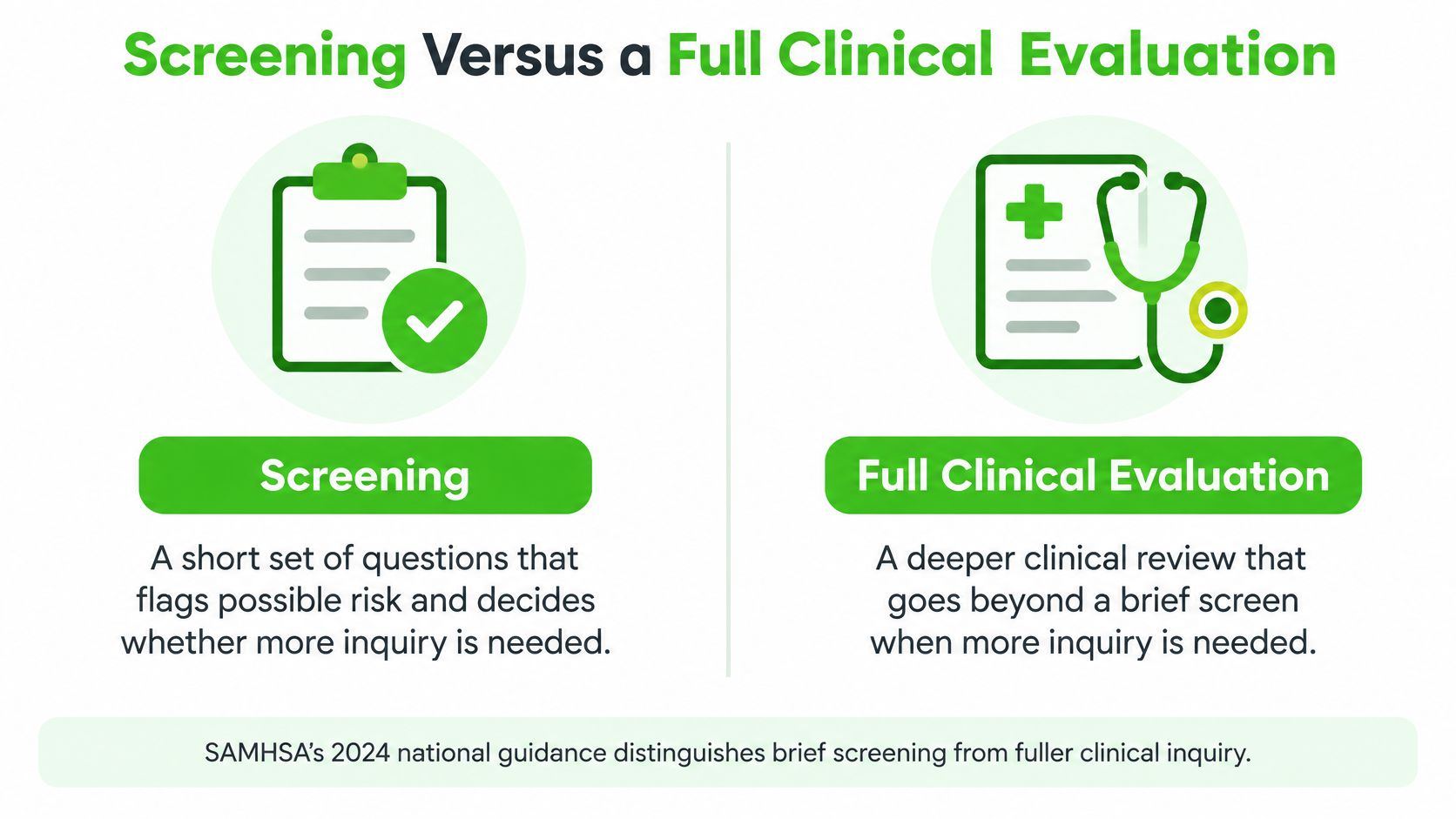
Screening is the shortest of the three: a handful of questions that flag possible risk and decide whether anyone needs to look closer. Nationally, it's routine rather than special. SAMHSA's 2024 profile counted 15,623 substance-use treatment facilities offering screening, or 97.9% of facilities, alongside 15,239 (95.5%) offering full assessment or diagnosis. Urine drug screening was offered at 88.6%, breathalyzer or other blood-alcohol testing at 60.9%, and oral-fluid testing at 44.1% (SAMHSA's 2024 National Substance Use and Mental Health Services Survey).
The Risk Reduction assessment is Georgia's own step. Before anyone sits in the DUI/Risk Reduction classroom, they complete the Assessment Component, a 130-question screening instrument commonly known as the NEEDS assessment. It isn't a pass or fail test. It feeds the intervention that follows.
The clinical evaluation is the one judges order by name. It's a separate, in-depth appointment with a medical or mental health professional (a DBHDD-approved evaluator) to determine whether a substance use disorder is present and whether treatment is required. A class certificate doesn't stand in for it.
| Encounter | What it is | Time and order | What it cannot do |
|---|---|---|---|
| Short screen | AUDIT-C, the full AUDIT, or the NIAAA single item on 5 or more drinks for men or 4 or more for women | Brief flag that decides whether more inquiry is needed | Diagnose a disorder or set the penalty |
| Risk Reduction assessment | Georgia's 130-question NEEDS instrument | About 25 to 45 minutes, required before the 20-hour Prime for Life intervention | Serve as the clinical evaluation or as a pass-fail test |
| Clinical evaluation | DBHDD-approved interview using DSM criteria and an ASAM level | Separate appointment, documented in a written report | Be replaced by the class certificate or by a negative lab result |
The two Risk Reduction components run in a fixed order: assessment first, then the 20-hour intervention, which combines education with group counseling. A live virtual class counts only when you're present and on camera with a live instructor for the full 20 hours, and coursework finished on your own schedule doesn't satisfy DDS.
If you're still sorting out which appointment the clerk circled, this walkthrough of the difference between a DUI assessment and a clinical evaluation is worth five minutes before you book anything.
How Answers Become the Report and the Recommendation
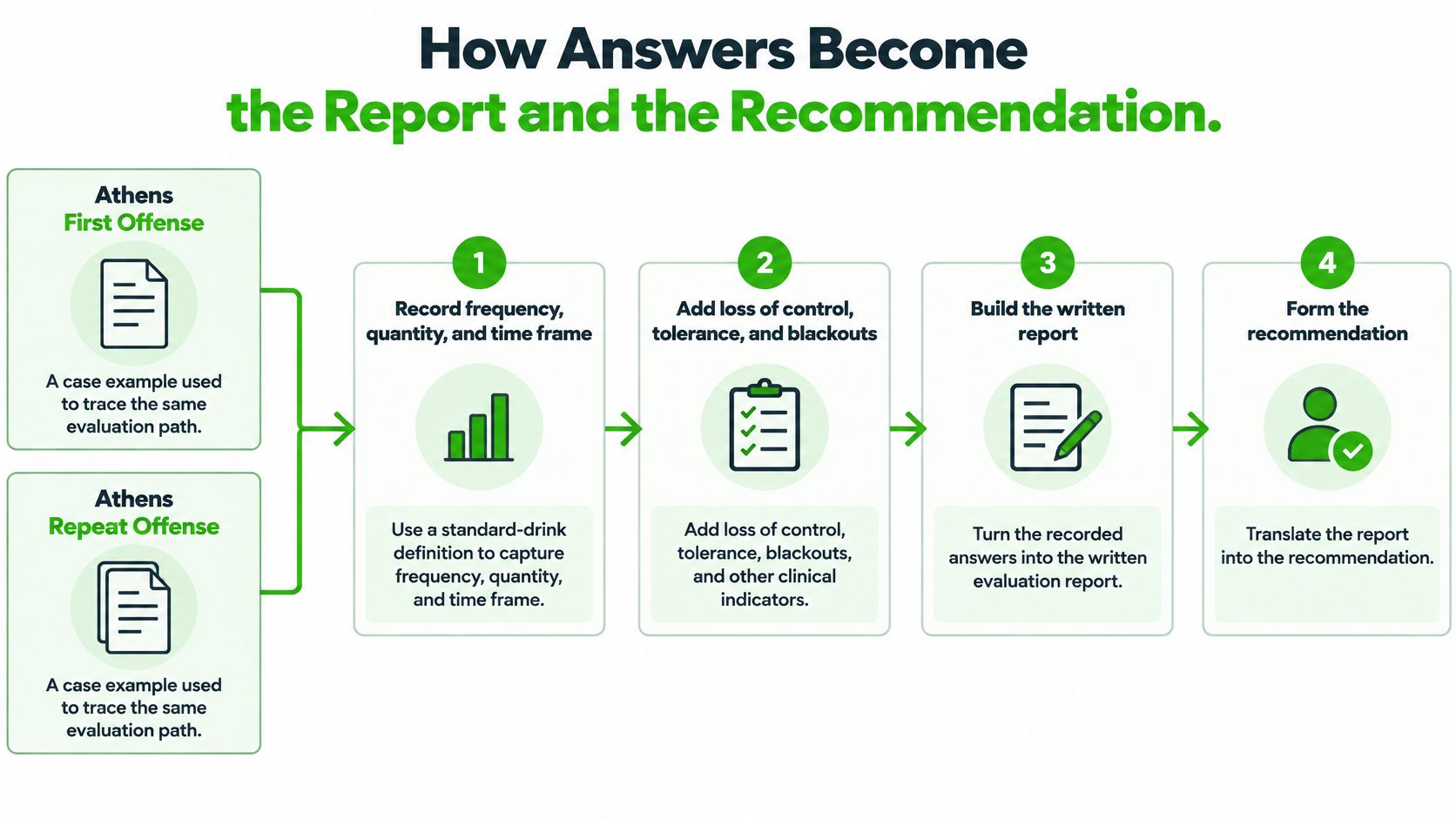
In Athens, two people can face very different circumstances after a DUI stop. One may be dealing with a first charge after an incident on Broad Street; another may have a prior charge and a court date in Clarke County. Their answers are considered in context, then documented as a clinical impression and recommendation. No single disclosure automatically creates a diagnosis or determines a penalty.
For a closer look at the document, read what the clinical evaluation report contains. The report connects the interview and information reviewed to the evaluator's clinical impression and recommended level of service.
The Path From Answers to a Service Level
1. Set the context. The evaluator records how often and how much a person drinks or uses substances, and the time period involved. Clarifying what “a couple of beers” means gives the report a more useful account than a vague phrase. Georgia DDS provides guidance about DUI requirements, but the clinical report is based on the individual evaluation.
2. Consider clinical indicators. The evaluator asks about experiences such as loss of control, tolerance, blackouts, other substance use, and prior treatment. One answer is only one part of the picture. Several answers may form a pattern when considered alongside the rest of the history.
3. Review surrounding information. Mental health concerns, current medications, driving history, and available records may help explain the circumstances. For example, the distinction between a first charge and a repeat charge does not rest only on what happened during the stop. The broader history matters to the clinical impression.
4. Apply diagnostic criteria. The clinician considers the answers in conversation and applies DSM-5-TR criteria. A questionnaire score can help organize information, but it does not make a diagnosis on its own. A toxicology result also cannot replace the clinical evaluation.
5. Document the recommendation. The written impression may recommend no treatment or identify an appropriate ASAM level of service, such as ASAM Level I. The recommendation follows from the overall clinical picture, not from one answer taken out of context.
The distinction that matters most: “No treatment recommended” means the evaluation did not support a treatment referral. It does not mean the evaluator doubted the person. An ASAM recommendation is not proof that someone lied, either. Honest disclosure about occasional use does not automatically mean a diagnosis or a more severe recommendation.
A report records the information reviewed, the clinical impression, and the recommendation. Its purpose is to explain the reasoning, not to turn one screening result into a verdict. A Risk Reduction assessment, a clinical evaluation, and a DUI program certificate serve different purposes, so one should not be treated as a substitute for another.
The Certificate of Completion for the DUI program is separate from a clinical evaluation report. It is issued after both required Risk Reduction components, the Assessment and Intervention, are completed. A judge may order a Clinical Evaluation in addition to the Risk Reduction Program. Completing the program does not fulfill a separately ordered evaluation, so check the court's order carefully.
The intervention course also has practical requirements. Its 20 hours cannot be completed in one day and are commonly scheduled over a weekend or several evenings. If a student arrives late, the school may deny entry; missed time cannot be made up, and the student may have to register and pay the full course fee again to start over.
A person convicted in Georgia who lives in another state must complete a substantially similar DUI intervention program there. It must be certified in that state, last at least 20 hours, and be verified by Georgia DDS. These course requirements concern program completion, while the clinical report addresses the separate evaluation and recommendation.
How to Answer Honestly When You Are Unsure
In an Atlanta evaluation, you may remember that an event happened in winter but not the exact date. In Athens, you might have a prescription list but be unsure which medication affected your driving. Say what you know, explain what you do not, and give an approximate answer when that is all you can provide.
Fear can make people treat every answer as if it were a score. Common screening barriers include limited time, competing medical and mental health problems, insufficient training, confidentiality concerns, doubts about truthful reporting, and limited treatment resources, especially for younger people. In an evaluation, uncertainty is information to clarify, not proof that someone is being evasive.

Substance use disorders affect many people. SAMHSA's 2024 national survey release reports that 48.4 million Americans aged 12 or older, 16.8% of the population, had a substance use disorder in the past year. An honest disclosure does not automatically establish a diagnosis or lead to a harsher penalty. The evaluator considers the answers together and documents a clinical impression and an appropriate ASAM level of service.
Answers to the Worries People Actually Have
- “What if I don't remember the exact date?” Give the closest month or season and say it is approximate. A reasonable range is more useful than guessing at a precise date.
- “Should I disclose prescribed medication?” Yes. Give the dose and prescriber if you know them. Prescription use differs from non-prescribed use, but medication can still matter if it affects driving.
- “Can anxiety, depression, trauma, sleep problems, or chronic pain affect the evaluation?” Mention them. They can help explain your use, safety, and what level of care may fit. They are not points added to a score.
- “What if my account differs from the police report or a family member's version?” Describe the difference clearly instead of trying to make the accounts match. The evaluator considers the discrepancy in context.
How confidentiality actually works: The evaluator documents information relevant to the recommendation. A court or probation order may require the report to go to the person or agency that ordered it. Ask at the start of the appointment where the report will be sent.
Be accurate rather than minimizing or exaggerating. Either can distort the record, and an inaccurate picture can lead to a recommendation that does not fit your situation.
Before the interview, write down substances you use, including alcohol and prescriptions; approximate dates of last use; current medications and doses; prior classes or treatment; and the court, probation officer, or agency that ordered the evaluation. Bring any paperwork you already have.
Georgia History Questions That Change the Path
Evaluators ask about prior cases for a reason that has nothing to do with tonight's answers: in Georgia, the consequence depends on who ordered the evaluation and on the dates of earlier convictions. A first conviction under O.C.G.A. § 40-6-391 can come with a court-ordered clinical evaluation and treatment program, yet the DDS Traffic Court Reference Manual states that DDS does not itself impose that clinical-evaluation requirement as a reinstatement condition for a first conviction. A court can still attach it to probation.
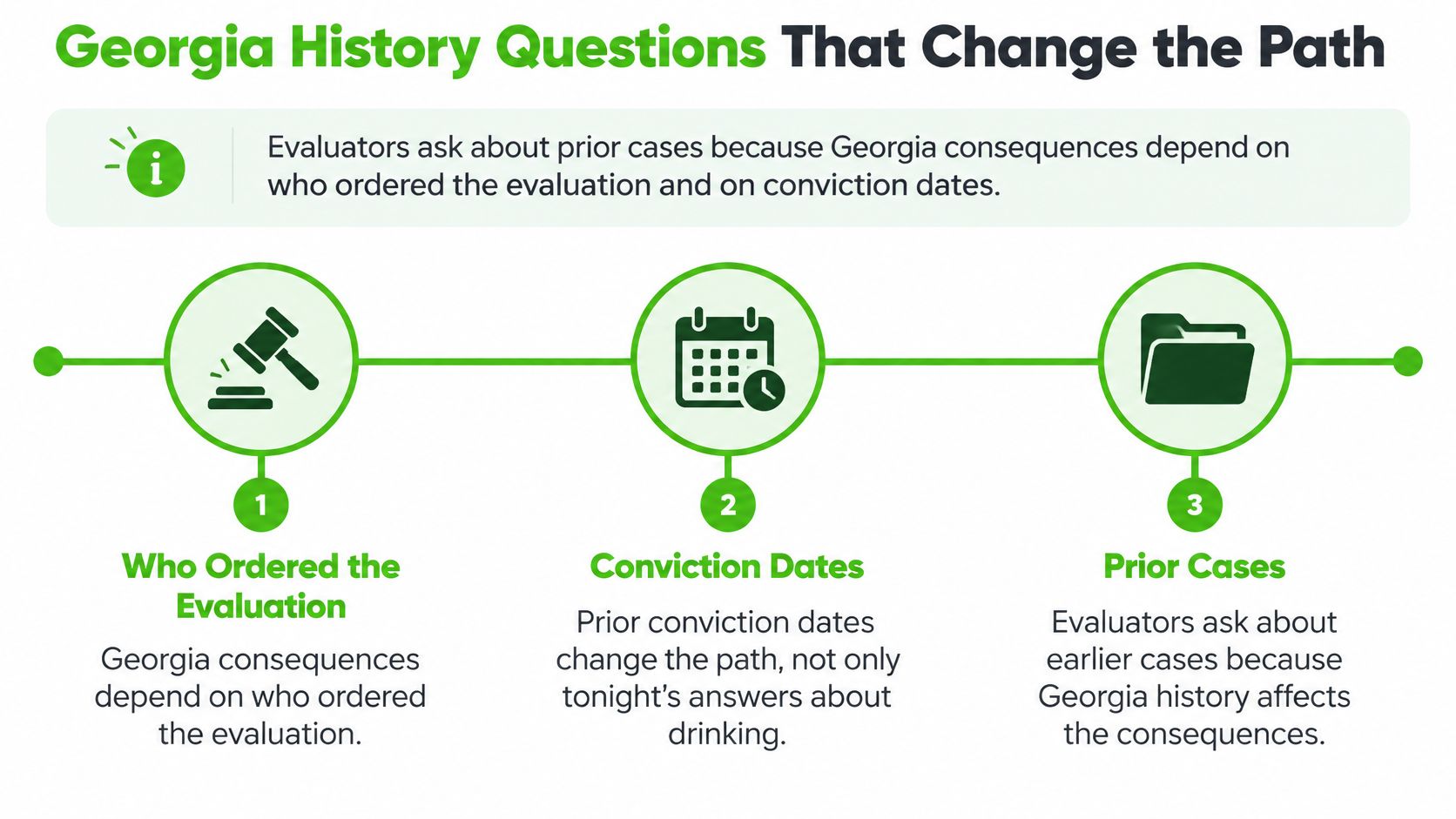
That's why the intake asks whether you're pursuing court compliance or license reinstatement, and whether the evaluation is a probation term. The answer changes which document you need and who has to receive it.
| Record pattern | License consequence | History the evaluator needs |
|---|---|---|
| First DUI conviction | Court may order clinical evaluation and treatment; DDS does not impose that clinical evaluation for first-conviction reinstatement | Who ordered it and whether it is a probation term |
| Second DUI within five years | At least 18 months suspension, opening with a 120-day hard suspension, then a certified ignition interlock for 12 months (Georgia DDS licensing chapter) | Prior conviction date and current offense date |
| Habitual violator | Third listed conviction within five years; revocation generally five years, with probationary-license eligibility possible after two (Georgia DDS habitual violator rule) | Qualifying offenses and whether Risk Reduction and treatment are complete |
Habitual violator status is triggered by a third conviction within five years for a mix of listed offenses, including DUI, vehicular homicide, serious injury by vehicle, hit-and-run, racing, or fleeing or attempting to elude an officer. Reinstatement in those cases can require more than a classroom: the DDS reinstatement rule for habitual violator revocations identifies a Drug or Alcohol Use Risk Reduction Program plus clinical evaluation and treatment when applicable.
The evaluator should also ask whether any recommended treatment is finished or still outstanding, because an incomplete referral looks very different from a completed one on paper.
Bring conviction dates, the county, and the name of the ordering court or probation officer to the appointment. Those three details decide more about your path than any single drinking question.
Start the Georgia Requirement That Matches Your Order
Read the order line by line before you book anything, then match the paperwork to the appointment. If it names the state DUI/Risk Reduction course, the assessment comes first and the 20-hour intervention follows. If it names a clinical evaluation, ASAM Level I treatment, or a Victim Impact Panel, that's a separate booking, because the class doesn't satisfy it. Defensive driving is a different six-hour option aimed at points and insurance, and it ends with a final exam or quiz you have to pass. It isn't a substitute for a DUI evaluation.
In practice, a driver ordered into Risk Reduction in Athens completes the assessment, then the weekend intervention and group counseling, and receives the certificate. A driver whose probation order also names a clinical evaluation needs both, and the certificate alone won't close the file.
Georgia DUI Schools offers DUI classes in person or online, plus Clinical Evaluations, ASAM Level 1 Treatment, and a Victim Impact Panel, so the requirement and the appointment can line up in one place. The total cost of the DUI/Risk Reduction Program is $360.00, set by state law and identical at every certified school. Courses run seven days a week, and instructors hold a degree from an accredited college or university plus at least two years of teaching or counseling experience, or are credentialed substance abuse counselors with a high school diploma or GED.
Call (770) 415-4384 or open the Georgia DUI course page with your conviction dates and your court or probation order in hand. Ask which document the clerk or DDS still needs before you pick a date. If the court has also pointed you toward treatment, our substance abuse classes cover that side of the requirement.
Georgia DUI Schools runs the full path drivers in Atlanta, Athens, and across the state need, from the 130-question assessment and the 20-hour Risk Reduction class to clinical evaluations, ASAM Level 1 treatment, and the Victim Impact Panel, with sessions seven days a week so a deadline doesn't cost you a month. Bring your conviction dates and the name of the court or probation officer, and the appointment you book will be the one your paperwork names. Start at Georgia DUI Schools and choose the date that fits your deadline.