

A drug and alcohol assessment form is a structured questionnaire on alcohol and drug use and its effect on driving. In Georgia, the DUI Assessment Component is a 130-question instrument, not a pass/fail test, and it's only one stage of the evaluation.
If you've finished the questionnaire, why might a court or licensing agency still need something else? Because screening, a clinical evaluation, classroom intervention, and proof of completion serve different purposes. Understanding those differences helps you complete the right requirement without treating every document as interchangeable.
What a Drug and Alcohol Assessment Form Is
A drug and alcohol assessment form records substance use, consequences, and risk factors in a consistent format. A reviewer uses those answers to identify concerns, document your history, and determine whether education, further evaluation, or treatment may be appropriate. It's a screening record, not a verdict about your character or a diagnosis by itself.
The distinction matters in Georgia. The Georgia DDS DUI FAQs describe the Assessment Component as a 130-question instrument about alcohol and drug use and its effects on driving, and identify a separate state-approved clinical-evaluation requirement for reinstatement after two or more DUI convictions within ten years.
A full clinical evaluation goes beyond filling in answers. The evaluator reviews the standardized screening instrument, conducts a face-to-face clinical interview, and uses an additional department-approved assessment tool. Medical concerns, mental health, family circumstances, employment, and offense-related information help the evaluator interpret the responses.
Important distinction: Completing a questionnaire doesn't automatically complete a separately required clinical evaluation.
Say an Athens driver receives instructions to complete Risk Reduction and a clinical evaluation. Finishing the screening questionnaire starts the program process, but it doesn't cancel the separate evaluation requirement.
Your next action is to identify the exact service named in your paperwork. Look for Assessment Component, DUI/Risk Reduction Program, Clinical Evaluation, and any treatment or reporting instructions. If the court order and reinstatement instructions name different services, keep each requirement on your checklist rather than assuming one completion document covers everything.
The Assessment Tools Behind the Form
Different screening tools ask different questions and serve different purposes. A short alcohol screen can flag a pattern for closer attention; Georgia's DUI/Risk Reduction Assessment Component is a required, driving-focused step in a larger program.
Assessment instruments compared
| Instrument | Items | Time | Coverage |
|---|---|---|---|
| AUDIT | 10 items, each scored 0–4, maximum 40 | About 3 minutes | Alcohol consumption, drinking behavior, alcohol-related problems |
| AUDIT-C | 3 items | 1–2 minutes | Drinking frequency, typical quantity, six or more drinks on one occasion |
| TAPS Tool | Initial substance screen followed by substance-specific questions | Depends on the substances reported, since follow-up questions vary by substance | Tobacco, alcohol, prescription medications, other substances |
| Georgia DDS Assessment Component | 130 questions | 25–45 minutes | Alcohol and drug use and its effect on driving |
The NIH clinical reference on screening instruments describes the AUDIT-C as a three-item screen taking one to two minutes and the full AUDIT as a ten-item questionnaire taking about three minutes. It also describes NIDA's TAPS Tool as a broader screen covering tobacco, alcohol, prescription medications, and other substances.
Short screens and fuller questionnaires
AUDIT-C asks about drinking patterns, rather than whether you consider yourself to have an alcohol problem. Its brief format makes it useful for an initial screen. The NIH reference reports that, in primary care, AUDIT-C performs as well as the full AUDIT for identifying risky and problem alcohol use. That does not make the two tools interchangeable for every clinical or legal purpose.
The full AUDIT gives more detail about drinking behavior and consequences. The World Health Organization's AUDIT manual describes ten questions, each scored from zero to four, for a maximum total of 40. The questions cover alcohol consumption, drinking behavior, and alcohol-related problems. WHO developed the tool to identify hazardous and harmful drinking in primary care, not to determine whether a Georgia driver has met a legal requirement.
TAPS covers more than alcohol. A person who reports little drinking may still be asked about prescription medications or other substances.
Georgia's driving-focused assessment
Georgia's Assessment Component, often called the NEEDS assessment, is the first part of the DUI/Risk Reduction Program. It must be completed before the Intervention Component, a 20-hour classroom course. The assessment takes 25 to 45 minutes and is a screening instrument, not a pass/fail test.
A screening score is a starting point, not a verdict about whether someone has a substance use disorder. A Clinical Evaluation is separate: a DBHDD-approved medical or mental health professional conducts it to determine whether a substance use disorder is present and treatment is needed. A court may require that evaluation in addition to the Risk Reduction Program, so completing the program does not replace a separately ordered evaluation.
Information the Form Asks For, Field by Field
ASAM domains and what the form records
| Domain | What the form records | Sample entry |
|---|---|---|
| Acute intoxication or withdrawal potential | Current intoxication, withdrawal history, timing of last use | Last drink several hours before the incident; prior withdrawal seizure |
| Biomedical conditions and complications | Medical illnesses, medications, pregnancy, injuries | Diabetes; blood-thinning medication |
| Emotional, behavioral or cognitive conditions | Mental-health history, suicidal thoughts, psychosis | Depression diagnosed; prior counseling |
| Readiness to change | Your view of your use and your goals | Wants to cut back to weekends only |
| Relapse, continued-use or continued-problem potential | Triggers, cravings, unsuccessful attempts to cut down | Repeated unsuccessful attempts during the past year |
| Recovery and living environment | Housing, family, employment, peers who use | Lives with a housemate who drinks daily |
These are illustrative entries, not suggested answers. The ASAM Criteria's third-edition framework organizes assessment around these six domains to support individualized treatment planning and level-of-care recommendations.
Each domain needs context: current findings, relevant history, risk indicators, protective factors, your goals, and a clinical implication. For example, living with someone who drinks doesn't tell the evaluator everything about your home. A supportive family member, stable housing, and a plan for avoiding substance-related pressure also matter.
Alcohol and drug history
The alcohol section should preserve a validated instrument's wording, response options, and recall period. The NIAAA guide to screening and assessment describes AUDIT-C's three questions about drinking frequency, typical quantity, and consuming six or more drinks on an occasion during the past year.
Follow-up fields may ask about beverage type, maximum consumption, binge episodes, blackouts, injuries, and driving after drinking. They may also cover cravings, tolerance, withdrawal, unsuccessful efforts to cut down, previous treatment, and related medical concerns.
For drugs, record each substance separately. Include the route of use, frequency, amount, last use, source, overdose history, injection-related risks, prescribed medications, and combinations. Don't combine everything into a vague entry such as occasional use.
Our explanation of drug and alcohol evaluation questions can help you understand the topics without rehearsing answers designed to produce a particular result.
Safety questions require direct answers
Suspected intoxication, significant withdrawal history, suicidal or homicidal thoughts, psychosis, pregnancy, serious illness, and medication risks need clear documentation. The evaluator should record any escalation or referral decision rather than merely checking a box.
If you've had a withdrawal seizure, for example, that history belongs in the safety assessment even if your current reason for attending is a driving-related requirement. Don't abruptly stop heavy alcohol use to prepare for an appointment without medical advice.
Screening, interview, diagnosis, risk formulation, and referral are distinct stages. Your responses inform those stages, but a qualified clinician must interpret them rather than letting a score automatically determine placement.
Who Must Complete a Form and When It Applies
Requirements by situation
| Situation | Required step | Key detail |
|---|---|---|
| First DUI conviction in Georgia | Assessment Component, then 20-hour intervention class | Both parts are completed in order |
| Two or more DUI convictions within ten years | Documented state-approved clinical evaluation | Required before reinstatement |
| Judge orders a clinical evaluation | Separate clinical evaluation in addition to the program | Completing the program doesn't satisfy it |
| Out-of-state resident convicted in Georgia | Substantially similar home-state program, at least 20 hours | Must be certified there and verified by Georgia DDS |
| Third conviction within five years for listed offenses | Habitual Violator review | Generally five-year revocation; probationary license possible after two years |
| Fourth DUI within ten years | Felony upon conviction | Fine of up to $5,000 and up to five years of imprisonment |
For the repeat-offense thresholds and consequences in the final rows, the Georgia DDS driver's manual identifies a third listed conviction within five years as the Habitual Violator threshold and a fourth DUI within ten years as a felony, with the penalties shown above.
Situations that change your next step
A Clinical Evaluation is a separate, in-depth assessment by a DBHDD-approved medical or mental-health professional. The evaluator determines whether a substance use disorder exists and whether treatment is needed. A judge can require this service in addition to Risk Reduction, so a program certificate won't satisfy an independently ordered evaluation.
For younger drivers, Georgia's zero-tolerance requirements can make Risk Reduction relevant even when the driver assumes a low alcohol reading means no course obligation. Drivers under the legal drinking age should verify the instructions attached to their arrest, court case, and license action rather than relying on an adult driver's experience.
An out-of-state resident also needs a different administrative check. A convenient local course isn't enough merely because it discusses impaired driving. The home-state program must meet Georgia's substantial-similarity, certification, duration, and DDS-verification requirements.
Before booking: Match your conviction history, court order, and reinstatement notice to the applicable requirements. Don't select a service based only on the word assessment.
An Atlanta driver with a first case and a separately ordered evaluation may need more services than another first-case driver. Your written requirements, not a friend's course list, should determine your bookings.
How to Complete the Assessment Step by Step
Prepare to give a usable account of your history, not a polished explanation of the incident. You don't need clinical vocabulary, but you do need to distinguish what you remember from what you've verified.
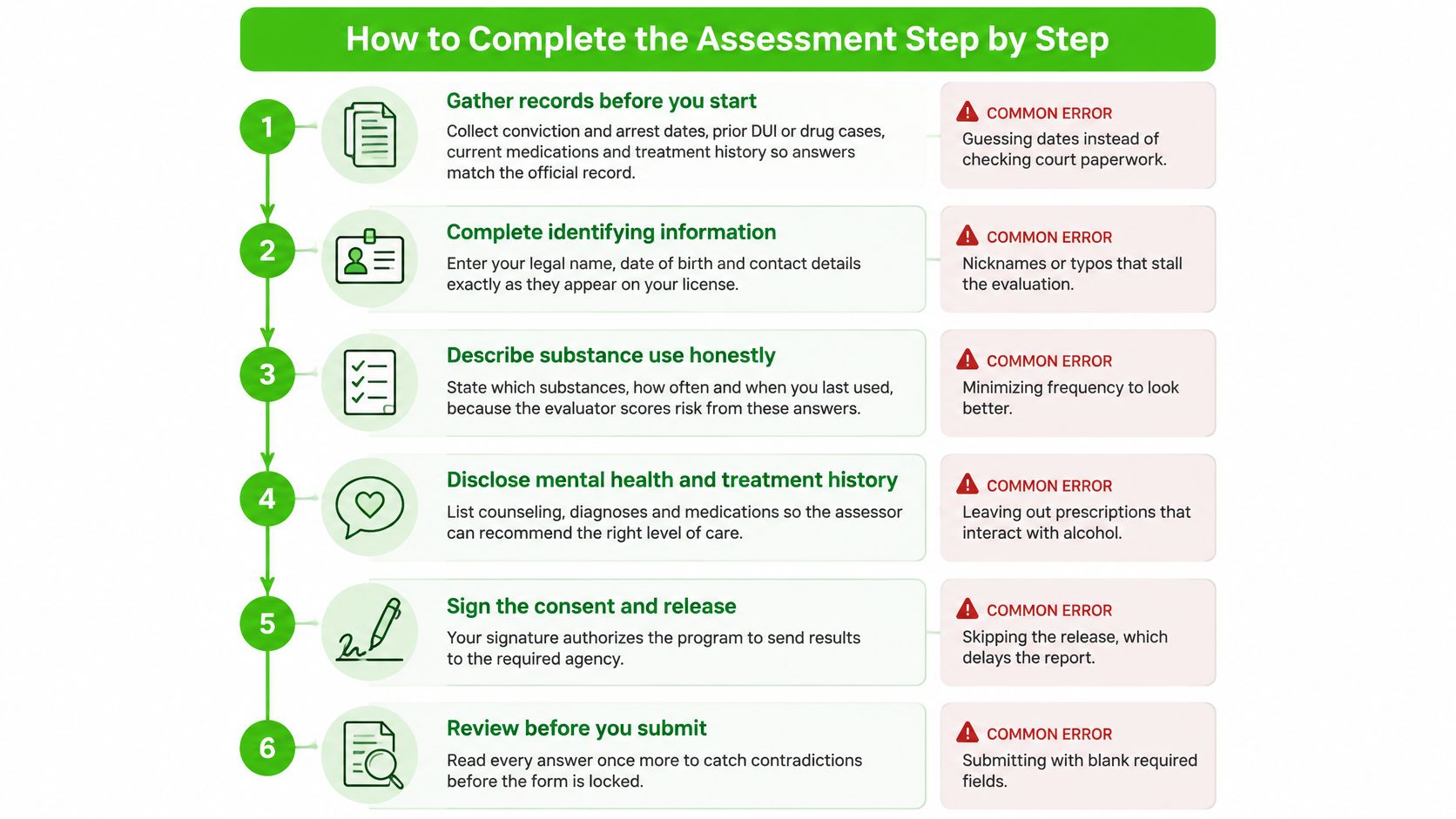
Gather records before starting. Collect arrest and conviction dates, prior DUI or drug-case information, current medications, and treatment history. Check court paperwork instead of guessing dates, and enter your legal name and identifying information accurately.
Confirm the recall period. Read whether a question asks about the past year, your lifetime, or the period surrounding the incident. A common mistake is answering every question about current behavior even when it asks about an earlier window.
Describe alcohol quantities clearly. Separate beer, wine, and liquor, and report both typical consumption and the most consumed when requested. Describe container sizes and beverage strength when you're unsure how to translate a pour into the form's units.
Complete the drug section substance by substance. Include prescribed medicines, last use, and combinations rather than listing only substances involved in the arrest. A medication can matter clinically even when you take it legally and exactly as prescribed.
Answer safety and mental-health questions directly. Disclose withdrawal history, suicidal thoughts, pregnancy, diagnoses, counseling, and relevant medication concerns. Leaving these out can prevent the evaluator from recognizing a need for medical assessment or other support.
Review for consistency without rewriting history. Compare dates and quantities across sections, and explain genuine differences in the periods being described. If you discover an error, tell the evaluator instead of changing another accurate answer just to make everything look identical.
Read the consent, then sign and date. Understand the difference between agreeing to an assessment and authorizing disclosure of information. Keep a permitted copy of your submission or confirmation, and ask how to correct an error discovered afterward.
Recognizing a submission-ready form
Required fields should be complete, dates should agree with the records you gathered, and any uncertainty should be identified. If a question doesn't apply, use the form's designated option rather than leaving it blank.
The graphic condenses the preparation process; it isn't a substitute for reading the actual consent and release. Your signature authorizes only what the document says, not every possible disclosure associated with the program.
Submitting the Form and Sequencing the Evaluation
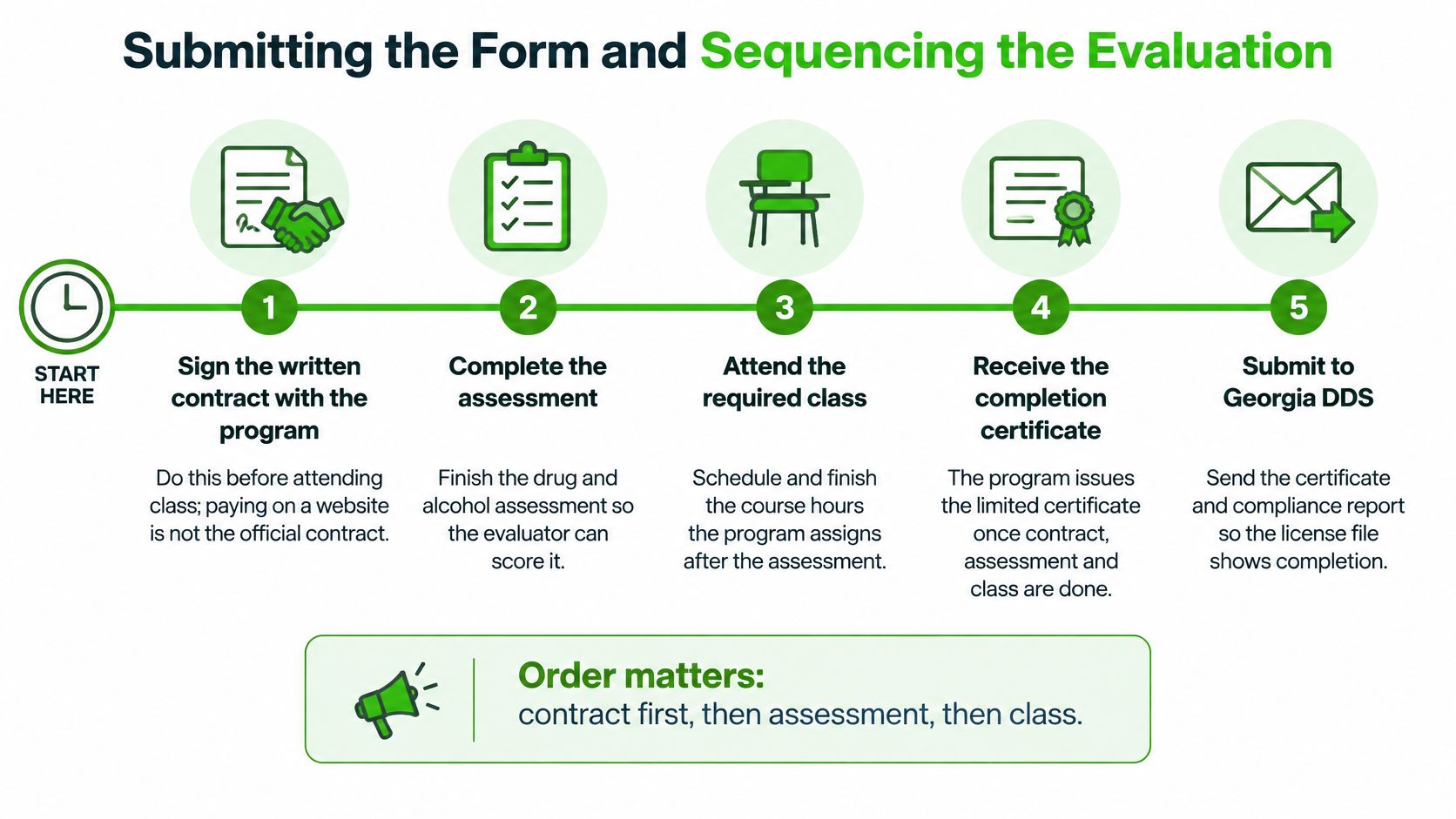
Contract first, assessment next, intervention afterward, certificate last. That administrative order is separate from any clinical evaluation or treatment requirement attached to your case.
The Georgia DDS Risk Reduction policies and procedures guide requires a valid assessment for program participants and an assessment-component contract, including applicable fees, before administration.
Checkpoints before you move forward
- Contract confirmation. We require a signed written contract before class. Advance website payment isn't the official contract, so retain confirmation that the enrollment paperwork is complete.
- Assessment completion. Record the assessment date and confirmation of completion before your intervention begins. Don't assume a reserved class seat means you've completed this prerequisite.
- Full class schedule. The 20-hour Intervention Component includes group counseling and education about alcohol, drugs, and driving. It can't be completed in a single day; a weekend schedule may include Friday evening and full sessions Saturday and Sunday.
- Certificate review. We issue the official Certificate of Completion only after both program components are finished. Check your name and identifying details before leaving or closing out your enrollment.
Presenting proof correctly
The certificate is official proof for court or DDS reinstatement purposes, but receiving it doesn't itself establish that every license requirement is resolved. Follow the receiving agency's submission instructions and keep confirmation of delivery.
Send the certificate, and any separately requested compliance documentation, through the method the court or DDS specifies. Don't send the entire clinical questionnaire merely because an office requests proof that you completed the program.
Mistakes That Delay Compliance and How to Fix Them
Minimizing use or giving contradictory answers is the mistake most likely to undermine the evaluation itself. Trying to appear low-risk can leave the evaluator without the information needed to interpret your history accurately. Correct inaccuracies openly rather than trying to maintain an earlier incomplete answer.
Common mistakes, consequences and fixes
| Mistake | Consequence | Fix |
|---|---|---|
| Minimizing or inconsistent answers | Undermines the clinical evaluation and delays compliance | Answer fully and match dates across sections |
| Starting class before the assessment | Breaks the required order | Finish the assessment before attending class |
| Choosing a self-paced online program for court or DDS | Certificate isn't accepted for reinstatement or court purposes | Confirm the accepted instructional format before paying |
| Arriving late to an intervention session | Entry may be denied; missed time can't be made up | Confirm session times and plan travel; restarting requires the full fee again |
| Assuming the form alone satisfies the order | A separate clinical evaluation may remain outstanding | Check each service named in your order |
Fix the enrollment problem before paying again
The label online doesn't tell you whether a program meets DUI/Risk Reduction requirements. Check whether the instruction is live, how attendance is recorded, and what completion document the school issues. Don't rely on a website's promise of fast completion.
Our intervention attendance policy is strict: students late to any session may be denied entry, can't make up missed time, and must re-register and pay the full course fee to start a new program. Contacting the school about a delay is sensible, but it doesn't guarantee admission or an exception.
Plan around the entire commitment
Say an Atlanta driver books a weekend course while arranging work coverage and transportation. The useful planning step is confirming every session's start and end time before requesting leave, booking travel, or relying on someone for a ride.
For a live virtual session, preparation also includes checking the camera, connection, charging cable, and private space. A scheduled appointment isn't completed attendance, and a saved payment receipt isn't proof that you finished the requirement.
Privacy, Consent and Online Completion
Your clinical record and your completion certificate or compliance report serve different purposes. A court, probation officer, attorney, employer, or licensing agency may need confirmation of completion or recommendations without receiving every answer from your assessment.
The HHS telehealth guidance for substance-use-disorder services explains that 42 CFR Part 2 protects covered substance-use-disorder treatment records and generally requires written consent before disclosure. Coverage, exceptions, and reporting obligations can differ, so ask how the rules apply to your records.

Questions before signing
- Information released. Will the recipient receive attendance, recommendations, a summary, or your underlying answers?
- Recipient and purpose. Who will receive the information, and what requirement does the disclosure address?
- Consent limits. Can you narrow or revoke authorization? What has already been disclosed?
- Digital handling. Who can access the submission, and how can you correct an error? A digital service's description of how response data is protected may help you understand its stated practices, but it does not establish how your evaluator handles records.
Verify the remote process
Before submitting sensitive information, ask how identity, privacy, and connection problems are handled. Review the process for an online drug and alcohol assessment and confirm that it fits your requirement.
DDS does not accept certificates from self-paced online DUI/Risk Reduction programs for court or license reinstatement. Live virtual instruction requires you to be present on camera with a live instructor throughout the 20-hour intervention. A course completed on your own time does not meet that requirement.
For a Clinical Evaluation, verify that the evaluator is DBHDD-approved and confirm the arrangements for the proposed remote process. A private setting and a plan for connection failure also help protect your information and keep the appointment on track.
Quick Reference Terms and Where to Find Them
Key terms and where they are explained
| Term | Plain meaning | Read more in |
|---|---|---|
| AUDIT | WHO alcohol-screening questionnaire with defined scoring | The Assessment Tools Behind the Form |
| AUDIT-C | Brief alcohol screen for risky drinking | The Assessment Tools Behind the Form |
| Assessment Component | Georgia DDS questionnaire stage before intervention | Submitting the Form and Sequencing the Evaluation |
| Clinical evaluation | In-depth evaluation by a DBHDD-approved professional | Who Must Complete a Form and When It Applies |
| ASAM six domains | Areas used to organize a full clinical assessment | Information the Form Asks For, Field by Field |
| Intervention Component | Required classroom instruction after assessment | Submitting the Form and Sequencing the Evaluation |
| Certificate of Completion | Official proof issued after both program components | Submitting the Form and Sequencing the Evaluation |
| 42 CFR Part 2 | Federal confidentiality protection for covered substance-use treatment records | Privacy, Consent and Online Completion |
| Habitual Violator | Status tied to repeated listed convictions within the specified period | Who Must Complete a Form and When It Applies |
Screening terms describe tools for gathering information. The name of a screening instrument doesn't tell you whether a separate clinical service is required.
Clinical terms describe the professional evaluation and the framework used to interpret your history. The difference between assessment and evaluation is especially important when separate appointments appear on your instructions.
Compliance and confidentiality terms describe what you must document and how information may be shared. A completion certificate answers a different question from a clinical recommendation.
Use this table to recognize unfamiliar words, not to determine your obligations. The requirements table and your actual court and DDS documents remain the practical guides for deciding what to complete.
Start Your Compliant Assessment in Atlanta or Athens
Begin with your case requirements, not the earliest available class. Identify whether you need Risk Reduction alone, a separate clinical evaluation, or additional ordered services, then have your identification, case dates, medication list, and relevant records ready.
Georgia DUI Schools helps drivers in Atlanta and Athens complete the required Risk Reduction Program to regain their licenses. We offer in-person and live online options, with DUI classes held every weekend. Enrollment requires the written contract, not just an advance payment.
The program cost is $100.00 for the Assessment Component, $235.00 for the Intervention Component, and $25.00 for the workbook, totaling $360.00. A separately ordered clinical evaluation is a different service and needs its own booking.
Before committing to a session, make sure you can attend the entire schedule. Keep your court instructions available when arranging enrollment so the assessment, class, and any independent evaluation requirement are treated as distinct tasks.
Georgia DUI Schools offers DUI/Risk Reduction instruction and clinical evaluation services to help you complete the right steps after a Georgia DUI. Visit Georgia DUI Schools to review enrollment options and the current DUI/Risk Reduction schedule, and have your court or DDS requirements ready when arranging your assessment.