You've left court with a sentencing order, a probation appointment, and a license you still can't use. You know you need DUI school, but you may not know whether finishing it clears probation, restores your license, or does both.
DUI probation in Georgia involves separate court and licensing requirements. Treating them as separate checklists helps you avoid a frustrating mistake: completing a class while another condition still prevents you from driving or leaves your probation file incomplete.
Georgia DUI Probation Terms at a Glance
Standard DUI probation terms by offense history
The Georgia Department of Driver Services penalty guide lists the probation, community service, Risk Reduction, and clinical evaluation requirements summarized below. The interlock row identifies the additional alcohol-related repeat-offense rule explained later.
| Requirement | First offense | Second offense within five years |
|---|---|---|
| Probation term | 12 months | 12 months |
| Community service | At least 40 hours | At least 30 days |
| Risk Reduction program | Required, at offender's expense | Mandatory |
| Clinical evaluation | Possible, at offender's expense | Mandatory, with treatment if indicated |
| Ignition interlock | Court may impose as a probation condition | Required for two or more alcohol-related DUIs within five years |
Read this as a minimum-requirements checklist, not your complete sentence. Some entries are mandatory minimums, while others describe conditions the judge may impose. Your sentencing order determines which additional requirements apply to you.
Read each condition separately
Start with the probation term. Finishing your classes doesn't, by itself, mean supervision has ended. Ask the probation office to identify your official start date, anticipated end date, and any custody credit reflected in the order.
Next, check community service carefully. Hours and days aren't interchangeable. Get approval for the organization before starting, and ask how the office converts and records service under your particular order.
Risk Reduction is the educational requirement commonly called DUI school. A clinical evaluation serves a different purpose: it assesses whether substance-use treatment is indicated. Don't assume completing the educational course also satisfies an evaluation or treatment order.
An ignition interlock adds equipment and monitoring obligations. If your order includes it, identify the approved installation arrangement and the records your officer expects.
Practical rule: A completed task isn't a closed condition until the probation office has accepted the proof.
Match the order to your checklist
Pull out your sentencing order and mark every applicable table row. Then create a separate list for anything the judge added, such as testing, a victim impact panel, payment deadlines, or restrictions on travel.
For reporting in Fulton, DeKalb, or Gwinnett County, confirm local practice directly with the assigned probation office. Don't borrow a friend's schedule, even if that person's DUI case sounds similar to yours.
Why Georgia Sets Probation Conditions
Court probation and license reinstatement run on two tracks. A judge sets behavioral conditions for the case under supervision. The Department of Driver Services decides, separately, whether a suspended license can come back. Finishing work on one track does not close the other.
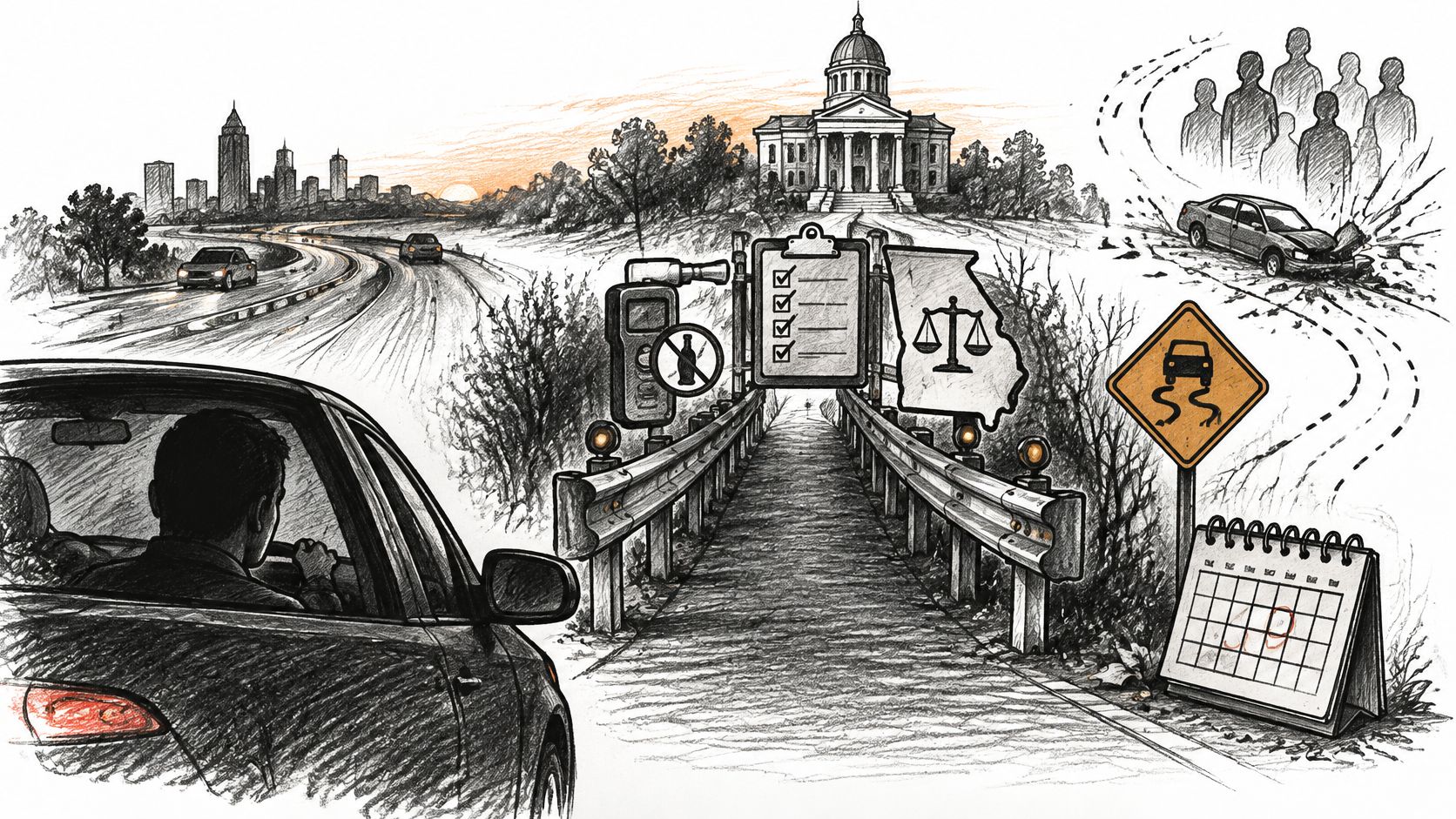
Probation conditions work like guardrails on a curve. They sit around the choices most likely to produce another impaired-driving crash: drinking and then driving, skipping a required program, or dropping out of contact with the court.
The Georgia Governor's Office of Highway Safety impaired-driving overview reports 1,403 traffic fatalities across 1,312 fatal crashes in 2024, including 325 deaths involving at least one alcohol-impaired driver, approximately 23% of the total, set against a national alcohol-impaired share of 30%, and identifies ordinary-driver impairment at 0.08 grams per deciliter or higher.
That share is why a sentence often stacks more than one requirement. Education teaches traffic law and crash avoidance. Screening looks at substance use. Supervision checks whether the person is following the order between court dates. Each piece covers a different part of the risk.
Community service, Risk Reduction, and clinical screening create separate obligations. One completed task does not stand in for the others, and the court's term length does not set the deadline for every item inside it.
Each condition has its own due date, and that date can arrive well before probation ends.
Court Probation and License Reinstatement
Think of two locks on one door: DDS controls the license lock, and the court controls the probation-compliance lock. You need valid driving privileges and must comply with applicable court restrictions, but you don't necessarily have to finish probation before driving legally.
According to the DDS first-DUI reinstatement guidance, a first DUI within five years generally brings a 12-month suspension, with reinstatement potentially available after a 120-day hard suspension upon submission of an approved Risk Reduction completion certificate and the required fee. Under O.C.G.A. § 40-5-63.1, DDS generally doesn't require clinical evaluation or treatment for that reinstatement pathway, although the judge may independently require either through probation.
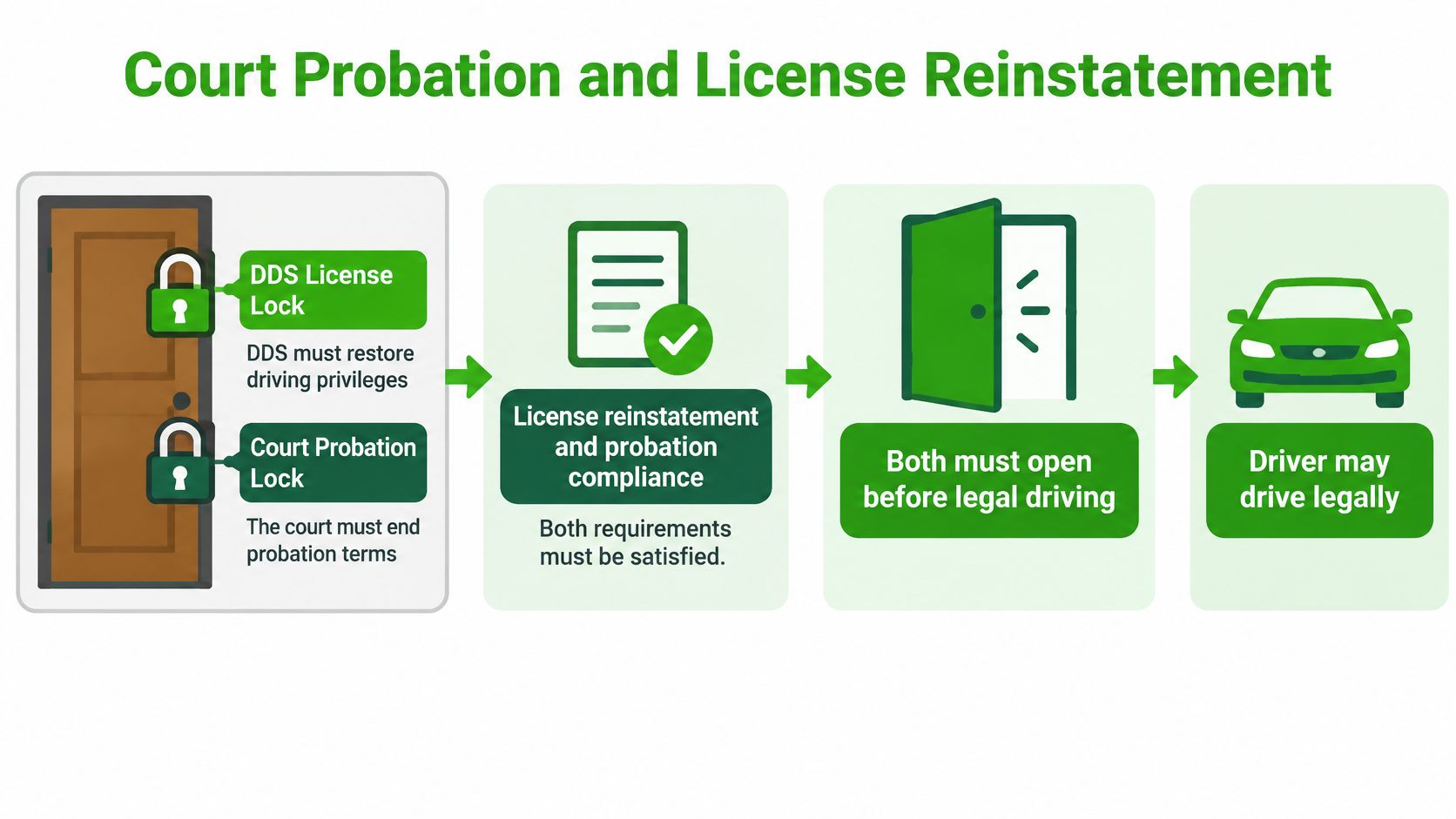
The important distinction is reinstatement versus compliance, not reinstatement versus the end of probation. A restored license doesn't close unfinished court conditions, and a probation officer's acceptance of paperwork doesn't independently restore a suspended license.
Reinstatement tracks compared
| Track | Who Sets It | What Proves Completion | Common Gap |
|---|---|---|---|
| DDS license reinstatement | Georgia Department of Driver Services | Certificate from a DDS-approved Risk Reduction program plus reinstatement fee | Certificate from a non-approved provider is not accepted |
| Court probation conditions | Sentencing order and probation officer | Probation records of each completed condition | Judge-ordered evaluation or treatment can stay open after the license is restored |
Say a driver in Decatur completes an accepted class and receives DDS confirmation of restored privileges. If the court also ordered treatment, that driver still needs to follow the treatment schedule and submit the required documentation.
Keep separate status lists
- Check DDS: Review your online account for the administrative items attached to your record.
- Read the order: List every unfinished court condition and its deadline.
- Verify approval: Confirm the school's DDS certification before paying or submitting its certificate.
- Check insurance obligations: The DDS reinstatement guidance notes that reinstatement can require SR-22 proof maintained for three years from conviction; verify whether this applies to your record.
- Reconcile regularly: Review both lists with your officer monthly, without assuming that this replaces your assigned reporting schedule.
Reporting Requirements and Supervision
Your sentencing order and probation office set reporting dates, payment instructions, and travel limits. License reinstatement and court supervision run on separate tracks: DDS controls the driving record, while the order controls reporting. The statewide penalty summary cannot tell you when a specific county office expects you, so treat the order as the calendar and the officer as the person who confirms it.
Ask how the supervision period is calculated from sentencing. Completing classes or community service does not end reporting. A request for early termination is not approval; wait for the court's written decision.
Build a supervision file with five entries:
- Calendar appointments: Record every check-in and the office's accepted reporting method.
- Confirm service records: Ask which log format and supervisor signatures the office accepts.
- Bring proof: Keep service logs, course certificates, and evaluation records ready to submit.
- Resolve travel restrictions: Request written permission before out-of-county travel when your conditions require it.
- Keep duplicates: Save every document you submit and every acknowledgment of receipt.
If screening is ordered, compare the court-ordered drug test procedure with the testing instructions you received. Confirm how you will receive notices and what to do when work or transportation conflicts with a check-in.
Reporting systems vary by state. A resource on avoiding supervision reporting violations describes Texas community supervision, so use it to compare how another court tracks check-ins, not to set Georgia deadlines.
Your calendar and your documents need equal attention. A missed check-in can create a compliance issue even when your coursework is finished.
Repeat Offenses, Interlock Devices and Habitual Violator Rules
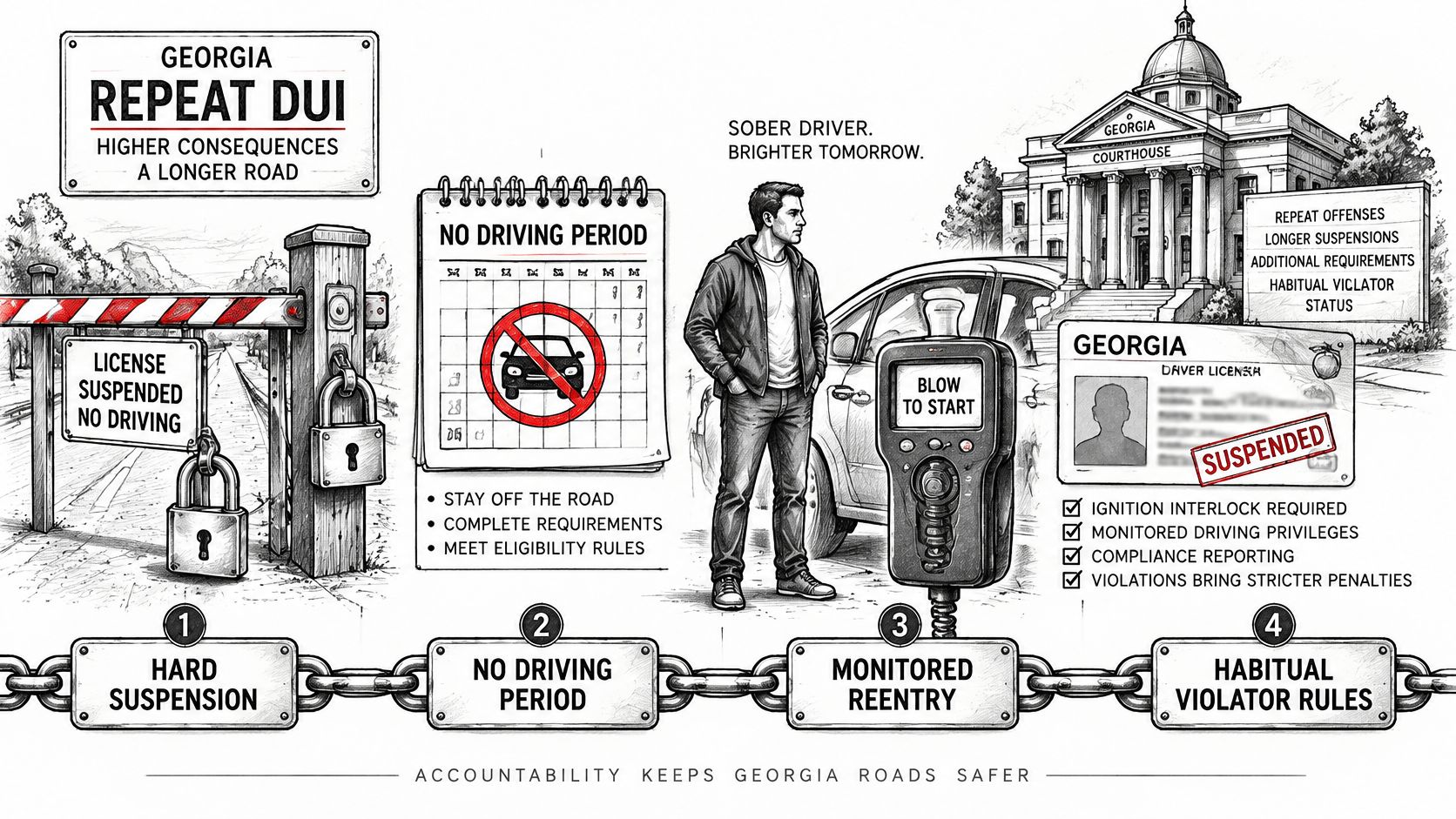
A repeat DUI can create a sequence of requirements rather than a single reinstatement date. The order matters: serving a suspension, qualifying for a permit, and maintaining an interlock are distinct steps.
The DDS ignition-interlock materials describe a second DUI within five years as carrying at least an 18-month suspension, including 120 days without driving privileges, followed by possible eligibility for an ignition-interlock limited permit requiring a certified device for 12 months. Those materials also identify the device requirement for two or more alcohol-related DUIs within five years and require calibration and monitoring every 30 days through a Georgia-certified provider.
Installation is only the beginning
A device installation receipt doesn't prove continuing compliance. Missed monitoring, failure to maintain the device, or driving an unauthorized vehicle can jeopardize the permit arrangement and may also create a probation problem.
For example, borrowing a family member's car because your own vehicle needs repair isn't a safe workaround. Confirm that any vehicle you intend to operate is permitted under your restrictions.
The ignition interlock restricted license guide can help you organize the questions to take to DDS and your probation officer.
Habitual Violator status follows a separate pathway
Under the DDS Habitual Violator guidance, a person declared a Habitual Violator may qualify for a probationary license only after serving two years of the revocation period. Completing Risk Reduction doesn't erase that period or automatically authorize driving.
Don't confuse a probationary license with court probation. The similar wording describes different legal obligations.
The Law Office of Bryan Fagan misdemeanor guide, from Law Office of Bryan Fagan PLLC, provides general courtroom-process context for Texas readers. It isn't authority for Georgia interlock eligibility or Habitual Violator rules.
Keep installation paperwork, calibration receipts, and monitoring records together. Before changing vehicles or providers, confirm the approved arrangement and document the answer.
Risk Reduction Program Rules and What It Costs
Georgia's DUI Alcohol or Drug Use Risk Reduction program is not a class you can join at any point. You complete the assessment first, then the intervention, and you need successful completion of both for the certificate.
The DDS DUI program FAQs specify a 130-question NEEDS Assessment, followed by a 20-hour Intervention Component, and list the statutory total at $360, allocated as shown below.
Risk Reduction program cost breakdown
| Component | What It Covers | Price Listed by DDS |
|---|---|---|
| NEEDS Assessment | 130-question assessment completed first | $100 |
| Intervention Component | 20 hours of group sessions | $235 |
| Workbook | Participant workbook | $25 |
| Total | Both components and workbook | $360 |
The intervention uses group sessions covering alcohol and drug use, effects on driving, therapeutic education, and peer-group counseling. It's distinct from a clinical evaluation, so don't book one expecting it to replace the other.
The explanation of Risk Reduction can help you understand the educational requirement before selecting a schedule. Build time around assessment completion, class attendance, and submission of the resulting certificate.
Verify format and out-of-state acceptance
DDS doesn't accept self-paced online DUI/Risk Reduction certificates for reinstatement or court purposes. Don't assume that an online course advertised as convenient is the same as an approved instructor-led program.
A client convicted in Georgia who lives elsewhere must complete a substantially similar intervention program in the home state. That program must be certified there, meet the required instructional duration, and be verified by Georgia DDS before it can satisfy the applicable requirement.
Before enrolling: Confirm the provider's approval and the exact program format, not merely whether the advertisement says DUI school.
Use these questions to prevent booking the wrong service:
- What remains open? Identify whether you still need the assessment, intervention, or a separate clinical service.
- What proof is accepted? Confirm the certificate and submission method the court requires.
- Is the provider approved? Verify DDS certification before payment and before the course starts.
Budget separately for other obligations in your order. The course price doesn't represent your entire probation or reinstatement cost.
Probation Violations and What Follows Them
A late report or missed class can seem like minor paperwork. If it breaches a condition of your sentencing order, however, the probation office can treat it as a compliance problem.
Potential issues include unfinished community service, skipped treatment, missed interlock calibration, a failed or missed test, and travel contrary to the order. A new arrest can also prompt review, although an allegation doesn't itself establish that a violation occurred.
Understand the possible escalation
The officer may receive notice of the problem and ask for an explanation or supporting documents. The matter can proceed to a hearing, where the judge determines whether a violation occurred and what response is legally available.
Possible consequences include additional conditions, changes to supervision where legally authorized, or incarceration through revocation of suspended time. Don't assume every technical problem produces the same outcome, or that late completion automatically prevents court action.
The Law Office of Bryan Fagan probation guide, from its Kingwood, Texas practice, provides general revocation context. Georgia procedure and your own sentencing order control your case.
Respond with records, not assumptions
- Read the notice: Identify the alleged breach, response deadline, and hearing information.
- Gather proof: Collect service logs, attendance records, receipts, and interlock documentation.
- Write promptly: Ask the officer to clarify any discrepancy without guessing or making unsupported statements.
- Get legal advice: Consult a Georgia criminal defense attorney before a violation hearing.
- Protect the dates: Calendar court appearances and continue following all remaining conditions.
Prompt documentation may resolve a recordkeeping discrepancy before it requires a hearing. It doesn't guarantee dismissal, but it gives your officer and attorney something concrete to review.
Confirm Your Conditions and Enroll in Risk Reduction
- Gather your records: Locate the sentencing order and check your DDS online account.
- List unfinished conditions: Include deadlines, payment instructions, reporting, and proof requirements.
- Confirm acceptance: Identify the Risk Reduction program your court and DDS will accept.
- Enroll and document: Complete the certified program and retain the certificate.
- Schedule remaining services: Arrange community service and any clinical evaluation early enough to meet their actual deadlines and document progress at your next report.
We're Georgia DUI Schools, a state-certified DUI school certified by the Georgia Department of Driver Services. We help drivers in Atlanta and Athens complete the required Risk Reduction Program as part of the process of regaining their licenses.
Enrollment follows a straightforward sequence: select the class, pick a location, and book a date. For scheduling questions, call (770) 415-4384; questions about changing court conditions should go to your probation officer or attorney.
Georgia DUI Schools offers DDS-certified DUI/Risk Reduction education to help you complete the educational portion of your court and licensing requirements. Visit Georgia DUI Schools to select DUI/Risk Reduction, choose your location, and book a date that fits your compliance deadlines.