An SR-22 is a certificate your insurer files with Georgia DDS, not a separate insurance policy, and after a Georgia DUI conviction it must stay on file for three years from the conviction date. If the cheapest quote gets you insured today but leaves you exposed to cancellation next month, have you actually protected your driving privileges?
That's the question worth asking before you buy “SR22 insurance.” The price matters, but so do the liability limits, payment terms, filing confirmation, and continuity of coverage. A policy that doesn't meet your reinstatement requirements isn't a bargain, and a coverage gap can create another license problem after you've completed the work to get reinstated.
Georgia SR-22 Requirements at a Glance
| Situation | Filing period | Minimum liability limits | Notes |
|---|---|---|---|
| Standard Georgia liability minimum | Not an SR-22 period | $25,000 / $50,000 / $25,000 | Ordinary minimum, not enough after a DUI |
| First DUI conviction under O.C.G.A. § 40-6-391 | 3 years from conviction date | $50,000 / $100,000 / $50,000 | Confirm the start date with DDS |
| Second or subsequent DUI conviction | 3 years from conviction date, confirm with DDS | $100,000 / $300,000 / $100,000 | Higher DUI-specific limits apply |
The three-year period runs from the conviction date, while the Georgia DDS DUI reinstatement rule sets the liability limits shown above for first and subsequent DUI convictions. Buying an ordinary minimum-limit policy doesn't satisfy those DUI-specific coverage requirements.
How to read the coverage limits
Insurers call these split limits because the policy separates liability coverage into different payment ceilings. Read the figures from left to right:
- Per person: The most the insurer pays for bodily injury or death involving one person.
- Per crash: The most it pays for bodily injury or death involving everyone in the same crash.
- Property damage: The most it pays for damage to other people's property in that crash.
The per-crash bodily-injury limit isn't an additional payment on top of the per-person limit. It's the combined ceiling when multiple people have injury claims. Property damage has its own separate ceiling.
Say an Athens driver asks an agent for the cheapest legal liability policy without mentioning a DUI reinstatement. The agent might quote ordinary coverage rather than the coverage DDS requires for that driver's conviction. The policy could be valid insurance without being sufficient for reinstatement.
Check the policy and the filing
Your policy declarations page, the document summarizing your coverage, should show the applicable liability limits. Your filing confirmation should separately establish that the insurer submitted the required certificate.
Before paying: Tell the insurer that you need coverage for a Georgia DUI reinstatement, not simply Georgia's ordinary minimum insurance.
The controlling DDS rule determines the start date, not the date you happen to buy insurance. If your conviction is recent, have the insurer match the applicable DUI row and confirm the filing details in writing before you submit your reinstatement documents.
What an SR-22 Is and Why It Is Not Insurance
Think of the insurance policy as the purchase and the SR-22 as the signed receipt the state requires. The policy provides coverage; the SR-22 certifies that qualifying coverage exists.
An authorized insurer submits that certificate to the state on your behalf. It isn't extra collision coverage, a substitute for liability insurance, or a document you can create and file yourself.

Why the certificate affects your license
For a conviction under O.C.G.A. § 40-6-391, Georgia requires the filing to remain in place for three years from conviction, and termination of the underlying coverage can lead to another suspension, as explained by the Georgia DDS financial-responsibility guidance.
Consider a driver in Atlanta who completes reinstatement and later cancels insurance because the car is no longer running. The driver may think there's no insurance issue because nobody is driving the vehicle. But the obligation to maintain the required proof hasn't necessarily ended.
The insurer can report the cancellation to DDS. That means a decision about the car can become a separate problem with the driver's license.
What if you don't own a car?
Drivers without a vehicle may be able to use a non-owner policy to support the filing, but the insurer still has to submit the required certificate, according to the Texas DPS explanation of SR-22 financial responsibility. For a Georgia requirement, ask an insurer authorized in Georgia whether its non-owner policy meets your specific DDS obligation.
Explain whether you borrow cars, have access to a household vehicle, or expect to buy a car. Don't assume that selling your vehicle eliminates the filing requirement.
Continuous qualifying coverage matters more than having a copy of the certificate in your glove compartment.
Reinstating Your License After a Georgia DUI
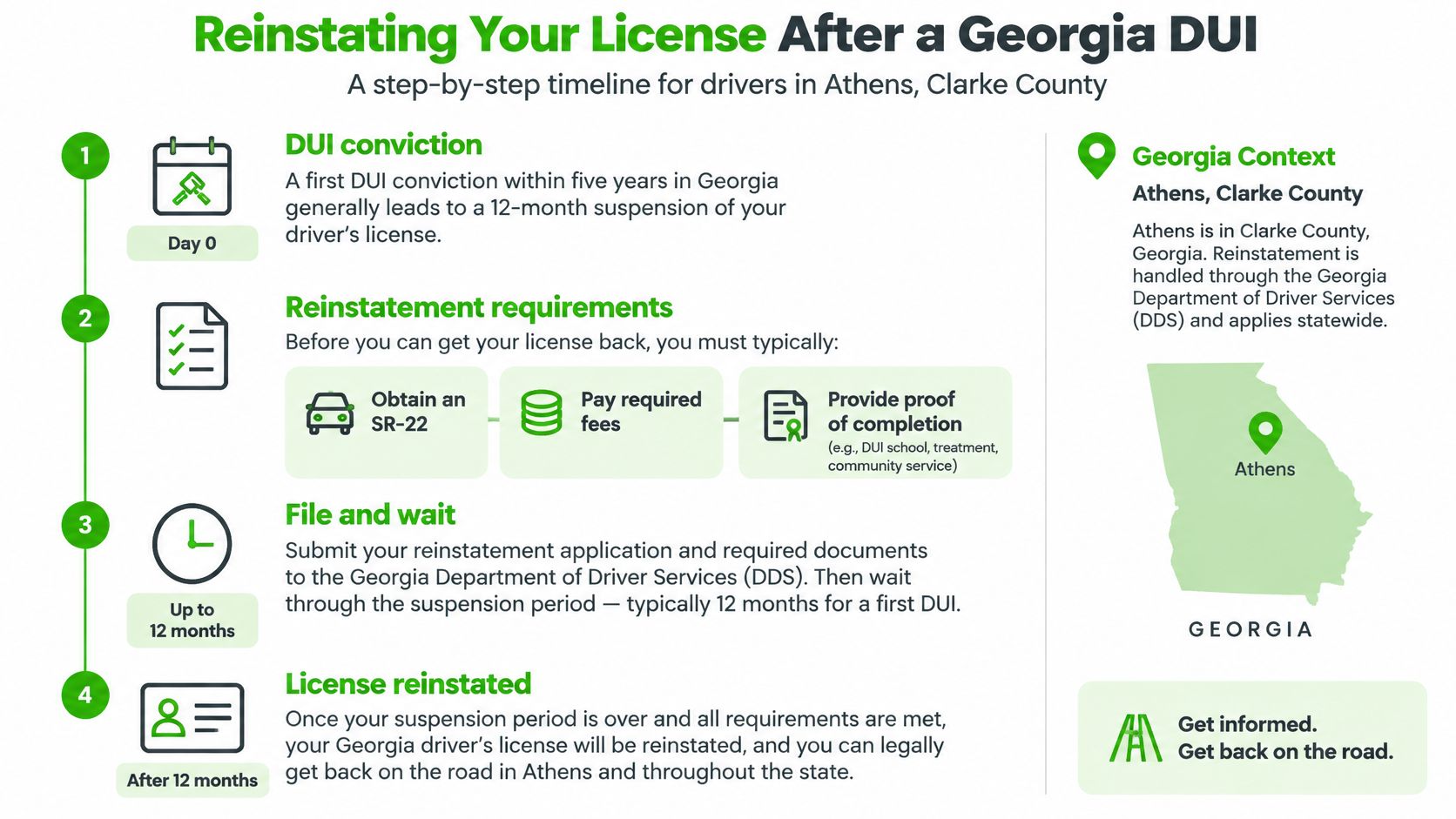
You may be eligible to apply for reinstatement after 120 days following a first DUI conviction within five years, even though the conviction generally produces a 12-month suspension, according to the Georgia DDS reinstatement guidance. Eligibility to apply isn't the same as automatic reinstatement.
Say a driver in Athens receives a DUI conviction in Clarke County. Purchasing insurance and finishing a class are important steps, but the driver still needs to satisfy the requirements attached to the DDS record and obtain confirmation that driving privileges have been restored.
Complete the required education in order
The DUI Alcohol or Drug Use Risk Reduction Program, often shortened to RRP, has mandatory components that must be completed in sequence. The Assessment Component comes first, followed by the Intervention Component, the class.
The Assessment takes 25 to 45 minutes and must be completed before the 20-hour class. Booking a class without allowing time for the Assessment can disrupt your completion schedule, especially if you're working toward a court or reinstatement deadline.
Course format also matters:
- DUI/Risk Reduction: Georgia DDS doesn't accept certificates from self-paced online DUI/Risk Reduction programs for reinstatement or court purposes.
- Defensive driving: A self-paced online defensive driving course isn't accepted by DDS for point reduction, court orders, or reinstatement. It's generally only suitable for a possible insurance discount after confirmation with the insurer.
- Instructor-led instruction: Choose the approved classroom or live virtual format appropriate to your requirement, rather than assuming any course advertised as online will qualify.
A defensive driving certificate also isn't interchangeable with a DUI/Risk Reduction completion certificate. Choose the program named in your requirements, not the shortest course available.
Keep court requirements separate
A judge may order a Clinical Evaluation in addition to the Risk Reduction Program. Completing RRP doesn't satisfy a separately ordered Clinical Evaluation, so keep those appointments and completion documents separate.
Your insurance filing, course completion, and reinstatement payment also serve different purposes. The insurer handles financial-responsibility certification; the course provider documents education; DDS determines whether you've met the reinstatement conditions.
Use the Georgia DUI license reinstatement guide to organize your documents alongside your individual DDS requirements. Prior convictions or other unresolved suspensions can change what you need to complete.
The practical sequence is suspension, Assessment, class, SR-22 filing, reinstatement payment, and confirmed reinstatement. Don't drive merely because you've reached an eligibility date or received a course certificate.
How to File an SR-22 in Georgia Step by Step
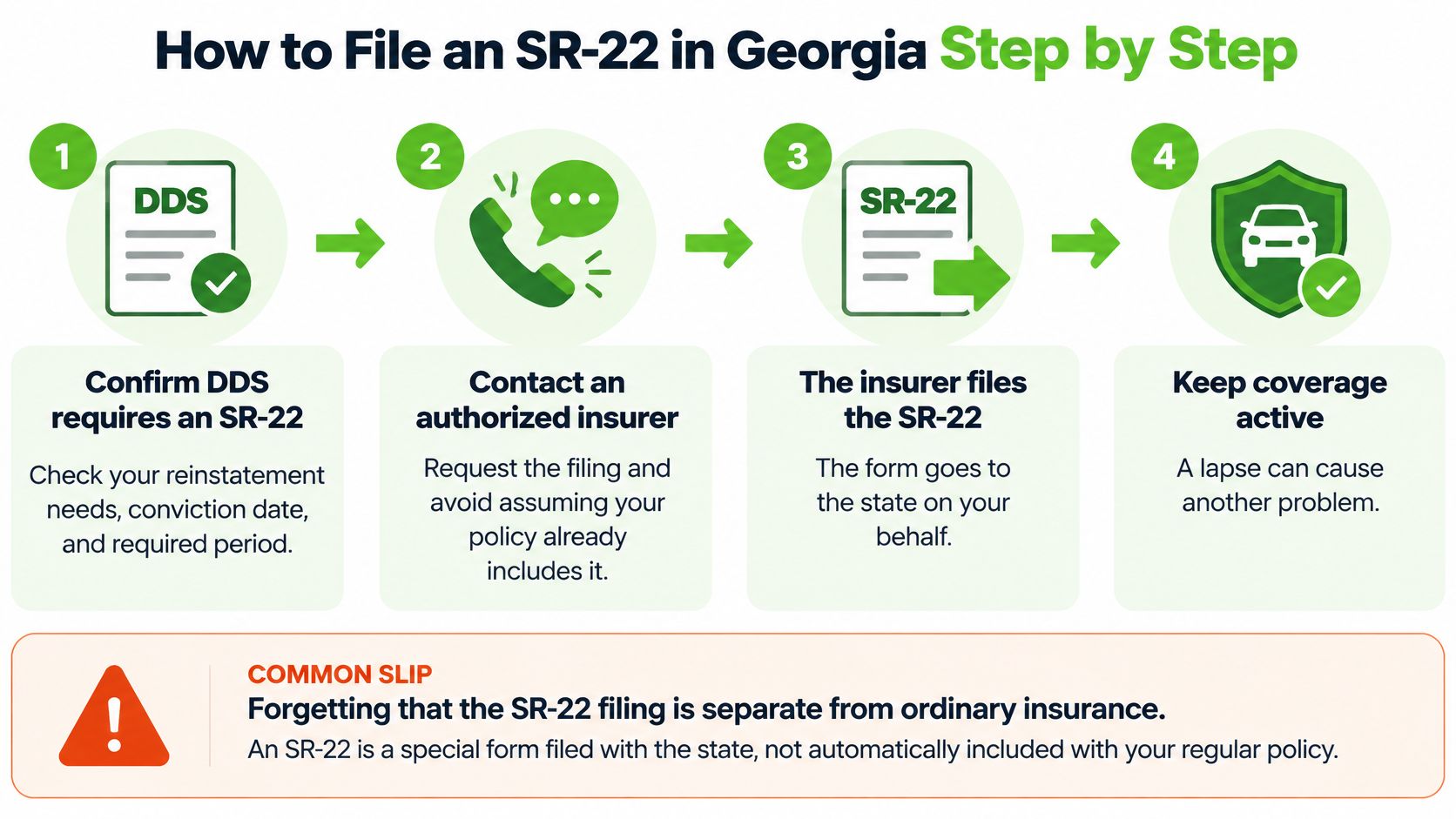
Treat the filing as a coordinated task between you, your insurer, and DDS. You supply accurate information and purchase qualifying coverage; the insurer transmits the certificate; DDS must have the required proof when processing reinstatement.
Arrange the policy and submission
Confirm your DDS requirement. Find the conviction date, required filing period, and insurance conditions associated with your record. Don't assume the obligation began when you first purchased a policy.
Contact an insurer authorized in Georgia. Ask specifically whether it handles Georgia SR-22 filings for DUI reinstatement. If you don't own a vehicle, discuss non-owner eligibility rather than buying coverage that doesn't fit your circumstances.
Request the applicable DUI-level liability limits. Tell the agent whether the conviction is your first or a subsequent DUI and have the agent confirm the corresponding requirements. The common mistake is requesting an ordinary minimum-limit policy without explaining why you need the filing.
Ask for electronic submission and written confirmation. Request the filing's effective date and confirmation that the insurer transmitted it to DDS. An insurance identification card alone doesn't establish that the separate filing was sent.
Pay the filing charge and required premium. In 2024, SR-22 filing fees generally ranged from $15 to $50, according to Ocho's SR-22 cost guide. Ask the insurer to distinguish its administrative charge from your insurance premium and explain when each payment is due.
Maintain coverage through the entire obligation. If you switch insurers, coordinate the replacement coverage and filing before the old policy terminates. Don't cancel the existing policy just because you've accepted a new quote.
Build filing time into your schedule
Ask the insurer how long its electronic filing takes. Then schedule the purchase and submission so the required proof can appear in DDS records when you become eligible to apply.
A promise to file isn't the same as a completed submission. Before sending reinstatement documents, request confirmation from the insurer and verify the status with DDS if anything is unclear.
Keep a dedicated folder containing:
- Policy documents: Your declarations page and coverage effective dates.
- Filing confirmation: The insurer's written submission confirmation and any reference information.
- Payment records: Receipts and the schedule for future premiums.
- DDS correspondence: Your reinstatement requirements and status notices.
Finished means documented: You should have a qualifying policy, a confirmed effective date, and written evidence of the insurer's filing.
If a document contains an incorrect name, license number, or effective date, ask for correction promptly. Resolving a mismatch before reinstatement is easier than trying to explain why the certificate doesn't match your driver record.
What an SR-22 Costs and What Can Break It
SR-22 costs vary, and a low quote can become expensive if the payment schedule makes it hard to keep coverage active. Compare the total premium and payment terms, not just the amount due today.
| Cost item | Typical figure | Scope |
|---|---|---|
| SR-22 filing fee | $15 to $50, one time | General insurer filing range described above |
| Full coverage with SR-22 after a DUI | About $3,744 per year | 2024 average reported by GoAuto Insurance, not a Georgia quote |
| Non-owner SR-22 | About $574 per year | National average in CarInsurance.com's published analysis, with state-level differences |
Your premium depends on the insurer, driving record, coverage type, and required limits. Before choosing a policy, ask what you owe now, what future installments will cost, and what happens if a payment is missed.
Compare cancellation risk, not just price
A missed installment can lead to cancellation. If your coverage ends while Georgia requires an SR-22 filing, your license may be suspended again. The Colorado DMV's explanation of SR-22 filings describes the distinction: the filing is proof of insurance, not the insurance policy itself.
Paying an overdue premium does not necessarily resolve a DDS notice or restore driving privileges. Check your status with DDS if your coverage lapses or you receive a notice.
Use this guide to insurance costs after a DUI to prepare for the premium expense, then compare quotes with the same coverage requirements.
Before accepting a cheaper replacement policy:
- Get confirmation: Obtain written evidence that the new insurer submitted the filing.
- Check dates: Match the new policy's effective date to the old policy's termination date.
- Prevent interruption: Keep qualifying coverage active during the switch.
- Ask about reporting: Find out how the new insurer will report the policy to DDS.
A small premium saving can put your license at risk if a payment is missed or the change leaves a gap in coverage.
Enroll in the Right Georgia DUI Course
Before paying for anything, make three checks: confirm your filing dates with DDS, have the insurer match the DUI-specific coverage requirement, and choose the correct course path. These are separate responsibilities, and completing one doesn't excuse an unfinished requirement elsewhere.
For the education requirement, our DUI/Risk Reduction Program includes an Assessment lasting 25 to 45 minutes, followed by a 20-hour class, completed in that order. The total program cost at Georgia DUI Schools is $360.00.
Plan around your actual deadline
Our courses run seven days a week, with weekday and weekend sessions. That gives drivers in Athens, Atlanta, and surrounding communities options for fitting the required instruction around work and court commitments.
Choose your schedule with enough room to complete the Assessment first. If you need instructor-led virtual instruction rather than an in-person classroom, confirm the approved format when arranging attendance.
Keep these details ready when planning your next step:
- Your deadline: Identify whether it comes from DDS, the court, probation, or more than one authority.
- Your required program: Distinguish DUI/Risk Reduction from defensive driving before enrolling.
- Separate obligations: Schedule any independently ordered Clinical Evaluation in addition to RRP.
- Your documentation: Keep completion records available for the agency or court that requires them.
The objective isn't to collect certificates. It's to complete the correct requirements, submit usable proof, and avoid an administrative mistake that delays reinstatement.
Your insurer must handle the SR-22 filing, while your education provider handles the required course process. Arrange both early enough that you're not waiting on missing paperwork when you're otherwise eligible to apply.
Georgia DUI Schools offers DDS-approved DUI/Risk Reduction instruction with weekday and weekend scheduling to help you complete the education portion of reinstatement while your insurer handles the SR-22. Visit Georgia DUI Schools for help coordinating your course path, and enroll in the DUI/Risk Reduction course to arrange your Assessment before class.