Older drivers accounted for 19% of fatal-crash involvement in 2021, compared with 11% in 2001. An online defensive driving course for seniors can make refresher education easier to access, but in Georgia, online completion doesn't automatically satisfy every DDS, court, or insurance requirement.
That distinction matters. A senior may want to sharpen hazard recognition, review changing traffic situations, reduce insurance costs, address points, or satisfy a legal order. Those goals can require different course formats and different forms of approval. The right choice starts with identifying the purpose of the course, then checking whether the provider and delivery method meet that purpose.
Why Senior Defensive Driving Matters Now
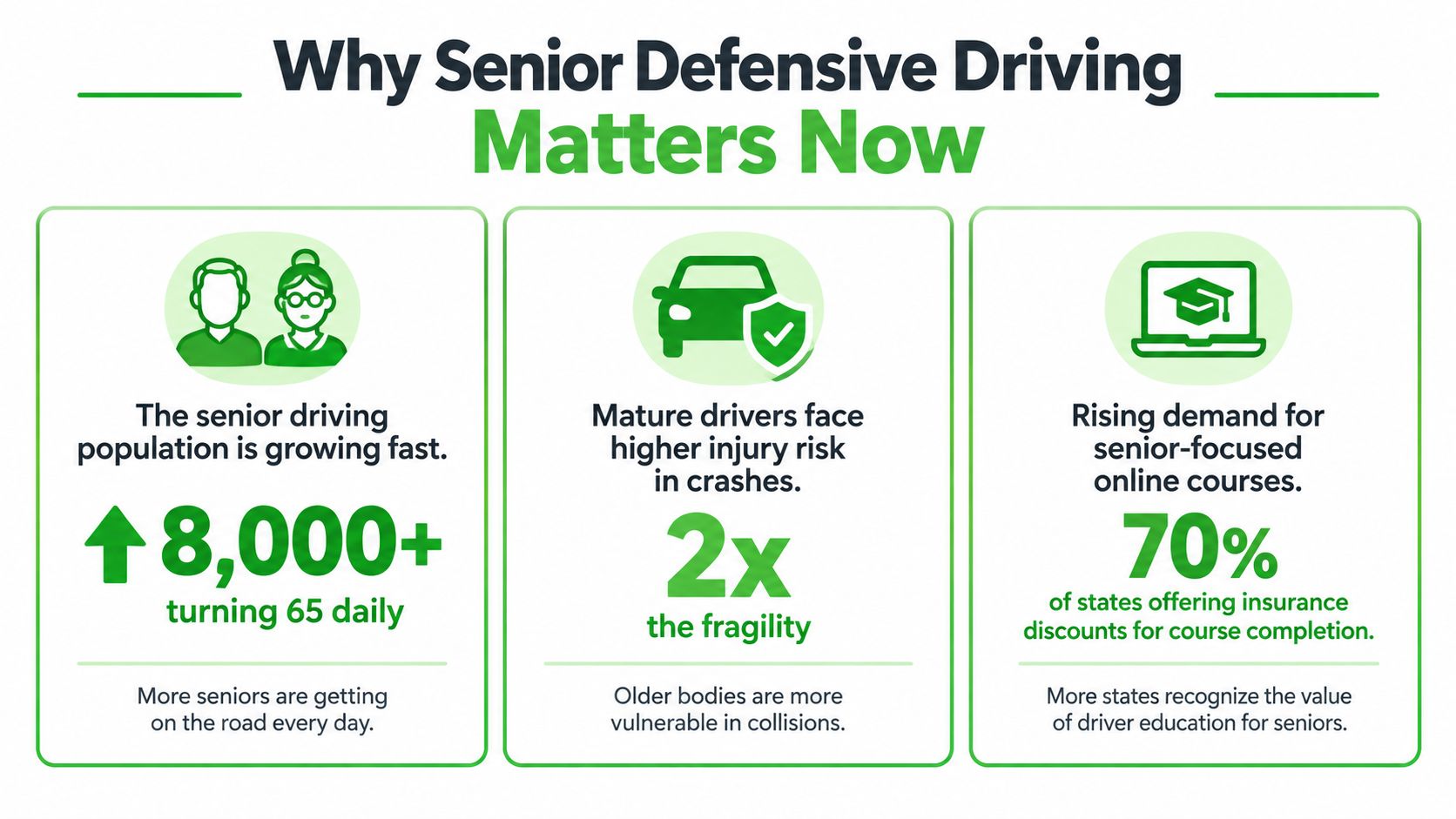
In 2023, the United States had 52.9 million licensed drivers aged 65 and older, 38% more than in 2014. During that period, the total licensed-driver population grew by 11%, and older adults rose from 18% to 22% of all licensed drivers, according to NHTSA crash data.
That growth makes senior-focused driver education relevant to everyday road safety. In 2023, 7,891 people aged 65 and older died in U.S. traffic crashes, or 19% of all traffic fatalities. An estimated 279,225 older people were injured. These figures come from the same NHTSA dataset.
Everyday driving creates the teaching opportunity
The same NHTSA dataset shows that older-driver fatalities most often occurred in familiar conditions: daylight hours, weekdays, and multi-vehicle crashes, representing 70%, 68%, and 68%, respectively. A useful lesson therefore works like a rehearsal for ordinary driving, covering turns across traffic, intersections, lane changes, following distance, and sudden stops.
Courses can also explain how vision, reaction time, medication effects, and busy modern roads may affect decisions. The goal is not to treat age as a reason to stop driving. It is to help each driver identify changing needs and choose safer habits, routes, speeds, and driving times.
Online delivery may reduce travel to a classroom, but it is not automatically easier for every older learner. A senior may need readable text, captions, adjustable sound, keyboard-friendly controls, or breaks between lessons. Those features should be checked before enrollment, just as carefully as Georgia DDS acceptance rules should be checked for any official purpose.
A course can provide structured practice with space management and collision avoidance. Drivers who want individualized feedback may also consider an elderly driver evaluation rather than relying on course completion alone.
Understanding Georgia DDS Requirements for Defensive Driving
Georgia's rules become clearer when you separate learning from official acceptance. The Georgia Department of Driver Services describes Driver Improvement as a six-hour course about safe-driving attitudes and behaviors. A certified course may serve a court order, points reduction, license reinstatement, insurance-premium reduction, or voluntary education purpose, as explained in the Georgia DDS defensive-driving FAQs.
The format can determine whether the certificate works. Georgia DDS states that online Driver Improvement certificates are not accepted for license-related purposes, including points reduction and reinstatement. Online study may teach useful habits, yet it can still be the wrong choice for an administrative or legal requirement.
Match the course to the reason for enrolling
Before paying, write down the exact goal:
- Voluntary education: An online course may fit a driver who wants to review safer habits without requesting official license action.
- Insurance reduction: Ask the insurer whether it accepts both the provider and the specific online format. Approval is a company decision, not an automatic result of course completion.
- Court compliance: Confirm the required course format with the court, an attorney, or a probation contact. Court instructions function like a checklist, and missing one requirement can make a certificate unusable.
- Points or reinstatement: Contact DDS before enrolling. A licensed Georgia resident may reduce up to seven points only once every five years, must complete a certified course, and must submit the original completion certificate to DDS. The same DDS guidance confirms these points-reduction rules.
Practical rule: A certificate is useful for a legal purpose only if DDS or the court accepts it.
This check can spare a senior from completing the wrong course. It also helps families avoid choosing an online option for convenience when the actual requirement calls for a certified classroom course. Online does not automatically mean easier, especially when accessibility needs and official acceptance must both be considered.
Comparing Self-Paced Online Versus Live Virtual Courses
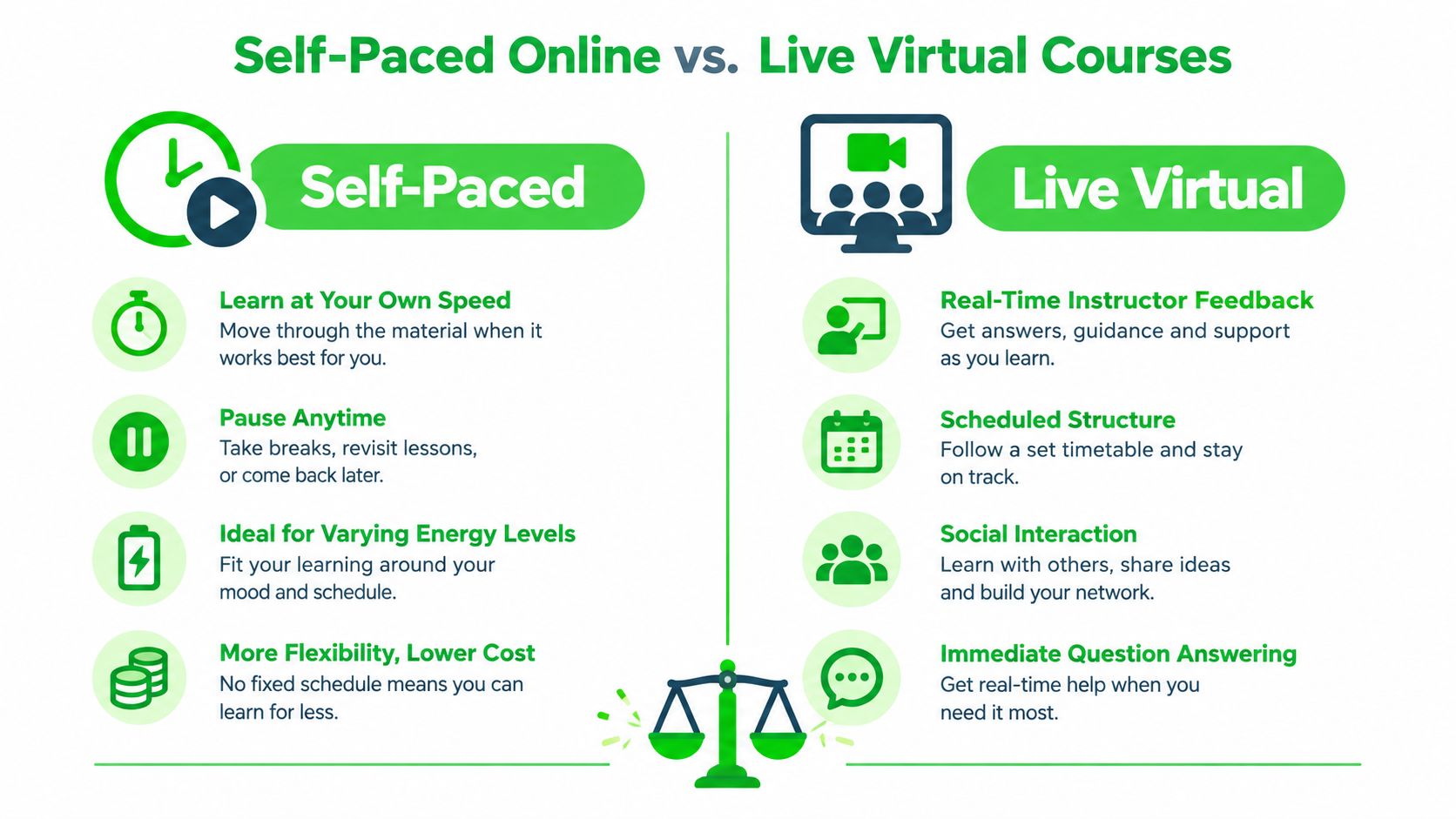
“Online” describes where instruction happens, not how it feels to learn. A self-paced course and a live virtual classroom can both use a computer, but they place very different demands on the student.
Self-paced learning
Self-paced study suits a driver who is comfortable opening links, remembering passwords, moving between screens, and completing modules without an instructor present. The learner can pause during a difficult topic, return to a lesson later, and choose a time when concentration is strongest.
That flexibility can help someone managing appointments, variable energy, or a caregiving schedule. It can also create problems if the course has timed quizzes, confusing navigation, limited technical support, or identity checks that the learner didn't expect.
Live virtual learning
A live virtual class, such as a session delivered through Zoom, offers scheduled instruction and real-time questions. The instructor can explain a confusing intersection scenario, clarify a rule, and help the participant stay engaged. Some seniors also find the presence of other learners more comfortable than studying alone.
The trade-off is structure. The student must attend at the scheduled time, use a compatible device, and follow the provider's attendance and identity-verification rules. Weekday and weekend scheduling can make live learning more practical for Georgia residents with different routines.
| Choose self-paced when | Choose live virtual when |
|---|---|
| You prefer flexible study times and can navigate the platform independently. | You learn better by asking questions and hearing explanations. |
| You want to pause and revisit lessons without a scheduled class. | You benefit from accountability and instructor contact. |
| You have reliable device access and can solve basic login issues. | You want a classroom-like experience without driving to a location. |
A plain-language comparison of legitimacy, approval, and course formats can help before enrollment. Review guidance on whether online defensive-driving courses are legitimate and then confirm acceptance for your particular purpose.
Research Evidence Supporting Senior Driving Interventions
A peer-reviewed meta-analysis found that structured interventions reduced motor-vehicle crash rates caused by older drivers by 32%, with a pooled relative risk of 0.68, a 95% confidence interval of 0.49 to 0.94, and P = 0.02 (NHTSA, Countermeasures That Work).
For a Georgia senior considering an online defensive driving course, this result provides direction rather than a promise. In the research evidence, participants who received an intervention had roughly two-thirds the crash rate of comparable older drivers. The same NHTSA synthesis reports that post-license education can moderately improve driving awareness and behavior, while evidence that it directly reduces crashes or injuries remains insufficient.
Knowledge needs a path to behavior
Reading Georgia traffic rules is only one part of safer driving. A stronger intervention combines a road-rules refresher with feedback, a specific plan for changing habits, and individualized driving lessons. Related randomized evidence found that 64% of drivers receiving individualized lessons were classified as safe after intervention, compared with 25% after workshop-only training, according to the same NHTSA synthesis.
The practical lesson is to look for course content that connects knowledge with decisions behind the wheel. Scenarios should cover intersections, lane changes, following distance, distractions, and collision avoidance. The learner should also choose one behavior to improve, such as scanning farther ahead before entering a busy intersection. Self-assessment can show whether the material is understood, but it cannot establish actual on-road performance. If a driver remains concerned about lane positioning, intersection scanning, or medication-related alertness, referral to an in-car evaluation may be appropriate.
Online delivery can make review more convenient, but it does not observe driving skills. For seniors, the right choice depends on the goal: use an accepted course to refresh knowledge or meet a documented requirement, and seek individualized assessment when the concern involves real-world performance.
Real Accessibility Barriers Seniors Face with Online Courses
A course isn't accessible merely because it has a login page. An older learner may struggle with small text, audio settings, timed quizzes, password recovery, smartphone compatibility, or unclear instructions about whether a family member may help.
Consider a Georgia driver who understands the material but can't read a low-contrast screen comfortably. Another may use a phone because it is familiar, only to discover that the course works better on a desktop. A third may need a daughter to help recover a password but still must complete attendance or identity checks personally.

Ask these questions before enrollment
- Screen design: Can the learner enlarge text, adjust contrast, or use browser accessibility tools?
- Audio support: Are lessons compatible with headphones or device-based screen reading?
- Timing: Are quizzes and modules untimed, or does the platform impose strict limits?
- Device choice: Does the provider recommend a desktop or laptop instead of a smartphone?
- Technical help: What are the support hours, and can staff assist with login recovery?
- Attendance rules: Can a family member provide technical help without completing lessons for the student?
- Identity verification: Does the provider require a camera, periodic checks, or other participation steps?
Georgia drivers aged 64 and older must complete a vision screening at every license-renewal period, while DDS separately directs drivers to certified defensive-driving providers (Georgia DDS driver's manual). License renewal and course completion are different processes, so completing one doesn't replace the other.
Online isn't automatically easier. A supported live virtual or classroom course may be the more accessible choice when independent navigation creates frustration.
Families who coordinate broader support for an older adult may also find practical guidance about in-home primary care accessibility. That resource addresses access needs outside the driving course itself, which can matter when health, mobility, and technology concerns overlap.
The Truth About Insurance Discounts for Senior Drivers
Insurance savings may be available, but a defensive driving course cannot promise a particular Georgia premium reduction. According to CNBC Select's analysis of mature-driver discounts, 34 states and the District of Columbia require insurers to offer them. Eligibility commonly begins around age 50 or 55, while reported discounts commonly start at 5% or 10% and may reach 15% (CNBC Select insurance reporting).
Those figures describe national policy, not a guaranteed result for a Georgia driver. The actual outcome can depend on the insurer, driver's age, policy terms, course approval, and whether the carrier accepts the specific online format. Georgia DDS certifies driver-improvement courses, but it does not guarantee any insurance discount.
A certificate is like a key that may fit the insurer's requirements, not a coupon that works automatically. Ask the carrier before paying for the course.
Get the insurer's answer before paying
Call the carrier and ask:
- Provider approval: Is this exact provider accepted?
- Format approval: Does the insurer accept self-paced online, live virtual, or only classroom completion?
- Eligibility: What minimum age and policy conditions apply?
- Coverage scope: Does the discount affect the whole policy or one coverage component?
- Start date: When will the reduction appear on the premium?
- Duration: How long does the discount last?
- Renewal: Is recertification required?
The insurer's answers should decide whether the possible saving justifies enrollment. A smaller-than-expected discount may still leave the course useful for refreshed rules, stronger hazard recognition, or an applicable court or points requirement.
Drivers comparing options can review this defensive driving course to lower insurance, then treat the insurer's confirmation as the final authority.
How to Choose the Right Georgia Defensive Driving Provider
Start with the outcome, not the format. A convenient online defensive driving course for seniors is useful only when it matches the learner's purpose and abilities.
Use a four-question screening process
First, identify the goal. Decide whether the course is for voluntary education, an insurance premium reduction, a court-accepted certificate, or DDS license action. Don't combine these goals into one assumption.
Second, verify acceptance. If points or reinstatement are involved, contact DDS before enrolling because online certificates aren't accepted for those license-related purposes. If insurance savings are the objective, ask the carrier about the specific provider and delivery method.
Third, test accessibility. Look for large-text controls, understandable audio, desktop compatibility, practical support hours, and clear identity requirements. If self-paced study feels stressful, select live virtual instruction or an in-person classroom instead.
Finally, compare scheduling and provider credentials. Georgia DUI Schools offers self-paced online, live virtual, and traditional classroom defensive-driving formats, along with 18 Georgia locations and weekday and weekend options. Its instructor-led programs have operated for more than 38 years, and the provider states that it serves Georgia drivers through DDS-approved education programs.
Before enrollment, confirm that the course serves your specific legal or insurance purpose. Then choose the delivery format that lets you participate fully, understand the material, and complete the requirements without avoidable technology barriers.
Georgia DUI Schools offers self-paced online, live virtual, and traditional classroom defensive-driving options for Georgia drivers who need flexible senior-friendly learning. Review the available Georgia DUI Schools defensive driving course and confirm the format and acceptance requirements that match your goal before enrolling.