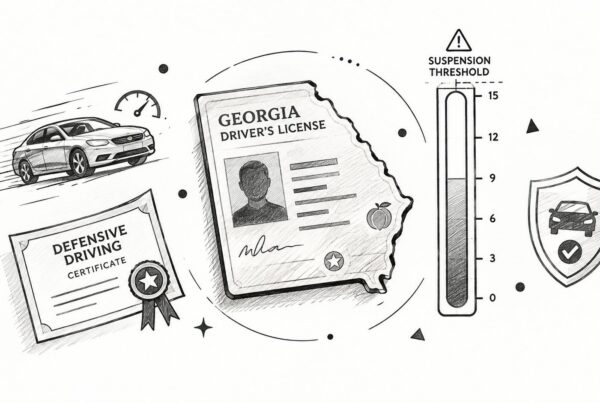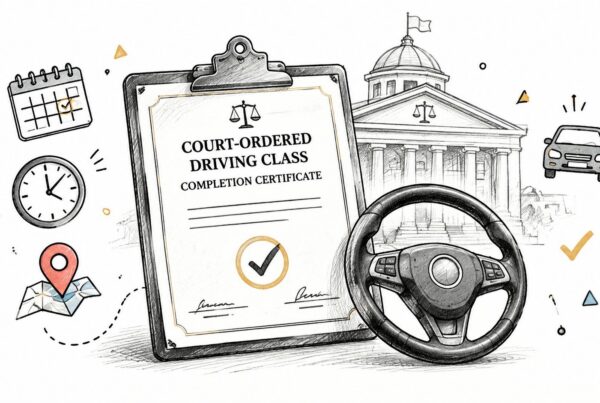
A defensive driving book does not satisfy Georgia DDS or court requirements by itself. For point reduction, Georgia allows up to 7 points to be reduced once every 5 years after a certified 6-hour course, and a book alone cannot create that certification.
You may be holding a traffic citation, reading a court order, or checking whether a defensive-driving course can lower your insurance premium. In each situation, the central question isn't really which book to buy. It's whether you need information, or whether you need an approved course and an official certificate.
For voluntary skill improvement, a well-written book can help. For Georgia DDS point reduction, an insurance discount, or a court-directed requirement, an approved course is the practical answer. That distinction saves drivers from spending time on material that a judge, insurer, or state agency won't accept.
What a Defensive Driving Book Actually Does for You
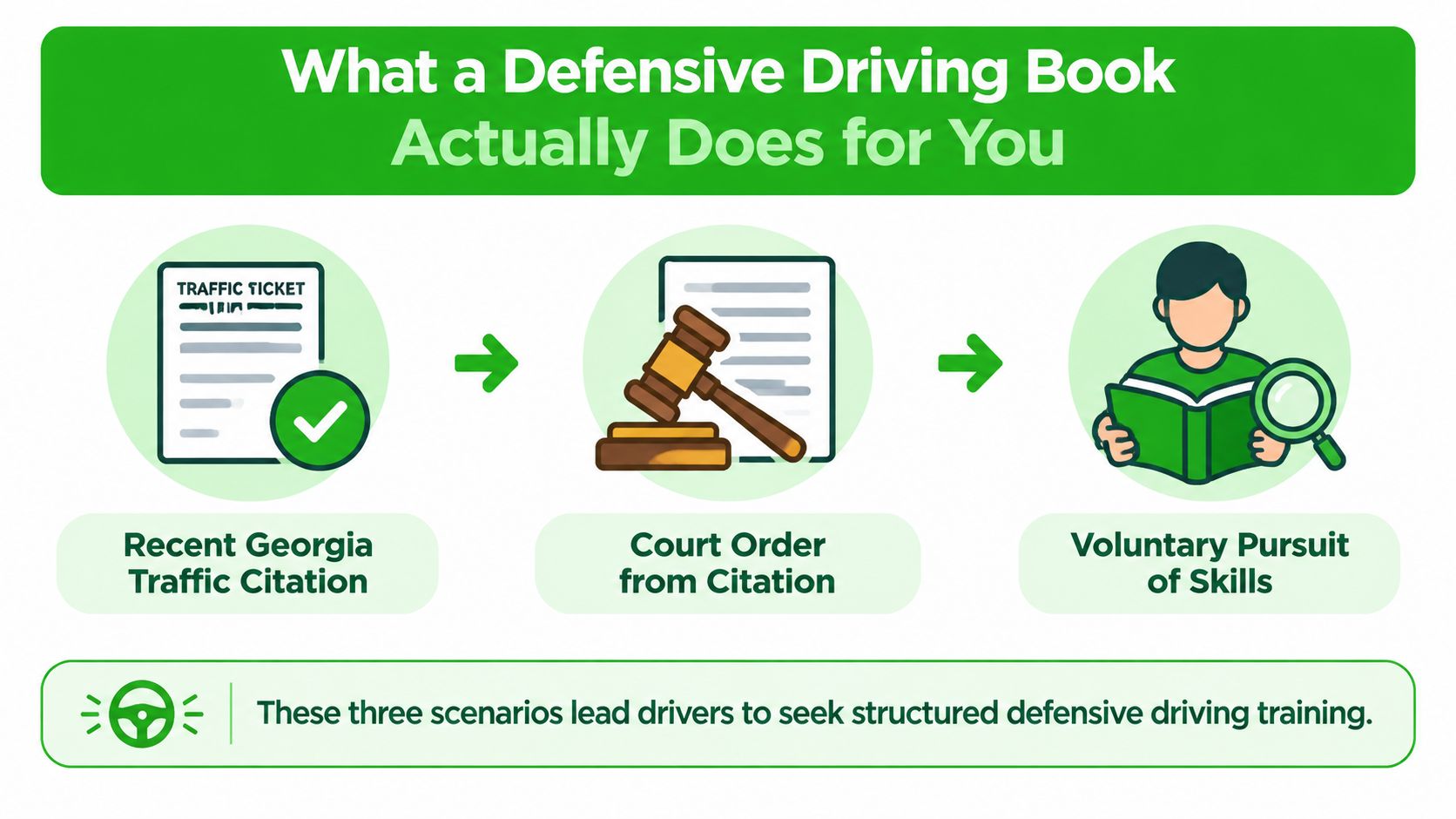
Searching for a defensive driving book usually follows one of three events: a recent Georgia traffic citation, a court order connected to that citation, or a voluntary effort to qualify for safer-driver benefits. Those situations look similar from the driver's seat, but they demand different solutions.
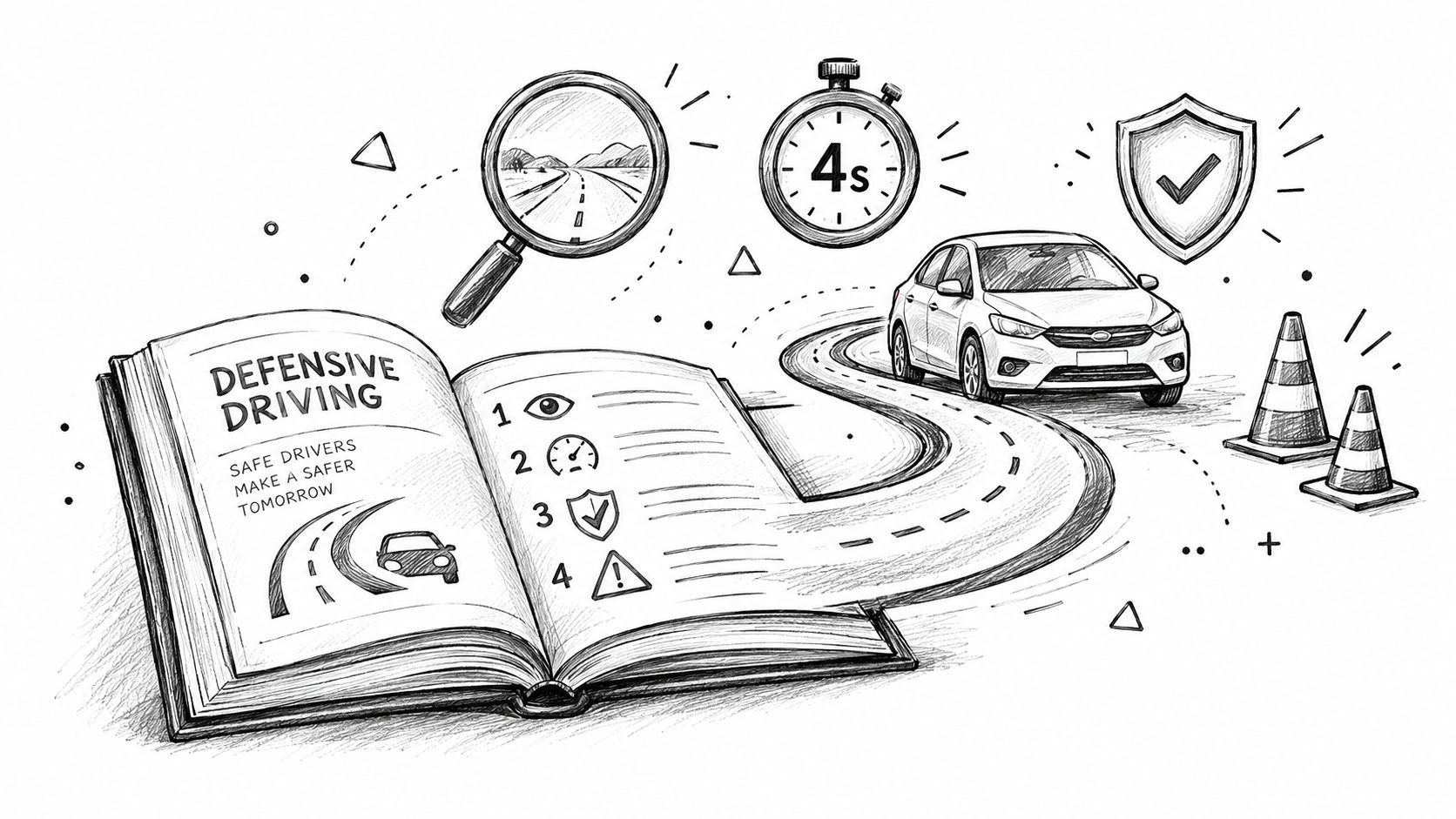
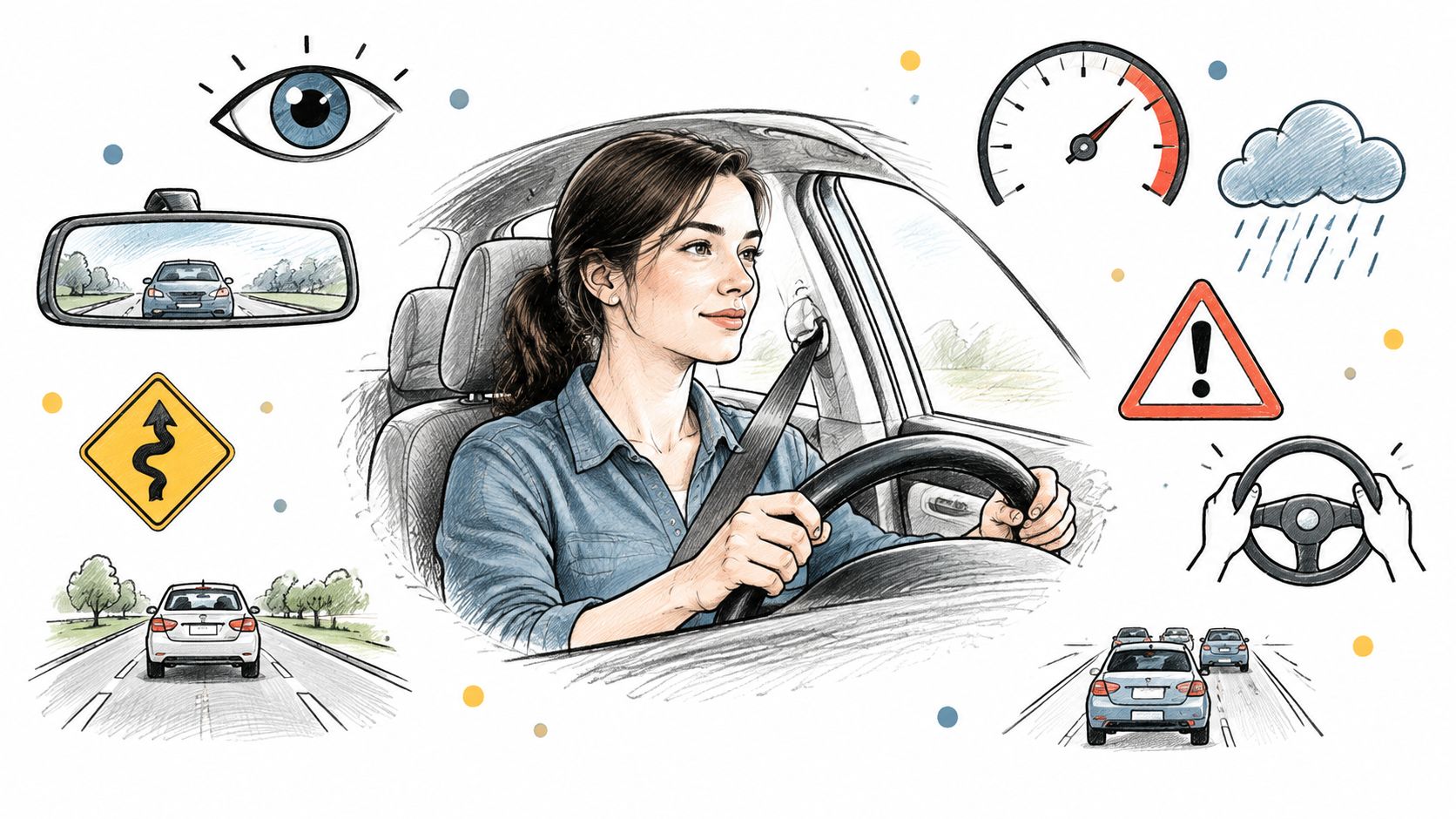
A book gives you a structured way to review hazard recognition, following distance, speed control, distraction prevention, and decision-making. It can help you understand why a driver should look beyond the vehicle directly ahead, leave room for sudden braking, and adjust to rain, congestion, poor visibility, or another motorist's mistake. It can also give you useful language for discussing your driving behavior with an attorney, probation officer, insurer, or judge.
What reading can change
A good book can create a mental checklist before you ever enter a vehicle:
- Scanning: Look for developing problems instead of reacting only when they become immediate.
- Space management: Preserve an escape path and avoid driving beside vehicles that block your view.
- Speed judgment: Match speed to visibility, road surface, traffic flow, and stopping distance.
- Distraction control: Put the phone away and secure objects that could move around the cabin.
- Early decisions: Reduce speed or change position before a hazard forces an emergency maneuver.
That preparation is useful before an approved class. It can make the course material easier to understand because you already recognize terms such as hazard perception, reaction distance, and space cushion. The benefits of defensive driving also make more sense when you connect them to actual decisions on Atlanta-area roads.
What a book cannot produce
Reading does not generate a DDS certificate of completion. It doesn't place a course record on your driving history, satisfy a court's documentation request, or give an insurer proof that you completed an approved program.
Practical rule: Use a book to build understanding, not to pretend that self-study is certification.
A book is therefore a supplement or study aid. It's worthwhile for a driver who wants to refresh habits, prepare for a class, or develop better judgment. It's the wrong substitute when an official course, certificate, or court-approved completion record is required.
The Core Concepts Every Defensive Driving Book Teaches
A reputable defensive driving book should teach more than traffic signs and basic legal vocabulary. Its useful material should train you to identify trouble early, preserve options, and act before another road user's mistake becomes your emergency.
Five skills deserve priority
Aggressive visual scanning means continuously checking the road, mirrors, intersections, shoulders, and areas where pedestrians or vehicles may emerge. On I-285, that means watching brake lights several vehicles ahead, not staring only at the bumper in front of you. A driver who spots compression in traffic early can ease off the accelerator instead of making a hard stop.
A four-second following cushion gives you more room to respond than tailgating does. Official driver guidance commonly uses a 2-second minimum in normal conditions and 4 seconds or more in poor weather in the Basic Drivers Handbook. Pick a fixed roadside object, watch the vehicle ahead pass it, and count before your own vehicle reaches it. If you arrive too soon, increase the gap.
Anticipating hazards ahead turns driving into prediction rather than reaction. A book may teach you to scan far enough ahead to identify a school-zone crossing, a stopped vehicle, a lane closure, or a truck preparing to merge. Near a Marietta school zone, the hazard isn't only the posted sign. It may be a child stepping from behind a parked vehicle or a parent making an abrupt turn.
Speed management connects visibility with stopping distance. A merging tractor-trailer on I-75 south of Macon may need more room than a passenger car, and wet pavement gives every driver less margin. The defensively trained response is to reduce risk before the merge becomes a forced brake or lane change.
Distraction control covers phones, navigation screens, food, loose cargo, and conversations that pull your attention away from the road. The U.S. traffic-safety problem is substantial. Motor vehicle crashes kill about 32,719 people annually, while distracted-driving crashes kill 3,154 and injure 424,000 each year, according to the defensive-driving facts overview.
Two frameworks make the material practical
The Smith System is a space-management approach built around seeing well, keeping your eyes moving, maintaining a cushion, and positioning your vehicle so you have time and room to respond. SIPDE means Scan, Identify, Predict, Decide, and Execute. In plain English, look for hazards, determine what matters, predict what may happen, choose a response, and carry it out safely.
Reading those steps improves understanding. It doesn't automatically create a habit. Rehearse them by naming hazards while driving, checking mirrors before each lane change, and deliberately adjusting speed before curves, merges, and limited-visibility areas.
How Defensive Driving Books Became Standard Course Material
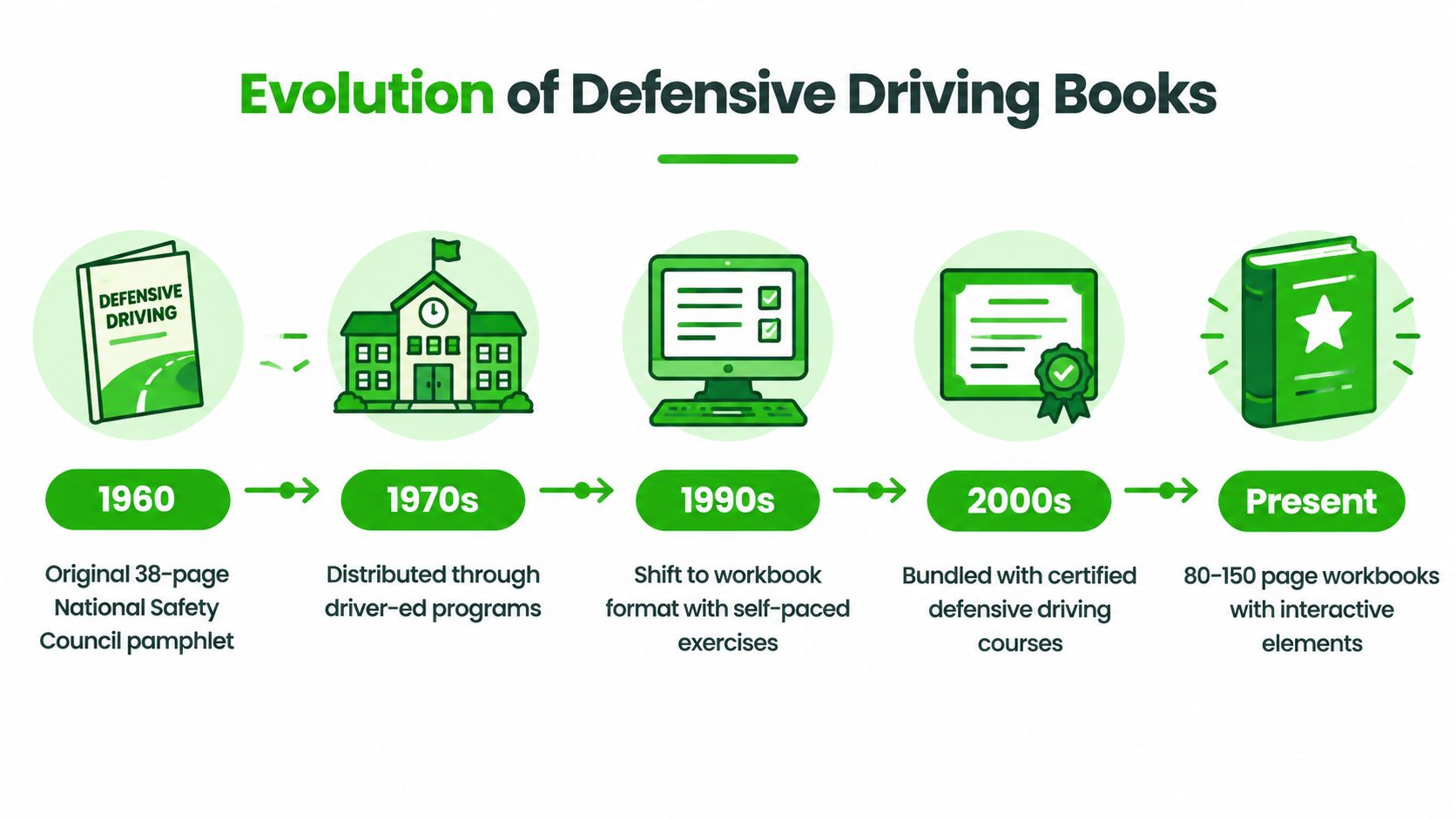
The defensive-driving manual became useful because safety education needed a repeatable format. A defensively oriented driving guide appeared in 1962 as a 38-page publication, showing that defensive-driving material was already being formalized as a standalone resource by the early 1960s. A later educational workbook appeared in 1971 as a 60-page student manual, indicating a move toward structured course content within less than a decade, as documented in the historical manual record.
Why the workbook format mattered
A short guide can explain principles. A workbook can organize lessons, exercises, review questions, and completion records. That distinction mattered as courts, licensing agencies, and insurers began relying on standardized education rather than informal proof that a driver had read safety advice.
The book format also made instruction scalable. A teacher could assign the same material to every participant, a court could identify the course a driver completed, and a provider could connect classroom instruction to a formal certificate. Over time, manuals became part of a broader compliance system rather than a bookstore purchase.
Georgia's modern system reflects that practical need. Drivers seeking point reduction or insurance benefits don't merely need to understand defensive driving. They need completion through a certified program and documentation that another institution can verify.
Why today's book may be state-specific
Generic national titles can explain scanning and space management, but Georgia drivers also need current state terminology and requirements. A local course may address Atlanta congestion, interstate merging, court documentation, DDS procedures, and the separate rules that apply to DUI or Risk Reduction matters.
That distinction is important because a defensive-driving book can become outdated while laws, forms, and agency procedures change. California DMV, for example, provides official handbooks in web, PDF, eBook, ASL video, and other language formats through its driver education materials. The larger lesson applies in Georgia: verify the current official source before relying on an older printed manual.
The book most drivers encounter today is therefore often a course companion. It supports instruction, but the course creates the record that courts, insurers, and DDS can use.
Defensive Driving Book vs Approved Online and Live Courses
The decision becomes simple once you compare the actual deliverable. A book provides information. An approved course provides instruction, assessment, and documentation tied to a recognized requirement.
| Factor | Defensive Driving Book | Approved Online or Live Course |
|---|---|---|
| Purpose | Self-study, review, and general skill improvement | Compliance, point reduction, insurance eligibility, and structured education |
| Time | Read at your own pace | Georgia's certified format requires a 6-hour course |
| Proof | No official completion certificate | Certificate of Completion issued through the approved provider |
| Court acceptance | Usually insufficient by itself | Designed to satisfy approved course requirements when the court accepts that program |
| Insurance use | Reading alone doesn't establish eligibility | Certificate can support an insurer's discount review |
| Feedback | No instructor review | Online or live instruction can include quizzes, assessment, and guidance |
| State relevance | Depends on the publisher and edition | Approved providers work within Georgia's certification requirements |
Choose based on the outcome
If you're curious about safer driving, choose a book. If you're preparing for an approved class, read the material before enrollment and use it to reinforce the lessons afterward. If you need documentation, skip the book-only route.
A self-study title cannot prove that you completed the required course hours. It cannot create the certified record associated with Georgia point reduction. It also cannot serve as the completion document an insurer may request before applying a discount.
Online and live courses solve different scheduling problems. An online course suits a driver who needs flexible access and can work independently. A live Zoom or classroom course suits someone who learns better with an instructor, scheduled participation, and the ability to ask questions.
A certificate is not the same thing as a book receipt. Agencies and insurers look for completion of an approved program, not evidence that you purchased safety material.
Before enrolling, confirm that the provider and course are currently approved for your purpose. If you need to prepare for an online assessment, review the Georgia defensive-driving online test information and make sure the course documentation matches what your court, DDS record, or insurer requires.
How to Pick a Defensive Driving Book That Actually Helps
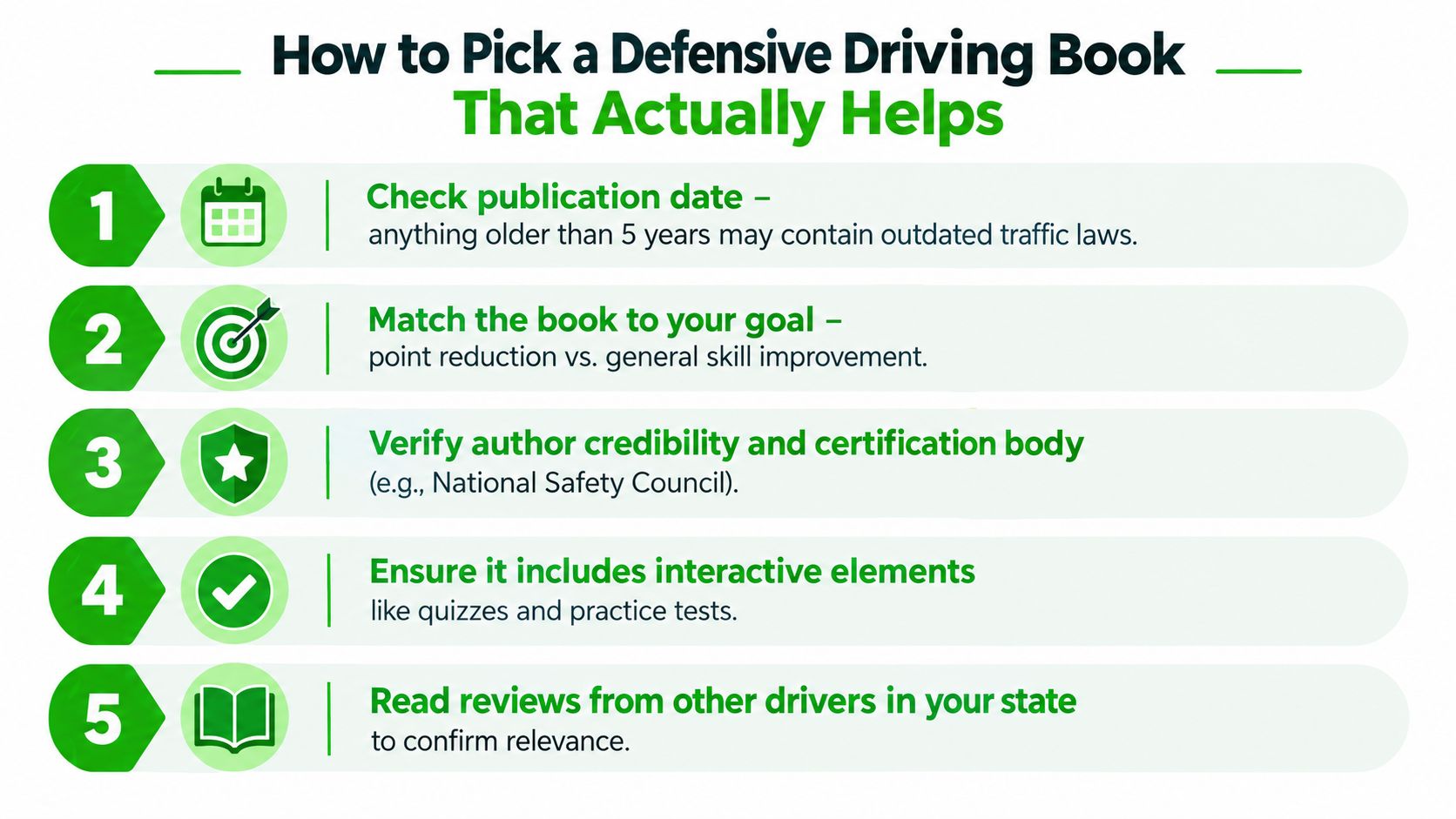
Don't buy the first national title that appears in a marketplace search. Match the material to your actual problem, then verify that it's current enough to be useful in Georgia.
Start with the edition
Check the publication date and revision history. A book that predates current Georgia rules may explain sound driving principles while using obsolete statute references, agency names, forms, or course procedures. Treat an older title as general education, not as your authority for a court or DDS decision.
Then inspect the publisher. An established traffic-safety organization or recognized course provider has more reason to maintain its material than an anonymous self-published title. That doesn't guarantee quality, but it gives you a clear place to verify revisions and credentials.
Look for Georgia relevance
A useful book should connect concepts to situations you face. Look for references to:
- Georgia terminology: DDS language, course certificates, and point-reduction procedures.
- Local driving conditions: Atlanta-area congestion, interstate merges, heavy rain, and construction zones.
- Legal boundaries: Traffic-law references that direct you to current official sources rather than presenting old rules as permanent.
- Risk behavior: Distraction, impairment, aggressive driving, following distance, and hazard perception.
- Active learning: Quizzes, practice questions, scenarios, and prompts that require a decision.
A commuter may prefer an audio format for general review, but listening alone isn't ideal for a court deadline or a formal course requirement. Someone preparing to teach may want a textbook. A driver refreshing skills before enrollment usually needs a concise workbook with clear examples and review questions.
Use the official Oregon provider guidance as a reminder that state agencies may direct drivers toward free or official educational materials instead of one commercial book. The right resource may be a current state handbook, a digital version, or an approved course workbook.
Georgia Point Reduction and Insurance Discounts Explained
A Georgia driver facing points, an insurance renewal, or a court deadline must match the tool to the outcome. A defensive driving book can explain safe-driving principles, but it cannot create the certificate DDS or an insurer requires.
Point reduction
Georgia DDS allows a licensed resident to request a reduction of up to 7 points once every 5 years after completing a certified 6-hour driver-improvement, or defensive-driving, course. The original certificate must be submitted to DDS by mail or in person, according to the Georgia DDS driver manual.
For the full process, see our guide to removing points from your Georgia driving record. The working sequence is:
- Confirm the provider and course are currently certified.
- Complete the required course.
- Obtain the official certificate.
- Submit it through a DDS-approved method.
- Keep copies and confirm that the requested action appears on your record.
A book cannot start this process. Point reduction depends on the certified course and its required certificate, and DDS limits how often the reduction may be requested.
Insurance discount
Georgia's insurance rule requires insurers to provide at least a 10% premium discount to drivers age 25 and older who complete a defensive-driving course and have maintained a clean driving record during the previous 3 years, as described in the Georgia insurance discount guidance.
The book alone does not qualify you. Ask your insurer which certificate it accepts, complete the approved course, and send the documentation directly to the company. Confirm renewal requirements with the insurer because this benefit is separate from DDS point relief.
Before paying, verify approval for your specific goal. A polished book or course website proves nothing about court compliance, point reduction, or insurance eligibility. Check current provider information and ask DDS, the court, or your insurer when the consequence matters.
When a Book Is the Wrong Tool and Georgia DUI Schools Can Help
A purchased book feels efficient because it costs less effort at the start. It becomes inefficient when you need a certificate, a documented course record, or a program that connects with a court or insurer.
Self-study reading won't satisfy a judge's order. It won't create the certificate DDS uses for a point-reduction request, and it won't establish eligibility for the insurance discount. It also won't replace Georgia DUI or Risk Reduction requirements after a qualifying DUI matter, where clinical evaluation, treatment, or a Victim Impact Panel may be part of the reinstatement path.
Georgia DUI Schools offers a DDS-approved defensive-driving course in three formats: self-paced online study, a live virtual Zoom class, and traditional instructor-led classroom sessions. The appropriate choice depends on your deadline and learning style, not on which format sounds most convenient.
Match the format to the problem
- Immediate citation pressure: Choose the online format when you need flexible access and can complete the required work independently.
- Need for accountability: Choose live Zoom instruction when scheduled participation and instructor interaction will keep you moving.
- Classroom preference: Choose an in-person session when you learn best by asking questions and working through examples with other drivers.
- DUI-related obligations: Confirm whether you need Risk Reduction, a clinical evaluation, ASAM Level 1 treatment, or a Victim Impact Panel instead of treating defensive driving as a replacement.
The provider's defensive-driving course is one option among approved routes. Check the exact requirement before enrollment, especially if a court order names a specific course type or if your license issue involves habitual-violator status. Georgia law treats habitual violator status separately, with three qualifying major traffic convictions within 5 years triggering a 5-year license revocation after DDS receives notice, and DUI is among the listed qualifying offenses, according to Georgia habitual-violator guidance.
A book can help you understand safer driving. It can't complete the administrative job. Choose the approved course when the outcome depends on proof.
Georgia DUI Schools offers DDS-approved defensive-driving options in self-paced online, live Zoom, and traditional classroom formats for drivers who need recognized completion rather than a book alone. If you're pursuing point reduction, an insurance discount, or court-related compliance, visit Georgia DUI Schools to choose the format that fits your deadline and confirm the course path before enrolling.