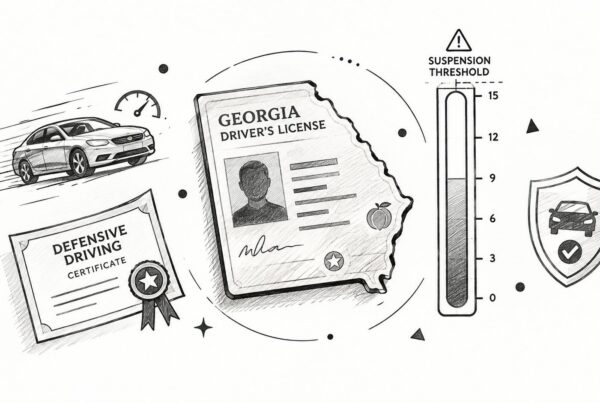

You've just left court with a paper that says you must complete a court ordered driving class. Your license may be suspended, your probation deadline may already be running, and the course names on the paperwork may sound interchangeable. They aren't. Enrolling in the wrong class, using an uncertified provider, or assuming the court and Georgia Department of Driver Services will automatically exchange your certificate can create an avoidable compliance problem.
Georgia drivers need a precise plan. Start by identifying the required program, verify the provider, complete every required component, submit proof to the right agency, and confirm that the record has been updated. The details below focus on Georgia DUI, Risk Reduction, defensive driving, clinical evaluation, and repeat-offender requirements.
Understanding Your Court Order and Georgia Requirements
A driver in Forsyth County may receive a probation directive that says “complete DUI school,” while another driver in Atlanta may see a reference to defensive driving or a clinical evaluation. Both people may search for the same court ordered driving class online, but they don't have the same legal obligation. The course title on your paperwork matters more than a provider's advertising.
Georgia's DUI Alcohol or Drug Use Risk Reduction Program applies to people convicted of DUI, possession of illegal drugs, underage possession of alcohol while operating a motor vehicle, or boating under the influence. The program has exactly two required parts, an assessment component and an intervention component, and both must be completed before the provider can issue a certificate of completion, according to the Georgia DDS DUI FAQ.
Read the order before choosing a course
Look for the exact language used by the court, probation office, or license-reinstatement notice:
- Risk Reduction: This usually identifies the state-mandated DUI or alcohol and drug intervention program.
- Defensive driving: This may refer to a driver-improvement course connected to a traffic offense, points, or another court directive.
- Clinical evaluation: This is a separate professional assessment. It isn't replaced by a classroom certificate.
- Treatment or Victim Impact Panel: These may appear as additional conditions. Don't assume the class satisfies them unless the order expressly says so.
A DUI conviction can also involve clinical services or treatment requirements. Georgia public-safety guidance states that all DUI convictions require a DUI Drug or Alcohol Risk Reduction Program and a clinical evaluation, with treatment added if the evaluation indicates it, so check the entire order rather than focusing only on the word “class.”
If someone is still in custody and trying to meet release conditions, legal and bail logistics can move alongside course planning. A resource about fast jail release for DUI may help explain the release process, but it doesn't replace legal advice or the court's written conditions.
Separate the class from the case
A certificate proves that you completed a particular educational program. It doesn't automatically prove that you completed an evaluation, treatment, panel, probation condition, or every document required for reinstatement. Use the DDS-approved driver education course information only after you've matched the course type to the wording in your order.
Practical rule: Write down every requirement as a separate line. Treat “class,” “evaluation,” “treatment,” “panel,” and “certificate submission” as separate compliance tasks until the court or DDS confirms otherwise.
Finding a DDS-Approved Provider in Georgia
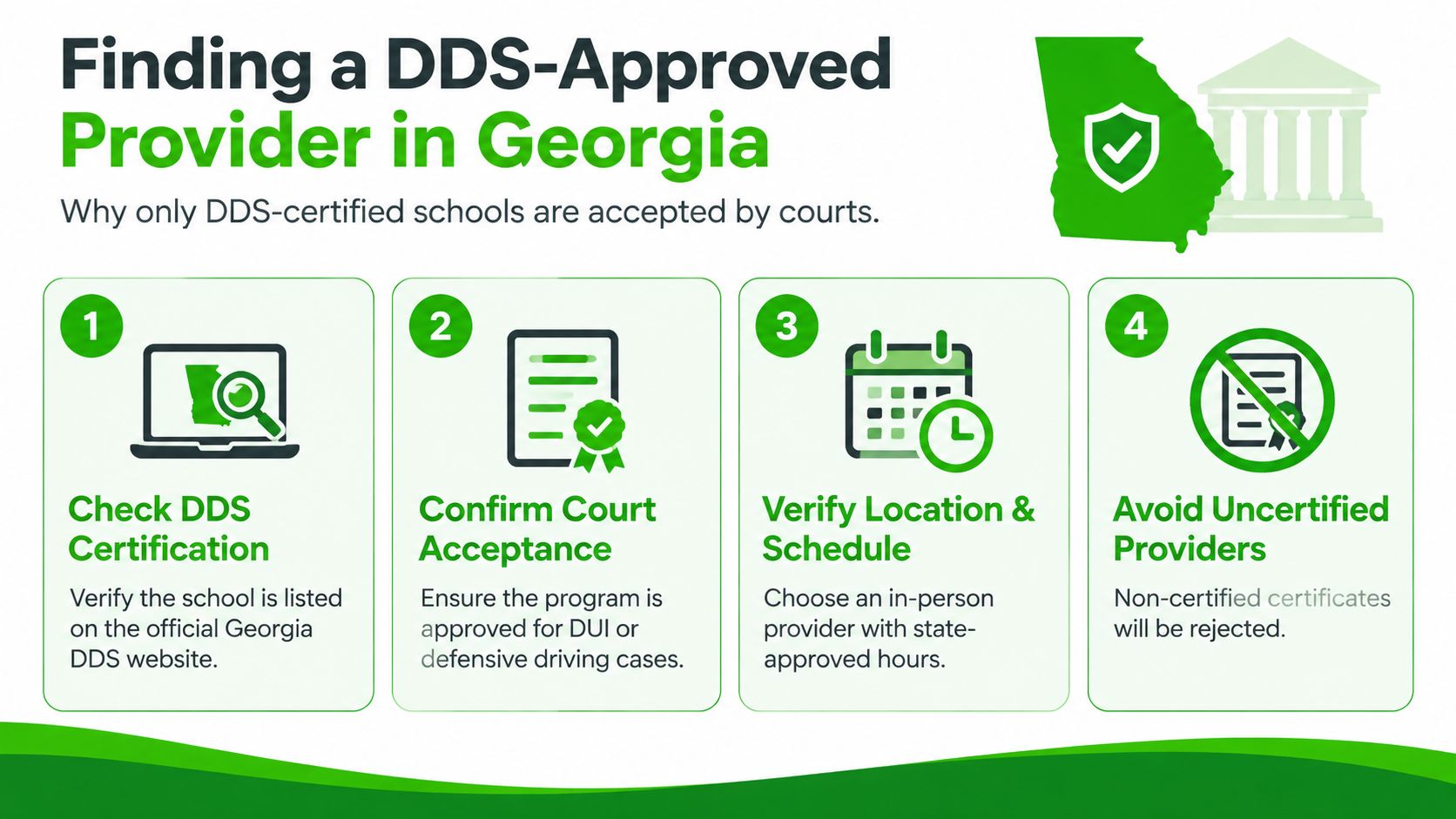
Provider approval isn't a marketing detail. Georgia law and DDS guidance make certification a hard acceptance gate. Only DDS-certified schools are approved for driver education, defensive driving, and DUI programs, and a class taken at an uncertified school won't be accepted for licensing, reinstatement, or court requirements, as explained by the Georgia DDS regulated programs guidance.
That rule creates a simple decision. Don't begin with price, location, or a claim that a website is “nationally accredited.” Begin with whether the provider is authorized for the exact Georgia program you need.
Verify the school in the right order
First, identify the program. A DDS-approved defensive driving provider may not be the provider you need for Risk Reduction. Confirm whether your paperwork calls for DUI/Risk Reduction, defensive driving, or another service.
Next, check DDS authorization. Use the Georgia Department of Driver Services program information and ask the school to identify its certification status. A provider should be able to explain which approved program it offers and what certificate it issues.
Then, confirm court fit. Court acceptance still depends on the order and jurisdiction. Ask the clerk, probation officer, or attorney whether the specific course satisfies the case requirement before you pay.
Finally, review delivery details. Confirm the schedule, attendance rules, identity verification, certificate process, and whether the course is offered in the format your order permits. An out-of-state website can look convenient and still produce unusable paperwork.
A Georgia provider with Atlanta Metro locations, broader local availability, and flexible scheduling may be practical for someone working in Athens, commuting through Marietta, or handling probation in Forsyth County. Convenience matters, but only after certification and course type are confirmed. You can review an approved online driving class option as part of that verification process.
Choosing Between Online and In-Person Classes
Online versus in-person isn't a universal Georgia answer. The court order, offense, program type, provider certification, and delivery rules control acceptance. A driver who chooses an online course without confirming those details may finish the lessons and still have an unresolved court condition.
The distinction is especially important between Risk Reduction and defensive driving. Risk Reduction is a regulated DUI intervention program with fixed components and mandatory attendance requirements. Defensive driving is a different course category and may be available through online, live virtual, or classroom formats when the provider and court permit it.
Use the format that matches the obligation
| Course Type | Online Option | In-Person Option | Court Acceptance |
|---|---|---|---|
| DUI Alcohol or Drug Use Risk Reduction | Confirm the specific DDS-approved delivery method and court permission before enrollment | Available through approved providers offering the required intervention format | Depends on DDS certification, the order, and jurisdiction |
| Defensive driving | May be available through an approved online course | May be available through an approved classroom course | Confirm that the court accepts that provider and format |
| Clinical evaluation | Ask the qualified provider whether remote evaluation is permitted for your case | Available through qualified clinical services | Separate from class completion and controlled by the order and applicable rules |
Don't confuse flexibility with permission
An online option can help a professional who can't attend a weekday classroom, a student balancing work, or a parent managing transportation. A classroom can be preferable when the order requires physical attendance, when the provider has clearly defined state-approved sessions, or when you need direct support with a structured intervention.
The right question isn't “Can I take a class online?” Ask, “Will this exact Georgia-certified course, in this format, satisfy this exact order?” Get the answer before registration. Save the email or written confirmation, and provide the provider with the court's wording so staff can identify any mismatch.
Before paying: Confirm the course name, provider certification, delivery format, attendance requirement, certificate type, and submission process. If one answer is unclear, pause enrollment.
Completing the Course and Meeting Hour Requirements
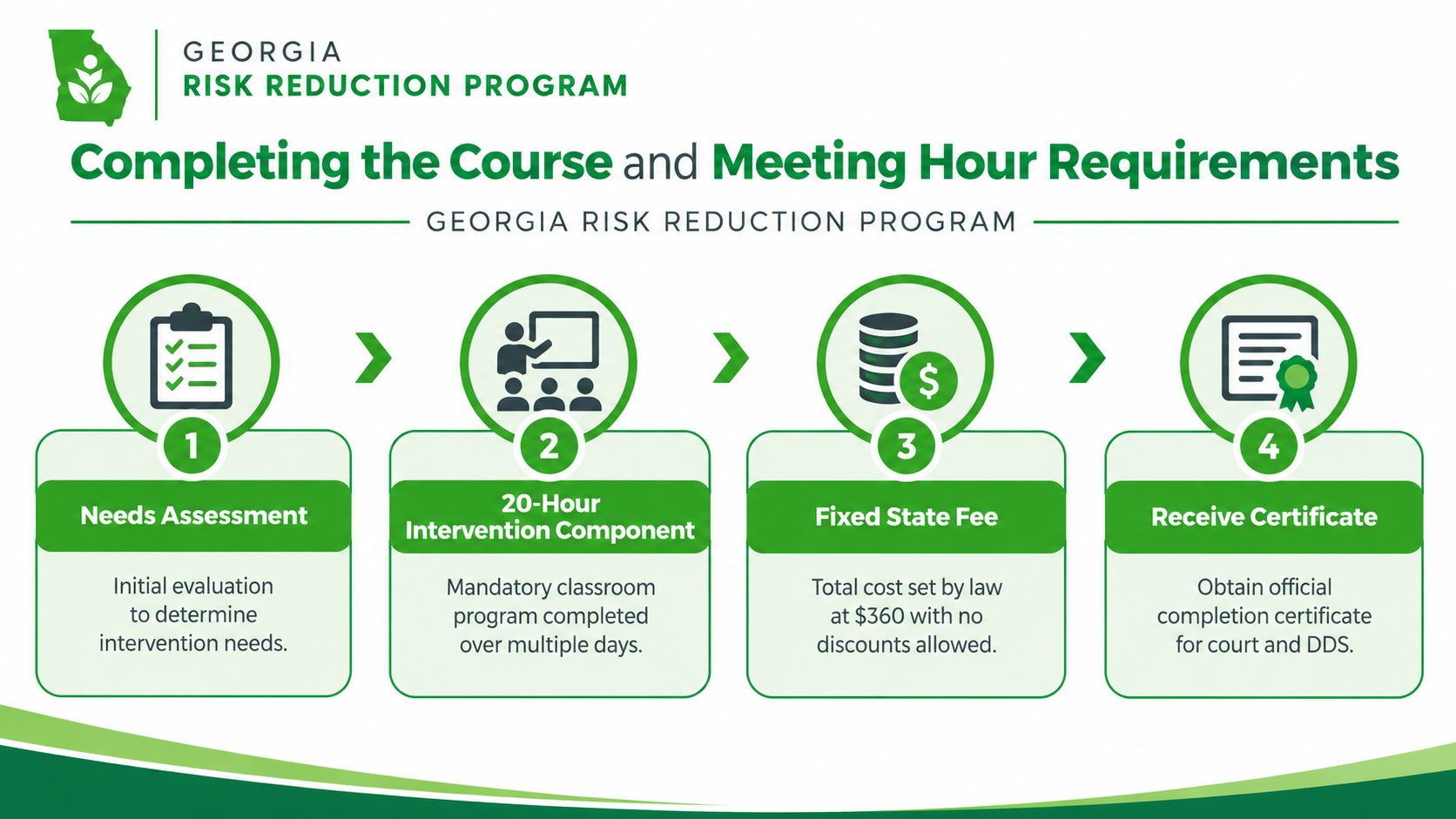
Georgia's Risk Reduction program isn't a short lecture that you can compress into a quick online session. Students must complete the full 20-hour intervention component, and the DDS policies and procedures guide states that all students must attend those mandatory twenty hours, according to the DDS Risk Reduction policies and procedures guide.
The intervention component is only one part of the program. The assessment must also be completed, and the provider needs to document the required work before issuing the certificate. Missing a scheduled portion can leave the program incomplete even if you attended most of it.
Budget for the fixed program structure
The Georgia Department of Driver Services states that the total course cost is fixed by law at $360, divided into a $100 assessment fee, a $235 intervention fee, and a $25 workbook fee, as listed in the Georgia DDS DUI FAQs. A provider shouldn't present a discount that changes the legally established total or imply that skipping a component will reduce the obligation.
Plan the course around the attendance requirement, not around the hope that a provider will make exceptions. Before scheduling, ask:
- Attendance: Which sessions are mandatory, and what happens if illness or an emergency causes an absence?
- Documents: What identification or court paperwork must you bring or upload?
- Certificate: When and how will the completion certificate be issued?
- Other conditions: Has the court separately ordered an evaluation, treatment, or Victim Impact Panel?
Treat the evaluation as a separate requirement
A clinical evaluation can affect what happens after the class. If the evaluation indicates treatment, completing Risk Reduction alone won't close the compliance gap. Schedule the evaluation early enough to understand whether additional services appear in the order or become necessary under the applicable requirements.
Don't assume you can test out, attend only the portions that seem relevant, or substitute a generic defensive driving class. The state-regulated structure controls the certificate, and the certificate controls only the requirement it is designed to document.
Submitting Your Certificate and Avoiding Compliance Gaps
A certificate in your email does not close a court case or restore driving privileges. The court, probation office, and DDS maintain separate records, so identify every recipient named in the order and confirm that each office processed the document.
Ask the provider before enrollment how it issues certificates. Some schools transmit records directly, while others return the certificate to you for delivery. Get the submission method, deadline, and required recipient in writing. A missed handoff can leave a completed class uncredited.
Use a documented submission checklist
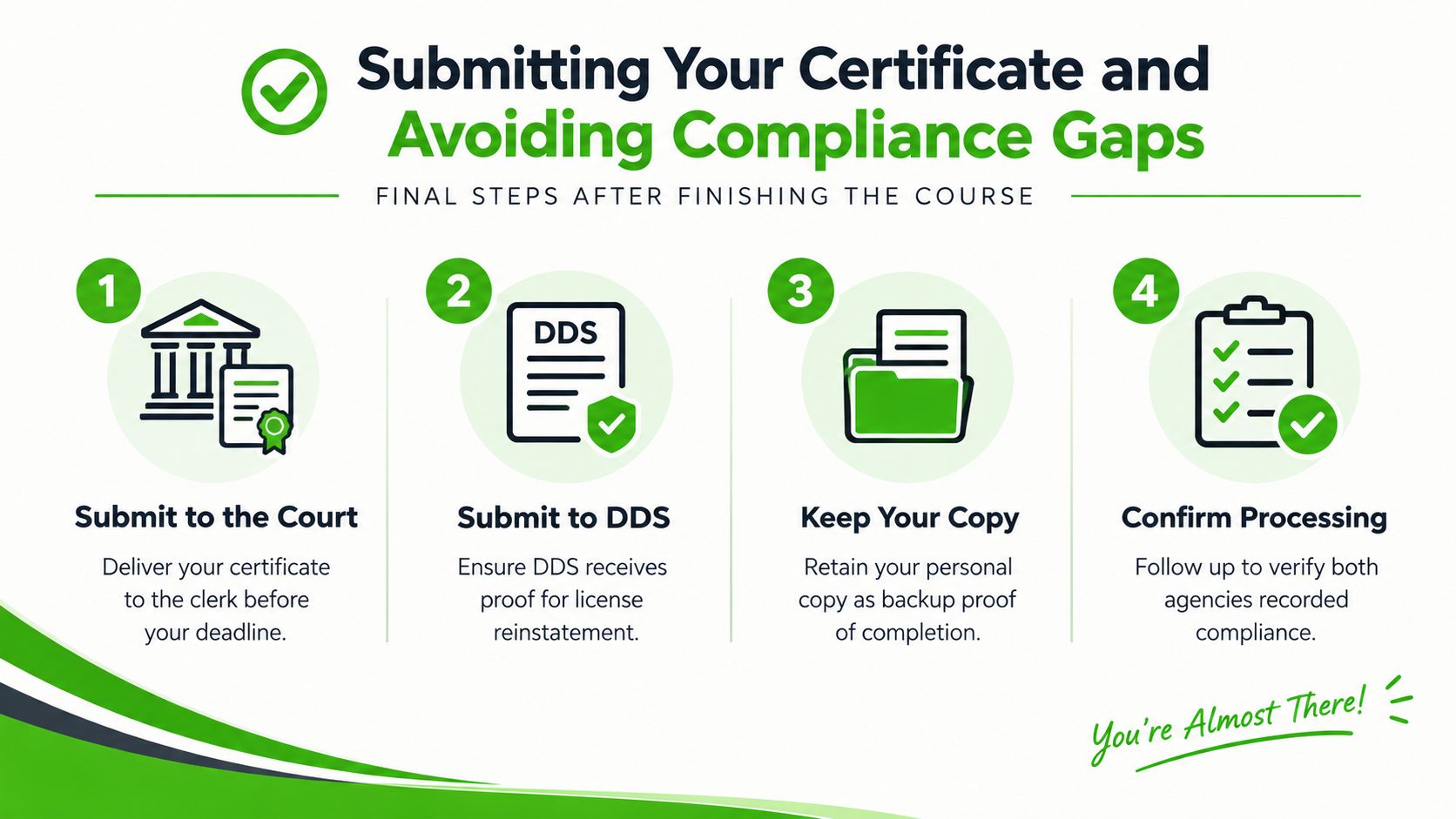
- Inspect the official certificate. Verify your name, course type, completion status, provider information, and issue date. Ask for a correction before submitting an inaccurate document.
- Deliver it to the court or probation officer. Follow the order's delivery method and deadline. Request written confirmation that the certificate was added to your file.
- Send proof to DDS when required. Court compliance and license reinstatement can involve separate records. Confirm DDS received the certificate, then ask which reinstatement conditions remain.
- Keep a complete file. Save the certificate, receipt, email, upload confirmation, evaluation records, and treatment documents. Use a privacy-first PDF form filler to complete DDS reinstatement forms without emailing unencrypted attachments containing your license number or case details.
- Follow up and record the result. Note the date, office, representative, and response. If the certificate is delayed or lost, contact the provider immediately and ask for its replacement process.
Review the Risk Management course certificate guidance when you need to verify certificate details or documentation practices.
Repeat offenses require a wider review
Georgia's habitual violator framework can apply after three or more convictions within a five-year period for specified offenses, including DUI, according to Georgia public-safety guidance on habitual violators. Habitual violator status may require a clinical evaluation and, if indicated, substance abuse treatment at the offender's expense.
Audit every obligation separately: the class certificate, evaluation, treatment decision, panel requirement, probation paperwork, and DDS reinstatement conditions. Completing the class proves only that course requirement, not full compliance with the entire order.
Common Mistakes That Delay Reinstatement
The most expensive assumption is that attendance equals compliance. A driver completes a class, leaves with paperwork, and waits for the court or DDS to update the file. Meanwhile, the certificate may be sitting in the driver's email, the wrong office, or a provider system that never transmits it.

Audit the mistakes that cause the most trouble
Wrong course: A defensive driving certificate doesn't automatically satisfy a DUI Risk Reduction order. Re-read the exact wording and match the program name.
Uncertified provider: Georgia won't accept a certificate from an uncertified school for licensing, reinstatement, or court requirements. Verify DDS status before enrollment, not after completion.
Online without permission: An online course may be convenient, but acceptance depends on jurisdiction, offense, provider, and order. Obtain confirmation before paying.
Missing the assessment: Risk Reduction requires both the assessment and intervention components. Completing classroom hours alone doesn't produce full program compliance.
Partial attendance: The full mandatory intervention requirement must be completed. Leaving early or missing a required session can prevent certification.
Ignoring clinical requirements: A clinical evaluation is separate from the educational course. If treatment is indicated or ordered, the class certificate won't replace treatment records.
Assuming automatic notification: Ask whether the certificate is sent to the court, probation, DDS, or you. Then confirm receipt with the actual office responsible for your case.
Confusing court closure with license restoration: A court may accept your compliance document while DDS still requires additional reinstatement steps. Check both tracks.
Fix a problem before the deadline
If you already used the wrong provider, contact the clerk, probation officer, attorney, and DDS as appropriate. Ask what documentation they will accept, whether the course must be repeated, and whether an extension or corrective filing is available. Don't discard the original certificate, but don't assume it solves the problem either.
If the provider has issued a correct certificate, send it through the required channel and preserve proof. If the certificate contains an error, request correction from the provider before submitting it. A clean paper trail gives the receiving agency something concrete to process.
Georgia DUI Schools offers DDS-approved DUI/Risk Reduction and defensive driving programs, including classroom and online options, along with clinical evaluations, ASAM Level 1 treatment, and Victim Impact Panels. If you need to match a Georgia court order to the correct course and complete the documentation properly, visit Georgia DUI Schools and confirm the required program before you enroll.