

You're back home after a Friday-night DUI arrest, perhaps outside Atlanta or Savannah. The bracelet mark is still on your wrist, your bond papers are spread across the counter, and arraignment is three weeks away. The question arrives quickly: Can you drink after a DUI before your court date?
The honest answer has two parts. First, does your signed bond order or release paperwork prohibit alcohol? Second, even if it doesn't, is drinking a smart move when testing, monitoring, and your first appearance before a judge are ahead? Georgia defendants get into trouble when they treat those questions as though they're the same.
The legal baseline may allow alcohol use in some situations before conviction. Your release conditions may not. And a drink that seems harmless can create a compliance problem, a court-day problem, or both. Here's how to separate the rules from the risks and decide what to do now.
The Two-Second Answer Nobody Likes
If your Georgia bond or pretrial release order says no alcohol, drinking can violate a court order before your first court date. If your paperwork doesn't prohibit alcohol, drinking at home may not automatically be a new crime merely because you were arrested for DUI. But my practical advice is still direct: don't drink before arraignment.
That recommendation isn't based on a moral judgment. It's based on how the weeks after an arrest work. Your lawyer may be reviewing the traffic stop, implied-consent issues, chemical testing, and the release terms. A prosecutor may be watching for noncompliance. A judge may decide whether your current conditions should remain in place. Alcohol adds risk without helping your defense.
Start with the document you signed
Find the bond order, release form, or magistrate paperwork you received when you left custody. Look for terms involving:
- Alcohol or controlled substances
- Random testing
- Ignition-interlock use
- Curfew
- Travel
- Contact with alleged victims or witnesses
- Locations associated with alcohol sales
The language matters. A condition requiring abstinence is different from a condition prohibiting driving after drinking. Don't rely on what an officer, friend, or online forum remembers from another case.
Practical rule: The question isn't whether someone else drank after a DUI. It's what your signed release conditions require.
Separate “legal” from “smart”
A DUI arrest creates a pending case, not a conviction. That distinction matters, but it doesn't make the waiting period consequence-free. Release conditions can impose restrictions before trial, and courts can respond seriously when a defendant ignores them.
Georgia's implied-consent framework also creates separate issues involving chemical testing and license consequences. If that part of your arrest is unclear, review Georgia implied consent requirements and ask a Georgia DUI attorney how the rule applies to your facts.
For a general comparison, readers handling a different state's rules can also review 2026 DUI rules in Colorado. Don't use another state's explanation to interpret a Georgia bond order. The document controlling your release is the one issued in your case.
What Georgia Law Actually Says Before Conviction
Georgia's DUI statutes don't automatically turn every adult's private alcohol use into a new offense after an arrest. A person who drinks at home after release hasn't necessarily violated a statute just because a DUI case is pending. The arrest begins a legal process, but it doesn't itself impose a universal, statewide ban on alcohol for every defendant.
That baseline has limits. Georgia law still prohibits conduct such as driving while impaired, driving with an unlawful alcohol concentration, and possessing an open container in a motor vehicle. Separate restrictions can apply to underage drinking or to someone already subject to probation or another court order. The mistake is treating “I'm not convicted yet” as permission to ignore every condition attached to release.
The baseline in plain language
| Situation | Statute Bars It? | Notes |
|---|---|---|
| Drinking at home after release | Not automatically | A bond or pretrial order may still prohibit alcohol. |
| Driving after drinking | Potentially | Impairment, alcohol concentration, and the facts of the stop matter. |
| Open alcohol container in a vehicle | Potentially | The container and vehicle circumstances can create a separate issue. |
| Drinking while under an existing court restriction | Potentially | Prior probation or supervision terms may control. |
| Drinking before a court appearance | Not automatically | Showing up impaired can create a separate courtroom and compliance problem. |
The key phrase is “not automatically.” Georgia law's default position doesn't override a judge's release order. If your bond says you must abstain, the restriction comes from the court order. If you have an ignition interlock, monitoring program, or existing probation condition, those obligations can create additional exposure.
Why the arrest date changes your decision
A person who drinks before a DUI arrest and drives may face the original charge. A person who drinks after arrest may create evidence that they ignored release conditions, especially if testing begins. Those are different legal situations.
Read every page before assuming the answer is no. If the order is unclear, don't test the boundary with a beer. Ask counsel to interpret it before you act.
Bond and Pretrial Release Conditions That Change Everything
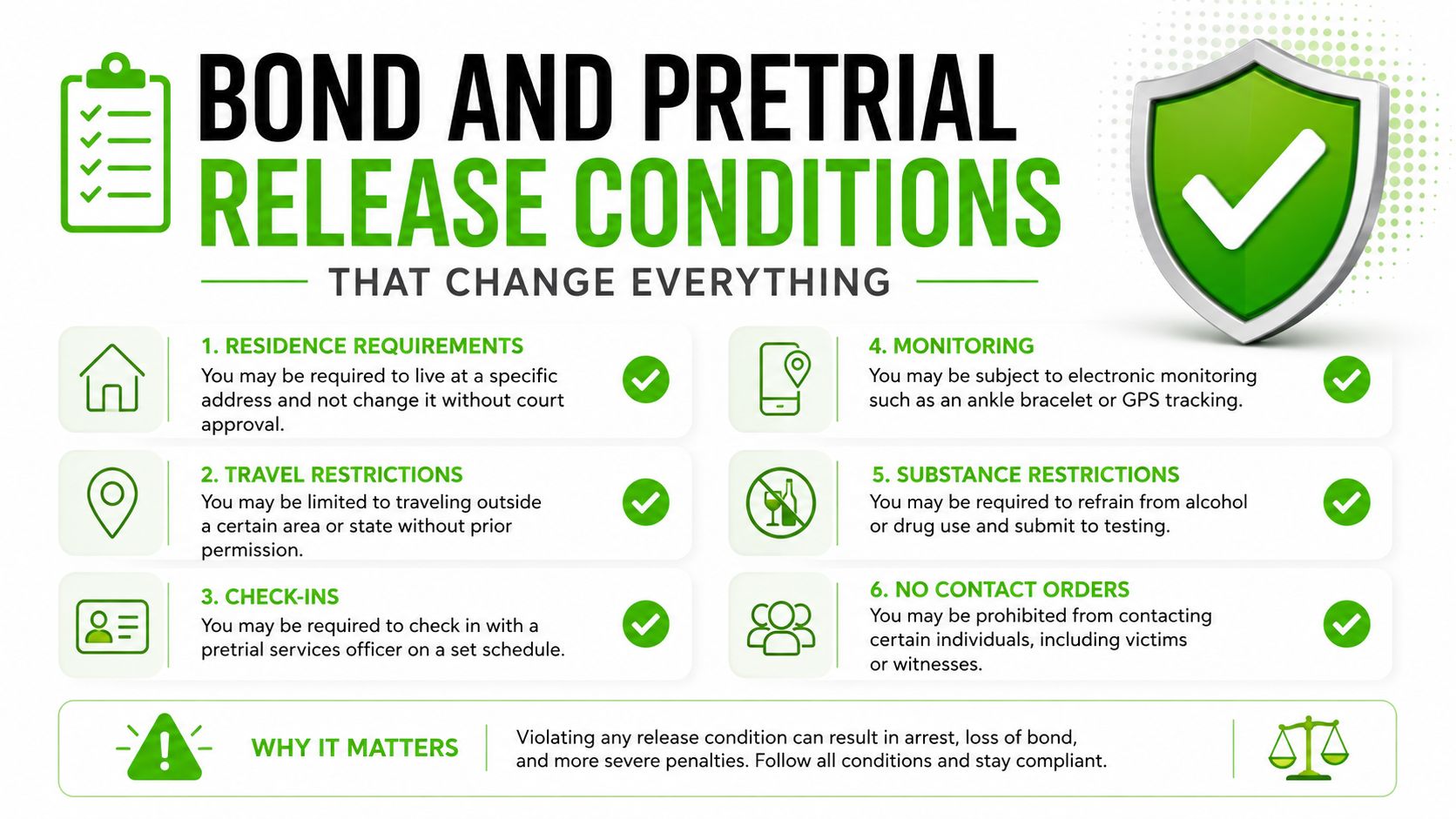
The bond order is where many Georgia defendants discover that alcohol restrictions begin before conviction. Conditions can require abstinence from alcohol and non-prescribed controlled substances, random urine or breath testing, curfews, or limits on entering places primarily devoted to alcohol sales. The exact terms vary by court, county, charge, and individual history.
A defendant arrested in Fulton County may receive conditions that differ from someone released in Cobb County or near Savannah. The county name matters less than the paperwork in your hand. Read the order line by line, including attachments and pages that may have been stapled separately.
How a violation becomes part of the case
A release violation doesn't always begin with an officer handcuffing you at home. It may appear through a positive urine screen, a missed monitoring appointment, an interlock report, or a traffic stop connected to a bar or alcohol-related location. Pretrial services or law enforcement can document the issue and report it to the prosecutor or court.
Possible documentation can include:
- Testing records: A urine or breath result showing alcohol exposure.
- Supervision notes: A supervising officer's report about missed appointments or suspected use.
- Interlock records: Device logs showing failed or prohibited attempts.
- Sworn statements: Affidavits describing an alleged violation or new contact with law enforcement.
The court may then consider whether bond should be modified or revoked. Depending on the order and circumstances, consequences can include a warrant, detention, or loss of posted bond money. The financial and procedural damage can outweigh the temporary benefit of drinking.
A release condition is not friendly advice. It's an enforceable court requirement.
If your paperwork says “no alcohol,” treat that language as an absolute rule. Don't assume one drink is too little to matter, that drinking only at home is exempt, or that no one will test you before arraignment.
How Long Alcohol Stays Detectable After You Stop Drinking
A breath test and a biomarker test answer different questions. A breath test generally focuses on alcohol present around the time of testing. Biomarker testing can identify evidence of earlier consumption after the immediate effects have disappeared.
Urine ethyl glucuronide, or EtG, and ethyl sulfate, or EtS, are direct ethanol metabolites. Clinical information from Mayo Clinic Laboratories on ethanol biomarker testing describes a typical urine detection window of about 2 to 5 days, with some clinical sources noting that EtG may remain detectable for up to five days. For heavier drinking episodes, published information notes EtG may be detectable up to roughly 80 hours, while blood PEth can extend detection to about 2 to 4 weeks.
That's why a person can feel completely sober and still produce a positive result. The test may be measuring metabolite clearance, not current impairment.
A practical comparison
| Test | Approx. Detection Window | Common Trigger in a Georgia DUI Case |
|---|---|---|
| Breath alcohol test | Focuses on alcohol present at testing | Supervision check, traffic stop, or court-related screening |
| Urine EtG and EtS | About 2 to 5 days, with some sources noting up to five days for EtG | Random abstinence monitoring |
| EtG after heavier drinking | Up to roughly 80 hours in published sources | Follow-up compliance testing |
| PEth blood test | About 2 to 4 weeks after heavier drinking patterns | Biomarker-based monitoring |
| Ignition interlock | Tests when the vehicle is started or during rolling checks | Driving a vehicle equipped with the device |
A positive EtG or EtS result doesn't prove that you were impaired when arrested. It can still support an allegation that you violated an abstinence condition. Georgia supervision systems use random testing and interlock enforcement to detect alcohol use, so the gap between drinking and court doesn't create a reliable safe zone.
If you're also worried about testing for another reason, don't confuse alcohol biomarkers with employment screening. The practical differences are explained in what happens when you drink the night before a pre-employment drug test, but your release order remains the controlling document in a DUI case.
Why Drinking on Court Day Is a Separate Problem
Chemical detection isn't the only danger. Appearing intoxicated in court can damage your position even if no one orders a biomarker test.
Judges, prosecutors, courtroom deputies, and courthouse staff notice behavior. Slurred answers, an odor of alcohol, poor balance, glassy eyes, or confused responses can trigger scrutiny. A judge may treat apparent intoxication as contempt, delay the proceeding, reconsider release conditions, or require additional safeguards. Court-preparation guidance also warns that intoxication can disrupt plea discussions and create extra attorney time and delay. See courtroom breathalyzer information if you need a clearer explanation of how breath testing differs from other testing methods.
Your behavior becomes evidence about judgment
Arraignment is often your first direct appearance before the judge in the case. You may need to answer questions, understand conditions, communicate with counsel, and make decisions about scheduling or pleas. Alcohol can impair those decisions even when you don't feel drunk.
A prosecutor who sees a defendant arrive smelling of alcohol may argue that the person isn't taking the case or release requirements seriously. That argument can affect the tone of negotiations and the court's willingness to trust voluntary compliance.
The court-day rule
My recommendation is simple: nothing within 24 hours of your appearance. Don't drink the night before, don't drink that morning, and don't assume coffee, food, gum, or a shower will erase the signs.
Arrive early, sober, organized, and quiet. Bring your paperwork, follow courthouse security instructions, and let your attorney handle legal questions. You're not trying to impress the judge with a performance. You're avoiding an entirely unnecessary problem.
How the Right Answer Changes by Situation
The same question produces different legal answers because defendants don't all stand under the same conditions. Compare the paperwork and supervision status, not just the fact that the arrest was a first DUI.
Profile one, no active alcohol monitoring
You're a first-time defendant arrested in Cobb or Fulton County. You have standard bond conditions, no ignition interlock, and no prior probation restriction. Your paperwork doesn't expressly prohibit alcohol.
In that narrow situation, drinking at home may be legally permitted before conviction. It's still strategically poor. Testing can be added, conditions can be changed, and a court appearance is approaching. Abstaining until arraignment gives the prosecutor no easy compliance issue to raise.
Profile two, supervision already controls your conduct
You're on probation from an earlier case, fitted with an ignition interlock, or subject to a pretrial alcohol-monitoring condition. Here, consuming alcohol can violate an existing order even if you're not driving. A positive test or interlock event may lead to a report, warrant request, or bond review.
For this profile, the answer is not “probably.” Do not drink. Contact your attorney if you already did, and don't try to conceal it or drive afterward.
The in-between cases
Out-of-state drivers and commercial license holders may face additional license and employment consequences. Implied-consent issues can also create separate administrative problems from the criminal case. A commercial driver should discuss the arrest promptly with counsel who understands both Georgia DUI law and licensing obligations.
| Your situation | Legal risk | Best decision |
|---|---|---|
| No alcohol restriction in paperwork | Drinking may not automatically violate a statute | Abstain until arraignment |
| Express abstinence condition | Consumption may violate a court order | Do not drink |
| Existing probation or interlock | Monitoring can create direct evidence | Do not drink and contact counsel |
| Commercial or out-of-state license | Separate licensing consequences may apply | Get individualized legal advice promptly |
What to Do Instead and How to Get Back on Track
Start with the paperwork tonight. Read the entire release order, highlight alcohol, testing, curfew, travel, driving, and contact restrictions, then keep the signed copy somewhere visible. If any phrase is unclear, send it to a Georgia DUI attorney before making assumptions.
Next, build a clean case file. Save the arrest paperwork, towing records, receipts, medical information, witness names, and every notice from the court or DDS. Write down what happened while your memory is fresh, but don't post about the arrest or discuss details publicly.
Use the waiting period productively
- Schedule legal advice: Ask counsel to review bond conditions, implied-consent consequences, testing exposure, and the first court date.
- Stay completely alcohol-free: This removes the avoidable risk of a positive abstinence test or impaired court appearance.
- Plan the required education: Georgia's DUI Risk Reduction Program is a 20-hour course, divided into a NEEDS assessment and an intervention component, and completion through a DDS-certified provider is tied to license reinstatement after qualifying DUI or drug-related offenses. The program is commonly offered as a 2.5-day schedule across Friday evening, Saturday, and Sunday, and one Georgia provider identifies the Prime for Life curriculum. Sources: Georgia DUI Risk Reduction course structure and typical Georgia class scheduling.
- Budget realistically: One Georgia course breakdown lists a total cost of $360, consisting of $100 for the assessment, $235 for the intervention class, and $25 for the workbook. Confirm the current fee with the provider before enrolling. Georgia DUI course fee breakdown
- Gather helpful records: Character references, treatment records, and proof of completed requirements can help your attorney present a more organized picture.
If alcohol use feels difficult to stop, seek appropriate professional support rather than trying to manage the problem alone. Readers researching treatment resources outside Georgia may find this overview of a top alcohol rehab in Hyderabad useful as a starting point, though Georgia defendants should also ask a local attorney or clinician about services that fit their court conditions.
The weeks before arraignment are a chance to demonstrate stability. Finish what you can, follow every condition, stay sober, and keep communication with counsel organized. A cautious decision now is easier than explaining a preventable violation later.
Georgia DUI Schools offers DDS-approved DUI/Risk Reduction education, with online and classroom options for Georgia drivers preparing for license reinstatement or court-related requirements. Review the available schedules and enrollment options at Georgia DUI Schools, then choose a course format that fits your court timeline and start preparing before arraignment.