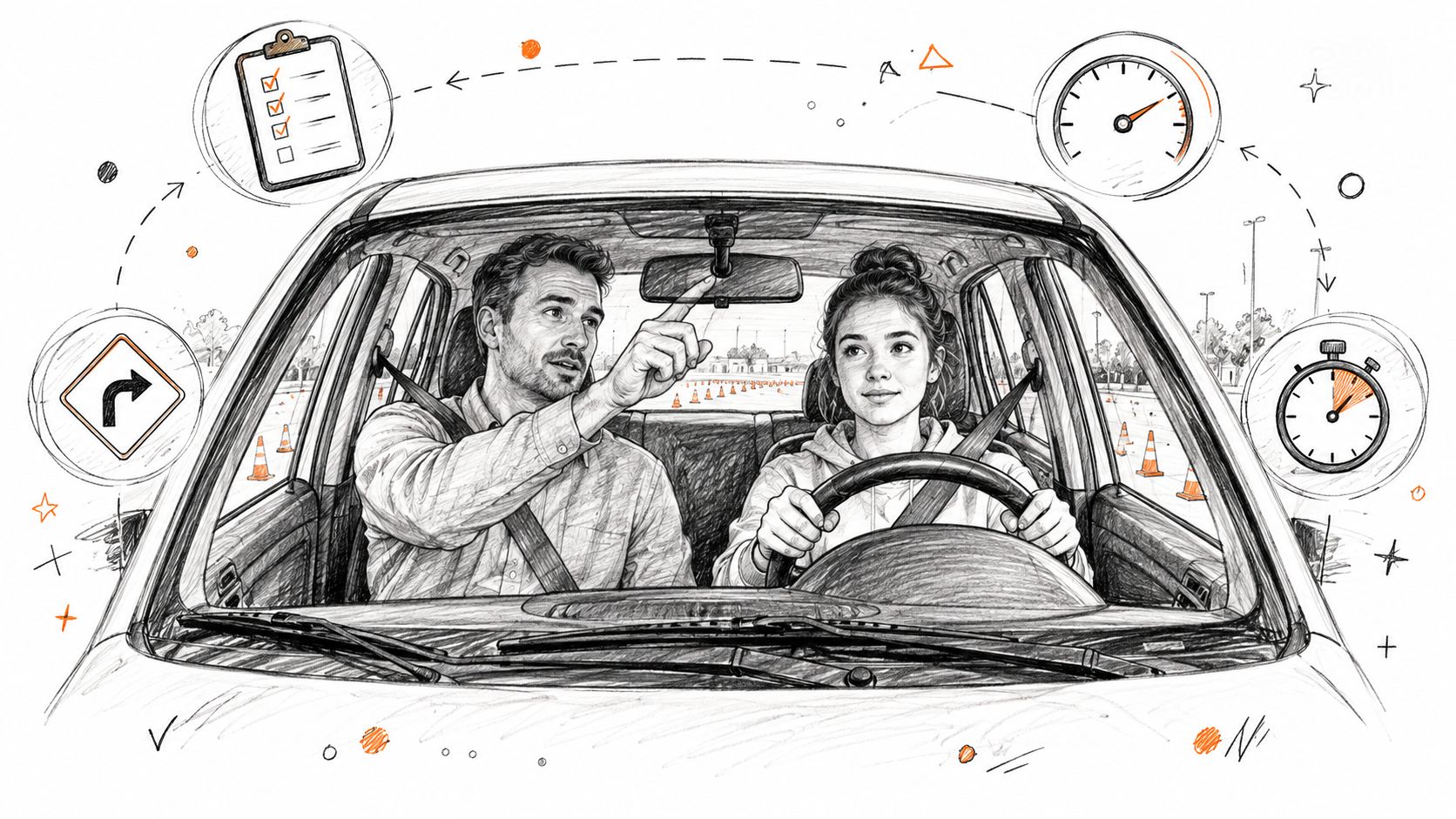
Most advice about driving lessons for first time drivers starts with a number. Take six lessons. Buy a package. Complete the required hours. Then book the road test. That advice is easy to market, but it confuses time spent in a car with competence behind the wheel.
A learner can repeat the same quiet neighborhood loop for lesson after lesson and still miss a pedestrian emerging between parked cars, misjudge an unprotected turn, or brake too late when traffic compresses. The better question is not, “How many lessons have I bought?” It's, “What can I recognize, judge, and control without being prompted?”
The evidence supports that distinction. Novice drivers face their greatest exposure soon after they begin driving alone, so supervised practice should build layered judgment before independence, not merely produce a completion certificate. In Georgia, that safety mindset also matters after the permit stage, when defensive driving, DUI Risk Reduction, clinical services, and license-reinstatement rules may become part of a driver's path.
Why More Lessons Are Not Always Safer
Two learners can finish the same package and still be nowhere near equally prepared. One repeats familiar residential turns in light traffic. The other practices intersection scanning, following distance, hidden driveways, supervised merges, and decisions in rain or at night. Their invoices match. Their exposure does not.
Classroom time alone does not guarantee safer driving. A major review of novice-driver training found no clear evidence that the traditional formula of about 30 hours of classroom education and 6 hours of in-vehicle instruction reduced crash involvement (NCBI review of novice-driver training). Instruction still matters, but its value depends on what the learner practices, how skills are sequenced, how closely the instructor supervises, and which conditions the learner encounters.
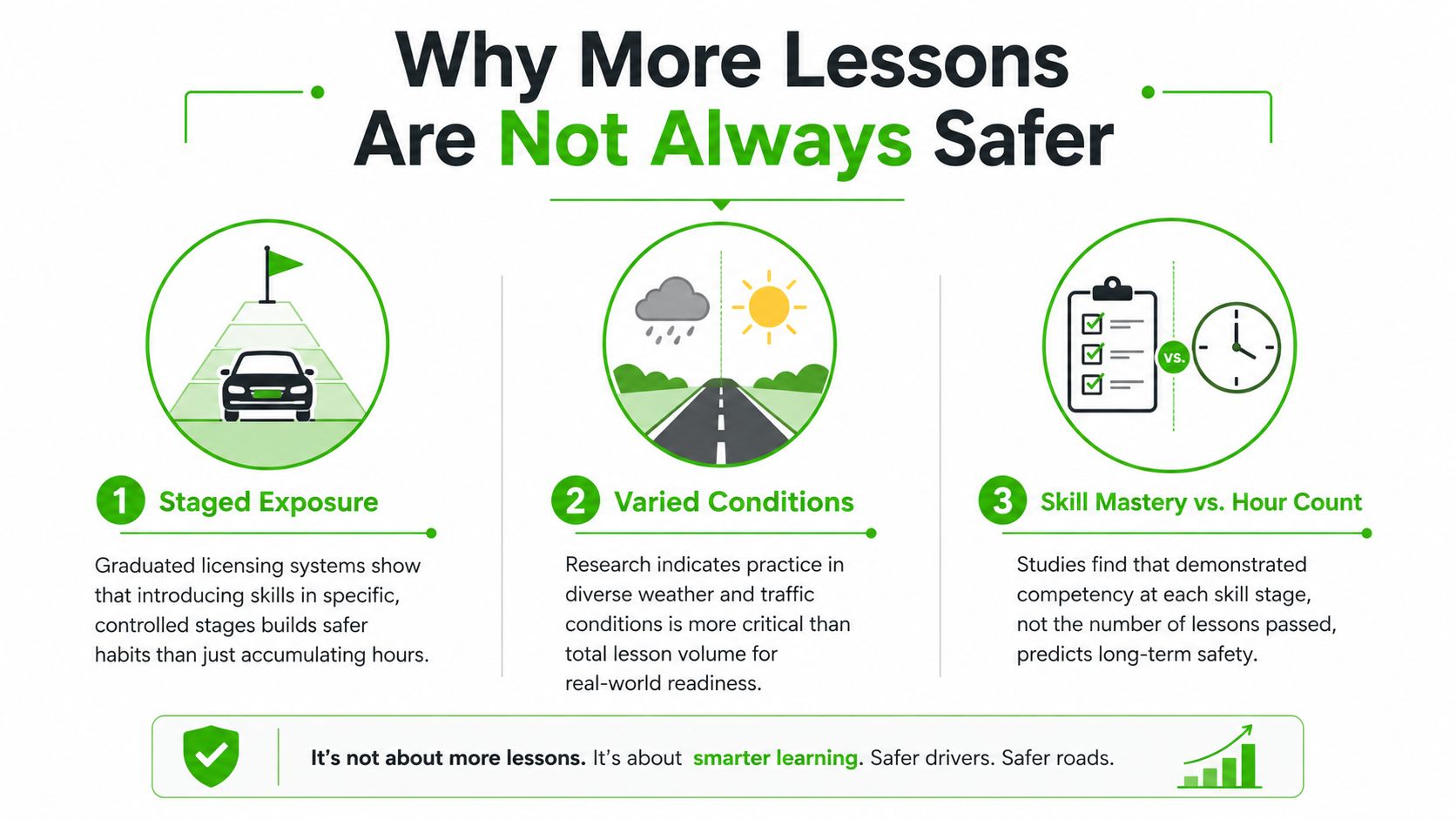
Graduated driver licensing, or GDL, applies that same principle to the period after instruction. Learners drive under supervision, face restrictions during early solo driving, and gain access to more demanding conditions in stages. A meta-analysis covering 46 U.S. states, the District of Columbia, and 11 Canadian jurisdictions found that GDL reduced the relative fatality risk of 16-year-old drivers by 19.1% (PubMed analysis of graduated licensing). The structure limits exposure while judgment is still developing.
A useful lesson record should show progress in four areas: smooth steering, braking, and positioning; early recognition of signs, pedestrians, cyclists, and brake lights; independent choices about speed, gaps, lanes, and following distance; and practice across roads and conditions before solo driving. If the instructor cannot identify the next skill to develop, buying more hours may repeat a comfortable route.
Teenage drivers were 8 times more likely to be involved in a collision or near miss during their first 3 months after licensure than during the previous 3 months on a learner's permit, according to an NIH summary of a driving study (NIH summary of early teen crash risk). Staged practice, followed by Georgia-specific education such as defensive driving or DUI Risk Reduction when required, connects lesson progress with the responsibility of keeping a license.
Choosing the Right Lesson Format and Provider
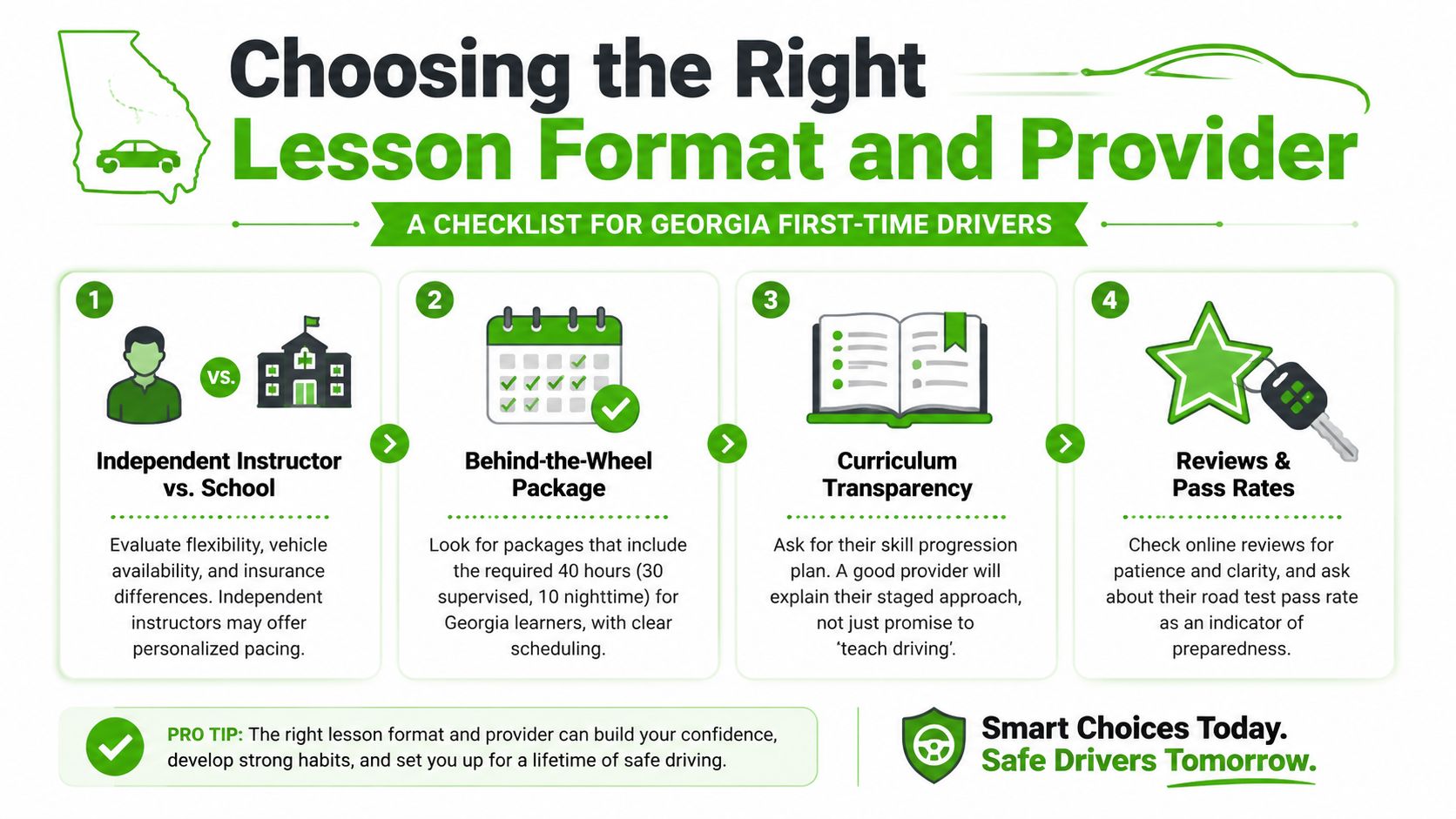
A Georgia learner has several reasonable formats, but each creates different trade-offs. A private instructor can tailor pace and focus closely to one student. A larger school may offer more vehicles, scheduling options, and structured programs. A hybrid package can combine online theory with in-car coaching, which suits students who need flexibility but still require direct feedback.
The provider matters more than the label on the package. Before paying, verify that the school is DDS-certified. Georgia DDS says only DDS-certified driving schools are approved to offer Driver Education, Defensive Driving, and DUI programs, and it directs consumers to verify certification before enrolling (Georgia DDS regulated programs).
Questions worth asking before booking
Ask how the instructor evaluates a beginner during the first session. A professional should be able to explain how lessons progress from cockpit setup and low-speed control to residential roads, multilane traffic, and highway judgment. Be cautious if the answer is a fixed block of hours with no skill benchmarks.
Confirm that the instructional vehicle is properly equipped for training. Ask whether it has dual controls, whether it's insured for instruction, who maintains it, and whether the student can practice in a vehicle similar to the one they'll drive after licensing. If you're still choosing a vehicle, a practical guide to cars for new drivers can help you compare beginner-friendly considerations before committing to a car.
Look for clear policies rather than pressure to buy a large package immediately. Red flags include no-questions-asked hour bundles, cash-only demands without documentation, and instructors who won't disclose their state certification information.
Before your first lesson, confirm:
- Certification: The school's DDS approval can be verified.
- Vehicle safety: The training car has appropriate controls and instructional insurance.
- Curriculum: The provider can describe staged skill development.
- Feedback: Each lesson includes specific errors, corrections, and next steps.
- Scheduling: You can practice across varied conditions instead of repeating one route.
- Compliance: You understand whether the service is Driver Education, Defensive Driving, or another DDS-regulated program.
For Georgia-specific beginner education, review the DDS-approved driver education course before enrolling so you understand what the program covers and how it differs from behind-the-wheel lessons.
What Your First Real Lesson Looks Like
A first lesson near a Roswell shopping center on a busy Saturday morning usually begins before the car moves. The instructor watches how you approach the vehicle, whether you look around it, and whether you wait for direction or start adjusting controls immediately. That observation isn't a test of confidence. It helps the instructor decide how much traffic and complexity you can safely handle.
Inside the car, the first task is a cockpit drill. You adjust the seat so your legs can operate the pedals without stretching, set the mirrors to create useful coverage, confirm the steering position, and locate the parking brake and gear selector. The instructor checks whether you understand the blind-spot check, hand position, and the difference between looking at a mirror and searching the space beside the vehicle.
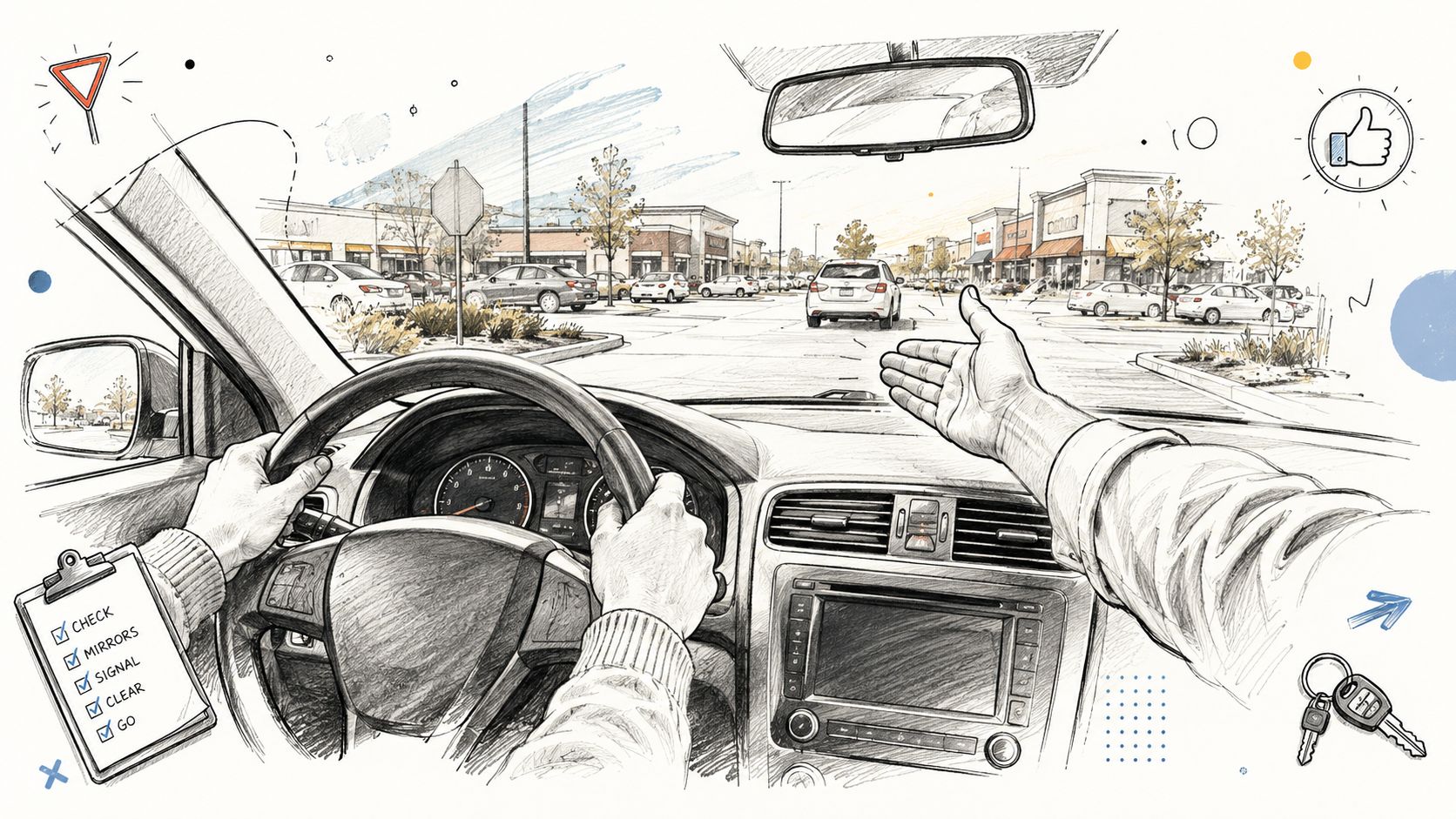
A careful start may involve selecting neutral, applying the parking brake, and confirming the surroundings before the engine is engaged or the vehicle moves. The instructor may also walk around the car with you, looking at tire condition, clearance, and anything that could affect the first maneuver. Those details feel slow when you're nervous, but they establish a repeatable pre-drive routine.
The first movements are deliberately simple
The initial pulls happen in a quiet parking lot or similarly controlled space. You'll practice easing onto the accelerator, holding a straight line, steering without chasing the curb, and stopping smoothly. Threshold braking is introduced as controlled pressure that brings the car to a firm stop without a panic jab.
From the passenger seat, the instructor is listening to your narration and watching your eyes. “What do you see near that parked SUV?” is more useful than “Turn left now.” The question links a visible object to a possible pedestrian, reversing vehicle, or blocked sightline.
The first ten minutes may contain long stretches of silence. That isn't failure. A professional instructor is assessing reaction time, smoothness, observation habits, and how you respond when a correction arrives. Polished turns aren't expected on the first outing. Honest attention is.
The Staged Skills Curriculum Instructors Follow
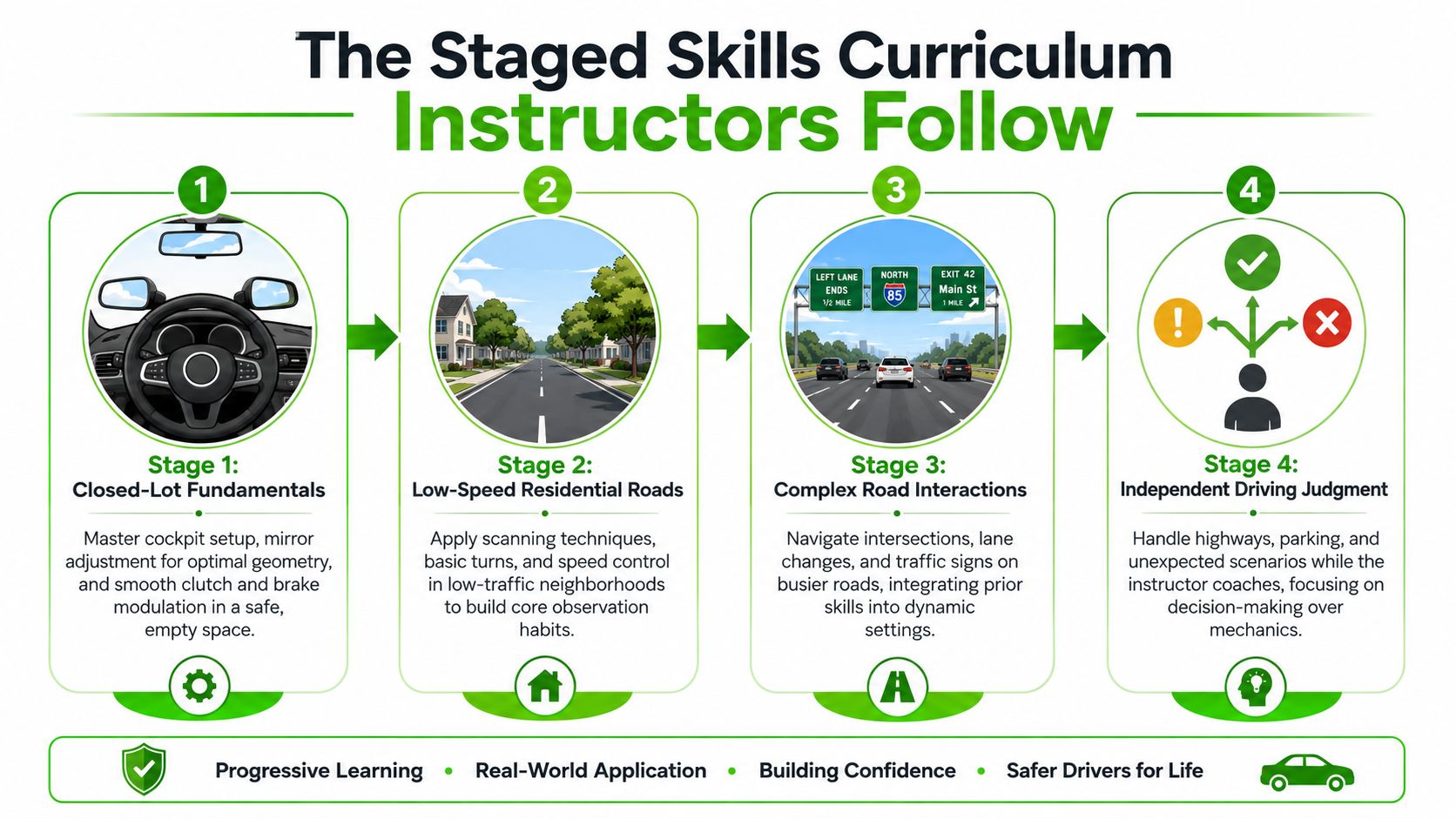
A competent curriculum moves from controlled vehicle handling toward independent judgment. The stages overlap slightly in real life, but they shouldn't be rushed. Each one answers a different safety question: Can you control the car? Can you read a simple road? Can you manage interactions? Can you make decisions at speed?
Stage one builds control without target fixation
In a closed lot, the learner practices seat and mirror setup, steering geometry, starting and stopping, reversing, and smooth pedal inputs. Manual-transmission students also work on clutch engagement and gear changes, while automatic-transmission students concentrate on brake release and controlled acceleration.
The hazard skill underneath these exercises is target fixation awareness. Beginners often stare at the curb, parked car, or cone they fear hitting, then steer toward it. The instructor teaches the learner to look through the intended path while maintaining peripheral awareness of nearby hazards.
Stage two turns observation into a habit
Quiet residential roads introduce intersections, right-of-way, driveways, parked vehicles, pedestrians, and speed control. The learner scans left, center, and right before entering an intersection, checks for hidden movement, and identifies locations where a child, cyclist, or vehicle could appear unexpectedly.
A house-lined road isn't automatically easy. Hidden driveways and school zones require the learner to read the environment, not just follow the lane. The instructor should ask what could change before the next block, then reduce prompts as the learner begins identifying those risks independently.
Stage three manages competing traffic demands
Multilane arterials and moderate-speed traffic add lane positioning, timed gaps, lane changes, traffic lights, turning queues, and merging. The key hazard-recognition skill is scanning beyond the nearest vehicle. The learner should notice brake lights several vehicles ahead, recognize when a queue may stop suddenly, and preserve an escape option.
This stage exposes the weakness in raw hour totals. A driver can operate the pedals smoothly and still make poor decisions when several vehicles, signs, and lanes compete for attention.
Stage four introduces highway judgment
Highway exposure should come after the learner can control speed and position reliably. Entrance ramps, speed adaptation, lane changes, truck blind zones, and exit planning become the focus. The instructor teaches a two-second following cushion, with additional space when the road is wet, while explaining why a large vehicle can hide developing traffic.
Practical rule: Highway practice isn't a graduation photo. It's a controlled test of whether earlier observation and judgment skills still work when speed and consequences rise.
Skills stack rather than run in parallel. Rushing residential practice to reach highway hours often creates habits that later need correction in defensive driving courses. The best instructor advances because the learner demonstrates readiness, not because the calendar says the next stage is due.
Tracking Progress Between Lessons
A calendar full of lessons can look impressive and tell you very little. Progress becomes clearer when the learner records what was practiced, what went wrong, and what can now be completed without help.
Track conditions, not just time
A useful practice log records supervised exposure across daytime and nighttime driving, dry and wet roads, quiet streets, multilane arterials, and at least one highway session when the instructor considers it appropriate. Total mileage still matters, but identical repetition has diminishing value. Sixty hours of the same neighborhood loop can leave gaps that a smaller, carefully varied practice plan reveals quickly.
The learner should also write an error log after each session. Use three categories:
- Observation errors: Missed signs, late hazard detection, weak mirror checks, or failure to see a pedestrian risk.
- Judgment errors: Poor gap selection, excessive speed, unsafe following distance, or hesitation that creates a new conflict.
- Vehicle-control errors: Stalls, jerky braking, drifting within a lane, or abrupt steering.
Review the log with the instructor at the beginning of the next lesson. Early improvement often appears as fewer observation errors, because the learner starts seeing hazards sooner. Vehicle control can look better while judgment remains weak, so don't let smooth steering create false confidence.
Replace hour milestones with demonstrations
A milestone should describe an observable ability. For example, the learner might reverse park without correction, complete a three-lane highway merge at an appropriate opening, or perform an emergency stop from 35 miles per hour with the instructor measuring the stopping distance. These demonstrations should occur only under safe, supervised conditions.
The central question is whether prompts are disappearing. A learner who needs a reminder before every lane change hasn't mastered the skill, even if the lesson package is finished. For a more individualized discussion of lesson planning, use this guide to how many driving lessons you may need, then treat any estimate as a starting point rather than a promise.
Next Steps After the Permit
A learner's permit and a Class C license mark different stages, and the programs that follow address different problems. Defensive driving handles certain violations and points. DUI Risk Reduction satisfies a state or court requirement. A clinical evaluation examines possible substance-use concerns when an order or referral requires it.
| Program | Who It Is For | Typical Trigger | Time Required |
|---|---|---|---|
| Defensive driving | Drivers addressing a qualifying moving violation, points, or possible insurance benefit | A court order, citation-related option, or proactive insurance request | A DDS-approved course, with the specific format set by the provider or requirement |
| DUI Risk Reduction | Drivers completing a state or court requirement after a qualifying DUI or related offense | DUI, certain drug or alcohol offenses, or another reinstatement requirement | Georgia DDS requires an assessment component and an intervention component. Both must be completed to receive the certificate (Georgia DDS DUI FAQs) |
| Clinical evaluation | Drivers whose court or DDS pathway requires assessment of possible substance-use concerns | A court, DDS, attorney, probation, or treatment referral | Set by the evaluator and the individual referral |
| Victim Impact Panel or treatment | Drivers whose case includes additional court or clinical requirements | Court or probation conditions | Determined by the specific order or provider |
Defensive driving serves a different purpose
Georgia law allows a court to order attendance at an approved defensive driving course for violations that carry points. If a driver completes a driver-improvement clinic after receiving a citation but before appearing in court, the court must reduce the fine by 20%, and DDS assigns no points for that offense (Georgia law on defensive driving and points).
A driver may also choose a course proactively when an insurer offers a possible discount. Confirm the insurer's rules before enrolling. A certificate does not guarantee a premium change, and a course chosen for insurance purposes may not satisfy a court or DDS requirement.
DUI requirements require exact compliance
The standard Georgia DUI Risk Reduction structure requires 20 hours covering the assessment and intervention components. Both parts must be completed through an approved provider before the completion certificate can be issued. The program applies to people convicted of DUI, illegal drug possession, underage alcohol possession while operating a motor vehicle, or boating under the influence.
A clinical evaluation may be required alongside the program or as a separate step. Victim Impact Panels and ASAM Level 1 treatment can also appear in an individual court or probation pathway. Read the order, ask the court or attorney what applies, and verify that the provider is DDS-certified. A friend's experience is not a reliable guide to your requirements.
Drivers dealing with a habitual violator revocation face an additional legal framework. Georgia law says a person revoked for five years may, after two years from surrendering the license, receive a probationary license for up to three years only if the person meets conditions including no moving-violation convictions during the prior two years, no conviction causing death or injury, and completion of an approved defensive driving course or DUI Risk Reduction Program (Georgia habitual violator statute).
For permit preparation and licensing fundamentals, review how to get your learner's permit in Georgia before booking instruction.
Building a Safety Mindset That Outlasts the Test
Passing the road test proves a driver can meet a standard under supervision. It does not prove the driver will manage risk alone. The first solo-driving period deserves more attention than the test itself. NIH reports that crash risk is highest during the first 6 months of independent driving, then declines more gradually over the following years (NIH summary of novice-driver crash risk). Experience reduces risk only when the driver uses it to improve decisions.
A test-oriented driver asks whether a maneuver is legal. A safety-oriented driver asks what could change before it ends. At an unprotected left turn on a yellow light, with a tailgater behind, that means checking the opposing lane, pedestrian crossing, available escape space, and whether pressure from the following driver is affecting the choice. Sometimes the safest decision is to wait.
Build four habits into every drive:
- Scan ahead: Look far enough ahead to spot slowing traffic, blocked sightlines, and developing conflicts.
- Manage space: Adjust speed and following distance before a problem becomes urgent.
- Refuse the phone: Keep the device out of the driving decision loop, even when traffic seems easy.
- Expect mistakes: Allow for other drivers to miss signals, yield late, drift across lanes, or change speed without warning.
A useful instructor does more than count lesson hours. Each stage should produce a repeatable behavior, then supervised practice should test that behavior in new traffic, weather, and road conditions. Between lessons, the driver should record one decision that went well, one moment that felt rushed, and one correction to apply next time. That turns experience into feedback instead of repetition.
The strongest program continues beyond the learner's test. It helps the new driver recognize patterns, seek corrective instruction early, and connect everyday judgment with Georgia's next licensing steps. Georgia DUI Schools offers DDS-approved Driver Education, Defensive Driving, and DUI Risk Reduction options, including online and instructor-led formats, plus clinical services and Victim Impact Panels where required. Before the road test, visit Georgia DUI Schools to select the course or service that fits the driver's Georgia licensing, safety, or reinstatement requirement.