

For a first Georgia DUI, the earliest reinstatement point under DDS guidance is 120 days, while Georgia law also provides a 180-day statutory benchmark in applicable cases. Getting your license back may still begin earlier through an interlock-restricted or limited permit, long before you have full driving privileges.
You're probably reading this after a Friday-night arrest, staring at a temporary permit, a DDS notice, and a criminal court date that may be months away. The frustrating part is that “how long to get license back after DUI” doesn't have one answer in Georgia. Your timeline depends on which suspension is active, whether you requested an administrative hearing, whether the court case has ended, what your driving history shows, and whether DDS has received every required certificate and fee.
I've seen drivers lose time because they waited for court before enrolling in a required program. Others completed the class but missed the clinical evaluation, submitted an incomplete packet, or assumed a restricted permit meant the license was fully restored. Those mistakes turn an eligible reinstatement into a longer administrative problem.
Where Georgia Drivers Usually Stand After a DUI
A Cobb County driver arrested Friday night may leave with a temporary permit, an implied-consent notice, and a separate criminal court date. The permit can allow limited short-term driving while the driver decides whether to request an administrative hearing through the Office of State Administrative Hearings. The criminal DUI case may proceed separately in state or superior court.
The administrative action can take effect before the criminal case is resolved. Under Georgia's implied-consent framework, reinstatement cannot occur sooner than 30 days after the suspension becomes effective. The driver must also provide proof of the required Risk Reduction Program and pay the applicable fee, as described in Georgia's implied-consent reinstatement statute. A hearing request may challenge the suspension, but missing the deadline can leave the administrative action in place.
The first calendar question
For a qualifying first offense involving a driver age 21 or older, DDS identifies a 120-day suspension period. Reinstatement after that point requires completion of a DDS-approved DUI Alcohol or Drug Use Risk Reduction Program and payment of the reinstatement fee, according to the DUI first-offense FAQ.
Georgia law also contains an overlapping statutory benchmark. After a first conviction, the suspension period is at least 180 days, and the person may apply for reinstatement at the end of that period under the applicable statute, as explained in the Georgia reinstatement statute. The right answer depends on the DDS record, conviction category, driver's age, and the type of relief requested. A calendar estimate alone cannot resolve those differences.
Practical rule: Keep the temporary permit, administrative notice, conviction paperwork, and DDS record together. They can describe separate consequences arising from the same arrest.
The reinstatement question is therefore a program-path question, not one universal waiting period. A driver may need to complete the Risk Reduction Program, satisfy the applicable suspension period, provide DDS with acceptable documentation, and pay the required fee. A limited or interlock-based permit may restore some driving sooner, but it does not equal an unrestricted license.
Drivers comparing state systems can review DUI defense in Connecticut, but Georgia residents must follow Georgia DDS and Georgia court requirements. A missed hearing deadline, incomplete certificate, or incorrect assumption about permit rights can extend the time off the road.
Two Clocks Run at Once Administrative and Criminal
A Georgia DUI can leave a driver answering to two separate systems at the same time. The administrative clock starts with the arrest and implied-consent process. The criminal clock usually becomes decisive after a plea or conviction, when DDS receives the court disposition and applies the consequence tied to that offense.
The administrative track
The administrative suspension concerns the license action connected to the arrest, testing, or refusal allegations. A driver may request an administrative hearing through the Office of State Administrative Hearings. That hearing can challenge or affect the suspension, but it does not decide guilt in the criminal DUI case or replace the court process.
The 30-day minimum under Georgia's implied-consent rule explains why a license deadline may arrive before the criminal case has meaningfully progressed. An arraignment, dismissal discussion, or first court appearance does not by itself complete the DDS process. The driver must still determine whether a hearing, reinstatement application, or other documentation is required.
The criminal track
A plea or conviction can trigger a separate DDS suspension. DDS states that the suspension period may range from 120 days to five years, based on the driver's history and the offense involved, under its license reinstatement guidance. The criminal suspension may run at the same time as the administrative suspension, but overlapping periods do not eliminate the underlying obligations. Program completion, fees, insurance, ignition-interlock requirements, and acceptable DDS documents may still be outstanding.
| Clock | Trigger | First-offense length | Authority | Can be contested |
|---|---|---|---|---|
| Administrative | Arrest, implied-consent action, or related DDS notice | At least 30 days before reinstatement can occur under the implied-consent rule | DDS and OSAH process | Yes, through the administrative hearing process |
| Criminal | Plea or conviction reported to DDS | DDS guidance may range from 120 days to five years, depending on the case and history | Criminal court and DDS | The criminal case and resulting disposition must be addressed separately |
The effective suspension is controlled by the longer period after both tracks are reviewed. A driver can finish the administrative period and still lack full driving privileges because the criminal suspension, required program proof, or DDS documentation remains unresolved.
The important distinction: An interlock-restricted permit generally belongs to the criminal suspension pathway. It is not a substitute for contesting an administrative action.
That distinction affects daily planning. A driver traveling to work in Marietta, treatment in Atlanta, or school in Athens should identify which authority issued the current restriction and which document authorizes each trip. An interlock installation alone does not expand the permit's conditions. Driving outside those conditions can create a new violation, even while the device is operating properly.
Risk Reduction Clinical Evaluation and Treatment
The program side of reinstatement often determines whether a driver is ready when the suspension period ends. Georgia DDS commonly requires more than proof that a driver attended a class. The packet may depend on the Risk Reduction Program, a clinical evaluation, treatment when recommended, and proof of any required Victim Impact Panel.
Start with the DDS-approved course
The Risk Reduction Program is the course many drivers call DUI school. It must be completed through a DDS-approved provider, and the driver needs the Certificate of Completion for the reinstatement file. Finishing the course early can prevent a calendar problem later, but the certificate must still match the information DDS expects.
The course isn't the same as defensive driving. Defensive driving may address points or insurance matters, while DUI reinstatement turns on the specific Risk Reduction requirement connected to the DUI disposition. Before enrolling, verify that the provider is approved and that the course format is accepted for your case.
Complete the evaluation honestly
A clinical evaluation looks beyond the arrest paperwork. The evaluator reviews substance-use history and other relevant information, then determines whether additional services are recommended. The recommendation may involve ASAM Level 1 treatment, a more intensive outpatient level, or residential placement, depending on the assessment.
Treatment is not optional when it has been recommended as part of the applicable case requirements. A driver who submits a course certificate but omits a required evaluation or treatment record can face a rejected or incomplete packet.
For a plain-language explanation of what the appointment involves, review what a Georgia DUI evaluation covers. If the process brings up concerns about stress, cravings, sleep, or emotional regulation, resources on signs your nervous system needs support may help you identify questions to raise with a qualified clinician.
Don't overlook the Victim Impact Panel
A Victim Impact Panel is a separate requirement when ordered or required for the case. Attendance proof must be preserved with the other records. The session may be offered through a designated Georgia facility, and the driver should confirm the accepted provider before attending.
The common operational failure is not the calendar. It's incomplete paperwork, a missing signature, or a treatment recommendation that was never finished. Build a document folder as you go, keep copies of certificates and evaluations, and compare your records with the DDS reinstatement requirements before submitting anything.
How Offense Severity Changes the Reinstatement Timeline
A first DUI does not create one universal reinstatement schedule. The controlling path depends on the driver's age, prior convictions, BAC or refusal record, controlled-substance allegations, and whether the case triggers habitual-violator review. Those details determine which suspension rule DDS applies and which proof must be filed before driving privileges return.
The 120-day and 180-day first-offense benchmarks are only starting points. A driver age 21 or older with a qualifying first offense may have an earliest DDS reinstatement point of 120 days, while Georgia law sets a 180-day minimum in applicable first-conviction circumstances. The disposition, statutory category, and completed requirements control the actual date.
BAC, refusal, and prior convictions: how each factor shifts your timeline
A BAC result, refusal, controlled-substance allegation, or age under 21 determines which statutory framework applies. A refusal creates a separate administrative suspension issue, even if the criminal case later ends differently. Child-endangerment allegations and felony-level habitual-violator consequences add restrictions that a standard first-offense checklist does not address.
Prior convictions create the largest timeline changes. Georgia's rules distinguish a first controlled-substance DUI from a second qualifying offense within five years. The first requires a statutory suspension of at least 180 days, Risk Reduction completion, and payment before restoration. The second requires a three-year suspension. A reinstatement request becomes available after one year when the required training proof and higher fee are submitted, under the Georgia controlled-substance DUI reinstatement statute.
| Offense tier | Hard suspension | Limited-permit eligibility | Full-reinstatement window |
|---|---|---|---|
| Qualifying first offense, driver age 21 or older | DDS guidance identifies 120 days, with a 180-day statutory benchmark in applicable cases | Depends on the disposition and permit rule | Earliest eligible date after the controlling suspension and required proof |
| First controlled-substance DUI | At least 180 days | Depends on the case and applicable permit authority | After the statutory period, Risk Reduction proof, and fee |
| Second qualifying controlled-substance offense within five years | Three years | Reinstatement request may be available after one year, subject to requirements | After the statutory eligibility point and complete compliance file |
| Habitual violator revocation | Extended revocation requirements apply | A first-offense permit is not assumed | Requires the separate habitual-violator process |
A third DUI within the applicable statutory framework triggers habitual-violator review instead of an ordinary repeat-suspension process. Georgia law addresses revocation after three DUI violations within five years and requires Risk Reduction proof before a new license can issue, as stated in the habitual-violator licensing statute.
Confirm the controlling category with DDS or qualified counsel before paying for an interlock or relying on a limited permit. An incorrect classification can create costs without granting lawful driving privileges.
SR-22 Ignition Interlock and Limited Driving Permits
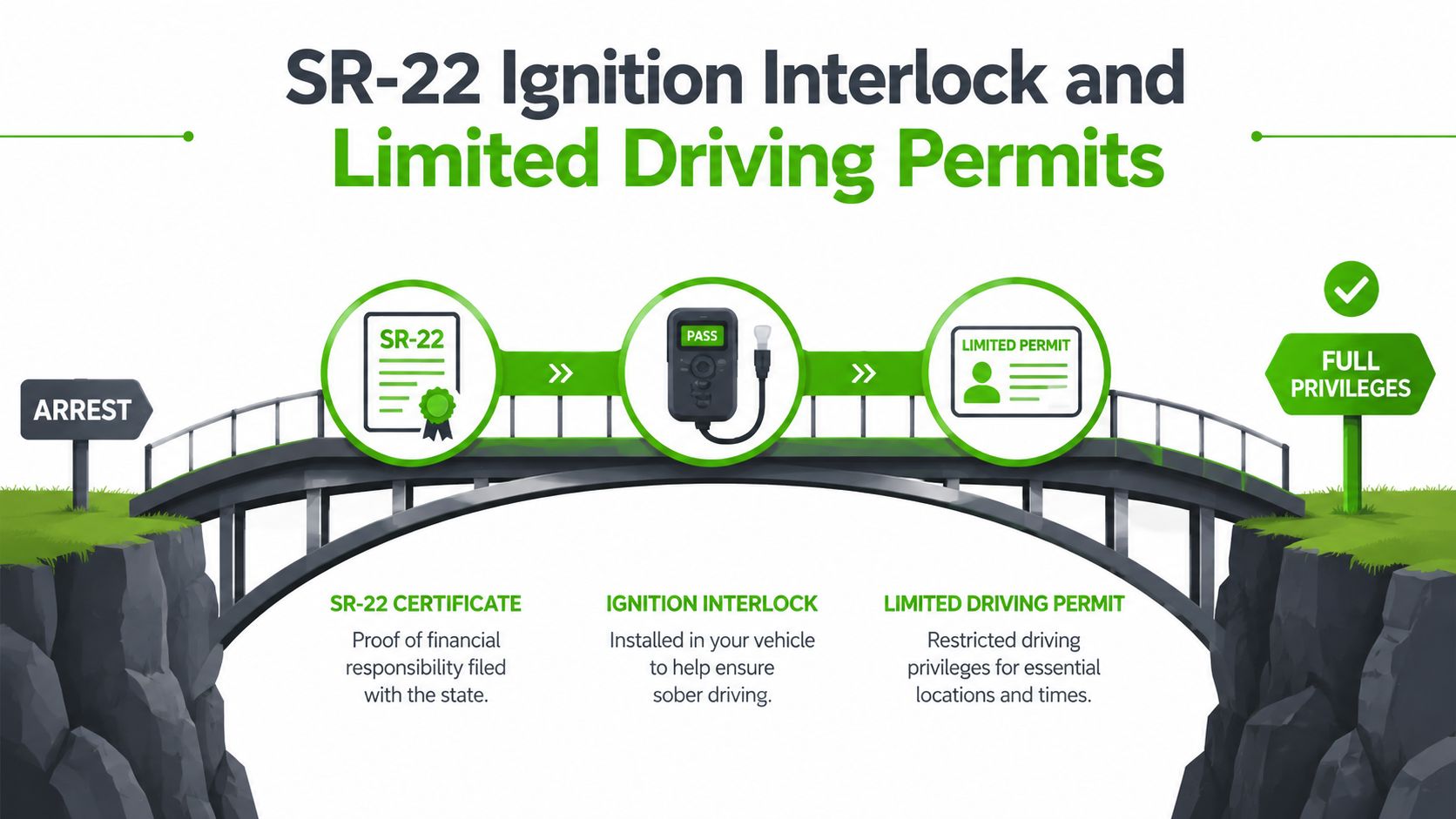
A driver can reach the eligibility date and still lack lawful driving privileges. In Georgia, the reinstatement path may require an SR-22 filing, an ignition interlock, a limited driving permit, or several of these requirements together. They address different parts of the case, and a permit authorizes only the travel listed in its conditions.
Insurance proof and vehicle technology
An SR-22 is proof of financial responsibility filed by an insurer authorized to provide it in Georgia. DDS reviews the filing when the applicable case requires it. Coverage must remain active for the required period. If the policy lapses, the insurer's filing can terminate, creating another compliance problem and delaying the driver's application.
An ignition interlock is installed through an approved vendor. The device requires a breath sample before startup and may request rolling samples during travel. Drivers must attend calibration appointments, follow reporting rules, prevent tampering, and report device problems promptly. A missed service visit or recorded violation can affect continued eligibility and postpone removal.
What restricted driving really means
A limited driving permit may cover employment, school, medical care, treatment, or other approved purposes. It does not authorize unrestricted personal driving. Keep the permit with you, follow its stated conditions, and plan routes and times around the authorization. A trip that seems reasonable may still fall outside the permit.
Drivers comparing different state systems can review these tagged DUI license articles, but those explanations cannot replace Georgia DDS instructions. For Georgia-specific planning, the Georgia ignition-interlock restricted-license guide explains the interlock pathway and its practical limits.
The checkpoint question is whether the interlock removal date matches the license reinstatement date. Usually, they are separate milestones. Removal depends on the applicable order and compliance record. Full reinstatement also depends on the controlling suspension, DDS approval, insurance proof, fees, and complete documentation. Confirm the required path before paying an installer or relying on a limited permit.
Reinstatement Fees and the Habits That Cause Delays
A driver can reach the eligibility date and still remain off the road. The difference is usually the reinstatement packet. Complete, consistent proof gives DDS what it needs to review the correct program path. Missing documents, expired filings, or a mismatch in the record can extend the process.
For an implied-consent reinstatement, Georgia lists a fee of $210, or $200 when paid by mail. A recidivist fee is $510, or $500 by mail. Those amounts do not automatically apply to every suspension. A repeat offense or habitual-violator record can place the driver in a different fee category. Review the Georgia license reinstatement fee guide and then confirm the amount against the individual DDS record.
Where the packet breaks down
The delays I see most often are administrative:
- Incomplete evaluation: The clinical form is missing a signature, date, or recommendation.
- Late course certificate: The Risk Reduction provider has not supplied acceptable completion proof.
- Unfinished treatment: The driver submits the class certificate but does not complete a clinical recommendation.
- Lapsed insurance proof: The SR-22 filing is not active when DDS reviews the application.
- Interlock compliance problem: A device report reflects a violation, missed service, or suspected tampering.
What doesn't work: Sending documents one at a time and waiting for DDS to identify every remaining problem. That creates extra correspondence and can leave an otherwise eligible driver unable to drive lawfully.
Use the DDS submission method that fits the case, save confirmation records, and check every certificate for the same legal name and identifying information. A clean packet does not shorten a statutory waiting period, but it prevents paperwork from adding another delay.
Before treating the matter as a first-offense reinstatement, verify these five points:
- Administrative hearing deadline: Confirm whether the implied-consent action remains contestable.
- Controlling suspension: Identify whether DDS is applying an administrative, criminal, or habitual-violator rule.
- Program proof: Confirm acceptance of the Risk Reduction certificate.
- Clinical compliance: Complete the evaluation and any recommended treatment.
- Permit authority: Verify whether an interlock or limited permit is available.
The timeline is therefore a program-path question, not one universal waiting period. The controlling suspension, fee tier, completed requirements, and DDS record determine when lawful driving can resume.
Your Georgia Reinstatement Roadmap and Next Step
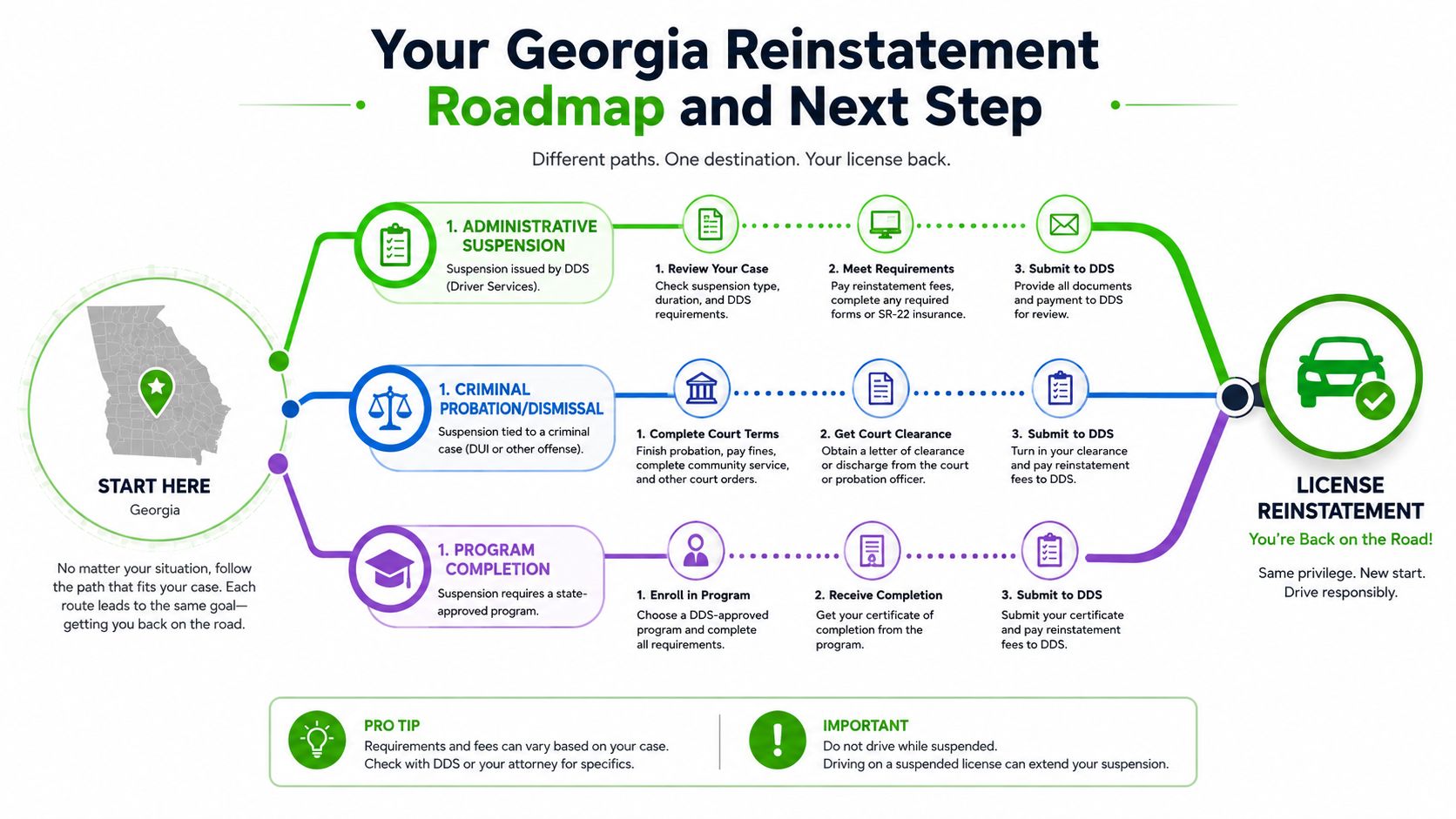
A driver can finish every required class and still be unable to drive legally if the wrong suspension controls, the DDS eligibility date has not arrived, or the application packet is incomplete. Georgia reinstatement follows parallel tracks, not one universal waiting period. The administrative action may begin near the arrest, the criminal case continues in court, and program requirements can often be completed while that case remains pending. Fees, insurance proof, interlock compliance, and the controlling DDS date must then align.
A practical sequence
At arrest: Keep every notice, temporary permit, and hearing form. Check whether an administrative hearing request remains available and whether its deadline is still open.
During the administrative period: Confirm the suspension's effective date and DDS category. The court date does not necessarily control this part of the case.
Before eligibility: Complete the DDS-approved Risk Reduction Program. Schedule the clinical evaluation early enough to complete any recommended ASAM treatment or other required service. Attend a Victim Impact Panel if required, and keep the certificate or attendance proof.
After the criminal disposition: Obtain final court paperwork, review the DDS record, and identify which suspension controls. For a qualifying first offense, the reinstatement fee is $210, or $200 by mail, under the DDS reinstatement guidance. Other categories can carry different requirements and fees.
For habitual-violator cases: Plan for a separate, more demanding path. Georgia's DDS rule requires that five years have elapsed, along with a Risk Reduction certificate, clinical evaluation and recommended treatment, proof of applicable ignition-interlock compliance, required testing for the license class, and the reinstatement fee. The fee is $210, or $200 by mail, for older revocations, and $410, or $400 by mail, for revocations imposed on or after July 1, 2009, under the DDS habitual-violator reinstatement rule.
Put your current position on paper
Record four dates: the arrest, administrative effective date, court disposition, and earliest DDS eligibility date. Then separate completed documents from missing ones. This inventory shows whether the delay comes from statutory time, eligibility, or paperwork.
If the program path has not started, book a Risk Reduction assessment and ask whether a clinical evaluation or Victim Impact Panel is required. If the suspension period appears complete, request a current driver history report and confirm status with DDS before driving. A calendar estimate does not authorize operation.
Georgia DUI Schools provides DDS-approved Risk Reduction education, clinical evaluations, ASAM Level 1 treatment, and Victim Impact Panels through online and classroom options. Visit Georgia DUI Schools to choose the course or assessment matching the reinstatement requirements and begin gathering the records DDS will review.