

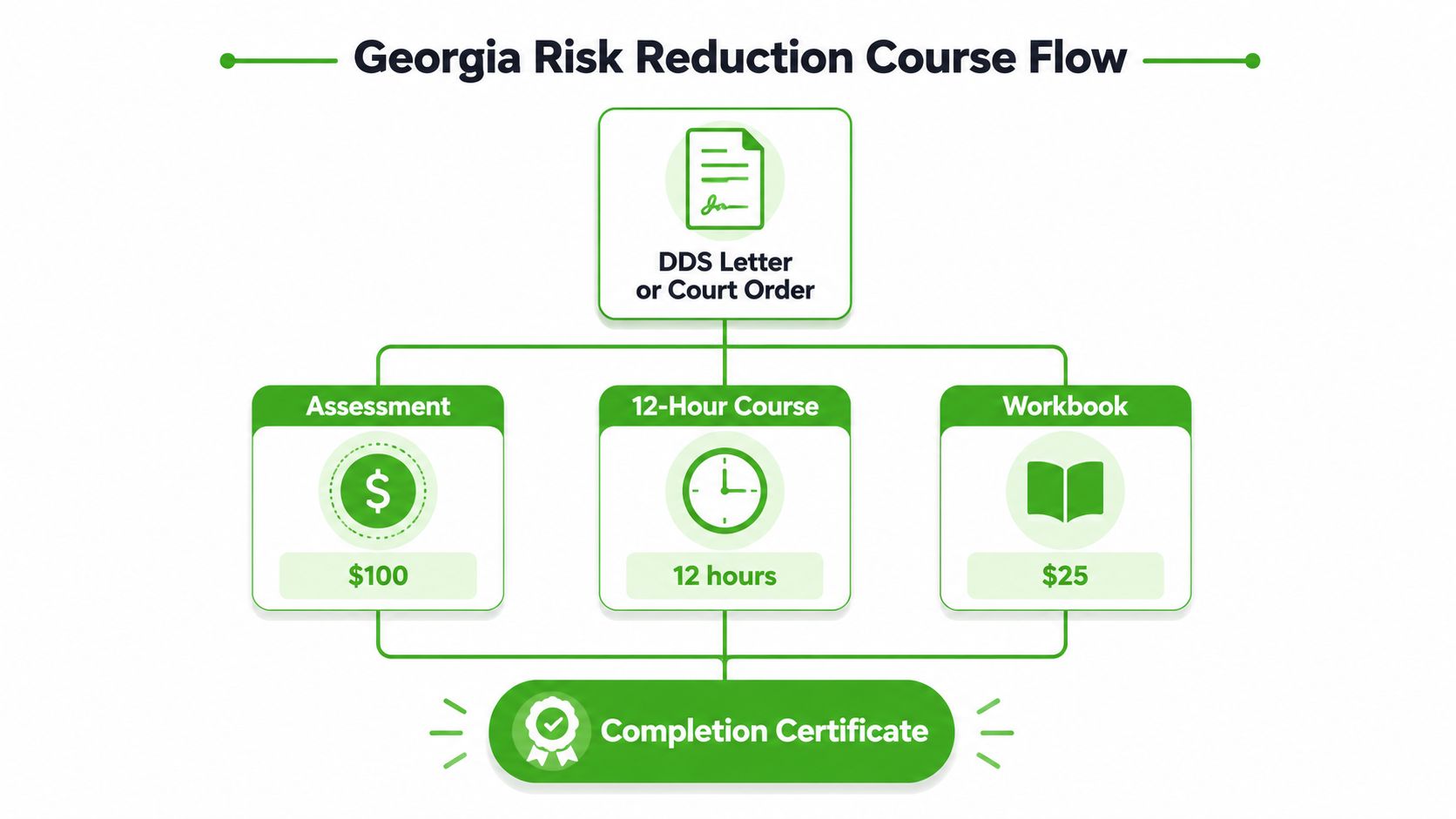
A Risk Reduction course in Atlanta is a state-mandated 20-hour DDS-approved program required after certain DUI or drug convictions, and the total fee is $360, usually split into a $100 assessment, a $235 course fee, and a $25 workbook fee. If you just got a DDS letter, a court order, or a reinstatement deadline, the first thing to understand is that this is not a generic traffic class. It's a formal compliance step tied to getting your driving privileges back.
That matters because a lot of Atlanta drivers walk in thinking they need “some kind of DUI school,” then discover the rules are more specific than that. The course, the assessment, the paperwork, and the schedule all work together, and each part affects how fast you can move toward reinstatement. If you're trying to keep your job, avoid more court trouble, or figure out whether you're even in the right program, the details below will save you a lot of guesswork.
What the Georgia Risk Reduction Course Actually Is
If a DDS notice or court order just landed on your kitchen counter, the phrase Risk Reduction course can sound vague. In Georgia, it isn't vague at all. It's a 20-hour state-regulated intervention built around a standardized screening assessment and a DDS-approved therapeutic education component, and the Georgia Department of Driver Services says it's designed to evaluate alcohol and drug use and its relationship to driving behavior. The course is part of the legal process, not an optional class you take for general awareness. Georgia DDS Risk Reduction program details
What makes it different from defensive driving
A lot of people hear “driver course” and think of point reduction or insurance savings. That's the wrong category. Risk Reduction is the program Georgia uses after certain DUI and drug-related convictions, while defensive driving is a separate education track with a different purpose. The risk reduction course exists as a bridge between a conviction and reinstatement, so the content, paperwork, and state oversight are all built around compliance.
The practical difference shows up at the front desk. If a driver needs a DDS-regulated DUI intervention, the school isn't just teaching safe habits, it's processing an official requirement. That's why the assessment comes before the class and why the completion certificate matters so much.
Practical rule: if your paperwork mentions reinstatement after DUI, drugs, or a related conviction, don't assume a generic traffic class will solve it.
Why Atlanta drivers run into this course so often
Atlanta drivers often meet this requirement after a local court hearing, a DDS reinstatement notice, or a referral from counsel. The key point is that the state framework is the same across Georgia, so Atlanta isn't dealing with a special city-only rule. What changes in the metro area is access, since local providers offer more schedule options to fit work and transportation needs.
That flexibility can make the course feel more like a service choice than a legal requirement, but the legal requirement never changes. You can pick how to take it, but you don't get to pick whether the state framework applies. Once that clicks, the rest of the process makes a lot more sense.
Who Georgia DDS and the Courts Require to Complete It
The cleanest way to tell whether this course applies to you is to look at the trigger, not the label on the class. Georgia DDS and the courts use the Risk Reduction program for people whose cases involve alcohol, drugs, or related compliance steps after a conviction or administrative action. That can include a first DUI, a repeat case, underage alcohol or drug violations, or a condition tied to license reinstatement.
The most common paths into the program
For many drivers, the requirement starts with a DUI case. A first-time offender usually has to complete the 20-hour Risk Reduction Program before reinstatement can move forward, and repeat offenders may face the same course plus additional court or probation conditions. Underage drivers can also be required to complete the program under Georgia's zero-tolerance framework, even when they don't think of their case as a “DUI” in the adult sense.
There are also non-DUI situations that lead to the same classroom. Drug-related convictions and other court-ordered compliance terms can send Atlanta drivers into the Risk Reduction process because the state looks at behavior, impairment risk, and driving safety together. The paperwork will usually tell you whether the requirement comes from DDS, the court, or both.
A good intake question is simple, “Am I here because of licensing, sentencing, or both?” The answer changes what paperwork you need next.
What to bring when you're checking eligibility
Bring the documents that show why you were referred. That usually means a DDS letter, court paperwork, or both, depending on how your case was handled. If you're unsure which rule applies, the safest move is to match the wording on the order to the provider's intake checklist before you register.
Conditional or limited license situations can add another layer. In those cases, drivers often need to show partial completion or proof that they've started the required steps before the license action can move ahead. That's why reading the order carefully matters more than guessing based on what a friend did after their own case.
Classroom, Live Virtual, and Self-Paced Online Compared
Atlanta drivers usually care about one thing first, which format will fit their week without creating a new problem at work or home. The good news is that DDS-approved providers now offer the same core Risk Reduction requirement in different delivery styles, so the main tradeoff is convenience, not compliance. The content stays tied to the state requirement, while the delivery method changes how you show up.
What each format actually changes
In-person classroom gives you a fixed schedule and direct contact with an instructor. That helps drivers who want structure, need fewer tech decisions, or prefer a traditional attendance record. It also suits people whose employer can only release them for a planned block of time.
Live virtual sessions mirror the classroom rhythm but remove the commute. If you live in the metro area and would rather not fight traffic across town, this format can save a real chunk of your day without changing the basic classroom experience.
Self-paced online coursework is the most flexible option when shift work, childcare, or unpredictable hours are part of your life. The tradeoff is that you have to manage your own pace and stay on track without an instructor in front of you.
One provider offering the online format is Georgia DUI Schools' Risk Management Course Online, which is useful when you need a DDS-approved path that fits a tighter schedule.
Acceptance worries usually come down to provider approval
The most common fear is, “Will DDS accept this?” The question is whether the provider is state-approved for the format you're taking. When a provider is DDS-approved, the completion certificate is the point of the course, not whether you sat in a room or logged in from home.
That's why two drivers can finish the same requirement in different ways and still end up with the same legal result. The format changes your week. It doesn't change the state requirement.
Atlanta Costs and How Real Schedules Are Built
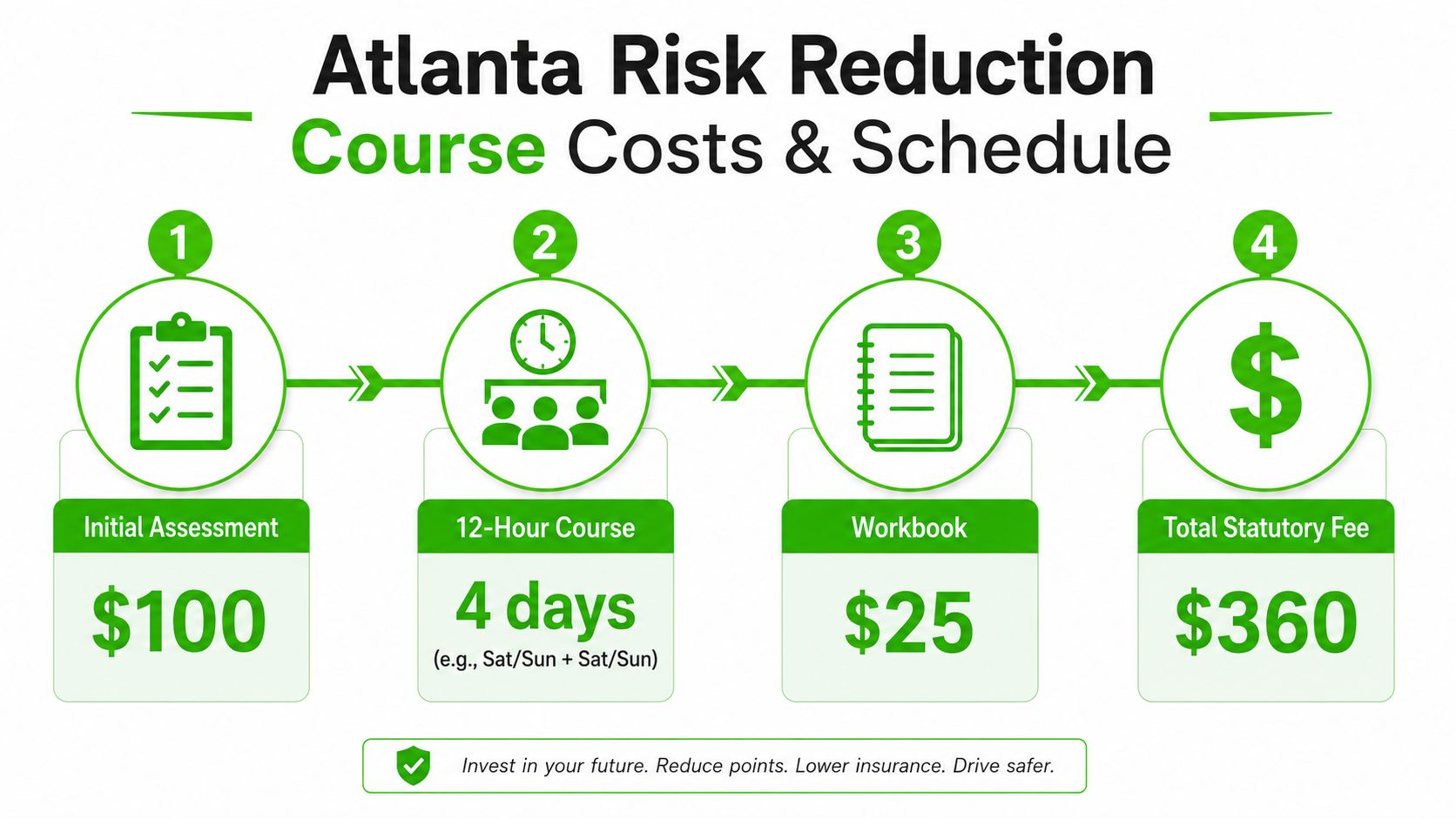
A driver who is already juggling work, court dates, and a deadline usually wants one thing first: the actual cost. In Georgia, the Risk Reduction program is set at $360 total, and that total is divided into a $100 assessment, a $235 course fee, and a $25 workbook fee. The state controls that fee structure, so comparing providers usually comes down to schedule, format, and how much time you have to miss from work, not price shopping. See the full fee breakdown for details, and review the Georgia DDS program fee structure for the state rule itself.
Why some sites make the price look inconsistent
Some Atlanta pages list the pieces differently, and that is where the confusion starts. One source may show the assessment, course, and workbook as separate parts, while another page may talk only about the total. For a driver trying to get reinstated, the practical answer is simple, this is a state-regulated compliance program with a fixed fee structure, so the question is not which school is cheaper, it is which schedule fits your week.
That fixed fee also explains why two providers can look alike on paper and still affect your life very differently. One may place the class in a weekend block, another may spread it across weekdays, and another may offer a format that reduces commute time. The amount you pay stays the same, but the amount of work time you lose can change a lot.
How Atlanta schedules are actually arranged
Atlanta providers usually organize the course around blocks that drivers can fit around jobs and family obligations. A weekend schedule may run Saturday 9:00 a.m. to 6:00 p.m., Sunday 9:00 a.m. to 6:00 p.m., and Monday evening 6:15 p.m. to 10:15 p.m. Other schedules are spread through the week, such as Tuesday 10:00 a.m. to 2:00 p.m. and Wednesday/Thursday 9:00 a.m. to 6:00 p.m. Those are the kinds of real choices Atlanta drivers compare when they are trying to finish the requirement without using more leave than necessary. The course options shown by Georgia DUI Schools' DUI classes page reflect how much format can matter once the fee is already set.
The smart move is to handle the assessment first, then choose the classroom block that interferes with work the least.
Georgia DUI Schools says it has served drivers for more than 38 years, helped over 100,000 participants, and operates 18 locations across Atlanta, Athens, and surrounding communities, with online access statewide. That scale matters because it shows how much the Atlanta market has grown around the same fixed requirement. Georgia DUI Schools
Clinical Services and Related Programs You May Also Need
The Risk Reduction course is often only one piece of the larger compliance picture. In Georgia, the process usually starts with the standardized screening assessment, which is a 130-question instrument completed before the class portion begins. That order matters because the assessment helps determine how the rest of the requirements should be handled, and it keeps people from wasting time enrolling in the wrong step first. Georgia DUI risk reduction assessment overview
How the related pieces fit together
A driver who gets flagged for a higher-risk issue may also need a clinical evaluation. That evaluation is a separate review of substance use concerns, and in some cases it leads to treatment recommendations such as ASAM Level 1 services. A court may also require a Victim Impact Panel, which is a different educational component tied to sentencing rather than the Risk Reduction class itself.
Defensive driving sits beside those items, not inside them. Some people need it for point reduction or insurance-related reasons, but it doesn't replace the DUI compliance path. The trap is assuming every course at a driving school serves the same purpose, when the state treats them very differently.
| Atlanta Compliance Component at a Glance | Purpose | Typical Hours | Format |
|---|---|---|---|
| Risk Reduction course | DUI and drug-related reinstatement requirement | 20 hours | DDS-approved classroom, live virtual, or online |
| Screening assessment | Standardized evaluation before class | 130 questions | Intake questionnaire |
| Clinical evaluation | Substance use assessment for referrals | Varies by case | Clinical visit |
| ASAM Level 1 treatment | Treatment recommendation for higher-risk cases | Varies by case | Treatment program |
| Victim Impact Panel | Sentencing-related education in some cases | Varies by case | Group presentation |
| Defensive driving | Point reduction or education track | Varies by program | Classroom, virtual, or online |
If you want a provider that can handle more than one of these steps, that can reduce hand-offs and paperwork delays. One example is Georgia DUI Schools, which also offers drug and alcohol evaluation online, alongside the state-required course and related services.
Enrollment Steps and the Documentation You Bring
The fastest way to avoid frustration is to treat enrollment like an administrative process, not a class signup. Start by registering with a DDS-approved provider, then bring your ID and any court or DDS paperwork to intake so the staff can match your case to the correct requirement. After that, you'll pay the assessment fee, complete the 130-question screening instrument, and then schedule the 20-hour class block that follows.
What happens in order
First, the provider confirms what you were ordered to complete. Then the assessment is handled before the course itself, which is why you can't skip straight to the class even if you're in a hurry. Once the screening is complete, you can book the classroom or online segment that fits your calendar.
If you already know you have an out-of-state prior or another unresolved charge, disclose it up front. Hidden history tends to cause delays later because the provider may need to review additional documentation before issuing the completion paperwork.
What to keep after completion
Keep copies of everything. That includes your receipt, the assessment record, and the completion certificate once the course is finished. Those documents are what you use when DDS or the court needs proof that you satisfied the requirement.
A lot of people try to piece this together after the fact and end up asking the same question twice. Bring the paperwork on day one, and you'll usually save yourself a return trip.
Common Misconceptions Atlanta Drivers Bring to Registration
The biggest registration mistakes come from assuming this course works like other driving classes. It doesn't. Risk Reduction is not the same as defensive driving, and if your order is for DUI or drug-related reinstatement, the generic traffic class won't satisfy that requirement.
Another common misunderstanding is that online completion won't count. That's not the issue. What matters is whether the provider is DDS-approved for the format you're using, because approved online and live virtual formats can satisfy the requirement when they're issued through the proper channel.
People also assume a completion certificate sits around forever. That's risky thinking. DDS reinstatement rules are time-sensitive, so you should act quickly after finishing instead of letting paperwork sit in a drawer.
Finally, not every driving school can issue a valid Risk Reduction certificate. Only DDS-listed providers can handle the state requirement, which is why the name on the door matters as much as the course title on the website. If a provider offers many services, that can be convenient, but the approval status is what makes the certificate usable.
For readers who want to see how service logistics affect real intake workflows, the idea behind how virtual receptionists handle patient calls is a helpful comparison. When calls are routed clearly and paperwork is captured correctly the first time, people move through the process with fewer delays.
Next Steps and Frequently Asked Questions
Your completion certificate is what DDS and the court care about, so ask the provider how it's transmitted and what copy you should keep. If you still have a court date coming up before the class ends, call the court or your attorney right away so nobody is surprised by the timing. The same provider may also help with related clinical services or panel referrals, but you should confirm that before you register.
If you need the course in Atlanta, register with a DDS-approved provider, complete the assessment, and lock in a class time that won't blow up your work week. The sooner you get the intake done, the sooner you can move from paperwork to reinstatement.
A CTA for Georgia DUI Schools.