
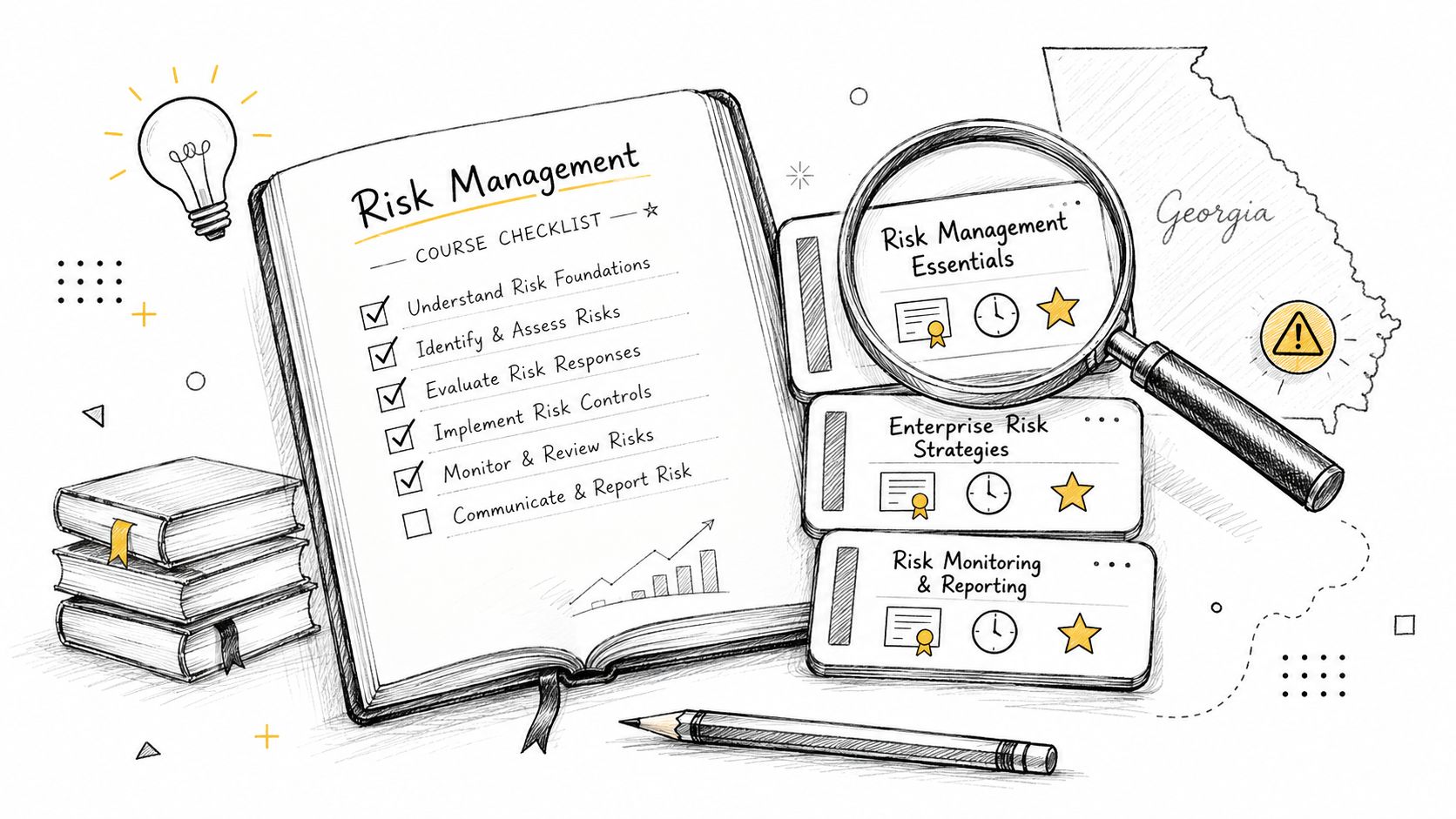
Build your skills with a free professional risk management course, but make sure you're solving the right problem. If you're trying to strengthen your career in business, project management, finance, cybersecurity, or operations, a good free course can give you a solid foundation in identifying risks, assessing impact, choosing controls, and monitoring outcomes.
If you're in Georgia and searched because of a court order, a DUI, or a license reinstatement issue, stop before you enroll in one of the courses below. These are professional development courses. They are not the Georgia state-mandated Risk Reduction Program. That distinction matters because a judge, probation office, or the Georgia DDS won't treat a general online risk management class as a substitute for the legally required DUI intervention course.
This guide does both jobs. It rounds up strong free or free-access options for professional learning, and it also points Georgia drivers away from a costly mistake. If your need is legal compliance, skip the business courses and use a state-approved provider. If your need is career growth, the list below will help you choose based on actual use case instead of marketing language.
1. Open University – Risk management (OpenLearn)
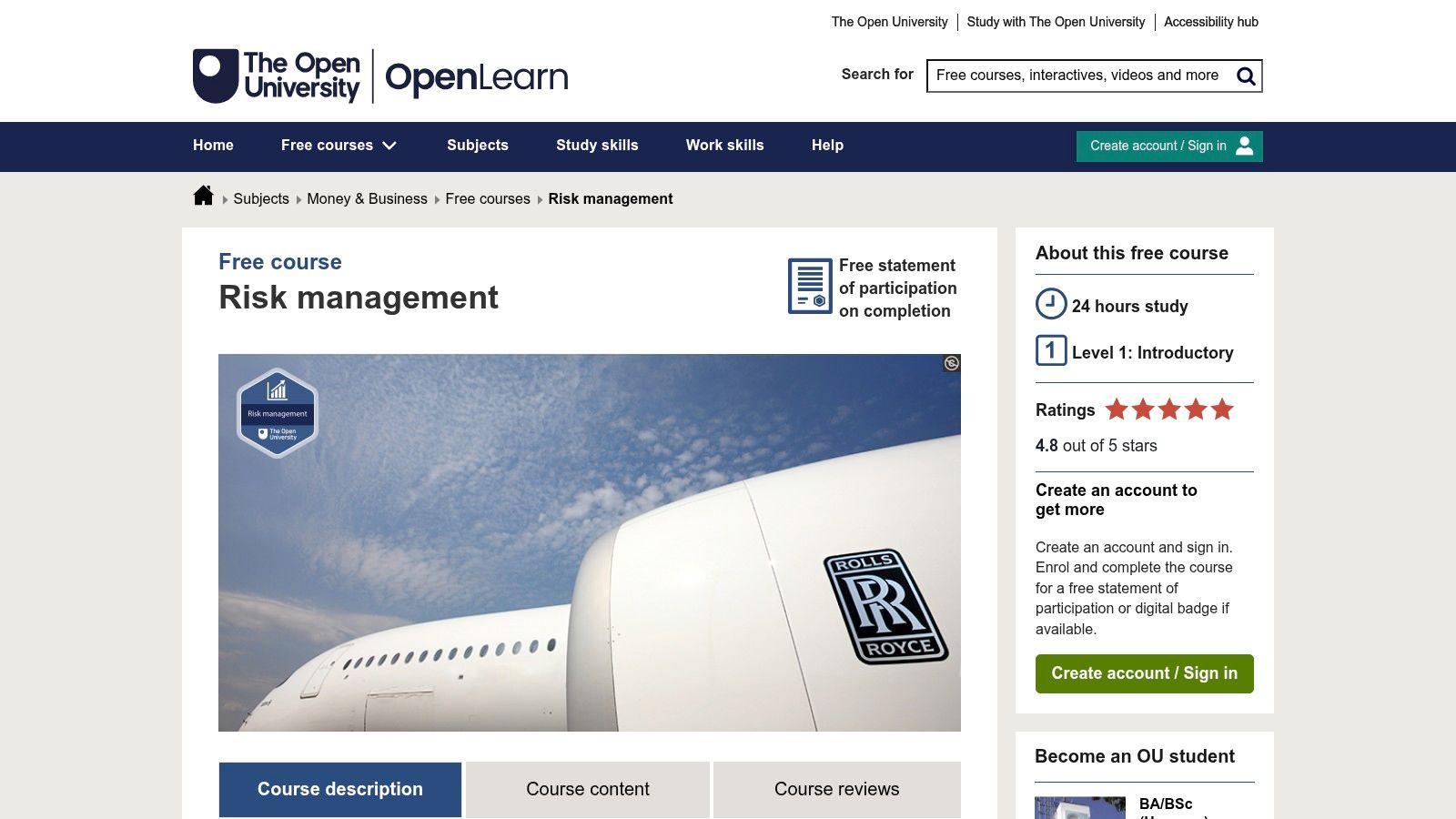
If someone asks me for one place to start with a risk management course free option, this is usually the cleanest answer. OpenLearn's Risk management course is structured as an eight-session program that covers risk identification, impact assessment, mitigation, enterprise risk management, and monitoring/reporting. That structure matters because it's the same logic used in real organizations, even when the jargon changes.
This one is especially useful for managers, compliance staff, team leads, and small business operators who need a working framework more than a niche credential. OpenLearn also makes clear that the course is designed to help learners identify and understand organizational risks, which gives it broader value than a narrow hazard-only course.
Why it works
The biggest strength here is the enterprise view. The course description explicitly emphasizes enterprise risk management, which is a practical signal that the material goes beyond isolated issues and looks at coordinated oversight across the organization.
Practical rule: If you're new to risk, start with a course that teaches the full cycle. Identify, assess, treat, monitor. That sequence transfers well across industries.
A few trade-offs are worth knowing:
- Best fit: People who need ERM vocabulary and a structured way to think.
- What it won't do: It won't function as a formal professional certification.
- Why Georgia drivers should care: If you need a court-approved DUI class, this is the wrong product entirely. Georgia's legal requirement is a separate program, explained in this overview of what a Risk Reduction course is in Georgia.
The practical value is simple. You finish with a clearer model for how organizations should surface, rank, and manage exposure.
2. Open University – Understanding and managing risk (OpenLearn)
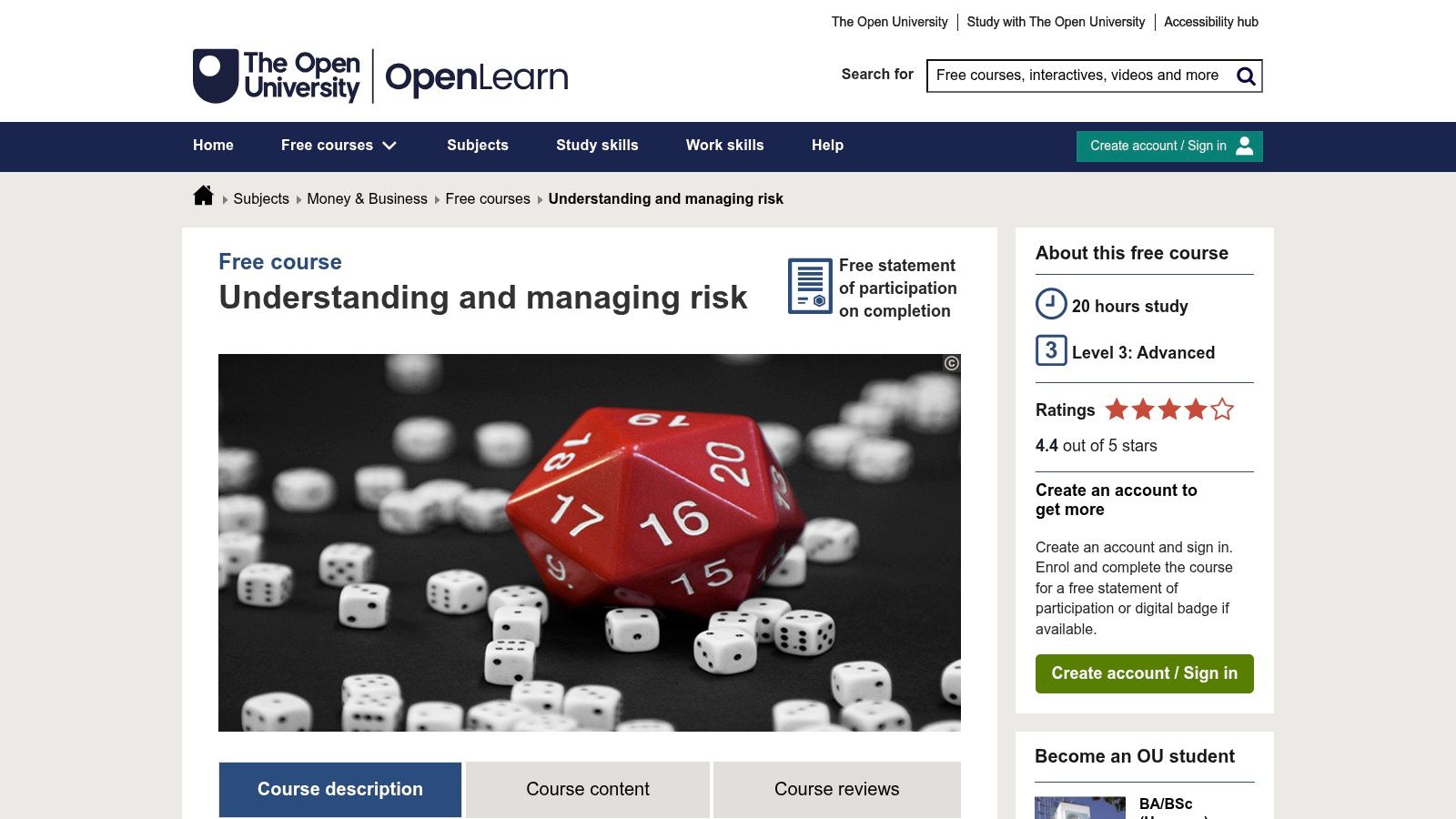
Some learners don't need a broad ERM survey first. They need help getting comfortable with uncertainty, probability, expected value, and why diversification changes the shape of risk. OpenLearn's Understanding and managing risk course fits that need better than a governance-heavy introduction.
This is the one I'd point non-quantitative learners toward when they want to stop treating risk as a vague management buzzword. It gives you a softer landing into financial reasoning without requiring advanced modeling skills.
Where it's strongest
Its best use is as a bridge course. You can move from general business risk language into the math mindset behind trade-offs, likelihood, and portfolio thinking.
That makes it valuable for:
- Students and early-career analysts: It builds intuition before technical finance training.
- Managers handling trade-offs: It sharpens thinking around downside, choice, and uncertainty.
- People comparing free options: It feels more focused than a broad intro, but less technical than specialist market-risk courses.
The limitation is equally clear. This isn't the right pick if your immediate need is operational controls, cyber frameworks, or safety process design. It leans toward financial contexts and decision logic rather than broad enterprise implementation.
Good risk education doesn't just tell you that uncertainty exists. It teaches you how to think when the outcome isn't guaranteed.
3. edX – New York Institute of Finance Introduction to Risk Management (audit option)
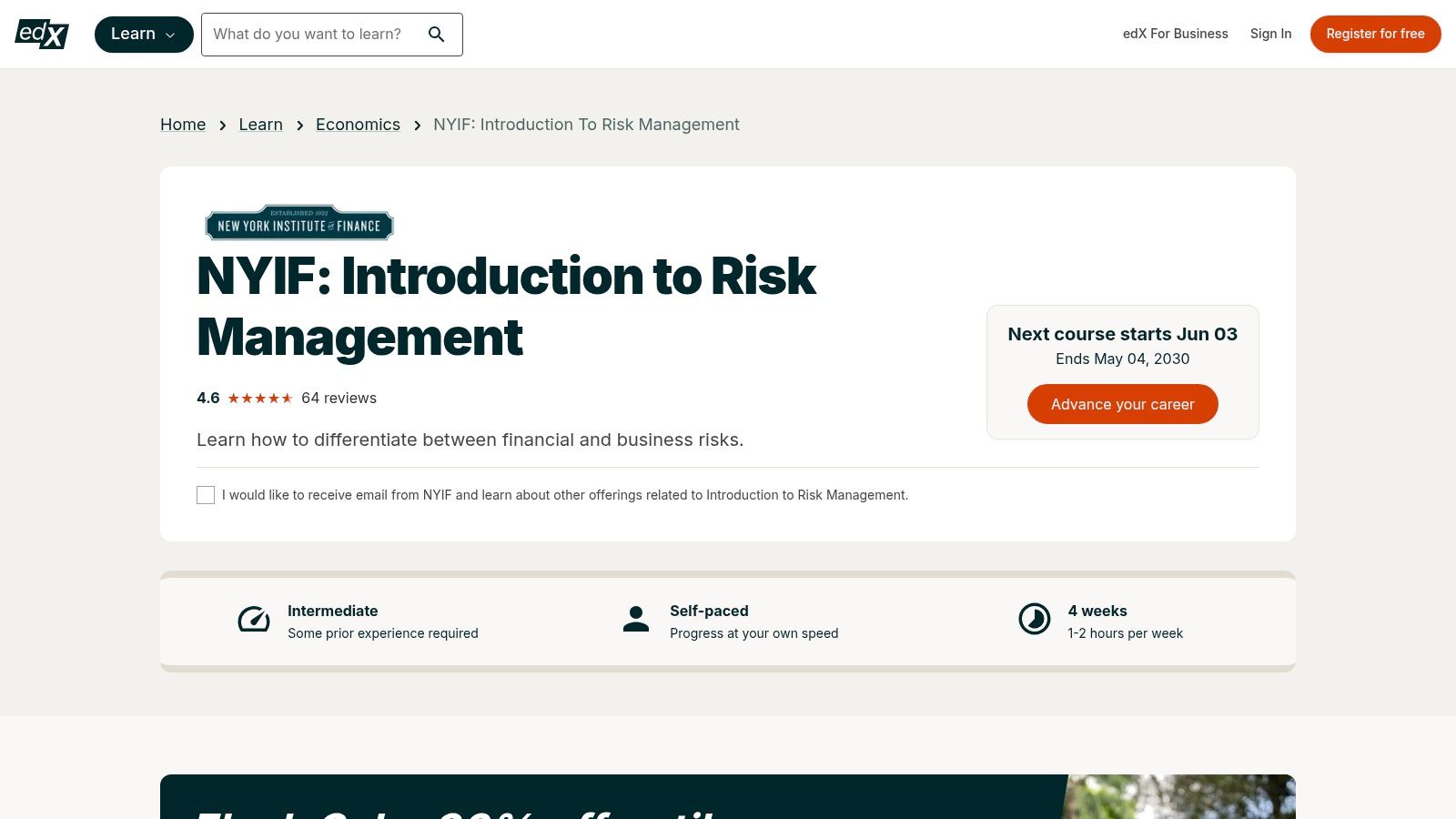
For finance-oriented learners, brand and context matter. NYIF's Introduction to Risk Management on edX is one of the better-known audit-track options if you want exposure to market, credit, and operational risk concepts from a finance training provider.
The phrase "free" often becomes ambiguous. Search results for risk management course free often mix true free learning with audit access and paid completion paths. That confusion is common across the market, and UniAthena's explanation of free access versus certificate cost is a good reminder that "free to learn" isn't always "free to credential."
The real trade-off
The upside is straightforward. NYIF signals finance relevance, and that matters if you're aiming at banking, treasury, investment support, or regulated financial roles.
The downside is also straightforward:
- Free access usually means audit access: You get the learning experience, not the full credential path.
- Assessment and certificate expectations need checking: Don't assume completion proof is included.
- Georgia compliance warning: If you need a court-approved DUI class, a finance course won't satisfy legal requirements, no matter what the word "risk" says. If you're comparing legal options, review Georgia Risk Reduction course fees and program expectations.
This is a solid pick for professionals who want financial risk vocabulary and institutional framing without immediately paying for a specialization.
4. edX – University of Adelaide Risk Management for Projects (audit option)
Project leaders often need a different kind of risk training than enterprise managers do. They care about schedules, budgets, deliverables, dependencies, and response planning. The University of Adelaide's Risk Management for Projects on edX is more practical for that audience than a general ERM course.
What makes this one useful is its project lens. It pushes you toward the habits that matter in active delivery work, such as identifying risks early, assigning responses, and monitoring them through execution rather than discussing them once in a kickoff meeting.
Best for people who ship work
If you're in operations, PMO, implementation, grants management, or compliance-heavy delivery work, this style of course tends to stick because it maps directly to what teams already track.
A good project risk course is worth more when it gives reusable artifacts, not just concepts. That's one of the clearest buying signals in this category. As Oxford Home Study Centre's overview of free risk management learning suggests, many free offerings are short-form online microcourses, so the practical question is whether they help you build things like risk registers, heat maps, or scenario templates.
- Choose this if: You run projects and need a repeatable risk workflow.
- Skip this if: You want enterprise governance or deep market-risk math.
- Expect this trade-off: Audit access is useful for learning, but not the same as a paid assessment route.
5. edX – Inter-American Development Bank Risk Management in Development Projects (audit option)
This is a smarter choice than it first appears, especially if your work touches grants, public-interest programs, nonprofit operations, or donor reporting. The Inter-American Development Bank course on edX leans into documentation, risk registers, response strategies, and life-cycle monitoring.
That documentation focus is not glamorous, but it's what many teams need. In regulated, funded, or externally reviewed environments, people don't just need to understand risk. They need to record it clearly and show what they did about it.
Why documentation-heavy training matters
A lot of professionals underestimate how much risk management is really record-keeping plus decision logic. This course is strong when accountability matters.
Documentation is often the difference between "we discussed the risk" and "we can prove we managed it."
The main trade-off is industry fit. If you work in a purely commercial environment, some examples may feel more public-sector oriented than private-sector driven. Still, the mechanics transfer well.
It's also a useful reminder that "free" isn't the only decision factor. Relevance matters just as much. edX's broader risk management category reflects how wide the field is, spanning different risk contexts and modular entry points, so a course should match your actual role, not just your budget.
6. NIST – Risk Management Framework Online Introductory Courses
If your world includes cybersecurity, federal contracting, system authorization, or security controls, stop looking at generic business courses and go straight to NIST's RMF courses. These introductory modules are built around the actual frameworks many U.S. teams work under.
This is a very different flavor of risk education. You won't get broad managerial theory first. You'll get structured, framework-based exposure that is far more useful for security, privacy, and control environments.
When this is the right choice
NIST is the best free option on this list for people who need cyber and IT governance grounding rather than general awareness.
The strongest use cases are:
- Security and compliance teams: Good primer before deeper RMF, CMMC, or control-mapping work.
- Vendors and contractors: Helpful if customer questionnaires and audits already use federal-style language.
- Internal training leads: Easy to share for staff upskilling because the content is concise.
The limitation is focus. This won't help much if your main problem is portfolio risk, legal risk, insurance, or broad operations management.
One practical buying rule applies here too. In technical risk training, look for courses that move beyond policy talk and into exposure measurement or control structure. CFI's market risk fundamentals page makes that point well by framing Value at Risk around returns and correlation matrices, which is the kind of quantification mindset that separates serious risk work from generic awareness content.
7. FEMA Emergency Management Institute – IS-1171.a Introduction to the Risk Management Process
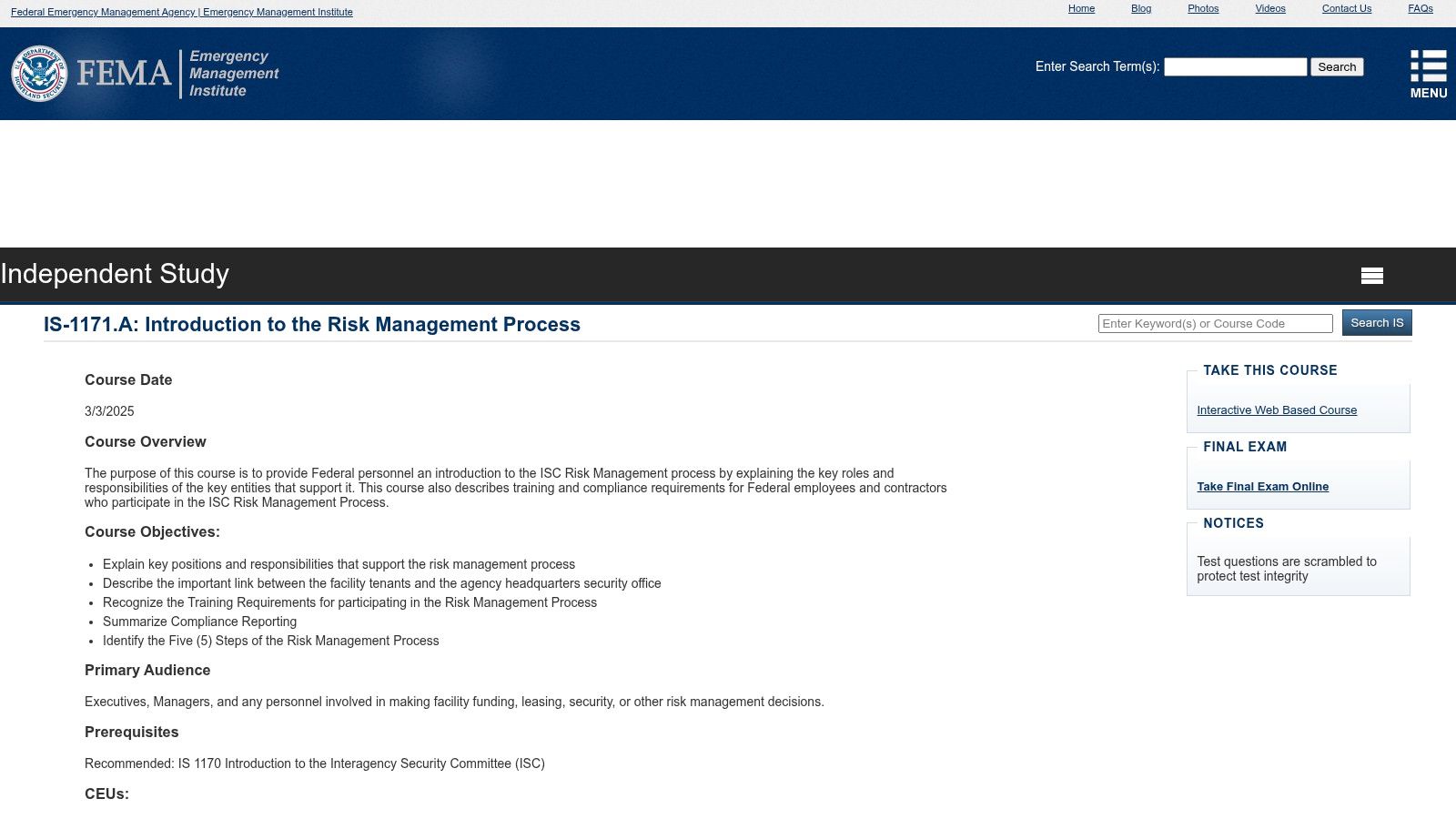
FEMA's IS-1171.a course is a practical niche option that deserves more attention. It introduces the Interagency Security Committee's risk management process for facilities, which makes it especially relevant for physical security, continuity planning, site operations, and hazard-focused environments.
This isn't the course for everyone, and that's exactly why it's useful. People often search "risk management course free" as if risk were one topic. It isn't. A facilities manager, emergency planner, and cyber analyst need very different things.
Strong fit for real-world operational environments
If your risk concerns involve buildings, access, occupancy, physical threats, or continuity functions, FEMA gives you a more grounded entry point than a business-school course.
- Good choice for: Facilities, government-linked work, campus operations, continuity planning.
- Less useful for: Finance specialists or people seeking broad ERM language first.
- Completion note: You need to follow FEMA's process for testing and certificate completion.
For Georgia readers, this is another place where people can go wrong. A FEMA certificate may be useful professionally, but it has nothing to do with Georgia DUI compliance, license reinstatement, or court-ordered intervention.
8. PMI – KICKOFF
PMI KICKOFF is the fastest option here for people who don't need a full curriculum. They need a shared team language, a simple template set, and enough project-risk grounding to start making better decisions this week.
That narrow scope is a strength. Many free courses fail because they're too broad to use and too shallow to trust. PMI KICKOFF works better as a team onboarding tool than as a standalone path for someone trying to become a risk specialist.
Best used as a practical add-on
If you manage projects, this kind of bite-size training can be enough to establish habits around issue tracking, assumptions, dependencies, and risk visibility.
Small teams usually benefit more from a simple log they actually update than from a sophisticated framework nobody maintains.
Use it when:
- You need immediate templates: Especially for simple project tracking.
- You're onboarding staff: It helps create common terminology.
- You don't need depth: This isn't a substitute for fuller ERM or finance-risk study.
I wouldn't choose this as my only course if I were changing careers into risk. I would choose it if I needed a lightweight, practical layer inside existing project work.
9. DisasterReady – Security Risk Management
DisasterReady's Security Risk Management program fills a gap that many mainstream business courses ignore. It focuses on safety, travel, incident preparedness, and duty-of-care style concerns rather than market risk, portfolio logic, or abstract governance.
That's valuable if your work includes field staff, travel, humanitarian operations, international programs, or employee safety obligations. In those contexts, scenario-driven learning beats generic theory every time.
A better option for safety-focused teams
This is one of the few entries here where context matters more than prestige. If your day-to-day problem is keeping people safe in unpredictable environments, a niche course is often more useful than a prestigious general course.
Its trade-offs are easy to understand:
- Stronger on: Security behavior, preparedness, field scenarios, practical checklists.
- Weaker on: Corporate finance, quantitative risk modeling, broad credential signaling.
- Best for: NGOs, nonprofits, security coordinators, program leads, travel-heavy organizations.
For the right audience, this will feel much more practical than a standard academic module.
10. Alison – Diploma in Risk Management
Alison's Diploma in Risk Management is the broad-access option people often choose when they want a general overview without much friction. It suits independent learners, career changers, and small teams that need terminology, process basics, and a quick introduction to enterprise-style thinking.
This category exists because demand is real. One sign of that is the way aggregators now curate lists of the 15 best free online risk management courses, which shows how mainstream the topic has become for managers, finance professionals, and compliance-oriented roles, as noted by MBA Central's roundup of free risk management learning. That same roundup also points out a key distinction in the market: Coursera's Risk Management Specialization is a 16-week program requiring 3–4 hours per week, but it isn't free, which shows how the market splits between no-cost basics and paid credential paths.
When Alison makes sense
Alison is useful when speed and accessibility matter more than pedigree. That's not a criticism. For many learners, getting through a complete intro matters more than chasing the perfect provider.
- Use it for: Broad exposure, self-paced review, team terminology alignment.
- Don't use it for: High-stakes credential signaling or specialized quantitative work.
- Georgia caution: A completion record from a general online platform is not the same thing as a state-approved legal certificate. If you're trying to prove DUI-related compliance, read what a proper Georgia Risk Reduction course certificate is for before enrolling anywhere.
10 Free Risk Management Courses, Comparison
| Course | Core focus & format | Target audience | Key benefits / unique selling points | Price & accessibility |
|---|---|---|---|---|
| Open University – Risk management (OpenLearn) | ERM introduction, self‑paced module with quizzes and checkpoints | Managers, compliance staff, small businesses | ISO/ERM concepts, guided structure, free digital badge/statement | Free; self‑paced; badge free; no tutor support |
| Open University – Understanding and managing risk (OpenLearn) | Financial risk primer; self‑paced reading + statement | Finance practitioners, non‑quantitative learners | Builds probability/EV intuition; links finance to ERM | Free; downloadable; statement free |
| edX – NYIF: Introduction to Risk Management (audit option) | Market, credit, operational risk; video modules | Finance professionals, students | NYIF brand; practical finance examples | Audit access free; graded work & cert require paid upgrade |
| edX – University of Adelaide: Risk Management for Projects (audit option) | Project risk (PMBOK‑aligned); templates and plan deliverables | Project & operations managers | Ready‑to‑use templates; full risk plan structure | Audit access free; certificate/assessments paid |
| edX – Inter‑American Development Bank: Risk Management in Development Projects (audit option) | Risk registers, qualitative analysis, monitoring; multilingual | Development sector, public projects, grant teams | Realistic cases; strong documentation focus; multi‑language | Audit access free; cert/assessments require upgrade |
| NIST – RMF Online Introductory Courses | RMF (SP 800‑37) & control families; short micro‑modules | IT/security staff, auditors | Federal alignment; Section 508 accessible; short primers | Free; open access; self‑attested completion |
| FEMA EMR – IS‑1171.a Introduction to the Risk Management Process | ISC facilities risk process; self‑study with exam | Facility/security managers, gov't contractors | FEMA certificate; compliance relevance; concrete roles/steps | Free; exam requires FEMA Student ID to earn certificate |
| PMI – KICKOFF (Project risk fundamentals) | 45–60 min micro‑course + toolkit (RAID log) | Project teams, new hires | Quick onboarding; PMBOK terminology; reusable templates | Free; requires PMI account |
| DisasterReady – Security Risk Management (Free Certificate) | Security/context assessments; scenario‑driven modules | NGOs, field staff, travelers | Practical checklists for field safety; credential on passing | Free enrollment; certificate after assessment |
| Alison – Diploma in Risk Management | ERM foundations; modular self‑paced course | Individuals, small teams seeking overview | Broad non‑technical coverage; ISO 31000 modules available | Free course access; paid certificates/prints available |
Your Next Step From Professional Skills to Legal Compliance
A free professional risk management course can absolutely be worth your time. The best options on this list help you build a usable framework, not just a glossary. Some are better for enterprise risk management, some are stronger for projects, some fit cyber and security work, and some work best as quick onboarding tools.
The mistake I see most often isn't choosing a bad course. It's choosing a course that solves the wrong problem. If your goal is career growth, a free or audit-track course can be a smart starting point. If your goal is to satisfy a Georgia court, probation requirement, DUI case, habitual offender issue, or driver's license reinstatement step, these courses won't do it.
That distinction needs to be explicit. A professional risk management course is education for business, operations, finance, project delivery, or security work. Georgia's Risk Reduction Program is a state-regulated DUI intervention requirement. It's tied to legal compliance, not general professional development. The content, approval status, completion record, and acceptance rules are different.
For Georgia drivers, the safest approach is to use a DDS-approved provider and confirm the exact requirement before spending money. That can also matter if your case involves related steps such as a clinical evaluation, ASAM Level 1 treatment, or a Victim Impact Panel. Those aren't interchangeable with general online learning either. Defensive driving is another separate category. It may help with points or insurance in the right situation, but it doesn't replace a DUI/Risk Reduction requirement.
If you're a Georgia resident and your search for "risk management course free" really started because of a legal or licensing issue, don't rely on a business-school platform, an audit course, or a free certificate from a general education site. Courts and agencies care about approval and compliance, not whether the course title sounds similar.
Georgia DUI Schools is one relevant option for people who need a Georgia DDS-approved DUI/Risk Reduction program, along with related services such as defensive driving and clinical support. The key is to match the course to the actual obligation. Professional learning for career advancement. State-approved intervention for legal compliance.
If you need a Georgia state-approved DUI/Risk Reduction class instead of a general professional course, visit Georgia DUI Schools and go directly to the program that fits your legal requirement.