

In Georgia, the required DUI Risk Reduction Program costs about $360 total, made up of a $100 assessment, a $235 intervention course, and a $25 workbook. That fee is one of the few predictable parts of a DUI case, which is why it helps to start there when everything else feels uncertain.
Those who call after a DUI aren't just asking one question. They're trying to figure out what they have to pay, what can wait, what can't, and what mistake will cost them more time. If that's where you are, the biggest relief is knowing that the class fee itself is fixed. The stress usually comes from everything wrapped around it.
Navigating Your Next Steps After a Georgia DUI
The call usually comes after a long night or an early court date. You are trying to figure out how to keep your job, whether your license is suspended, what the court expects, and how much cash you need in the next few weeks. That is why people search for DUI school cost in Georgia first. They want one number they can plan around while the rest still feels unsettled.
There is one predictable part of this process. The rest depends on your case, your county, and what DDS, the court, probation, or a clinician require.

The first cost people can actually count on
In practice, the Risk Reduction course is usually the first line item a driver can budget with confidence. Court fines may still be unknown. Reinstatement may depend on where you are in the DDS process. A clinical evaluation may or may not lead to treatment. The class requirement, though, is a fixed part of the Georgia system and often the first step toward getting back into compliance.
That is why I tell people to treat the course fee as the starting point, not the full bill.
A lot of stress comes from assuming the DUI school payment settles everything. It does not. Paying for class can satisfy the education requirement and still leave court costs, probation fees, license reinstatement fees, ignition interlock expenses, or treatment costs unresolved.
Practical rule: Build your budget in layers. Start with the class, then add court, DDS, and any clinical requirements tied to your case.
Why people get confused so fast
Georgia splits DUI obligations across different systems. The court handles its side. DDS handles licensing. A state-approved school handles the Risk Reduction requirement. If a clinical evaluation recommends treatment, that creates another separate cost and timeline.
That separation is where drivers get tripped up. I have seen people finish class on time and still be unable to reinstate because they had not completed the DDS steps. I have also seen drivers pay a fine in court and assume the education requirement was waived. It usually is not.
If you are comparing how DUI cases work in other states, understanding Texas DUI charges can help show how different the process can look once an arrest moves into licensing, court, and compliance requirements.
For drivers with employment-related compliance questions, the Georgia return-to-duty process for substance-related job requirements is a separate issue from Georgia DUI school and should be handled as its own track.
What actually helps
Drivers who avoid extra delays usually do three things early:
- Confirm every requirement in writing: Verify whether you need the Risk Reduction Program, a clinical evaluation, treatment, reinstatement steps, or all of them.
- Use a state-approved provider: A generic driving class will not satisfy a Georgia DUI requirement.
- Keep every document together: Save court paperwork, DDS notices, payment receipts, and your completion certificate the day you get them.
That discipline saves money. Missed steps usually cost more than the class itself.
The Standard Cost for Georgia's DUI Risk Reduction Program
A lot of drivers call after court and ask the same question first: “What does DUI school cost in Georgia?” They are usually hoping the answer is simple and limited to one class payment. The class fee is the clearest part of the process, but it is only one line item in a much larger bill.
For the Georgia Risk Reduction Program itself, the price is generally fixed by the state. Approved providers do not have wide room to set their own tuition, so shopping around rarely produces major savings on the required program.
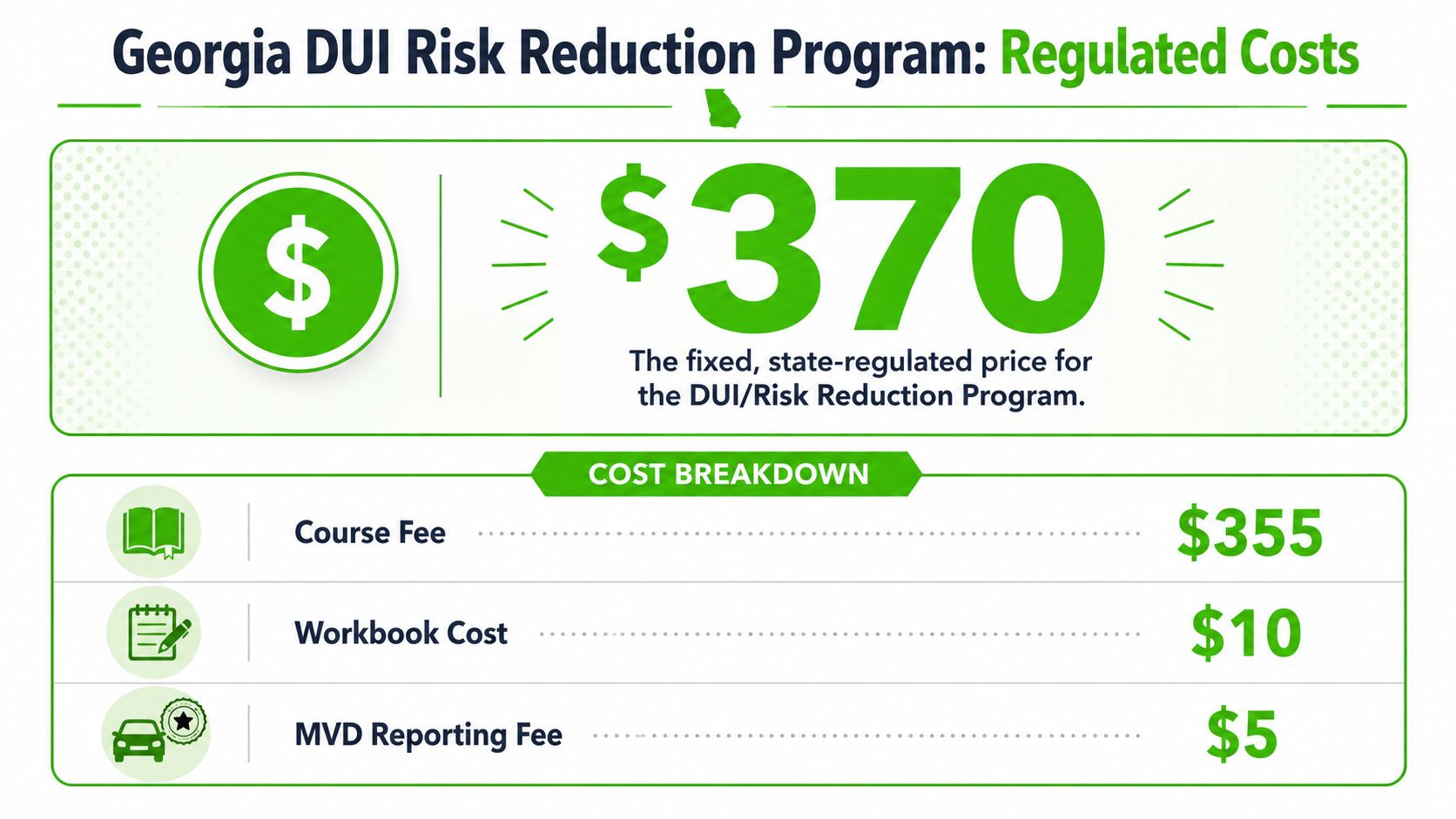
The standard breakdown is straightforward. The program fee is typically about $360 total, made up of a $100 assessment, a $235 intervention course, and a $25 workbook. The course requirement is 20 hours.
What the fee actually covers
Here is the usual state-set structure:
| Program part | Cost |
|---|---|
| Assessment | $100 |
| Intervention course | $235 |
| Workbook | $25 |
The assessment is completed first. The intervention course is the classroom portion required for completion. The workbook is required material, not an optional add-on. Put together, those charges make up the standard price for the education piece of a Georgia DUI case.
That fixed price helps, but it also creates confusion. Drivers hear “$360” and assume they now understand the cost of getting through the DUI requirement. In practice, they only understand the cost of one mandatory step.
Why calling ten schools usually does not save much
Price is not where approved programs differ most. Schedule, communication, and how quickly a provider can get you assessed and enrolled usually matter more.
I tell people to compare the things that affect deadlines and stress level:
- How soon you can start: Waiting too long can create court or probation problems.
- Class schedule: Weekend, weekday, and timing options matter if you are trying to keep a job.
- Attendance rules and rescheduling: A missed class can cost time and money.
- Certificate process: You need to know when and how proof of completion is issued.
- Whether staff explain the full process clearly: Good administration prevents expensive mistakes.
A provider that answers the phone, explains the paperwork, and gets you into class on time can save more money than a provider that sounds cheaper at first but creates delays.
The bigger point most articles miss
The Risk Reduction Program fee is standardized. The total DUI cost is not.
Court fines, reinstatement charges, probation fees, ignition interlock in some cases, time away from work, and possible treatment costs can push the actual number far past the class fee. If release conditions include monitoring, costs can rise there too. This guide to Georgia ankle monitor expenses gives a useful example of how one added requirement can change a budget fast.
So yes, Georgia DUI school usually costs about $360 for the program itself. The hard part for many drivers is not finding that number. It is understanding that the class fee is the smallest clear bill in a process filled with separate agencies, separate deadlines, and separate payments.
Budgeting for Fines Reinstatement and Other DUI Fees
The class fee is usually the easiest number in the whole case. The harder part is the larger financial stack that sits around it.
A 2026 Georgia legal cost summary says the full financial impact of a DUI in Georgia often ranges from $10,000 to $25,000 or more once fines, fees, insurance increases, and indirect losses are included. That same summary notes that even a first-offense case may begin with a base fine of $300 to $1,000, while license reinstatement can require additional fees totaling about $410, as outlined in this Georgia DUI cost breakdown.
Estimated DUI-related costs in Georgia
| Expense Category | Typical Cost Range |
|---|---|
| DUI school / Risk Reduction Program | About $360 |
| First-offense base fine | $300 to $1,000 |
| License reinstatement fees | About $410 |
| Total financial impact in some cases | $10,000 to $25,000 or more |
That table doesn't mean every case lands the same way. It means the class fee is often one of the smaller pieces once the full case unfolds.
Where the real budget pressure shows up
For many, the painful costs aren't limited to what the court says on sentencing day. They show up in layers:
- Court fines and required payments: These can start early and often have firm deadlines.
- DDS reinstatement costs: You can finish the class and still need to pay separate reinstatement-related amounts before driving privileges are restored.
- Insurance consequences: Many drivers feel the monthly impact long after the case is closed.
- Indirect losses: Missed work, transportation problems, rideshare dependence, and time off for court or classes add up quickly.
If a judge also orders extra monitoring or supervision, those costs can sit outside the usual class-and-fine conversation. In some cases, this guide to Georgia ankle monitor expenses helps people understand one of those less obvious add-on categories.
The mistake I see most often is budgeting for the class and the fine, but not budgeting for the period between losing easy transportation and getting legally back on the road.
A practical way to build your budget
Don't try to solve the whole number in your head. Break it into buckets.
Immediate compliance costs
These are the payments that keep you moving through the case, such as the class and any near-term court obligations.License-related costs
These cover what DDS requires for reinstatement when you become eligible.Case-specific extras
Treatment, monitoring, document replacement, and administrative delays can increase the total.
People handle this better when they stop asking, “How much is a DUI?” and start asking, “What do I owe, to whom, and by when?” That question gets clearer answers.
Understanding Clinical Evaluation and ASAM Treatment Costs
Many people often get tripped up, assuming the DUI class covers everything educational and clinical in one package. It doesn't.
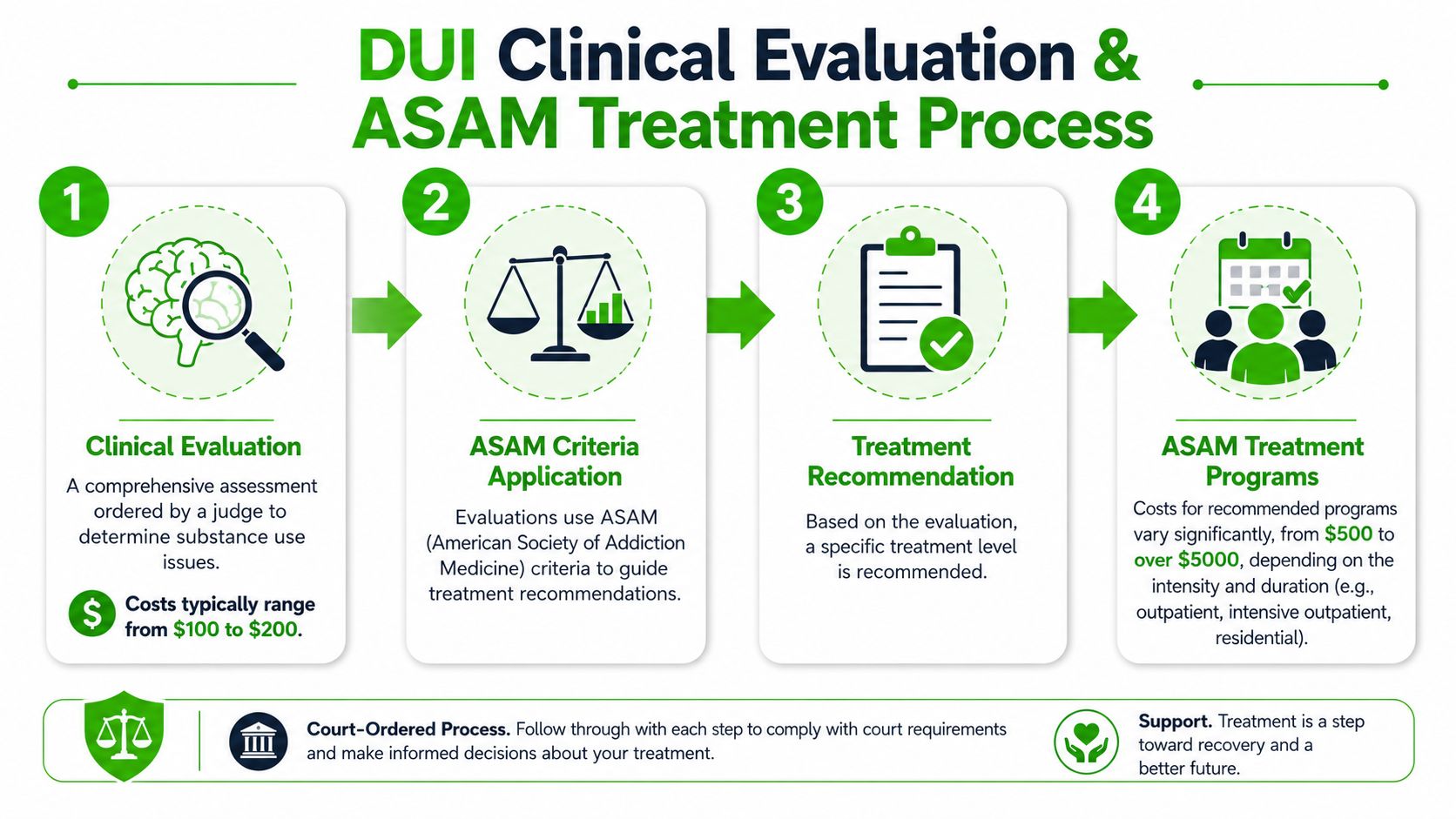
A clinical evaluation is a separate process from the Risk Reduction course. If a judge, probation officer, or another authority requires one, you should treat it as its own step with its own timing, paperwork, and possible follow-up recommendations.
What the evaluation does
The evaluation is used to assess substance use concerns and determine whether treatment is recommended. That recommendation can affect what the court, probation, or another decision-maker expects you to complete.
The key point is simple. DUI school is education. Clinical evaluation is assessment. Treatment is another category after that. They connect, but they are not interchangeable.
Where people lose time and money
Most confusion comes from one of these mistakes:
- Taking the class and assuming that's enough: It may be enough for one part of the case and not enough for another.
- Waiting too long to schedule the evaluation: Delays can slow down compliance.
- Using different providers without clear records: That can create document problems when someone asks for proof of completion or recommendations.
A clean process beats a cheap-looking process. When records are scattered, people often pay in delay before they pay in dollars.
If treatment is recommended, the level and duration can vary by the facts of the case and the evaluator's findings. That's why broad price promises are usually not helpful. Without a specific recommendation, nobody can accurately tell you what your full treatment cost will be.
How to think about ASAM treatment
When someone is referred to ASAM-based services, they're no longer dealing only with a class requirement. They're dealing with a clinical recommendation that may affect legal compliance. The smart move is to get clear answers on four points:
- Who ordered it
- What exact document is required
- Whether completion must be reported somewhere
- Whether treatment is separate from the school fee
For people who need that next step, the Georgia ASAM Level 1 treatment program gives a more focused look at that part of the process.
What works best in practice
If your case may involve both education and clinical follow-up, integrated providers can reduce friction because your paperwork and scheduling stay in one system. Georgia DUI Schools is one example of a provider that offers Risk Reduction classes along with clinical services, which can help when a case requires more than one compliance step.
That doesn't change your legal requirements. It just makes them easier to track.
Defensive Driving vs DUI School Costs and Benefits
A lot of people hear “take a driving class” and assume all programs do the same thing. They don't. This is one of the most expensive misunderstandings in Georgia because taking the wrong class can leave you still out of compliance.
DUI school, meaning the Georgia Risk Reduction Program, is tied to DUI-related requirements and license restoration issues. Defensive driving serves different purposes, such as point reduction, ticket-related matters, or insurance-related goals depending on the situation.
They solve different problems
Here's the simplest comparison:
| Course type | Main purpose |
|---|---|
| DUI / Risk Reduction | Required for certain DUI-related compliance and reinstatement situations |
| Defensive Driving | Used for point reduction, ticket dismissal in some situations, or insurance-related benefits |
If you have a DUI case, a defensive driving course usually does not substitute for the required Risk Reduction program. That's the part people need to hear clearly. A cheaper class is still wasted money if it doesn't satisfy the order you were given.
Why people mix them up
The confusion usually comes from broad language on court paperwork, advice from friends, or online searches that lump every driving course together. Someone in DeKalb may be trying to handle a speeding ticket issue. Someone in Gwinnett may be handling points. Someone in Fulton may be trying to satisfy DUI reinstatement requirements. Those are not the same administrative problem.
That's why you need to identify the exact requirement before enrolling.
When defensive driving makes sense
Defensive driving can be useful when your goal is not DUI compliance but traffic-related improvement or insurance-related benefits. If that's your situation, this Georgia defensive driving course for lowering insurance explains that separate path.
The practical difference is this:
- If DDS, the court, or probation requires Risk Reduction after a DUI, enroll in the DUI program.
- If your issue is points, a non-DUI traffic matter, or insurance concerns, defensive driving may be the right fit.
Taking the wrong class doesn't usually create a partial credit situation. It creates a second enrollment.
Cost isn't the only comparison
People naturally compare price first. That's understandable when money is tight. But the better question is whether the course matches the legal purpose attached to your case. A lower-priced class with more flexibility may sound appealing, but it won't help if your actual requirement is the Georgia DUI course.
When in doubt, read the exact wording from the court, probation, or DDS notice and verify before paying.
Tips to Meet Georgia's DUI Requirements Efficiently
You leave court thinking the hard part is over. Then the paperwork starts. One office wants proof of class completion, another wants a clinical evaluation, and nobody explains what has to be done first. That is where people lose time and spend more than they expected.

The fastest way through a Georgia DUI requirement is to treat it like a compliance file, not just a class signup. The $360 course fee is only one part of the cost. Delays, missed deadlines, repeated intakes, and bad assumptions are what usually make the total bill climb.
A checklist that prevents extra expense
- Confirm the exact requirement before you pay: Read the order, probation terms, or DDS notice line by line. "School" can mean Risk Reduction, defensive driving, evaluation, or treatment.
- Verify that the provider is approved for the requirement you have: A class that sounds similar does not help if the agency expects a different program.
- Ask how absences, reschedules, and late arrivals are handled: A cheap registration can become expensive if your schedule makes completion unrealistic.
- Keep every record the day you receive it: Save receipts, certificates, intake forms, and any instructions about where proof must be sent.
- Confirm who needs the completion document: Court, probation, DDS, and treatment providers do not automatically share paperwork with each other.
- Complete steps in the right order: If your case includes evaluation or treatment, one unfinished item can hold up the next and delay reinstatement.
Where people usually get stuck
The common mistake is not laziness. It is confusion.
A person hears "take DUI school" and signs up for the first class with an open seat. Later, they learn the court also expects an evaluation, probation wants separate proof, or DDS still needs a different filing before reinstatement can move. Then they pay for more appointments, take more time off work, and start calling around trying to fix a problem that could have been avoided on day one.
Waiting until the deadline is close causes a second kind of trouble. If you leave no room for document issues, scheduling conflicts, or a follow-up referral, a routine requirement turns into a compliance problem fast.
Keep one folder for court papers, DDS notices, payment receipts, class records, evaluation documents, and completion certificates. That one habit prevents a surprising number of repeat fees.
How to keep the total cost down
You may not be able to lower the state-set class fee. You can still cut waste.
Pick a schedule you can attend. Ask direct questions before paying. If evaluation or treatment may be part of your case, ask how records move between providers and whether you will have to repeat intake steps. Missed steps often become paid steps.
Georgia DUI cases feel expensive partly because the charges come from different directions. Once you separate the fixed program cost from the variable court, reinstatement, evaluation, and treatment costs, the process becomes easier to handle and easier to budget for.