A Will County victim impact panel is a court-ordered session where people who survived an impaired-driving crash, or relatives of someone who died in one, describe the harm that driver caused. Under 625 ILCS 5/11-501.01, a judge may require it after a DUI guilty finding, a guilty plea, or an order of court supervision, and the session is one condition among several that a case can carry.
You probably have the paperwork in front of you right now. A sentencing order from the Will County courthouse in Joliet with a line about a victim impact panel, a deadline you're not certain you read correctly, and no obvious answer to whether the panel you found online will count. The order looks simple. The compliance path around it isn't.
The session itself is easy to understand once someone explains it. What trips people up is everything attached: which provider the judge named, whether the format was supposed to be in person, and what happens when a defendant registers for something legitimate but wrong. That gap between a real panel and a panel that satisfies your order is where cases get continued, and it's the gap this guide closes.
Who Must Attend a Will County Victim Impact Panel
A DUI case in Will County rarely ends at the plea. The judge attaches conditions, and one of them is often a victim impact panel: a restorative session in which a person seriously injured by an impaired driver, or a family member of someone killed, describes the physical, emotional, financial, and social cost of that crash to an audience the court has sent.
The statute is the right place to start, because it names both who can require the panel and who can deliver it. The Illinois General Assembly text of 625 ILCS 5/11-501.01 allows a court to order attendance for a person found guilty of, pleading guilty to, or receiving court supervision for driving under the influence. It identifies county state's attorney offices, probation and court services departments, Mothers Against Drunk Driving, and the Alliance Against Intoxicated Motorists as eligible providers or contracting organizations.
Here's how those categories line up in practice.
| Legal status | Who may be ordered | Eligible provider | Fee |
|---|---|---|---|
| Guilty finding for DUI | Person found guilty of driving under the influence | State's attorney, probation or court services, MADD, or AAIM | Offender fees or as the court determines |
| Guilty plea to DUI | Person who pleaded guilty to DUI | State's attorney, probation or court services, MADD, or AAIM | Offender fees or as the court determines |
| Court supervision | Person receiving court supervision for DUI | State's attorney, probation or court services, MADD, or AAIM | Offender fees or as the court determines |
| Will County local referral | Defendant directed by the Circuit Clerk's DUI-case instructions | AAIM or MADD information linked by the Circuit Clerk | Confirm on the provider registration, not a county price list |
Read the first column as your case posture and the third as your shopping list. A guilty finding, a guilty plea, and an order of supervision all sit inside the same statutory language, which is why a person who never went to trial can still walk out of the courthouse with a panel date to schedule.
What the Circuit Clerk actually publishes
Will County's Circuit Clerk does not run a single county-wide calendar with one price and one location. It directs people to AAIM and MADD information for the county's victim impact panel requirements, which tells you the program is embedded in the local court-compliance system rather than offered as an optional educational extra.
That referral structure matters for one reason. The clerk's page identifies the requirement; it doesn't replace the specific provider name written into your order.
Why an evaluation shows up in the same statute
The same provision requires a professional evaluation after a DUI finding and before final sentencing or an order of supervision, to determine whether an alcohol, drug, or intoxicating-compound problem exists and whether treatment is appropriate. That placement is deliberate. It frames the panel as one step in a sequence of accountability, assessment, and possible treatment, not an isolated class you squeeze in and forget.
Read the order before you pay anyone: The provider named in your sentencing or supervision order controls. If it names AAIM, a MADD certificate may not close the file, and the reverse is just as true.
If your case is pending in Georgia instead of Illinois, the consequences of a DUI run through a different statutory framework with its own deadlines and its own two-part course requirement. Confirm which state's courthouse issued your order before you register anywhere.
What Happens During the Panel Session
Walk into a typical session and the setup is plain: rows of chairs, a sign-in table where someone checks your name against a list, and a facilitator who opens with a short explanation of why everyone is there. Then three or four speakers take over, one at a time. A person who was hit by a drunk driver describes the surgeries and the years of physical therapy. A parent describes the phone call about a child who didn't come home. Nobody lectures you on statutes. Nobody runs a group discussion.
That shape is intentional. Program materials describe victim impact panels as not punitive in nature, and note that Illinois judges order them primarily for prevention among people charged with DUI or related offenses. You're there to hear harm described firsthand by the people it landed on.
The scale behind that room is bigger than most attendees realize. A 2009 evaluation of Illinois victim impact panels reported that panels reached more than 700 defendants across several Illinois counties each month, and that AAIM's network included monthly facilitation in Cook, DuPage, Kane, McHenry, and Will counties. Lake County capacity was reported at up to 150 participants per month.
The same evaluation collected session-level feedback from February through April 2009 and found positive ratings generally ranging from approximately 80.0% to 94.3% across the measured items. Those items asked whether participants found the program useful or very useful, whether they intended to change drinking-and-driving behavior, whether they would recommend it, and whether they intended to drive under the influence in the future.
Those percentages are what attendees said on a feedback form. They are not evidence that crashes or arrests fell, and no one should quote them as if they were.
One practical detail the county doesn't post is a standing session length. Treat the confirmation email from your provider as the schedule of record. Plan to arrive early enough to be checked in, plan to stay for the whole thing, and don't expect the panel to stand in for the evaluation your case also requires.
How the Panel Differs From Evaluation and Treatment
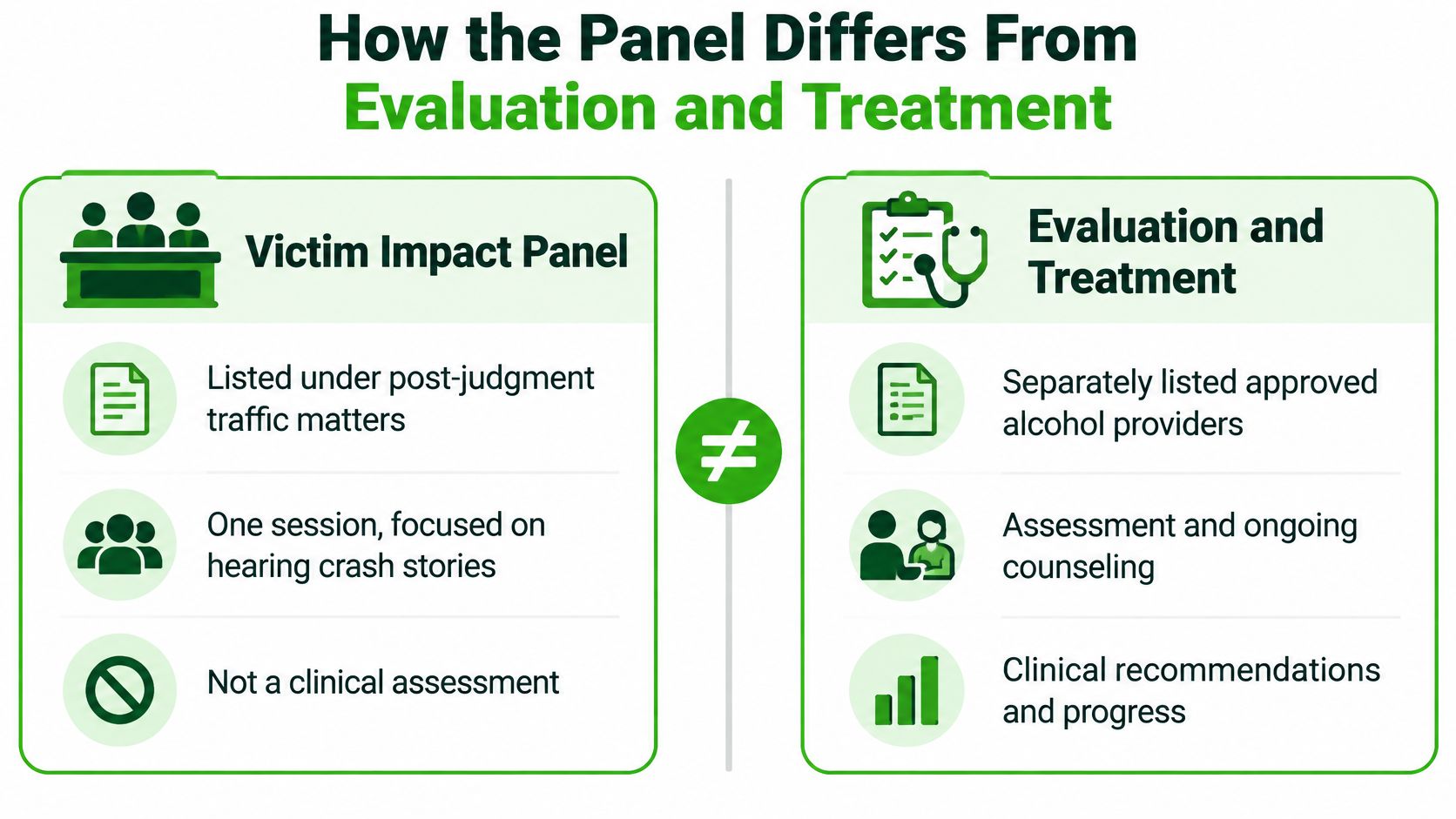
You leave with a certificate in your email and treat it like the last page of the case. In a Will County DUI, that certificate is one condition on a longer list. Public information about the panel does not say that finishing it replaces, supplements, or shortcuts the evaluation, treatment, probation reporting, or license steps that may sit beside it. When that paperwork stays quiet, people invent a shortcut: panel done, case done. The shortcut fails.
| Obligation | Purpose | Proof goes to | Panel replaces it |
|---|---|---|---|
| Victim impact panel | Hear firsthand harm from impaired driving | Court and sometimes probation, as the order states | Not applicable; this is the panel |
| Professional DUI evaluation | Decide if an alcohol, drug, or intoxicating-compound problem exists | Court before sentencing or supervision | No |
| Treatment if recommended | Address a substance problem found in the evaluation | Provider and the court or probation | No |
| Probation reporting | Meet supervision conditions beyond the panel | Probation or court services | No |
| Illinois license reinstatement | Restore driving privileges under Secretary of State rules | Illinois Secretary of State | No |
Read the last column from top to bottom. Every answer is no, because each row answers a different question. The panel is about hearing the harm. The evaluation is about whether a clinical problem exists. Treatment is about working on that problem if the evaluation finds one. License reinstatement is about driving privileges under rules the Illinois Secretary of State administers, not the Will County courthouse.
A useful picture is three separate errands after the same charge. One errand is sitting in the room and listening. Another is the professional assessment. The third is the license office. Finishing the first errand does not stamp the other two complete.
The order of operations in plain words
The evaluation comes early. The statute requires it before final sentencing or an order of supervision, and it looks for an alcohol, drug, or intoxicating-compound problem. If the evaluator recommends treatment, treatment follows that finding. It does not wipe the finding out, and the provider plus the court or probation track whether you finish. The panel is education the judge ordered. It sits beside those steps, on the same level, with its own proof.
A clinical evaluation from another state's program is the same kind of separate question. The drug and alcohol evaluation used in Georgia DUI cases is a professional assessment of substance use. It still would not satisfy a Will County victim impact panel, and it would not stand in for the Illinois evaluation your order requires.
Filing rule: Panel proof, evaluation or treatment proof, and license paperwork go in three separate folders. They travel to different offices and get checked at different times.
Misdemeanor DUI, felony DUI, supervision, and out-of-state defendants can each carry different add-on orders. The written Will County order controls. A forum post does not, and neither does a friend's case from two years ago. A missed panel is a compliance problem to raise with your lawyer. A later treatment appointment does not erase it.
Confirming the Panel Will Count and Planning Around Access
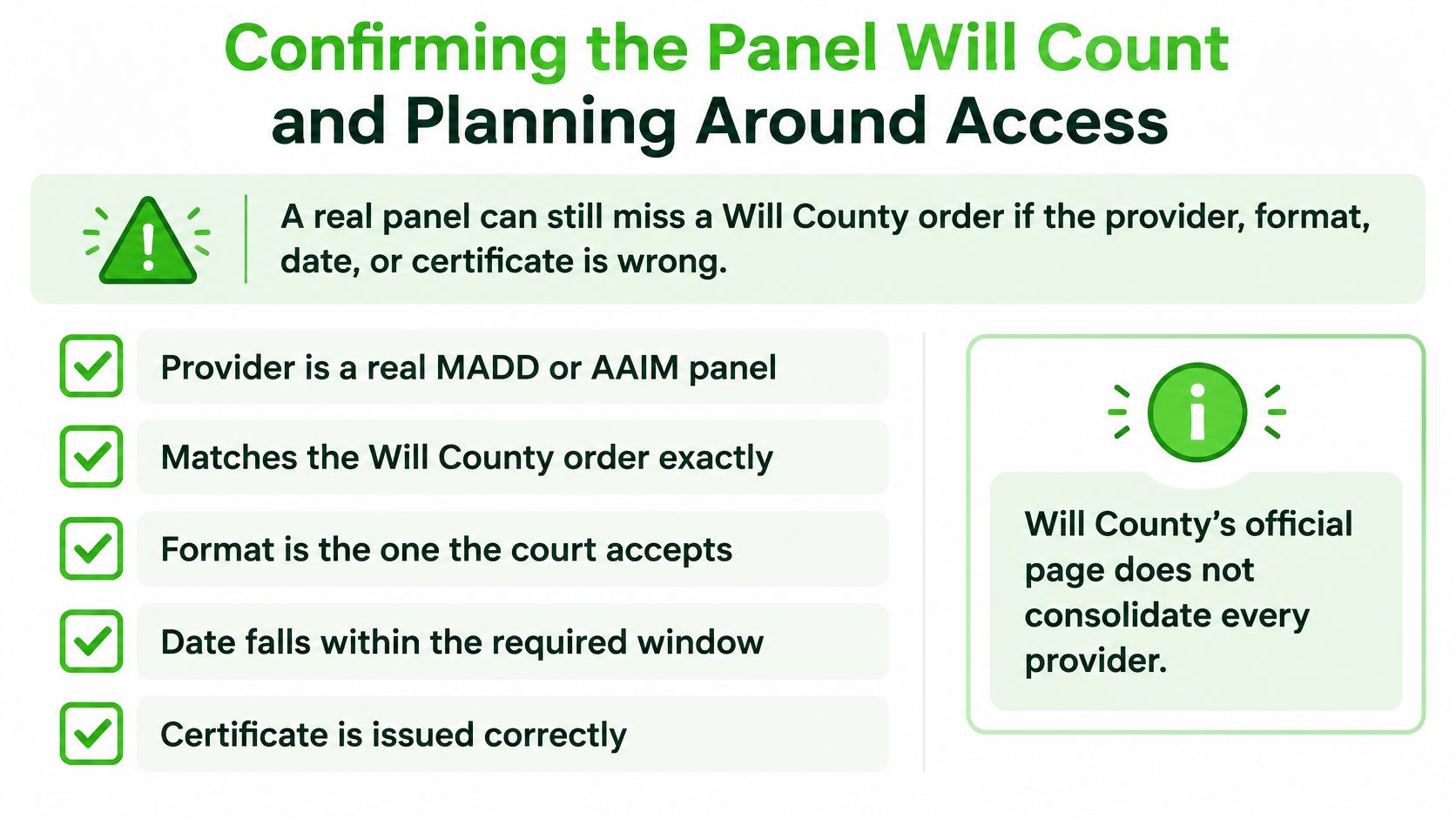
A driver pays for a real MADD or AAIM session, stays for the whole meeting, and still gets called back to Will County court. The session was legitimate. The provider, the format, the date, or the certificate did not match the written order. Showing up and satisfying the condition are not the same step. A panel works like a key cut for one lock. A similar key from another office will not turn it.
Will County's official page does not gather the details you need before you register. Dates, how long the session runs, fees, the room, identification, cancellation rules, accessibility, language support, and how fast a completion certificate reaches the court sit on separate AAIM and MADD pages. Matching those pages to the order is your work, and it happens before you pay.
Work through the checks in this order. Registration comes last.
- Read the order line by line. Find the named provider, the completion deadline, and whether electronic attendance is allowed. If the order names one organization, that name is the requirement.
- Confirm acceptance with counsel or probation. Ask whether this provider and this format are accepted in this courtroom. Defense counsel and probation officers know how a specific judge reads a specific condition.
- Register only after the order and the provider agree. Save the receipt and the confirmation email. Both show the date you acted if a deadline is later disputed.
- Bring the required identification and arrive early. You have to be marked present for the full session. A late arrival or an early departure is recorded as incomplete, and an incomplete entry looks like a missed panel in the court file.
- Ask how cancellations and missed dates are handled before you need the answer. A provider cancellation and a defendant no-show are different events. Your no-show may need a continuance or a motion, not a quiet makeup session.
- Keep the certificate and confirm where it goes. Ask whether it goes to the court, to probation, or to both, and keep your own copy. A certificate from the wrong organization, or one that never reaches the office named in the order, leaves the condition open.
Planning around access, work, and distance
The same order is harder for some people to meet. Someone living outside Joliet, working nights, without a car, or managing a disability still has to reach one room on one evening. The order does not pause for a shift change or a missed bus.
Before you pay, ask the provider three questions. Where is the session held, and how is the door marked? Is language support or an accommodation available? What happens if you cannot reach the location on the assigned date? Get the answers in an email you keep.
Holding pattern: If counsel or probation cannot tell you that a specific registration will satisfy the order, the seat is not booked yet. Ask again before you pay.
Save every email that shows an attempt to comply, including the ones the provider did not answer. If a deadline slips through no fault of yours, that record is what your lawyer uses to explain the delay to the judge.
A finished panel closes only the panel condition. It does not stand in for an evaluation, it does not stand in for treatment, and it does not reinstate a driver's license. Those checks belong to other offices, and each one looks for its own paperwork.
What Studies Show About Rearrest Risk
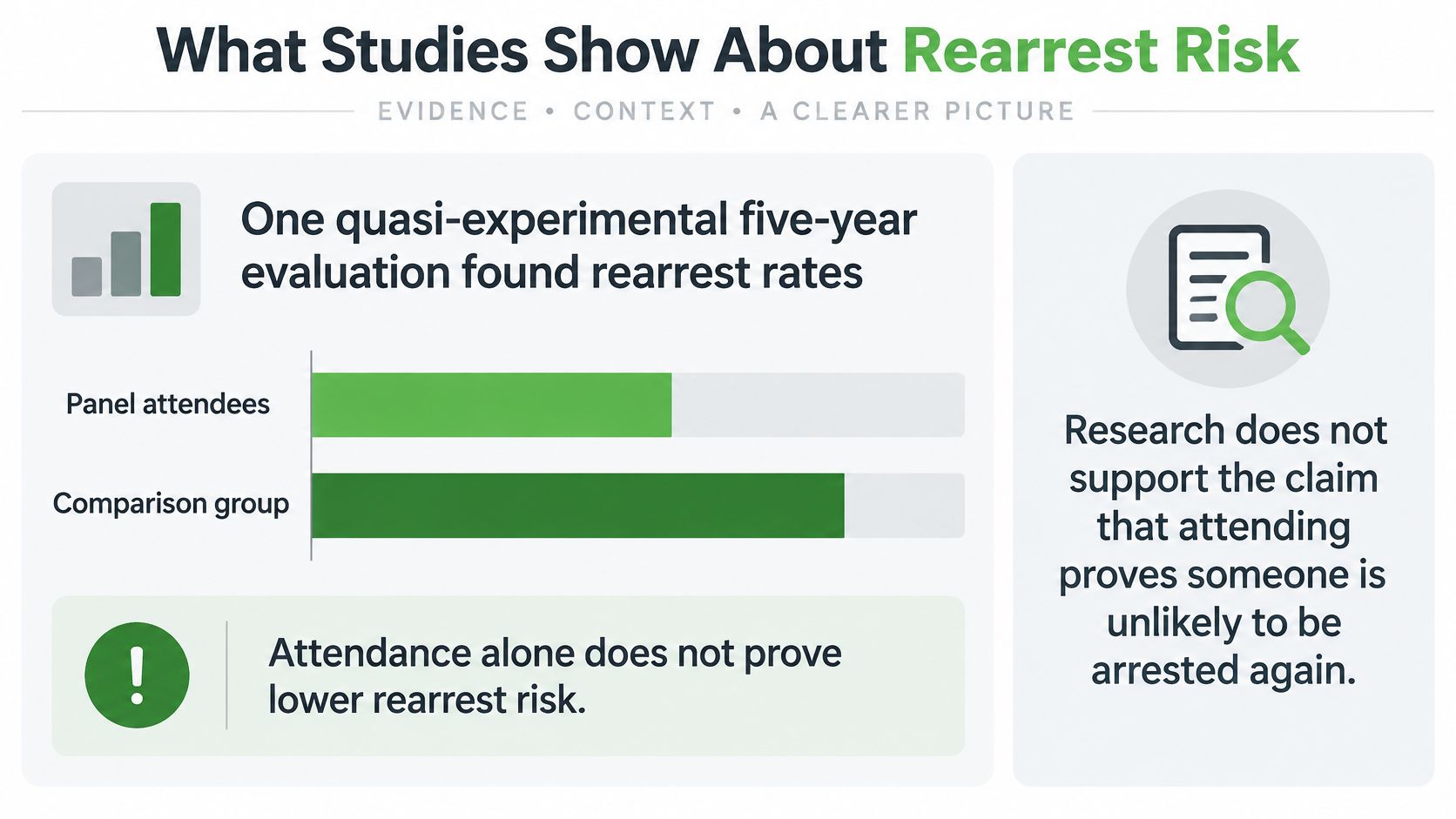
A defendant walks out of a Will County panel sure the story they just heard will stop the next impaired drive. That is the hope the session is built on. Research treats the hope as an open question. Attendance, by itself, does not show that a later arrest is unlikely.
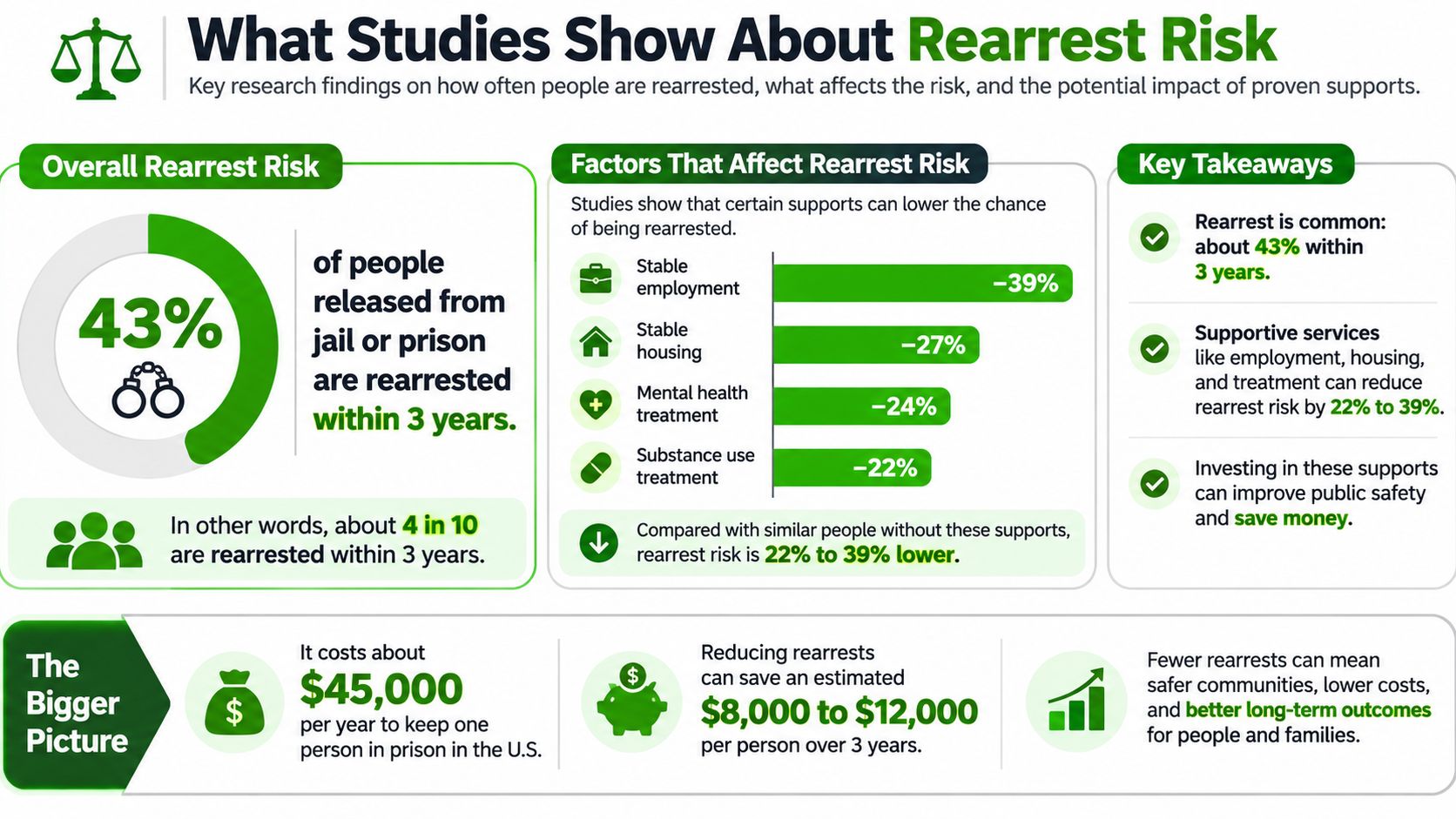
One quasi-experimental five-year evaluation found rearrest rates of 15.8% for panel participants versus 33.5% for comparison subjects, an estimated 55.7% lower rearrest hazard, with the effect strongest during the first two years and declining afterward, according to the federal review of victim impact panel rearrest findings.
A U.S. Department of Transportation evaluation of offenders in Oregon and California found no consistent recidivism difference between attendees, no-shows, and matched controls. One favorable result does not erase a null result.
The classroom theory is easy to follow. Firsthand testimony works like a mirror held up to the crash. It raises perceived harm and victim empathy, which may change how a person weighs the next drive. Measuring that change is harder, because the court chooses who sits in the room.
A comparison of 410 DUI offenders ordered to a panel and 373 offenders from the same court system who were not reported significantly lower DUI and general-criminal-recidivism odds among participants at six months, one year, and two years. Higher-quality reviews often find no significant difference. Some analyses found repeat offenders who attended were more likely to reoffend than comparable non-attendees.
Researchers call that mix confounding by indication. It works like comparing two patients after a doctor has already sent the sicker one to a specialist. Judges order panels for defendants with particular histories, ages, and charges, so the later record may reflect that starting point rather than the session.
What you shouldn't claim: A panel certificate is proof you attended. It is not proof you're at low risk of reoffending, and it won't be treated that way by a court or a licensing agency.
For a Will County case, keep the panel in its own box. The order can list a panel, an evaluation, treatment, and supervision as separate conditions. Finishing the panel does not finish the others, and a published rearrest result does not turn the certificate into a low-risk finding or a license-reinstatement shortcut. A favorable study also does not rescue a provider or format the order did not accept. Document attendance the way the court requires. Leave risk reduction to the evaluation, any treatment, supervision, and the impaired-driving controls already in the order. Compliance is what the panel can deliver. The studies do not promise a lower chance of arrest.
If Your DUI Case Is in Georgia Instead
A driver books the wrong class because the arrest happened in one state and the mailing address sits in another. The order from the courthouse, not the address on the license, decides which class counts.
If a Will County judge wrote the sentence, finish with the provider named on that order, and use AAIM or MADD only after counsel or probation confirms the choice. Georgia's Risk Reduction rules do not rewrite an Illinois case. If the arrest and the courthouse are in Georgia, a Will County panel is the wrong assignment.
Georgia's DDS-approved DUI Alcohol or Drug Use Risk Reduction Program has two mandatory parts, completed in order. First comes a 130-question NEEDS Assessment. It screens alcohol and drug risk. It is not a pass/fail test. Then comes a 20-hour Intervention Component: classroom education and group counseling, commonly scheduled over a weekend or several evenings, not squeezed into one day. DDS issues no certificate until both parts are finished, per the Georgia DDS DUI frequently asked questions.
For a first DUI conviction at age 21 or older, the license suspension is generally 12 months, with reinstatement possible after 120 days once a program certificate and the reinstatement fee are provided, as the Georgia DDS reinstatement guide explains. Drivers with a third qualifying conviction within five years should read the Georgia habitual violator rules before assuming a course alone restores a license, because that status is a revocation, not a short suspension.
A judge may also order a separate clinical evaluation on top of the Risk Reduction Program. Finishing the course does not satisfy that order. A panel, when the judge orders one, is its own line. It does not stand in for the assessment, the 20-hour class, treatment, or the certificate DDS uses for reinstatement. The courthouse that issued the order still decides which document fills which box.
States write those boxes differently. The Hawaii OVUII penalties explained guide covers Hawaii's impaired-driving penalties, not a Georgia sentence and not a Will County order.
Georgia DUI Schools offers DUI classes in person or live and online with an instructor, plus Clinical Evaluations, ASAM Level 1 Treatment, and a Victim Impact Panel. Georgia DDS does not accept a self-paced online DUI course, finished on your own time, for license reinstatement or court purposes. A live virtual class counts only when the student stays present and on camera with a live instructor for the entire 20-hour intervention. If a Georgia judge ordered a panel, register through the Georgia victim impact panel course page and match that registration to the sentencing line the same way a Will County defendant matches AAIM or MADD.
Georgia DUI Schools keeps the Risk Reduction Program, Clinical Evaluations, ASAM Level 1 Treatment, and a Victim Impact Panel with one provider, so each court condition has its own paperwork. DDS-approved courses run at 18 locations, with sessions seven days a week, plus live virtual instruction for students who remain on camera for the full intervention. Start at Georgia DUI Schools and open the course page that matches the condition your judge wrote.