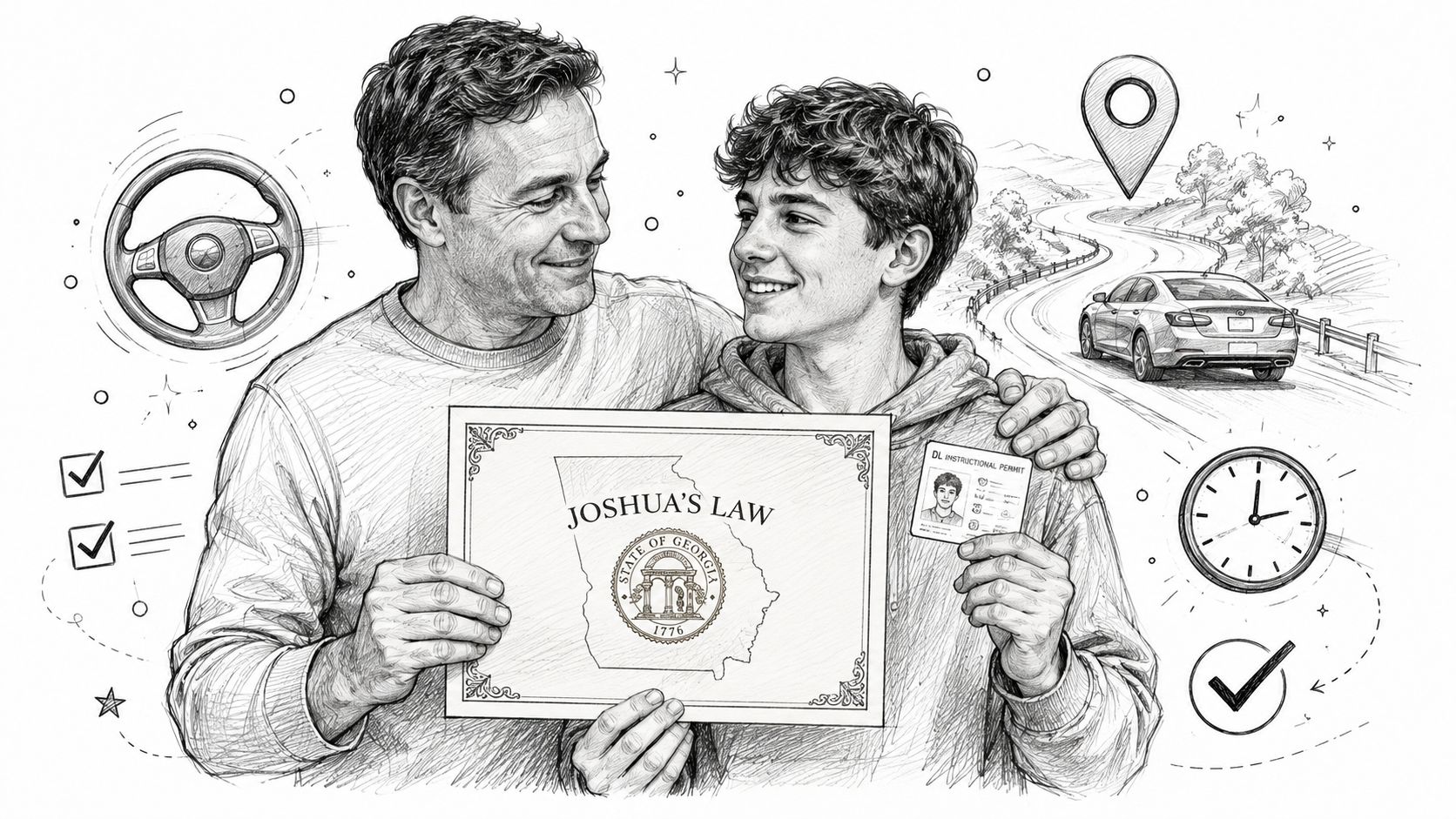
Your teen has the permit. You've got a folder on the kitchen counter, a few screenshots on your phone, and at least one unanswered question: what exactly counts, what doesn't, and what will get you turned away at DDS?
That's where most families lose time. Not because Joshua's Law is impossible, but because the process is split into separate requirements that people wrongly assume are bundled together. The Joshua's Law certificate matters, but it's only one part of a file that has to be complete on license day.
Your Teen's Path to a Georgia Driver's License
You arrive at DDS with a teen who has finished the course, logged practice hours, and is ready for the next step. Then the clerk asks for one document that never made it into the folder, or points out that the school certificate and the other licensing requirements are not the same thing. That is how a routine appointment turns into a reschedule.
For Georgia teens working toward a Class D license, the process depends on more than passing a permit test and showing up for the road test. Parents need the file in order before the appointment is booked. The delays I see rarely come from driving ability. They come from missing proof, incomplete records, or assumptions that one completion certificate covers everything.
What parents usually miss first
Start with the paperwork, not the calendar.
Before anyone grabs an appointment time, review the documents needed to legally drive in Georgia and match them against what you have in hand, not what you assume the school or DDS can pull up electronically. Printed copies still save families a lot of trouble. If your teen completed any part of training online, verify that the completion record is final and available, not just marked "in progress" in a student portal.
One more point trips people up. The Joshua's Law course certificate is one document in the licensing file. It does not automatically cover every other requirement DDS may ask you to show.
Practical rule: Build the DDS folder a week early, then check every name, date, and completion record against the permit.
Why the certificate matters
The Joshua's Law certificate proves the classroom requirement was completed through an approved provider. If that certificate is missing, mismatched, or not accepted because the provider was not approved, DDS cannot move the application along.
Parents also lose time when they treat every teen driving requirement as one bundle. It is not. The course certificate, supervised driving log, and school-based ADAP requirement are separate items, and families should confirm each one independently before license day. That extra check prevents the most common counter surprise.
The Core Components of Joshua's Law
A lot of DDS delays start the same way. Parent and teen show up with a course certificate, a permit, and a half-finished folder, then find out one missing item stops the whole license application. Joshua's Law has a few separate parts, and DDS treats each one as its own checkpoint.
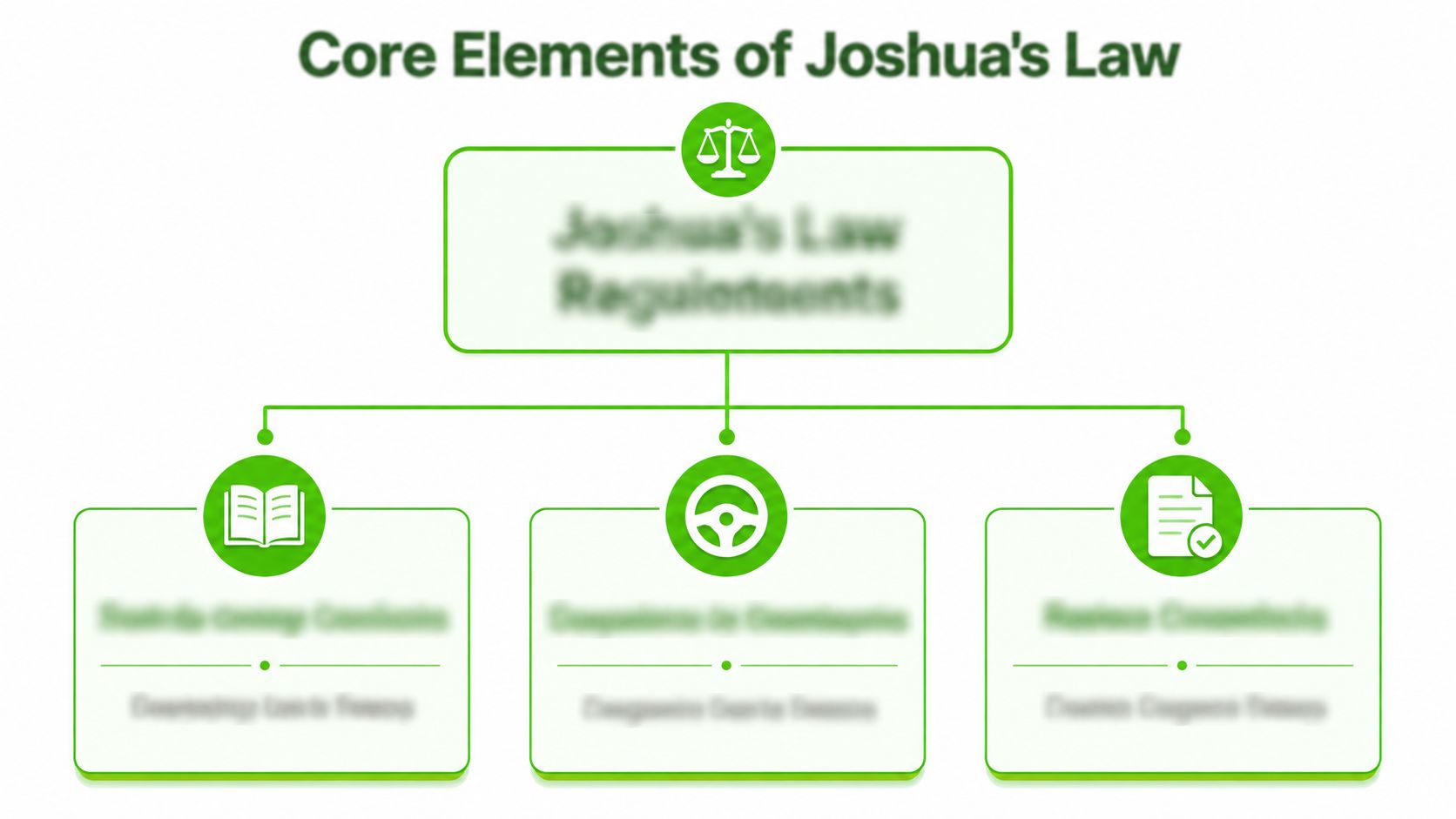
The 30-hour course
The 30-hour driver education course is the piece tied to the Joshua's Law certificate. It must come from a DDS-approved provider, and families should verify that approval before paying or starting coursework. A completion screen inside a student portal is not the same thing as a finalized record DDS will accept.
The course itself covers the basics a new driver needs: Georgia traffic laws, right-of-way, speed control, hazard awareness, defensive driving, and the judgment issues that cause teen crashes. The practical mistake is assuming any online driver ed class counts. It only counts if the provider is approved for Georgia. If you need to compare approved online options, use a Georgia online driver education course list and confirm the student name matches the permit exactly before the certificate is issued.
The six hours that parents cannot replace
The 6 hours of behind-the-wheel training must be completed with a certified driving school. Parent practice does not substitute for that requirement, even if your teen has already logged far more time on the road.
This is one of the biggest points of confusion I see. Families often combine all driving time into one mental bucket, but DDS does not. School-based driving instruction satisfies one requirement. Parent-supervised practice satisfies another. If the certified school hours are missing, the license process stops right there.
The 40-hour supervised log
Parents or guardians usually handle the supervised driving log, and it needs to be kept carefully from the start. The requirement is 40 hours total, including 6 hours at night.
Night driving is where logs get sloppy. Families remember the grocery run or the drive back from practice, but they do not write down dates, times, and total hours while it is fresh. Then license week turns into a reconstruction project.
A clean log is simple and specific. Record the date, approximate route, time of day, and running total after each drive. I also tell parents to separate daytime and nighttime entries clearly so nobody is doing math in the DDS parking lot.
The separate ADAP requirement
ADAP, or eADAP, is separate from driver education. It is often completed through school, which is why families assume it is automatically bundled with the Joshua's Law course. It is not.
A teen can finish the 30-hour course, complete the driving hours, and still be turned away if ADAP has not been completed or cannot be shown. Check that item on its own, save the proof, and put it in the same folder as the certificate and driving log. That one habit prevents a lot of repeat trips to DDS.
Choosing an Approved Driver Education Course
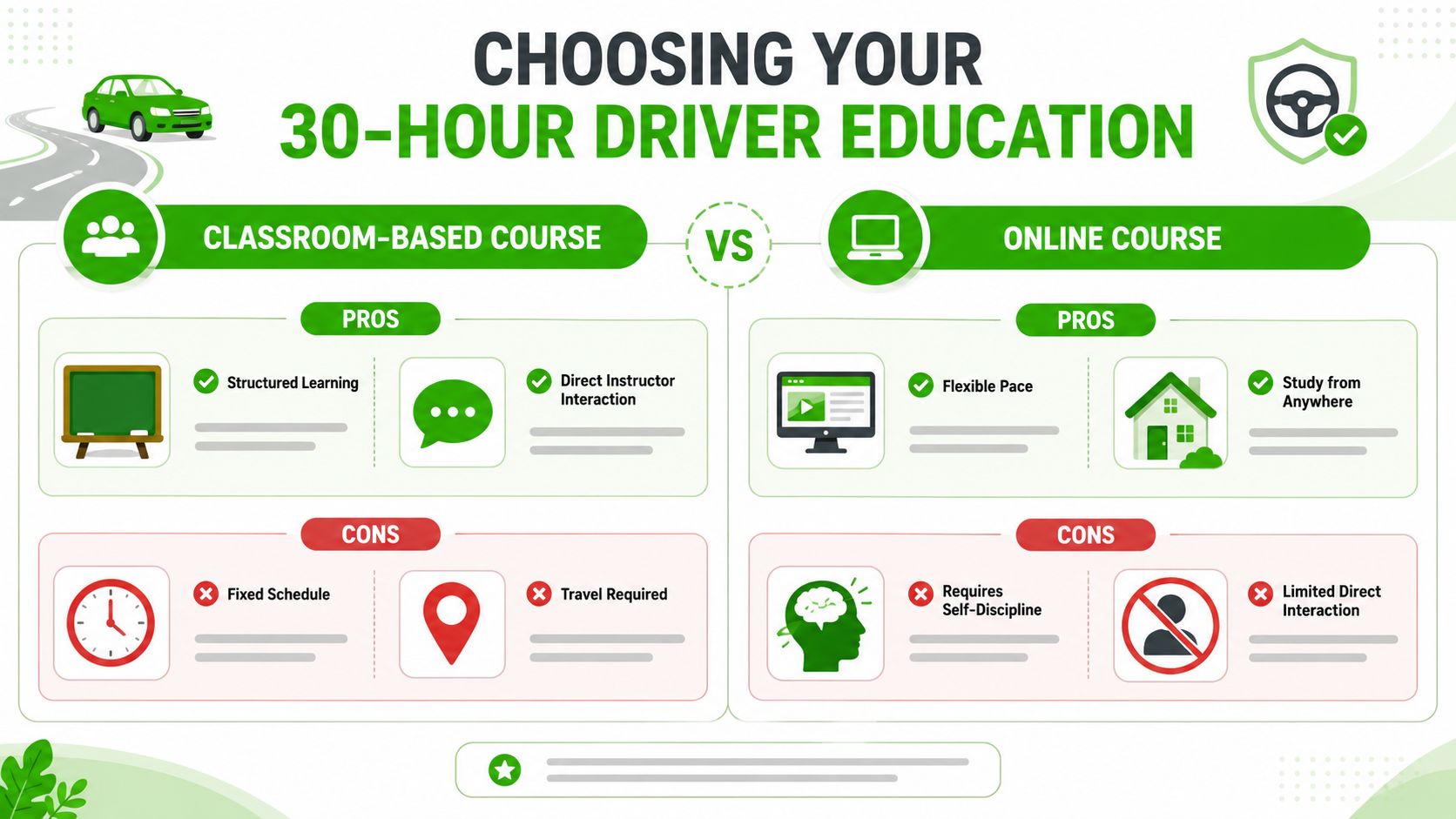
Once you understand the moving parts, the next real decision is format. Families usually narrow it down to two choices: an online course or an in-person classroom course. Both can work if the provider is approved. The better choice depends on how your teen learns, not what sounds convenient on enrollment day.
When online works best
For a student-athlete in Gwinnett, a teen with an after-school job in Athens, or a family juggling split schedules in metro Atlanta, online often makes the most sense. The big advantage is flexibility. A teen can work around school, practice, and family obligations instead of waiting for the next fixed classroom date.
The trade-off is discipline. If your teen already pushes homework to the last minute, online can drag out longer than expected. The format is convenient, but convenience doesn't finish modules.
A practical place to compare approved online options is this Georgia online driver education page.
When classroom instruction is the better fit
Some teens do better when an instructor is physically in front of them and the session has a start and end time. That structure matters more than parents sometimes think.
Classroom learning also makes it easier to ask questions in the moment. If your teen tends to nod through confusing material online and move on, an in-person course can prevent weak spots from becoming bad driving habits later.
A simple comparison
| Course format | Often works well for | Common drawback |
|---|---|---|
| Online | Teens with packed schedules and strong self-management | Easy to postpone |
| In person | Teens who learn better with live structure and discussion | Less flexible scheduling |
What I'd check before paying
Don't start with price. Start with compliance and logistics.
- DDS approval first: If the course isn't approved, the certificate won't help at DDS.
- Certificate process: Ask how the school issues the Joshua's Law certificate and how the student accesses it after completion.
- Behind-the-wheel options: If the same school also offers the required driving instruction, the paperwork flow is usually easier.
- Support responsiveness: If nobody answers basic questions before enrollment, don't expect smoother help when there's a certificate issue later.
A good course doesn't just teach rules. It leaves the family with usable records, clear next steps, and fewer chances to make a paperwork mistake.
Your Step-by-Step Guide to Getting Licensed
A lot of families hit trouble at the same point. The teen has finished the course, everyone assumes they are ready, and then the DDS clerk asks for one document that was never printed, never signed, or never completed. The fastest path to a license is not just finishing the requirements. It is finishing them in the order DDS expects, with records you can produce on appointment day.
Georgia's process is straightforward if you treat it like both driver training and paperwork management. The sequence is simple: get the permit, complete the 30-hour Joshua's Law course, complete the 6 hours of professional behind-the-wheel training, log the 40 supervised driving hours, confirm ADAP, gather the documents, then take the DDS tests, as outlined earlier in the NHSA breakdown of Joshua's Law steps.
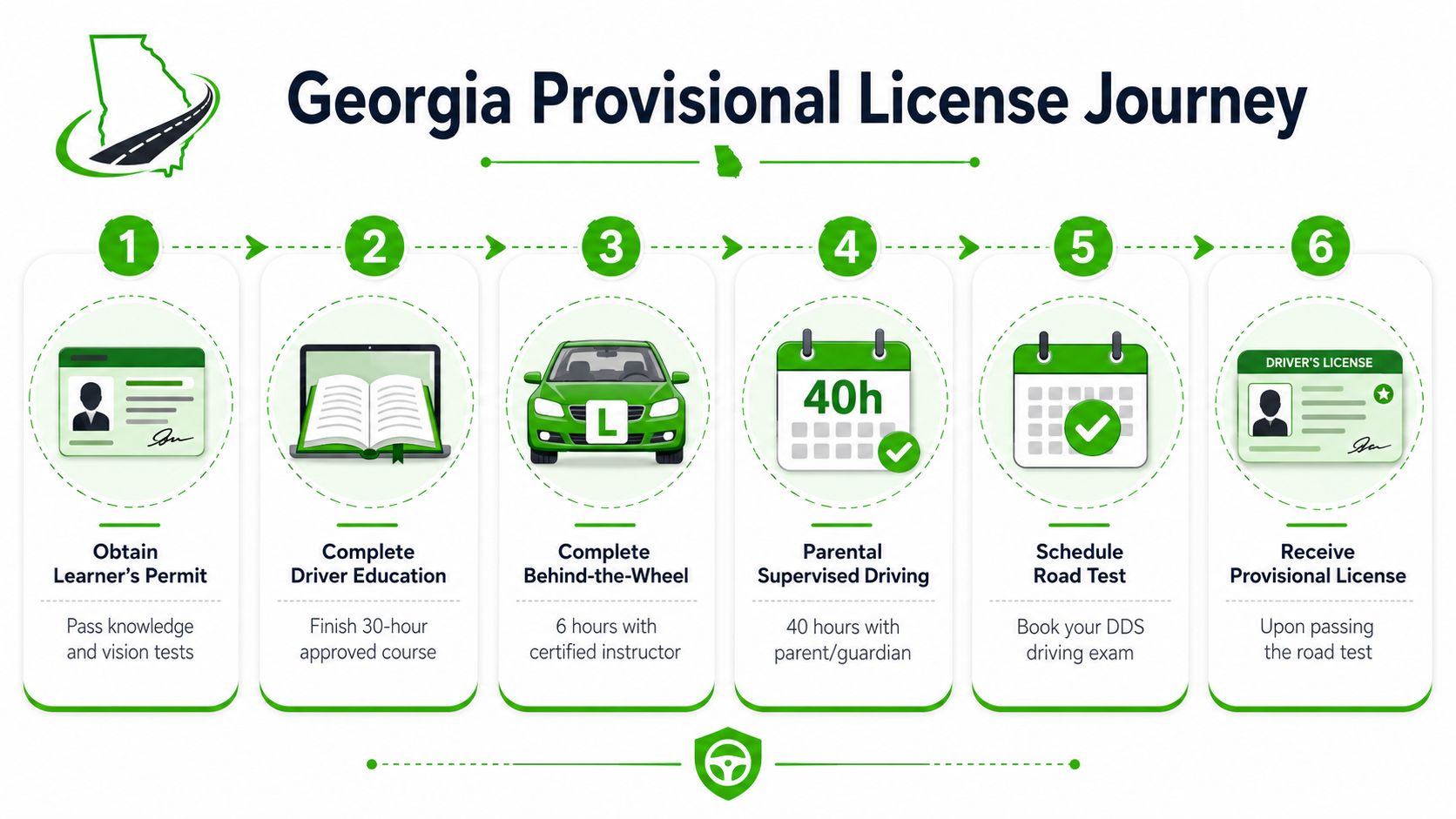
Step 1 through Step 3
Start with the learner's permit. Without that, the rest of the timeline tends to get sloppy because families rush the training and paperwork later.
After the permit, complete the 30-hour course through a DDS-approved provider, then book the 6 hours of in-car instruction with a certified school. Keep those as separate items in your folder because DDS treats them as separate items. I have seen parents show up with proof of the online course and assume it covers the driving portion. It does not.
If your teen needs help reviewing course material before finishing, this Joshua's Law test prep resource is a useful study tool. It can help prevent a small academic delay from turning into a scheduling problem later.
Step 4 and Step 5
Now the parent-managed part starts.
The 40 hours of supervised driving need to be logged as they happen, including the required night driving. A backfilled log written the night before the appointment is one of the easiest ways to create doubts, especially if times, dates, or totals do not add up cleanly. Keep it current and keep it readable.
Then check ADAP separately. Families mix this up all the time. ADAP is not the same thing as the Joshua's Law course, and it is not something I would assume the school handled unless you have the proof in hand. Verify it before you book the DDS visit, not after.
Step 6 and Step 7
Before the appointment is even scheduled, put every record in one folder and review it like a DDS clerk would. Look for missing signatures, name mismatches, and documents that exist only on someone's phone.
By appointment day, have the permit, the Joshua's Law certificate, proof of ADAP, any school enrollment or attendance documents required for your situation, and the parent or guardian documents needed for signatures or sworn statements. Then the teen takes the vision and road tests.
What works on appointment day
Families who get through DDS with fewer problems usually do these four things:
Check every document the night before
Last-minute parking lot searches waste appointments.Bring paper copies, even if the school uses digital records
Phones die. Login passwords get forgotten. Printed records solve that.Match the teen's legal name across every document
A missing middle name or suffix can slow things down fast.Leave time after course completion before the DDS visit
Some schools need time to finish certificate processing or reporting. Confirm that part is done before you reserve the slot.
My practical checklist
- Permit in hand: Bring the original.
- Joshua's Law certificate ready: Printed copy plus saved digital access.
- ADAP proof confirmed: Do not rely on memory.
- Supervised driving log complete: Make sure the night hours are clearly recorded.
- Parent or guardian ready: The correct adult needs to be available for any required signature or verification.
A prepared DDS visit is usually uneventful. That is the goal. Quiet, complete, and finished on the first trip.
Avoiding Common Delays and Costly Mistakes
Licensing delays are rarely caused by difficult driving. They usually happen because a parent arrives at DDS with one missing record, one name mismatch, or one requirement they thought was covered by something else.

I see the same pattern over and over. A teen finishes the course, logs practice hours, gets comfortable behind the wheel, and the family assumes DDS will treat that as one complete package. DDS does not. Joshua's Law training, supervised driving hours, and ADAP proof are separate items. If one piece is missing, the appointment can fall apart fast.
The mistake that causes the most trouble
The biggest mix-up is treating parent-supervised practice as if it covers the professional training requirement. It does not. The 40 hours of supervised driving and the 6 hours of professional behind-the-wheel instruction serve different purposes, and DDS treats them as different records.
The second frequent problem is ADAP. Families often assume it is part of the Joshua's Law course because both come up during the same licensing process. In practice, ADAP is its own requirement, with its own proof of completion. If you wait until appointment week to track it down, you are already late.
Bureaucracy hacks that actually help
These are the habits that prevent the wasted trip to DDS:
- Confirm DDS approval before paying for a course: Do not rely on a course title alone. Ask whether the provider is DDS-approved and whether the student will receive the correct Joshua's Law completion certificate.
- Check how the provider records completion: Some schools issue the certificate quickly. Others need extra processing time after the final lesson or driving session. Ask that question before you schedule the DDS appointment.
- Keep ADAP in a separate folder: Do not store it with the Joshua's Law certificate and assume they are interchangeable. They are not.
- Audit the driving log before it is full: Parents who wait until the end usually find missing dates, vague night-hour entries, or totals that do not add up cleanly.
- Match the legal name on every record: Jr., middle names, hyphens, and suffixes matter more than families expect.
- Call the school if anything looks incomplete: A missing instructor signature, delayed upload, or wrong birthdate is usually fixable, but not from the DDS parking lot.
One practical rule helps: if a document exists only on a phone, assume it is not ready yet.
What does not work
Some habits create repeat appointments:
| Bad habit | What usually happens |
|---|---|
| Assuming ADAP is included with Joshua's Law | DDS asks for separate proof |
| Counting parent practice as professional driving instruction | The application is treated as incomplete |
| Filling in the night log from memory at the end | Dates and totals do not hold up under review |
| Booking DDS before the school finishes certificate processing | The teen shows up ready, but the paperwork does not |
| Ignoring small name differences across documents | Staff pauses the file until the records line up |
The families who get through DDS on the first try are usually not better organized in general. They just treat this month like an audit. That is the right approach.
Using and Managing Your Certificate
A lot of DDS headaches happen after the course is finished, not during it. A parent books the road test, the teen shows up ready, and then nobody can pull up the completion certificate because it is buried in an old email, saved under the wrong name, or sitting on one phone with no signal in the parking lot.
Treat the Joshua's Law certificate like license paperwork, not like a class handout. Save a PDF copy, print a paper copy, and store both where the teen and parent can reach them quickly. I also tell families to rename the file with the student's legal name and course completion date so it is easy to spot later.
The certificate may still matter after the DDS visit. Some insurance carriers ask for proof of driver education when they review teen driver discounts, so keep it in your long-term family records instead of tossing it once the license is issued.
Handling the certificate after completion
Use a simple system that holds up under pressure:
- Keep two copies in two places: one printed copy in your licensing folder and one digital copy in cloud storage
- Check the legal name immediately: if the course provider listed a nickname, missing suffix, or wrong birthdate, get it corrected before the DDS appointment
- Verify the completion record posted properly: a certificate in your inbox helps, but families should still confirm the school has finished its reporting and issued the final proof
- Bring the certificate even if you think DDS can see it: staff access and family expectations do not always match
- Keep it after licensing day: insurance, school records, or future questions can come up months later
If the certificate is missing, contact the course provider first. Ask them to confirm the student's full name, date of birth, completion date, and whether the course record was finalized. That five-minute call solves a lot of same-day problems that DDS cannot fix at the counter.
One more practical point. The Joshua's Law certificate proves driver education completion. It does not replace every other document tied to teen licensing, and families lose time when they treat it like the only paper that matters.
If you're dealing with Georgia driving requirements beyond teen licensing, including DUI Risk Reduction, defensive driving, clinical evaluations, or related state compliance issues, Georgia DUI Schools offers DDS-approved programs with online and in-person options across Georgia. For families focused on safer long-term driving habits after Joshua's Law, the most relevant next step is the Defensive Driving Course.