
The need for Drivers Ed Albany GA often involves circumstances far more pressing than a teen's initial driving instruction. You might be facing a notice from the Georgia Department of Driver Services, a court deadline, a probation requirement, or an insurance issue demanding swift resolution. In Albany, this urgency is palpable, as a single incorrect enrollment decision can consume valuable time and fail to provide the essential paperwork you need.
The first thing to clear up is simple. In Georgia, "drivers ed" can mean very different programs depending on your age and your situation. Teen driver education under Joshua's Law is one category. Adult compliance courses, such as DUI Risk Reduction and Defensive Driving, are another.
If you're an adult trying to satisfy a court order, restore driving privileges, reduce points, or meet a DDS requirement, you're usually not looking for a teen driver's ed class at all. You're looking for the right state-recognized course, in the right format, from the right provider, with proof that will count.
Your Guide to Required Driving Courses in Albany
A lot of Albany drivers start in the wrong place because the search term is broad. They type in Drivers Ed Albany GA, then land on teen permit and license information when what they really need is a compliance course tied to a DUI, a suspension, or a traffic case. That mix-up can cost you days when you're already on the clock.
If you're dealing with a Dougherty County court date, a DDS reinstatement issue, or pressure from an employer or probation officer, start by identifying the reason the course is required. In most adult cases, the answer falls into one of two buckets:
- DUI or drug-related offense means you may need the Georgia DUI Alcohol or Drug Use Risk Reduction Program
- Ticket, points, or insurance issue often points to a Defensive Driving Course
- Teen license preparation is a separate topic entirely and usually isn't what adult Albany drivers need in this situation
Why this confusion happens
Georgia uses similar language for very different programs. A teen may need a state-approved driver education course. An adult with a DUI-related suspension needs a specific two-part Risk Reduction program. Another driver may only need defensive driving to deal with points or try to help with insurance costs.
That means the right question isn't, "Where can I take drivers ed in Albany?" It's, "What exact requirement did the court or DDS give me?"
Practical rule: Match the class to the paperwork. If the notice says DUI, Risk Reduction, assessment, reinstatement, or intervention, don't sign up for a standard driving course first.
For Albany residents, convenience matters too. You may work long shifts, depend on family for rides, or be trying to handle this around childcare and court dates. That's why many drivers look for approved online or live-virtual options first. If you're sorting out what kind of class fits your situation, this overview of Georgia online driver education options can help you separate teen-style driver training from adult compliance programs.
What to do before enrolling
Read every line of your notice or court paperwork and look for exact wording. Terms matter. "Risk Reduction" is not the same as "Defensive Driving." "Clinical Evaluation" is not the same as a classroom course. "Victim Impact Panel" is another separate requirement that sometimes comes after or alongside other steps.
Use this quick checklist before you spend any money:
- Find the trigger. Was it a DUI, drug offense, points issue, or insurance concern?
- Look for mandatory wording. If the document says DDS-mandated or court-ordered, assume the course must meet specific state rules.
- Confirm the format allowed. Some programs can be self-paced online. Others must be live and instructor-led.
- Verify the school. If the provider isn't properly approved, the certificate may not count.
That clarity makes the rest of the process much easier.
DUI Risk Reduction vs Defensive Driving
These two courses are often confused, but they serve different legal purposes. One is tied to alcohol or drug-related driving matters. The other is commonly used for traffic improvement, point reduction, court negotiation, or insurance benefits.
The DUI Alcohol or Drug Use Risk Reduction Program is the more rigid of the two. In Georgia, it isn't a casual refresher course. It's a state-structured program that must be completed the right way when required.
According to Barber's DUI School's Georgia Risk Reduction overview, the DUI Alcohol or Drug Use Risk Reduction Program consists of two required components: the 130-question Assessment Component, called the NEEDS Assessment, which costs $100, and the 20-hour Intervention Component, which requires a separate $260 fee made up of a $235 course fee and a $25 workbook fee.
What each course is for
Defensive Driving is more flexible. People usually take it because a court allows it, because they want help with points, or because they hope to qualify for an insurance discount. It focuses on safer driving habits and decision-making on the road.
Risk Reduction is different. It's tied to DUI and drug-related cases and has a fixed structure. You don't substitute another traffic class for it.
| Attribute | DUI / Risk Reduction Program | Defensive Driving Course (DDC) |
|---|---|---|
| Primary purpose | DUI-related compliance, reinstatement, court or DDS requirement | Point reduction, court approval, safer driving habits, insurance-related use |
| Who usually takes it | Drivers with alcohol or drug-related violations | Drivers with tickets, points, or insurance concerns |
| Required parts | Assessment first, then intervention class | Usually a single course |
| Format rules | Must follow state rules closely | More flexible depending on provider and approved format |
| Cost structure | State-set components and fees | Varies by provider and course type |
| Best described as | Mandatory compliance program | Driver improvement course |
Georgia Driving Course Comparison for Albany Residents
The mistake that causes delays
A common Albany-area problem is this: a driver knows they "need a class," searches for drivers ed Albany GA, and chooses the first online driving course they see. Then they find out later that the class doesn't satisfy the DUI requirement listed in their paperwork.
That happens because the names sound similar, but the legal effect is different. A Defensive Driving Course may be useful in the right situation, but it won't replace a Risk Reduction requirement.
If your paperwork mentions reinstatement after a DUI or drug-related offense, treat Risk Reduction as a separate legal requirement, not as a general driving school class.
If you're trying to compare approved formats and understand which online option fits a ticket or point-related situation, this page on a Georgia online driving course is a useful reference point.
A simple way to decide
Ask yourself one question first: Was alcohol or drug use part of the reason you're being sent to class?
- If yes, look at Risk Reduction requirements first.
- If no, and you're dealing with points, a ticket, or insurance, Defensive Driving may be the right course.
- If your court paperwork includes more than one requirement, treat each item separately.
That distinction saves time and prevents enrollment mistakes.
Navigating the DUI Risk Reduction Program in Albany
For Albany drivers, the DUI Risk Reduction process feels complicated until you break it into the exact order Georgia requires. The sequence matters. You don't just register for a class and show up whenever it's convenient.
The state treats this as a formal compliance program. That means you need to complete the steps in order and use a provider that is allowed to issue a valid certificate.
Step one through step four
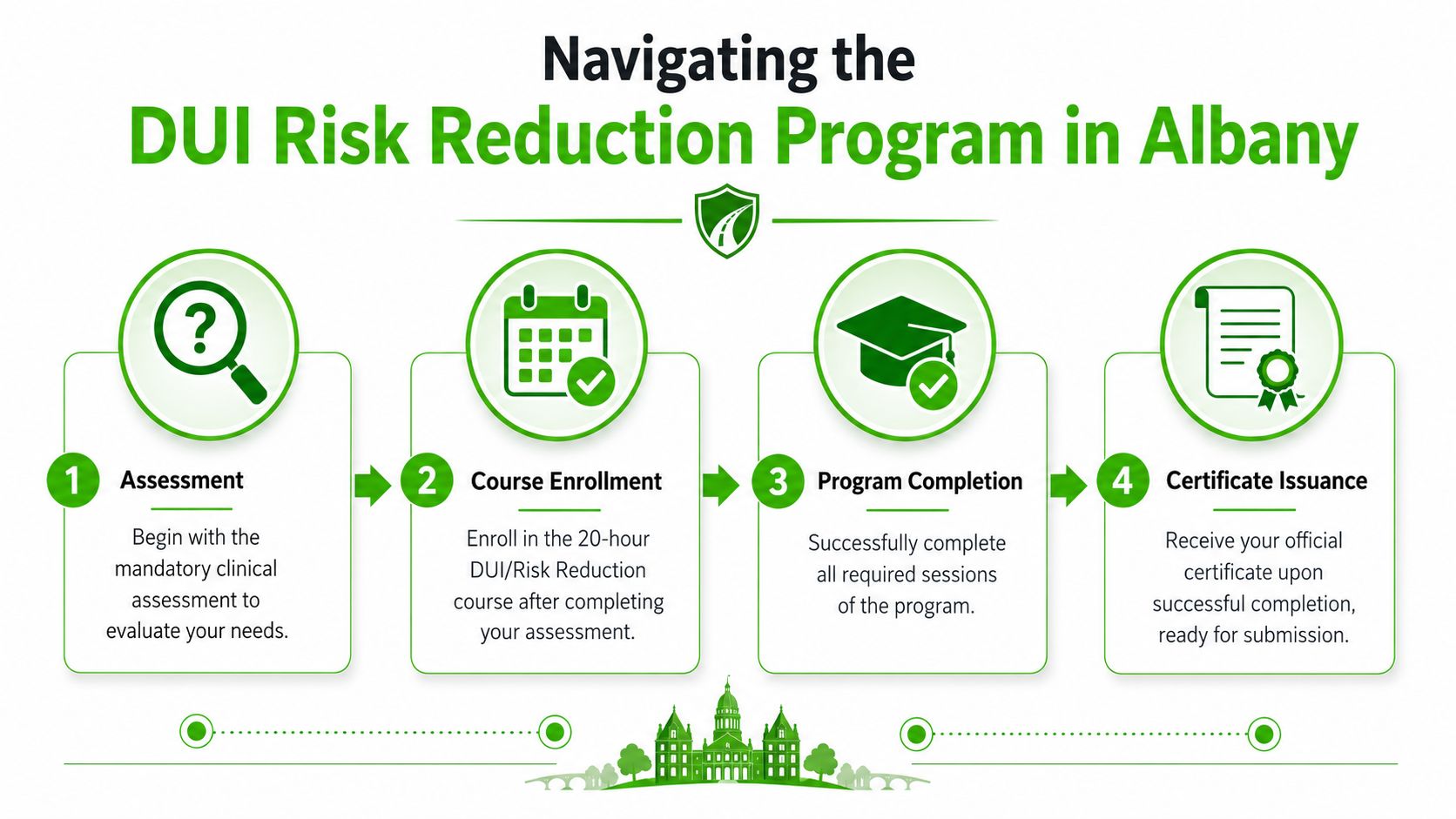
Start with the assessment. In Georgia, that means the 130-question NEEDS Assessment. It has to be completed before the intervention class. This part is designed to evaluate your needs and place you properly within the program process.
After the assessment, you enroll in the 20-hour Intervention Component. This is the classroom portion often envisioned when "DUI school" is mentioned. The course focuses on behavior, choices, and the impact of alcohol or drug use on driving decisions.
Then you complete all required sessions. Attendance matters. So does following the provider's instructions on timing, identification, and participation. At the end, you receive the completion documentation needed for the next step in your legal or DDS process.
The fees are fixed statewide
Many drivers in Albany spend time shopping around, thinking one school may charge less than another. For this specific program, that isn't how Georgia law works.
According to AGLC DUI School's explanation of Georgia's Risk Reduction fees, Georgia law sets fixed fees for the entire Risk Reduction Program at $360.00 total, broken down as $100 for the Assessment, $235 for the Intervention course, and $25 for the workbook, and certified DUI schools can't legally charge more or less.
That matters for two reasons:
- You can spot red flags quickly. If someone quotes a lower or higher total for the official program, ask questions immediately.
- You can budget with confidence. The amount is set by law, so the primary variable is scheduling, provider legitimacy, and format.
Important: Price competition isn't the issue with Risk Reduction. Compliance is.
What Albany drivers should expect
If you live in Albany, you don't always need to hunt for a nearby physical classroom first. Georgia allows some live virtual options for qualifying programs when they meet the state's rules. That can help if transportation is difficult or your schedule changes from week to week.
Still, don't confuse live virtual with any course that is posted online. For DUI Risk Reduction, the format must follow state rules, and participation requirements are stricter than with many general online classes.
A practical way to stay organized is to keep a small file with:
- Your court or DDS paperwork
- Proof that you completed the assessment
- Your class registration details
- Your completion certificate or confirmation information
That file becomes useful if DDS, the court, your attorney, or probation asks for documentation later.
Using Defensive Driving for Points and Insurance
Defensive Driving serves a different purpose from Risk Reduction, and for many adult drivers in Albany, it's the course they meant when they searched for Drivers Ed Albany GA. This course is often used after a ticket, during a court resolution, or when a driver wants to show a proactive effort to improve driving habits.
Unlike a DUI-mandated course, Defensive Driving is usually about prevention and mitigation. It can help you present a more responsible record, and in some situations it may support a request related to points or insurance.
When Defensive Driving makes sense
A Defensive Driving Course can be a smart option if you're trying to clean up the consequences of ordinary traffic trouble rather than a DUI-related case. Courts sometimes approve it in traffic matters. Drivers also look at it after they receive a citation and want to take a constructive next step.
Some Albany drivers take it because they're trying to avoid bigger licensing problems down the road. Others take it to qualify for an insurance discount if their insurer accepts the course.
If insurance is part of your concern, it can also help to understand how minimum coverage rules differ by state. For comparison, this Miami driver's guide to Florida insurance shows how another state structures auto coverage requirements and why drivers need to pay attention to the details in their own jurisdiction.
How it differs from teen driver education
Local confusion often arises. Albany residents searching for "drivers ed" may end up on teen training pages, especially because local programs are visible online.
For example, Albany Technical College's driver education program page explains that Joshua's Law-compliant teen programs in Albany require 30 hours of classroom instruction and 6 hours of behind-the-wheel training, with a full local program offered for around $425. That's useful for families with teen drivers, but it isn't the same as an adult Defensive Driving Course or a DUI compliance program.
So if you're an adult handling points, insurance, or a traffic citation, don't let the teen program details send you in the wrong direction.
Format flexibility matters
Defensive Driving is attractive partly because scheduling is often easier. Depending on the provider and course approval, the class may be available in a classroom, by live virtual session, or in a self-paced online format.
That flexibility helps drivers in Albany who work rotating shifts, commute, or need to fit the course around family obligations. If your main goal is insurance-related savings, this guide to a Defensive Driving course to lower insurance gives a clear overview of how many drivers approach that decision.
A Defensive Driving Course can be the right tool for the right problem. It just isn't a substitute for a DUI-mandated program.
Before you enroll, check whether the course is being taken for court approval, personal improvement, or insurance purposes. The reason matters because the proof you need at the end may differ.
How to Choose a DDS-Certified School
The most important decision isn't whether the class is close to your house or starts this weekend. It's whether the school is properly certified for the course you need. If it isn't, the certificate may be useless for your court case, your reinstatement, or your compliance deadline.
That point matters most for DUI Risk Reduction. Georgia doesn't treat this like a casual continuing education class. It must come from a provider approved to issue valid completion records.
What the state allows
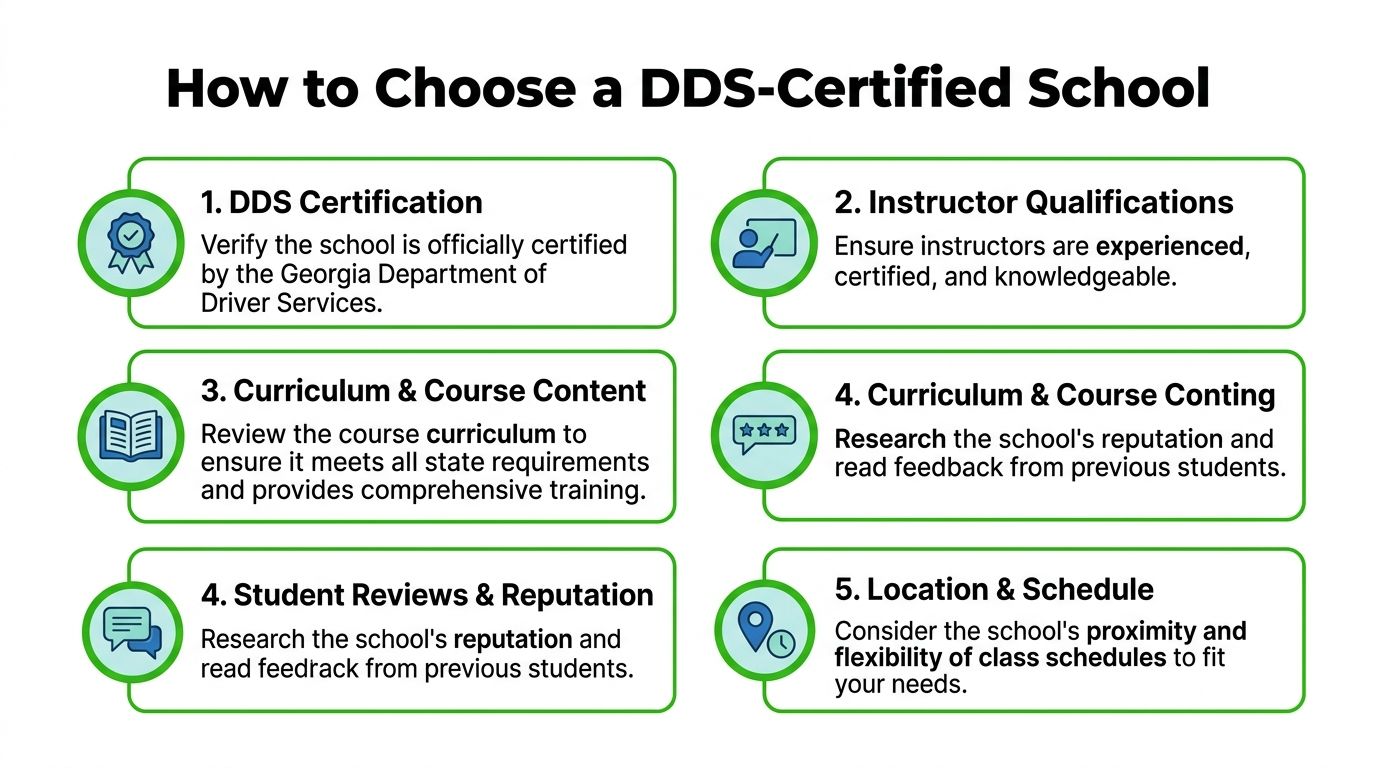
The Georgia Department of Driver Services is clear on this point. According to the official Georgia DDS Risk Reduction Program page, only DDS-certified schools may offer the DUI Risk Reduction Program, remote instruction is allowed only when it is synchronous with real-time interaction, and courses from uncertified schools won't be accepted for license reinstatement.
That means two things for Albany residents:
- A valid live virtual class can count if it follows DDS rules.
- A random prerecorded course or uncertified provider can create a serious delay.
A practical checklist
Use this checklist before you register:
- Verify certification first. Check that the provider is DDS-certified for the exact course you need.
- Ask about class format. If it's remote, confirm that it is live and instructor-led when the program requires that format.
- Match the schedule to your life. Weekday, weekend, and evening options can make the difference between finishing on time and missing a deadline.
- Confirm statewide service. Albany drivers can often use providers that serve all of Georgia through approved virtual formats.
- Check for related services. Some drivers also need a Clinical Evaluation, a Victim Impact Panel, or later treatment steps. It's easier when the provider can explain those next requirements clearly.
Warning signs to watch for
If a school promises to skip steps, lower mandatory fees, or issue quick proof without the required participation, stop there. Those offers usually create bigger problems than they solve.
A valid certificate starts with a valid school. If the provider can't explain its certification status clearly, keep looking.
Another good sign is straightforward communication. A reputable school should tell you what documents to bring, what identification is required, whether the course is live or self-paced, and what happens after you finish. In stressful situations, clarity is part of compliance.
Completing Your Course and Restoring Your License
Finishing the class is a major step, but it may not be the final step. Many Albany drivers feel relief after course completion, then get frustrated because they still have another item to satisfy before DDS or the court considers the matter resolved.
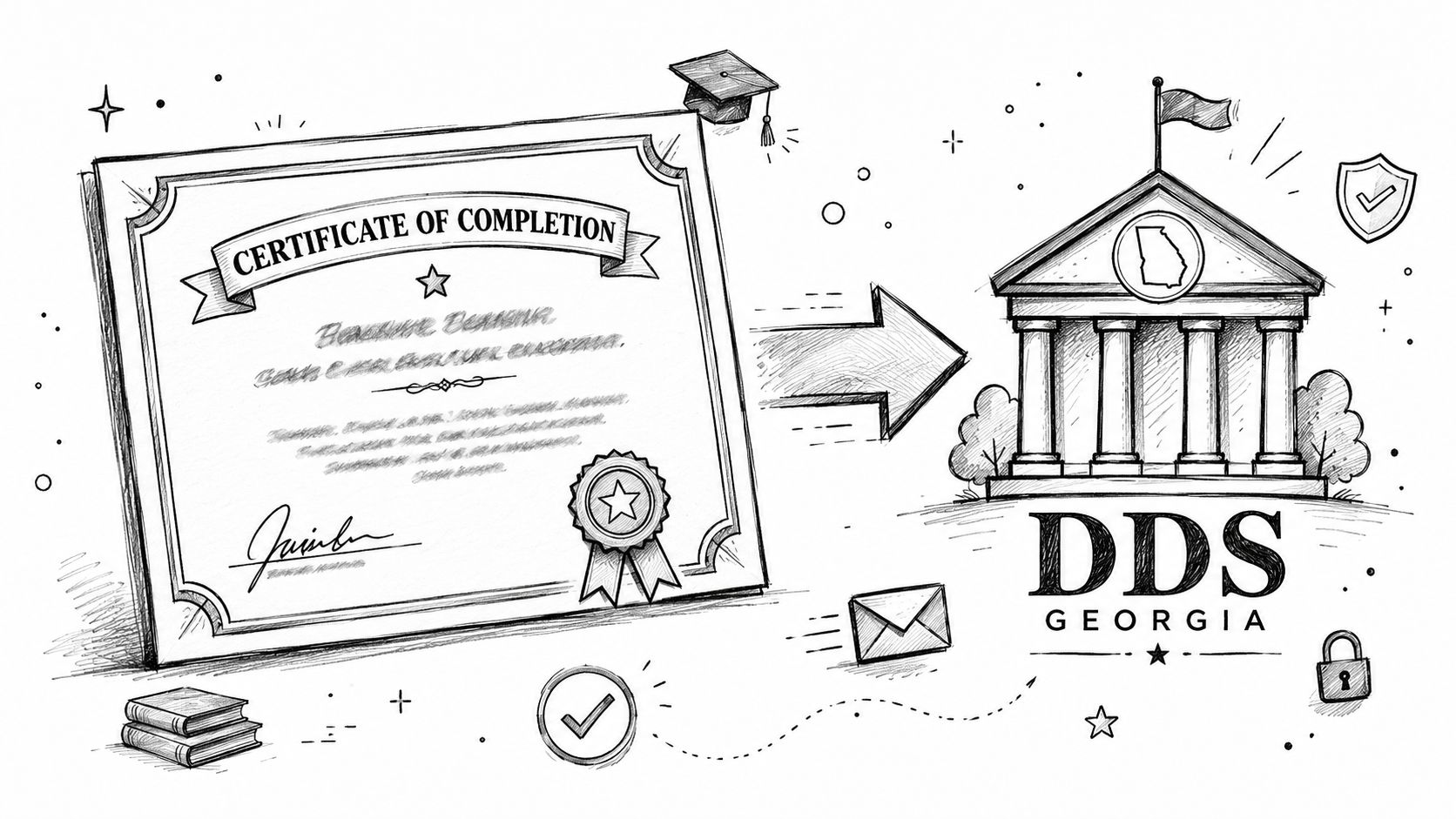
The key is to think of the course certificate as part of a larger compliance file. You complete the class, receive proof, and then make sure that proof reaches the right place in the right way.
What may happen after class
In many cases, the completion record is processed for DDS purposes through the approved provider's reporting system. But you should still keep your own copy of every confirmation, certificate, receipt, and registration record. Courts, attorneys, probation officers, and employers may each ask for proof in slightly different ways.
Some drivers also have additional obligations that are separate from the course itself. These can include:
- Clinical Evaluation
- Victim Impact Panel
- ASAM Level 1 treatment
- Other court-specific conditions
These items aren't interchangeable. A person can complete Risk Reduction and still need a Clinical Evaluation because the court ordered it. Another person may complete Defensive Driving but still need to file proof with the court by a certain date.
Why Georgia is strict about mandated education
Georgia takes required driver education seriously. One example comes from teen licensing law. As explained by A-1 Driving Schools' Joshua's Law summary, 16- and 17-year-olds must complete exactly 30 hours of classroom instruction and 6 hours of behind-the-wheel training to qualify for a Class D license, and failing to complete both results in license denial.
That teen-law example shows the broader principle. When Georgia says a course is required, the details matter. Correct course. Correct provider. Correct sequence. Correct proof.
Keep every record until your license status, court case, and any probation conditions are fully closed out.
If you're trying to get back on the road legally, don't assume the class alone finishes the process. Confirm what DDS requires next, what the court requires next, and whether any added evaluation or panel remains outstanding.
Common Questions About Albany GA Driving Courses
Can I take my required course online if I live in Albany
Sometimes yes, but it depends on the course type. Defensive Driving may be available in self-paced online formats, while DUI Risk Reduction has stricter delivery rules and is generally handled through live, instructor-led participation when offered remotely. The safest move is to confirm that the format matches your exact requirement before enrolling.
What is a Clinical Evaluation
A Clinical Evaluation is a separate assessment process that may be required by a court, probation, or another part of the DUI case process. It isn't the same thing as a standard driving class. Its purpose is to evaluate your situation and determine whether further action, such as treatment or additional recommendations, is needed.
Will a course from anywhere in Georgia count if I live in Albany
In many cases, yes, if the provider is properly certified for the course and the format is approved. Certification is statewide, so Albany residents aren't limited only to a physical classroom in Albany. That flexibility is especially helpful if your work schedule or transportation situation makes local attendance hard.
How long should I keep my completion records
Keep them until every part of your matter is closed. That means your DDS status is corrected, your court obligations are satisfied, and any probation or related requirements are finished. Even if a provider reports electronically, your own copy can save you a lot of trouble later.
For drivers comparing license reinstatement issues across states, this article on navigating Florida DUI license suspension gives a useful outside example of how complicated post-DUI requirements can become.
If you're still unsure which course applies to your situation, start with the exact words on your paperwork. In Albany, the term "drivers ed" is often too broad to be useful. The legal requirement is usually much more specific.
If you need a state-compliant next step, Georgia DUI Schools offers Georgia DDS-approved DUI/Risk Reduction, Defensive Driving, and related support services for drivers across the state, including Albany residents using online and live-virtual options. If your situation involves DUI-related compliance, the most relevant place to start is the Georgia DUI Risk Reduction course page.