
If you need a defensive driving course renewal in Georgia, you are likely in one of three situations. You took a class a while back and just got another ticket. Your insurance company wants a fresh certificate. Or a court gave you a deadline and now you're trying to figure out whether your old completion still counts.
That confusion is common because in Georgia, "renewal" usually doesn't mean renewing an active membership or extending a certificate with a fee. It usually means retaking a Georgia-approved course for a specific purpose, and the rules depend on that purpose. What works for insurance may not work for DDS point reduction. What satisfies your insurer may not satisfy a judge.
As someone who works in the Georgia DDS-approved system, I can tell you that most mistakes happen at the handoff points. People assume an old certificate is still usable, assume the course provider automatically handles everything, or assume one completion covers every need. It doesn't. The details matter.
Understanding Defensive Driving 'Renewal' in Georgia
In Georgia, there isn't a stand-alone state process called defensive driving course renewal. What drivers usually mean is one of these:
- They want to retake the course for point reduction
- They've been ordered by a court to complete a course again
- They need a current certificate for an insurance discount
Those are three different goals, and they run on three different timelines.
What most drivers mean by renewal
A driver in Atlanta may have completed a defensive driving course years ago after a speeding ticket in Fulton County. Later, that same driver gets another citation in DeKalb or Gwinnett and assumes the prior certificate can be reused. It usually can't. A certificate is tied to the reason you took the course and to the agency reviewing it.
Insurance creates another layer of confusion. Your policy renewal notice may suggest you need a current course completion to keep a discount, but that has nothing to do with whether DDS will reduce points on your Georgia license. If you're also dealing with vehicle damage after a crash, it's smart to review these expert tips for auto insurance claims so you don't mix up your policy paperwork with your driving course requirements.
For a broader look at what the class can and can't do, review these benefits of defensive driving.
Practical rule: Before you sign up, decide who needs the certificate. DDS, a court, or your insurance company. That answer controls everything else.
The three buckets that matter
You can approach it this way:
| Purpose | What matters most | Common mistake |
|---|---|---|
| Point reduction | DDS eligibility timing | Assuming any recent class removes points automatically |
| Court order | The judge's order and deadline | Thinking a past certificate will satisfy a new case |
| Insurance discount | Your insurer's current rules | Assuming policy renewal follows DDS timing |
In practice, "renewal" isn't one rule. It's retaking the course at the right time, in the right format, for the right reason.
Eligibility Rules for Retaking a Defensive Driving Course
You took a defensive driving class three years ago after a ticket. Now you have another citation, your insurer wants a current certificate at renewal, and you're wondering whether one more class will also knock points off your Georgia record. That is where drivers get tripped up.
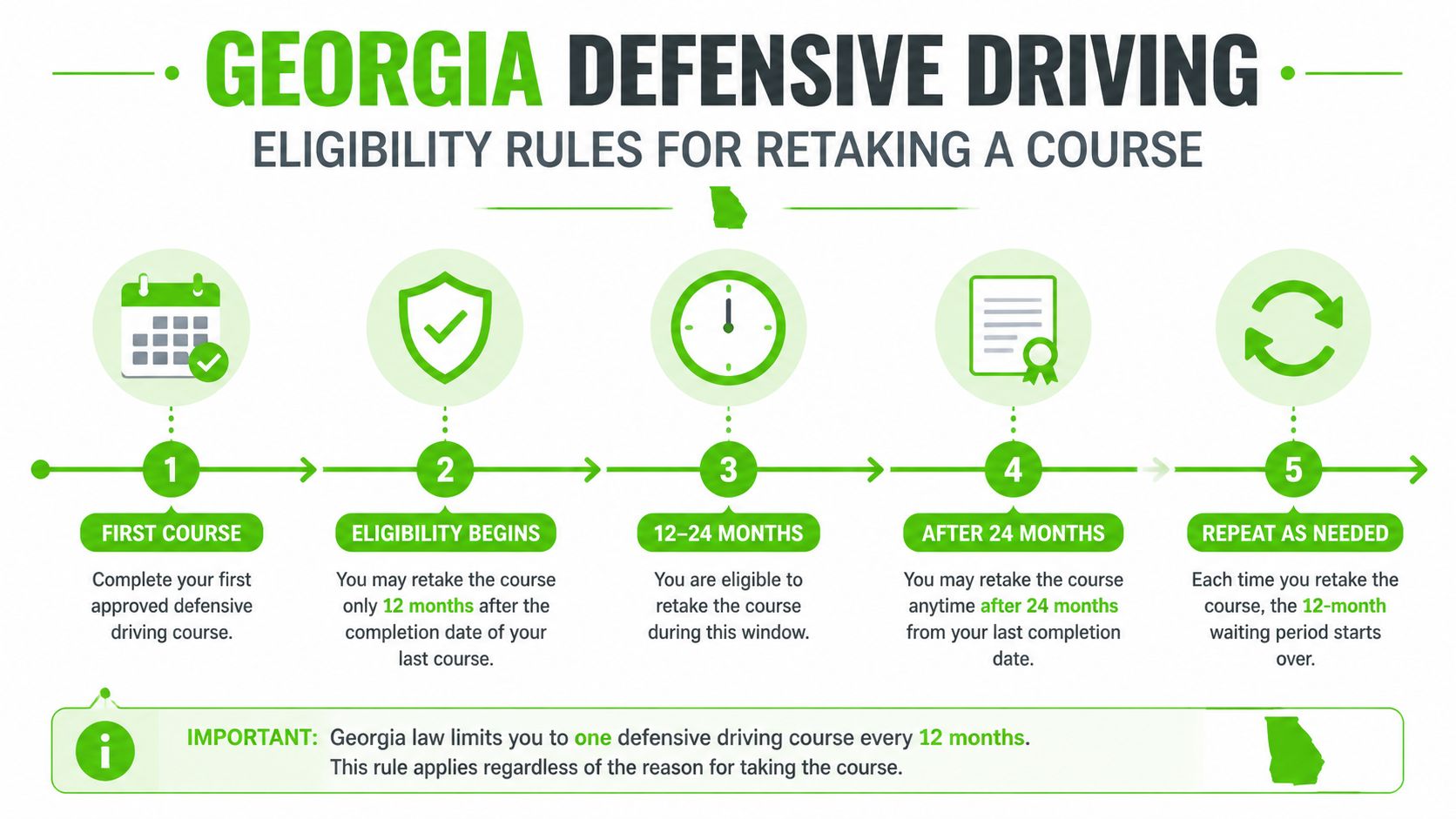
In Georgia, "renewal" is not one rule. Retaking a course can satisfy a court, help with an insurance discount, or support a DDS point reduction request. Those are separate tracks, and the timing for one does not automatically satisfy the others.
Point reduction follows the DDS cycle
For DDS point reduction, the question is not whether you can sit through another class. The question is whether you are eligible to use that new certificate for credit with DDS.
Georgia allows point reduction only once in each 5-year eligibility cycle for licensed Georgia drivers. If you retake the course before that window resets, you may still complete it for a court or for insurance, but DDS will not give you another point-reduction benefit from that new class. That is the distinction many drivers miss.
If points are your main concern, review this guide on how to remove points from your driving record in Georgia before you enroll. It helps to know what DDS can do, and what it cannot do, before you spend the time and money.
A simple way to avoid mistakes is to ask DDS-focused questions first:
- When did DDS last give me point-reduction credit?
- Am I past the 5-year mark yet?
- Am I trying to solve a court problem, an insurance problem, or a DDS record problem?
That last question matters most.
Court orders run on the court's deadline
A judge can require a fresh course even if you took one recently for another reason. Courts usually care about the current case number, the current deadline, and a certificate that matches that case. An older certificate may be rejected unless the court says it will accept it.
I see this often with drivers who had a prior class for insurance or a previous ticket. They assume the old completion should count because they already did the work. Clerks and prosecutors do not usually treat it that way. If the order says complete a defensive driving course by a certain date, use a certificate tied to that order unless the court gives you different instructions in writing.
Use this checklist if your course is court-related:
- Read the order carefully. Check the deadline, the required course type, and whether the court wants a Georgia DDS-approved program.
- Match the certificate to the current case. If the court expects recent completion, an old certificate may not satisfy the order.
- Verify who must receive it. Some courts want you to upload or file it yourself. Others want it sent to the clerk in a specific way.
- Do not wait until the last day. A class completed on time can still cause problems if the certificate reaches the court late.
Insurance discounts follow your carrier's schedule
Insurance works on a different clock. A company may ask for a recent certificate to start or continue a discount, even when you are still inside the DDS 5-year window and cannot use the class again for point reduction.
That does not mean the insurer is wrong. It means the insurer is applying its own underwriting rules, not DDS rules.
Here is the practical breakdown:
| Purpose | Timing that controls | What a retake may do |
|---|---|---|
| DDS point reduction | DDS 5-year eligibility cycle | May help only if you are outside the 5-year window |
| Court compliance | Judge's order and deadline | Often requires a new completion for the current case |
| Insurance discount | Carrier's renewal or eligibility rules | May help keep or restart a discount |
So yes, you can retake the course before five years have passed. But if your goal is DDS credit, the retake alone does not create new eligibility. That is the rule to pin down before you enroll.
Choosing Your DDS-Approved Georgia Driving Course
A driver gets a ticket, retakes a class the same week, and assumes that new certificate will automatically clear points, satisfy the court, and keep the insurance discount in place. In Georgia, those are three separate questions. The course can be the same. The approval status, format, and timing still need to match the reason you are taking it.
Start with the provider. If the school is not approved for Georgia's Driver Improvement Program, the certificate may be useless for your purpose, even if the class itself looks legitimate. I tell students to verify approval before they compare prices, schedules, or log-in convenience.
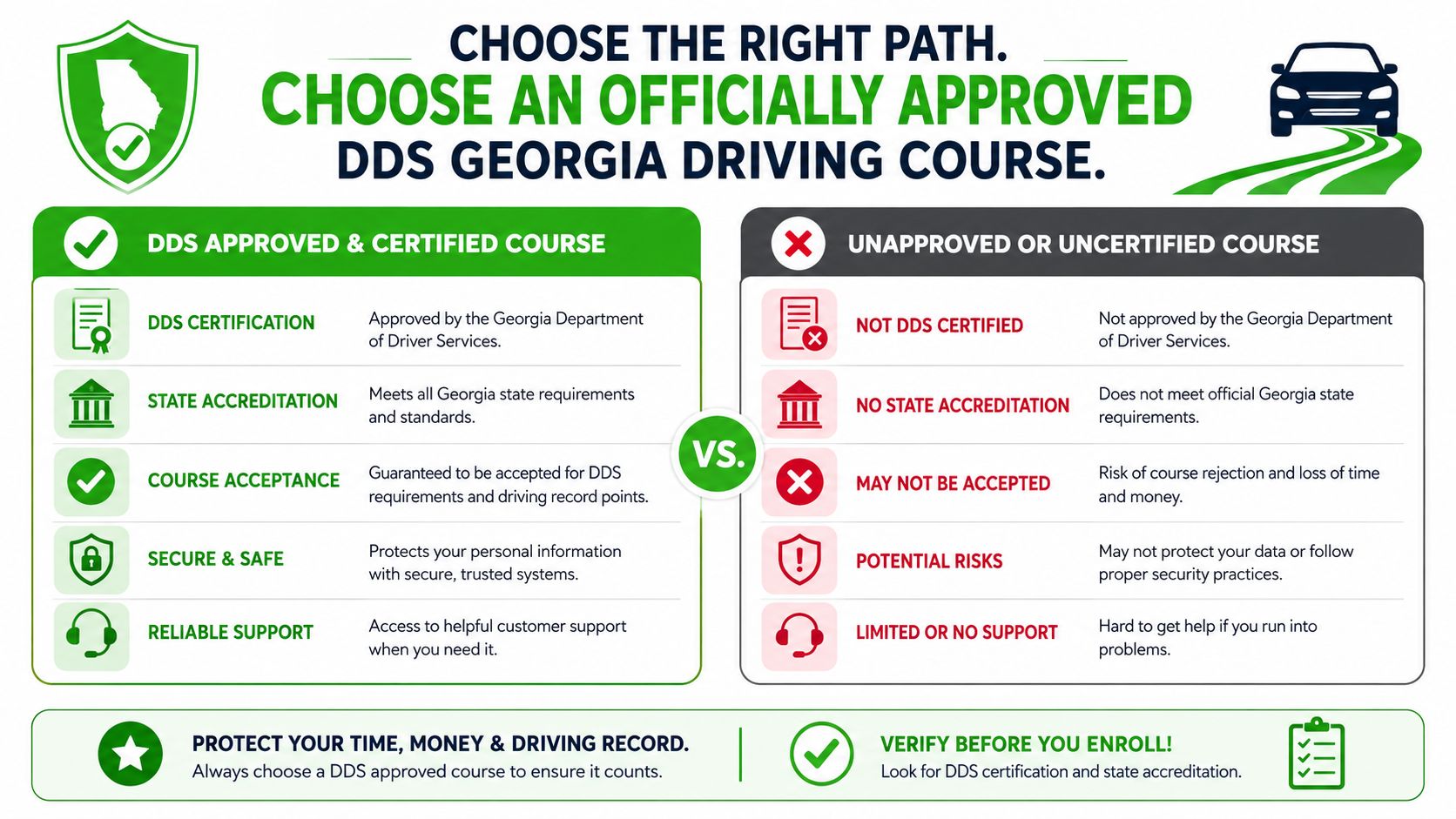
A good course choice comes down to two checks:
- Is the provider Georgia DDS-approved?
- Does the format fit your deadline and your learning style well enough that you will finish?
The format matters less than students think. The completion does.
| Format | Best for | Trade-off |
|---|---|---|
| Self-paced online | Drivers with irregular work hours or family obligations | Requires self-discipline and steady internet access |
| Live virtual class | Drivers who want instructor interaction without traveling | You must attend at the scheduled time and stay engaged |
| In-person classroom | Drivers who learn better in a structured setting | Travel time and fixed class dates can be harder to manage |
Self-paced online works well for a parent in Athens trying to fit the course around shift work, pickups, and evening obligations. Live virtual works better for the student who wants to ask questions in real time but does not want to drive across metro Atlanta to sit in a classroom. In-person still helps plenty of drivers, especially those who know they focus better when they are away from home distractions.
Here is the trade-off I see every week. Online is convenient, but some drivers wait too long and run into deadline trouble. Classroom and live virtual require more planning, but they create structure, and structure helps people finish.
Pick the format you are most likely to complete correctly and on time.
One example of a provider offering these Georgia-approved defensive driving options is Georgia DUI Schools, which offers online, live virtual, and classroom formats for defensive driving needs in Georgia.
What does not work is choosing a course based only on a low price or a promise that it is "accepted everywhere." That kind of shortcut causes problems. A court may want a current certificate for the case in front of it. An insurer may have its own renewal rules for discounts. DDS point reduction follows its own 5-year cycle. The smart choice is the approved course you can finish on time, with a certificate that fits the specific reason you enrolled.
A Step-by-Step Guide to Enrollment and Completion
A driver in Georgia gets a ticket, signs up for a defensive driving course that night, finishes it, and assumes the point reduction will follow automatically. Then the problem shows up. The court wanted the certificate by a set date, the insurer wanted its own form, and DDS point reduction was not even available if the driver already used that benefit within the last 5 years.
That is why enrollment starts with one question. What are you taking the course for?

What to have ready before you sign up
Before you register, pull together the information that controls how the school should guide you:
- Your Georgia driver's license information
- Any court paperwork, if a judge, clerk, or probation office ordered the class
- Your deadline, if one applies
- The reason you are taking the course, such as DDS point reduction, court compliance, insurance, or personal education
That last item prevents a lot of mistakes. Retaking a course is easy. Using it for the result you want is where drivers get tripped up.
If your goal is DDS point reduction, say that up front and verify whether you are still inside or outside the Georgia 5-year eligibility window. If your goal is insurance, ask what your carrier wants to see and how often it accepts a new certificate. If your goal is a court requirement, match the course timing to the court's deadline, not to your own schedule.
What the class is actually like
Georgia's defensive driving course is a 6-hour driver improvement class. It covers traffic laws, risk awareness, driver attitude, and decision-making behind the wheel. It is education, not a driving test.
The format changes how you take it, but not the need to finish it properly. Online students should set aside uninterrupted time and complete identity checks carefully. Live virtual and classroom students need to show up on time and stay for the full session. I have seen plenty of drivers create their own problem by trying to squeeze the course in between work calls, errands, or childcare pickups.
If you are taking the class to help with premiums, review how a Georgia defensive driving course may lower insurance before you enroll. Insurance discount timing often runs on a different track from DDS point reduction and court compliance.
What you receive at the end
After successful completion, you should receive a Certificate of Completion.
Keep it.
Even when a provider reports completion electronically, keep your own copy and confirm the name, license information, and completion date are correct. A small mismatch can slow down court filing, DDS posting, or insurance processing.
Finish the course, then confirm the next step with the party that needs the certificate. Taking the class and getting credit are two different steps.
For personal education, the process may end with the certificate. For DDS, court, or insurance use, completion is only part of the job.
Submitting Your Certificate for Credit
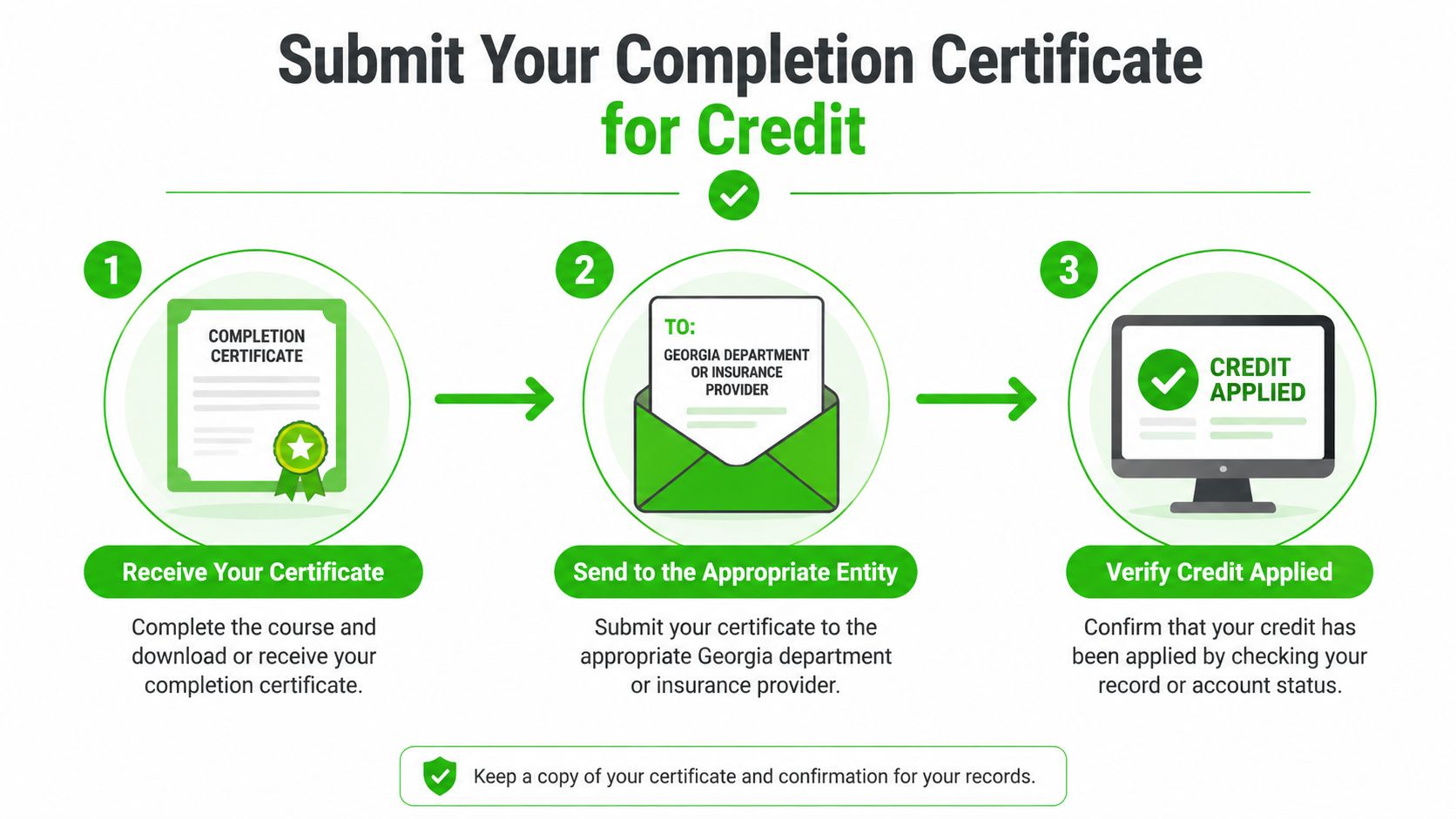
Many drivers make their most expensive mistake at this point. They complete the class and assume the credit will just show up where it needs to go.
It doesn't always work that way.
If you're using it for DDS
For point reduction or another DDS-related purpose, ask the school exactly how completion is reported. Many approved providers handle reporting, but you should still confirm what was sent and when.
Keep your own copy of the certificate even if the provider submits electronically. If something doesn't post correctly, your copy is what helps you straighten it out.
If you're using it for court
Court submission needs more caution. The court cares about the deadline and the filing path. In some situations outside Georgia, completion must occur within 90 days for suspension-related cases or driving privileges may be suspended, which shows why submission timing matters, as noted by the Indiana BMV driver safety program guidance. The practical lesson applies everywhere. Don't wait until the deadline week to ask how the clerk wants the certificate.
For Georgia courts, take these steps:
- Call the clerk if instructions aren't clear.
- Ask whether they want the original, a copy, or electronic delivery.
- Keep proof that you submitted it.
A finished class doesn't help if the court never connects your certificate to your case.
If you're using it for insurance
Insurance companies run their own process. Some want the certificate uploaded through a portal. Others want it emailed to an agent. Some update the policy at renewal rather than mid-term.
If your goal is lower premiums, review what a defensive driving course to lower insurance can realistically do, then contact your carrier directly before and after completion. Ask two questions: whether the course qualifies, and how they want proof submitted.
A simple submission checklist
- Save the certificate immediately
- Send it to the right party
- Verify receipt
- Follow up until the credit is applied
That final follow-up is what separates a smooth process from a frustrating one.
Frequently Asked Questions About Course Renewal
What if I lost my certificate
This comes up more than you might expect. A driver finishes the class, needs proof later for court, insurance, or personal records, and realizes the certificate is gone.
Start with the school that issued it. In Georgia, driver improvement records are not kept forever, so waiting too long can turn a simple replacement request into a full retake. If the school has closed and the class was taken recently enough to still be in DDS records, DDS may be able to help by phone at 678-413-8745. A small replacement fee can apply. If too much time has passed, the practical answer is usually to take the course again.
Does an expired insurance discount mean my points came back
No. Insurance timing and DDS point reduction timing are separate.
This is the mistake I correct most often. A driver retakes the course because an insurer wants a newer certificate, then assumes that retake also resets the state's point-reduction clock. It does not. In Georgia, the DDS point-reduction benefit follows its own 5-year eligibility cycle. Insurance companies can ask for a more recent course on their own schedule, and that schedule does not put points back on your record.
The same course can serve different purposes. The deadline and the benefit depend on who is asking for it.
Can I use an old course for a new court case
Maybe, but do not assume it will count.
Courts usually focus on the order in front of them. Some judges or clerks want a certificate completed after the citation or within a specific deadline tied to the current case. If you plan to use an older certificate, ask the clerk before you rely on it. That quick call can save you from missing compliance and finding out too late that the court wanted a fresh completion.
Does a retake always help
It helps only when it matches the reason you are taking it.
If your insurer wants a current certificate, a retake may help with the discount even if you are still inside Georgia's 5-year DDS window and cannot get another point reduction yet. If the court ordered a class for a pending case, the court's timeline controls. If your goal is state point reduction, retaking early does not create a second DDS credit before that 5-year cycle runs out.
That distinction matters. Retaking a course is easy. Getting the specific credit you want depends on whether you are dealing with DDS, a court, or an insurance company.
If you need a current Georgia-approved class for point reduction, court compliance, or insurance documentation, review the Georgia DUI Schools defensive driving course options.