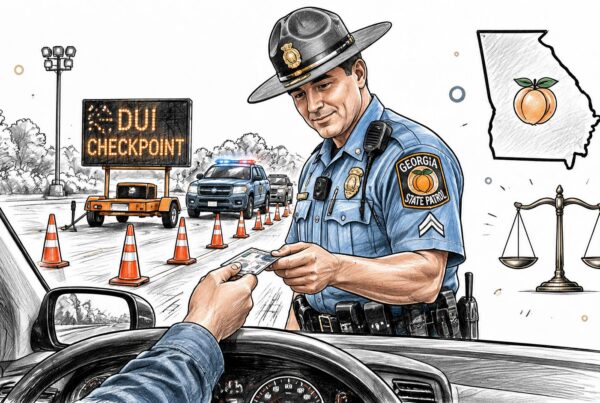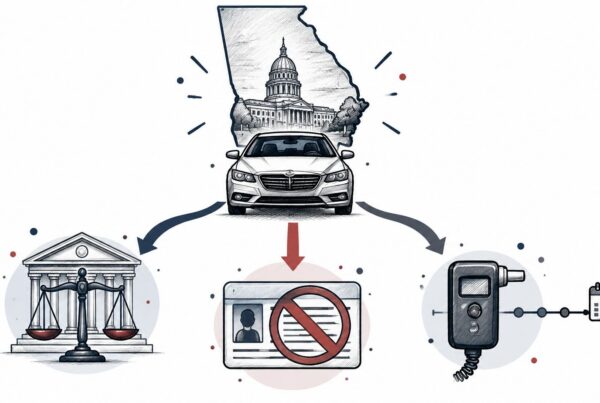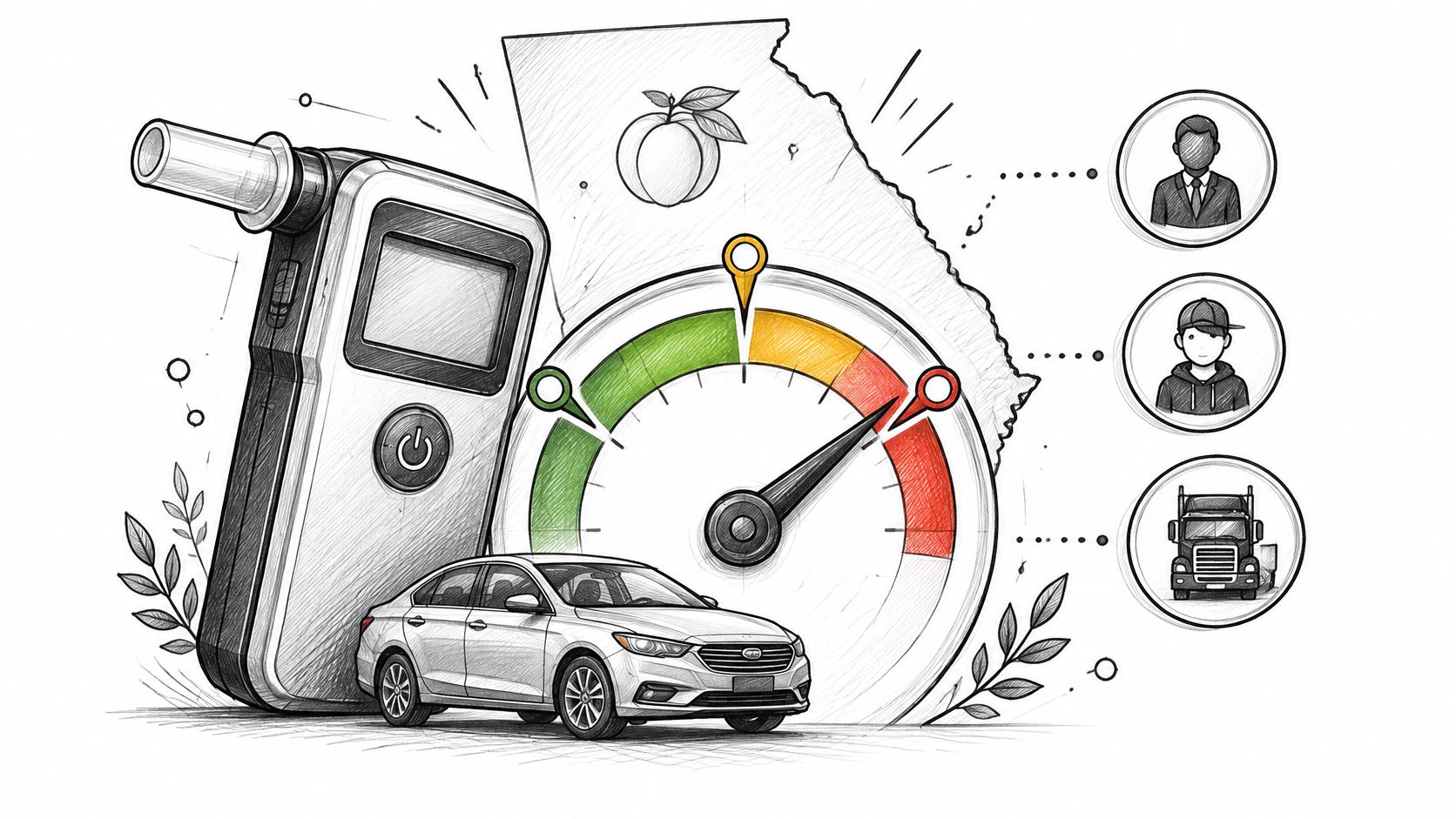
Georgia's adult per se legal blood alcohol limit is 0.08% BAC (0.08 g/dL), while the limit is 0.02% for drivers under 21 and 0.04% for commercial motor-vehicle drivers. A reading below the applicable limit doesn't automatically make driving safe or rule out an impairment-based DUI charge.
The familiar advice to stay under the limit leaves out a critical distinction: a legal threshold isn't a personal safety allowance. For Georgia drivers, understanding the number means separating a per se violation, evidence of impairment, and license consequences. Those issues can overlap, but they aren't interchangeable.
Georgia Legal Blood Alcohol Limits at a Glance
The adult per se limit is 0.08% BAC, or 0.08 grams of alcohol per deciliter of blood, while the Georgia DDS Driver's Manual describes lower thresholds for younger drivers and commercial operation, along with consequences for impaired driving below the general adult threshold.
Georgia BAC limits by driver group
| Driver group | Per se BAC limit | What it means |
|---|---|---|
| Adult driver, 21 and older | 0.08% (0.08 g/dL) | General per se limit for most drivers |
| Driver under 21 | 0.02% | Lower per se limit for drivers under 21 |
| Commercial motor-vehicle driver | 0.04% | Lower limit for operating a commercial vehicle |
| Any driver | Below 0.08% possible | Impairment-based charge if ability to drive safely is impaired |
An adult driving a personal vehicle generally falls under the adult rule. A younger driver faces the age-specific threshold, even if they feel alert and believe they can handle the drive home.
For commercial drivers, the vehicle being operated matters. The commercial-operation threshold shouldn't be confused with the rules governing every trip a commercial license holder makes in a personal vehicle. Commercial licensing consequences also deserve separate attention.
Read the table as a starting point
BAC measures concentration, not a driver's overall ability to respond to traffic. It doesn't directly tell you whether someone noticed a pedestrian, maintained lane position, or reacted appropriately when another vehicle stopped.
Consider a drive home from dinner in Atlanta. Knowing the applicable threshold answers a legal classification question, but it doesn't establish whether that particular driver can safely negotiate a dark intersection or an unexpected lane closure.
The useful questions are broader than whether a test crossed a line:
- Who was driving? Confirm the driver's age and license class.
- What were they operating? Identify whether the trip involved a commercial motor vehicle.
- What happened on the road? Consider evidence of impaired driving separately from the chemical result.
For younger and commercial drivers, relying on the adult number people commonly quote can lead to the wrong conclusion before the trip even begins.
The 0.08 Limit and Impairment Below It
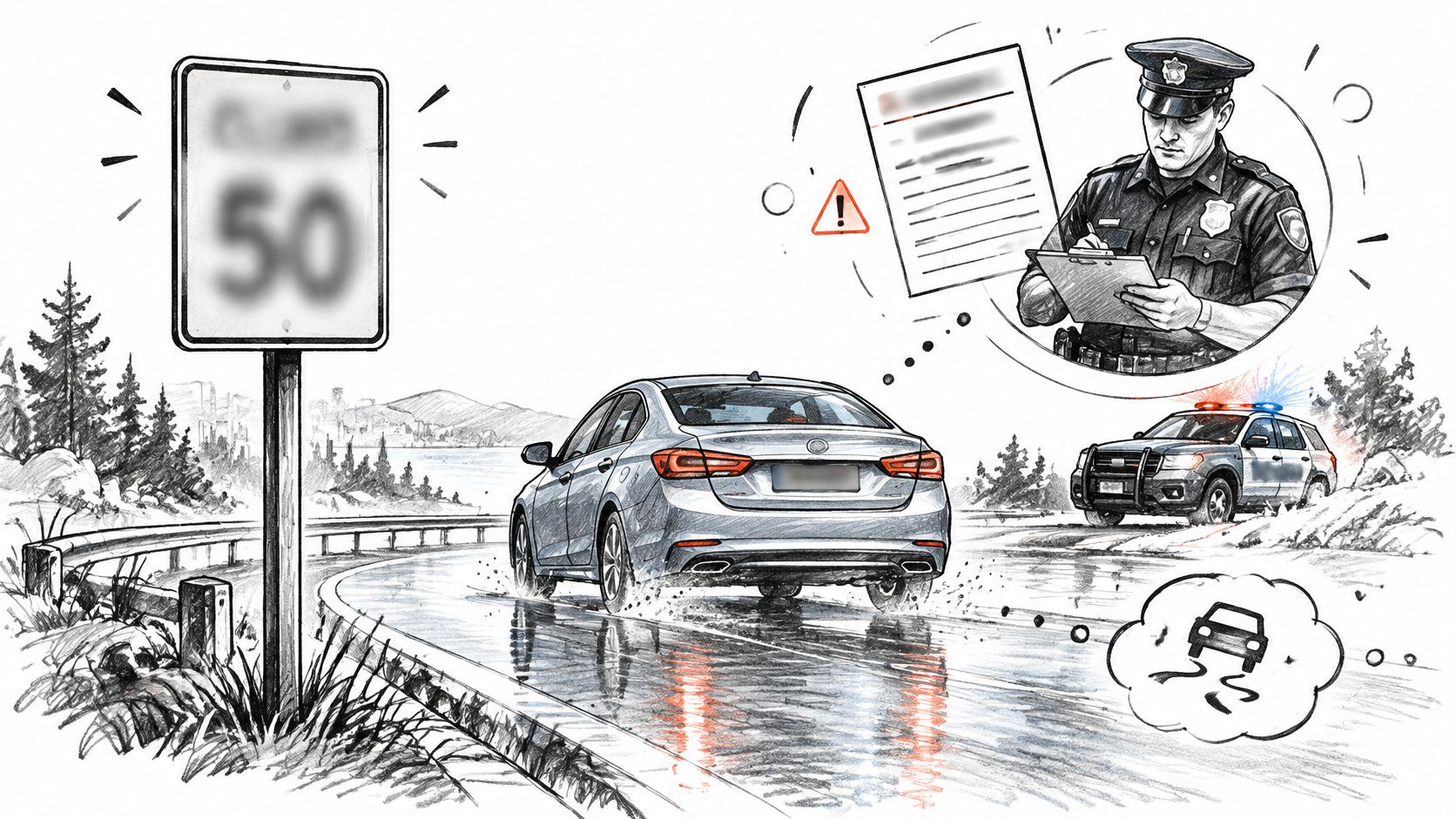
A posted speed limit offers a useful analogy. A driver can obey the number on the sign yet still drive too fast for a rain-soaked road. The numerical rule and the obligation to drive safely address different problems.
Georgia's alcohol rules make a similar distinction. The Georgia DDS guidance on fitness to drive identifies 0.08% BAC, equivalent to 0.08 g/dL, as the adult per se threshold while explaining that alcohol-related impairment can support enforcement below that level.
A number-based charge and an impairment-based charge
Per se means the prohibited concentration itself supplies the basis for that type of allegation, subject to proof of the relevant legal elements and the reliability of the evidence. The prosecutor doesn't need to turn the threshold into a personalized assessment of how well someone believes they drove.
An impairment-based DUI allegation, often called DUI less safe in Georgia, addresses whether alcohol made the driver less safe to operate the vehicle. A result below the adult threshold doesn't resolve that question.
Alcohol can interfere with reaction time, coordination, judgment, and hazard detection. A person might speak confidently and still make poor decisions about following distance or miss a changing traffic signal. Feeling composed isn't the same as processing road information accurately.
Evidence beyond the chemical result
An officer may document several kinds of evidence:
- Driving behavior: Lane departures, delayed responses, or other observations before the stop.
- Roadside performance: How the driver follows instructions and performs field sobriety exercises.
- Physical observations: Speech, balance, and an odor of alcohol, considered in context.
- Recorded evidence: Dash-camera or body-camera footage that can support or challenge an account.
An odor alone doesn't measure BAC, and an allegation isn't a conviction. An attorney can assess whether the observations, testing, and other evidence support the charge.
Practical distinction: A chemical result addresses alcohol concentration. An impairment allegation addresses the driver's ability to operate safely.
A personal breathalyzer can't determine legal status. It doesn't evaluate every relevant fact, resolve the reliability of official testing, or decide whether the driver's conduct supports a less-safe allegation.
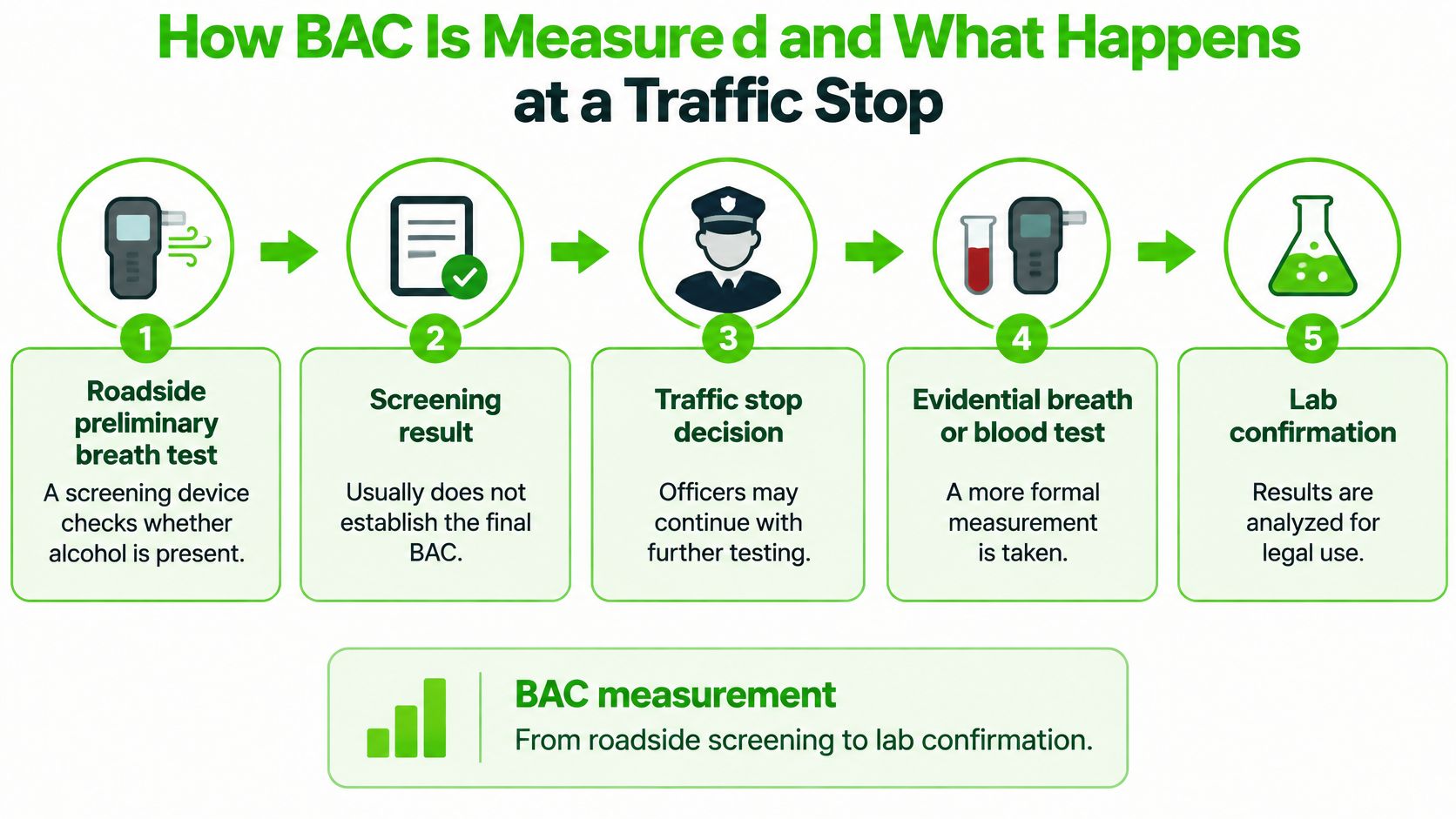
How BAC Is Measured and What Happens at a Traffic Stop
A roadside alcohol screening and a formal chemical test serve different purposes. A handheld preliminary breath device can help an officer investigate alcohol use, but it shouldn't be treated as interchangeable with an evidential breath instrument or a laboratory blood analysis.
Our breathalyzer test information provides additional context for understanding those distinctions. A driver should also distinguish a request for roadside screening from a request for chemical testing after arrest.
The usual sequence
Traffic stop and officer observations. The officer investigates the reason for the stop and may observe speech, movement, and driving behavior. You can ask why you were stopped, and you generally have a right not to answer investigative questions about drinking.
Roadside screening. The officer may request field sobriety exercises or a preliminary breath sample. Ask which test is being requested rather than assuming every request has the same legal consequences; roadside exercises and post-arrest chemical testing are different decisions.
Arrest and evidential-test request. Following an arrest, an officer may request formal breath or blood testing and read an implied-consent notice. Listen carefully: refusal can carry separate license consequences, and questions about consent, warrants, or refusal require case-specific legal advice.
The result is recorded. An evidential breath instrument analyzes a breath sample, while a laboratory analyzes a blood sample. Georgia law provides for an additional independent chemical test under applicable conditions, so promptly raise that request if you want one.
Administrative and court proceedings follow. Licensing action and a criminal prosecution may proceed on separate tracks. You can seek legal representation and review available ways to challenge the evidence or licensing action; don't assume resolving one proceeding resolves the other.
Understand what the test can establish
A result measures concentration at the time the sample is collected. It may not match an earlier peak, and interpreting the relationship between the test time and driving time can require professional analysis.
Don't assume blood testing automatically replaces breath testing whenever a driver disputes a result. Medical circumstances, consent, warrants, and the investigation can affect which sample is obtained.
An out-of-state arrest also requires state-specific guidance. For a Florida matter, Blandon Bail Bonds, Inc.’s explanation of what raises Florida DUI bail addresses a separate issue from Georgia testing and license reinstatement; it shouldn't be used to predict a Georgia outcome.
What Changes Your BAC Besides the Drinks
Counting containers isn't the same as counting alcohol. A strong beer, a generous wine pour, and a mixed drink with multiple measures of spirits can contain very different amounts.
The National Institute on Alcohol Abuse and Alcoholism's guide to alcohol consumption explains standard drinks and describes binge drinking as a pattern typically reaching 0.08% BAC, commonly about four standard drinks for women or five for men within roughly two hours. That's a population estimate, not an individual driving calculator.
Standard drinks and approximate alcohol content
| Drink | Standard serving | Typical alcohol by volume |
|---|---|---|
| Beer | 12 oz | About 5% |
| Wine | 5 oz glass | About 12% |
| Distilled spirits | 1.5 oz shot | About 40% |
These standard servings contain roughly comparable amounts of alcohol. Equal-sized pours don't: a glass filled with spirits isn't comparable to the same volume of beer.
Absorption and distribution change the result
Drinking rapidly delivers alcohol faster than spreading the same amount over a longer period. Food can affect absorption, but eating doesn't cancel alcohol already consumed.
Several other factors affect concentration or the risks associated with drinking:
- Body mass and alcohol distribution: People don't distribute the same dose identically.
- Drink strength and serving size: Restaurant pours and home measures may exceed a standard serving.
- Medications and liver metabolism: Interactions and individual processing can change the situation.
- Fatigue: Tiredness can further undermine driving performance, even though it isn't a dependable predictor of BAC.
Our explanation of alcohol's effects on driving helps connect those physical effects with the tasks drivers perform on the road.
Waiting a short period isn't a reliable way to certify that you're legally or physically ready to drive.
A drink-count calculator can't account perfectly for pours, timing, absorption, or individual metabolism. If you've consumed alcohol, arrange a sober driver, taxi, or rideshare rather than using how alert you feel as permission to drive.
Lower Limits for Drivers Under 21 and Commercial Drivers
Local examples show why the driver's circumstances matter. These are hypothetical situations, not predictions about a particular charge or sentence.
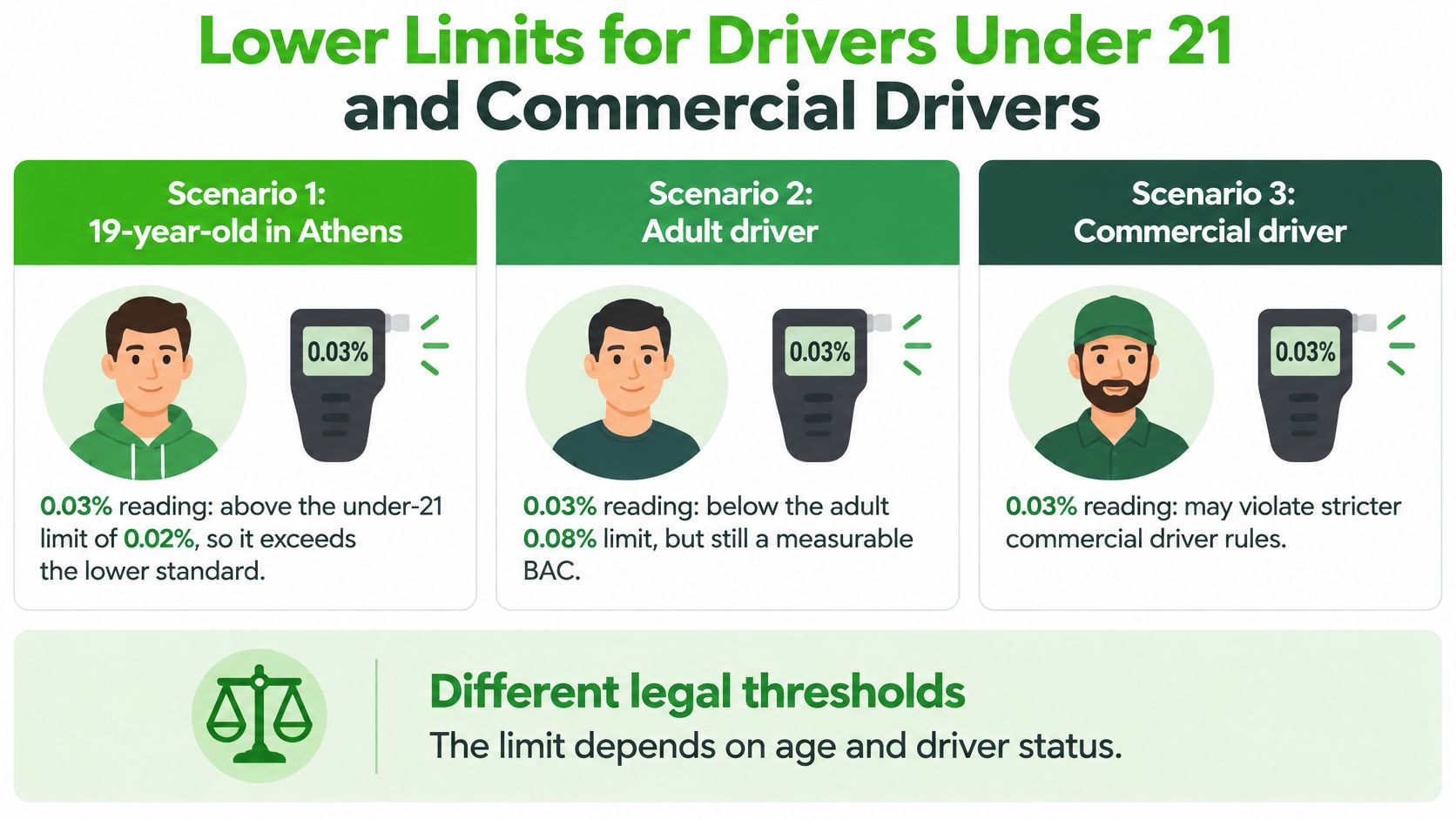
A younger driver leaving Athens
Say a 19-year-old in Athens has a hypothetical 0.03% reading after leaving a gathering. That reading exceeds the age-specific threshold listed in the comparison table, even though it falls below the general adult threshold.
The likely issues include an underage DUI allegation and licensing consequences. The driver should check the age recorded in the case paperwork, the charge, and any DDS notice rather than assuming an adult friend's experience applies.
The driver's belief that they felt normal doesn't replace the age-specific rule. Nor does taking a course erase the underlying allegation.
A commercial operator in Atlanta
Consider a commercial motor-vehicle driver with a hypothetical 0.05% reading while operating the commercial vehicle in Atlanta. That exceeds the commercial-operation threshold, making the general adult threshold the wrong comparison.
Commercial disqualification and employment concerns may arise separately from the criminal case. The Law Offices of Attorney Angel Lugo's discussion of federal BAC limits for commercial drivers offers context for understanding why commercial-license issues need their own review.
The driver should confirm the vehicle's classification, the operation involved, and the licensing action alleged. A commercial license holder driving a personal car presents a different legal question from someone operating a commercial vehicle.
An adult driver in Lawrenceville
A 40-year-old in Lawrenceville with a hypothetical 0.06% reading might still face an impairment-based allegation if video and other evidence show unsafe operation associated with alcohol.
Here, the relevant questions concern the driving, the officer's observations, and the quality of the evidence. The driver should preserve available recordings and have counsel examine the allegation rather than treating the reading as an automatic defense.
Check the actual allegation: Age, vehicle class, and evidence of impairment determine which rules need attention.
A threshold comparison identifies a possible legal issue. It doesn't establish guilt, predict a sentence, or tell someone when their driving privilege will be restored.
What Reinstatement Requires After a Limit Violation
Offense count and timing can change reinstatement obligations. The Georgia DDS DUI chart states that clinical evaluation and recommended treatment aren't required for reinstatement after a first DUI within five years under O.C.G.A. § 40-5-63.1, although a court may order them as probation conditions; they are required for a second DUI within 10 years.
Reinstatement requirements by DUI offense count
| Offense | Look-back period | Clinical evaluation and treatment for reinstatement |
|---|---|---|
| First DUI | Within 5 years | Not required; a court may still order evaluation or treatment as probation |
| Second DUI | Within 10 years | Required, plus any treatment the evaluation recommends |
Separate education from clinical requirements
The DUI/Risk Reduction program consists of an assessment followed by a 20-hour intervention course, completed in that order. The course assessment isn't a substitute for a separately required clinical evaluation.
After successful completion of both course components, the certified school issues an official Certificate of Completion, the legal proof needed for court or DDS reinstatement. Completing education alone doesn't establish that every reinstatement condition has been satisfied.
Live virtual attendance is acceptable only when the student is present and on camera with a live instructor throughout the intervention. DDS doesn't accept self-paced online DUI/Risk Reduction certificates for reinstatement or court purposes.
Organize the requirements before enrolling
- Confirm offense count and dates: Use the actual record, not memory.
- Read the court order: Identify evaluation, treatment, or other probation conditions.
- Confirm the format: Choose compliant classroom or live virtual instruction.
- Keep the certificate: Retain proof of completion and submission.
For someone convicted in Georgia who lives elsewhere, the home-state program must be certified there, substantially similar, at least 20 hours, and verified by Georgia DDS.
Our license reinstatement after DUI guide explains the process further. BDISchool's overview of Georgia license reinstatement fees and documents can also help organize paperwork, but the individual DDS record and court order determine what remains outstanding.
Confirm Your Requirements Before You Drive
Before driving again, confirm your current license status rather than relying on a course receipt or an expected completion date. Check age and vehicle classification for the driving rules, then offense dates and court-ordered conditions for reinstatement.
Bring a copy of your court order to an enrollment conversation. That helps distinguish required education from a clinical evaluation, recommended treatment, or another probation obligation.
At Georgia DUI Schools, the total DUI/Risk Reduction program cost is $360.00. The intervention can't be completed in one day and is commonly scheduled over a weekend or several evenings, so plan around the full attendance requirement.
Confirm current pricing, session times, and eligibility before enrolling, and verify legal requirements with the court or DDS. Book a compliant live format, not a self-paced certificate.
Georgia DUI Schools offers DUI/Risk Reduction education serving Atlanta, Athens, and Lawrenceville, with classroom and compliant live virtual options to help drivers complete required education. Visit Georgia DUI Schools for enrollment assistance, and review the Georgia DUI/Risk Reduction course to choose a session that fits your court and DDS requirements.