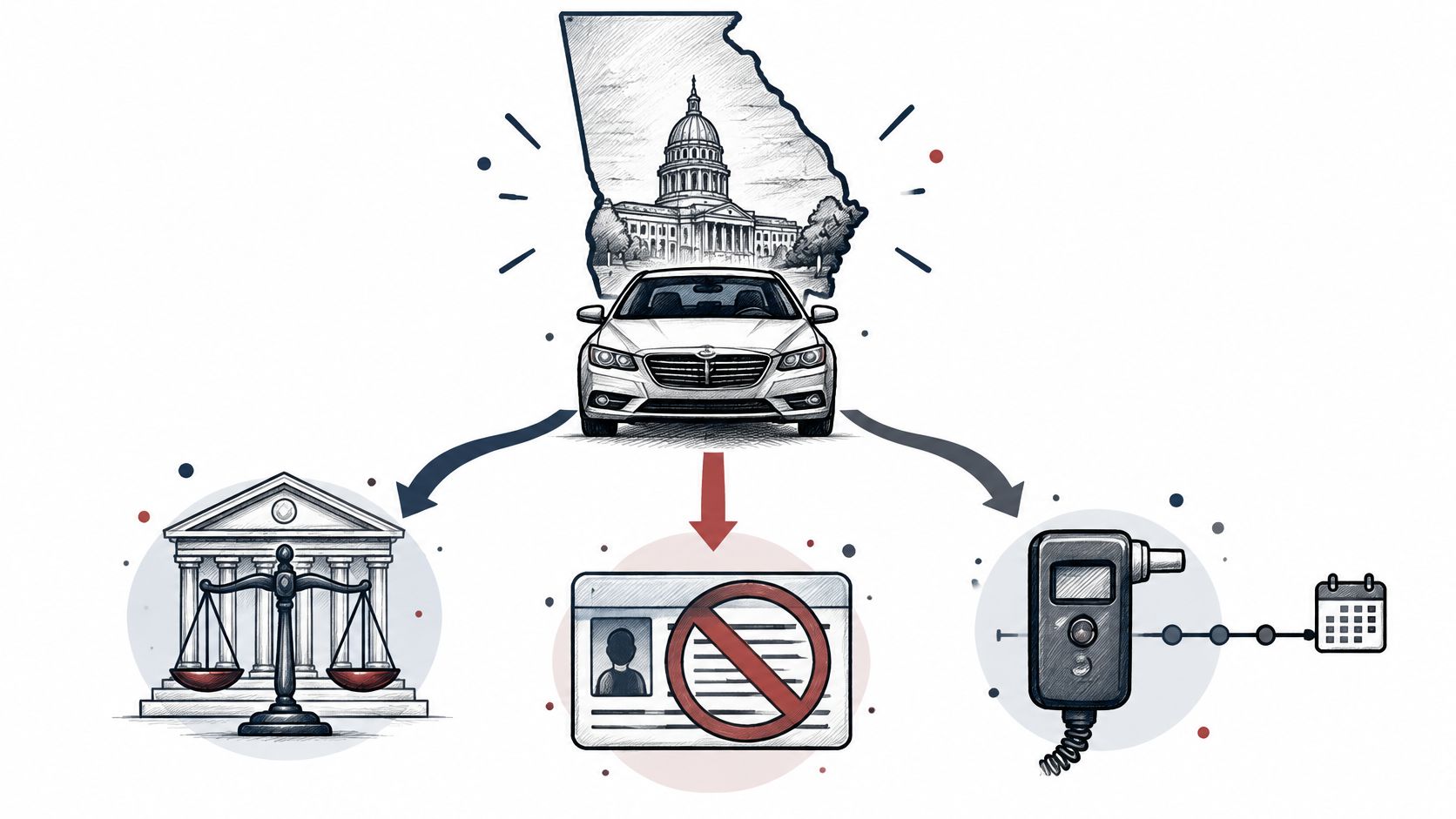
You're home after a DUI arrest in Atlanta, looking at release paperwork and wondering how you'll get to work. The car may need to be collected from a tow lot, your court date is approaching, and someone has told you to sign up for a class. What's less clear is which of those steps lets you drive again.
Georgia DUI penalties make more sense when you separate court punishment, license restrictions, and required education or treatment. Each has its own paperwork, and finishing one doesn't automatically resolve the others.
What a Georgia DUI Penalty Really Includes
Say an Atlanta driver, age 21 or older, is arrested after dinner for a first DUI. Booking, a possible tow, and the first court appearance are immediate concerns, but they aren't the whole penalty.

The Georgia DDS driver guidance describes separate licensing consequences involving a BAC of 0.08 or higher or implied-consent test refusal, including a suspension of at least 12 months. That administrative process can matter while the criminal case is still unresolved.
Can this driver legally drive to work next month? That's the practical question, not simply what the maximum fine says.
The separate decisions you need to track
The court disposition records what happened in the criminal case. It can include a fine, jail, probation, community service, and conditions such as testing or treatment.
DDS suspension and permit eligibility determine your licensing status. A court's permission to attend work or school isn't, by itself, a DDS driving permit.
Behavioral requirements include the DUI Alcohol or Drug Use Risk Reduction Program and, when ordered, a clinical evaluation, treatment, or a Victim Impact Panel. Completing an education requirement doesn't erase the sentence or independently restore driving privileges.
Keep these responsibilities organized:
- Court folder: Charging documents, court dates, disposition, probation instructions, and completion deadlines.
- DDS folder: Suspension notices, permit information, reinstatement requirements, and submission receipts.
- Program folder: Assessment records, attendance instructions, certificates, and evaluation or treatment documents.
Use your conviction history to identify the appropriate penalty category below. Be sure to keep the court disposition and DDS reinstatement checklist as separate documents, because they answer different questions.
Georgia DUI Penalties by Conviction Count
Georgia sets DUI fines and jail ranges by counting prior convictions inside a lookback window, and the court's count isn't always the same count DDS uses for licensing.
| Offense | Fine | Jail | Minimum add-ons |
|---|---|---|---|
| First conviction | $300 to $1,000 | 10 days to 12 months; all but 24 hours may generally be suspended, stayed, or probated at BAC 0.08 or higher | 40 hours of community service, 12 months of probation, DUI Risk Reduction |
| Second conviction within 10 years | $600 to $1,000 | 90 days to 12 months; all but 72 hours may generally be probated | At least 30 days of community service, 12 months of probation, DUI Risk Reduction; a second conviction within 5 years generally brings a longer DDS suspension and about 12 months of ignition interlock after the 120-day hard suspension |
| Third conviction within 10 years | $1,000 to $5,000 | 120 days to 12 months; all but 15 days may generally be probated | At least 30 days of community service, 12 months of probation, DUI Risk Reduction; a third conviction within 5 years triggers habitual-violator review |
| Fourth or subsequent within 10 years | $1,000 to $5,000 | 1 to 5 years; all but 90 days may generally be probated; felony | At least 60 days of community service and probation; felony case; DDS and education conditions may still apply |
The criminal ranges and felony threshold in this table come from Georgia's DUI statute. The community-service, probation, and education requirements follow DDS guidance; interlock and habitual-violator consequences involve a separate licensing review.
Find the row that matches both the offense count and the applicable lookback period. Don't select a row because this is your latest arrest. An arrest, a conviction, and a license suspension aren't interchangeable events.
How to read the criminal penalty range
A statutory range describes possible sentencing exposure. It cannot predict what a particular judge will order. The charging document, prior record, facts of the incident, and final disposition all matter.
The phrase "all but X may be probated" sets the floor of the sentence. On a first conviction that floor is 24 hours; on a second it rises to 72 hours; on a third, 15 days; on a fourth, 90 days. Everything above the floor can be structured as probation, but the floor itself must be served. That rising floor is why repeat rows matter more than the fine column: each count increases the time a judge can't suspend.
Likewise, a fine isn't the entire amount you should budget. Keep the criminal fine separate from probation expenses, education, evaluation or treatment, insurance, and DDS reinstatement payments. A receipt showing you paid the fine doesn't establish that you've satisfied those other obligations.
The lookback windows also differ by decision-maker. The court counts priors within 10 years to pick the sentencing row, while habitual-violator status uses three convictions within 5 years. A driver whose three convictions span more than five years can face third-offense sentencing while avoiding habitual-violator status entirely.
Why similar cases can feel very different
An Athens student and a Decatur commuter can face the same statutory sentencing range but very different practical restrictions. The student may need to coordinate classes, probation appointments, and transportation to campus. The commuter may need a work arrangement that doesn't depend on driving.
Probation can also bring testing, treatment, or a Victim Impact Panel when ordered. Read the actual conditions rather than assuming every person convicted of DUI receives an identical checklist.
For a family still handling release from custody, 24-7 Best Bonding provides information about help arranging a loved one's DUI bail. Release arrangements address the immediate custody problem; they don't decide the criminal case or restore a driver's license.
Before treating any row as your final outcome, confirm:
- The offense history: Identify prior cases that resulted in convictions.
- The applicable dates: Have the relevant lookback calculation checked under both the 10-year criminal count and the 5-year habitual-violator count.
- The exact charge: A DUI case involving additional allegations needs more than a general penalty chart.
- The final order: Follow the signed disposition and probation instructions, not an informal estimate.
The licensing rules and your current DDS status decide whether you can legally drive. The fine and jail columns describe only the court's sentence.
How Long the License Suspension Lasts
How long a Georgia DUI keeps you off the road depends on which suspension you are looking at. A single arrest can start two clocks: a court clock tied to the conviction, and an administrative clock that DDS runs on its own schedule. Needing a car for work, finishing a class early, or carrying an employer's letter grants no permission to drive while either clock is still running.
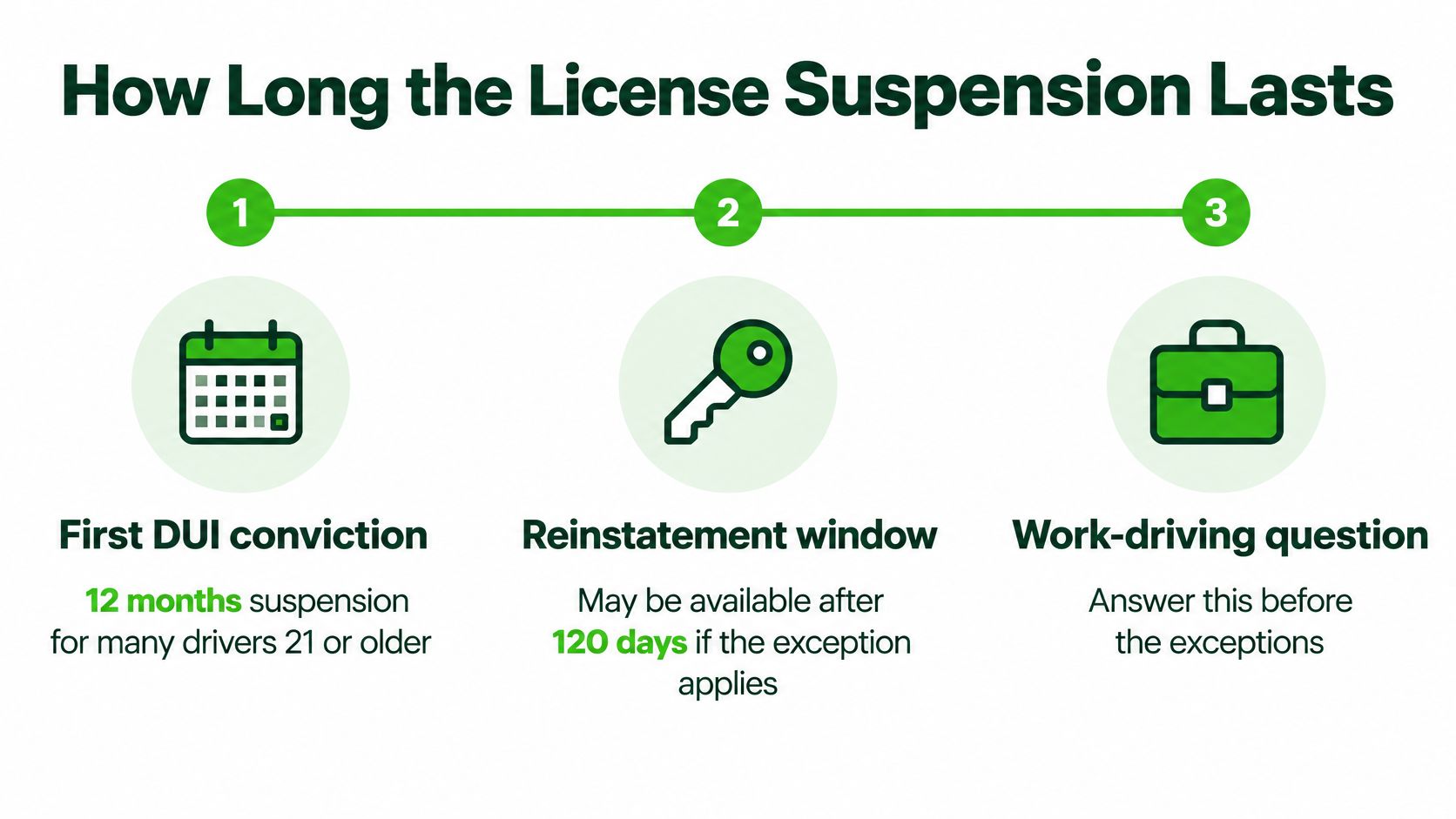
For many drivers 21 or older, a first DUI conviction produces a 12-month suspension, with reinstatement potentially available after 120 days once the driver completes an approved Risk Reduction program and pays the required fee, according to DDS guidance on first-DUI reinstatement. The same guidance treats a chemical-test refusal as a separate restriction: at least a one-year suspension and no limited permit following a first-DUI conviction.
| Case | Suspension | Earliest limited driving | What changes it |
|---|---|---|---|
| First DUI, age 21 or older, eligible case | Generally 12 months | Reinstatement may be available after 120 days with approved Risk Reduction and the fee; DDS still has to approve and restore the license | Conviction date, priors, age, and probation conditions |
| First suspension at BAC 0.08 or higher | A separate administrative term that runs alongside the court case | Permit availability depends on the exact action DDS recorded; confirm the status before driving | Administrative action can operate separately from court |
| First DUI with implied-consent refusal | At least 1 year | No limited permit after the first-DUI conviction | Refusal can create an administrative consequence independent of the criminal result |
| Second DUI within 5 years | Longer than a first-offense suspension | A hard no-driving period must finish before any limited privilege is considered | Interlock eligibility comes only after that hard period |
Read the middle column carefully. An eligibility date works like qualifying for a loan: meeting every condition gets you to the front of the line, and DDS approval is what restores the license. Treating that date as an issued permit is how drivers pick up a new charge on top of the old one.
Match the rule to the actual suspension
Confusion usually starts with the paperwork. A conviction-based suspension and an administrative suspension can grow out of the same arrest, so a broad statement about a first DUI may miss the specific action DDS placed on your record.
Start with the notice itself. Identify whether it concerns a conviction, a chemical-test result, a refusal, or another licensing issue. Two notices can mean two separate restrictions, and clearing one leaves the other in place.
Then ask DDS to confirm your current eligibility and the requirements attached to each action. When the documents seem to contradict each other, an attorney can explain how the administrative matter and the criminal case interact.
Before driving: Confirm that DDS has actually restored your privilege or issued the appropriate permit. A completed checklist sitting on your kitchen table is still just paperwork.
Build a usable reinstatement checklist
An Atlanta worker circling a date on the calendar and an Athens student finishing a class before the semester face the same risk: the license comes back when DDS restores it, on DDS's schedule.
Keep a written checklist:
- Identity and history: Match your age, license information, prior offenses, and conviction details.
- Implied-consent result: Identify whether a refusal or a chemical-test result created a separate action.
- Required documents: Determine where the certificate, court disposition, and other proof must go.
- Remaining conditions: Check fees, probation obligations, and any interlock requirement.
- Confirmation: Save DDS receipts and verify your updated status before driving.
A hard suspension means zero driving during the prohibited period. Finishing your education requirement satisfies one condition; the prohibition still runs its full length, and a second unresolved suspension stays in force until DDS clears it.
Interlock High BAC Injury and Habitual Rules
Repeat offenses and additional allegations can change the practical consequences of a DUI case. Treat them as separate conditions that must be identified, not as details automatically included in a general fine range.
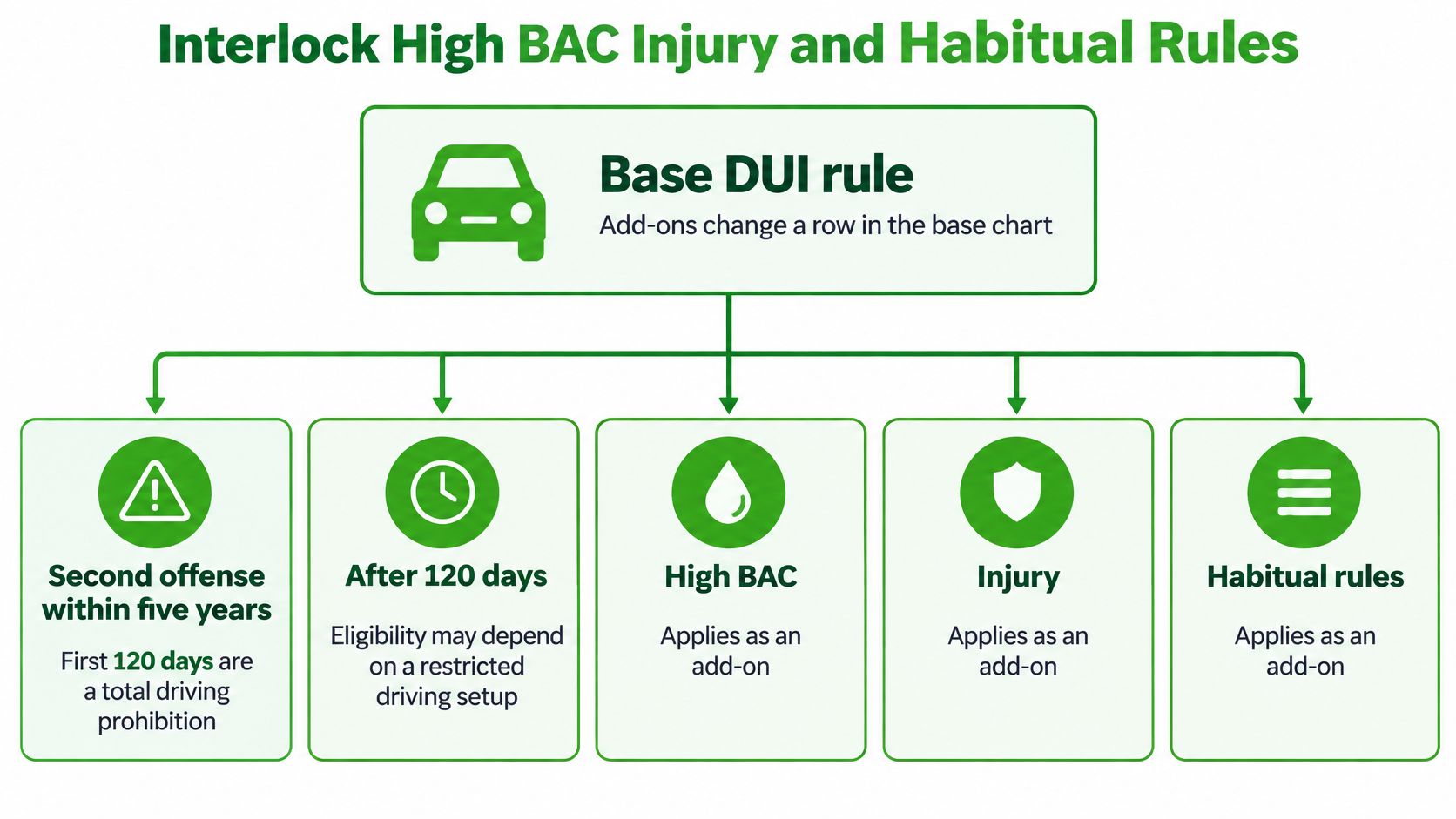
For a second DUI within five years, Georgia DDS guidance describes a minimum 18-month suspension, an initial 120-day driving prohibition, and possible eligibility afterward involving a certified ignition interlock for 12 months; the device generally prevents operation unless a breath sample is below a preset level, usually 0.02.
Interlock means ongoing compliance
An ignition interlock is more than an installation appointment. The driver must follow the applicable permit conditions and maintain the device as required.
Georgia guidance generally calls for interlock on vehicles operated by qualifying repeat offenders, subject to a financial-hardship exception. Don't assume that an exception applies because installation is difficult to afford. Obtain the actual determination and understand what driving privileges, if any, remain available.
Plan for the practical work:
- Installation: Coordinate the approved device and the vehicle you'll legally operate.
- Calibration and service: Keep required appointments and retain receipts.
- Maintenance: Address device problems through the authorized service process.
- Compliance records: Preserve documents that demonstrate you followed the order.
The explanation of an ignition-interlock restricted license can help you understand the restricted-driving arrangement. Installing a device doesn't independently authorize driving during a hard suspension.
Habitual-violator status requires a history review
A third suspension can involve revocation rather than an ordinary suspension, with later interlock conditions. The distinction matters because revocation can require a different return-to-driving process.
Georgia legislative language addressing habitual violators describes a third or subsequent conviction within five years, measured using the arrest dates associated with the convictions, as a basis for habitual-violator treatment under Code Section 40-5-58. It also describes proof of Risk Reduction completion and payment of the applicable restoration fee as requirements for ending a DUI-related suspension.
Have the history reviewed using actual records. Memory about when an older case “finished” may not match the date that controls the legal calculation.
High BAC and injuries need charge-specific advice
A higher alcohol result or a crash involving injury can affect charging decisions and court conditions. Don't assume that a familiar-looking DUI fine range captures the entire case.
For an injury or fatality case, obtain the charging document and have an attorney explain each count. There isn't one responsible statewide jail estimate that can replace identifying the alleged offense, its required elements, and the applicable sentencing law.
The same caution applies when repeat-offense history raises felony exposure. Education remains important, but enrolling in a course doesn't resolve the additional charges, habitual-violator determination, or interlock conditions.
Risk Reduction Evaluations and Required Programs
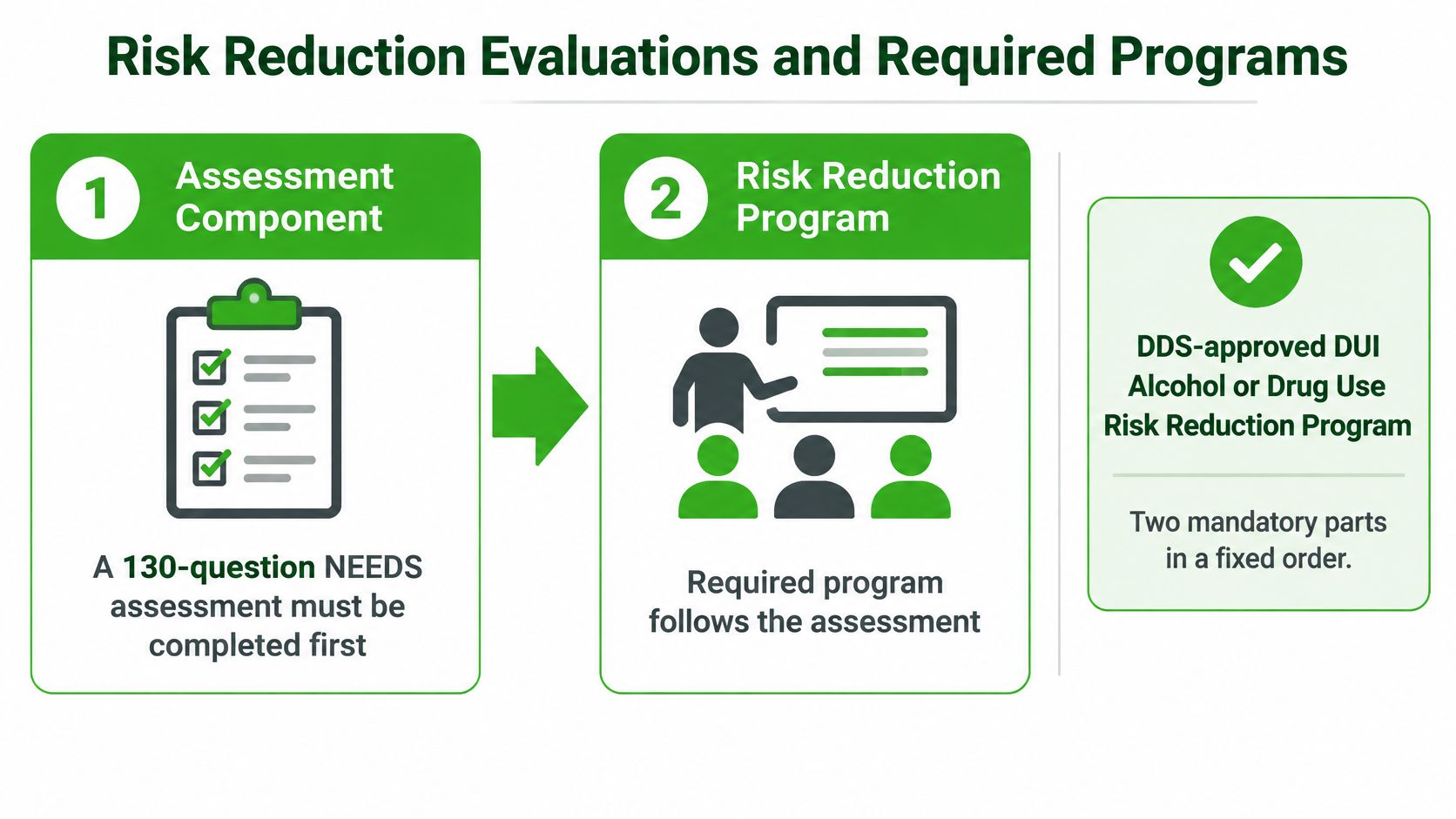
The DUI Alcohol or Drug Use Risk Reduction Program has a required order. You complete the Assessment Component first, followed by the Intervention Component. Booking classroom sessions without completing the assessment doesn't satisfy that sequence.
The DDS DUI program FAQs describe a 130-question NEEDS assessment followed by a 20-hour intervention course, with a certificate issued only after successful completion of both components.
What each component does
The NEEDS assessment is a screening instrument, not a pass/fail exam. You don't need to study for it or try to supply answers you think someone wants. Complete it truthfully so the screening serves its purpose.
The intervention follows through group sessions addressing alcohol and drug use, their effects on driving, therapeutic education, and peer-group counseling. It isn't interchangeable with watching a video, attending a panel, or taking a general driving class.
DDS accepts the required education through certified schools. An uncertified course can leave you with a certificate that doesn't satisfy the obligation you paid to complete.
For a plain-language explanation of the program's purpose, see what Risk Reduction involves. The essential enrollment question is whether the specific course and delivery format satisfy your court and DDS requirements.
Separate the course from other orders
Several requirements can appear on the same paperwork without being the same service:
- Clinical evaluation: A distinct assessment that may lead to treatment when the evaluator or court requires it.
- Treatment: A separate obligation with its own attendance and completion documentation.
- Victim Impact Panel: A possible court or probation requirement that doesn't replace DUI Risk Reduction.
- Defensive driving: A different course used for purposes such as points or insurance, not a substitute for the DUI program.
Say a Decatur student has an order listing Risk Reduction, a clinical evaluation, and a Victim Impact Panel. Scheduling the course alone won't complete that order. The student needs separate appointments and proof for each applicable condition.
Choose a compliant format and protect attendance
Georgia DDS doesn't accept self-paced online DUI/Risk Reduction certificates for court purposes or license reinstatement. Don't confuse instructor-led virtual attendance with a course you click through independently.
At our school, late arrival to an intervention session may result in denied entry. Missed time can't be made up, and the student must re-register, pay the full course fee again, and begin a new program.
That makes transportation planning part of course preparation. Arrange a ride that doesn't depend on driving illegally, test your setup before a virtual session, and keep work or childcare obligations clear during scheduled instruction.
Enrollment check: Match every requirement on the court order to a separate appointment, completion document, or submission task.
Keep a copy of your certificate and follow the submission directions. Don't assume the school's completion record means every agency involved has received what it needs.
The Insurance and Reinstatement Bill
The most expensive part of a DUI may be the recovery budget, not the headline fine. You may need to pay different organizations at different times while also covering transportation you previously handled by driving.
The DDS reinstatement procedures for DUI suspensions specify an SR-22 filing for three years, liability limits of at least $50,000/$100,000/$50,000 for a first qualifying conviction and $100,000/$300,000/$100,000 for a second or subsequent conviction, and a first-DUI reinstatement fee of $200 by mail or $210 in person.
| Cost | First qualifying conviction | Second or later | How long it lasts |
|---|---|---|---|
| SR-22 liability limits | At least $50,000/$100,000/$50,000 | At least $100,000/$300,000/$100,000 | 3 years |
| DDS reinstatement fee | $200 by mail or $210 in person | Different fee by suspension category | Paid at reinstatement |
| Ignition interlock | No first-offense cost established by the cited guidance | Generally ordered for second and subsequent offenses within 5 years | 12 months when ordered |
| Risk Reduction certificate | Required before restoration | Required before restoration | Proof submitted to DDS or court |
The liability limits aren't the insurance premium. They describe coverage amounts, not the price an insurer will charge you. Obtain a quote for the policy and filing you need rather than treating the coverage numbers as your bill.
Compare the practical burden
A first-offense Atlanta worker may have an earlier reinstatement opportunity if eligible, yet still face continuing insurance obligations. Returning to lawful driving doesn't mean the financial consequences have ended.
A repeat case can add interlock expenses and a longer period of restricted mobility. The driver needs to budget for installation, calibration, maintenance, and service appointments, not just the initial device charge.
For both drivers, the course payment and DDS restoration payment are separate. Course completion also doesn't arrange the insurance filing. Keep the school's certificate, insurer's confirmation, and DDS receipt as distinct records.
For the insurance questions to bring to your agent, use our explanation of insurance after a DUI. Ask for a written quote that identifies the required coverage, filing responsibility, payment schedule, and any continuing conditions.
Build a worksheet without guessing prices
Use actual amounts from your order, invoices, and quotes. Leave an item open until the responsible organization confirms it.
| Worksheet item | Amount to enter | Supporting document |
|---|---|---|
| Court fines and assessed charges | Amount ordered | Court disposition or payment statement |
| Probation costs | Confirmed charges | Probation instructions |
| DDS fee | Fee for your suspension category | DDS reinstatement checklist |
| Approved program | Enrollment total | School agreement |
| Clinical evaluation or treatment | Quoted or billed amount | Clinical provider paperwork |
| Insurance and SR-22 | Actual premium and filing charges | Insurer's written quote |
| Interlock if ordered | Installation and ongoing service charges | Device-provider agreement |
| Backup transportation | Your expected spending | Work, school, and appointment calendar |
Then place each payment beside its deadline. A budget that lists only totals can still fail if the insurance payment, program enrollment, and reinstatement fee come due before your next paycheck.
Keep room for travel to appointments and lost work time where applicable. Those aren't fixed legal charges, but they're real planning concerns for a driver who can't legally use a car.
The useful question is: What must I pay, complete, submit, and verify before I drive, and what continues afterward? That gives you a workable recovery plan instead of an incomplete fine estimate.
Start the Approved Risk Reduction Course
Start with the documents, then choose a course date. Confirm whether your case involves a first offense, refusal, repeat history, or additional restrictions, and collect both the court disposition and DDS reinstatement requirements before paying.
Follow the completion sequence
- Read the deadlines. Identify the dates for education, evaluation, treatment, probation reporting, and DDS submissions.
- Complete the assessment first. Don't schedule your intervention as though the screening were optional.
- Protect every session. Arrange transportation, work coverage, and the required technology before instruction begins.
- Submit the proof. Send the official certificate and any required payment to the court or DDS as directed, then retain confirmation.
Georgia DUI Schools offers the approved Risk Reduction course for drivers in Atlanta, Athens, Decatur, and other Georgia communities. The total program cost is $360.00. The intervention can't be completed in one day; it's commonly scheduled across a weekend or several evenings.
Finish the paperwork as carefully as the class
After successful completion of both components, our certified school issues the official Certificate of Completion, the legal proof needed for court or DDS license reinstatement. Follow your paperwork's delivery instructions rather than assuming possession of the certificate ends the process.
The certificate doesn't file your SR-22, cancel an ordered interlock, or authorize driving. Those tasks still need their own confirmation.
Review the Georgia DUI Risk Reduction course and match a session date against the deadline on your court or DDS paperwork. Leave enough time to complete the assessment, attend the full intervention, and submit the required proof.
Georgia DUI Schools provides DDS-approved Risk Reduction education to help you complete the education portion of your DUI requirements. Visit Georgia DUI Schools with your court order and DDS checklist ready, and choose the course session that fits your completion deadline.