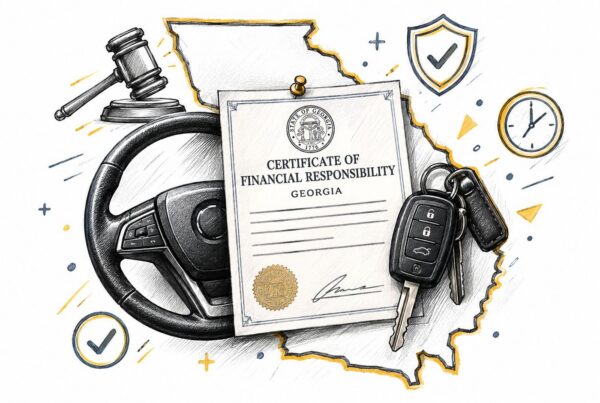

You may be searching for “certification in substance abuse” because you want to help people with substance use disorders. Or you may be in Georgia, facing a DUI conviction and trying to understand which course, evaluation, or treatment program will satisfy the court. Those searches look similar, but the obligations are very different.
A clinician is choosing a professional pathway involving education, supervised practice, examination, and possibly state licensure. A court-referred participant is completing a compliance process that may include a Georgia Department of Driver Services Risk Reduction Program, a clinical evaluation, treatment, and a Victim Impact Panel. Confusing those paths can lead to the wrong enrollment, missed deadlines, or a credential that doesn't authorize the work you expected to perform.
Two Different People Search for Certification in Substance Abuse
Maya is a 28-year-old community health worker in Atlanta. She already spends her days helping clients find housing, medical care, and behavioral health services. She's considering a Certified Addiction Counselor credential, but she wants to know whether she needs a degree, how supervised practice works, and whether a national credential will help her move into clinical counseling.
At the same time, James is a 31-year-old carpenter from Savannah. After a second DUI, he's searching for “certification in substance abuse” because someone told him he needs a certificate before his driving privileges can be restored. James doesn't need a professional addiction-counseling credential. He needs to complete the Georgia process required for a DUI conviction, beginning with an approved Risk Reduction Program and any additional requirements ordered by the court.
Maya is asking, “What can I legally and competently do as a counselor?” James is asking, “What documentation do I need to complete my case?” Both questions matter, but the answers come from different systems.
A short course certificate may show that James completed an assigned program. It won't make him a substance use disorder counselor. Conversely, Maya's future professional credential won't substitute for James's court-ordered requirements. Georgia's overview of substance abuse treatment can help clarify why education, evaluation, and treatment are separate services rather than interchangeable labels.
The practical distinction: A professional certification qualifies a worker for a defined role. A court-required completion certificate documents that a participant finished a required service.
The rest of this guide keeps both routes visible. The clinician path focuses on competency, supervision, credential levels, and portability. The Georgia pathway focuses on DDS approval, clinical evaluation, treatment placement, documentation, and deadlines.
What Certification in Substance Abuse Actually Means
Certification in substance abuse is formal recognition that a person has met defined education, experience, examination, and competency requirements for addiction-related work. It isn't the same as receiving a certificate of attendance after completing a class. Attendance proves participation. Certification evaluates whether a professional is prepared to perform specific duties safely.
SAMHSA's competency model organizes addiction counseling readiness into four foundational domains: understanding substance use disorders, knowing treatment approaches, applying knowledge to practice, and demonstrating professional readiness. The model connects knowledge with practical work such as screening, assessment, treatment planning, referral, counseling, and cultural competency. SAMHSA's addiction counseling competency model is useful because it asks what a counselor can do, not merely how many classroom hours the counselor completed.
The word certification still causes confusion because several credentials can sit beside one another:
- National credentials come from organizations such as NAADAC, the International Certification and Reciprocity Consortium, and the National Board for Certified Counselors. They signal that an applicant has met that organization's standards.
- State licenses come from a state licensing board. Credentials such as LPC, LCSW, or LMFT authorize practice within the scope defined by state law.
- Academic certificates provide focused education through a college or university, but they don't automatically authorize independent counseling.
- Short course certificates document completion of a particular training or court requirement.
The credential name isn't the scope of practice
A credential title doesn't answer every question about what its holder may do. Scope depends on the issuing authority, state law, employer policies, supervision status, and the setting where services are delivered. A certified counselor may be able to provide counseling under supervision while lacking authority to diagnose independently or operate a private practice.
Virginia illustrates how detailed state requirements can become. Its rules require 2,000 hours of supervised experience and at least 16 clock hours in each of 13 content areas, including relapse prevention, pharmacology, trauma and crisis intervention, co-occurring disorders, cultural competency, treatment planning, group counseling, and screening and assessment. Those requirements appear in the Virginia substance abuse counselor regulations.
A Georgia resident completing a court-ordered evaluation has a different need. The evaluator determines whether the participant needs services. The evaluator isn't awarding a counseling credential. Georgia residents should therefore read the explanation of drug and alcohol evaluations separately from professional certification information.
The Main Credential Tiers From Peer Support to Master Level
The credential ladder is easier to understand when you match each level to the work it permits. Titles and requirements vary, so treat the table as a planning framework, not a substitute for the board or credentialing commission in the state where you intend to practice.
Start with recovery support
A Peer Recovery Support Specialist usually works from lived experience and state-approved training. The role centers on mentoring, advocacy, navigation, practical support, and connection to services. Peer specialists don't replace clinicians and generally don't conduct independent clinical assessment or treatment.
The next level includes entry or associate addiction-counselor credentials, often called CAC-I, CAC-II, CADC, or a state equivalent. These pathways may accept a high-school diploma or associate degree, depending on the jurisdiction. They typically combine addiction education, supervised practice, and a written examination. Some IC&RC pathways specify 270 or 300 education hours, but applicants must confirm which standard applies to the credential they want.
Move toward clinical responsibility
A Certified Clinical Addiction Counselor, sometimes labeled CCAC, LAC, or a comparable state credential, generally expects bachelor's or master's education, broader competency preparation, supervised clinical work, and an examination. These counselors may perform more advanced assessment, treatment planning, individual counseling, group work, and care coordination, subject to state scope and supervision rules.
At the highest clinical tier sit master's-level independent licenses such as LPC, LCSW, and LMFT, sometimes paired with an addictions endorsement or specialization. These licenses involve graduate education, supervised clinical experience, an examination, and state approval. The addiction specialization adds expertise, but the underlying license determines the legal authority to practice.
| Credential | Minimum Education | Supervised Hours | Exam Required | Scope of Practice |
|---|---|---|---|---|
| Peer Recovery Support Specialist | State-approved training and lived experience, where required | Varies by state | Often required | Peer support, advocacy, navigation, and recovery assistance |
| CAC-I or entry-level CADC | High school diploma or equivalent in some states | State-specific | Usually | Counseling support and addiction services within defined supervision |
| CAC-II or advanced CADC | Associate-level or higher education, depending on jurisdiction | State-specific and often substantial | Usually | Broader counseling duties within state scope and supervision |
| CCAC or LAC | Bachelor's or master's degree, depending on the credential | Often 2,000 or more for advanced pathways | Usually | Clinical addiction counseling within state authorization |
| LPC, LCSW, or LMFT with addiction specialization | Master's degree | State licensure requirement | Yes | Independent practice where state law permits |
Renewal and continuing education requirements also differ. A counselor who plans to move should keep syllabi, transcripts, supervision logs, examination records, renewal confirmations, and employment verification. Those documents can become important when a new board reviews whether prior training meets its own standard.
Why U.S. Addiction Credentials Are So Fragmented
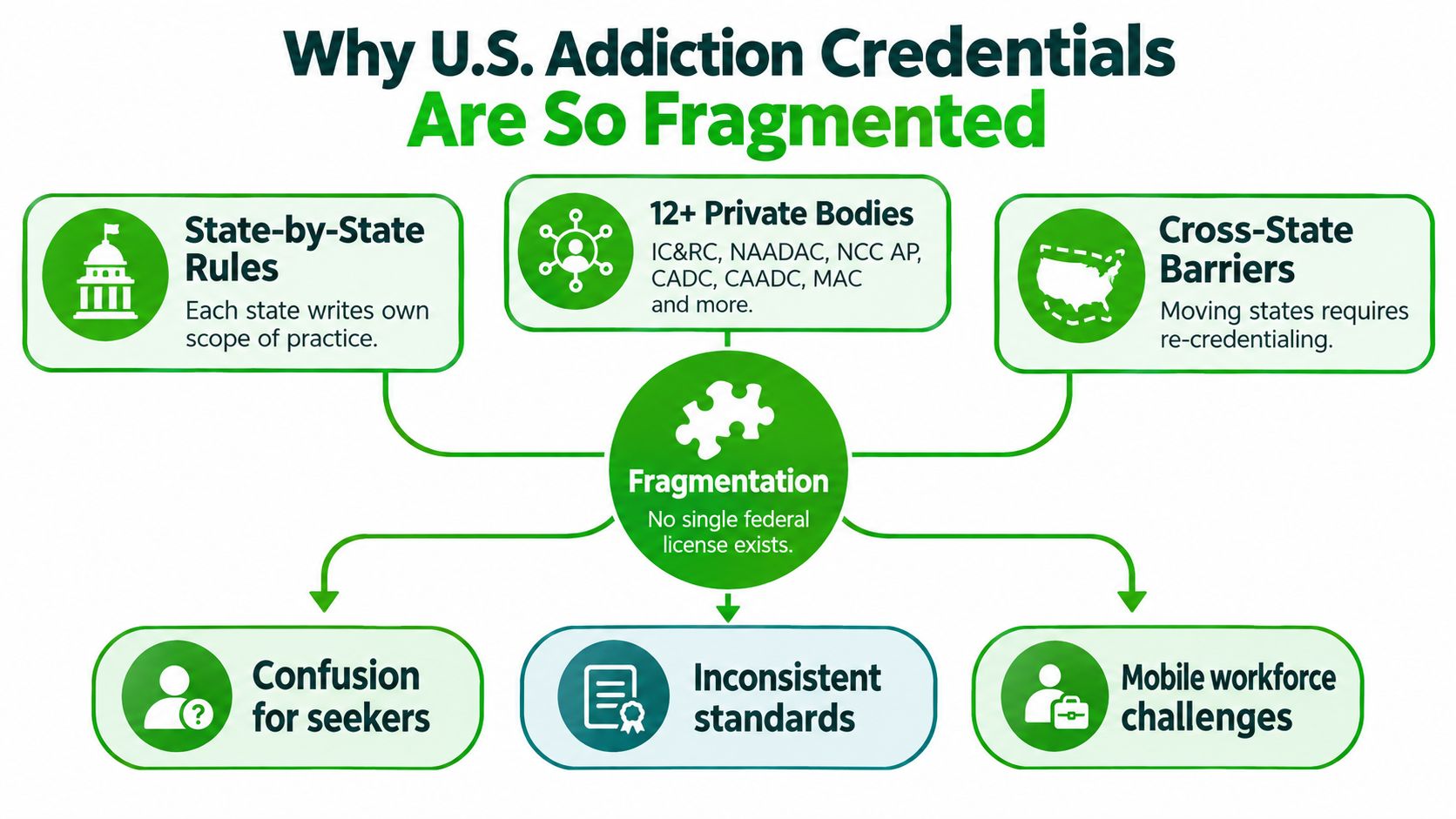
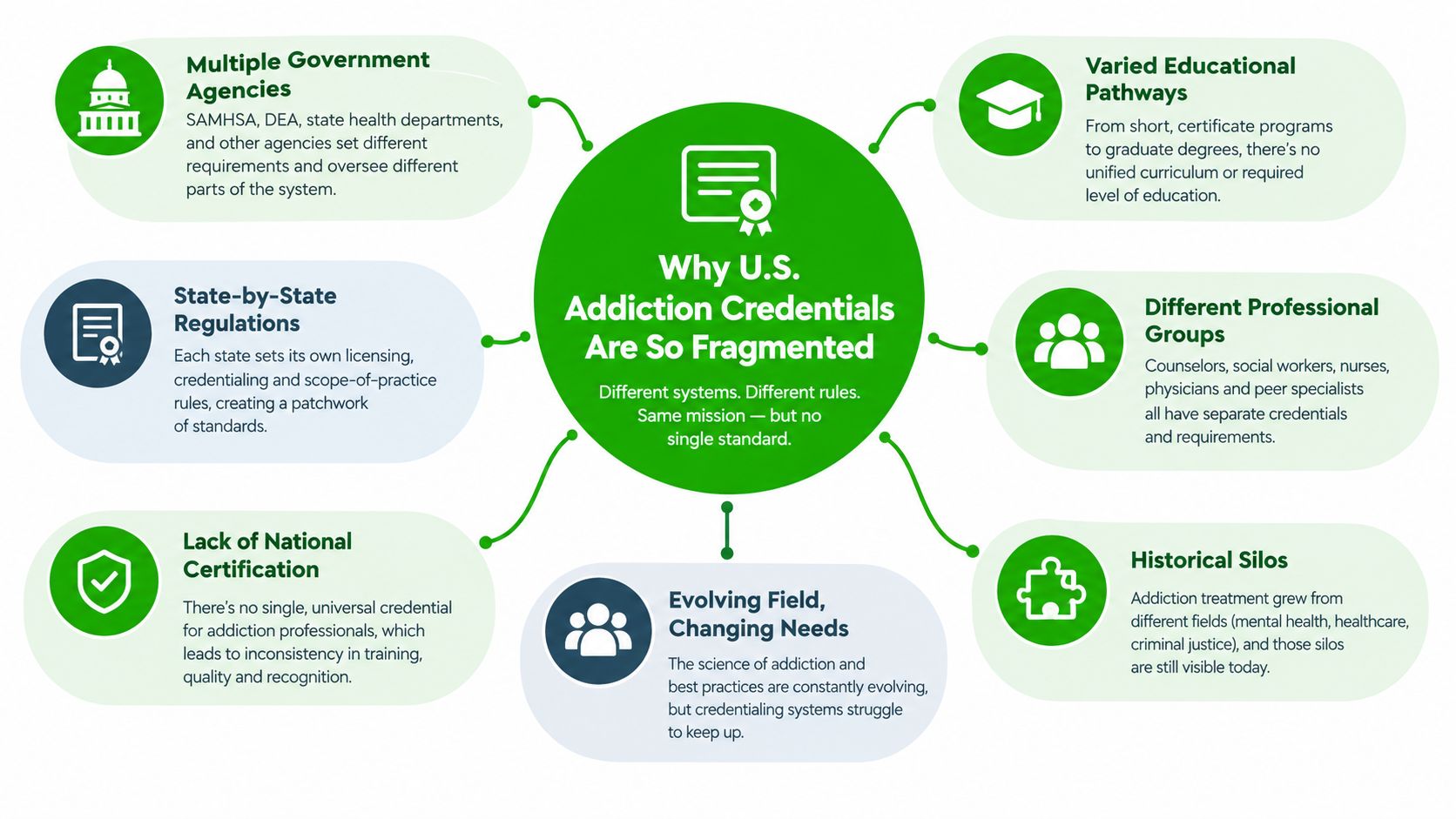
The United States doesn't have one federal license for addiction counseling. State governments define scope of practice, while private and professional bodies create credentials that employers and state systems may recognize in different ways. A recent review identified 160 addiction-counselor credentials across all 50 states and D.C. and noted that there is no standardized definition or title for an addiction counselor. The workforce review on addiction-counselor credentials captures the central problem: the same job title can represent different preparation in different jurisdictions.
Portability is a separate question from credibility
A respected credential isn't automatically portable. A counselor moving from Georgia to another state may discover that the receiving board wants different coursework, a different examination, additional supervised hours, or documentation in a particular format. The new state may also distinguish between a credential used for employment under supervision and a license used for independent practice.
Georgia's CAC-AD and CADC structures can connect with IC&RC reciprocity systems, but that doesn't mean every national credential transfers in the same way. A pure NAADAC NCAC I or NCAC II credential may be professionally valuable while still requiring separate review by the destination state. Reciprocity usually depends on the specific credential, the issuing body, the receiving board, current status, disciplinary history, and whether education and supervised experience match local rules.
A move can expose supervision gaps. For example, a counselor may have completed hours under a supervisor accepted in the original state, but the new board may require a particular supervisor credential or reject hours that weren't documented with the required forms. The safest strategy is to contact the destination board before enrolling in a program or accepting a position.
Portability rule: Choose the credential that satisfies the rules of the state and job you want, then add national recognition if it supports your career. Don't assume the order works in reverse.
Fragmentation also affects employers. A treatment program may need staff who meet state certification rules, payer requirements, court expectations, and internal clinical policies at the same time. The fastest employable path is therefore not always the most prestigious credential. It's the pathway that meets the local requirements without leaving gaps in supervision or scope.
The Georgia DUI and Court Ordered Pathway
James's Georgia process begins with the DUI Alcohol or Drug Use Risk Reduction Program. Georgia DDS requires the program for people convicted of DUI, possession of illegal drugs, underage alcohol possession while operating a motor vehicle, or boating under the influence. The program has two required parts, a NEEDS assessment and an intervention component. Both must be completed to receive a certificate of completion, as explained in the Georgia DDS DUI FAQs.
For a Georgia DUI conviction, the program must be completed within 120 days after conviction, or within 90 days after release from custody if the person was incarcerated. The statute also requires at least 40 hours of community service, reduced to 20 hours only for certain low-BC cases involving an alcohol concentration below 0.08. Georgia DUI law should be read alongside the court's order because an individual case can include additional conditions.
Assessment determines whether treatment follows
A clinical evaluation is different from the Risk Reduction course. A qualified evaluator reviews substance use history, driving history, mental health concerns, legal circumstances, functioning, and treatment needs. The evaluator may use structured criteria, including ASAM placement guidance, to determine whether outpatient services are appropriate.
If the evaluation recommends ASAM Level 1 outpatient treatment, the participant enrolls with an appropriately licensed provider and completes the assigned services. The court, probation officer, judge, solicitor, or another referring authority may specify which documentation must be returned. A completion certificate from one step doesn't prove completion of another.
Georgia DDS also explains that a defensive driving course may allow a licensed Georgia resident to request a reduction of up to 7 points once every 5 years, under O.C.G.A. § 40-5-86. That course serves point management and reinstatement needs, but it isn't a substitute for a DUI Risk Reduction Program when the court requires the latter. Georgia DDS defensive-driving FAQs clarify the distinction.
| Step | Hours / Duration | Approving Authority |
|---|---|---|
| NEEDS assessment | Part of the required Risk Reduction Program | Georgia DDS-approved provider |
| Risk Reduction intervention | 20 hours | Georgia DDS |
| Clinical evaluation | Determined by the provider and referral requirements | Court, probation, or applicable state authority |
| ASAM Level 1 treatment | Set by the clinical recommendation and court order | Licensed treatment provider and referring authority |
| Victim Impact Panel | Set by the panel provider and court order | Court or approved referring program |
| Community service | 40 hours, or 20 hours in the specified low-BC circumstance | Georgia court |
The sequence isn't always identical for every participant. Skipping a class, missing an evaluation, or failing to complete treatment can delay reporting and create a compliance problem. Read the court order, ask who receives each certificate, and keep copies of every document. A plain-language guide to Georgia's SAP program can help participants understand how assessment and treatment fit into the larger process.
Time and Cost Tradeoffs Across Both Pathways
Cost comparisons become misleading when they ignore what the payment buys. Maya is investing in education, supervised practice, examination, and professional access. James is paying for compliance services tied to a legal case. Neither should choose a program solely because it has the lowest advertised price.
For a clinician, a peer recovery credential may cost a few hundred dollars and take weeks. An associate-level CADC certificate may cost $1,500 to $4,000 across six to twelve months, including coursework and practicum. A master's degree followed by licensure may take two to six years and cost tens of thousands of dollars. These are planning ranges, not universal fees, and the actual amount depends on the school, credential, state, supervision arrangement, and financial aid.
For a Georgia participant, a DUI Risk Reduction Program commonly falls in the $250 to $400 range. A clinical evaluation may cost $100 to $300, while ASAM Level 1 treatment may range from $1,500 to $5,000. A Victim Impact Panel may cost around $75. Verify current fees directly with the provider and confirm which services are included.
| Pathway | Total Cost Range | Typical Duration |
|---|---|---|
| Peer recovery credential | A few hundred dollars | Weeks |
| Associate-level CADC certificate | $1,500 to $4,000 | Six to twelve months |
| Master's degree and licensure | Tens of thousands of dollars | Two to six years |
| Georgia DUI Risk Reduction Program | $250 to $400 | 20 hours |
| Georgia clinical evaluation | $100 to $300 | Provider-dependent |
| ASAM Level 1 treatment | $1,500 to $5,000 | Court and clinical plan dependent |
| Victim Impact Panel | Around $75 | Provider-dependent |
Clinicians should ask about employer reimbursement, scholarships, tuition payment plans, and whether practicum supervision is included. Georgia participants should ask whether insurance applies to clinical services, whether payment plans exist, and whether the court requires a specific provider. Keep receipts and completion records because cost alone doesn't establish compliance.
Choosing the Right Program and Planning Next Steps
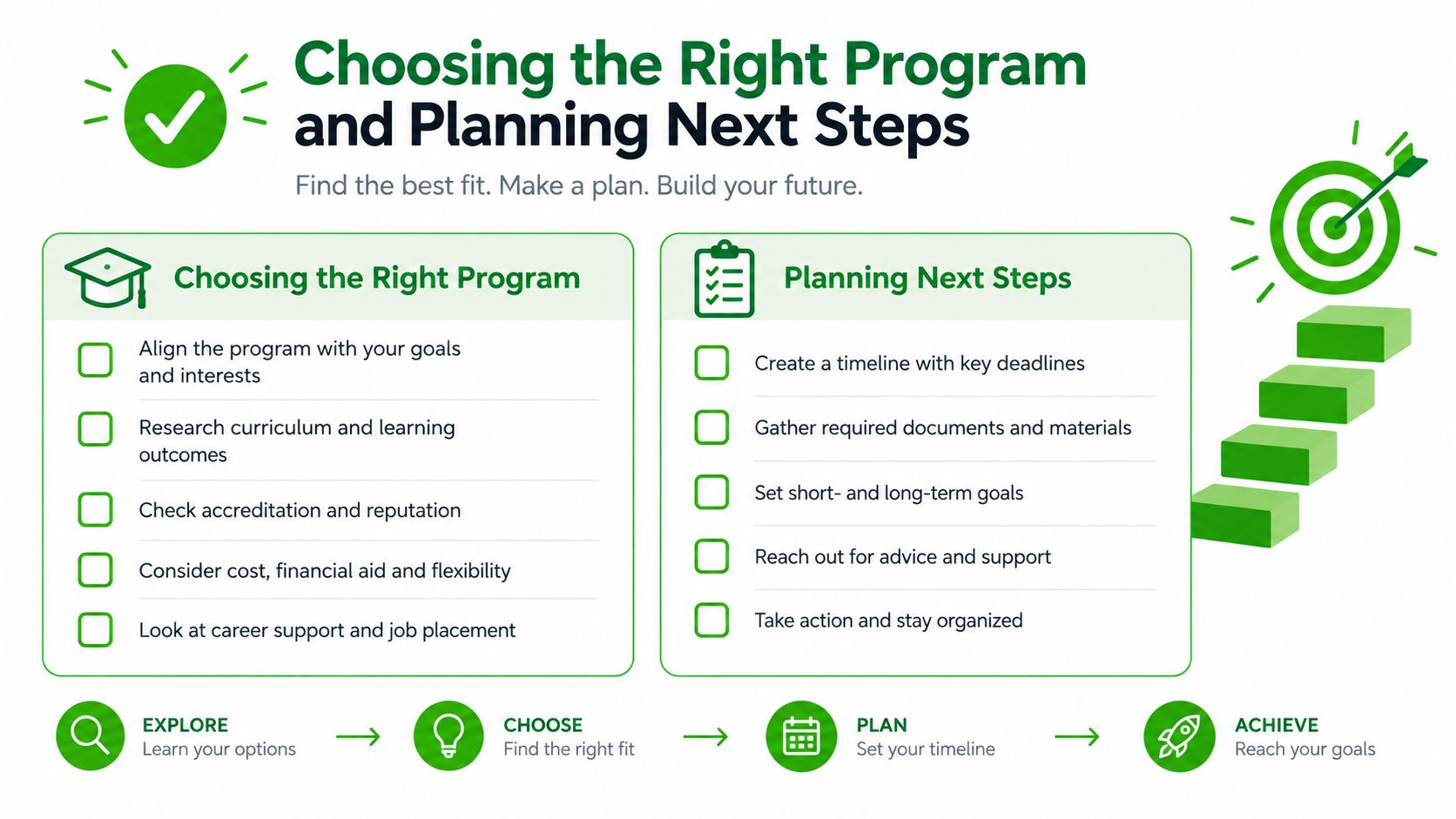
Maya's first task is to identify the job she wants, not just the credential that sounds most advanced. She should ask the state board or credentialing commission whether the program's education, practicum, supervisor, examination, and renewal requirements will count toward that target. She should also confirm whether the credential supports the setting she wants, such as a community clinic, residential program, hospital, or private practice.
James's first task is to obtain the court or probation requirements in writing. He should verify that the provider is DDS-approved, ask whether the NEEDS assessment is bundled with the Risk Reduction Program, and confirm where certificates must be sent. He should schedule the clinical evaluation, treatment, and Victim Impact Panel in the order required by the referral.
Use this short checklist:
- Define the role: Decide whether you need a professional credential, a state license, or a court-completion certificate.
- Verify authority: Confirm the issuing board, DDS approval, or licensing status before paying.
- Count qualifying hours: Ask in writing whether education and supervised practice will apply to the intended credential.
- Map the sequence: Record enrollment, evaluation, treatment, examination, renewal, or court deadlines.
- Protect your records: Save certificates, receipts, transcripts, supervision logs, assessment reports, and correspondence.
Professionals should preserve documentation for renewal and future reciprocity applications. Court-referred residents should keep a personal file even when the provider reports completion directly. If a deadline or requirement is unclear, ask the court, probation officer, licensing board, or provider before making assumptions.
Common Questions About Substance Abuse Certification
Will an NCAC II automatically transfer from Georgia to Texas or Florida? No. A national credential can demonstrate competency, but the receiving state decides whether it satisfies local employment, certification, licensure, supervision, and scope requirements. IC&RC reciprocity also requires review of the specific credential and supporting records, so confirm the destination state's rules before moving.
How do continuing education requirements work? Renewal rules vary by credential and state. Many counseling systems use a 40-hour biennial expectation, with specific ethics education among the required subjects, but CADC, CAC-II, and Georgia renewal rules may differ. Check the issuing body and state board rather than relying on a general number.
How can I identify a genuine Georgia DDS-approved program? Ask for the provider's DDS approval information and verify it through Georgia DDS. Provider approval includes compliance controls such as a $10,000 surety bond per location, GAPS fingerprinting, motor vehicle reports for applicable owners, and a recent fire-code inspection report, as described in the Georgia DDS program approval requirements.
Why does ASAM Level 1 placement matter for counselors? The placement decision shapes the services delivered, documentation required, and experience a counselor gains in court-referred care. Counselors should understand how evaluation recommendations connect to their own credential scope and supervision plan.
Georgia DUI Schools provides DDS-approved DUI and Risk Reduction education, clinical evaluations, ASAM Level 1 treatment, and Victim Impact Panel services for Georgia residents working through court or license requirements. With online and in-person options across the state, you can review the appropriate next step and visit Georgia DUI Schools to begin arranging the service your case requires.