
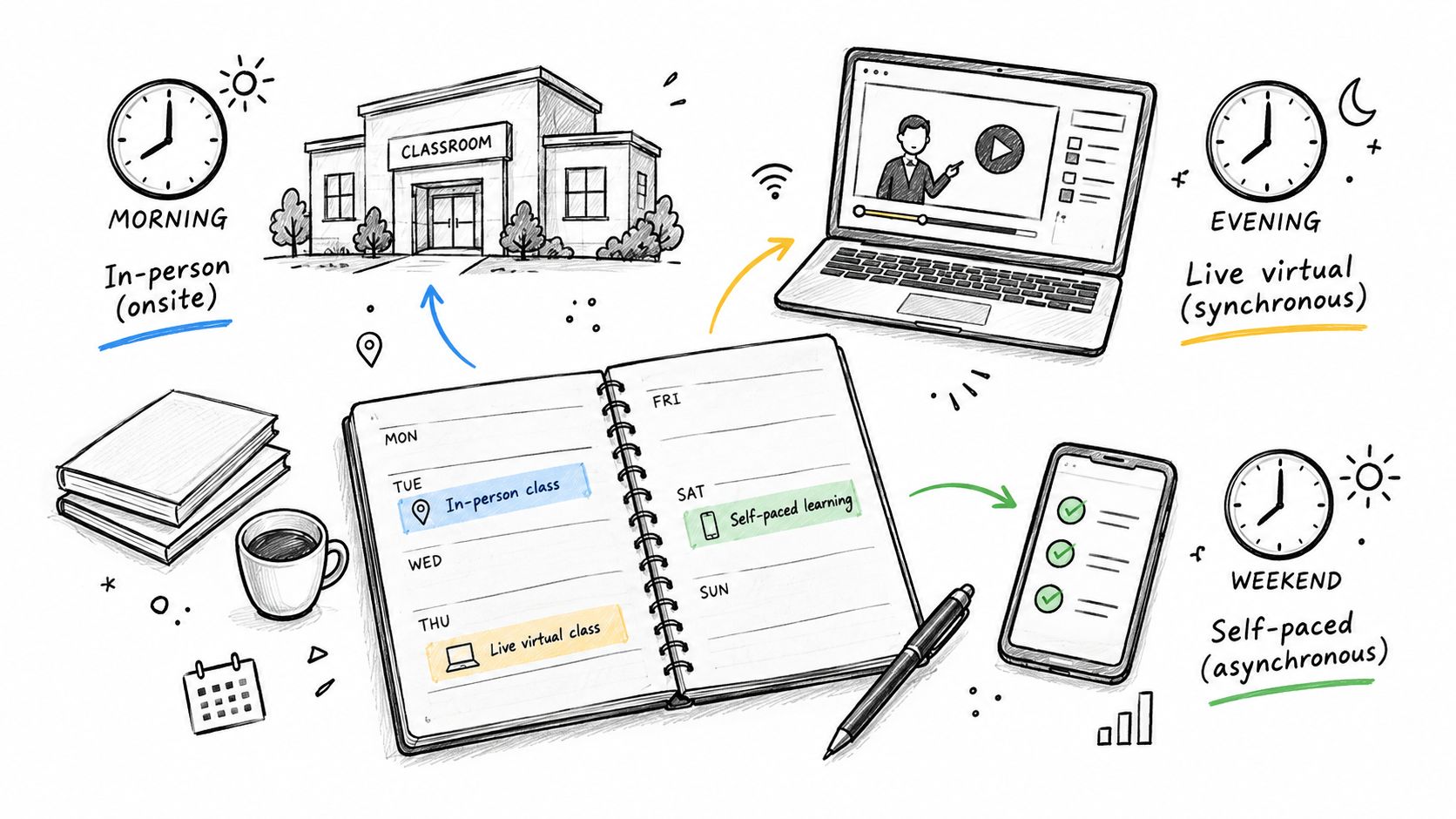
Georgia's DDS-approved defensive driving course is 6 hours and can be taken in person, live virtually through Zoom, or through a self-paced online program. The right schedule depends on your format, your reason for enrolling, and any court deadline attached to your citation.
You may be sitting in a courthouse parking lot with a court order on the passenger seat, a laptop open beside you, and a child's soccer practice marked on your calendar. Your first question is probably simple: “How many hours is this going to take?” In Georgia, the official course length is clear, but the way those hours fit into your week can vary widely.
A six-hour requirement can feel like one Saturday in a classroom, several live online sessions after work, or short self-paced study periods spread across your available time. The important task is to confirm what Georgia requires, which format your provider offers, and when your completion certificate must be ready.
Why Defensive Driving School Hours Are Not One-Size-Fits-All
“How many hours?” usually means three different questions:
- What minimum time does the state or court require?
- When does the clock run in the format I choose?
- How quickly must I finish for my specific reason?
Georgia's answer to the first question is a 6-hour Driver Improvement Program approved by the Georgia Department of Driver Services. The state's official program information explains that defensive driving, also called driver improvement, teaches safe driving attitudes and behaviors and may be used for court orders, points reduction, license reinstatement, insurance premium reduction, or personal education. You can review those approved purposes in the Georgia DDS Driver Improvement Program information.
The second question depends on delivery. An in-person class fixes you to a location and a published schedule. A live virtual class fixes you to scheduled online attendance, but removes the drive to the classroom. A self-paced course gives you more control over the start and stop times, subject to the provider's approved tracking and completion rules.
The third question is personal. A driver taking the course voluntarily for education may have plenty of room to choose a convenient date. Someone responding to a court order has less flexibility. A person seeking an insurance discount needs to confirm the insurer's requirements before assuming any course will qualify.
Practical rule: Treat the six hours as a compliance requirement first, then choose the format that makes finishing on time realistic.
The same six hours may be a single Saturday for a parent with a free weekend, several evening sessions for a full-time employee, or a series of short online study periods for someone working changing shifts. The rest of your planning should answer the Georgia timing rule, compare the three formats, and work backward from your deadline.
The Georgia Standard for Defensive Driving Course Hours
Georgia's DDS-approved Driver Improvement Program is a 6-hour course. The Georgia DDS describes it as a program designed to teach safe driving attitudes and behaviors, with approved uses that include court orders, points reduction, license reinstatement, insurance premium reduction, and personal education. The Georgia defensive driving course requirements provide a practical place to check the provider's course details before you register.
That fixed duration matters because a court, insurer, or licensing agency needs a recognizable completion standard. A provider can offer different scheduling options, but a shorter class shouldn't be treated as an equivalent Georgia DDS-approved Driver Improvement Program because it covers similar topics.
Georgia isn't unusual in defining course time, but it isn't representative of one national rule either. Defensive driving school hours are generally shaped by state-level requirements, insurance rules, and court systems. Commonly cited course lengths cluster around 4 to 8 hours, while some programs may be shorter or longer depending on the jurisdiction and purpose, as explained in this overview of defensive driving course length and state rules.
| State or program example | Minimum hours | Common format |
|---|---|---|
| Georgia Driver Improvement Program | 6 hours | In person, live virtual, or approved online |
| New York PIRP | 5 hours 20 minutes | Approved classroom course |
| National Safety Council state programs | 2, 4, 6, or 8 hours | State-authorized formats |
New York's Point and Insurance Reduction Program is specifically 320 minutes, or 5 hours and 20 minutes, according to the New York DMV PIRP requirements. The National Safety Council also offers state-authorized formats in 8-, 6-, 4-, and 2-hour versions, which shows why a driver moving between states shouldn't assume that one course length applies everywhere.
For broader context on Georgia driving rules and insurance considerations, QuoteFii's driver's guide to Georgia coverage can help you separate general insurance questions from the specific approval requirements for your course.
How In-Person, Live Virtual, and Self-Paced Online Structure the Hours
The six required hours don't feel the same in every format. Choose based on how much structure you need, whether you can travel, and how firmly your weekly calendar is fixed.
In-person classroom scheduling
A traditional classroom course places you at a school for a scheduled block. The instructor leads the material, answers questions in real time, and records attendance at the location. This option works well when you want a clear beginning and end, or when a court order makes a fixed class date easier to document.
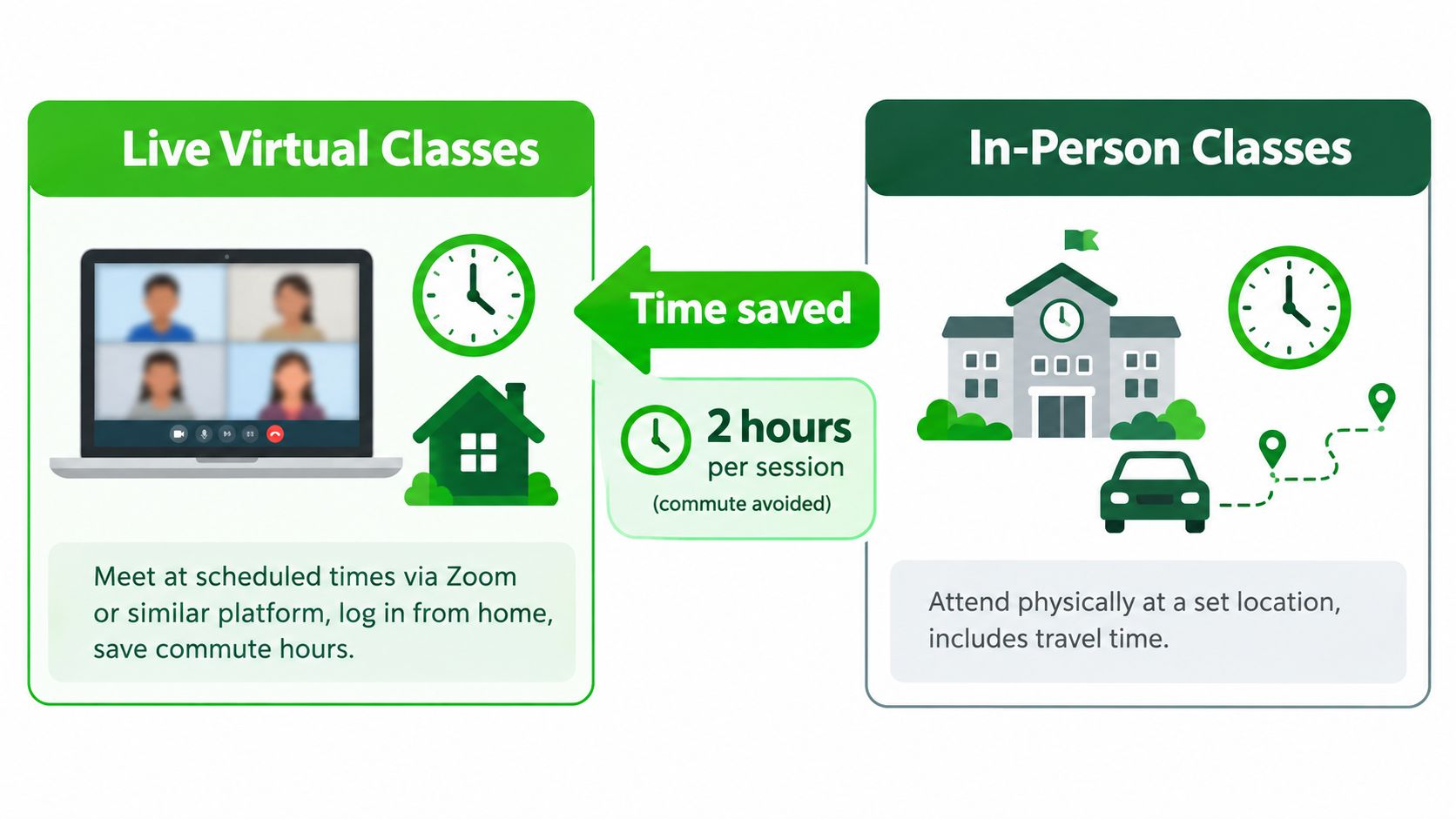
The trade-off is travel and less control over interruptions. You'll need to arrive at the correct location, remain present for the required instruction, and plan around breaks and the provider's schedule.
Live virtual attendance
A live virtual class uses Zoom or a similar platform, with an instructor teaching at set times. You still have to attend the scheduled sessions and follow the provider's identity and attendance procedures, but you can participate from home, a private office, or another suitable location.
This format suits drivers who want instructor interaction without commuting. It isn't the same as a self-paced course, because missing a scheduled session may require a makeup or rescheduling.
Self-paced online progress
A self-paced online course lets you choose when to work through the approved material. You can divide the course across several study periods instead of reserving one large block, but convenience doesn't remove the six-hour requirement. The provider's system must verify participation and completion according to its approved process.
Before paying, ask whether the course is self-paced, how progress is recorded, what device requirements apply, and how long you have to finish. The online defensive driving course option can help you compare the flexibility of online study with a scheduled classroom or live virtual session.
| Format | Time control | Instructor interaction | Main scheduling concern |
|---|---|---|---|
| In person | Low | Direct, in the classroom | Travel and fixed attendance |
| Live virtual | Moderate | Live through Zoom or similar platform | Scheduled login and attendance |
| Self-paced online | High | Usually built into the platform | Completion tracking and provider deadline |
Weekday, Evening, and Weekend Class Schedules
Most students don't need a complicated scheduling system. They need a class that fits around work, transportation, family responsibilities, and the date on a court document.
A weekday daytime class can work well if your schedule is flexible. Retirees, students between commitments, and people with daytime availability may prefer to complete the course during the week rather than give up a weekend.
Evening schedules are more practical for many full-time workers. Some schools divide the instruction across recurring weeknight sessions, while others offer a concentrated evening schedule. Ask whether every session is required and what happens if a shift change causes you to miss one.
Weekend classes appeal to drivers who want the course finished in one planned period. A Saturday option may be easier to protect than several weeknights, especially for people whose work schedule changes during the week. You'll still need to confirm the exact start time, breaks, attendance policy, and certificate timing.
A simple planning table
| Format | Days offered | Typical time | Weekly commitment | Best for |
|---|---|---|---|---|
| Weekday daytime | Weekdays | Daytime block | One weekday | Flexible daytime schedules |
| Weeknight series | Selected weeknights | Evening sessions | Repeated evenings | Full-time workers |
| Weekend block | Saturday or split weekend | Morning or daytime | One weekend period | Drivers who want concentration |
Schools may publish schedules well ahead of the class date, but availability changes. Use the provider's calendar as the starting point, then call to confirm the seat, attendance rules, and available makeup options. Scheduling platforms such as Tutorbase's scheduling feature illustrate why clear calendars and appointment details matter, even though the provider's own DDS approval and attendance policy remain the deciding factors.
Write the class date, start time, location or login instructions, and certificate delivery process in one place. If childcare or work coverage depends on the schedule, don't rely on a verbal promise that “the class should be done by then.” Get the exact timing before you register.
Online and Live Virtual Scheduling Flexibility
Live virtual and self-paced online courses solve different scheduling problems.
A live virtual class keeps the structure of a classroom while removing the commute. You log in from home at the provider's scheduled times, see the instructor, and participate during the assigned sessions. That can be useful when you learn better with a teacher present but can't easily reach a physical classroom after work.
A self-paced course gives you control over when each lesson happens. You might study after a late shift, during an available lunch period, or in short sessions between errands. The platform records your progress, but you still need to follow the provider's rules for identity verification, active participation, quizzes, and final completion.
The main mistake is confusing flexibility with unlimited time. Self-paced doesn't mean you can leave a course open in a browser while doing other tasks and assume the hours count. Ask how the provider measures active progress, whether you can pause and resume, and what happens if your connection drops.
Live virtual students should also check the technical requirements before class. A reliable internet connection, working camera if required, and a quiet place to attend can prevent an avoidable attendance problem. If your home is busy, plan a location where you can stay engaged for the full scheduled session.
Online is most useful when it matches your real routine, not the routine you wish you had.
For a shift worker, short self-paced sessions may be more realistic than a fixed evening class. For someone who struggles to stay accountable alone, a live virtual schedule may provide the structure needed to finish. Your best choice is the format you can complete correctly before the relevant deadline.
Meeting Court Deadlines and Confirming Class Times
Suppose your citation says you must complete defensive driving before a court date. Start with the document, not the school calendar. The court's instruction controls what you need to submit and when you need to submit it.
Pull out the order or citation and mark the completion deadline. Then contact approved providers and ask four direct questions:
- Next available start: When does the next eligible class begin?
- Exact schedule: What are the start and end times for every required session?
- Certificate process: Will the provider give you the certificate, send it to the court, or require you to submit it?
- Missed-session policy: Can you make up an absence, and what rescheduling conditions apply?
Confirm the provider's DDS approval through Georgia's official information before registering. A course that sounds similar but isn't approved for your purpose may not satisfy the court order.
Court use can also affect the benefit you expect. The Georgia DDS driver manual states that, for a Georgia court-related use, a completed certified 6-hour Driver Improvement course can reduce the fine by 20 percent and prevent points from being assessed for that citation, with the plea accepted by the court only once every five years. Review the Georgia DDS driver manual and confirm eligibility directly with the court handling your citation.
Before you pay: Ask who receives the certificate and how much time the court needs to process it.
Keep your registration email, attendance confirmation, final result, and certificate in one folder. If the provider can't explain how completion is documented, choose a provider that can give you a clear answer before the deadline becomes urgent.
Choosing the Right Schedule for Your Situation
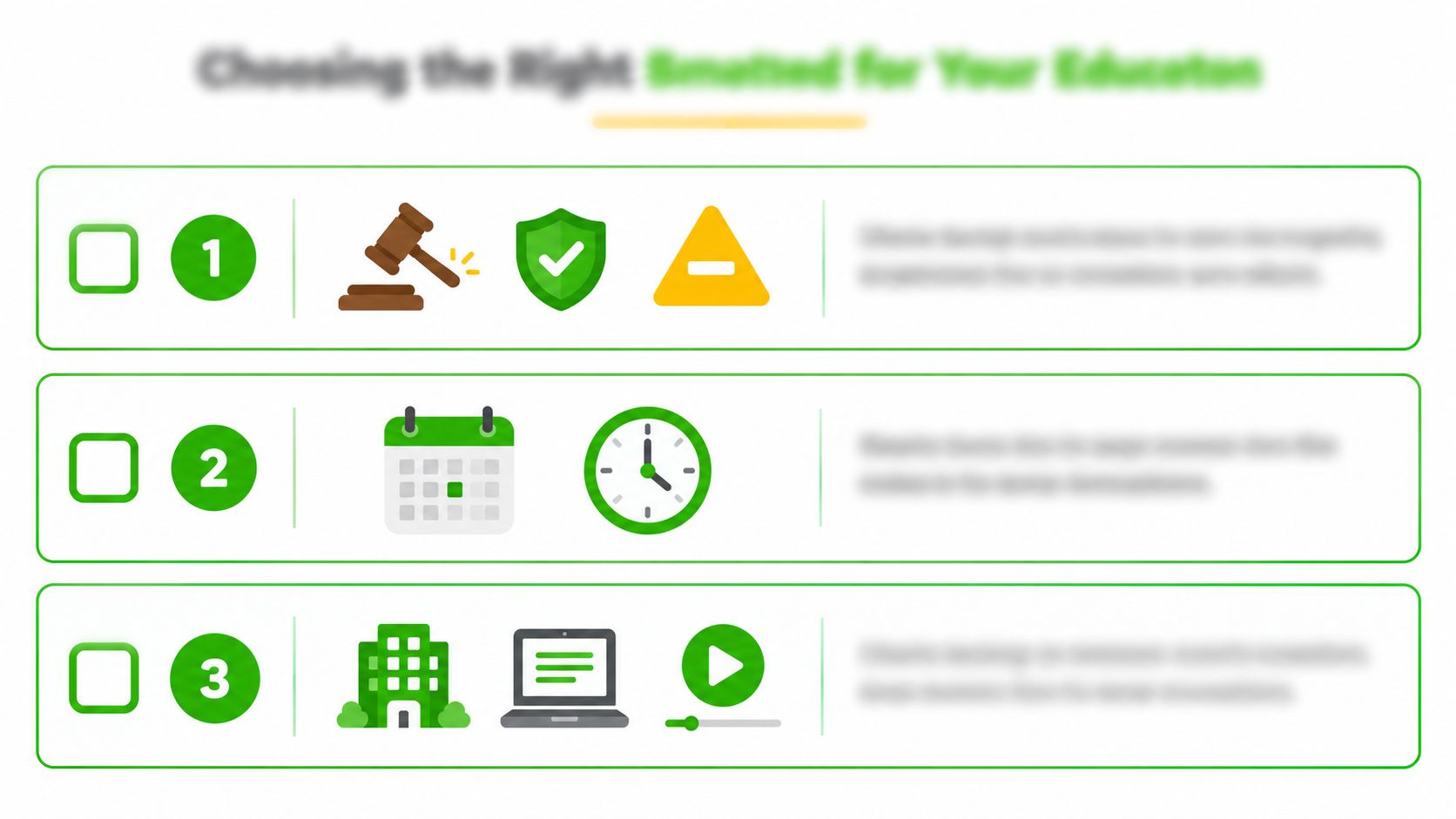
Use three filters.
First, identify the purpose. A court order requires careful deadline planning. Point reduction and insurance use may involve separate eligibility rules, so confirm the benefit with the court, Georgia DDS, or your insurer rather than assuming completion automatically creates the result.
Second, map your actual availability. A predictable free Saturday may make an in-person class simple. A rotating work schedule may favor self-paced online study. Live virtual works well when you want instruction and interaction but need to avoid travel.
Third, verify the provider before enrolling. Check DDS approval, attendance rules, identity procedures, quiz requirements, certificate delivery, and the final date for completion. The Georgia defensive driving eligibility information can help you identify questions to answer before selecting a format.
Once you register, save the confirmation email and put every required session or completion deadline on your calendar. Leave enough room for a missed session, a technical issue, or a certificate correction. The six hours only help when they end with properly documented completion.
Georgia DUI Schools offers DDS-approved defensive driving options in traditional classroom, live virtual, and self-paced online formats, giving Georgia drivers a way to match the course schedule to work, family, and court obligations. Review the available formats and choose a defensive driving course through Georgia DUI Schools before your deadline becomes difficult to manage.