

The statutory fine for a first DUI conviction in Georgia is $300 to $1,000. Your total out-of-pocket cost can be several hundred to several thousand dollars higher after reinstatement, SR-22 filing, Risk Reduction education, ignition interlock, court expenses, and insurance consequences are added.
A driver leaving an Atlanta restaurant after a late dinner may focus on the number printed on the citation. After a stop on I-285, an Intoxilizer 5000 reading of 0.09, a night in custody, bond, and the first court notice, that driver usually discovers the fine is only one line in a much longer ledger. Georgia treats DUI as both a criminal matter and a licensing matter, so the court case and the Department of Driver Services process create separate obligations.
The practical question isn't merely, “How much is the DUI fine?” It's what must be paid, completed, filed, monitored, and maintained before driving can resume.
The Real Cost of a DUI in Georgia Starts Before the Fine
Consider a representative first-offense situation in the Atlanta area. A driver is stopped late at night on I-285, provides a breath sample on an Intoxilizer 5000 that reads 0.09, spends the night in custody, posts bond, and expects the eventual fine to be manageable. Georgia's first-offense statute sets the fine at not less than $300 and not more than $1,000, and generally doesn't allow that fine to be suspended, stayed, or probated. (Georgia Code § 40-6-391)
The surprise comes afterward. The driver may face the $210 DDS reinstatement fee, a Risk Reduction course, an SR-22 filing, clinical evaluation expenses, court surcharges, towing, and possible ignition interlock costs. The Georgia Governor's Highway Safety guidance describes the first-offense fine range and connects it with escalating license consequences, including a 12-month suspension for a first offense. (Georgia impaired-driving laws)
Two systems create two bills
The criminal court imposes the fine, incarceration or probation conditions, community service, and education requirements. DDS controls the administrative license process, including suspension and reinstatement. Paying the court doesn't automatically restore driving privileges, and paying DDS doesn't resolve the criminal case.
The driver also has to account for costs that aren't printed in the statutory fine range:
- Reinstatement: DDS lists a $210 fee for a first-offense DUI reinstatement when handled in person. (Georgia DDS first-offense DUI FAQ)
- Education: The Risk Reduction requirement is a separate compliance expense, not part of the fine.
- Insurance documentation: An SR-22 filing may be required, and maintaining coverage matters.
- Vehicle access: Towing and storage can begin accumulating before the driver understands the full case timeline.
- Transportation: A suspension can affect commuting, childcare, work appointments, and court attendance.
Practical rule: Treat the statutory fine as the opening line item, not as a reliable estimate of the total cost.
A first arrest doesn't guarantee a conviction, and a charge isn't the same as a final judgment. But anyone dealing with a pending case should preserve every deadline, ask the court and DDS for written requirements, and avoid budgeting around the fine alone. The more useful estimate is the full compliance stack, including costs that continue after court.
How Georgia Sets DUI Fines by Offense Number
Georgia uses a tiered fine structure based on the offense count within the applicable five-year period. The fine increases with repeat convictions, but the more important change is that each tier travels with separate jail, service, license, and reinstatement consequences.
For a first conviction, the statute provides a $300 to $1,000 fine, imprisonment from 10 days to 12 months, at least 40 hours of community service, and completion of a Risk Reduction program within 120 days of conviction. (Georgia Code § 40-6-391) The statutory language makes the fine generally non-suspendable, so a payment plan or court arrangement shouldn't be confused with eliminating the underlying obligation.
The Georgia safety guidance summarizes the escalating framework as a 12-month suspension for a first offense, a three-year suspension for a second offense, and a minimum 15-day jail term for a third offense. (Georgia impaired-driving laws) Because sentencing details can depend on the charge, conviction date, and licensing status, readers should confirm the exact consequence with the sentencing court and DDS.
Comparison by offense count
| Offense | Fine Range | Min. Jail | Community Service | License Action |
|---|---|---|---|---|
| First within five years | $300 to $1,000 | Statute allows 10 days to 12 months, with the statutory framework imposing mandatory penalties | At least 40 hours | 12-month suspension |
| Second within five years | $600 to $1,000 | Escalating mandatory jail consequences apply | Additional mandatory service may apply | Three-year suspension under Georgia safety guidance |
| Third within five years | $1,000 to $5,000 | Minimum 15-day jail term | Mandatory service and other penalties apply | Escalating revocation consequences, including habitual-violator rules |
The fine schedule is only a floor-and-ceiling framework. A judge considers the conviction history and case facts when imposing sentence, while DDS applies its own licensing rules. A high alcohol concentration, a refusal, an underage driver, or child endangerment can create additional complications, but those facts shouldn't be reduced to a simple fine calculation.
The key planning mistake is comparing only $300 to $1,000, $600 to $1,000, and $1,000 to $5,000. Repeat offenses increase exposure through stacked requirements, longer loss of driving privileges, and more difficult reinstatement, not just through the base fine.
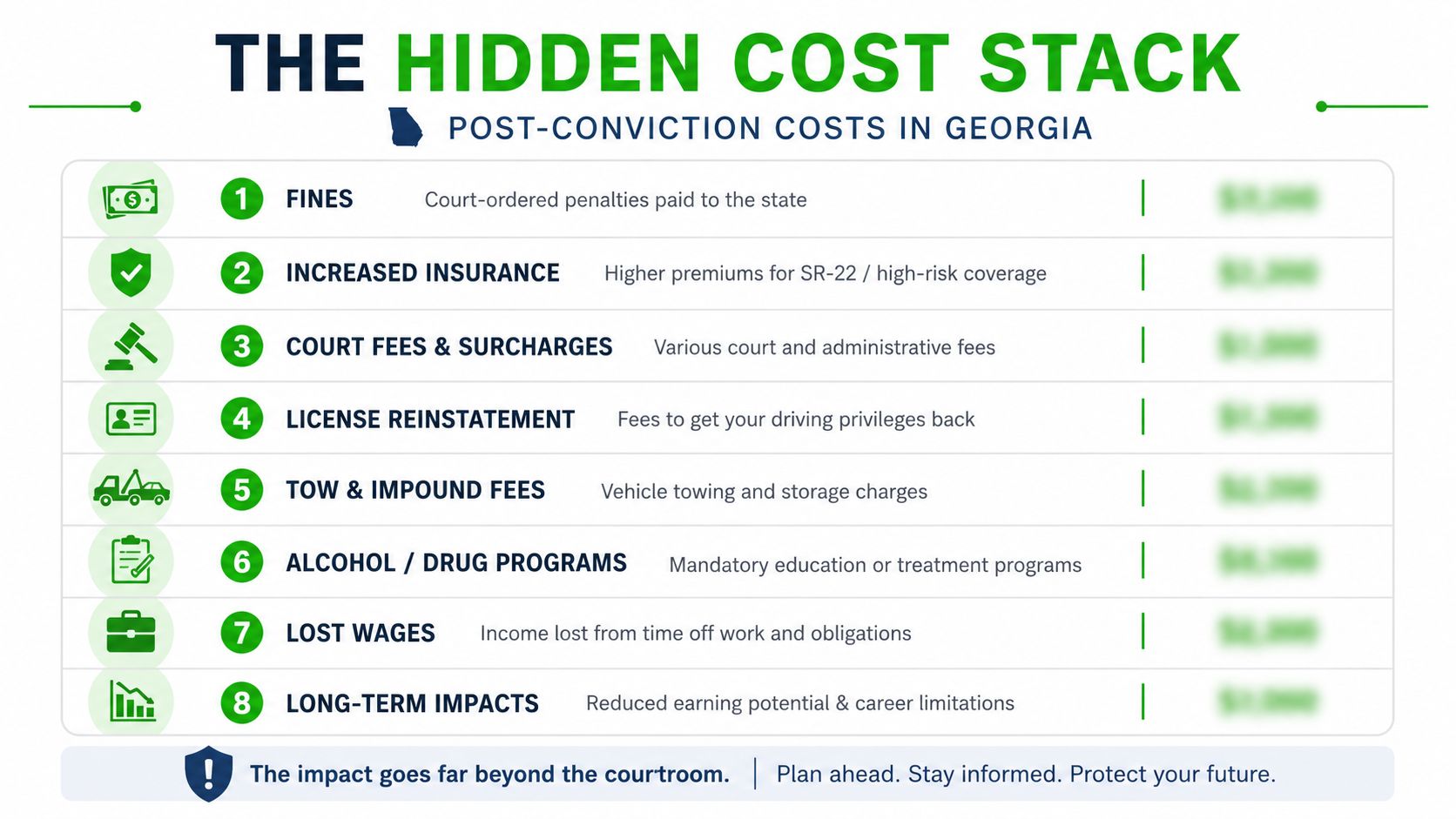
The Hidden Cost Stack the Fine Does Not Cover
The fine doesn't pay for the administrative steps required to get a license back. For a first offense, DDS identifies a $210 reinstatement fee, while the Risk Reduction program, SR-22 filing, clinical evaluation, and insurance changes remain separate obligations. (Georgia DDS first-offense DUI FAQ)
Some Georgia-oriented cost guides identify an SR-22 filing fee of approximately $25 to $50 and a Risk Reduction course fee around $360. (Georgia DUI cost overview) Those are not substitutes for a written quote from your insurer or provider, but they illustrate why the statutory fine doesn't answer the budgeting question.
What belongs on the worksheet
Build the estimate by separating fixed obligations from variable expenses:
- Court fine: The statutory range depends on the offense count.
- Court costs and surcharges: The sentencing court may add charges beyond the fine.
- DDS reinstatement: The first-offense fee is $210.
- Risk Reduction: A state-approved program is required after conviction.
- SR-22: The insurer determines the filing and policy cost.
- Clinical evaluation: The provider sets the evaluation fee and may recommend further services.
- Ignition interlock: Installation, monitoring, calibration, and removal can apply when required.
- Insurance: The carrier may raise premiums, change coverage, or decline renewal.
Towing and impound charges belong in the same worksheet, especially when a vehicle remains at a lot while the owner waits for release paperwork. Attorney fees, lost work time, transportation, and treatment are also real financial effects, but they vary too much to assign a universal amount.
The course is often the first controllable expense. A driver can compare schedule, delivery format, approval status, and total enrollment charges through a Georgia DUI course cost guide, then confirm that the selected provider meets the court and DDS requirement.
Don't use a single “average DUI cost” as your personal budget. The fine may be known, but insurance, interlock, legal, towing, and treatment decisions can move the final number substantially.
First, Second, and Third DUI Costs Compared
Repeat convictions within five years change the financial calculation because the court penalty and licensing response become more severe. The Georgia safety framework lists $300 to $1,000 for a first conviction, $600 to $1,000 for a second, and $1,000 to $5,000 for a third. (Georgia impaired-driving laws)
A second or third conviction can also make ordinary transportation much harder. Longer suspensions or revocations may require more time paying for rides, relying on another driver, arranging work transportation, or maintaining an interlock-based driving privilege when available. The cost stack isn't identical for every driver, so the table below identifies categories rather than inventing a single total.
Side-by-side exposure
| Cost or Penalty | 1st DUI | 2nd DUI within five years | 3rd DUI within five years |
|---|---|---|---|
| Statutory fine | $300 to $1,000 | $600 to $1,000 | $1,000 to $5,000 |
| Jail exposure | Statute allows 10 days to 12 months | More severe mandatory consequences apply | Minimum 15-day jail term |
| License action | 12-month suspension | Three-year suspension under Georgia safety guidance | May trigger five-year habitual-violator revocation |
| DDS reinstatement | Required after eligibility | Required after eligibility | More complex reinstatement process |
| Risk Reduction | Required when ordered or required for reinstatement | Repeat compliance requirements may apply | Repeat compliance requirements and possible treatment |
| Interlock | May apply depending on the licensing path | More likely to affect reinstatement planning | 12-month requirement after habitual-violator eligibility |
| Insurance | Carrier review and possible increase or non-renewal | Greater underwriting difficulty | High-risk or non-standard coverage may be harder to obtain |
The third offense deserves special attention. Georgia law can classify a driver as a habitual violator after the third conviction of a qualifying combination of offenses within five years, and DUI is expressly included. (Georgia habitual-violator safety-responsibility rules)
That means early action matters. Completing a course won't erase a conviction, but understanding the first suspension, the reinstatement process, and the next legal deadline can help prevent an administrative problem from becoming a longer licensing crisis. Drivers should also confirm current requirements before paying for any program, particularly when the court order and DDS notice use different language.
When a DUI Becomes a Habitual Violator Case
A driver in Cobb County who receives a third qualifying DUI conviction within the relevant five-year period may not be dealing with an ordinary suspension anymore. Under Georgia's habitual-violator framework, three qualifying convictions can trigger a five-year license revocation, and DDS identifies a 12-month ignition interlock requirement once the person becomes eligible for reinstatement. (Georgia habitual-violator safety-responsibility rules)
The trigger isn't limited to DUI. Georgia materials identify other qualifying offenses, including fleeing or attempting to elude police, leaving the scene of an accident, and certain fraudulent-license offenses. (Georgia criminal-defense FAQ) A driver who refuses a Statewide Breath Test and later accumulates another qualifying conviction may face several separate administrative and criminal issues, but the exact result depends on the orders and records in that case.
Why revocation changes the plan
A suspension generally describes a loss of driving privileges for a defined period with a reinstatement pathway. Habitual-violator revocation is a deeper licensing barrier. DDS says a declared habitual violator may drive only with a probationary license under O.C.G.A. § 40-5-58(e) or after five years have passed since the revocation began and DDS has issued a new license. (Georgia Department of Public Safety habitual-violator guidance)
The financial consequences can include an interlock, professional installation and monitoring, reinstatement charges, insurance difficulty, court-ordered services, and transportation costs. Don't assume that paying a standard reinstatement fee automatically ends the revocation or that a Risk Reduction certificate by itself authorizes driving.
A habitual-violator case should be managed from the DDS notice, the court disposition, and the eligibility date together. One missing document can delay the next step.
The most effective response is calendar discipline. Obtain the conviction records, identify the revocation start date, confirm whether probationary driving is available, and ask DDS exactly which documents and fees apply. If you drive before authorization, the licensing consequences can become more serious than the original budgeting problem.
How DUI School and Risk Reduction Shape the Outcome
Georgia's Risk Reduction program isn't a casual class. State rules describe a standardized screening instrument, and the clinical-evaluation rules require a clinical interview plus review of that screening instrument. (Georgia Risk Reduction and clinical-evaluation rules)
The first-offense statute requires completion of a DUI Alcohol or Drug Use Risk Reduction Program within 120 days of conviction. (Georgia Code § 40-6-391) A provider may also direct the driver to a clinical evaluation, community-service documentation, a Victim Impact Panel, or additional treatment based on the court order and assessment.
Complete the required pieces in the right order
- Confirm the order: Read the sentencing paperwork and DDS notice together.
- Enroll in an approved Risk Reduction program: Verify the provider's approval and obtain completion documentation.
- Schedule the clinical evaluation: The evaluation can include the screening review and clinical interview required by state rules.
- Finish additional requirements: Complete community service, a Victim Impact Panel, treatment, or interlock obligations when ordered.
- Submit reinstatement documents: Keep certificates, receipts, and provider records before contacting DDS.
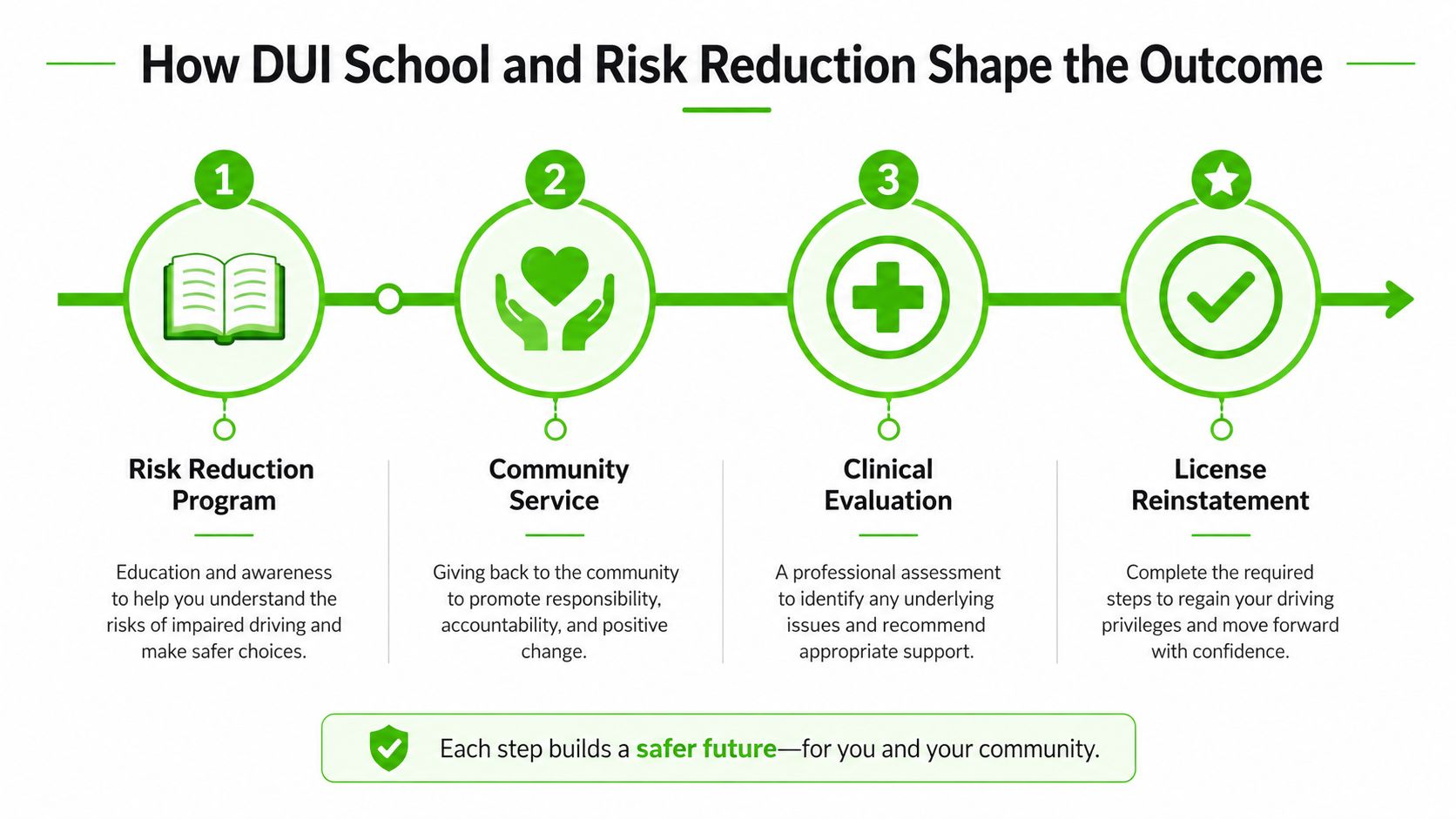
The practical benefit of acting early is avoiding preventable delays. A missed deadline can leave the driver unable to complete reinstatement, maintain required insurance, or satisfy probation conditions on schedule. A clinical recommendation may also create additional treatment obligations, so the initial course price isn't necessarily the final program expense.
Risk Reduction is therefore not just another fine-related charge. It's part of the compliance path that connects the conviction to license restoration. Keep the certificate, verify that the provider transmitted or supplied the required record, and ask DDS what remains outstanding before assuming the case is complete.
Where Defensive Driving Fits in a Georgia DUI Story
Defensive driving and Risk Reduction solve different problems. A DDS-approved defensive driving course is a separate tool for eligible drivers who want to address points or discuss insurance options, while Risk Reduction is the program tied to DUI compliance and reinstatement.
Georgia defensive driving rules allow a six-hour course, a five-point credit on an otherwise clean seven-year record, and eligibility once per five-year period, according to the publisher's course guidance. Those figures should be confirmed with DDS and the insurer before enrollment because eligibility and insurer treatment depend on the individual record.
| Feature | Defensive Driving | Risk Reduction |
|---|---|---|
| Primary purpose | Point reduction and possible insurance discussion | DUI-related education and reinstatement compliance |
| Course format | May be online, live virtual, or classroom depending on provider | Must meet Georgia approval requirements |
| DUI substitute | Cannot replace DUI requirements | Required when ordered or required for reinstatement |
| Record effect | May address eligible points | Satisfies a compliance requirement, not a conviction erasure |
| Suspension relief | Doesn't shorten an active DUI suspension | Supports reinstatement when all requirements are met |
| Interlock waiver | Doesn't waive an interlock requirement | Doesn't automatically waive one either |
A driver with an active DUI suspension can't use defensive driving to shorten that suspension or eliminate an ignition interlock requirement. Enrolling in a Georgia defensive driving course for insurance and point reduction may be useful on its own track, but it shouldn't be presented to the court or DDS as a replacement for Risk Reduction.
The right question is “Which requirement am I trying to satisfy?” If the answer is license reinstatement after DUI, start with the order and DDS requirements. If the issue is an eligible traffic citation or insurance conversation, defensive driving may be relevant separately.
Common Questions and Where to Start
Georgia drivers usually need answers to timing questions before they need another general explanation of the fine. The first step is to compare the court disposition with the DDS notice, then create a document checklist for every requirement.
Frequently asked questions
How long does a first DUI remain on a Georgia driving record?
The record and insurance effects can last well beyond the suspension period. Insurance companies may use their own underwriting and scoring rules, and a habitual-violator analysis uses its own qualifying-offense lookback. Don't assume that completing the course removes the conviction.
When should the reinstatement fee be paid?
Pay only after confirming eligibility and the exact DDS requirements. The $210 first-offense reinstatement fee is an administrative charge, and paying it too early or without the required documents may not restore driving privileges. (Georgia DDS first-offense DUI FAQ)
Must SR-22 coverage remain active?
If DDS or the court requires SR-22 coverage, ask your insurer how long it must remain active and what happens after cancellation. A lapse can create a new licensing problem, so maintain continuous communication with the carrier.
How do I enroll in Risk Reduction?
Use a Georgia-approved provider, confirm the schedule and delivery format, and ask what documentation will be issued. Complete the clinical evaluation and Victim Impact Panel when required by the order or assessment. Providers that use clear intake workflows should collect the conviction details, deadlines, and contact information consistently. Reviewing secure intake form best practices can help attorneys, probation officers, and referral organizations organize those records without losing key dates.
Can fines be paid over time?
Ask the sentencing court or clerk whether a payment plan is available. Payment arrangements vary, and a plan doesn't automatically cover DDS fees, course charges, insurance, interlock, towing, or treatment.
Keep copies of the citation, court disposition, DDS notice, payment receipts, course certificate, evaluation paperwork, and insurance filings. A complete file makes it easier to identify what remains before a deadline lapses.
Georgia DUI Schools offers DDS-approved Risk Reduction education, clinical evaluations, ASAM-related services, and Victim Impact Panel support, with online and in-person options for Georgia drivers. Review the requirements tied to your offense, gather your deadlines and documents, and visit Georgia DUI Schools to find a program that fits your reinstatement path.