You may be sitting in a driveway in Marietta, Macon, or metro Atlanta with the keys in your hand and a hard question on your mind. You've driven for years. Then an injury, surgery, stroke, hearing change, or another medical condition changed how your body responds behind the wheel. Now you're wondering whether driving is still possible, whether Georgia will let you keep your license, and what steps come next.
That uncertainty is heavy. It also doesn't mean your driving life is over.
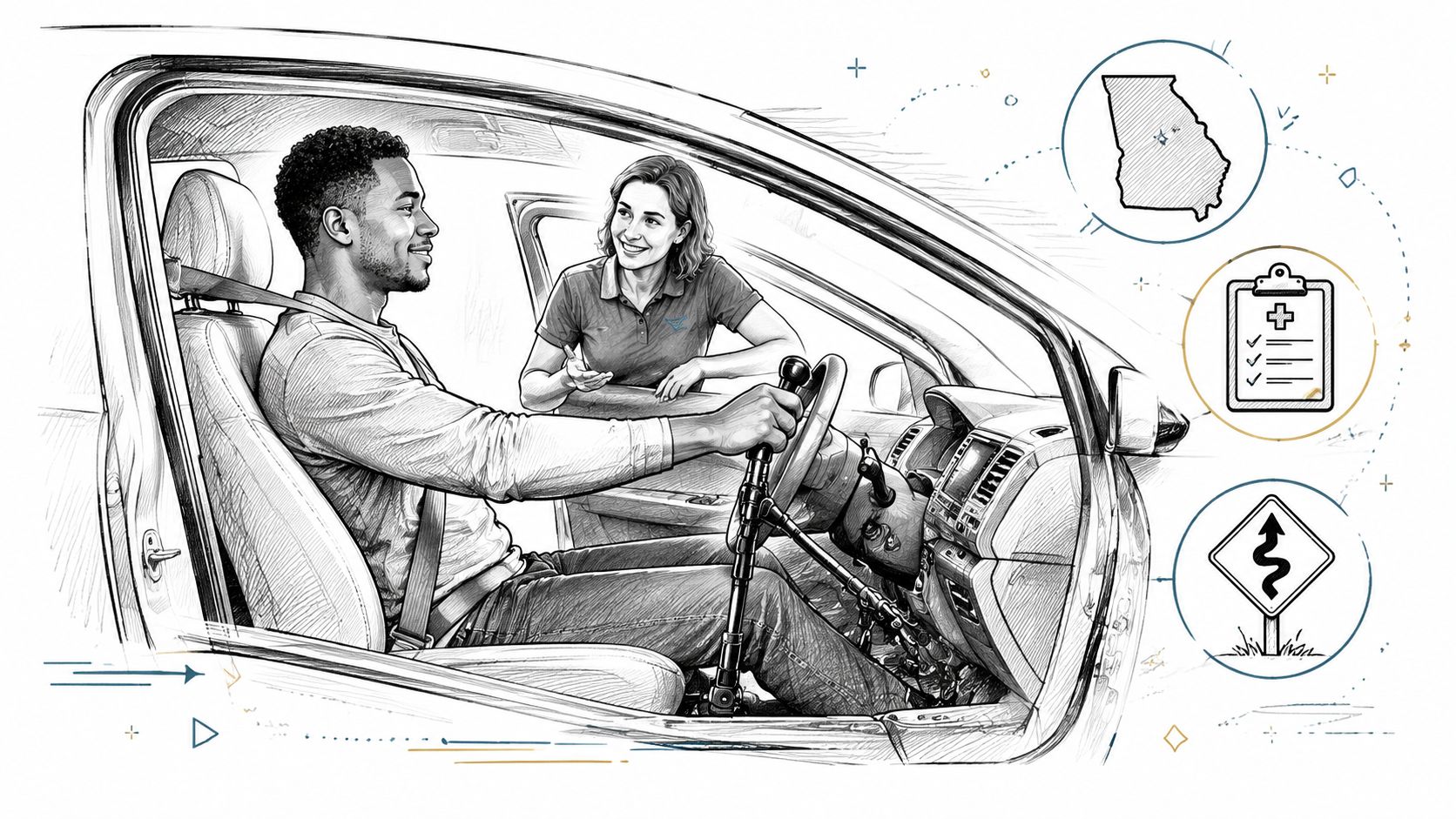
Disabled driver training is a structured path for people whose physical, sensory, or cognitive condition affects driving. It isn't a punishment, and it isn't the same thing as a routine road test. It's specialized instruction designed to help you drive safely, legally, and with the right equipment if you need it.
Regaining Independence Behind the Wheel
A lot of Georgia drivers arrive at this point after a life change they didn't plan for. A retired driver in Athens may be recovering from a hip procedure and suddenly find it painful to move from brake to gas. A parent in Decatur may be helping an adult child return to driving after a brain injury. A worker in Augusta may be dealing with weakness on one side after a medical event and wondering if hand controls could make driving possible again.
Those situations are more common than many families realize. Among people participating in driving rehabilitation programs, physical disabilities were the most common reason at 60.34%, followed by brain injuries at 25.56% and hearing impairments at 14.10% according to this driving rehabilitation study. That range matters because it shows disabled driver training isn't limited to one diagnosis or one age group.
Who this training is really for
Some readers assume disabled driver training is only for someone who uses a wheelchair. It's broader than that.
It can help drivers who are dealing with:
- Reduced leg strength after surgery or injury
- One-sided weakness that changes steering or pedal control
- Brain injury effects that affect timing, focus, or processing
- Hearing impairment that changes how road information is taken in
- Pain with sitting or pedal use, especially on longer drives
If part of your concern is pain rather than a formal disability label, practical comfort changes can matter too. This guide on hip pain while driving relief is a useful starting point for understanding seating position, joint strain, and why certain movements feel harder in the car than they do at home.
Disabled driver training starts with one simple idea. Find what has changed, then match the driver with the safest way to keep driving.
What people often get wrong
Many drivers fear they're walking into a pass-or-fail judgment. That fear keeps people from getting evaluated.
The better way to see it is this. The process is meant to answer practical questions. Can you steer safely? Can you brake in time? Do you need a left-foot accelerator, hand controls, a spinner knob, or more practice in traffic? Once those answers are clear, the path usually feels much less intimidating.
The Critical First Step a Comprehensive Driver Assessment
The first formal step isn't a Georgia DDS road test. It's a thorough driver assessment.
Adaptive driving training begins with a thorough in-vehicle driver assessment conducted by occupational therapy driver rehabilitation specialists, which forms the basis for later training, as described in this overview of adaptive driving training.
Before looking at the details, this process map helps most families understand the sequence.
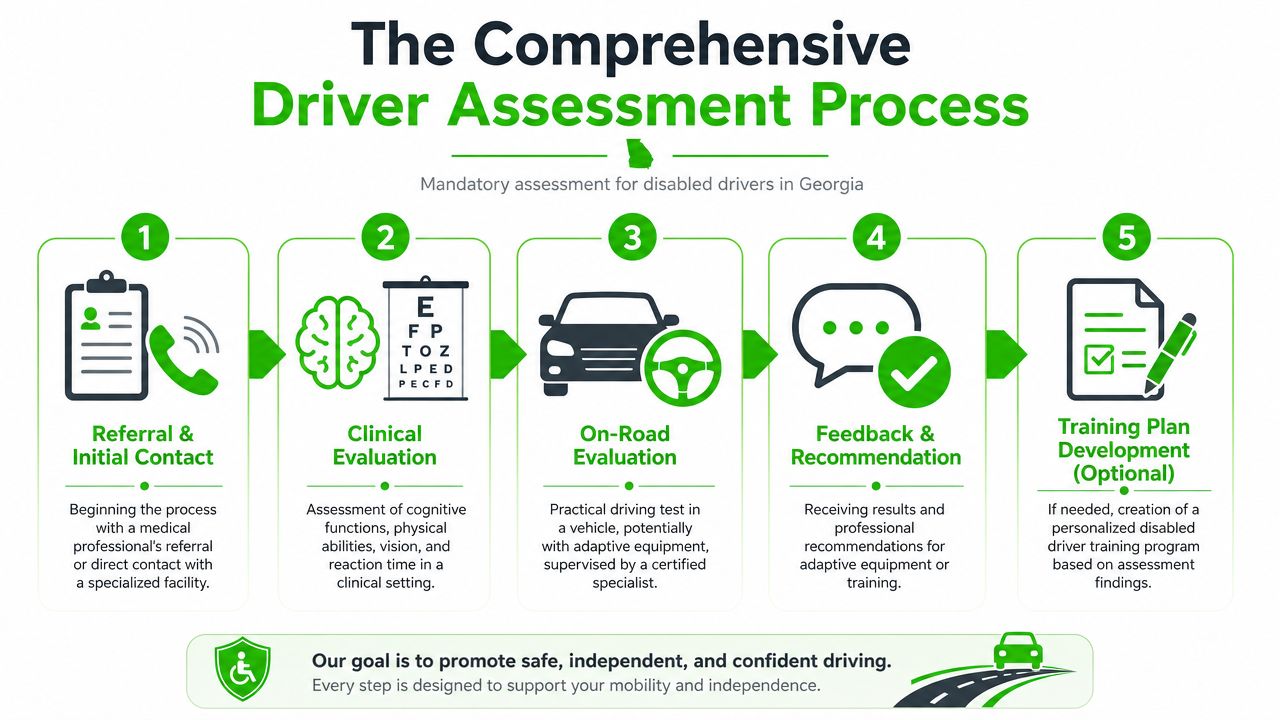
Part one happens before the car moves
The clinical portion usually happens first. During this, the specialist reviews the medical picture and how it affects driving.
They may look at:
- Vision and visual scanning
- Reaction timing
- Strength and range of motion
- Attention and processing
- How easily you transfer in and out of the vehicle
A standard driving examiner doesn't typically do this kind of clinical review. A rehabilitation specialist does, because the question isn't just whether you can drive today. It's whether you can drive safely with the right setup.
Part two happens on the road
After that comes the in-vehicle evaluation. This is often the first part imagined, but it works better when it comes after the clinical review.
You may drive in a vehicle with adaptive options available so the specialist can observe how you manage:
- Starting and stopping smoothly
- Turning and lane positioning
- Managing intersections and traffic flow
- Using any needed adaptive device
- Handling divided attention without becoming overloaded
Practical rule: The assessment is there to identify the safest match between driver, vehicle, and training. It isn't there to embarrass you.
What the result usually looks like
The outcome may be one of several paths. Some drivers are ready for limited changes. Others need a training plan. Some need updated medical paperwork before moving forward.
A specialist may recommend adaptive equipment, additional behind-the-wheel sessions, or both. If you're trying to understand who performs this type of evaluation, review this page on Certified Driver Rehabilitation Specialists in Georgia. It helps clarify the role of the clinician versus the role of DDS.
People often leave the assessment relieved. Not because every answer is easy, but because they finally have a concrete recommendation instead of guessing.
Finding the Right Fit Adaptive Equipment and Training
Assessment answers the question, “What do you need?” Training answers a different one. Can you use it safely in real traffic?
That difference matters. A hand control device or steering aid isn't helpful just because it exists. It has to match your body, your movement pattern, and your vehicle.
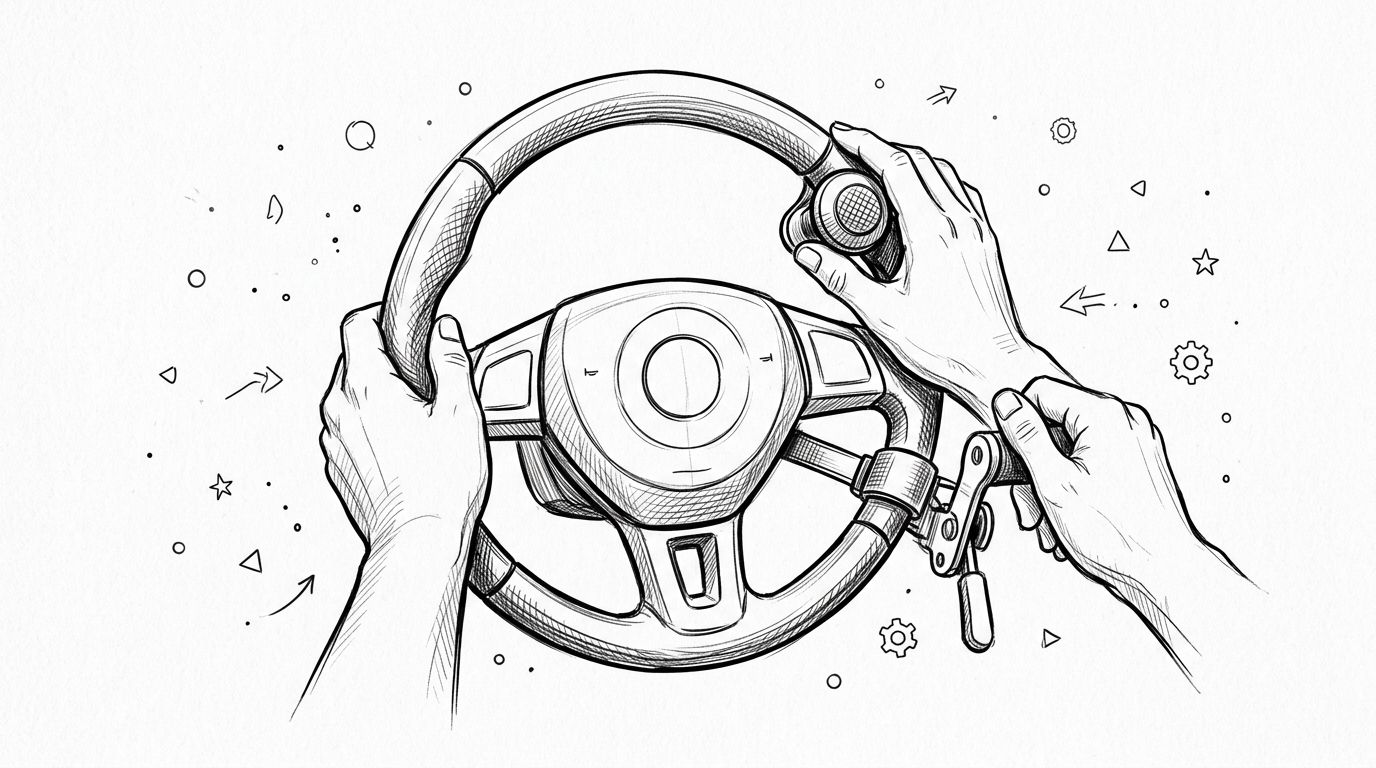
Training must be delivered by a Certified Driver Rehabilitation Specialist, or CDRS, in a vehicle modified according to a specific Vehicle Modification Prescription, so equipment like hand controls or pedal adaptations matches the driver's physical needs for safe operation, as outlined in this adaptive driving evaluation and training guidance.
Common equipment and what it solves
Some adaptive tools are straightforward. Others take more practice than families expect.
Here's a simple comparison:
| Equipment | Often used when | What training focuses on |
|---|---|---|
| Hand controls | Leg strength or pedal use is limited | Smooth acceleration, controlled braking, panic-stop response |
| Left-foot accelerator | Right-leg impairment affects gas pedal use | Foot placement, avoiding crossover habits, consistency in stops |
| Spinner knob | One hand does most steering work | Turning precision, parking, quick wheel recovery |
| Specialized steering aids | Grip or range of motion is reduced | Steering stability, lane tracking, shoulder checks with reduced motion |
Why one-on-one instruction matters
This isn't like borrowing a friend's car and trying out a new gadget in an empty parking lot.
A CDRS teaches the driver how to build new movement patterns, then tests those patterns under realistic conditions. That may include neighborhood turns, multi-lane roads, parking lots, left turns across traffic, or heavier driving environments like those around Atlanta perimeter routes or busy suburban corridors in Gwinnett and Cobb.
Some drivers need to unlearn old habits. A person switching from foot pedals to hand controls may instinctively reach with the wrong limb under stress. Someone using a spinner knob may overcorrect at first. Training slows that down and replaces it with repeatable technique.
Safe adaptive driving depends on fit. The wrong equipment, or the right equipment used the wrong way, creates risk.
What good training feels like
Good disabled driver training is highly individualized. One driver may need repetition on stop-and-go control. Another may need more work on visual scanning and distraction control. Another may be technically capable but hesitant, and confidence becomes part of the training process.
A useful overview of support options appears on this page about drivers ed for special needs in Georgia. The key idea is that adaptive instruction isn't generic. It has to be customized for the driver's exact needs and prescribed setup.
If you live in Georgia, think in terms of your own routes. Can you safely handle Roswell Road, I-20 feeder traffic, a rural two-lane road near Rome, or school pickup traffic in a smaller town? Training should prepare you for the roads you use, not just a sterile driving loop.
Navigating Georgia DMV and Medical Requirements
The medical side is where many families get stuck. Not because the process is impossible, but because the paperwork can feel scattered and unclear.
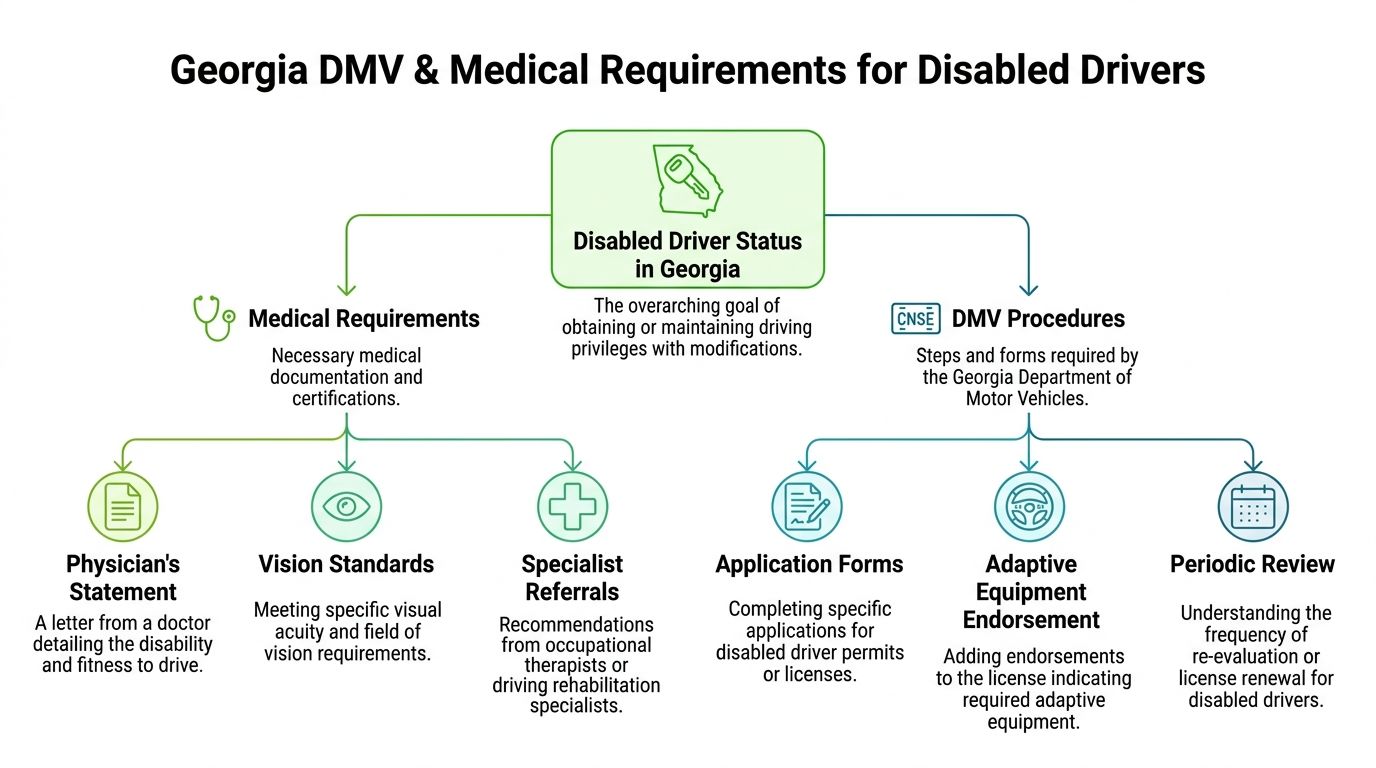
A valid medical prescription from a physician is required before the adaptive driving process starts, and the process typically spans three to six months while the driver moves through evaluation, training, and written and practical testing in an adapted vehicle, according to this adaptive driving certification overview.
This visual summary helps organize the Georgia-facing parts of that process.
What paperwork usually starts the process
In practical terms, many drivers begin with a physician. That doctor documents the condition and supports referral into adaptive driving evaluation.
You may also need supporting records, depending on the condition involved. Families often run into questions like these:
- What does the doctor need to write? Enough detail to explain the condition and the need for evaluation.
- Do I need testing results too? Sometimes supporting clinical or neuropsychological information is part of the file.
- Can I train in my own vehicle? Sometimes, but the vehicle must meet safety requirements and be properly set up.
- Will DDS add restrictions to my license? If adaptive equipment is required, your license may reflect that.
Where confusion happens
Referral requirements sound simple until you try to complete them. Public information often tells families they need a physician referral, but not exactly what the referral should include, how long approvals may take, or how insurance questions fit into the process.
That gap is especially difficult for caregivers helping a teen or adult with a newer diagnosis. If you need Georgia contact information while sorting out state requirements, this Georgia DDS contact page can help you identify the right starting point for licensing questions.
Bring copies of every relevant medical document to your first appointment. It cuts down on delays and prevents repeat visits.
A workable Georgia checklist
This isn't a legal form list. It's a practical checklist most drivers can use:
- Talk with your physician about how the condition affects driving.
- Get the medical prescription or referral needed for adaptive evaluation.
- Schedule the clinical and in-vehicle assessment with a qualified specialist.
- Complete any recommended training in the prescribed adapted vehicle.
- Follow DDS instructions for testing, restrictions, or license updates.
If your hearing, mobility, or cognition has changed recently, don't wait until a renewal deadline or after a traffic stop to ask questions. Early clarification usually makes the process smoother.
Funding Your Training and Finding Certified Providers in Georgia
The next question is usually blunt and reasonable. Who pays for this?
Private health insurance may help with parts of medical care around the disability itself, but families often find that adaptive driving services aren't covered in the way they expected. That's why it helps to look at funding from a problem-solving angle instead of assuming one payer will handle everything.
Funding paths worth checking first
In Georgia, these are often the first places people investigate:
- Georgia Vocational Rehabilitation programs if driving supports employment, job retention, or work access
- Workers' compensation when the driving change is tied to a job-related injury
- Major rehabilitation systems, including programs in the Atlanta area, if they coordinate evaluation or referral support
- Private payment, sometimes used for the assessment first, then equipment decisions later
Each path works differently. Employment-related cases often move through different channels than age-related or medically driven cases.
How to evaluate a provider
Don't choose based only on location. Ask practical questions.
A good provider should be able to explain:
- whether the evaluator is a CDRS
- what vehicle adaptations are available for training
- whether they work with your specific diagnosis
- how they handle recommendations for equipment and follow-up
- what the next licensing step will likely be after training
One directory that helps
If you're searching across Georgia and don't know where to begin, the national directory from the Association for Driver Rehabilitation Specialists is often the most efficient route. It helps families locate professionals with the right rehabilitation background rather than guessing from a generic driving school listing.
The right provider should leave you with a clear recommendation, not more confusion. If a program can't explain who does the evaluation, what vehicle modifications are available, and how training ties into legal driving clearance, keep looking.
Beyond Training Staying Safe and Meeting State Requirements
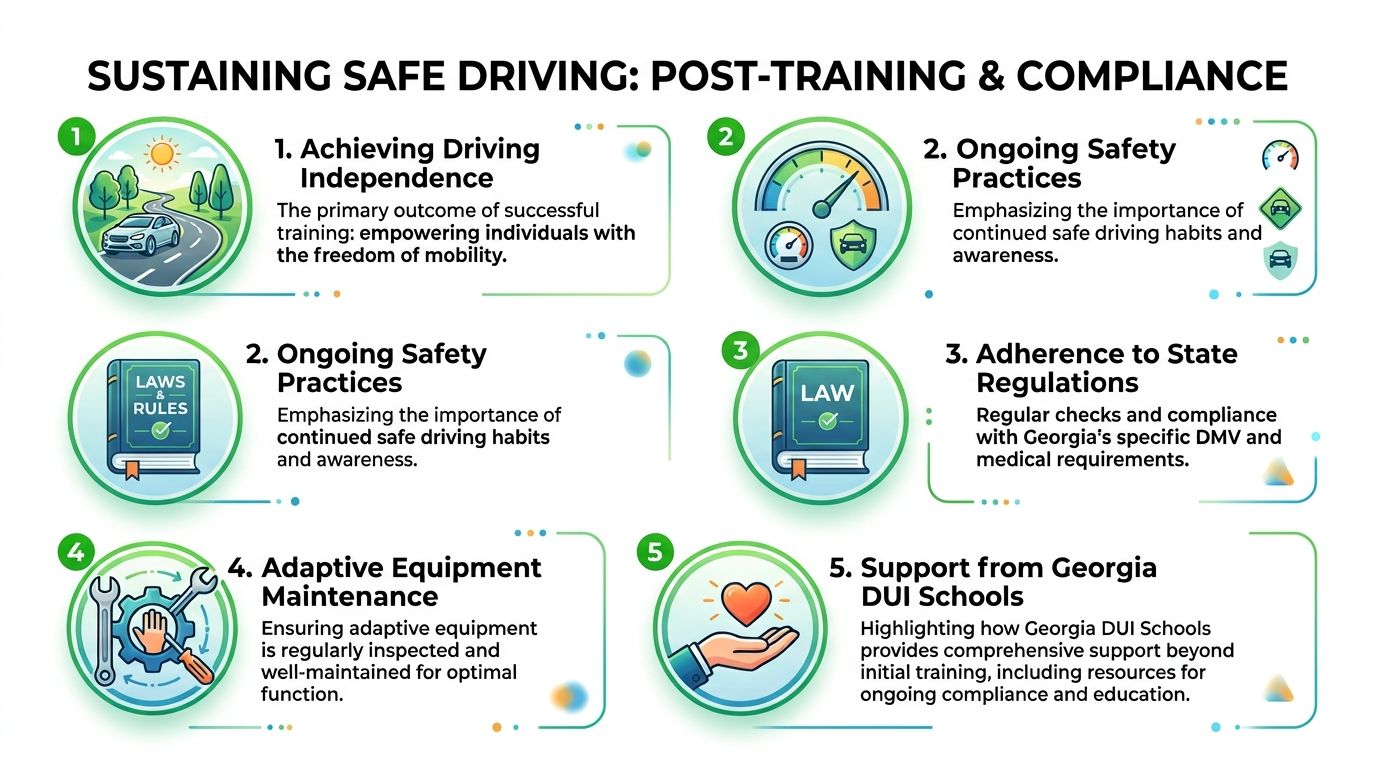
Getting through disabled driver training can reopen daily life. Work becomes reachable again. Medical appointments become easier. Grocery trips stop requiring favors from family members. That independence is a significant milestone.
But adaptive training doesn't replace every other Georgia requirement that might affect your license.
When adaptive driving and reinstatement overlap
Some drivers are dealing with two separate issues at once. They may need adaptive driving clearance because of a medical condition, and they may also need to satisfy a license reinstatement requirement because of a DUI-related suspension.
Those are not the same process.
Georgia's mandatory DUI Risk Reduction Program has a state-set cost of $360.00 and includes a 130-question assessment and a 20-hour intervention course using the Prime for Life curriculum for certain reinstatement situations, as explained in this Georgia DUI Risk Reduction overview. If your license issue involves DUI history, adaptive training alone won't satisfy that separate legal requirement.
Why defensive driving still matters
Even if DUI reinstatement isn't part of your situation, a defensive driving course can still make sense after returning to the road with adaptive equipment.
It gives drivers a structured way to refresh core habits like:
- Hazard recognition in dense traffic
- Following distance when reaction style has changed
- Lane management in unfamiliar or high-speed settings
- Decision-making under pressure when using new controls
That kind of review can be especially helpful after a long break from driving.
Returning to the road safely isn't just about equipment. It's also about judgment, routine, and staying current with the rules attached to your license.
Keep the whole picture in view
Families also need to think beyond the car itself. Medical coverage questions, disability-related treatment, and practical transportation planning often sit right beside the driving issue. For readers sorting through insurance questions at the same time, this expert guide on health coverage for disabled offers helpful background on coverage considerations before you commit to major next steps.
If you're a Georgia driver trying to rebuild mobility, keep your checklist simple. Get the right medical referral. Complete the right driving evaluation. Train with the correct adaptive setup. Then make sure any separate state requirement tied to DUI, reinstatement, or ongoing safe driving is handled on its own track.
If you need to complete a Georgia state-required course as part of license reinstatement or want to strengthen your safety skills after returning to the road, start with the most relevant option at Georgia DUI Schools Risk Reduction Program.