
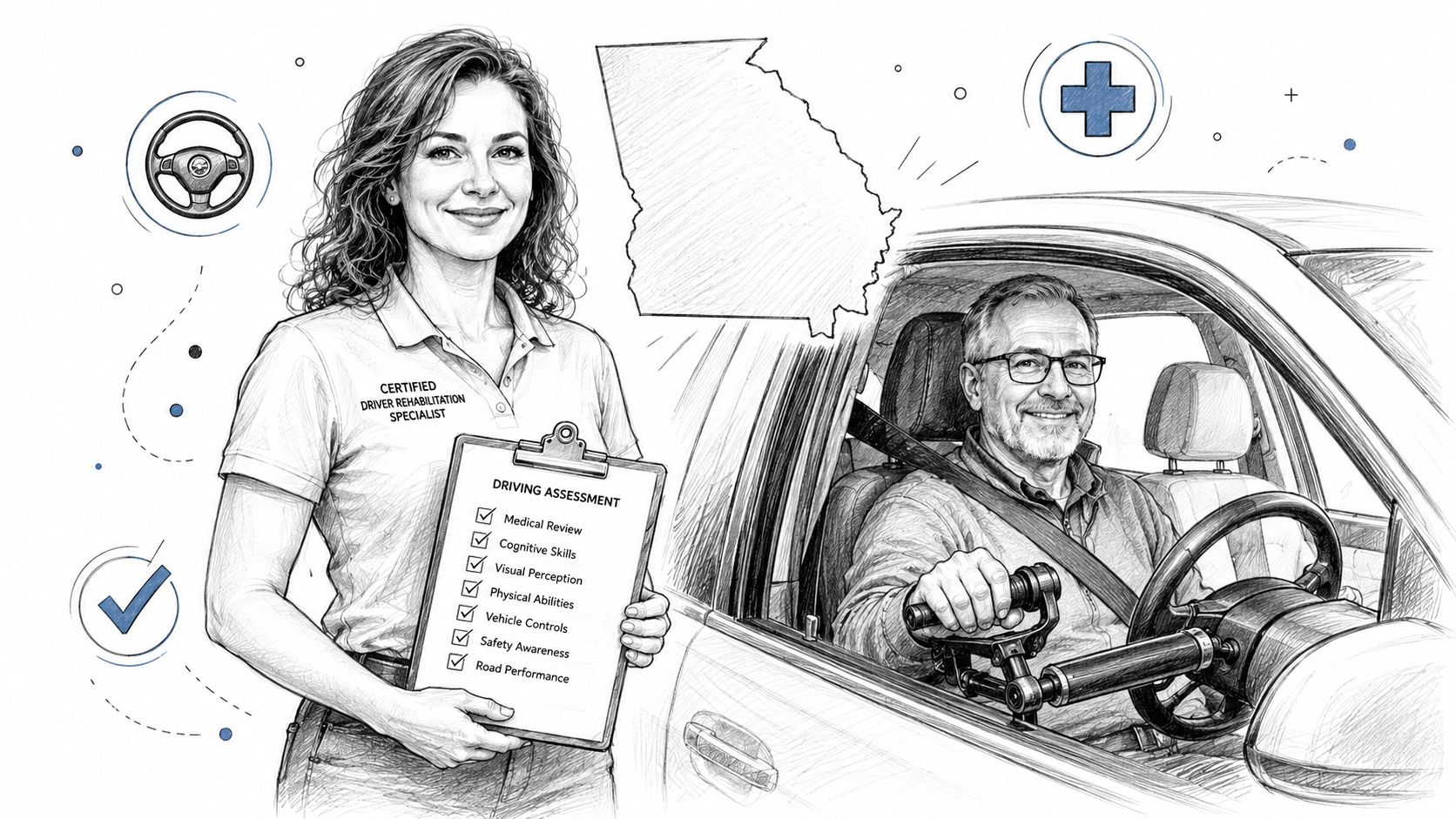
If Georgia DDS, a judge, or your doctor has told you to get evaluated before you can keep driving or work toward reinstatement, you're probably dealing with a mix of stress and confusion. A lot of drivers hear a term like Certified Driver Rehabilitation Specialist for the first time only after a DUI case, a medical event, or a notice that their driving ability needs further review.
That can feel unfair at first. You may already be juggling court dates, paperwork, a suspended license, and questions about what DDS still needs from you. If you're also recovering from injuries after a crash, resources like this guide to post-accident physical therapy can help you think through the physical side of recovery while you sort out the driving side.
Navigating Your Path Back to Driving in Georgia
Take a common Georgia scenario. A driver finishes the court process after a DUI, starts asking about reinstatement, and then learns there may be more than one requirement. The Risk Reduction course handles one part of the process. A separate driving evaluation may address something very different, such as reaction time, vision, mobility, judgment, or the impact of a medical condition.
That distinction is where many people get stuck.
A court-ordered program deals with the offense and the legal consequences of impaired driving. A driver rehabilitation evaluation looks at whether you can safely operate a vehicle now, and if so, under what conditions. Those are related questions, but they are not the same question.
Why this catches people off guard
Individuals often expect Georgia's reinstatement process to be mostly paperwork and class attendance. Then they hear about an evaluator, adaptive equipment, or a report going to DDS, and it suddenly sounds clinical instead of administrative.
Here's the practical way to understand it:
- If DDS wants evidence of driving fitness: a driver rehabilitation evaluation may help provide it.
- If the court ordered education or intervention: that points you toward the Risk Reduction process.
- If a doctor raised concerns after a stroke, injury, vision change, or cognitive issue: a specialist may need to assess how that affects real-world driving.
Practical rule: Don't assume one requirement replaces the other. In Georgia, people often need to satisfy both the legal side and the safety side.
What readers usually want to know first
Most questions fall into a short list:
- Who is this specialist?
- What happens during the evaluation?
- How does it connect to Georgia DDS and reinstatement?
- Where do you find someone qualified in Georgia?
- What if your issue is DUI-related, but there's also a medical concern?
Those questions matter because the answer affects your next move. If you understand which requirement solves which problem, you can stop wasting time, gather the right records, and move through the process in the correct order.
What Is a Certified Driver Rehabilitation Specialist
A Georgia driver may finish the DUI class, pay the reinstatement fees, and still get stuck on a different question: can you drive safely right now?
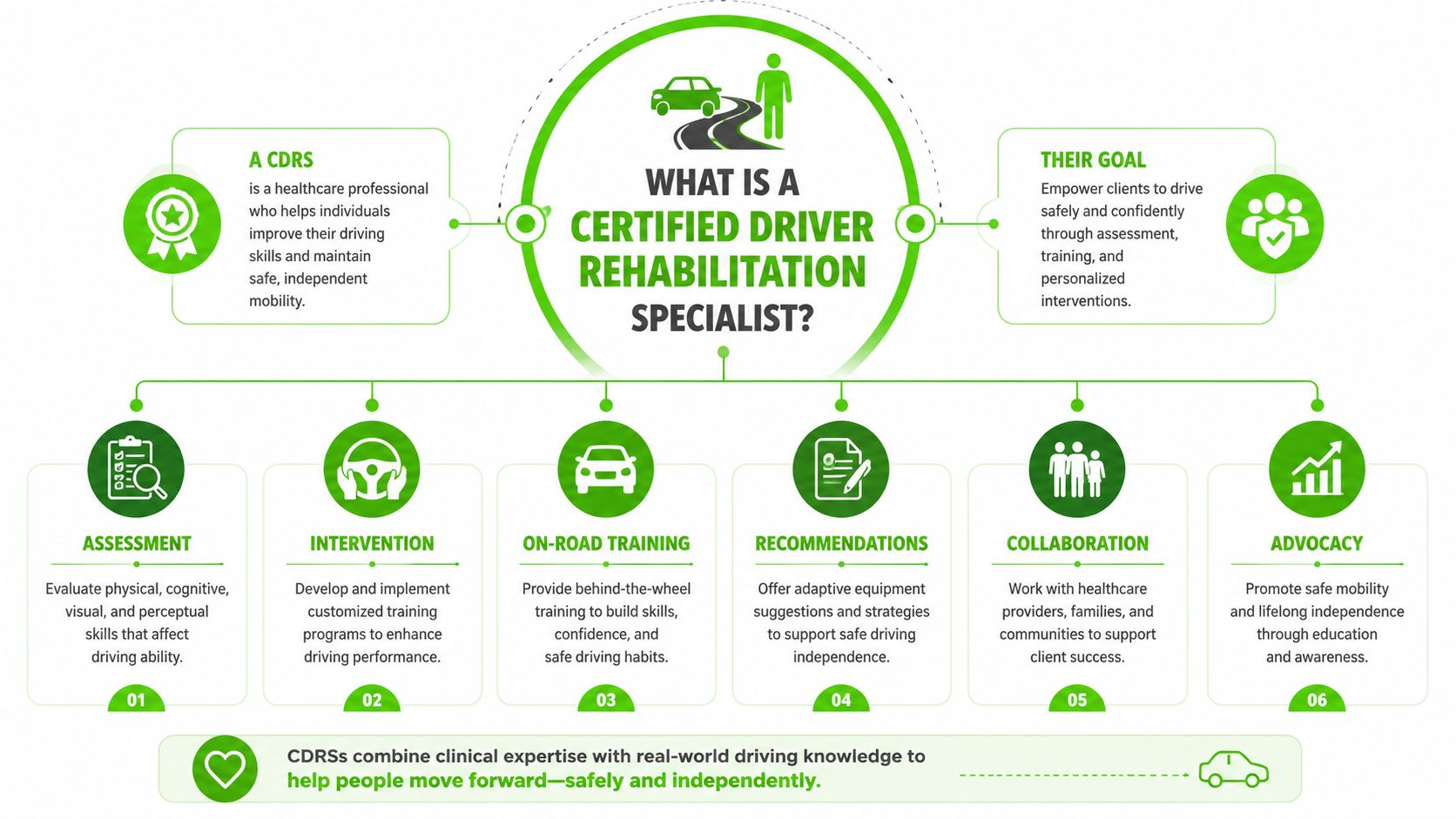
A Certified Driver Rehabilitation Specialist, or CDRS®, is the professional brought in when that question involves more than traffic rules. This specialist evaluates how medical conditions, physical limits, vision problems, cognitive changes, or disability-related needs affect real-world driving. Many come from occupational therapy or other clinical backgrounds because the work sits between healthcare and driving safety.
In plain terms, a CDRS works like a bridge between medical facts and driving decisions. A doctor may identify a condition. Georgia DDS may need evidence about driving fitness. A CDRS helps translate the condition into practical findings about whether a person can drive, what restrictions may be appropriate, and whether training or vehicle changes are needed.
Why the CDRS credential carries weight
The credential is specialized. According to ADED's overview of the CDRS credential, the field is relatively small, many specialists come from occupational therapy, candidates need 1,664 documented practice hours before they can take the certification exam, and certificants must complete continuing education every three years to keep the credential active.
That matters for a Georgia driver because you are not just looking for someone who teaches driving. You may need someone qualified to evaluate the effect of a stroke, seizure history, mobility limitation, medication issue, or age-related decline on safe vehicle operation. If your situation overlaps with family concerns or DDS review, an elderly driver evaluation in Georgia can help show how these assessments fit into the larger safety process.
What a CDRS helps with
A CDRS may work with drivers who are dealing with:
- A medical change: stroke, neurological conditions, orthopedic limits, or vision-related concerns
- Age-related decline: slower processing, reduced flexibility, or lower confidence behind the wheel
- Adaptive equipment needs: hand controls, left-foot acceleration, specialized seating, or transfer solutions
- DUI cases with added safety concerns: situations where the legal case is only part of the issue and DDS or a physician needs a clearer picture of present driving ability
Here is the practical distinction that trips people up in Georgia:
| Question | Who usually addresses it |
|---|---|
| Did you complete the court or DDS-required DUI intervention? | DDS-certified Risk Reduction provider |
| Are you medically and functionally able to drive safely? | CDRS or another qualified driver rehabilitation evaluator |
| Do you need adaptive equipment or training? | CDRS and related mobility professionals |
A CDRS is not there to punish you or look for a reason to deny your return to driving. The job is to provide an objective evaluation. For someone dealing with a Georgia DUI suspension plus a medical issue, that can be the missing piece that connects your health records, DDS requirements, and the steps required to get your license back.
The Driver Evaluation Process Explained
A short road test is often anticipated. A driver rehabilitation evaluation is much more detailed than that.
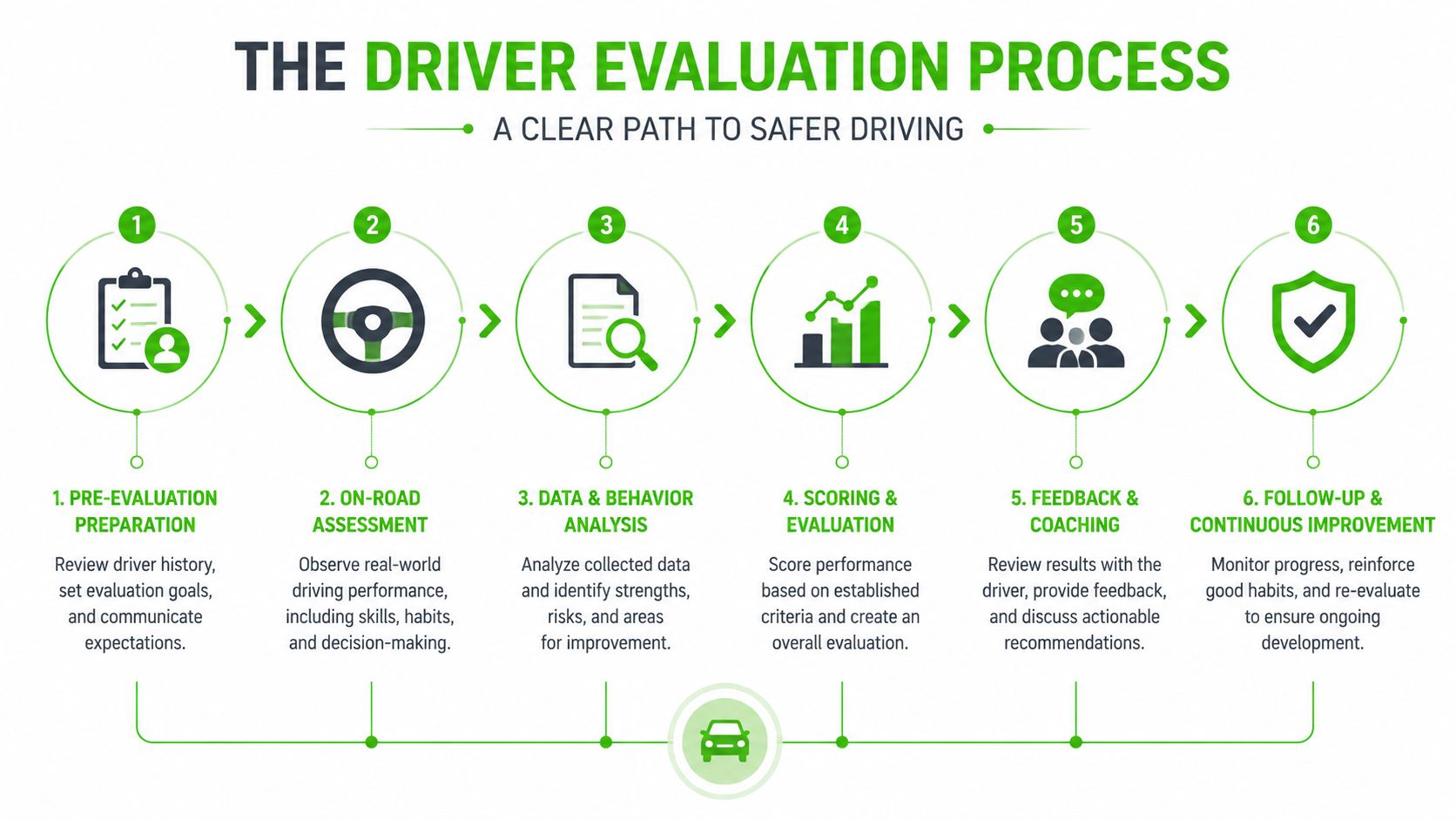
It usually has two parts. First comes a clinical assessment. Then comes a behind-the-wheel evaluation. Together, those pieces help the evaluator decide whether you can drive safely, whether you need restrictions or adaptive equipment, or whether more training makes sense.
Part one of the evaluation
The office portion often feels more like a healthcare appointment than a driving lesson. The specialist may review your medical history, ask about medications, discuss prior crashes or violations, and look at the practical demands of your daily driving.
They may also assess areas tied directly to safe vehicle operation:
- Vision-related function: not just seeing clearly, but processing what you see.
- Cognitive skills: attention, memory, judgment, problem-solving, and speed of response.
- Physical ability: strength, range of motion, coordination, transfers, and pedal or steering control.
- Functional tolerance: whether you can maintain safe control over time rather than for only a few minutes.
This part matters because unsafe driving doesn't always show up as obvious weakness. Sometimes the problem is delayed decision-making at intersections, confusion in traffic, or difficulty coordinating multiple actions at once.
Part two of the evaluation
The second part takes place in a vehicle. In many cases, that vehicle has safety features or adaptations that make evaluation possible even when the driver has special needs.
The evaluator watches how you handle real traffic situations, not just a parking lot. That may include lane changes, turns, speed control, scanning, braking, route-following, and responses to busy roads.
According to the adaptive driving evaluation guidance from SC Vocational Rehabilitation, a CDRS's role includes assisting individuals with navigating state driver licensing processes, coordinating with mobility equipment dealers, and delivering objective evidence of driving abilities through standardized clinical and on-road assessments.
That phrase, objective evidence, is important. DDS and courts often need more than a family opinion that “you seem fine.”
What happens after the road portion
The result is usually a written report with recommendations. Those recommendations can vary a lot. One person may be cleared to continue driving without changes. Another may need training sessions, restrictions, or adaptive equipment. Another may be told that driving is not safe at this time.
A report may address:
- Current driving fitness
- Need for adaptive devices
- Need for additional training
- Whether medical follow-up is needed
- What information should be shared with licensing authorities
If your case involves age-related concerns or medical review, this elderly driver evaluation page offers a useful example of how specialized driving assessments fit into safety and licensing decisions.
Some people worry the evaluator is looking for one mistake to end their driving. In reality, the process is designed to identify patterns, limitations, and workable solutions when they exist.
CDRS and Georgia License Reinstatement
In Georgia, the confusion usually comes from trying to fit very different requirements into one mental bucket. A DUI case, a medical issue, and DDS review can overlap, but they still serve separate functions.
If you're trying to get your license back, a CDRS evaluation may become relevant when DDS, a court, or a treating provider needs a reliable opinion about your ability to drive safely. That's especially true when the record suggests more than a one-time legal violation. Concerns about cognition, medication effects, physical limitations, or recovery after a health event can trigger the need for an additional review.
The legal requirement and the driving-fitness requirement
Georgia's DUI Alcohol or Drug Use Risk Reduction Program is a state-mandated program with two sequential components: the 130-question NEEDS Assessment and the 20-hour Intervention course, and certified schools cannot charge more or less than the state-mandated total fee of $360.00, according to the Georgia DDS Risk Reduction program rules.
That requirement addresses the behavioral and legal side of impaired driving. It does not replace a medical or functional driving evaluation when one is separately required.
This is the core distinction:
| Requirement | What it answers |
|---|---|
| Risk Reduction Program | Have you completed the state-required DUI intervention process? |
| CDRS or driver rehabilitation evaluation | Can you safely operate a vehicle, and do you need restrictions, training, or equipment? |
How the two can overlap
A person convicted of DUI may also have a medical issue that affects safe driving. For example, the file might raise concerns about balance, vision, medication use, reaction time, or cognitive function. In that situation, DDS isn't only looking backward at the offense. It's also looking forward at public safety.
That's where the CDRS report can help. It gives DDS an expert, structured account of what the driver can do, what the limits are, and whether there's a path to safe driving with support.
The safest way to approach reinstatement is to treat each requirement as its own lane. Finish the DUI intervention requirements. Then satisfy any separate DDS or medical review requirements fully and in writing.
If you're sorting through the bigger reinstatement process, this Georgia license reinstatement guide is a helpful place to see how program requirements and DDS expectations fit together.
A Georgia-specific point many people miss
Georgia also requires that the Risk Reduction program be completed through a DDS-certified school, and the official completion document matters. If you completed something informal, self-paced, or from an uncertified provider, that usually won't solve the DDS problem.
For drivers who also need a specialized evaluation, that means keeping careful records and confirming exactly what DDS or the court asked for. When the order mentions a clinical evaluation, medical review, or proof of driving fitness, don't assume your Risk Reduction certificate alone will cover it.
Finding and Choosing a CDRS in Georgia
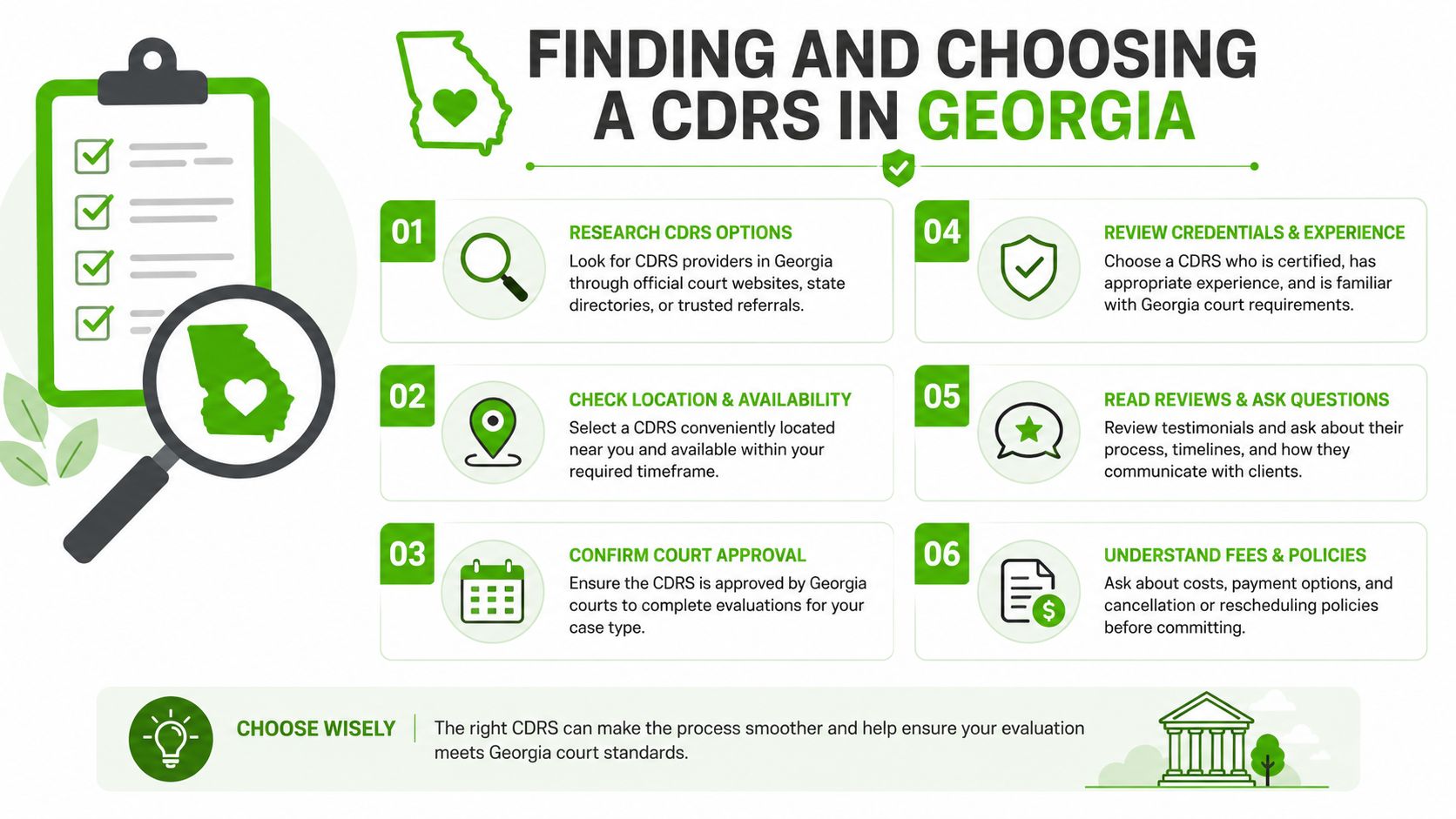
Finding the right evaluator isn't just about booking the first available appointment. It's about choosing someone whose credentials, process, and reporting style fit the reason you were referred.
Start with the official directory from the Association for Driver Rehabilitation Specialists. That's the most direct way to identify professionals who hold the CDRS credential. Then call the office and confirm that the credential is active and that the provider handles cases like yours.
Questions worth asking before you schedule
A strong intake call can save you time and frustration. Ask direct questions, and listen for direct answers.
- What's included: Ask whether the quoted fee covers the clinical assessment, the road evaluation, and the written report.
- What vehicle is used: Some evaluations require a specially equipped car. Confirm whether the provider supplies it.
- How reports are handled: Ask whether the report goes to you, your attorney, your doctor, DDS, or some combination.
- What experience they have: If your case involves DUI history plus a medical concern, say that clearly.
- How long the process takes: You want to know whether there is one appointment or several, and when the final paperwork is typically available.
Cost and coverage
The financial side can be a real barrier. The Right at Home overview of driver rehab specialists notes that the cost of a driver evaluation varies nationwide from $200 to $1,000, and although health insurance or Medicare may cover some costs, many drivers still face a significant out-of-pocket burden.
That means you should ask billing questions early, not after the appointment is booked.
A short checklist helps:
- Request a written fee explanation
- Ask whether any part may be reimbursable
- Confirm cancellation and rescheduling rules
- Find out whether training sessions would be separate from the evaluation
- Ask if follow-up letters or forms cost extra
Don't ask only, “What's the price?” Ask, “What exactly does that fee include, and what might trigger additional charges?”
Choosing based on your situation
Not every referral is the same. A younger driver with a physical disability may need adaptive equipment planning. An older adult may need a fitness-to-drive opinion. A person involved in a Georgia DUI reinstatement case may need an evaluator who understands how a driving-fitness report intersects with DDS review.
That's why broad “driving school” experience isn't enough on its own. You want a specialist who can explain the difference between a standard driving lesson and a medically informed driving evaluation.
If your concerns involve disability, accommodations, or adaptive support, this special needs driving resource can help you think through what specialized instruction and evaluation may look like in practice.
What to bring to the appointment
Bring anything that helps the evaluator understand the referral and your current condition:
| Bring this | Why it helps |
|---|---|
| DDS notice, court order, or referral note | Shows exactly why you were sent |
| Medication list | Helps identify possible driving effects |
| Glasses or corrective devices | Needed for realistic testing |
| Medical records that explain the condition | Gives context for the evaluation |
| Questions in writing | Keeps you from forgetting details under stress |
A good evaluator should be able to tell you what they need before you arrive. If the office can't explain the process in plain language, keep looking.
Your Next Steps to Get Back on the Road
A Georgia driver can finish court, leave with a stack of papers, and still feel unsure about what gets a license back. That confusion usually comes from having more than one requirement in play. One item may go to the court, another to DDS, and a CDRS report may answer a different question entirely about whether you can drive safely.
The practical goal is to turn that stack of instructions into a checklist you can complete in order.
Put the process into one Georgia-specific checklist
Use this as your final pass before you file for reinstatement:
- Match each requirement to the agency asking for it. Court orders, DDS notices, and medical referrals may overlap, but they do not always ask for the same thing.
- Complete every program or evaluation listed in your case. If DDS needs a driving-fitness review from a CDRS, treat that as its own step. If your reinstatement also depends on a state-required DUI intervention course, complete that through an approved provider.
- Check your paperwork before you submit anything. Names, dates, case details, and provider information should match your official documents.
- Keep one folder for all records. Store your CDRS report, completion certificate, receipts, DDS correspondence, and any court paperwork together so you can respond quickly if DDS asks for proof.
What matters at the end is simple. DDS and the court usually want the right documents from the right providers, submitted in the right sequence.
That is why drivers often lose time. They complete one step and assume the whole case is resolved, even though Georgia may be looking for separate proof of course completion, evaluation results, or reinstatement eligibility.
If your case includes both a DUI-related requirement and a CDRS evaluation, handle them like two lanes feeding the same highway. Both may need to clear before you are back behind the wheel legally. Doing each step carefully the first time usually saves more time than rushing and having DDS reject incomplete paperwork.
If you need to complete Georgia's state-required DUI/Risk Reduction course for license reinstatement, enroll with Georgia DUI Schools for a DDS-approved program available in person and through live virtual classes.