

The letter from DDS usually lands on a normal day. You were heading to work in Atlanta, trying to keep up with court dates in Athens, or just opening mail after putting it off for a week. Then you see the words that stop everything. Suspended.
Those seeking license reinstatement don't need more legal jargon at that moment. They need a clean answer to one question: what do I do next so I can drive again legally?
For License Reinstatement Georgia cases, the answer depends on why the license was suspended. A DUI suspension moves on one track. A Failure to Appear goes on another. A points issue has its own logic. What trips people up is assuming every suspension gets fixed with one payment and one form. In Georgia, that's often not how it works.
We see the stress behind this every day. People show up convinced they've already handled the problem because they paid something online, or because they finished one class, or because the court clerk told them the case was closed. Sometimes that's enough. Often it isn't. The practical fix is to identify the exact suspension type first, then follow the right sequence without skipping steps.
First Steps After a Georgia License Suspension
The first move is simple. Stop guessing and identify the reason for the suspension. If you don't know whether DDS suspended you for DUI, a court-related issue, points, child support, or something overlapping, every later step becomes harder.
Start with the notice and your driving record
Look at the paperwork you received from DDS or the court. If you have the suspension notice, keep it. If you don't, don't panic, but understand that missing documents can slow things down later because DDS may have to manually match your payment and record.
A lot of drivers tell us the same story. They paid a fee, waited, then found out the underlying problem was still sitting with the court. Others finished a required class but never sent in the proof that DDS needed to process reinstatement. The system feels confusing because there isn't one path. There are several, and each starts in a different place.
Practical rule: Before you enroll in anything or pay anything, confirm the cause of the suspension and whether there's more than one hold on the record.
The three scenarios we see most often
For most Georgia drivers, the first real fork in the road looks like this:
- DUI or drug-related suspension: This usually means state-required education, and sometimes additional clinical requirements, before DDS will restore driving privileges.
- Failure to Appear or court-related suspension: This often must be fixed with the court first. DDS is usually the second step, not the first.
- Points suspension or other administrative issue: This may involve a defensive driving path, separate court obligations, or a different reinstatement requirement altogether.
If you're stressed, narrow your focus to today's task. Find the cause. Gather the notice. Check whether the court, DDS, or both are involved. That one step removes most of the confusion.
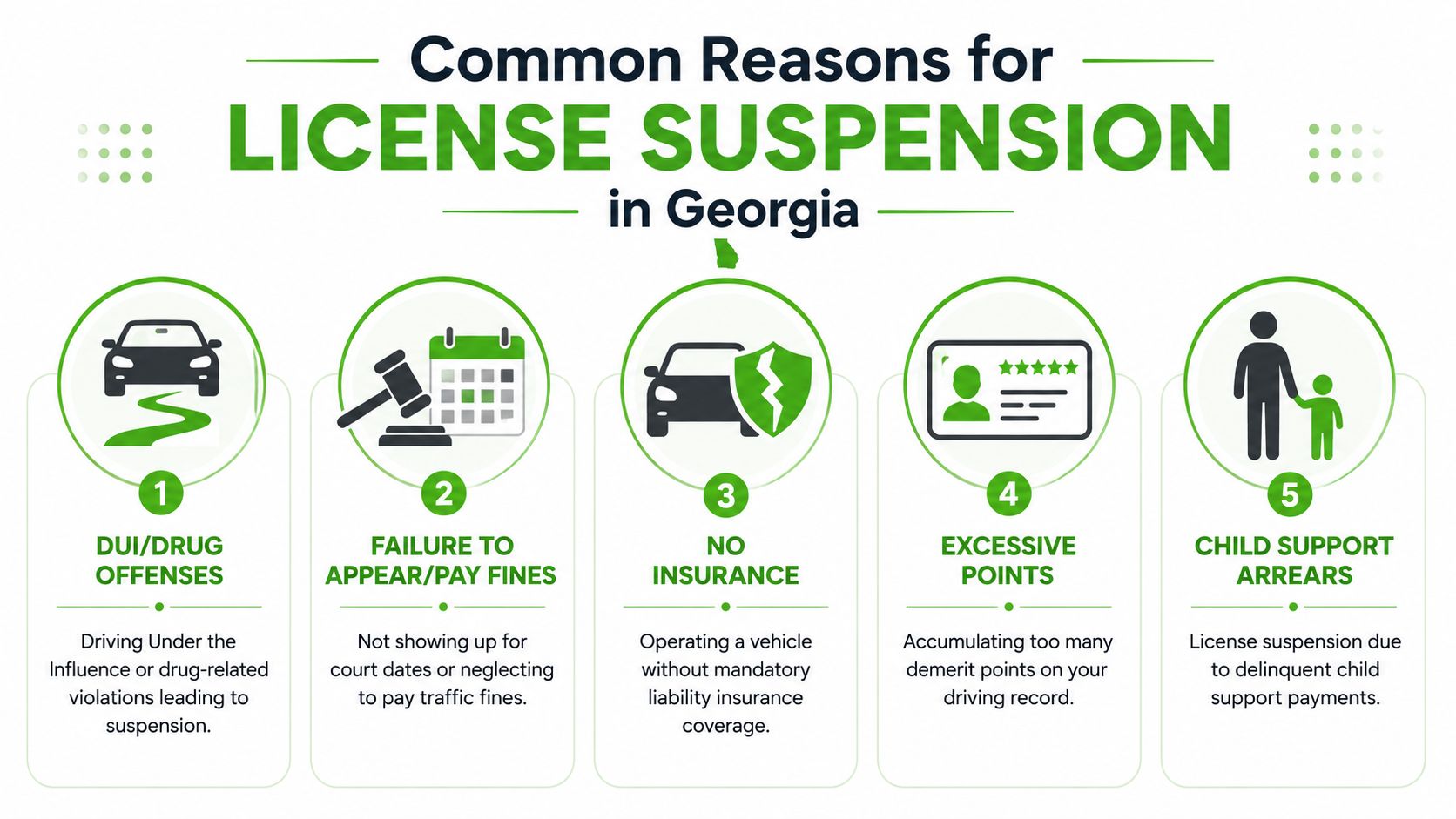
Why Was Your License Suspended? Common Georgia Scenarios
A reinstatement problem can't be solved correctly until it's diagnosed correctly. Georgia drivers often search for a fee chart when what they need instead is a category chart.
DUI and drug-related suspensions
This is the path people usually associate with risk reduction classes, clinical evaluations, treatment recommendations, and court conditions. If the suspension comes from DUI, the process is rarely just administrative. It usually involves completing required program work and making sure DDS receives the right proof.
If you're also trying to understand long-term consequences, this overview of how long a DUI stays on your Georgia record helps separate record issues from reinstatement issues. People often combine those two questions, but DDS treats them differently.
Failure to Appear and missed court dates
FTA suspensions cause some of the biggest misunderstandings. Drivers pay DDS first, then learn the court still hasn't cleared the hold. In many of these cases, the court is the gatekeeper. If you missed a hearing or didn't resolve a traffic case, start there.
Georgia's system also changed in this area. A policy analysis reports that about 105,000 driver's licenses were automatically suspended each year over missed traffic court appearances before the 2022 reform changes, and the law gave judges more discretion to suspend, reinstate, and sometimes waive fees during the court process, with retroactive reach for older cases through court action instead of only an administrative DDS loop (Reason Foundation on Georgia court-related suspension reform).
If you need a plain-language explanation of what missing court can trigger, this article from Cherokee Bail Bonds on missing court is useful because it spells out the practical effect of an FTA in everyday terms.
A missed court date doesn't just create a court problem. It can become a driving problem.
Points, insurance, child support, and overlapping holds
Many drivers don't have a single clean suspension. Georgia DDS makes clear that reinstatement can involve multiple overlapping suspensions, and different causes such as FTA, DUI, or child support can carry different fees, proof requirements, and payment methods (Georgia DDS reinstatement guidance).
That matters in real life. You might clear a ticket in one county, only to find another unresolved hold still blocks reinstatement. You might complete a DUI requirement but still have a separate child support issue preventing your status from changing. In these situations, generic advice fails.
A quick comparison helps:
| Suspension reason | First place to focus | Common mistake |
|---|---|---|
| DUI or drug offense | Program and compliance requirements | Paying DDS before finishing required steps |
| Failure to Appear | The court that issued the hold | Assuming court closure automatically restores the license |
| Points or other admin issue | DDS record and underlying violation | Treating all suspensions like the same process |
| Child support-related hold | The enforcing agency plus DDS follow-up | Clearing one matter and missing another hold |
If your case feels messy, that's not unusual. It usually means you need to separate each hold and resolve them one by one.
Completing Your DUI and Clinical Requirements
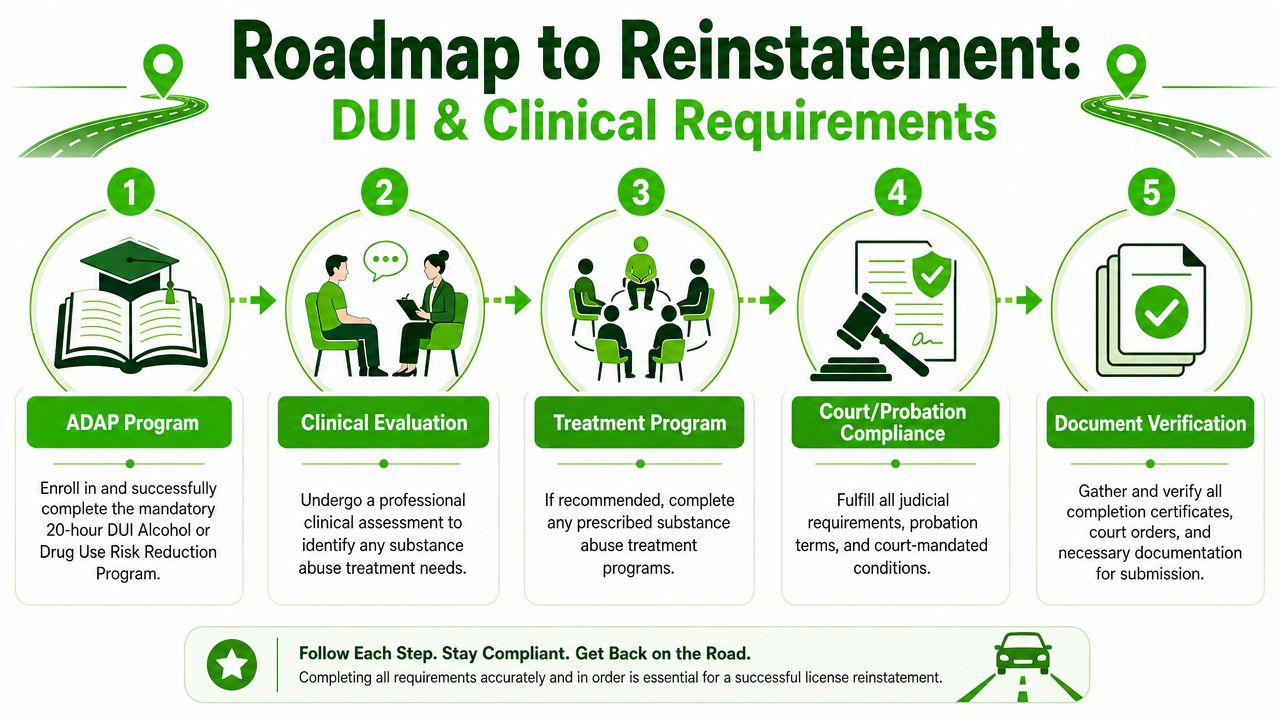
When a Georgia suspension comes from DUI or a drug-related offense, the fastest route is usually the most structured one. Follow the sequence, keep every completion document, and don't assume one part of the process substitutes for another.
What the state usually expects first
For drivers age 21 or older, a first DUI conviction in Georgia carries a minimum 180-day suspension, while a second DUI conviction within five years can trigger a mandatory three-year suspension. The same source notes the ordinary reinstatement fees are $210 in person or $200 by mail for a first offense, $310 in person or $300 by mail for a second offense, and $410 in person or $400 by mail for a third or subsequent offense (Georgia DUI suspension and reinstatement overview).
Those numbers matter, but the process matters more. Most DUI reinstatement problems come from doing the right things in the wrong order.
The working sequence that tends to hold up
For DUI-related reinstatement, the path is usually built around three practical stages:
- Complete the required risk reduction step. This is often the first educational requirement DDS and the court expect to see handled.
- Address any clinical requirement. Some drivers need only the course. Others also need a clinical evaluation and follow-up services based on the outcome.
- Finish court or probation conditions and keep proof. If the court imposed additional terms, DDS reinstatement won't erase those.
At Georgia DUI Schools, one available route is the state-approved course and related clinical services in the same process flow, including classes in Atlanta and Athens and online options for Georgia residents who need scheduling flexibility. The key isn't convenience alone. It's making sure every required completion record is available when DDS or the court asks for it.
Clinical evaluations and treatment aren't the same thing
This distinction matters. A clinical evaluation is an assessment. It identifies whether more services are recommended or required. It is not automatically the same as treatment.
If treatment is required, drivers may also need follow-through such as ASAM Level 1 recommendations or other court-recognized compliance steps. Some courts also require a Victim Impact Panel. These items don't replace the Risk Reduction Program. They sit alongside it when ordered.
For readers who have heard probation officers or employers mention SAP and aren't sure how that differs from Georgia DUI requirements, this explanation of what the SAP program is can help separate federal return-to-duty concepts from state reinstatement obligations.
Finish exactly what your case requires, not what someone else's case required. DUI reinstatement in Georgia is path-dependent.
What usually works and what usually stalls
What works is boring but effective. Keep every certificate. Confirm names and dates match. Follow the order the court or DDS expects. Ask for clarity before the class date if you don't know whether you also need a clinical piece.
What doesn't work is assuming the course alone fixes every DUI suspension. It may be necessary, but in many cases it isn't the whole file.
Handling Fees Forms and SR-22 Insurance
The administrative side of reinstatement feels smaller than the class or court side, but many drivers experience delays at this stage. The issue usually isn't effort. It's sequence.

The order matters more than people think
Georgia DDS says the operational sequence is to complete the program, pay the applicable reinstatement fee, and submit any required proof, with case-specific instructions available from the individual's record. DDS also says it uses the Official Notice of Suspension to match payments to the correct record, and if that notice is missing, the driver must supply full identity details for manual matching, which increases delay risk (Georgia DDS reinstatement fees and payment instructions).
That explains a common problem we see. Someone pays first because it feels productive. Then DDS can't complete reinstatement because the proof isn't attached, the notice is missing, or another hold still exists.
Forms that commonly control the timeline
The exact paperwork depends on the reason for the suspension, but these are the items that often decide whether things move smoothly:
- Official Notice of Suspension: Keep it if you have it. It helps DDS connect the payment to the right record.
- Course completion proof: For DUI-related cases, don't assume attendance is enough. DDS needs the completion documented correctly.
- Court clearance paperwork: In court-based matters, the right court form or clearance letter often matters more than the fee receipt.
- Insurance filing if required: Some drivers need an SR-22 filing before privileges can be restored.
SR-22 confuses people because it sounds like a type of insurance policy. It isn't. It's a certificate your insurer files to show financial responsibility. If DDS or the court requires it, ask your insurance company specifically whether they file SR-22s and how they handle cancellation notices. And if you're trying to understand the wider insurance fallout after violations, this guide for drivers on ticket insurance impact gives a practical consumer view.
Restricted licenses and ignition interlock questions
Some drivers don't move directly from suspension to full reinstatement. They move through a restricted driving phase first. If your case involves limited driving privileges or device-based requirements, this guide to an ignition interlock restricted license is worth reviewing before you assume you're eligible to drive normally again.
Payment is not the finish line. Payment is one part of a file DDS still has to process.
The safest habit is to treat every receipt, certificate, and court document like it may be needed again later. In practice, that's often what keeps a reinstatement from dragging out.
Mistakes to Avoid and What New Georgia Laws Mean for You
The most expensive assumption in this process is that Georgia reinstatement works like online shopping. You pay, click submit, and the problem disappears. It doesn't.
Mistakes that slow people down
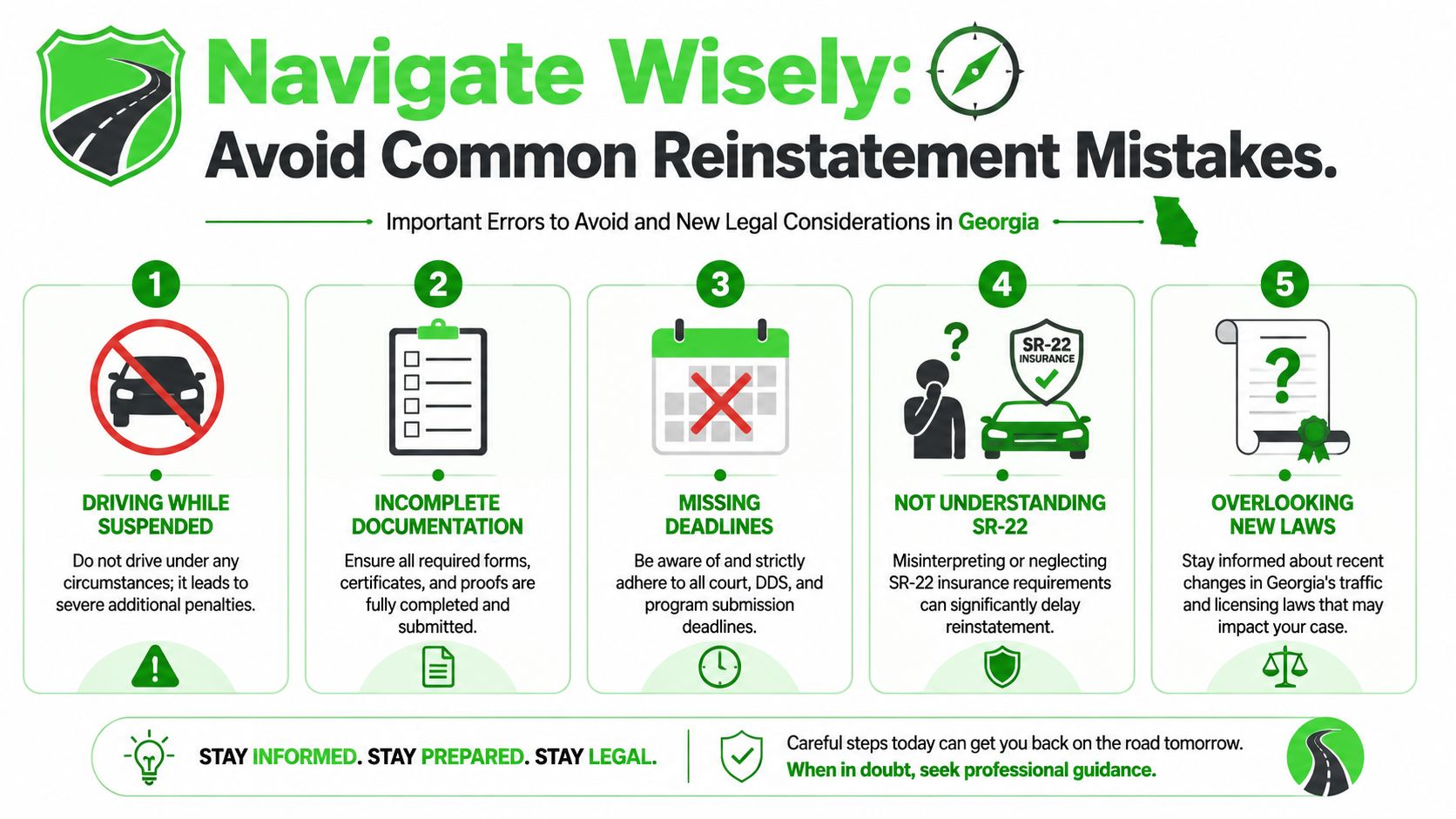
A few patterns come up repeatedly:
- Paying DDS before clearing the court hold: This is common in FTA cases and often leaves drivers frustrated because the status doesn't change.
- Assuming online payment means you can drive immediately: DDS processing and proof verification still matter.
- Treating one suspension like the only suspension: A cleared issue in one place doesn't remove every hold elsewhere.
- Bringing incomplete paperwork: Missing notices, missing certificates, and mismatched names can all stall the file.
- Ignoring restricted-license rules: Some drivers regain limited privileges and mistakenly treat them like full reinstatement.
What HB 926 changed, and what it didn't
A lot of people searching for license reinstatement Georgia information really need guidance on missed traffic court suspensions, not generic fee lists. One recent policy analysis says lawmakers passed HB 926, described as the Second Chance Workforce Act, in 2024 to make reinstatement easier, but DDS added procedural barriers that may still block low-income drivers from getting fee relief (analysis of HB 926 and DDS fee-waiver friction).
That creates a real-world trade-off. On paper, the law gives more room for relief in court-related suspensions. In practice, drivers may still need to work through extra DDS process friction even after a judge acts.
If your suspension came from a missed traffic court date, ask two separate questions. Did the court clear it, and did DDS process that clearance?
The strategic takeaway
The law is more favorable than it used to be for some court-related suspensions. That's good news. But don't confuse a better law with an automatic result.
What works now is being very specific with the court about what document is being issued, whether any fee waiver was granted, and what DDS will need to recognize that action. The drivers who move faster are usually the ones who treat court resolution and DDS resolution as connected but separate tasks.
Your Actionable Georgia Reinstatement Checklist
When drivers finally get traction, it's usually because they stop chasing random steps and start working from a checklist. Use this one in order.
Your reinstatement checklist
- Identify every reason your license is suspended. Don't stop at the first answer. Check whether DUI, FTA, child support, points, or another hold appears on the record.
- Match the problem to the right starting point. DUI cases usually begin with required program and compliance steps. FTA cases usually begin with the court.
- Complete every required class or clinical item. If your case requires a Risk Reduction Program, clinical evaluation, treatment follow-up, Victim Impact Panel, or defensive driving course, finish the exact requirement listed for your case.
- Collect proof immediately after completion. Don't assume a court or agency will automatically have it when needed.
- Resolve court holds before expecting DDS to clear your status. For Failure to Appear matters, a court-issued clearance letter or 912 form must be submitted to DDS before reinstatement is effective, even if the fee has already been paid, and drivers should confirm status online because payment alone does not restore driving privileges (FTA reinstatement guidance for Georgia drivers).
- Handle any insurance filing required in your case. If SR-22 applies, get it filed through your insurer and verify that it remains active as required.
- Pay the correct reinstatement fee only after the underlying requirement is cleared.
- Submit every required document carefully. Match names, case details, and dates.
- Verify your DDS status before driving. Never assume that a payment receipt or class certificate alone means your privileges are fully restored.
A final practical check
If your file has been stuck, ask yourself three questions:
- Did I clear the court, or did I only pay DDS
- Did I complete the requirement, or did I only enroll
- Did DDS receive proof, or am I assuming they did
Those three questions catch a surprising number of reinstatement problems. The Georgia system can be frustrating, but it isn't impossible to work through once you separate the steps and deal with them in the right order.
If your suspension involves DUI or drug-related requirements, the most useful next step is usually getting the state-required course scheduled so the rest of the reinstatement process can move. Georgia DUI Schools offers the Georgia DDS-approved Risk Reduction path and related compliance support for drivers who need a practical starting point. You can review the course details and register here: Georgia DUI Schools Risk Reduction Program.