
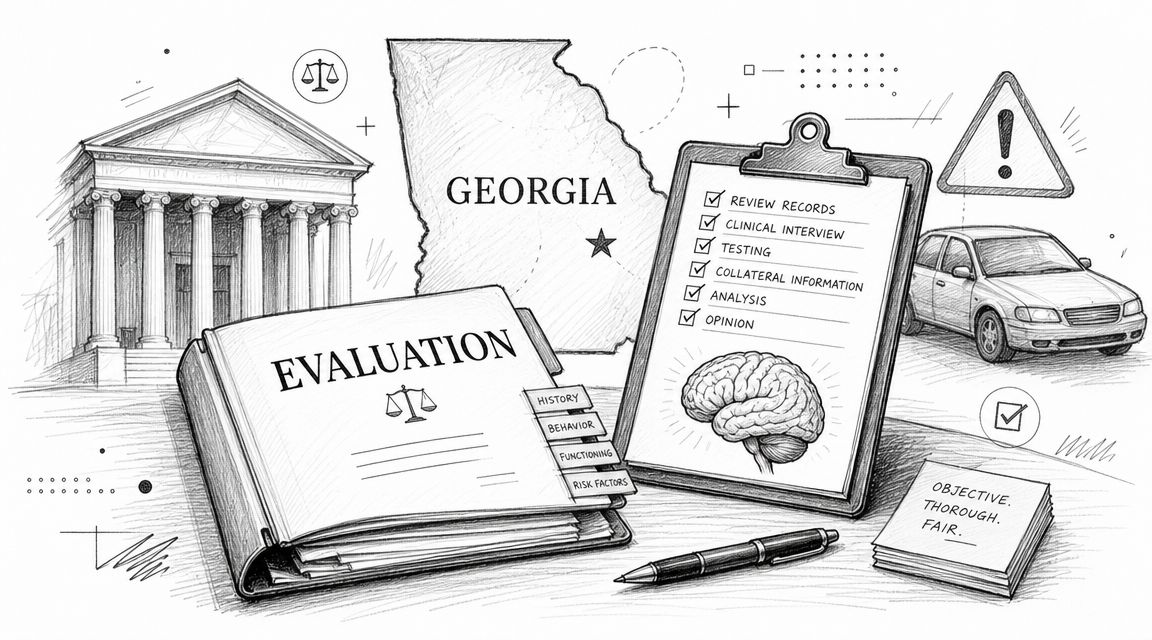
A judge mentions a psychological evaluation after your Georgia DUI case, and your stress level jumps fast. Many individuals hear that phrase and assume the court thinks something is wrong with them. That usually isn't what's happening.
In many Georgia DUI situations, the court wants a structured, professional opinion about substance use, decision-making, risk, and what kind of education or treatment may fit the case. That's different from therapy, and it's different from a criminal defense interview. It's a legal process with clinical parts.
If you've been told to complete a court psychological evaluation, you probably want clear answers. What is it. Who does it. What should you bring. What ends up in the report. What happens if the evaluator recommends treatment. Those are the questions that matter when you're trying to keep your case moving and get your life back into order.
This guide is written for Georgia residents dealing with DUI-related court requirements. It uses plain language, local context, and practical steps so you can walk into the process informed instead of guessing.
Your Guide to Navigating a Court-Ordered Evaluation
A court order can feel blunt. One short sentence from a judge, probation officer, or lawyer can create days of worry. If that sentence includes “psychological evaluation,” many people immediately picture a hostile interrogation or a trap they can fail.
That's not the most useful way to think about it.
In a Georgia DUI case, the evaluation is usually part of the court's effort to answer a practical question. Does this person show signs of a substance use problem or related behavioral concern that the court needs to address through education, monitoring, treatment, or another condition?
Start with this mindset: the evaluation is about giving the court a clearer picture, not about labeling you as a bad person.
That distinction matters because it changes how you prepare. You don't need to perform. You don't need to memorize perfect answers. You do need to understand the purpose, show up organized, and answer truthfully.
Georgia drivers often encounter this process alongside other DUI requirements such as a Risk Reduction course, a clinical evaluation, treatment recommendations, or a Victim Impact Panel. Those pieces can feel disconnected at first. In reality, they often fit together as part of one larger legal path.
If you know what the evaluator is looking at, what documents matter, and how the report may affect next steps in your case, the process becomes far less mysterious.
What Exactly Is a Court Psychological Evaluation
A court psychological evaluation is a forensic assessment. That means it's built for a legal setting. It is not the same thing as counseling, and it doesn't function like a therapy session where the main goal is healing, support, or ongoing treatment.

It answers a legal question
The court usually wants an evaluator to answer something specific. In a DUI-related case, that may involve substance use patterns, risk, functioning, or whether further services make sense. The evaluator's job is to collect information, analyze it, and write an opinion for the court.
Best practice for this type of assessment is a multi-method process that combines a clinical interview, standardized psychological testing, and collateral review of records such as medical files or police reports. That approach helps the evaluator compare information from different sources instead of relying on one conversation alone, which improves reliability for court use according to best-practice guidance on court-ordered psychological evaluations.
If you're trying to understand how this works in a Georgia legal context, a court-ordered mental health evaluation overview can help you see how the assessment fits into court compliance.
It is not confidential in the same way therapy is
People often get confused here. In therapy, privacy is a central expectation. In a forensic evaluation, the evaluator is usually preparing findings for a judge, lawyer, probation officer, or another party identified in the referral.
That doesn't mean you should become guarded and evasive. It means you should understand the role clearly. The evaluator is not becoming your personal counselor. The evaluator is gathering information for a report.
What the evaluator may use
A simple way to picture the process is this:
| Component | What it involves | Why it matters |
|---|---|---|
| Interview | Questions about history, current concerns, alcohol or drug use, and legal background | Gives context and timeline |
| Standardized testing | Structured questionnaires or other assessment tools | Adds consistency beyond conversation alone |
| Collateral records | Court papers, arrest reports, treatment history, medical or school records when relevant | Checks whether the story fits the documents |
The more the evaluator can compare interview answers with records and testing, the stronger the final opinion tends to be.
Why Georgia Courts Order Evaluations in DUI Cases
A Georgia judge may already have the arrest report, the breath or blood test result, and your driving history. Even so, those records do not answer a different set of questions the court often cares about in a DUI case. Is this a one-time lapse in judgment, or does it point to a larger alcohol or drug problem? Does the person need education, treatment, monitoring, or some combination of those steps?
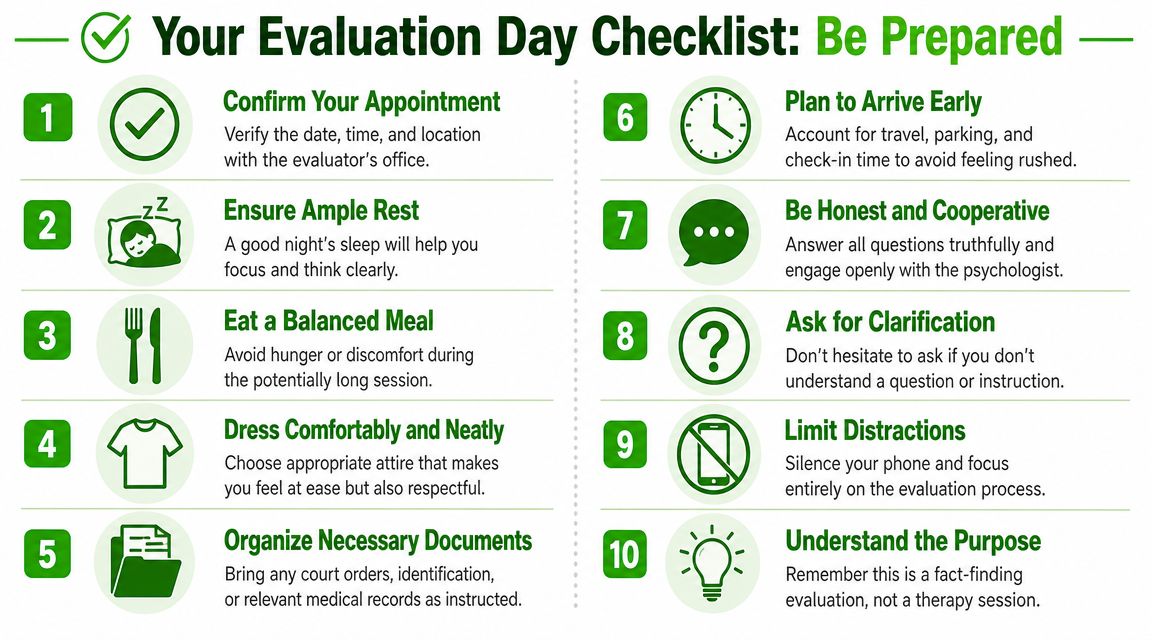
Georgia courts use evaluations to answer practical sentencing questions
In DUI cases, Georgia courts usually order evaluations to get a clearer picture of risk, substance use patterns, and what kind of intervention fits the case. The court is trying to make a grounded decision, not rely only on the facts of one traffic stop.
That point eases a common fear. Hearing the phrase "psychological evaluation" can make people assume the court is questioning their basic mental stability. In many Georgia DUI matters, the focus is narrower. The evaluator is often being asked whether alcohol or drug use appears tied to unsafe driving, repeated legal trouble, poor judgment, or trouble following court rules.
A useful comparison helps here. The arrest report is like a snapshot. An evaluation works more like a short video clip. It gives the court context about what led up to the DUI and what may happen again without the right response.
The court is often looking beyond the arrest itself
A judge in Fulton County, DeKalb County, Gwinnett County, Cobb County, Athens-Clarke County, or another Georgia court may want information the police report cannot supply on its own. That includes questions such as:
- whether the DUI appears isolated or part of a longer pattern of alcohol or drug misuse
- whether substance use has affected work, school, family duties, or prior court compliance
- whether the facts point toward education alone or toward counseling, treatment, or monitoring
In many cases, a court-ordered substance abuse evaluation is the structured tool used to answer those questions.
This is different from a competency evaluation
Courts order different kinds of forensic evaluations for different legal reasons. A competency evaluation asks whether a person understands the case and can assist in their defense. A DUI-related evaluation usually serves a different purpose. It helps the court assess substance use concerns and decide what conditions may reduce future risk, as explained in this guide to mental health evaluation for court.
If you have looked up other assessment topics, the broader ADHD and ASD evaluation process can also help you see a general pattern. Evaluations are used to answer a defined question, and the question shapes the process.
Why judges give these reports weight
Courts rely on evaluations because trained clinicians can connect interview answers, testing, and records into a professional opinion that is more useful than guesswork. The American Psychological Association's overview of forensic psychology describes how psychological expertise is used to inform legal decision-making. In a Georgia DUI case, that often means helping the court decide which conditions are proportionate and which ones may lower the chance of another alcohol- or drug-related offense.
For you, the practical point is straightforward. The evaluation can influence what happens next. A report suggesting limited concern may support education and standard compliance terms. A report showing stronger warning signs may lead the court to require treatment, follow-up services, or closer supervision.
The Evaluation Process from Start to Finish
Most court-ordered evaluations follow a sequence. Once you know the sequence, the experience feels less unpredictable.
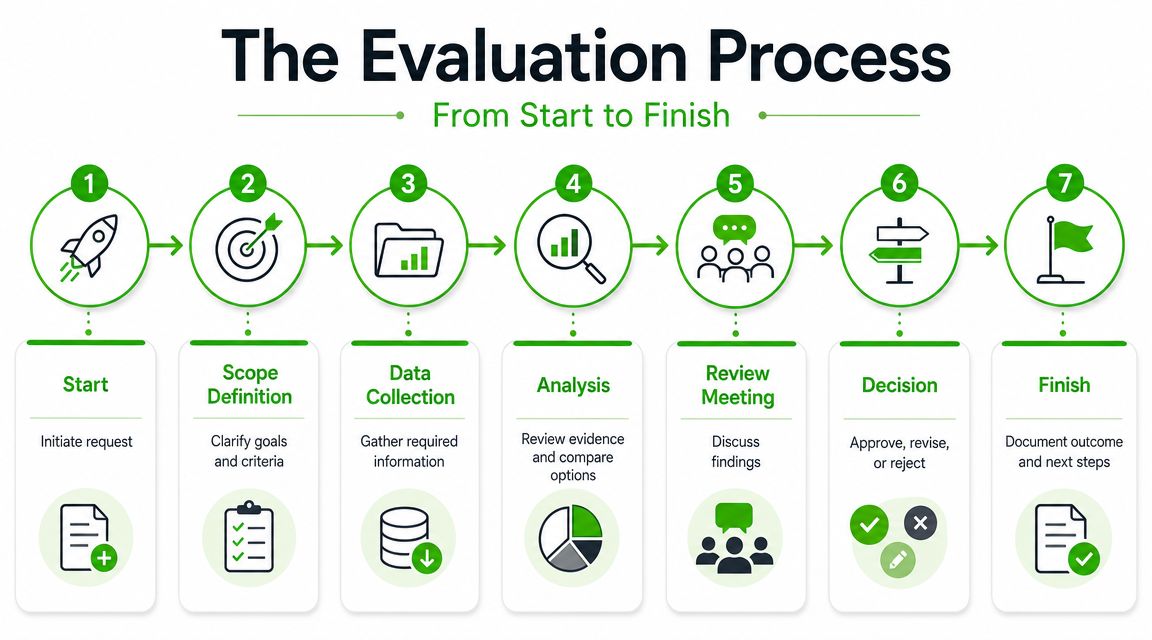
Step one is the referral and intake
The process begins when the evaluator receives a referral, court order, or request from a lawyer, probation office, or court. You may be asked for identification, the court paperwork, prior treatment records, and details about the DUI case.
Some offices also ask about past counseling, medications, prior arrests, school history, employment history, and family background. That can feel broad for a DUI matter, but evaluators often need context to understand whether the incident appears isolated or part of a longer pattern.
The interview is usually the longest part
The evaluator will ask direct questions. Expect topics such as your alcohol and drug history, the events around the arrest, prior legal issues, mental health background, medical history, stressors, and current functioning.
This isn't a cross-examination. But it is structured. The evaluator may revisit the same topic in different ways to check clarity and consistency.
Practical rule: if you don't remember something, say you don't remember. Guessing can create inconsistencies that become more important than the missing fact.
Testing adds structure
Many evaluations include standardized instruments or questionnaires. These aren't there to trick you. They're used to organize information and compare your answers against established scoring methods.
At the same time, test quality matters. A thorough review looked at 364 psychological assessment tools across 876 court cases and found insufficient evidence of general admissibility for 51% of the tools. Of the generally admitted tools, experts rated 16.8% unacceptable. The same review found only 40% of courtroom assessment tools were favorably rated overall, with 37% mixed and 23% unfavorable, according to this review of court-admitted psychological assessments.
That doesn't mean your evaluation is invalid. It does mean the evaluator's training, method selection, and ability to explain the basis for conclusions matter.
Records review can change the picture
Evaluators often compare your interview answers with outside documents. That may include the citation, arrest narrative, prior clinical records, probation information, or earlier treatment history if available.
This comparison can help in both directions. Sometimes records support what you said. Other times they reveal gaps, contradictions, or issues you forgot to mention.
The report closes the loop
After the interview, testing, and records review, the evaluator writes a report that answers the legal referral question. In a Georgia DUI matter, that often means giving an opinion about substance use concerns, risk factors, and recommended next steps.
If you want a non-court example of how a structured evaluation can unfold over several stages, the ADHD and ASD evaluation process is useful because it shows how clinicians gather history, testing, and interpretation over time. The legal purpose is different, but the step-by-step logic is similar.
How to Choose a Qualified Evaluator in Georgia
Not every clinician is the right fit for a forensic case. A strong therapist is not automatically a strong court evaluator. For a Georgia DUI matter, you want someone who understands legal referral questions, writes reports clearly, and has experience with substance-use-related assessments.
What to look for first
Start with licensure and role clarity. The evaluator should be appropriately licensed in Georgia and should be able to explain whether they provide forensic assessments, substance abuse evaluations, or broader court-related clinical work.
Then ask about case type. Someone who mostly does custody disputes may not be the best person for a DUI sentencing-related referral. Someone familiar with Georgia courts, probation expectations, DDS-related requirements, and DUI treatment pathways will usually understand what the report needs to address.
One practical local option is Georgia DUI Schools, which offers Georgia State and DHR-approved drug and alcohol clinical evaluations along with ASAM Level 1 treatment and related DUI compliance services.
Questions worth asking before you book
Use a short screening list when you call:
What kinds of court evaluations do you perform most often
You want to hear whether DUI and substance-use-related work is a routine part of their practice.What materials should I bring
A clear answer signals an organized process.Who receives the final report
This helps you understand where the information is going.Do you offer in-person and remote appointments
If remote is available, ask how they handle identity verification, privacy, test administration, and observation.What happens if the court wants clarification
Some evaluators are more comfortable with follow-up questions, addenda, or testimony than others.
Be careful with remote evaluations
Remote appointments can be convenient, especially if you live outside metro Atlanta or have work and childcare barriers. But remote forensic assessment has limits. Recent forensic literature notes that remote evaluations can miss nonverbal cues, arousal changes, and other behavioral observations, so evaluators may need added safeguards and more direct questioning to conduct a thorough assessment, as discussed in this forensic review of remote psychological assessment.
That doesn't mean telehealth is wrong. It means you should ask how the evaluator handles the parts that are harder to observe through a screen.
If an office offers remote evaluation, ask what they do to address missed nonverbal information, distractions, interruptions, and identity verification.
Administrative systems matter too. Court-related clinical practices deal with scheduling, documentation, compliance, and payment workflows that can affect how smoothly your case moves. For a behind-the-scenes look at how specialized practices organize those operations, this article on the specialized revenue process for mental health clinics gives helpful context.
A Practical Checklist for Your Evaluation Day
Preparation doesn't mean trying to control the outcome. It means removing avoidable problems so the evaluator gets an accurate picture of you.
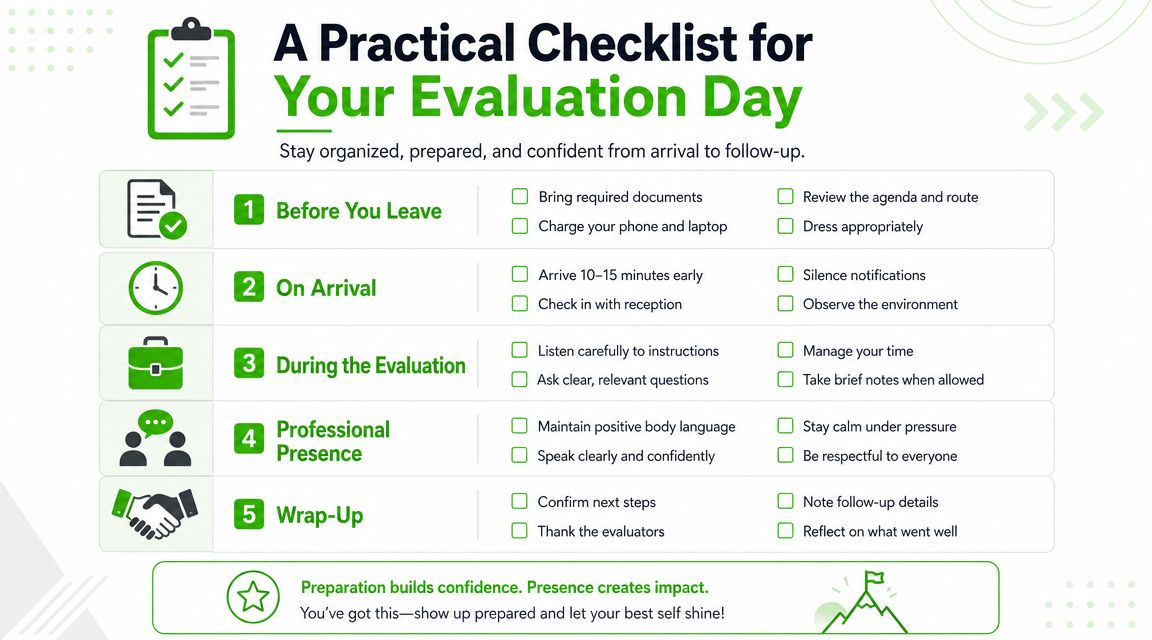
The night before
Small choices help more than people expect.
Confirm the details
Double-check the date, time, address, parking instructions, and whether the appointment is in person or remote.Gather your paperwork
Put your court order, ID, referral information, medication list, and any records the office requested in one folder.Sleep and food matter
Try to get rest and eat normally. If you show up exhausted, hungry, or shaky, it may affect concentration and how you present.
What to bring and how to behave
This part is simple, but it's where people often stumble.
| Bring | Why |
|---|---|
| Photo ID | Confirms identity |
| Court paperwork | Shows exactly what was ordered |
| Referral contact information | Helps if the evaluator needs to verify where the report goes |
| Medication list | Gives accurate health context |
| Any requested records | Reduces delay and confusion |
Dress neatly and comfortably. You don't need to look formal, but you should look like you take the appointment seriously.
Answer questions directly. If the evaluator asks about your use history, prior treatment, or the DUI arrest, don't minimize and don't dramatize. Courts and evaluators have seen a lot of stories. Overexplaining can be just as unhelpful as saying too little.
If you feel anxious during the appointment
That's normal. Many people worry they'll say the wrong thing, freeze up, or look bad if they admit past mistakes.
Try these grounding steps:
- Pause before answering if a question catches you off guard.
- Ask for clarification if wording is confusing.
- Correct yourself plainly if you realize you misspoke.
- Stay factual instead of trying to sound impressive or harmless.
“Honest and organized” is a better goal than “perfect.”
If the session is remote, pick a quiet room, stable internet connection, and a private space where nobody will walk in. If you can't secure privacy at home, tell the office beforehand rather than hoping it works out.
Understanding the Report and Possible Outcomes
After the evaluation, the clinician prepares a written report. This document is what the court, attorney, probation officer, or referral source will rely on. Many people focus on the appointment itself and forget that the report is the part that ultimately travels through the legal system.
What the report usually includes
Most reports contain several core parts:
Referral question
Why the evaluation was ordered.Background summary
Personal, medical, legal, substance use, and treatment history relevant to the referral.Methods used
Interview, testing, and records reviewed.Clinical findings
The evaluator's interpretation of the information collected.Opinion and recommendations
The answer to the court's question.
For a Georgia DUI case, recommendations often revolve around education, substance use treatment, or further monitoring. That can include a Risk Reduction course, outpatient counseling, or ASAM Level 1 services depending on what the evaluator concludes. If you've heard a probation officer or counselor mention SAP and aren't sure what that means, this explanation of what the SAP program is helps connect the terminology to real next steps.
What if you don't like the conclusion
People sometimes ask whether they can “fail” a court psychological evaluation. In a strict school-test sense, no. The evaluator is not grading your character. But the report can still contain conclusions you don't like.
If the findings are more serious than you expected, talk with your lawyer about options. Depending on the situation, counsel may review the report for accuracy, ask questions about unclear points, or consider whether a second opinion makes sense. That's a legal strategy issue, not something to argue directly with the evaluator in the middle of the appointment.
A hard report isn't the end of the road. It's often the point where the path becomes clearer. If treatment is recommended, completing it can become part of resolving the case and showing the court that you're taking the issue seriously.
Georgia DUI Evaluation FAQs and Your Next Steps
You are in Georgia, your court date is approaching, and a judge or lawyer tells you a DUI evaluation is part of what happens next. For many people, that raises the same practical questions right away. What happens if the report is negative. Who sees it. What do you do next if you disagree with it.
Can I fail the evaluation
A Georgia DUI evaluation is not a school exam with a passing score. It is closer to a snapshot the evaluator prepares for the court. The report may describe low concern, mixed concern, or a need for education, treatment, or monitoring. What matters is how the evaluator answers the court's question about risk, judgment, and substance use concerns connected to the DUI case.
Is what I say private
Privacy works differently here than it does in regular counseling. In a court-ordered or court-related evaluation, the audience is usually legal, not therapeutic. That often means the report may be shared with the court, your lawyer, the prosecutor, probation, or another approved party depending on the case. Ask before the appointment who will receive the report and whether anything stays outside the written file.
What if I disagree with the report
Start with accuracy. If the report lists the wrong arrest date, treatment history, or testing detail, tell your lawyer promptly so the issue can be reviewed in the proper legal channel.
If your concern is larger than a factual error, such as the evaluator's reasoning or recommendations, your attorney can decide whether to request clarification, challenge the opinion, or consider a second evaluation when that makes legal sense. If you want a plain-English example of how attorneys test an expert's logic, this guide to questions for cross examination shows the kinds of points lawyers often examine.
Why does the court put so much weight on this
Georgia courts use these evaluations because they give a structured professional opinion, not just a quick impression from one hearing. In DUI cases, that helps the court decide whether the person before it likely needs education only, a closer substance use review, treatment, or tighter supervision. The report does not decide the whole case by itself, but it can strongly shape what the court sees as an appropriate next step.
The Georgia court system also relies on evaluations in other settings, including accountability courts. The Council of Accountability Court Judges explains that clinical evaluations help determine treatment needs and suitability for court programs. That same basic idea carries into many DUI-related decisions. The court wants a grounded opinion before assigning requirements.
What should I do now
Act quickly and stay organized. Schedule the evaluation as soon as you are ordered or advised to do it. Confirm that the provider works with Georgia DUI cases and understands local court expectations. Gather the documents you were told to bring, arrive on time, and answer questions carefully and truthfully.
Small delays can create bigger problems. A missed deadline may affect probation terms, court scheduling, or the pace of license-related requirements.
If you need to complete a DUI-related evaluation, Risk Reduction course, ASAM Level 1 treatment, or another Georgia court requirement, Georgia DUI Schools offers a clear next step with state-compliant services designed for drivers working through court and DDS obligations.