You're probably reading this because the stakes feel immediate. Maybe you hold a CDL and spend your week on I-75, I-285, or the long stretches between Atlanta, Macon, and North Georgia. Maybe you manage drivers and need a clear answer on what counts as smart safety practice versus what's required by law. Or maybe you're an attorney or compliance professional trying to line up federal rules with Georgia court and DDS expectations.
Commercial driving in Georgia leaves very little room for casual habits. A passenger vehicle can recover from a late lane change, a short following gap, or a distracted glance more easily than a loaded tractor-trailer can. Defensive driving for commercial drivers isn't remedial. It's part of operating professionally, protecting a CDL, and keeping a workday from turning into a citation, a preventable crash, or a licensing problem that follows you long after the trip ends.
The Professional Driver's Edge on Georgia Roads
A driver rolling north on I-75 through Atlanta at rush hour is dealing with more than traffic. Cars cut across lanes to reach exits. A delivery van brakes hard. A driver in a compact car sits in the blind spot by the trailer. Rain starts falling near the Downtown Connector, and every move on the road gets tighter.
That's where professional defensive driving shows its value. A skilled commercial driver doesn't wait for danger to become obvious. They build space early, read behavior before it turns into a problem, and keep the truck in a position that leaves an escape option open.
According to NHTSA-related defensive driving research, driver error accounts for 77% of all traffic crashes, and commercial drivers who complete formal defensive driving programs experience 29% fewer collisions. For a CDL holder, that's not abstract safety language. It points to the part of crash prevention drivers can control.
Why professionals treat this as a career skill
A commercial vehicle operator isn't just moving from one stop to another. They're managing time pressure, vehicle weight, cargo stability, weather changes, aggressive motorists, and inspection exposure, often in the same shift.
Defensive driving becomes the edge that separates a routine run from a costly mistake. It helps protect:
- Your CDL record against violations that can threaten employment
- Your earning power by reducing preventable incidents
- Your employer's risk when your actions affect claims, downtime, and public safety
- Other road users who often misjudge what a heavy vehicle can and can't do
A professional driver's first job isn't speed. It's control.
In Georgia, that mindset matters on urban interstates, warehouse corridors south of Atlanta, and mountain grades farther north. Conditions change fast. The drivers who stay out of trouble are usually the ones who started planning for trouble before anyone else on the road recognized it.
What this looks like in real life
Sometimes defensive driving is dramatic, like spotting a chain-reaction slowdown early enough to avoid hard braking. More often, it's quiet. It's choosing not to crowd traffic. It's backing off before a merging conflict develops. It's recognizing that being technically “right” doesn't help if another driver does something reckless in front of your bumper.
That's the professional driver's edge on Georgia roads. Not aggression. Not luck. Disciplined anticipation.
What Defensive Driving Means for a Commercial Driver
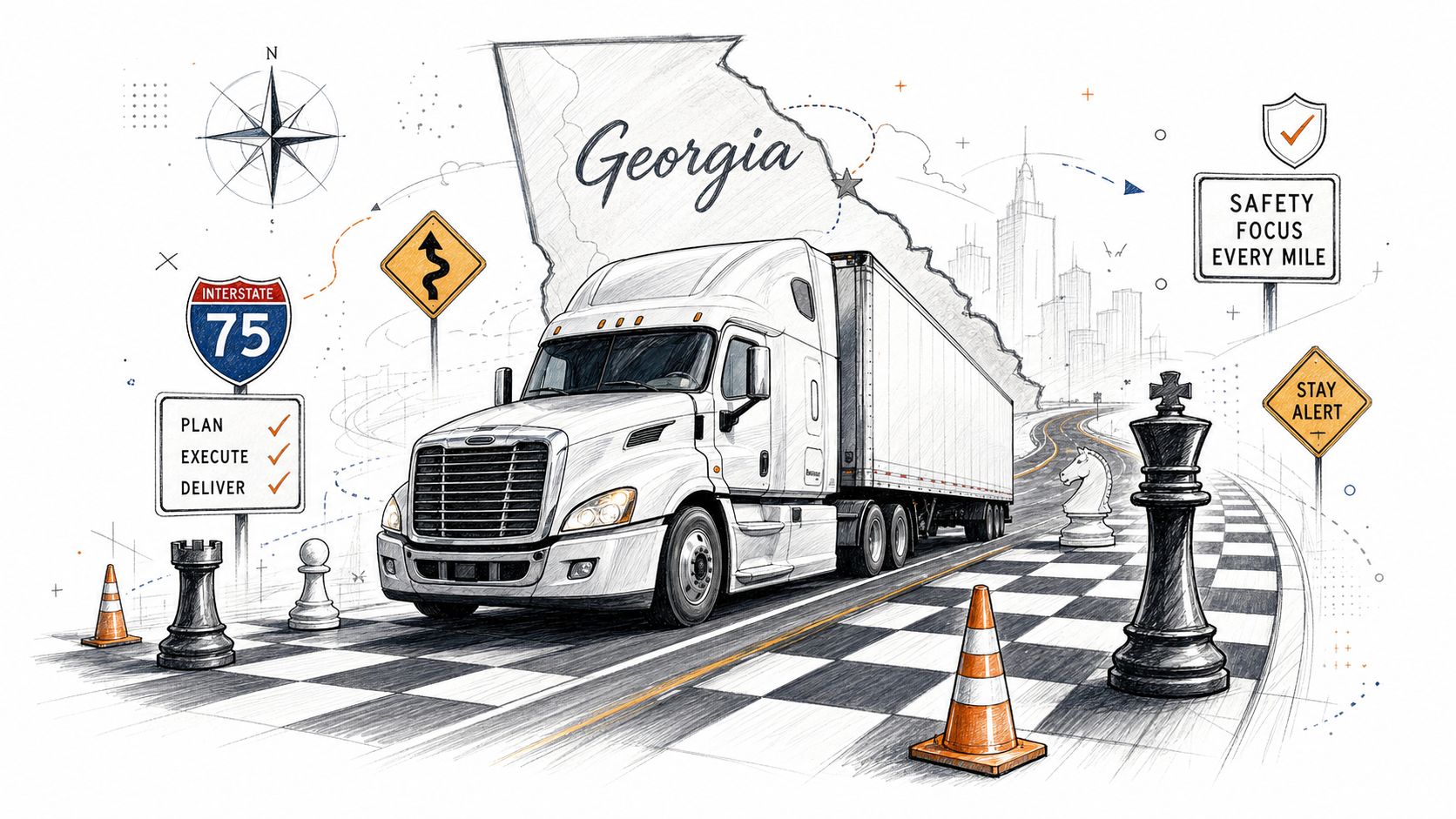
Passenger-car driving is often reactive. Commercial driving can't be. A good comparison is checkers versus 3D chess. In a car, you can sometimes correct late. In a commercial motor vehicle, late corrections can create a larger problem than the original hazard.
Defensive driving for commercial drivers means proactive risk management. You're not just steering and braking. You're continuously evaluating space, time, visibility, road surface, and the likely mistakes of the people around you.
The mindset shift that matters
Most confusion starts here. Many drivers hear “defensive” and think it means driving slowly or timidly. It doesn't. It means driving in a way that leaves you options.
A commercial driver uses a mental process that sounds simple but takes discipline:
- See the risk early
- Decide what could go wrong next
- Create space before the problem matures
- Use smooth control inputs to keep the vehicle stable
That process applies whether you're on I-20 near Lithonia, moving through Savannah-area freight traffic, or pulling through a crowded industrial yard.
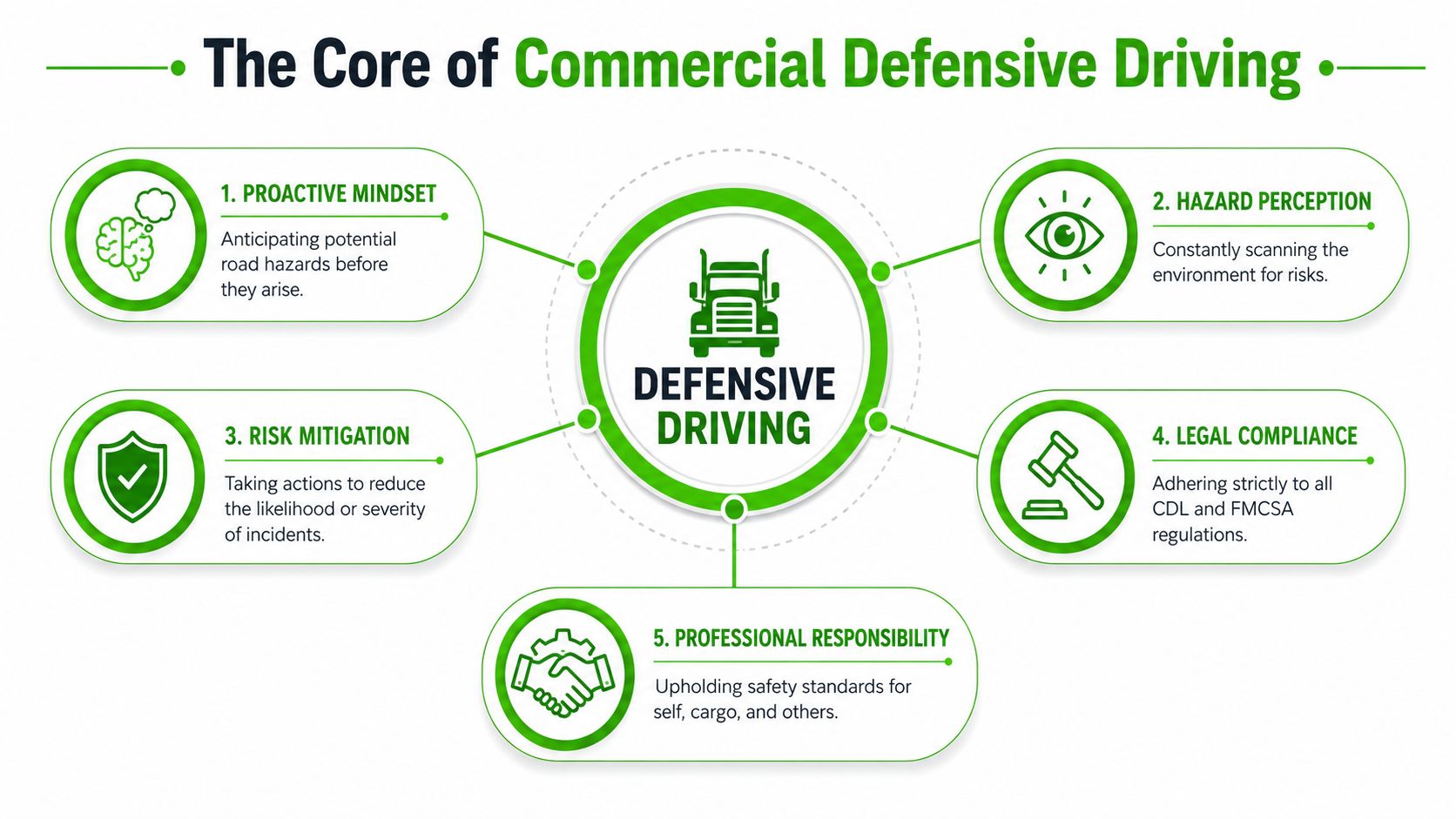
Five parts of real commercial defensive driving
Proactive thinking
The best drivers don't ask, “What is happening?” They ask, “What is likely to happen in the next few seconds?” A car drifting toward the lane line, a brake light wave ahead, or a driver accelerating up an on-ramp can all signal a conflict before it fully develops.
Hazard perception
Commercial drivers need a wider scan pattern than most motorists. You're watching farther ahead, checking mirrors regularly, and tracking movement beside the tractor and trailer. The point isn't to stare at everything. It's to notice the clues that matter.
Practical rule: If a situation surprises you, the scan probably started too late.
Risk mitigation
The concept of defensive driving often trips up many newer CDL holders. Defensive driving isn't just identifying danger. It's taking early action to lower the odds of a crash or reduce its severity. Sometimes that means slowing slightly. Sometimes it means changing lane position. Sometimes it means choosing patience over forcing a move.
Legal compliance
For a commercial driver, safe driving and legal compliance overlap heavily. Following-distance rules, braking practices, hours-of-service limits, inspection duties, and alcohol and drug restrictions aren't separate from safety. They are safety.
Professional responsibility
A CDL holder carries more than freight. They carry public trust, company exposure, and often the difference between a routine shift and a life-changing incident. That's why defensive driving for commercial drivers has to be treated as a professional standard, not an optional extra.
Navigating Georgia CDL and FMCSA Regulations
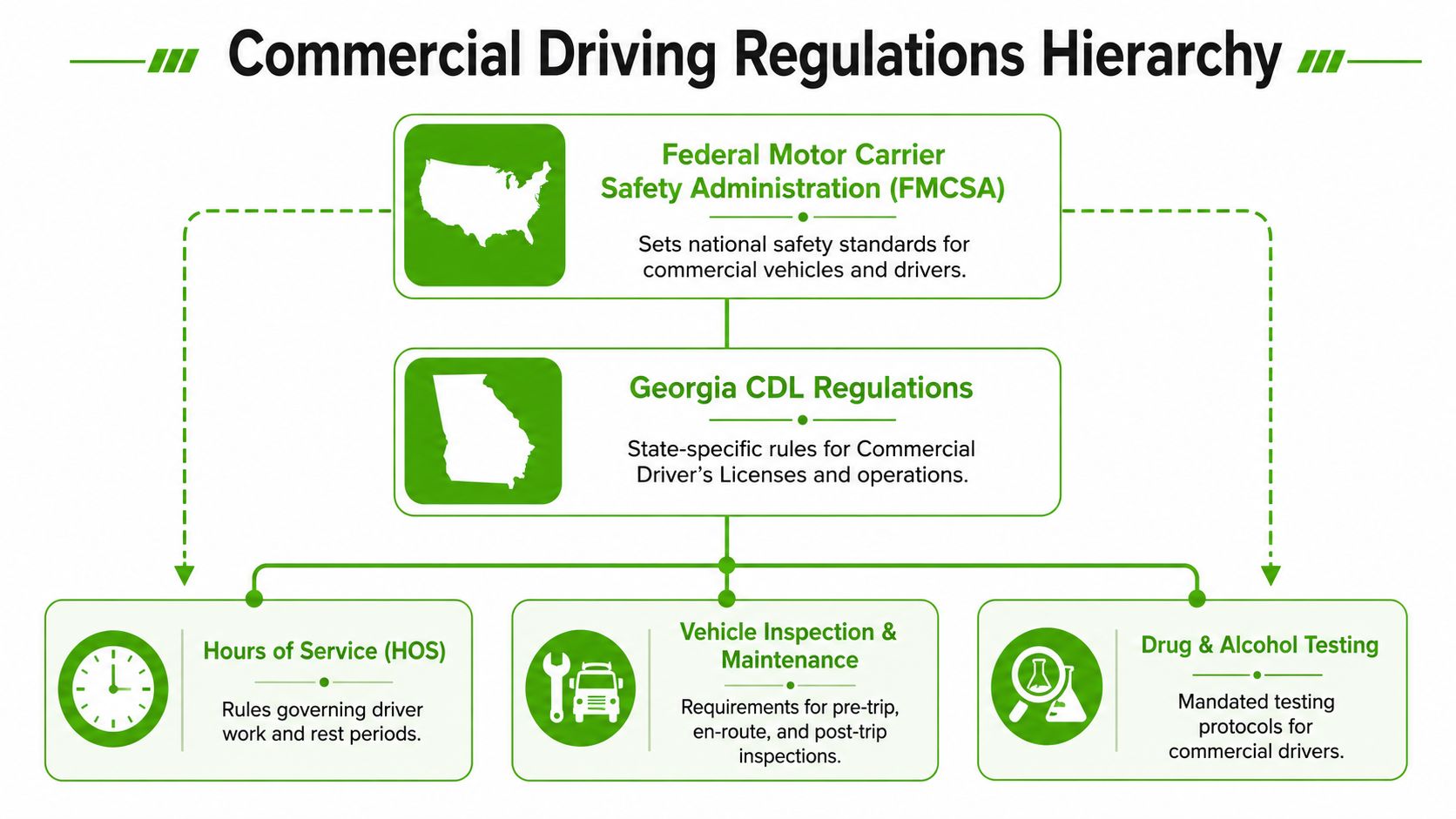
Commercial drivers in Georgia answer to more than one system at a time. That's where people get confused. Federal rules set the broad safety framework for commercial motor vehicles, while Georgia controls licensing, court processes, and DDS-approved course recognition inside the state.
Federal rules shape daily operation
The Federal Motor Carrier Safety Administration, or FMCSA, governs the operating rules commercial drivers follow on the road. That includes areas like hours of service, inspection practices, drug and alcohol testing, and safe vehicle operation.
Those federal standards matter in Georgia just as much as they do anywhere else. If a driver violates an operating rule on a Georgia roadway, the consequences can ripple beyond the ticket itself. The event can affect employment, company oversight, and the driver's standing as a CDL holder.
Georgia controls licensing and course acceptance
Georgia's Department of Driver Services, or DDS, is the state agency drivers and courts deal with on licensing matters. That matters for commercial drivers because a court-ordered class, a plea arrangement, or a reinstatement issue only helps if the program is one Georgia will recognize.
For local drivers, that means understanding the difference between a generic online class and a state-approved one. The same principle shows up in other parts of CDL training and compliance. Drivers looking at career-entry resources may also review truck driving school options in Atlanta to understand how state and federal expectations overlap in practice.
Why minor mistakes can become major CDL problems
A non-commercial driver might view a traffic citation as a nuisance. A CDL holder can't. Commercial driving creates a tighter connection between roadway behavior and professional consequences.
Here's the practical hierarchy:
| Level | Who governs it | Why it matters |
|---|---|---|
| Federal safety rules | FMCSA | Sets national operating standards for commercial drivers |
| State licensing rules | Georgia DDS | Controls Georgia CDL status, approved programs, and state compliance |
| Court requirements | Georgia courts | May impose defensive driving or related conditions in a case outcome |
| Employer policies | Fleet or carrier | Often add stricter internal expectations for safety and recordkeeping |
How defensive driving fits legal protection
A defensive driving course can matter in several different ways in Georgia. A court may require it. An attorney may use it to show a client is taking safety seriously. An employer may expect it after a preventable event or moving violation. A driver may also choose it proactively to strengthen their record and reduce future risk.
The safest legal position usually starts long before anyone steps into court.
This is the intersection many people miss. FMCSA rules tell a commercial driver how to operate safely. Georgia law determines how certain violations, reinstatement issues, and approved educational programs are handled. Drivers, employers, and legal professionals need both pieces at the same time.
Essential Defensive Driving Techniques for CMVs
For commercial motor vehicles, defensive driving becomes real in the choices a driver makes every minute. How much space you leave. When you back off. How you approach rain, curves, grades, and impatient motorists. Safe driving in a CMV isn't one big skill. It's a chain of small, correct decisions.
Following distance is a non-negotiable tool
The FMCSA rule is specific. According to commercial following-distance guidance summarizing FMCSA standards, commercial drivers must maintain at least one second of following distance for every 10 feet of vehicle length, plus an additional second if traveling over 40 mph. For a standard tractor-trailer at highway speeds, that means an 8 to 9-second gap.
Many drivers understand the rule but still apply it too loosely in traffic. The purpose isn't just avoiding a rear-end collision. That space gives you time to identify brake lights, lane blockages, sudden merges, and debris while keeping braking smooth enough to maintain control and protect cargo.
If weather turns bad, the same guidance says drivers should increase that margin and reduce speed. In Georgia, that matters during sudden heavy rain on I-16, standing water on metro Atlanta interstates, and early morning fog in rural corridors.
Blind spots and lane discipline
A CMV has large no-zones. Defensive drivers manage them actively instead of hoping other motorists will behave well.
Use these habits consistently:
- Track problem vehicles early by identifying cars that settle beside the trailer or hover near the tractor.
- Signal with time so smaller vehicles have a clear warning before you move.
- Avoid being boxed in when possible. A commercial driver should prefer lane positions that preserve an out.
- Delay a lane change if a four-wheeler is acting unpredictably. Being right doesn't prevent contact.
If you lose sight of a vehicle near your rig, assume the risk has increased, not decreased.
Weather and traction on Georgia roads
Defensive driving for commercial drivers in Georgia has to account for fast weather swings. Dry pavement can become slick in minutes. The first moments of rain are often the most deceptive because drivers around you may keep moving as if conditions haven't changed.
In poor traction, the safer sequence is simple:
- Ease off speed early.
- Increase your following gap.
- Brake smoothly and in a straight line when possible.
- Keep steering inputs calm and deliberate.
For drivers who want a practical review of braking habits that support safer stopping, this overview of commercial braking and defensive driving is a useful reference.
Steep grades require discipline, not confidence
North Georgia brings another challenge. A driver descending a grade near Dalton, Ellijay, or other hilly routes can't wait until speed starts running away.
According to AIG's commercial motor vehicle defensive driving guidance, a driver should select a gear for downhill deceleration that is no higher than the gear required to ascend the same grade. If speed can't be controlled with light brake pressure of about 10 psi, the driver should downshift immediately. The same guidance warns against using only trailer brakes because that can overheat the system and reduce stopping capability.
That's not just technique. It's physics. Sustained braking builds heat. Heat reduces brake effectiveness. Once a driver is managing brake fade instead of preventing it, the margin is already shrinking.
The practical standard
A safe CMV driver doesn't measure success by making up lost time. They measure it by keeping the truck stable, visible, predictable, and far enough ahead of the problem that sharp corrections aren't needed. That's the daily working form of defensive driving for commercial drivers.
Managing Modern Distractions and Driver Fatigue
A lot of safety talk still treats distraction as if it begins and ends with texting. That's too narrow for modern commercial driving. Today's CDL holder often works with an ELD, dispatch messages, navigation prompts, and delivery updates while also managing traffic, weather, and timing pressure.
That split attention creates a different kind of risk. According to federal transportation material on fatigue and digital task load, 34% of commercial driver fatigue incidents involve ELD compliance stress, and switching between driving and digital compliance tasks causes 22% more lane drift than physical fatigue alone.
Why this catches good drivers off guard
A driver may feel alert and still be overloaded. That's the trap. The body isn't sleepy, but the mind keeps switching tasks. Each switch takes attention away from lane control, speed management, and hazard recognition.
The fix isn't pretending digital tools don't exist. The fix is controlling when and how you interact with them.
- Set inputs before rolling so route and dispatch details are handled while parked
- Use pull-off points for non-urgent updates instead of trying to “just tap one thing”
- Standardize in-cab routines so ELD and messaging checks happen at predictable, safer moments
- Speak up early if dispatch practices create attention conflicts during active driving
Drivers who need a clearer framework for scheduling and fatigue prevention should review understanding commercial driving limits, which helps connect hours-of-service rules to real-world decision making.
Defensive habits for digital pressure
The safest drivers treat cognitive load like any other hazard. They reduce it before it starts stacking. That may mean planning fuel stops better, organizing paperwork before departure, or refusing to handle avoidable in-cab tasks while moving through dense areas like Atlanta interchanges.
For a broader look at everyday distraction control behind the wheel, these distracted driving prevention tips align well with commercial safety habits.
A distracted commercial driver doesn't always look reckless. Often, they look busy.
The Business Case for Defensive Driving
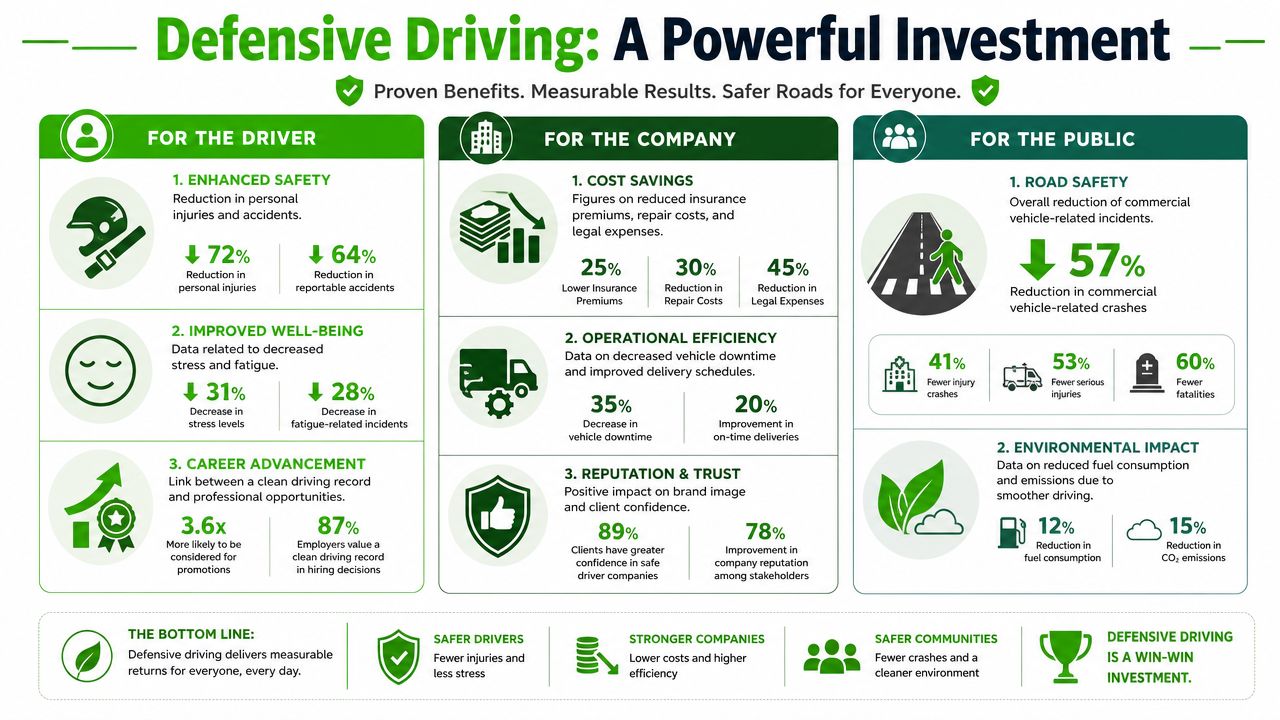
For fleets, drivers, and attorneys, defensive driving is more than a safety slogan. It's one of the few risk controls that affects daily behavior where losses begin, on the road, in traffic, under pressure.
For the driver
A driver with strong defensive habits usually experiences a calmer workday. They're not forcing moves, recovering from late decisions, or living on the edge of hard braking events. That matters for stress, confidence, and long-term employability.
It also matters when something does go wrong. An attorney or employer reviewing a driver's history will look differently at someone who has taken proactive safety steps than at someone who waited until after repeated issues.
For the employer
A fleet manager doesn't need a spreadsheet to know what a preventable incident does. Trucks go out of service. schedules break down. Supervisors spend hours on documentation. Claims exposure rises. Customer relationships can suffer if a load is delayed or a crash becomes public.
Defensive driving improves the behaviors that sit underneath those business problems:
| Stakeholder | Operational benefit | Why it matters |
|---|---|---|
| Driver | Cleaner record and steadier decision-making | Supports retention and day-to-day safety |
| Carrier | Fewer preventable incidents and less downtime | Protects operations and service reliability |
| Legal team | Better mitigation posture | Shows a documented safety commitment |
| Public | More predictable CMV behavior | Reduces roadway conflict around large vehicles |
For agencies and fleet professionals evaluating recurring loss patterns, this guidance for independent agencies on auto claims offers helpful context on how avoidable driving behaviors translate into claims.
For attorneys and compliance professionals
Defensive driving can also support legal and compliance strategy. In the right setting, course completion helps show that a driver understands the seriousness of the issue and has taken corrective action. It won't erase every problem, but it can strengthen a narrative of responsibility.
Courts and employers often respond better to documented corrective action than to excuses.
That's why defensive driving for commercial drivers belongs in safety planning, case mitigation, and post-violation response. It supports the people behind the wheel, the organizations employing them, and the professionals trying to limit the damage after a mistake.
Find Your Georgia-Approved Defensive Driving Course
A commercial driver in Georgia needs the right course for the right purpose. That's where many people waste time. A class that sounds similar online may not meet a court requirement, satisfy DDS expectations, or help with a formal compliance issue.
Match the course to the reason you need it
Commercial drivers usually look for one of three formats in Georgia:
- Self-paced online courses for convenience when an approved online option fits the requirement
- Live virtual classes for drivers who want scheduled instruction without traveling
- In-person classroom courses for court, employer, or personal preference situations where face-to-face learning makes the most sense
The key is approval, not convenience alone.
According to the Georgia DDS DUI FAQ, for license reinstatement or official court purposes in Georgia, certificates from generic online driving courses are explicitly not accepted by the DDS; drivers must complete a state-approved Risk Reduction or Defensive Driving program from a certified provider.
Why CDL holders should verify first
This point matters even more if your case touches DUI-related obligations, reinstatement, or a court order. A general defensive driving class and a Georgia Risk Reduction course are not interchangeable. If your situation involves DUI law, habitual offender consequences, clinical evaluations, victim impact panels, or ASAM-related treatment steps, make sure each requirement is handled through the proper approved channel.
Georgia also has separate DUI course rules that are very specific. For example, the state-approved Risk Reduction program has a mandatory intervention structure, and DDS does not accept online DUI course certificates for reinstatement purposes under the DDS guidance linked above. That distinction trips up a lot of people who assume any completion certificate will work.
A simple selection checklist
Before enrolling, confirm these points:
- Court purpose and whether the judge or probation terms specify a certain type of program
- DDS acceptance if your license status or reinstatement is involved
- Employer expectations if a fleet or carrier is requiring the class
- Format fit based on your schedule, location, and whether online, virtual, or classroom attendance is acceptable
A state-approved course saves time because the certificate is more likely to match what the court, DDS, or employer is asking for.
If you need a compliant next step in Georgia, Georgia DUI Schools offers DDS-approved defensive driving options in self-paced online, live virtual, and in-person formats, along with Risk Reduction courses and related services for drivers handling court, license, or reinstatement requirements.