
A lot of Savannah drivers start looking for a defensive driving class on a bad day. Maybe it was a speeding stop on Abercorn Street. Maybe your insurance renewal showed up higher than expected. Maybe a court clerk told you that a course could help, but nobody explained which course, which format, or what counts in Georgia.
That confusion is common. In Georgia, what is commonly referred to as defensive driving is officially the Driver Improvement course. Regarding defensive driving classes in Savannah GA, the primary issue usually isn't whether a class exists. It's whether the class fits your reason for taking it, whether the provider is properly approved, and whether you should choose an in-person seat, a live virtual class, or a more flexible online option.
Savannah drivers also deal with local conditions that make practical instruction matter. Historic downtown traffic, tourist congestion, one-way streets, roundabouts, and quick lane decisions near major corridors all punish inattention fast. If you're trying to fix a ticket problem, reduce points, or show your insurer you've completed a recognized course, you need a straightforward answer, not legal jargon.
Your Guide to Defensive Driving in Savannah
If you got a citation in Savannah, don't guess your next step. First, figure out why you're being asked to take the course. That one detail changes everything.
Start with your actual requirement
Some drivers are trying to satisfy a court instruction. Others want help with insurance. Others want a safer driving reset after a close call near Victory Drive, DeRenne Avenue, or downtown where traffic patterns can get tight and unpredictable.
Georgia treats this course as a formal state program, not a casual seminar. The DDS calls it a Driver Improvement course and describes it as a statewide option drivers use for official and practical reasons. If you want a local overview of available school types, Savannah driving school options can help you sort through what's offered in the area.
Why Savannah drivers should care about format
In practice, many Savannah-area students ask one question first. "Can I do this from home?" Sometimes yes. Sometimes that works perfectly. Sometimes it doesn't fit the requirement you've been given.
The right course choice depends on three things:
- Your purpose. Court, points, insurance, reinstatement, or personal education each create different questions.
- Your learning style. Some people do better when they can ask an instructor direct questions.
- Your schedule. Shift work, military schedules, port logistics jobs, and family obligations often make format the deciding factor.
Practical rule: Before you register, match the course format to the reason you're taking it. Convenience matters, but compliance matters more.
If you manage drivers for work, the same logic applies at the fleet level. For broader policy and training context, this essential reading for fleet managers offers useful perspective on how defensive driving instruction supports safer operating habits.
Top Reasons to Complete a Driving Course
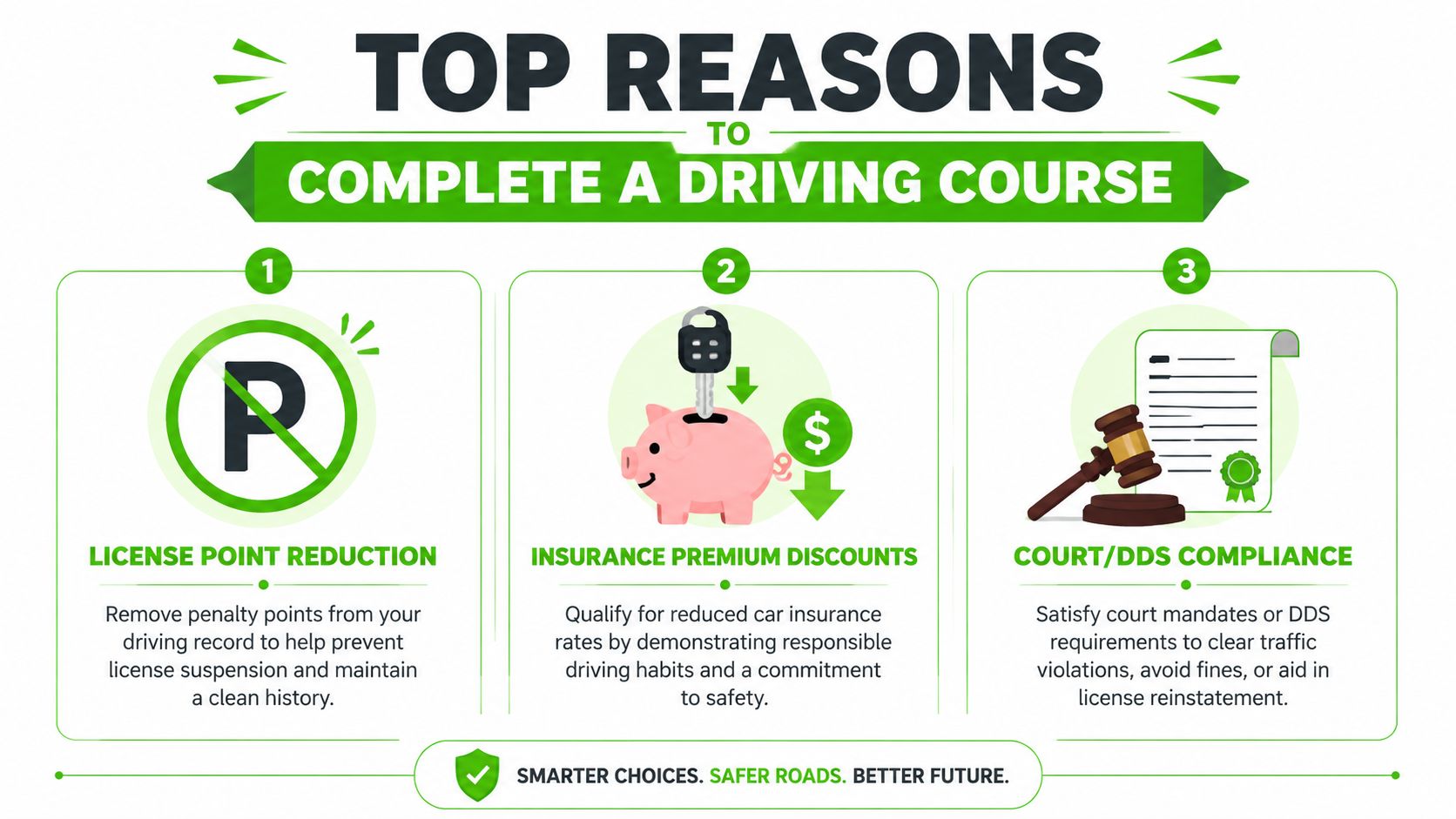
Motorists don't sign up for a course because they're excited about classroom time. They sign up because they want a real result. In Savannah, that usually means protecting a license, dealing with a court matter, or improving the insurance picture.
Georgia gives this course real legal weight. The DDS says a defensive driving class is formally a Driver Improvement course, that it is a 6-hour program, that licensed residents may request a reduction of up to 7 points on a Georgia license once every 5 years, and that clinics must charge $95 when the class is taken for license reinstatement, points reduction, or court purposes, according to the Georgia DDS Defensive Driving Program FAQs.
Point reduction can matter fast
If you already have points on your Georgia record, this is the part that gets attention. A completed course may support a request to reduce points, but the state limits how often you can use it for that purpose.
That matters for drivers who are tempted to use the course too casually. If you have a more serious record concern, don't burn that option without understanding the timing.
Don't treat point reduction like an everyday fix. Use it deliberately, because the state doesn't let you repeat that benefit whenever you want.
Insurance value depends on the carrier
Insurance savings are one of the biggest reasons drivers ask about defensive driving classes in Savannah GA. The important part is this: ask your insurer what they require before you enroll, then keep your completion certificate.
Some carriers want proof that the course is state approved. Some want the certificate submitted a certain way. If you advise clients or households that move between states, this overview of advising clients on TN auto coverage is a useful comparison point for how insurance compliance questions change by state.
For a Georgia-specific look at why many drivers use this course to try to improve premium costs, see defensive driving benefits for insurance and driving records.
Courts often care about proof, not intent
If a Savannah or Chatham County driver tells me, "I meant to take the course," my response is always the same. Intent doesn't satisfy a court. The certificate does.
Courts usually want a completed course from the right type of provider, finished by the right deadline, with your information matching your case paperwork. That means details matter:
- Use the correct name. Register under the same legal name used on your license or court document.
- Check the purpose first. A course for personal education isn't the same thing as a course taken to satisfy an official requirement.
- Keep your certificate handy. Save the final document where you can find it when the court, lawyer, or insurer asks for it.
What to Expect in a 6-Hour Georgia Driving Course

A good Georgia driving course isn't just a traffic law recap. It focuses on how drivers think, react, space their vehicles, and make decisions under pressure. That's why students who come in expecting a simple ticket class are often surprised by how practical the material is.
For Savannah-area training, course descriptions emphasize a live 6-hour format and focus on safe driving attitudes and behaviors, along with hazard-specific skills such as following distance, distraction management, alcohol and medication impairment effects, right-of-way, and roundabout handling, as described by Drive Smart Georgia's Savannah defensive driving page.
The course is built around real driving mistakes
Most citations don't happen because a driver forgot a vocabulary term from the manual. They happen because the driver was late, distracted, tailgating, overconfident, or rushed through a decision.
That's why the strongest parts of the curriculum tend to be behavioral. Students work through the habits that lead to preventable trouble.
- Following distance. This is one of the first things drivers let slide in city traffic.
- Distraction control. Phones are obvious, but mental distraction and multitasking are just as dangerous.
- Right-of-way choices. Savannah's downtown flow can punish hesitation just as much as aggression.
- Roundabout handling. If a driver is unsure here, the class usually clears it up fast.
Local examples make the material stick
Savannah has a mix of street types that force quick judgment. Downtown squares demand patience and awareness of pedestrians. Busier arterial roads reward lane discipline and steady spacing. Areas with visitors often create abrupt braking and uncertain turns.
The drivers who get the most out of this course usually aren't the ones memorizing rules. They're the ones recognizing their own patterns and correcting them.
That shift matters more than people think. When a student leaves understanding why they keep ending up too close, too distracted, or too hurried, the course has done its job.
Comparing Course Formats for Savannah Drivers
When Savannah drivers ask which format is best, the honest answer is that no single format wins for everyone. The right choice depends on deadline pressure, comfort with technology, and whether you need direct instructor interaction.
Some drivers want a classroom because it keeps them focused. Others need to log in from home after work. Others prefer the least disruptive option possible. The trade-off is usually between structure and flexibility.
Side by side format comparison
| Format | Best For | Schedule | Interaction |
|---|---|---|---|
| In-person classroom | Drivers who want face-to-face instruction and fewer tech issues | Fixed class times at a physical location | Direct interaction with instructor and classmates |
| Live virtual class | Drivers who want instructor-led teaching without traveling across Savannah | Scheduled sessions attended from home or work | Real-time interaction through a virtual platform |
| Self-paced online course | Drivers with irregular schedules who need maximum flexibility | Completed on your own time within provider rules | Limited live interaction, more independent learning |
In-person classroom
A traditional classroom works well for students who don't want to troubleshoot devices, webcams, logins, or unstable internet. It also helps drivers who learn better when they can stop an instructor and ask, "Does this count for my court?" or "What's the next step after I finish?"
The downside is obvious. You have to travel, arrive on time, and carve out the day around the class. For some Savannah drivers, especially those commuting from surrounding areas or juggling childcare, that's the hardest part.
Live virtual classes
Live virtual classes are often the practical middle ground. You get real-time instruction without crossing town, dealing with parking, or losing extra time to travel.
This format works especially well for adults who can stay attentive at home and who want a scheduled class to keep them accountable. A provider such as Georgia DUI Schools offers live virtual defensive driving instruction as one format option for Georgia drivers who need instructor-led access without attending a physical classroom.
If you want instructor guidance but don't want to sit in traffic to get it, live virtual is usually the cleanest compromise.
Self-paced online courses
Self-paced online options appeal to busy people for obvious reasons. If your work hours change week to week, this format can be much easier to finish.
But flexibility cuts both ways. Students who procrastinate often stall out. Drivers who have a court date coming up sometimes assume "online" means "instant," then realize too late that they still needed to verify whether their specific requirement accepted that format.
A simple way to choose is to ask yourself these questions:
- Do I need live instruction for confidence or compliance?
- Am I likely to delay the course if nobody is expecting me at a set time?
- Will travel across Savannah make this harder than it needs to be?
- Did the court, DDS, or insurer say anything specific about the format?
If you're honest with those answers, your best format usually becomes obvious.
Finding a DDS-Approved Course and Getting Started
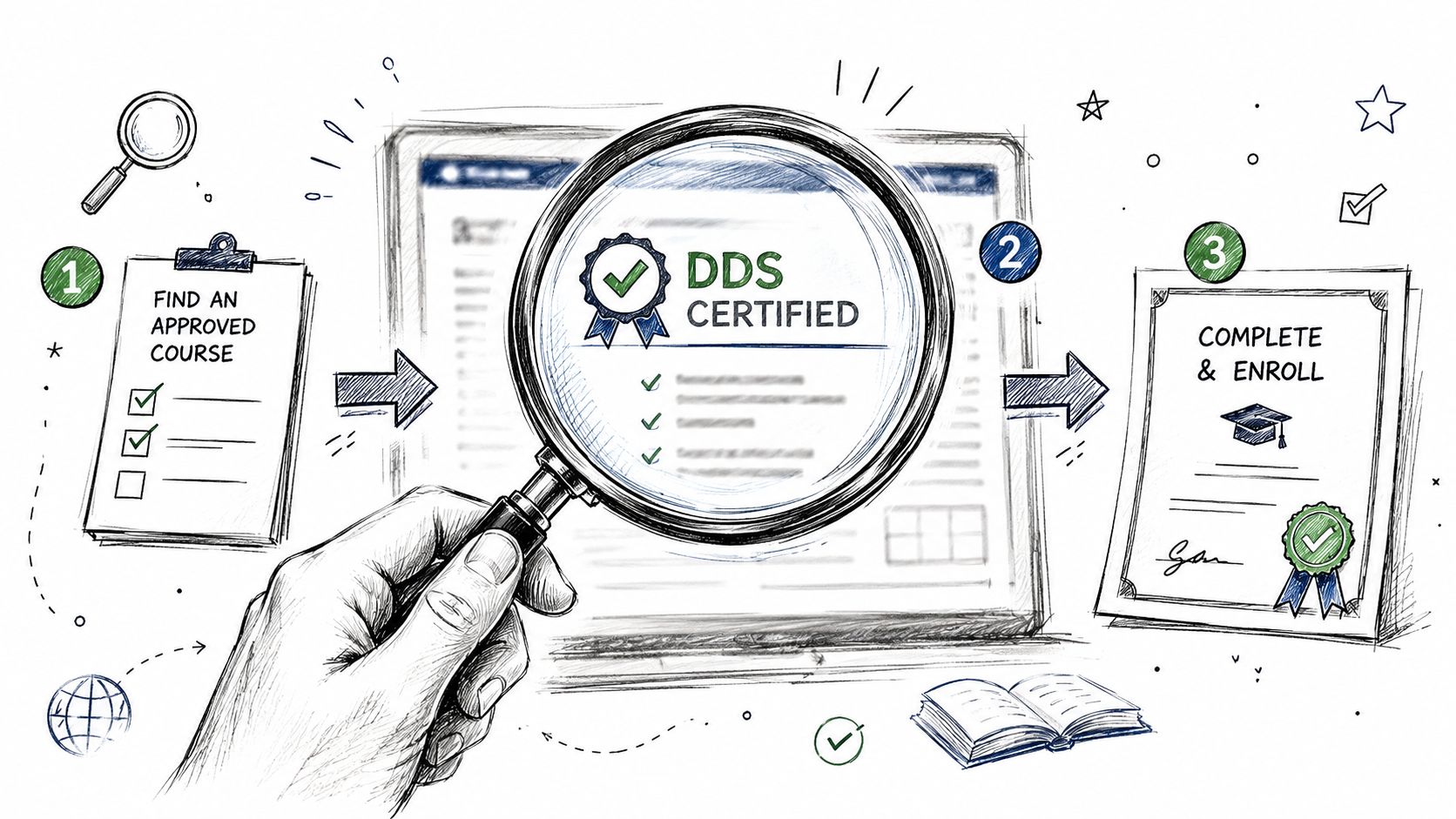
The most common mistake drivers make is choosing a course based on convenience first and certification second. That's backwards.
The Georgia DDS says the Driver Improvement Program is a 6-hour DDS-approved course used for court orders, points reduction, license reinstatement, insurance premium reduction, or personal education, and that only DDS-certified schools are accepted for licensing, reinstatement, and court requirements, according to the Georgia DDS Driver Improvement Program page.
Step one is always verification
Before you pay anything, confirm that the school is DDS-certified for the purpose you need. That is the single biggest compliance issue.
If you're taking the class for insurance only, you still want a recognized provider because insurers often ask what type of course you completed. If you're taking it for court, reinstatement, or point-related reasons, certification isn't optional.
A simple enrollment checklist
Use this sequence and you'll avoid most problems:
- Identify your reason. Court order, insurance, points, reinstatement, or personal education.
- Confirm provider approval. Don't rely on vague marketing language. Verify DDS certification.
- Gather your documents. Usually that means your driver's license and any court paperwork you were given.
- Register using accurate information. Your name should match your official records.
- Complete the course fully. Partial attendance or missed requirements can create problems.
- Save your certificate immediately. Store a digital copy and a printed copy if possible.
For drivers who are mainly focused on premium relief, this guide to a defensive driving course for lower insurance gives a practical starting point.
What works and what doesn't
What works is boring but effective. Verify first. Register carefully. Finish on time. Submit proof exactly where it's needed.
What doesn't work is assuming that all online classes are treated the same, assuming any completion email is enough, or assuming a court clerk or insurance rep will fix a mismatch after the fact.
A compliant course is the one that satisfies your exact requirement, from a certified provider, with a valid completion record. Everything else is just wasted time.
Savannah Defensive Driving FAQs
How do I submit my completion certificate
That depends on who required the course. If a court required it, follow the court's instructions and deadline exactly. If your insurer asked for it, contact the company or your agent and ask how they want the certificate delivered. Some accept digital submission. Others may want you to upload it through a customer portal or send it to an agent.
Keep a copy for yourself no matter what. Don't assume the other side will store it in a way that's easy to retrieve later.
Is a defensive driving class the same as a DUI or Risk Reduction course
No. These are different programs with different purposes.
A defensive driving or Driver Improvement course is generally about safer driving behavior, point reduction, insurance issues, court traffic matters, or personal education. A DUI Risk Reduction course is a separate state-regulated program tied to alcohol or drug-related driving matters and often involves different requirements. If your paperwork says Risk Reduction, don't enroll in defensive driving and expect it to substitute.
I have an out-of-state license and got a ticket in Savannah
That can complicate things. The first question is whether the Savannah-area court handling your case will accept the course for your specific matter. The second question is how your home state treats any record or completion issue tied to the citation.
The safest move is to confirm both sides before you enroll. Check with the court named on your citation and, if necessary, your home licensing agency or your attorney.
How quickly are points removed after I finish
There's no smart reason to promise a timeline unless the agency handling your record gives you one directly. Processing depends on when the completion is reported, how the request is handled, and how DDS updates the record.
If timing matters for a suspension concern, don't wait until the last minute to take the course. Finish early, keep proof of completion, and follow up if the record doesn't update when expected.
Do Savannah drivers have to choose in-person classes
Not always. Some drivers prefer classroom instruction because they focus better in person. Others do better with a live virtual course or a self-paced option because of work or family demands.
The better question isn't "Which format is easiest?" It's "Which format will satisfy my requirement and get finished?" That's the format to choose.
What if I only want the course for personal improvement
That's a valid reason. Some drivers take the course after a near miss, after adding a teen driver to the household, or after realizing their habits have gotten sloppy in heavy city traffic. Savannah's mix of tourist traffic, narrow streets, and quick stops makes a refresher worthwhile even when no court or insurer is involved.
If you need a compliant next step, Georgia DUI Schools offers a course path for Georgia drivers dealing with defensive driving requirements. Start with the option that matches your reason for taking the class, then complete it before your deadline turns a manageable issue into a bigger one.