
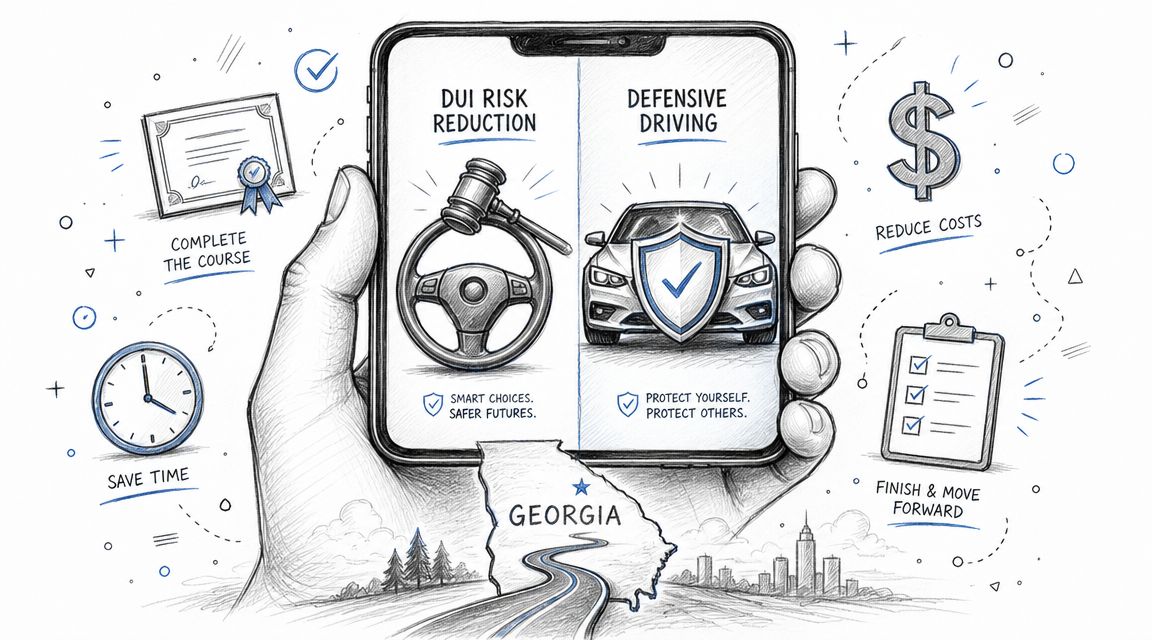
You got a ticket, a court notice, or a letter connected to your license, and somewhere in the paperwork it says you need a driving course. Then you search for a GA online driving course and get a confusing mix of DUI classes, defensive driving, driver improvement, and teen driver education.
That confusion is normal. In Georgia, those are not the same thing, and signing up for the wrong course can waste time and leave you still out of compliance.
The safest approach is simple. Match the course to the reason you were told to take it. A DUI-related case usually points toward a different path than a speeding ticket, point reduction request, or insurance discount. Some drivers also have a separate clinical requirement that goes beyond the course itself.
Which GA Online Driving Course Do You Really Need?
Georgia separates driver programs into distinct categories. The Department of Driver Services lists Driver Education Programs, the Driver Improvement Program, and the DUI Alcohol or Drug Use Risk Reduction Program separately, which is why one search phrase can lead people to the wrong answer if they aren't careful. You can see that separation on the Georgia DDS driver education programs page.
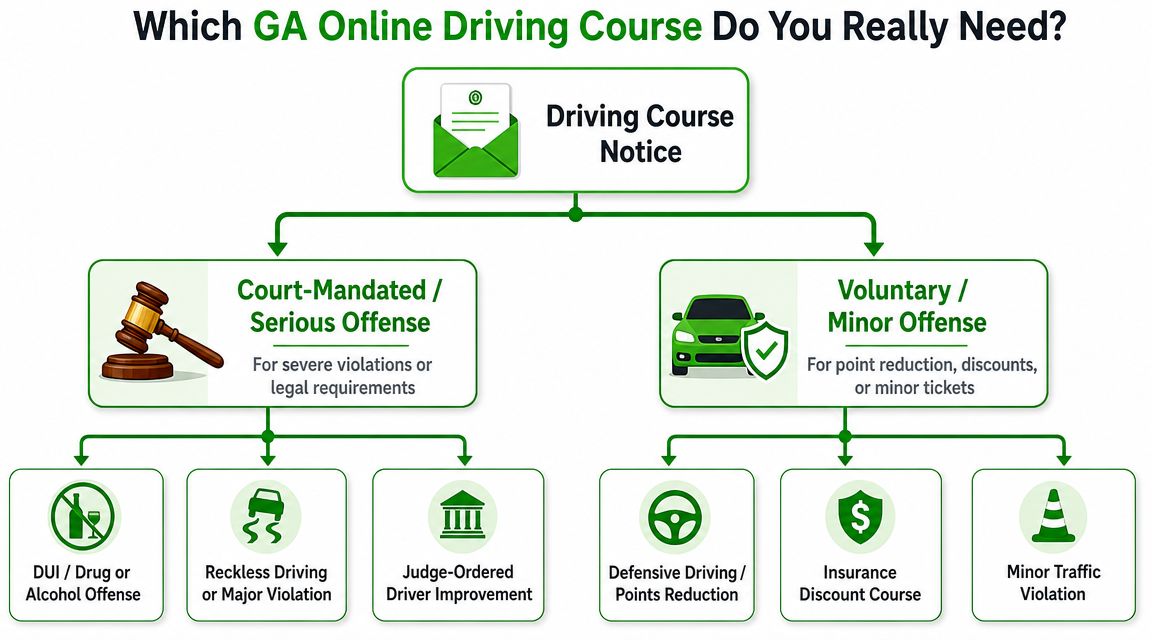
The three course paths people mix up
Here's where most stress starts. People use the words “online driving course” as if Georgia has one catch-all class. It doesn't.
- DUI or drug-related case: This usually means the Risk Reduction Program, sometimes called DUI school.
- Ticket, points, insurance, or minor court order: This usually means Defensive Driving, also called the Driver Improvement Program.
- Teen licensing requirement: This is driver education under Joshua's Law, which is a separate training track and not a substitute for DUI or defensive driving.
If you're trying to sort out the teen licensing side of the system, this guide to Georgia online driver's ed options can help you separate that from the court-related programs discussed here.
A fast way to identify your course
Look at the language on your paperwork.
| If your notice mentions | You likely need |
|---|---|
| DUI, drug offense, Risk Reduction, DUI school | Risk Reduction Program |
| points, driver improvement, insurance discount, traffic ticket | Defensive Driving |
| under 18 license requirement, Joshua's Law, driver education | Driver Education |
If your court order, probation terms, or DDS notice names a specific program, follow that wording exactly. Don't substitute a similar-sounding course.
A lot of drivers in Atlanta, Athens, Marietta, Roswell, and surrounding communities run into this after searching late at night and clicking the first result that says “Georgia driving course.” The course title matters. Approval status matters. The legal purpose matters.
The DUI and Risk Reduction Program Explained
A Risk Reduction Program is not the course people take for a basic speeding ticket. It is tied to more serious situations, including DUI-related matters and some drug-related cases.

The purpose of the Risk Reduction Program is corrective and educational. It is meant to address impaired-driving and substance-related decision-making, not just review basic traffic rules.
Who usually needs it
You should pay close attention to this course if your paperwork involves:
- A DUI-related offense
- A drug possession or drug-related charge
- A court instruction that specifically says Risk Reduction
- A license reinstatement step tied to a DUI-type case
If you're also dealing with the legal side of a new charge, it can help to review what attorneys discuss about experienced DUI defense representation so you can separate the court case from the education and compliance requirements.
What people often misunderstand
Many drivers assume any Georgia course can be completed fully online in the same way. That isn't how Georgia structures all driver programs. State rules for virtual driver training define a Department-approved web-based course as requiring at least 30 hours of online instruction plus a separate 6 hours of actual driving that can't be replaced by simulator time, as shown in the Georgia rules for virtual driver training courses. That rule belongs to the driver education framework, but it illustrates a larger point that matters here: Georgia treats course types differently, and each one has its own approval rules and delivery rules.
That's why a generic “online driving class” search result can be misleading in a DUI-related situation.
What to do if your order says Risk Reduction
Start by reading the order or reinstatement notice word for word. If it says Risk Reduction, enroll in that program, not defensive driving. If it also mentions evaluation, treatment, or additional conditions, don't assume the class alone finishes everything.
A plain-English overview of the process is available in this explanation of what the Risk Reduction course is.
One practical example
A driver in DeKalb County might receive a court instruction related to a DUI case and search for an online class from home. If the order says Risk Reduction, a defensive driving certificate won't solve the problem. The names sound similar to a stressed reader, but the state does not treat them as interchangeable.
Defensive Driving for Points and Insurance Discounts
If your situation involves a traffic ticket, license points, a request from a judge in a less severe traffic case, or a possible insurance discount, you're usually looking at Defensive Driving, which Georgia also calls the Driver Improvement Program.
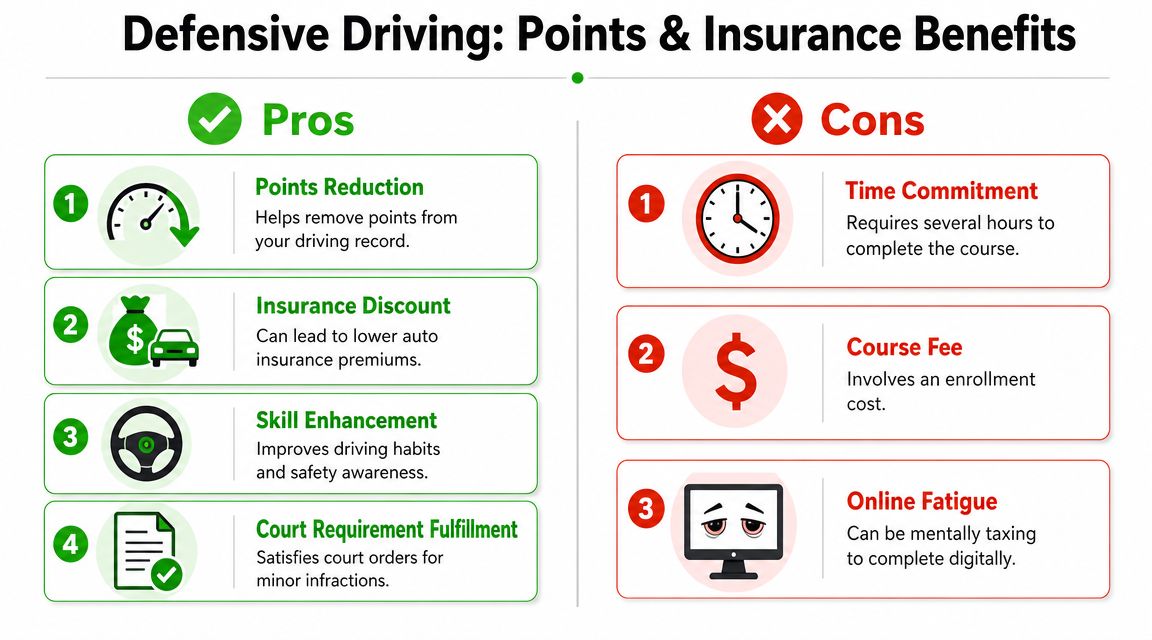
What this course can do
Georgia defensive driving rules make this program useful because one completed course may help in several ways at once. According to published Georgia course information, it may remove up to 7 points from a Georgia license, may qualify a driver for a 10% to 15% insurance discount in some cases, can be used only once every 5 years for point reduction, and the listed class fee is $95. That same information also notes it can help with ticket-related court requirements and license reinstatement. You can review those details on this page about the online Georgia defensive driving course.
When defensive driving fits
- You want point reduction: This is one of the most common reasons drivers in Georgia enroll.
- You need to satisfy a court requirement for a traffic matter: Some courts accept this course for qualifying minor offenses.
- You want to ask your insurer about a discount: The course can support that conversation, though your carrier decides what it offers.
- You need a refresher after a rough stretch of tickets: Many people take it voluntarily.
If your goal is saving on premiums, it also helps to compare your policy structure with a Georgia-focused insurer resource like TCDS Insurance Agency before or after you submit your certificate.
What this course is not
It's not DUI school. It's not a teen Joshua's Law class. It's not a clinical evaluation. Those are separate requirements.
Practical rule: If your paperwork says “driver improvement” or “defensive driving,” use that exact program name when you register.
A lot of drivers in Fulton, Gwinnett, and Cobb counties make the same mistake. They know they need “some kind of class,” but they don't confirm whether the court wants defensive driving or whether DDS requires something else.
If you're specifically taking this course to help with premium costs, this page on a defensive driving course to lower insurance gives a more direct explanation of how people usually use the certificate.
Navigating Clinical Evaluations and ASAM Treatment
Some drivers finish the required class and then learn they still have another step. That extra step is often a clinical evaluation.
A clinical evaluation is a separate assessment. It isn't the same as a Risk Reduction class or a defensive driving course. The purpose is to determine whether substance use treatment or additional services are recommended or required in your case.
When this comes up
This usually appears in more serious or more complicated situations. A court, probation officer, attorney, or state authority may tell you to obtain an evaluation before your case can move forward or before all compliance items are considered complete.
The most important thing to understand is that a course certificate and a clinical document do different jobs. One proves class completion. The other addresses assessment and, when required, treatment planning.
Why approval status matters
Georgia is strict about provider status in regulated driving programs. For the DDS-approved Driver Improvement Program, the required benchmark is a 6-hour course used for court compliance, point reduction, license reinstatement, and insurance discounts, but DDS states that only certificates issued by a DDS-certified driving school are accepted for licensing or reinstatement purposes. Uncertified courses aren't accepted. That approval principle is laid out on the Georgia DDS Driver Improvement Program page.
That same compliance mindset matters when you're dealing with clinical services. In other words, close enough isn't good enough.
What ASAM treatment means in plain English
If an evaluation recommends ASAM treatment, that usually means a structured level of care based on an established assessment framework. For most readers, the important part is practical: follow the recommendation exactly as written and make sure the provider and paperwork match what the court, probation officer, or DDS expects.
Some people, especially professionals worried about privacy and scheduling, look into more individualized care models such as luxury rehab for DUI professionals when treatment needs go beyond a basic education requirement.
Questions to ask before you schedule anything
- Who ordered the evaluation
- What document do they need back
- Whether treatment is already required or only possible
- Where the final paperwork must be sent
- Whether the provider meets Georgia requirements for your case
That short checklist prevents a lot of delays.
Your Step-by-Step Enrollment and Completion Guide
Once you know which course applies, the process gets easier. Most problems happen before enrollment, not during it.
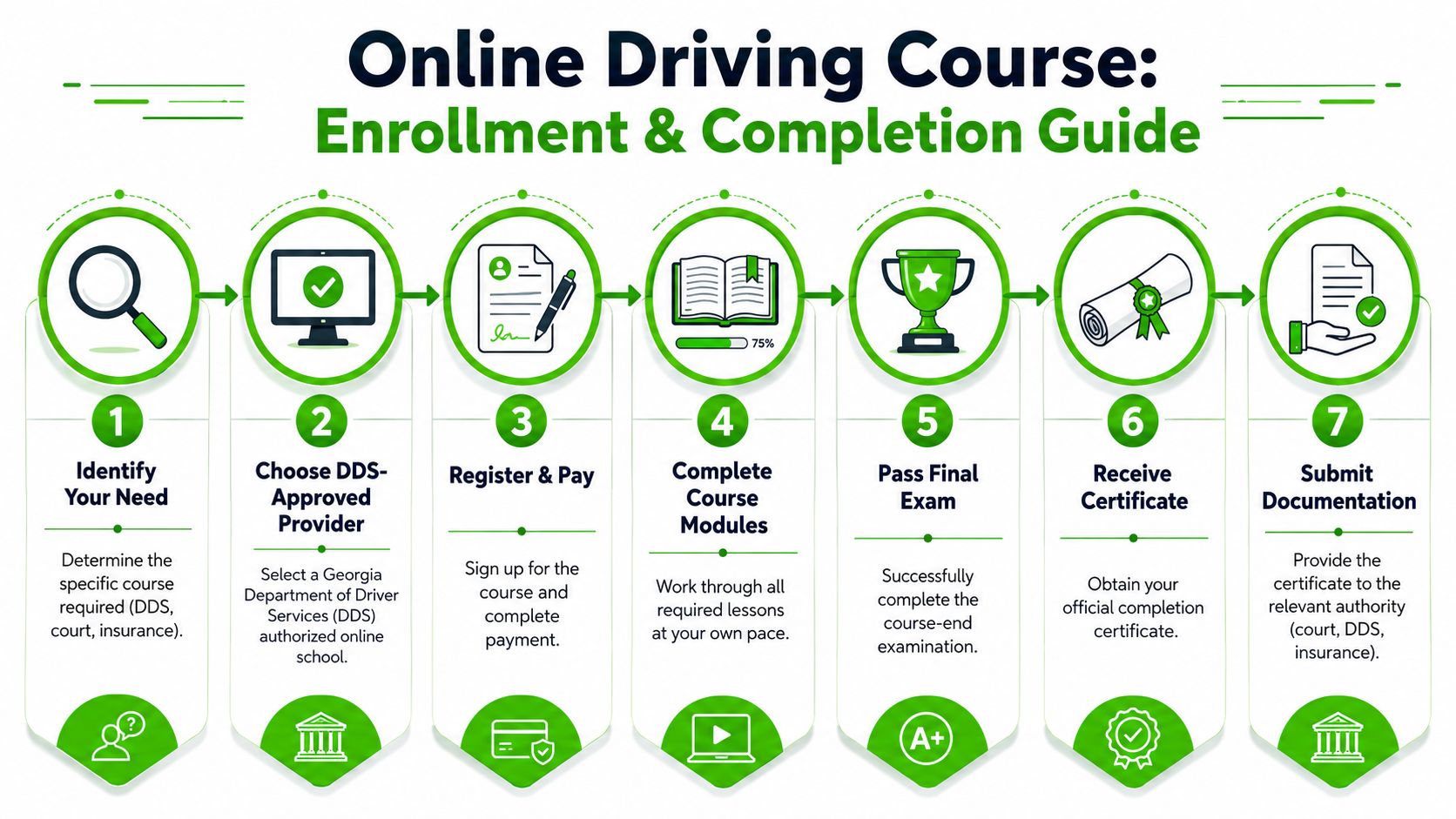
Follow the course name on your paperwork
If your notice says Risk Reduction, register for Risk Reduction. If it says defensive driving or driver improvement, choose that. If it refers to a teen licensing requirement, that is driver education, not a substitute for the other two.
Write the exact wording down before you start comparing providers.
Choose a DDS-approved provider
Drivers should proceed with caution. A polished website doesn't mean the certificate will be accepted.
One provider option is Georgia DUI Schools, which offers Georgia-regulated course options and related services in both online and in-person formats. Whatever school you choose, confirm that the course approval matches your requirement.
What to have ready
A short prep list helps:
- Your court paperwork or DDS notice
- Your driver's license or identifying information
- Any case number or citation number
- A clear understanding of who needs the certificate
Complete the course exactly as assigned
Georgia's state-approved defensive driving course is built around a 6-hour curriculum, and DDS testing materials also show how standardized the state's system is by requiring at least 15 out of 20 on both the road rules and road signs sections of the Knowledge Exam, while the road skills test requires at least 75%. Those standards appear on the Georgia DDS testing and exams information page. The point for stressed drivers is simple: Georgia treats driving compliance as a formal process, not as casual box-checking.
Finish every required portion in the approved format. Don't assume partial completion, screenshots, or payment receipts count as a certificate.
Send the certificate to the right place
Some people need to give the certificate to a court. Others need it for insurance. Others need it tied to DDS or a reinstatement process. Ask before the class ends where the proof of completion must go.
A common mistake in places like Atlanta Municipal Court or county probate and state courts is sending the certificate to the wrong office. The class may be complete, but the requirement still looks unfinished until the right person receives the document.
Get Back on the Road Confidently
The phrase GA online driving course sounds simple, but in Georgia it can point to very different legal requirements. That's why the first question isn't “Which class is fastest?” It's “Which class does my notice require?”
If your issue is tied to a DUI or drug-related case, the answer is usually the Risk Reduction Program. If you're dealing with points, a traffic ticket, or an insurance-related goal, the answer is often Defensive Driving. If someone also ordered an evaluation or treatment, that is a separate layer and needs separate attention.
The clearest takeaway
Don't register based on a search result headline. Register based on the exact words in your court order, DDS notice, or attorney instructions.
That one step can save you from redoing a class, delaying reinstatement, or having a certificate rejected. Drivers across Georgia, from Athens to metro Atlanta, run into trouble when they choose a course by guesswork instead of by requirement.
The right course gets you closer to compliance. The wrong course just takes your time.
If you're still unsure, pause before enrolling and verify the program name with the court, DDS, probation, or your attorney. Once the course type is confirmed, the rest of the process becomes much more manageable.
Frequently Asked Questions About Georgia Driving Courses
Can I take a DUI course online in Georgia?
That depends on the specific program format being offered and whether it is approved for your situation. The important part isn't whether the website says “online.” The important part is whether the state and the authority requiring the class will accept that exact format and provider for your case.
Is defensive driving the same as Risk Reduction?
No. They serve different legal purposes.
Defensive driving is usually used for points, qualifying traffic matters, insurance-related purposes, or some reinstatement situations. Risk Reduction is tied to DUI and certain drug-related situations. If you swap one for the other, the certificate may not satisfy the requirement.
What if the court also ordered a clinical evaluation?
Then you likely have more than one requirement. The course and the evaluation are separate. Complete both exactly as instructed, and make sure each result goes to the correct person or agency.
What is a Victim Impact Panel?
A Victim Impact Panel is an additional program some people are required or advised to attend in connection with DUI-related consequences. It is not automatically the same thing as Risk Reduction, and it should not be assumed to replace any class or evaluation. If your paperwork mentions it, treat it as its own requirement and confirm the approved provider and submission process.
Can I use any provider I find online?
No. Approval matters. If the certificate must satisfy a court, DDS, or reinstatement condition, the provider has to be acceptable for that purpose. If you're not sure, verify before payment.
How do I know whether I need a live virtual class or a self-paced class?
Start with the order or requirement notice. Some situations allow flexibility, while others are tied to a specific approved format. If the paperwork is unclear, ask the court clerk, probation officer, DDS, or your attorney before registering.
I got a ticket outside Georgia. Can I still take a Georgia course?
Maybe, but the answer depends on who required the class and where the certificate must be accepted. An out-of-state court may have its own rules. Confirm acceptance before you enroll.
How fast will I get my certificate?
That depends on the provider, the course type, and the completion process. Some programs issue proof promptly after successful completion, while others involve administrative review or reporting steps. Ask this question before you register so you can plan around court or reinstatement deadlines.
What if my paperwork just says “driving course”?
Ask for clarification. That wording is too vague to safely rely on by itself. A quick phone call can prevent the much bigger headache of taking the wrong class.
If you're ready to sort out the right requirement and enroll with a DDS-focused provider, Georgia DUI Schools offers guidance for Risk Reduction, defensive driving, clinical services, and related Georgia compliance needs.