You know this moment if you drive in Georgia. You're on I-285, traffic is moving fine, then brake lights flare up in a wave and the lane ahead goes from highway speed to a near stop. The driver who stays calm, brakes correctly, and keeps the car pointed where it needs to go usually avoids the crash. The driver who panics, stabs the pedal, or follows too close often doesn't.
That's why brakes defensive driving matters so much. Good braking isn't just about stopping. It's about seeing trouble early, using the right pedal pressure for your vehicle, and keeping enough control to steer if stopping alone won't solve the problem. In Georgia, that skill shows up everywhere, from the Downtown Connector at rush hour to a wet two-lane road outside Athens after a summer storm.
Why Brakes Are Your Most Important Defensive Driving Tool
A lot of drivers think of brakes as the last move in the sequence. Hazard appears, then brake. In real driving, braking starts earlier than that. It starts with how far ahead you're scanning, how much space you leave, and whether you force yourself into sudden stops by driving too fast for the traffic pattern around you.
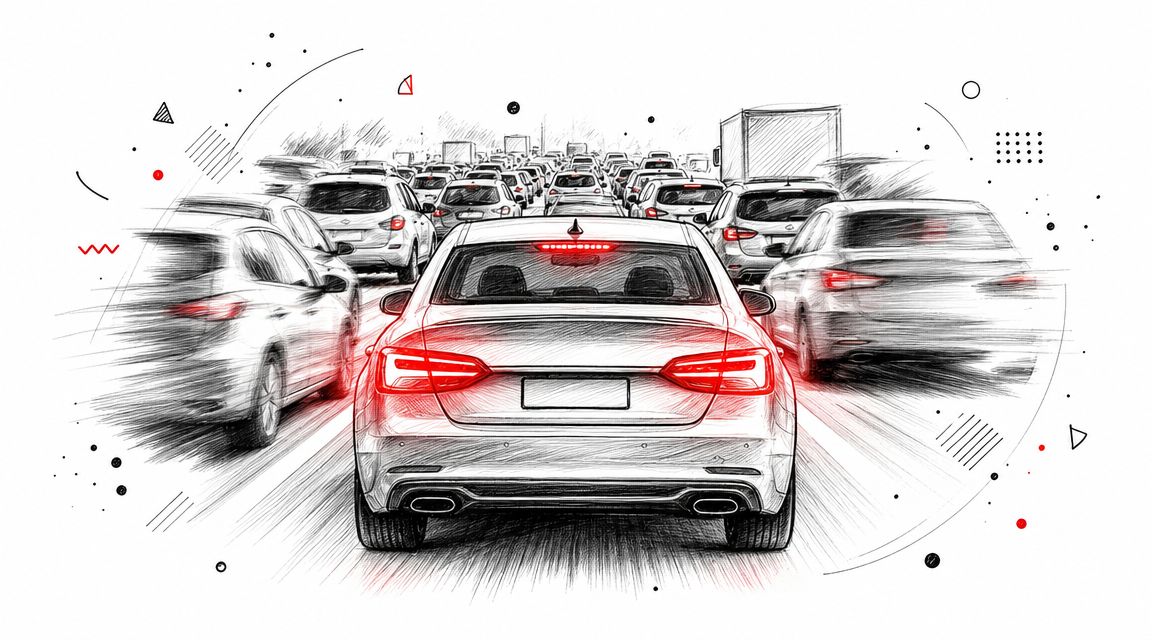
On Atlanta roads, the classic mistake is treating braking like a reflex instead of a skill. A driver barrels down I-285, closes the gap, glances at a phone, then slams the pedal when traffic compresses. At that point, the brakes are doing cleanup for several bad decisions made seconds earlier.
Braking is a thinking skill first
The safest drivers use the brake pedal early and deliberately. They don't wait for the full emergency unless they have to. They read stale green lights in town, bunching traffic on GA-400, and lane changes near exits before the problem gets close.
Practical rule: If your first hard brake happens only after the danger is already in front of your hood, you reacted late.
That's what makes braking the center of defensive driving. Steering matters. Mirrors matter. Speed choice matters. But braking is the tool you use most often to create time and space again.
What good braking protects you from
Solid braking habits help with more than crash avoidance. They also reduce the kind of chain reaction that turns a small driving mistake into a citation, a rear-end collision, or a roadside stop that gets more complicated than it should.
A formal course can help drivers connect those decisions to everyday outcomes. If you want a practical overview of the benefits of defensive driving, that's a useful place to start. The main point is simple. Better braking supports a safer record because it improves judgment under pressure, not just pedal technique.
Understand Your Vehicle's Braking System
A lot of Georgia drivers press the pedal hard without knowing how the car will respond. That gap matters most in the first second of a sudden stop, especially in Atlanta traffic where a normal commute can turn into a panic brake near a merge, exit ramp, or stale green light.
Your job is to know which brake system you have and what the pedal is supposed to feel like. If you get that part wrong, the rest of your technique falls apart fast.
What ABS feels like
If your vehicle has anti-lock brakes, the pedal may pulse, chatter, or push back under your foot during a hard stop. You may hear grinding or rapid clicking. That is normal. ABS is rapidly adjusting brake pressure so the tires keep enough grip to roll and steer instead of locking and sliding.
The mistake I still see is drivers lifting off because the pedal vibration feels like something is breaking. It usually means the system is doing its job. In an ABS-equipped car, firm pressure and steady steering input are usually the right response.
That basic skill shows up early in driver preparation for a reason. Students working through Georgia road test practice and confidence-building habits do better when they already understand what the car will feel like under hard braking, instead of trying to interpret pedal feedback in the middle of a scare.
What non-ABS feels like
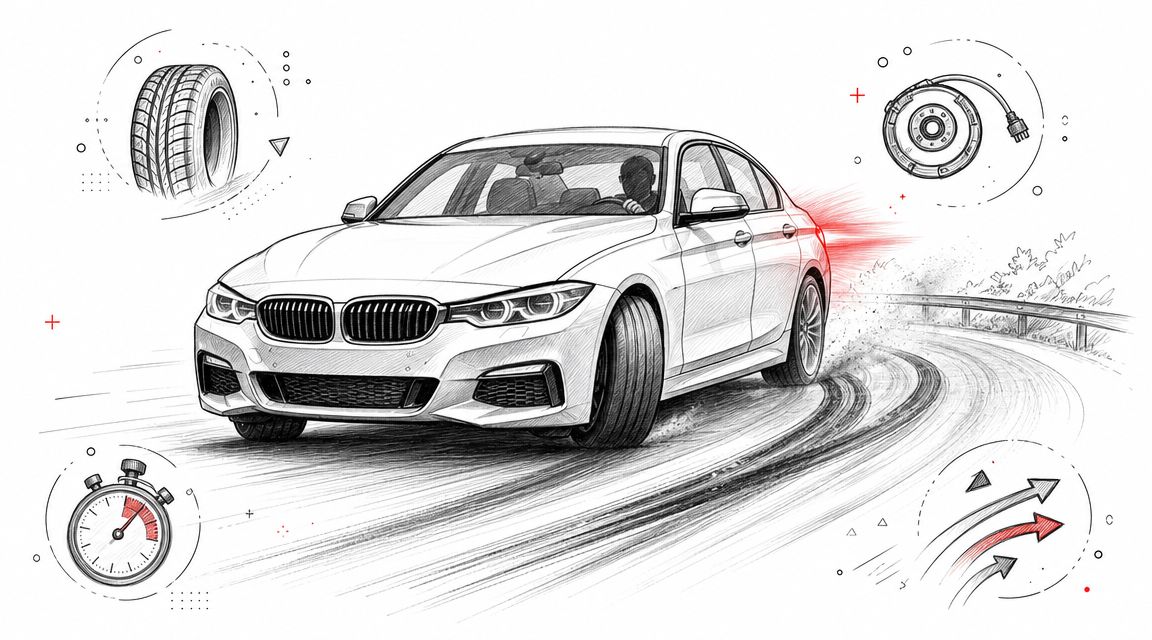
A non-ABS vehicle asks more of the driver. Press too hard and the wheels can lock. Once they lock, the tires slide across the pavement and steering control drops hard.
That is why threshold braking matters in older vehicles. The goal is strong, controlled pressure right up to the point before lock-up. If the wheels start sliding, ease off slightly and reapply with better feel. It takes more judgment than ABS, and on wet North Georgia back roads or loose gravel shoulders, that difference gets obvious fast.
Mechanical condition matters too. Technique cannot cover for worn pads, old fluid, weak hoses, or a long soft pedal. If you need to upgrade your vehicle's stopping power, fix the hardware before you expect better emergency braking from your footwork alone.
ABS vs. Non-ABS Emergency Braking Technique
| Driver Action | ABS-Equipped Vehicle | Non-ABS Vehicle |
|---|---|---|
| Initial pedal input | Press hard and quickly | Press firmly but build pressure with feel |
| What you may feel | Pulsing or vibration in the pedal | Smooth pedal until lock-up starts |
| What you should do next | Stay on the brake and steer as needed | Ease slightly if wheels lock, then reapply at the limit |
| Common mistake | Pumping the brakes | Mashing so hard the wheels lock and the car slides |
| Steering control | Generally maintained if tires still have grip | Reduced sharply during lock-up |
Georgia DUI Schools courses work best when drivers connect this kind of system knowledge to real outcomes. A cleaner stop can prevent the rear-end crash that adds points, raises insurance costs, and follows you long after the repair is paid for. Better braking judgment is not just a road skill. It is one of the habits that supports point reduction, insurance discount eligibility, and a safer driving record over time.
If your car has ABS, pumping the pedal fights the system instead of helping it.
How to Perform an Emergency Stop Safely
A child runs after a basketball into the street in Marietta. A car ahead slams its brakes on I-285. In that moment, the stop is won or lost before your foot reaches the pedal.
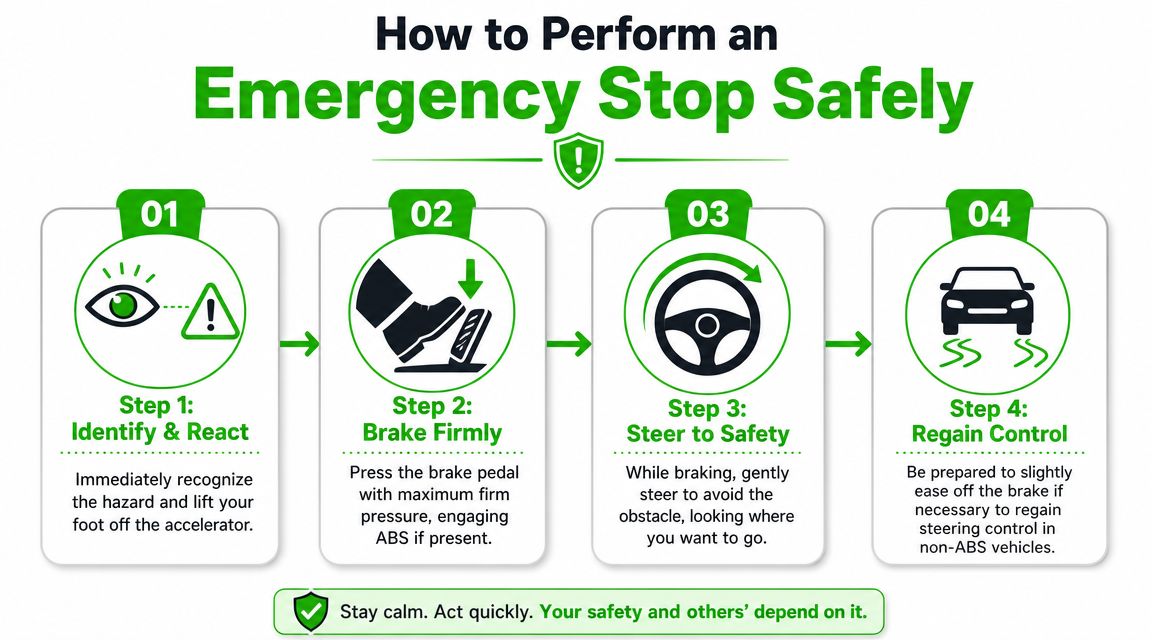
Start with your eyes, not your foot
Drivers who stop short without losing control usually do three things fast. They come off the gas, they look for space, and they keep their attention ahead instead of locking onto the hazard.
On Georgia roads, that can mean spotting brake lights around a curve on I-75, seeing a driver cut across lanes near an Atlanta exit, or catching a tractor slowing early on a two-lane road outside Tifton. The sequence is simple:
- Lift off the accelerator right away.
- Look toward open space, not at the object you want to miss.
- Scan the shoulder and lane edges before you need them.
Hesitation burns distance. A late, confused stop usually starts with a driver who coasts for a beat too long and then stomps the pedal without a plan.
Brake hard, then stay organized
Once the decision is made, commit. Press the brake firmly and keep both hands settled on the wheel. If the car has ABS, maintain hard pressure and let the system work. If the car does not have ABS, squeeze to the edge of lockup and back off slightly if the tires start to slide.
The trade-off is real. Maximum braking gets speed off quickly, but only if you leave enough tire grip to keep the car pointed where it needs to go. Drivers who panic often waste that grip with a jerk of the wheel or a second-guess release of the pedal.
I teach students to treat emergency braking as a practiced sequence, not a reaction they will somehow invent under stress. That is one reason Georgia DUI Schools programs matter beyond the classroom. Better braking judgment can help drivers avoid the rear-end and lane-change crashes that lead to points, higher premiums, and lost chances at insurance discounts.
Keep an escape path available
A straight, hard stop is usually the first choice. If the lane closes, steer once, cleanly, into open space. Do not saw at the wheel. Do not mix a violent lane change with full panic steering and expect the car to stay settled.
The Downtown Connector is a good example. One overcorrection can turn a near miss into a spin or a hit in the next lane.
Practice helps, but it needs to be deliberate. An empty lot can help drivers rehearse vision, pedal timing, and hand position at low speeds. New drivers building those habits can also study road-test fundamentals with this guide on how to pass your driver's road test in Georgia with confidence. The payoff is practical. Cleaner emergency stops support the same safe-driving habits that help keep a record eligible for point reduction and insurance-related savings.
Braking Techniques for Different Road Surfaces
Road surface changes everything. The brake input that works on dry pavement in Macon can be the wrong input on standing water in Atlanta or on a leaf-covered road in North Georgia. Drivers get in trouble when they use one braking style for every condition.
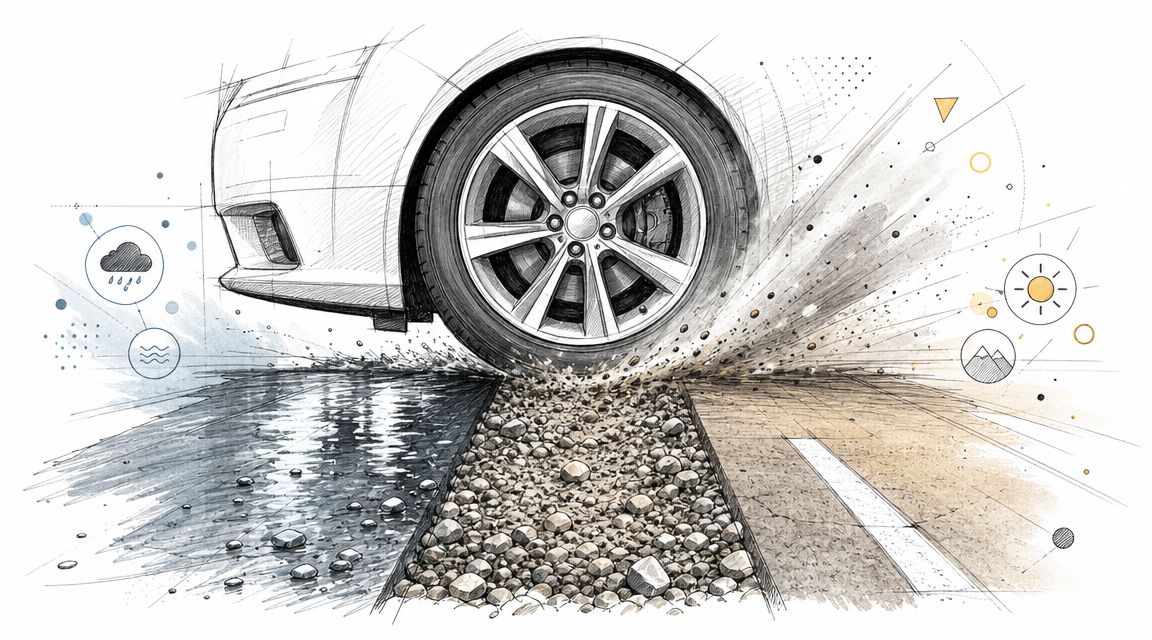
Wet pavement and hydroplaning risk
A sudden summer downpour on the Downtown Connector changes braking almost immediately. The road may look manageable, but water reduces tire grip and increases the risk that the tire rides up on the surface instead of cutting through it. Federal highway research confirms that wet pavement significantly increases stopping distance and hydroplaning risk, and that instinctive hard braking can be counterproductive on low-friction surfaces, as summarized in this wet-weather defensive driving overview.
That means your first adjustment happens before the brake pedal. Slow down earlier. Increase following distance. Make smoother inputs.
When the road is wet:
- Reduce speed before the problem area. Don't wait until you're already in pooled water.
- Brake progressively. Firm is fine. Abrupt and jerky isn't.
- Keep the wheel calm. Sharp steering on a slick surface can break traction fast.
Leaves, gravel, and mountain descents
North Georgia drivers see a different version of the same issue in fall and winter. Shaded roads can hold moisture, leaves pack down slick, and loose gravel on shoulder edges can upset the car when one side loses grip before the other.
On a downhill grade, the mistake is riding the brakes until they feel weak or the car starts pushing forward. Use your speed choice early. Enter slower than you think you need to. Then make short, deliberate braking inputs instead of dragging the pedal continuously.
On low-grip roads, smooth beats sudden. The goal is to preserve tire grip long enough for the brakes and steering to keep working together.
What to avoid on compromised traction
Some habits make slick-road braking worse:
- Panic stabbing the pedal can overwhelm available traction.
- Following normal dry-road spacing leaves no margin when stopping distance stretches out.
- Correcting too aggressively can turn a small slide into a spin.
Brakes defensive driving on bad surfaces is mostly about humility. You accept that the road has less to give, then you drive in a way that asks less from it.
Critical Braking Mistakes Georgia Drivers Make
The most dangerous braking errors aren't rare. They happen every day on the Perimeter, on suburban arterials, and in school-zone traffic. Most come from bad habits that drivers repeat until one day the margin disappears.
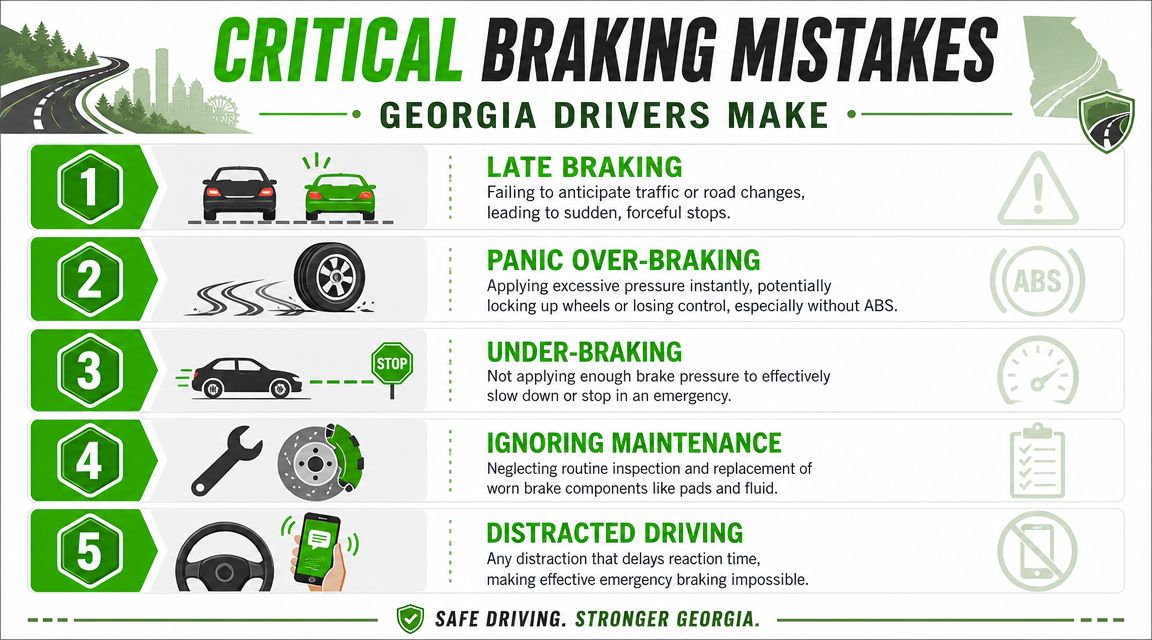
The old habits that keep causing trouble
Late braking is the first one. Drivers leave themselves no runway, then blame traffic for being unpredictable. On I-285, traffic isn't unpredictable. It compresses, expands, and changes lanes constantly. You have to expect that.
Another common mistake is misunderstanding vehicle technology. Drivers with ABS still pump the pedal. Drivers with modern driver-assistance features trust them too much, then stop paying attention.
Here are the big ones I see most often:
- Tailgating in dense traffic. This turns every stop into an emergency.
- Braking while distracted. If your eyes are late, your foot will be late.
- Ignoring maintenance. Worn pads, weak tires, and neglected fluid lengthen the problem.
- Overcorrecting during hard stops. Drivers miss the first obstacle and create a second one.
Modern systems change the job
Many drivers were taught rules that don't fully fit current vehicles. Automatic emergency braking, stability systems, and other ADAS features have changed what the car can do and what the driver needs to understand. A 2024 IIHS analysis found that automatic emergency braking significantly reduced rear-end crashes, reinforcing that braking safety now depends on both driver skill and system awareness, as noted in this driver training reference discussing modern defensive driving systems.
That doesn't mean the car can save a careless driver. It means you need updated habits. If your vehicle intervenes, don't fight it blindly. If you drive an EV or hybrid, remember that regenerative braking changes deceleration feel, especially in stop-and-go traffic. You still need smooth spacing and active attention.
The dangerous assumption is that more technology means less need for skill. In practice, it means the driver has to understand the technology well enough to work with it.
Turn Skills into Savings and a Safer Record
Braking skill becomes valuable when it changes what happens on the road and on your driving record. That's the practical case for formal instruction. Drivers don't just need information. They need repetition, correction, and a framework they can apply under pressure.
The strongest public benchmark tied specifically to hands-on braking instruction comes from teen advanced driver training. Graduates of B.R.A.K.E.S. have been reported as approximately 64% less likely to have a car crash in their first three years of driving, according to the program's research summary and outcomes page. That doesn't prove every classroom course works the same way, but it does support the core idea that coached, practiced emergency braking and skid recovery can translate into safer results.
Why the course matters in Georgia
For Georgia drivers, a formal defensive driving course can also serve practical goals beyond safety. It may help with point reduction, support court or DDS-related requirements, and help some drivers pursue an insurance discount. Those benefits matter most when the course reinforces usable habits instead of just reviewing rules.
One Georgia option in that category is the DDS-approved defensive driving program offered by Georgia DUI Schools, available in online, live virtual, and classroom formats for drivers who need a compliant course tied to traffic safety and driver improvement. If your focus is the financial side as much as the safety side, this guide on how to lower car insurance rates is a practical next read.
What actually transfers to real driving
The useful parts of brakes defensive driving are not abstract:
- Recognizing the hazard sooner
- Applying the right pedal pressure for your vehicle
- Keeping the car steerable under hard braking
- Adjusting for weather and poor traction
- Dropping outdated habits that modern systems have replaced
Those are the skills that help you avoid the rear-end crash, the ticket after a bad decision, and the record damage that follows preventable mistakes.
If you need a Georgia defensive driving course that fits court, DDS, point-reduction, or insurance needs, review the available options at Georgia DUI Schools. Choose the course format that matches your schedule and use it to turn safer braking habits into a cleaner, cheaper, and more controlled driving future.