
The question usually doesn't come up on a calm day. It comes up after a ticket in Gwinnett, a court date in DeKalb, a notice from your insurer, or that uneasy moment when you realize a few more points could create a real problem.
That's why those searching why take defensive driving course aren't looking for theory. They want to know whether it will help with money, points, court requirements, or keeping a Georgia license in good standing. Fair question.
A defensive driving course is often treated like a box to check. In practice, it's more useful than that. It can help some drivers reduce license points, support an insurance discount, satisfy a court order, and sharpen the habits that keep small mistakes from turning into bigger ones. That matters on Georgia roads, where metro traffic, aggressive merging, rain-slick interstates, and distracted drivers make every commute a little less predictable than it should be.
The bigger point is simple. This course isn't only for “bad drivers.” It's for drivers dealing with consequences, trying to prevent worse consequences, or trying to lower the overall cost of driving.
Practical rule: If a ticket, rising premium, or court paperwork pushed you to look this up, you're already in the group that should seriously consider a defensive driving course.
Introduction Why You Might Need a Defensive Driving Course
A Georgia driver gets a ticket on the way home, pays the fine online, and assumes the problem is over. Then the significant questions arise. How many points does this put on the record? Will insurance jump at renewal? Did the court expect a class by a certain date? That is usually the moment a defensive driving course stops sounding optional.
In my experience, drivers sign up for this course for one reason. They are trying to limit the damage from a driving issue before it gets more expensive or harder to fix.
Sometimes the trigger is a citation. Sometimes it is a judge's instruction. Sometimes it is noticing that a clean driving record is getting less clean, and a few small mistakes are starting to carry real consequences in Georgia.
What people are usually trying to fix
The practical reasons tend to fall into four buckets:
- Protecting a Georgia license: Drivers want to reduce points where Georgia rules allow it before another violation creates a suspension risk or a bigger DDS problem.
- Lowering insurance costs: Drivers want a course completion certificate they can use when asking an insurer about available discounts.
- Meeting a court requirement: Drivers have been told by a court, probation officer, or clerk to complete a class by a deadline and need the right one.
- Refreshing driving habits: Drivers want to correct habits that lead to repeat tickets, near misses, and preventable mistakes in heavy Georgia traffic.
Those are businesslike reasons. They are tied to cost, compliance, and record management.
That distinction matters. In Georgia, a defensive driving course is often a practical tool, not a moral lesson. It can help someone deal with DDS points, respond to a court order, or create a better position when insurance costs are climbing. For a clearer look at how that works, review these practical benefits of defensive driving in Georgia.
A lot of drivers wait too long. They treat the course as something to handle after the court date, after the premium increase, or after another ticket. The better approach is to use it early, while there is still room to protect the record and control the cost.
The Core Financial and Legal Benefits
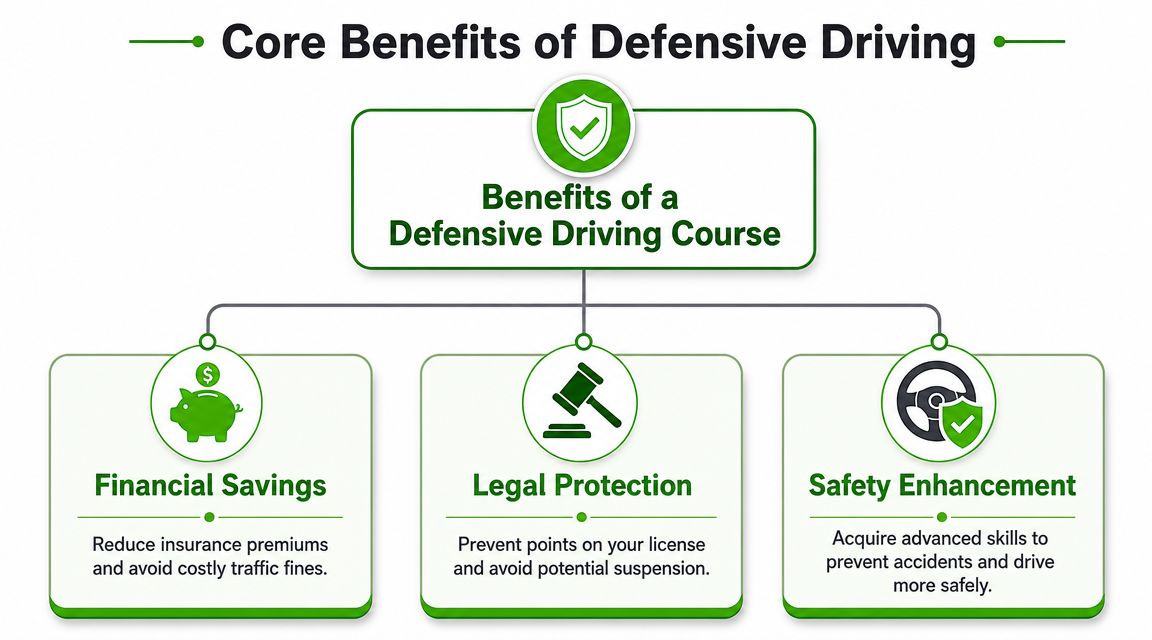
For most adults, the value of a defensive driving course comes down to three things. Money, record protection, and compliance. If a course doesn't help in one of those lanes, people usually won't bother with it.
Saving money matters more than people admit
Insurance companies care about risk. A completed course can function as documented safety training, which is why some states explicitly tie defensive driving to underwriting relief. In New York, for example, a state-approved course can provide a 4-point reduction on a driver record and a 10% insurance discount for up to three years, even for drivers with a clean record (New York defensive driving point and insurance rules).
Georgia rules aren't identical to New York's, but the mechanism is what matters. The course can affect the cost side of driving in two different ways. First, by helping with record management where allowed. Second, by giving you a completion certificate you can use to ask your insurer whether a discount applies.
For a plain-language breakdown of how these advantages work, see benefits of defensive driving in Georgia.
Protecting your license is often the bigger issue
Many drivers focus on the ticket they just got. The larger problem is what repeated violations do over time. Points don't feel urgent until you're near a threshold, trying to reinstate driving privileges, or standing in court explaining why this was not just “one mistake.”
A defensive driving course makes the most sense when you treat it as record management. If you already have points, taking the course early can create breathing room. If the court ordered it, completion can show that you followed instructions on time, which is usually the smartest position to be in.
Courts and insurers don't reward intentions. They respond to completed requirements and documented training.
The legal value is straightforward
Some drivers take the class voluntarily. Others don't have a choice. In Georgia traffic cases, a judge may require defensive driving as part of the outcome. When that happens, the course stops being optional and becomes part of your legal to-do list.
That's why the practical question isn't whether the class sounds interesting. It's whether it helps you avoid higher costs, record damage, or noncompliance. In many situations, it does.
Navigating Georgia DDS and Court Requirements
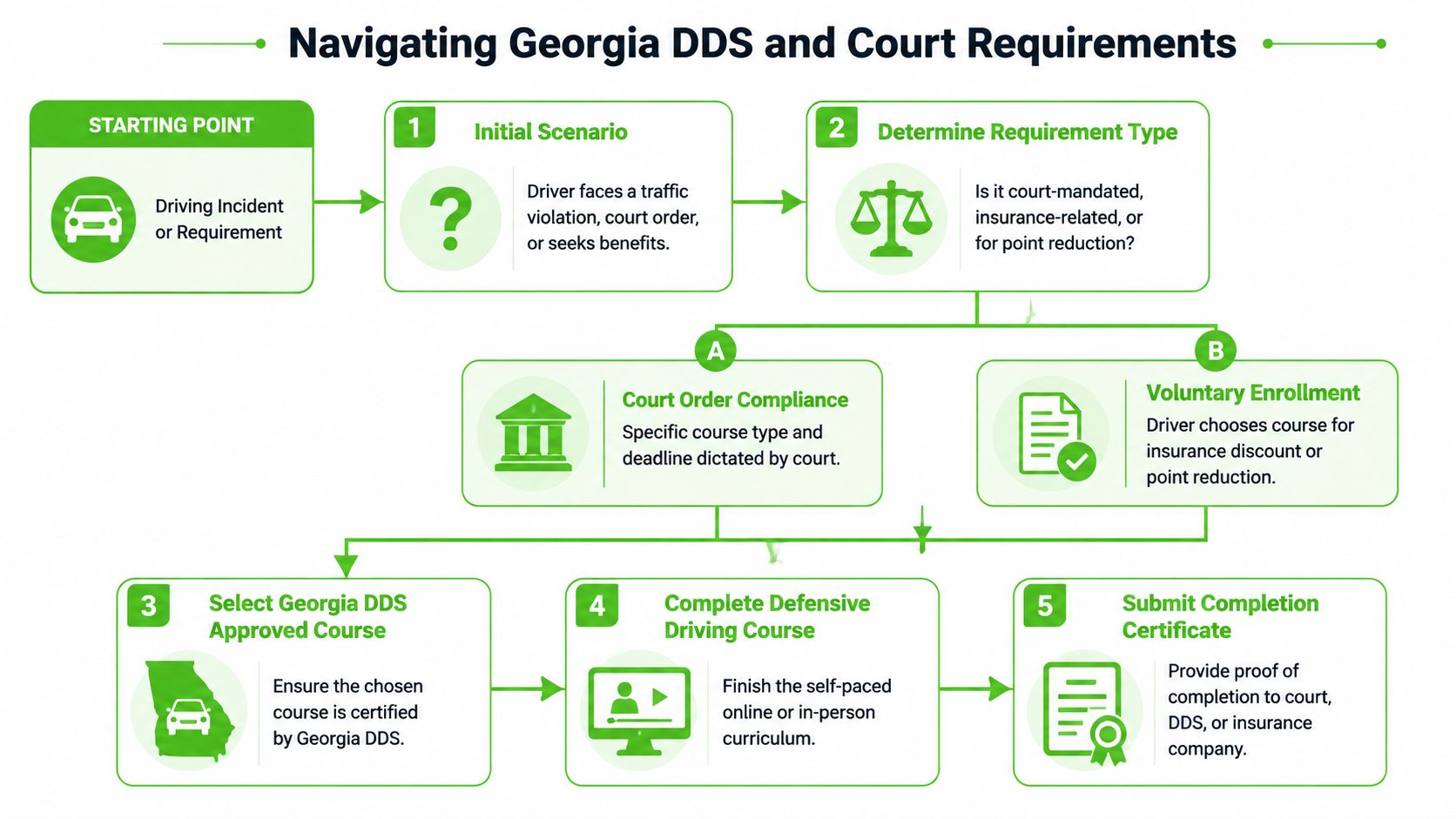
A driver gets a ticket in Georgia, signs up for the first online class that looks right, finishes it, and then finds out the court wanted a different course. That mistake costs money, time, and sometimes another trip back to court. The class only helps if it matches the legal or DDS requirement attached to your case.
Georgia drivers run into trouble when they assume every driving course serves the same purpose. It does not. A defensive driving course and a DUI Risk Reduction course solve different problems. Picking the wrong one can leave your record unchanged and your court obligation unmet.
When Georgia point reduction is the goal
For many drivers, the course is a DDS record-management tool. The goal is simple. Reduce points if you qualify and create some margin before the next violation puts your license in worse shape.
Before you enroll, confirm three things:
- DDS approval: The course must be accepted for Georgia purposes.
- Eligibility: Your record and case details determine whether the course will do what you expect.
- Deadline: DDS and courts care about completion by the required date.
This is the part drivers skip, and it is usually the part that causes problems. A quick phone call to the court clerk, your attorney, or the school can prevent paying for a course that does not count.
When the court ordered the class
A court order changes the job. At that point, the class is not mainly about insurance or voluntary point reduction. It is about compliance.
Follow the order exactly as written. If the judge required defensive driving, take the course type the court named, use a provider the court accepts, and turn in proof the way the court requires. Some courts want the certificate filed by a deadline. Others want you to bring it on your court date. Those details matter.
Drivers also need to avoid a common mix-up. A generic online driving class is not automatically approved for every Georgia court case. Course title, provider status, and submission method can all affect whether the court accepts it.
There is a practical reason courts keep using these classes. A review of 14 controlled studies found that, in stronger studies, defensive driving courses did not show a consistent effect on crashes but did reduce traffic violations by about 10% (review of defensive driving course outcomes on traffic violations).
That fits what courts are trying to do in routine traffic cases. They are often trying to reduce repeat violations and close the case with documented compliance.
Defensive driving is not the same as DUI Risk Reduction
This confuses a lot of Georgia drivers, especially after a first serious offense.
If your case involves a DUI, a drug-related driving offense, or license reinstatement tied to a DUI matter, the state may require the DUI Risk Reduction Program instead of a standard defensive driving course. That program serves a different legal purpose and follows different rules.
Use this basic guide:
| Situation | Likely Course Type |
|---|---|
| Ticket, points, insurance, or court order after a routine traffic case | Defensive driving |
| DUI-related reinstatement or DUI court requirement | DUI Risk Reduction |
If your paperwork mentions DUI, substance use, clinical evaluation, or reinstatement conditions, verify the requirement before you pay for any class. In my experience, this is one of the most expensive avoidable mistakes drivers make.
How Defensive Driving Courses Work in Practice
A lot of drivers expect the course to be a long lecture about obvious rules. A good class is more practical than that. It's built around hazard management, which means spotting trouble early enough to avoid being pulled into it.

What you actually learn
Effective courses focus on situations that cause ordinary crashes and violations. Common modules include maintaining safe following distance, adjusting speed to weather and traffic conditions, recognizing distracted drivers, and using proper emergency maneuvers to improve reaction quality under pressure (hazard-management skills taught in defensive driving).
That matters more than people think. Most bad driving outcomes don't start with something dramatic. They start with being a second late to notice brake lights, following too closely in Atlanta traffic, entering a merge without reading another driver's intent, or assuming rain hasn't changed stopping distance.
Different formats fit different schedules
Drivers in Georgia usually want the course to fit around work, family, and court deadlines. That's why format matters almost as much as content.
Here are the common options:
- Self-paced online course: Good for drivers who need flexibility and want to complete the material around their own schedule.
- Live virtual class: Better for people who prefer real-time instruction without driving to a classroom.
- In-person classroom course: Useful when a student learns best face-to-face or prefers a traditional setting.
Georgia DUI Schools is one DDS-approved option that offers the 6-hour defensive driving course in self-paced online, live virtual, and classroom formats for Georgia drivers dealing with points, insurance questions, or court requirements.
What works and what doesn't
A defensive driving course helps most when the student treats it as a refresher in decision-making, not just a certificate hunt. The people who get the most out of it usually connect the lessons to their own habits. They know where they rush, where they drift into distraction, and where traffic pressure makes them impatient.
A course won't do much if you complete it mechanically and go right back to tailgating on I-285 or treating every yellow light as a challenge.
You don't need more confidence behind the wheel. You need better judgment under pressure.
That's the point of defensive driving. Better scanning. Better spacing. Better speed choices. Better reactions when the driver next to you does something careless.
Choosing the Right Georgia Defensive Driving Course
You get a ticket in DeKalb County, look at the deadline on the paperwork, and realize the wrong class wastes both time and money. That is usually when drivers stop asking, “Which course is easiest?” and start asking the better question. “Which course solves my problem in Georgia?”
Start there. Defensive driving is not one single use case. In Georgia, the course can serve three very different purposes: helping with insurance, helping with points, or satisfying a court requirement. If you do not match the class to the reason you need it, the certificate may not help the way you expect.
Match the course to the reason
Use this quick comparison before you enroll:
| Your Goal | Primary Reason | Who It's For |
|---|---|---|
| Lower insurance costs | You want proof of completed safety training to discuss with your insurer | Drivers with rising premiums or anyone looking for a voluntary benefit |
| Reduce points | You need to manage your driving record and protect license status | Drivers with accumulated points |
| Satisfy a court order | You were told by a judge or court to complete a class by a deadline | Drivers handling a ticket or traffic case outcome |
If insurance savings is the main goal, review how a defensive driving course may help lower insurance before you enroll.
Why an established course matters
The practical risk is simple. You finish the class, pay for it, and then learn the court wanted a different program or your insurer wants different documentation.
That is why established providers matter. Look for a Georgia DDS-approved course when point reduction is the issue, and read the course description closely if the class is being taken for court. Courts can be specific about what they will accept, and “defensive driving” is not automatically the same as every other traffic or DUI-related program.
A reliable provider should make four things clear:
- what the course is approved for
- how long it takes
- what proof of completion you receive
- whether the format fits your deadline and learning style
Georgia DUI Schools is one example of a provider that clearly identifies its 6-hour defensive driving course and the purposes students commonly use it for, including points, insurance documentation, and some court-related situations.
One more practical point. Cheap is not always cheaper. If a bargain course creates confusion about approval, completion records, or timing, the actual cost shows up later in extra fees, another enrollment, or a missed court deadline.
Ask one question before you register. What does this certificate need to do for me in Georgia?
That answer should drive the choice.
Common Questions About Defensive Driving in Georgia
If I'm already a careful driver, is there still a reason to take it
Yes, often there is. Defensive driving isn't only about fixing reckless habits. It's about responding well to other people's mistakes.
Progressive describes defensive driving as creating safe responses to hazards such as other drivers, damaged roads, debris, and bad weather, and says it can help drivers anticipate dangerous situations and reduce crash likelihood (Progressive explanation of defensive driving).
That's why even careful drivers benefit. You can do everything right and still get tested by someone else's lane change, sudden stop, or distraction.
Does a newer car with safety tech make the course unnecessary
No. Driver-assist features can help, but they don't replace judgment. A course still matters because it trains the person using the technology.
In real traffic, the problem usually isn't whether your car has alerts. It's whether you left enough following distance, saw a merge conflict early enough, or adjusted to weather before the car had to intervene. Safety tech works best when the driver already uses defensive habits.
Is defensive driving the same as DUI Risk Reduction in Georgia
No. They serve different purposes.
A defensive driving course is generally used for point reduction, insurance purposes, or court orders tied to traffic matters. DUI Risk Reduction is the separate program used in DUI-related situations and reinstatement contexts. If you've been told to complete a DUI-related requirement, don't assume a defensive driving certificate will substitute for it.
Can I take the course before I get into bigger trouble
That's often the smartest time to do it. Waiting until another violation lands can limit your options or increase the pressure.
Proactive enrollment makes sense for:
- Drivers with some points already: Creating room on the record can matter.
- People seeing higher premiums: A completion certificate may help when discussing discounts with an insurer.
- Frequent metro commuters: Heavy traffic around Atlanta, Athens connectors, and major suburban corridors rewards anticipation more than reaction.
- Older drivers or returning drivers: A refresher can help rebuild comfort with current traffic conditions.
What's the biggest mistake people make
They focus only on the certificate.
The certificate matters, but the day-to-day value comes from changing how you drive in common Georgia situations. Following distance in stop-and-go traffic. Speed choice in rain. Reading the distracted driver beside you before that driver drifts. If you miss those lessons, you've only used half the course.
Your Next Step to a Better Driving Record
A defensive driving course makes sense when you need a practical result. You may want to manage points, ask about an insurance discount, satisfy a court requirement, or become harder to catch off guard in Georgia traffic.
That's the answer to why take defensive driving course. It gives you a legal and financial tool, not just a classroom experience. It can help you protect your license, control costs, and make better decisions when traffic gets messy.
If your next step is point-related, start by reviewing how to remove points from your driving record in Georgia. That will help you connect the course to the record issue you're trying to solve.
Then act before a deadline, another ticket, or another premium increase makes the decision for you.
If you need a Georgia-approved option for point reduction, insurance documentation, or court-related defensive driving requirements, Georgia drivers can review course details and enrollment options through Georgia DUI Schools.