
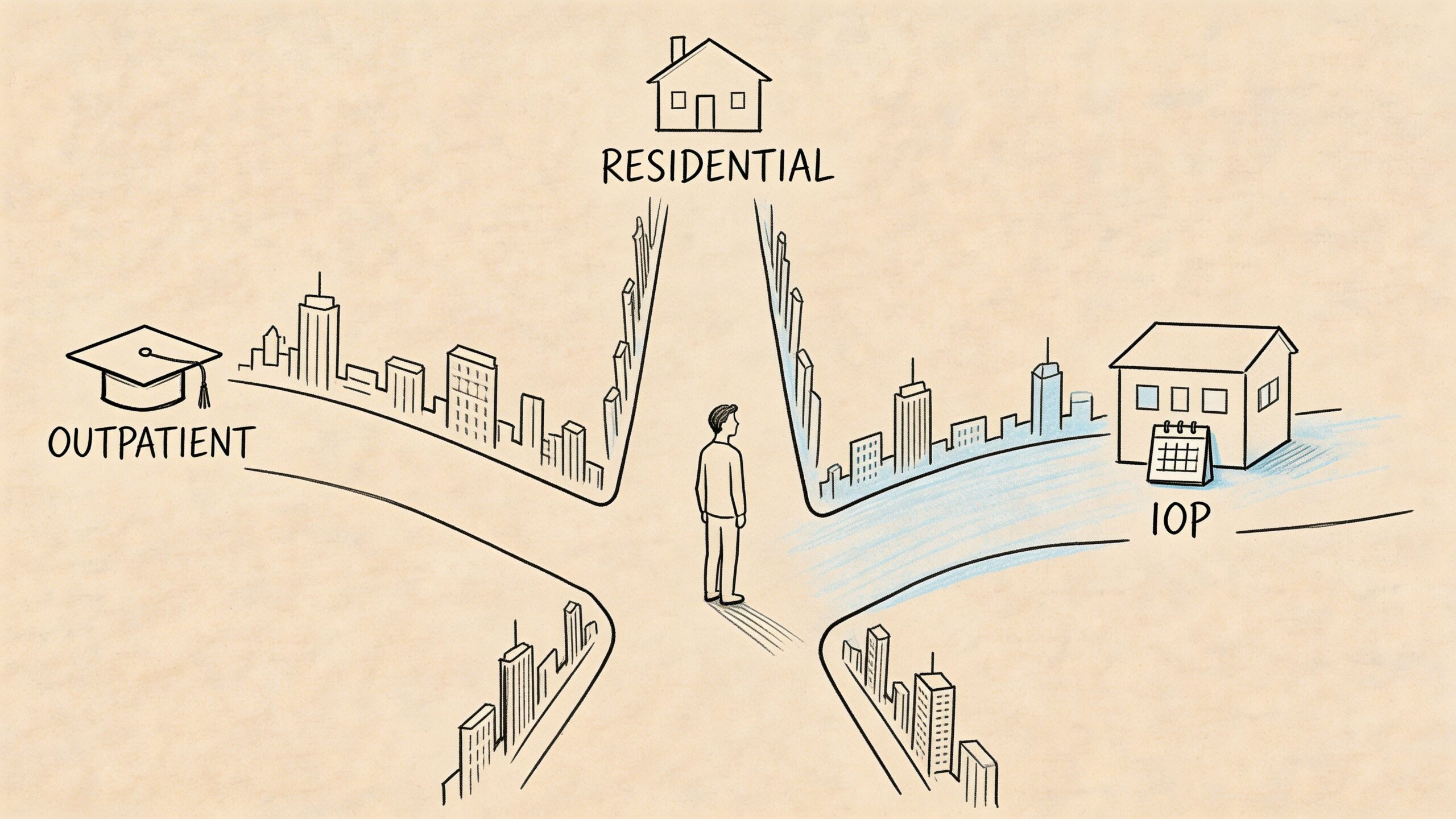
You finished the class. You met the court deadline. Then someone tells you there’s another step, a clinical evaluation, and maybe treatment after that.
That’s the point where many Atlanta drivers feel lost.
A DUI case in Georgia often turns into more than a traffic matter. It can affect your license, your probation terms, your work schedule, and the way the court views your next move. If your evaluator or probation officer mentions an IOP program Atlanta option, you may not know whether that means rehab, counseling, a court class, or something in between.
It’s usually the last one.
An Intensive Outpatient Program, or IOP, is a structured treatment program for substance use or mental health concerns that lets you live at home while attending regular therapy sessions. For many people after a DUI, it becomes the practical bridge between legal compliance and getting daily life back under control.
The confusing part is that the court process and the treatment process often overlap. One system is asking whether you’ve met requirements. The other is asking what level of care fits your actual needs. This article connects those dots in plain language, with a focus on what that looks like in Atlanta.
Your Next Step After a Georgia DUI Evaluation
A common Atlanta scenario goes like this.
You were arrested for DUI in Fulton, DeKalb, Cobb, or another metro county. You’ve already heard about the Risk Reduction course. Maybe you’ve completed it. Then your attorney, probation officer, or court paperwork says you also need a clinical evaluation.
That sounds simple, until the evaluation comes back with language you weren’t expecting. Instead of “you’re done,” you hear terms like ASAM Level 1, Level 2.1, or Intensive Outpatient Program.

For many people, that moment feels like the ground shifted. They thought the DUI process was mainly about court dates, fees, and classes. Now they’re being told they need treatment.
Why this happens after a DUI
A DUI case can trigger a closer look at alcohol or drug use patterns. The court isn’t always deciding treatment on its own. Often, it relies on a clinical assessment to determine whether education alone is enough or whether more support is needed.
That’s where an IOP can come in.
An IOP is not the same thing as the standard DUI class. It’s more structured and more therapeutic. It’s designed for people who need more help than an occasional counseling appointment, but who don’t need to live at a treatment facility.
If you’ve also heard SAP language and you’re trying to understand how evaluation and treatment recommendations connect, this overview of the SAP program process in Georgia can help place the requirement in context.
What an IOP means for your life
The good news is that an IOP usually allows you to keep living at home, keep working, and keep handling family responsibilities while you complete treatment.
That matters in Atlanta, where commute time, work schedules, and childcare can make any court requirement feel overwhelming.
Practical rule: If an evaluator recommends IOP, treat it as both a legal requirement and a support plan. You’ll need to satisfy the court, but you also need a program you can actually attend consistently.
A lot of people hear “intensive” and assume it means inpatient rehab. Usually, it doesn’t. It means the treatment is more focused and more frequent than standard outpatient counseling.
That distinction can make the next step feel less frightening. You’re not being told to disappear from your life. You’re being told to enter a structured program that fits around it.
What Exactly Is an Intensive Outpatient Program
After a Georgia DUI evaluation, some people learn that a weekly counseling appointment will probably not give them enough structure. They also may not need to live at a treatment center. An Intensive Outpatient Program, or IOP, fills that gap.
An IOP is a non-residential treatment program. You keep living at home, going to work, and managing daily responsibilities, but you attend treatment several times each week on a set schedule. In Atlanta, programs often meet multiple days a week for several hours at a time, according to MARR’s overview of Intensive Outpatient Programs in Atlanta. For someone dealing with court deadlines, traffic, work shifts, or childcare, that structure matters because it is intensive without requiring an overnight stay.
The word “intensive” trips people up.
In this setting, it usually means more hours, more repetition, and more accountability than standard outpatient counseling. You are not just checking in. You are practicing new skills often enough that they can start to hold up in real life, including stressful evenings, social pressure, and the routines that can lead back to drinking or drug use.
What happens inside the program
A strong Atlanta IOP usually combines several parts of treatment so the program does more than lecture you about substance use.
You may see elements like:
- Group therapy: This is often the center of the program. A clinician leads discussions about triggers, stress, patterns of use, relapse prevention, and how to respond differently.
- Individual counseling: These sessions focus on your own history, goals, setbacks, and progress.
- Cognitive behavioral therapy: CBT helps you notice the thoughts and habits that feed substance use, then replace them with healthier responses.
- Life skills work: This can include communication, stress management, routines, planning, and decision-making.
- Relapse prevention: You learn how to spot risky situations early and build a plan before a lapse turns into a larger setback.
That mix is one reason courts and evaluators use IOPs after a DUI. A DUI charge may look like one event, but the behavior behind it can involve stress, anxiety, alcohol habits, poor coping skills, or an environment that keeps reinforcing the same choices. An IOP is meant to treat those patterns, not just record your attendance.
Why an evaluator may recommend it
An evaluator may point you to IOP if basic outpatient care seems too light and inpatient treatment seems unnecessary. In other words, the evaluator is matching the level of care to the level of risk and support you need.
Research from 2014 in The Journal of Psychiatric Services, as summarized by the same MARR source, found that IOPs can be as effective as inpatient treatment for many patients, depending on the person’s condition and needs. That helps explain why IOP is commonly recommended for people who need steady treatment and accountability while still living in the community.
What people often misunderstand
Many Atlanta drivers hear “program” and assume they are being sent to another class. That is not how an IOP works.
An IOP is treatment. Attendance still matters for court and probation purposes, but participation matters too. Clinicians are looking for engagement, honesty, skill-building, and consistent follow-through.
That distinction matters in practical ways. If your DUI case requires proof that you followed the recommendation from your evaluation, a solid IOP can document your compliance. At the same time, the program is supposed to help you build safer routines so the same chain of events does not lead you back into court.
Comparing IOP with Other Levels of Care
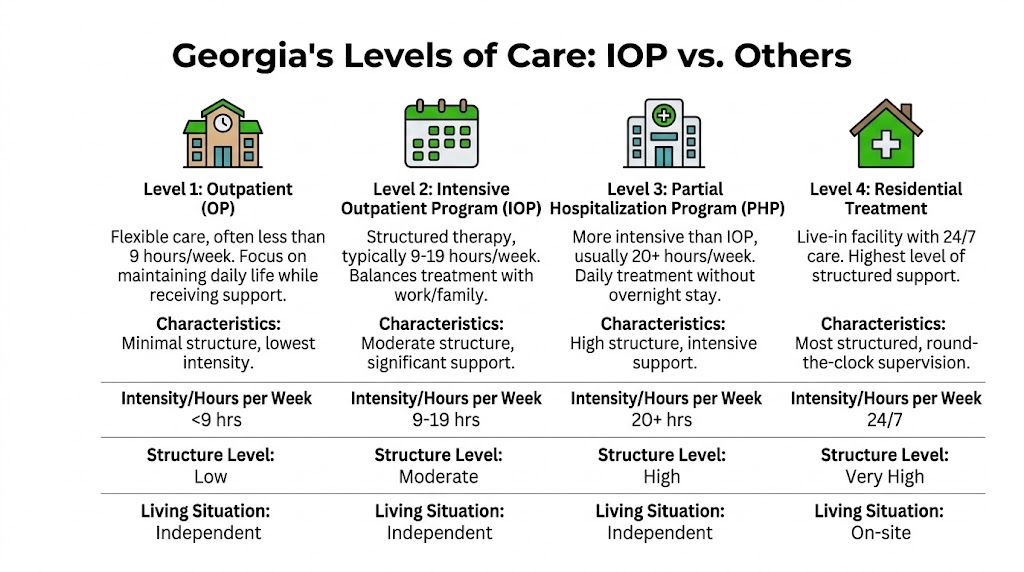
The easiest way to understand an IOP is to compare it with the other care levels people hear about after a DUI evaluation.
Some people need only basic outpatient counseling. Some need a full-day program. Some need residential treatment. An IOP sits in the middle.
Where IOP fits
Traditional outpatient care is the least intensive. You might meet with a counselor once a week or on another light schedule. That can work if your risk is low, your home life is stable, and you don’t need much structure.
At the other end, residential treatment means living at a facility full time. That level is for people who need round-the-clock support and supervision.
IOP falls between those two extremes. It gives you repeated contact with clinicians and peers while letting you live independently.
Treatment Levels at a Glance IOP vs. Other Programs
| Level of Care | Weekly Time Commitment | Living Situation | Best For Individuals Who… |
|---|---|---|---|
| Outpatient (OP) | Lower weekly commitment | Independent | Need support, but can manage with less structure |
| Intensive Outpatient Program (IOP) | Several therapy blocks across the week | Independent | Need more accountability and skill-building while keeping daily responsibilities |
| Partial Hospitalization Program (PHP) | Most of the day, multiple days each week | Independent | Need a high level of support without overnight stay |
| Residential Treatment | Full-time care | On-site | Need continuous supervision and a highly controlled setting |
The practical differences
Here’s how these levels feel in real life.
Outpatient care
This is the lightest-touch option.
A person in outpatient care might be working full time, living at home, and doing fairly well, but still needs support for decision-making, relapse prevention, or mental health symptoms. It’s often a fit when a clinician thinks the person can stay stable with less frequent contact.
IOP care
IOP is for someone who needs more repetition and structure.
That person may be able to hold a job, care for family, and get to sessions reliably, but still needs multiple treatment contacts each week. They may have a DUI tied to a pattern of alcohol use, poor coping, or a mental health issue that keeps colliding with substance use.
In Georgia treatment language, this is often where people hear ASAM Level 2.1.
PHP care
A Partial Hospitalization Program is more demanding than IOP.
It’s often recommended when symptoms are more severe or when the person needs near-daily clinical monitoring but still doesn’t need overnight care. If someone is too unstable for IOP, PHP may be the safer choice.
Residential care
Residential treatment is the most structured.
The person lives at the program site, follows a full daily schedule, and has very little unstructured time. This is often used when independent living is unsafe or when prior lower levels of care haven’t been enough.
Why people move between levels
Treatment doesn’t always stay at one level from start to finish.
Someone might begin in residential care, improve, step down to PHP, then move into IOP as they become more stable. Another person might start directly in IOP because they’re safe at home and don’t need full-day treatment.
That step-down model matters in DUI-related cases. A recommendation for IOP doesn’t automatically mean your situation is extreme. It often means the evaluator thinks you need moderate structure with real-world follow-through.
Quick test: If you can live safely at home but need more than occasional counseling to stay on track, IOP is often the level that makes sense.
For Atlanta drivers, this distinction matters because work schedules, commuting, and court deadlines all affect what’s realistic. The right level of care is not the most intense one available. It’s the one that matches your actual clinical need and your ability to participate consistently.
Understanding Your Eligibility for an Atlanta IOP
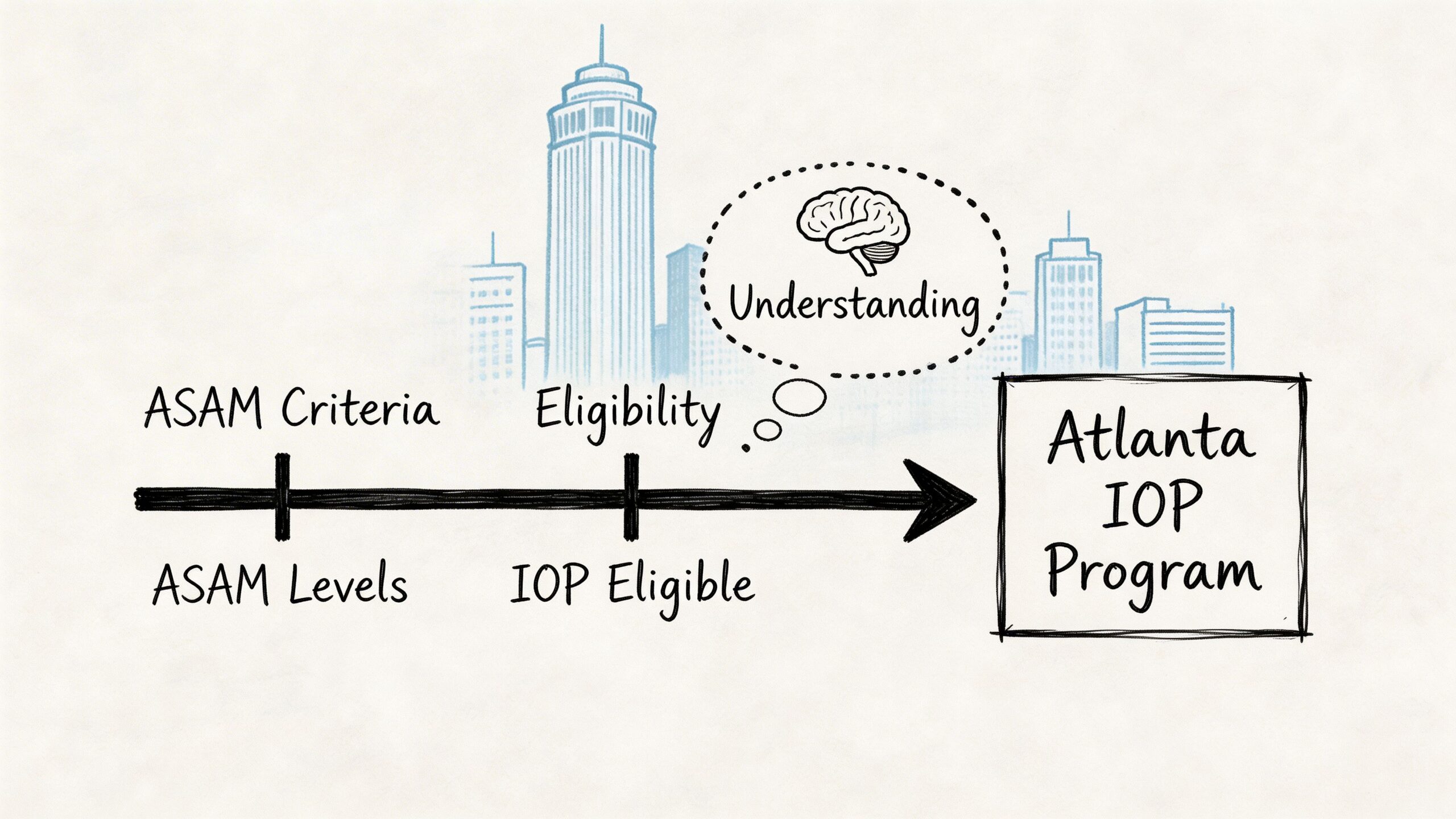
People often assume an IOP recommendation is subjective, like one counselor’s opinion. In practice, the decision is usually tied to a structured assessment.
That’s where ASAM criteria come in.
What ASAM means in plain English
ASAM stands for the American Society of Addiction Medicine. In Georgia, evaluators often use this framework to decide what level of care fits a person’s needs.
You don’t need to memorize the formal language. What matters is the kind of questions the evaluator is trying to answer.
They’re looking at things like:
- Withdrawal risk: Are you in danger if you stop using without medical support?
- Physical health: Do you have medical issues that make outpatient treatment unsafe or unrealistic?
- Mental health: Are anxiety, depression, trauma, or other symptoms making substance use harder to control?
- Readiness: Are you willing to participate, or are you still highly resistant to treatment?
- Relapse potential: How likely are you to return to use without close support?
- Recovery environment: Is your home stable, or are the people and routines around you pulling you backward?
Who usually fits IOP best
An IOP often fits someone who has enough stability for outpatient treatment, but not enough stability for a low-contact approach.
That might describe a person who:
- Lives in a safe place: Home may not be perfect, but it’s stable enough to support attendance and basic recovery work.
- Doesn’t need detox or inpatient monitoring: There isn’t an immediate medical crisis requiring round-the-clock care.
- Needs frequent accountability: Weekly counseling alone probably won’t be enough.
- Can still function in the community: The person can usually manage transportation, communication, and a regular schedule.
If you’re trying to prepare for that first required assessment, this guide to a Georgia drug and alcohol evaluation online can help you understand what the evaluation process generally looks like.
What evaluators are really deciding
The evaluator is not deciding whether your DUI was “bad enough.””
They’re deciding whether your current level of risk and need calls for a treatment structure that’s stronger than standard outpatient care. That’s a clinical judgment tied to safety, functioning, and the likelihood that a person can follow through without more support.
Here’s a plain-language version of the decision:
| What the evaluator sees | What it may suggest |
|---|---|
| Low risk, good stability, strong follow-through | Standard outpatient may be enough |
| Moderate risk, some instability, repeated poor decisions, need for close support | IOP may fit |
| High instability or need for intensive daily oversight | PHP or residential may be more appropriate |
A recommendation for IOP usually means the evaluator believes you can recover while living at home, but not without a solid treatment framework around you.
That can be encouraging. It means you’re not being written off. You’re being placed at a level that expects progress, responsibility, and participation.
A Typical Week in an Atlanta IOP Program
Once you know you need an IOP, the next question is usually simple.
What will my week look like?
That question matters because Atlanta drivers are trying to fit treatment around jobs in Midtown, shifts near the airport, classes at Georgia State, childcare in Decatur, or long commutes from places like Marietta, Stockbridge, or Lawrenceville.

The weekly rhythm
A typical Atlanta IOP often runs on a repeated weekly pattern rather than random appointments.
You may attend on several set days each week for a block of hours. That consistency helps you build routine, and it also gives the court or probation system a clear attendance record if proof of compliance is required.
The sessions themselves usually mix several formats so the week doesn’t feel like one long lecture.
What happens in group therapy
Group therapy is often the center of the program.
Participants talk about cravings, stress, relationships, shame, triggers, and setbacks with a licensed clinician guiding the conversation. In a DUI-related context, group can also help people stop minimizing what happened. Hearing other people describe the same rationalizations can make your own patterns easier to see.
A group session might focus on:
- Trigger recognition: Noticing what situations, emotions, or people make use more likely.
- Coping skills: Practicing what to do instead of drinking or using.
- Relapse prevention planning: Mapping out danger points before they become emergencies.
- Accountability: Reporting back on the previous week and being honest about what worked and what didn’t.
The role of individual counseling
Individual sessions are usually quieter and more specific.
In individual sessions, you talk about your own history, court pressure, family conflict, work stress, or the events around the DUI. A counselor may help you connect the legal problem to the underlying habits that need to change.
For one person, the primary issue might be binge drinking on weekends. For another, it might be mixing stress, isolation, and alcohol after work. The one-on-one setting is where those details become part of a treatment plan.
Some people expect IOP to feel like punishment. Many find it feels more like structured coaching with clinical support.
Skills, education, and home practice
Most IOPs also include psychoeducation and practical assignments.
That may mean learning how substance use affects judgment, sleep, relationships, and mood. It may also mean writing out a trigger plan, tracking emotions through the week, or practicing responses to real-world situations at home or work.
This is one reason IOP can be effective for people after a DUI. You don’t just talk about choices in a room. You go back into daily life and test better choices in the exact places where old patterns usually show up.
Family involvement and support
Some programs include family sessions or encourage family participation when appropriate.
That can help if trust has been damaged after the DUI. A spouse, parent, or partner may need support too. Treatment often goes better when the people at home understand the process and know how to support recovery without taking over it.
What attendance really means
In a court-related case, attendance isn’t casual.
Missing sessions can create problems with the provider, with probation, or with the paperwork you need to show completion. If transportation, work hours, or childcare are going to be difficult, it’s better to discuss that before enrolling than after you start missing appointments.
An IOP works best when the schedule is demanding but realistic. The right Atlanta program is one you can complete.
Navigating Georgia's Referral and Payment Process
You finish your DUI evaluation, look down at the paperwork, and realize the hard part is not over. One document may mention treatment. Another may mention probation. Your license requirements may sit on a different track from your court case. In Atlanta, people often lose time because they assume all of those systems are talking to each other.
They often are not.
That is why this part of the process needs a paper trail. An IOP referral in Georgia usually starts with the clinical evaluation, but the referral path can branch after that. A judge may order the evaluation. A probation officer may require you to complete the recommended level of care. An attorney may suggest starting treatment early to show good-faith compliance. In some cases, the Department of Driver Services has its own requirements tied to reinstatement.
A good rule is simple. Treat your case like you are building a folder for a substitute teacher. The provider should be able to understand what is required, who needs updates, and when those updates are due without guessing.
Before you contact a program, gather:
- Court paperwork with any sentencing terms, probation conditions, or treatment language
- Your evaluation results, especially the page that names the recommended level of care
- Reporting deadlines for enrollment, progress notes, or completion
- One contact name for each agency involved, such as probation, the court, your attorney, or DDS
- A list of Atlanta-area options, including programs that regularly work with court-related cases, such as providers listed on this Atlanta DUI services page
Once you have those documents in hand, ask sharper questions on the first call.
Questions that prevent compliance problems
A provider may offer strong clinical care and still be a poor fit for your case if their reporting process is slow or unclear. Ask how they handle attendance records, progress updates, missed sessions, and final completion paperwork. Ask how long documents usually take to prepare. Ask whether you need to sign a release so they can send records to probation or the court.
One mistake causes trouble over and over. A person assumes the provider will send paperwork automatically, while the provider assumes the client will request it.
Do not leave that unclear.
Understanding what treatment may cost
Cost can feel confusing because the total is rarely one flat number. Program fees may include group sessions but not intake, individual counseling, drug screens, or family sessions.
According to the Georgia cost overview at https://sylviabrafmangeorgia.com/cost/iop/, the average cost for an IOP in Georgia is approximately $1,710 per person. That same cost overview at https://sylviabrafmangeorgia.com/cost/iop/ also states that individual sessions can range from $200 to $800, depending on intensity and included services, and that insurance often covers a significant portion.
The practical takeaway is easier than the pricing language. Ask for the full list of charges before your first session, not just the weekly rate.
What to ask your insurance company
If you have insurance, do more than ask whether the program takes your plan. A better approach is to ask the same way you would check a phone bill before signing a contract. You want the hidden parts, not just the headline price.
Ask:
- Is this provider in network
- Do I need preauthorization before starting IOP
- How much of my deductible is still unpaid
- Will I owe a copay or coinsurance for group sessions
- Are intake, individual therapy, family sessions, or drug screens billed separately
Write the answers down. If possible, get the reference number for the call.
If you are paying out of pocket
Private pay can work, but only if the terms are clear. In Atlanta, treatment costs often land on top of fines, higher insurance premiums, transportation, and missed work hours. Small billing surprises can become big problems fast.
Ask whether payment is due weekly, monthly, or up front. Ask whether the intake assessment is separate. Ask what happens financially if you miss a session. Ask whether completion paperwork is included in the fee or charged later.
Clear pricing is not a luxury in a court-related case. It is part of choosing a program you can finish.
How to Find and Enroll in an Atlanta Program
It is Tuesday afternoon. Your DUI evaluation says you need treatment, your court date is on the calendar, and now every program listing starts to sound the same. The process gets easier once you put it in the right order.
Start with your paperwork in hand. Your evaluation is the map. It should tell you the recommended level of care, any conditions tied to completion, and whether the recommendation points to IOP or a different service. Without that document, calling programs can waste time because you may be asking about the wrong kind of treatment.
Read the recommendation slowly. Look for the exact wording, not just the general idea. A program coordinator in Atlanta will usually want the same details you do, because the recommendation affects scheduling, intake, and the type of reports they may need to send to court, probation, or an attorney.
Once you know what was recommended, begin screening providers.
Start with fit, not just availability
A fast opening is helpful, but the right fit matters more. An Atlanta IOP has to work in the world of traffic, job hours, childcare, probation check-ins, and the time it takes to get across the city.
Use the first phone call to answer a simple question: Can I finish this program without creating a new problem?
Ask each program:
What days and times are your IOP sessions
Evening hours may matter if you work during the day. Morning groups may be better if your job runs late.Do you regularly work with DUI or court-ordered cases in Georgia
You want a provider that understands attendance records, completion letters, and deadlines.What is your attendance policy for missed sessions
Missing one group can affect both treatment progress and court compliance. Ask how make-up sessions work.What services are included in the program
Some IOPs include group counseling, individual sessions, family work, or drug screens. Ask what is part of the program fee and what is billed separately.What documents do you provide at intake, during treatment, and at completion
This is one of the most practical questions you can ask.
What to confirm before you say yes
Enrollment is closer to signing up for a class with strict attendance rules than joining a gym. You need the schedule, cost, and paperwork expectations in plain language before the first session.
Try to get these points in writing:
| What to confirm | Why it matters |
|---|---|
| The program matches the level of care listed in your evaluation | Helps you avoid starting the wrong service |
| The weekly schedule fits your job, family, and transportation limits | Makes completion more realistic |
| The provider handles court, probation, or attorney documentation | Reduces the chance of paperwork problems |
| Fees, insurance billing, and any separate charges are explained clearly | Helps you plan for the full cost |
| The intake process and start date are clear | Keeps you from losing time after the referral |
If you need a place to start your search, review the Atlanta DUI and treatment service locations and compare options based on schedule, documentation, and location.
Speed matters here, but accuracy matters too. A rushed choice can lead to missed sessions, wrong-level enrollment, or delays in getting proof of compliance. A careful choice gives you a program you can attend, pay for, and complete.
If you still need help with the first step, Georgia DUI Schools offers support for people handling DUI-related requirements in Georgia, including evaluations and related services. As noted earlier, that evaluation often determines what kind of program you should enroll in next.