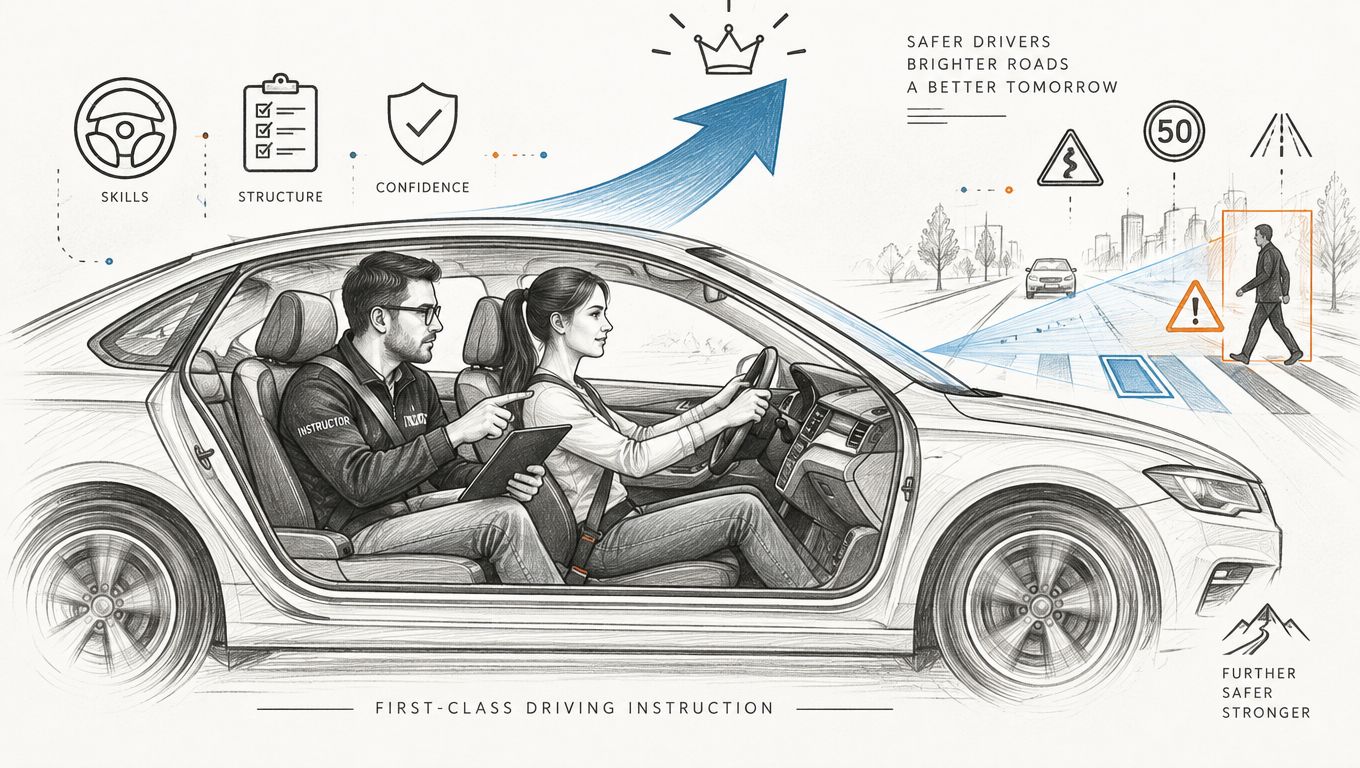
1.19 million people die in road crashes worldwide each year, and in the U.S. 12,429 people died in alcohol-impaired-driving crashes in 2023. First class driving means you lower those risks with sharper hazard detection, zero tolerance for impairment, and Georgia-approved paperwork that matches your case.
If you're staring at a DUI notice, a points problem, or a court deadline, this isn't the moment for a brochure-level refresher. It's the moment to learn what good driving really looks like, what Georgia requires, and how to avoid paying twice for the same mistake.
What First Class Driving Actually Means
A lot of drivers hear first class driving and think it means being smooth, polite, or able to park without sweating. That's part of it, but it's not the whole job. In plain English, first class driving means you can see trouble early, avoid impairment completely, and choose the right Georgia-approved course when the state or court says you need one.
The moment the difference becomes obvious
The difference usually shows up when a driver realizes a basic six-hour ticket class won't solve the underlying problem. Maybe the issue is a DUI. Maybe it's points. Maybe it's a teen who can steer but hasn't learned how to read traffic on I-85 at rush hour. In those moments, the driver doesn't need a slogan, they need a map.
That map starts with three habits. First, hazard awareness, which means scanning farther ahead than the bumper in front of you. Second, impairment avoidance, which means not driving after drinking and not pretending a “feel okay” judgment is the same as being safe. Third, technology literacy, which means knowing what lane-keeping, adaptive cruise control, and blind-spot alerts can do, and what they can't.
If you want a plain-English example of how that shows up after a crash or claim, the guidance at insurance claim navigation tips helps drivers think through the paperwork side without losing sight of the safety side.
Practical rule: if the course you're looking at only promises a certificate, but never teaches you how to avoid the same mistake next month, it's selling convenience, not competence.
For Georgia drivers, that distinction matters. A provider can talk about safety all day, but if it isn't the right kind of DDS-approved program for your situation, the class may not solve your reinstatement or court problem. If you want a broader look at the defensive-driving side of this, this Georgia guide on defensive driving benefits is a useful companion read.
What to look for in your own habits
A driver with first class habits can explain, in simple language, what they do before a merge, before a left turn, and before they ever decide to drink and drive. They know when they're relying on mirrors, when they're relying on space, and when they're relying too much on luck.
If that sounds more demanding than a standard refresher class, that's because it is. First class driving is a skill set, not a slogan.
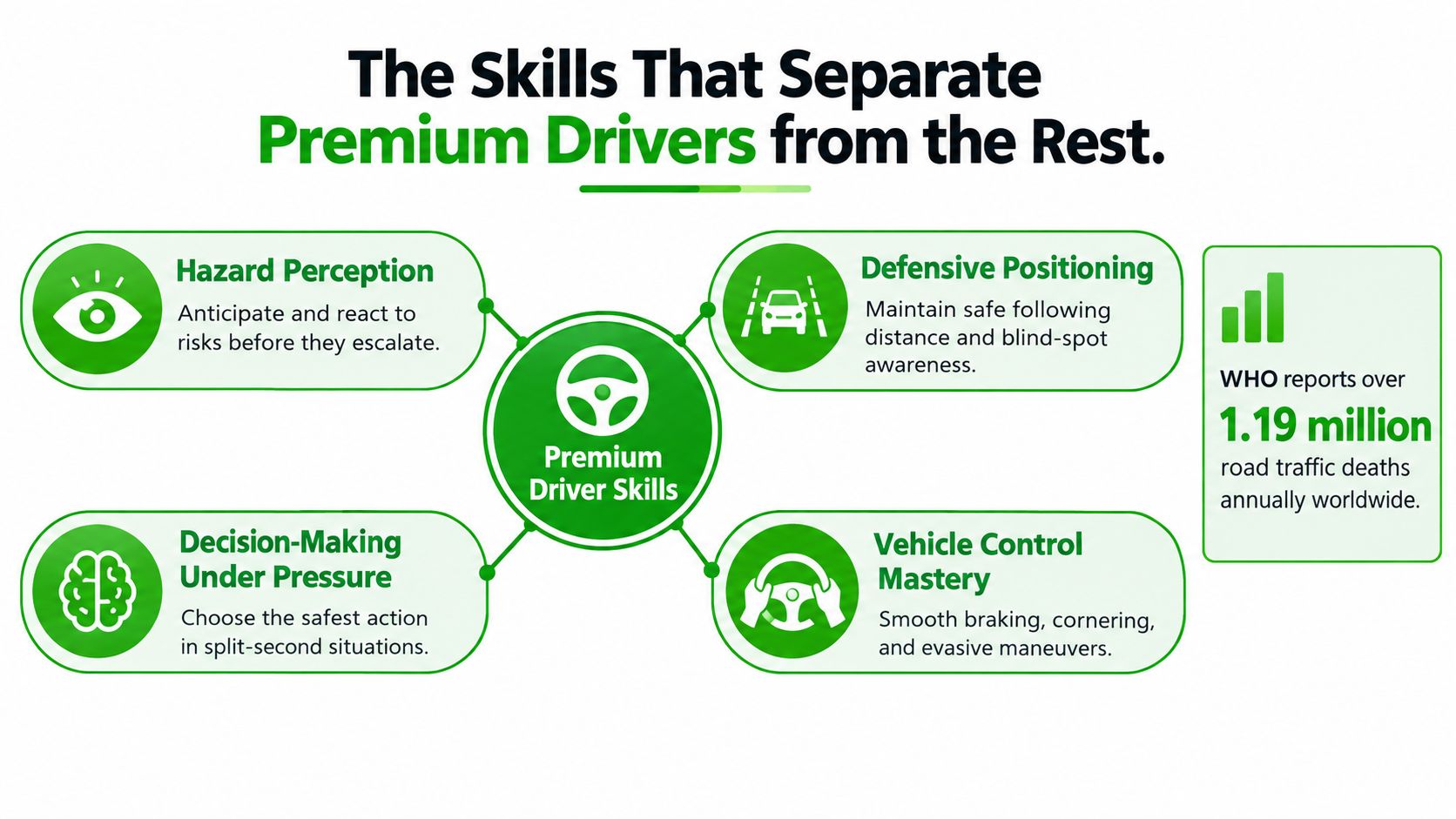
The Skills That Separate Premium Drivers from the Rest
A driver can know the rules and still miss the moment that matters. That gap shows up in research on hazard detection, where trained drivers recognized hazards more often than untrained drivers in both near-transfer and far-transfer scenarios (DOT hazard detection study). The lesson is simple, good driving is about seeing trouble early enough to leave yourself room.
Hazard perception beats casual confidence
On an ordinary Georgia road, hazard perception means looking past the hood ornament in front of you. You scan mirrors at regular intervals, watch for the driver who is drifting or braking late, and notice the car that is about to cut into your lane.
One useful habit is to choose an escape path before you need it. Before a busy merge or turn, ask yourself where the car could go if the space ahead closes up. That habit keeps your choices clear when traffic gets busy.
If you want a structured way to build these habits, this guide on how to improve your driving skills breaks the process into practiceable steps.
Keep your eyes working like a fan, not a flashlight. A flashlight locks onto one thing. A fan covers the whole room.
Impairment avoidance is a required skill
Alcohol changes judgment before many drivers feel fully impaired. The CDC says impairment can begin below the commonly used U.S. 0.08 g/dL per-se limit, so legal and physical safety are not the same thing (CDC impairment guidance). In 2023, alcohol-impaired-driving crashes caused 12,429 deaths in the U.S., which was 30% of all traffic fatalities, and 60% of those killed were the alcohol-impaired drivers themselves (NHTSA 2023 fatality data).
That is why first class driving includes a hard rule. If you are drinking, you do not drive. You arrange a sober driver, rideshare, taxi, or another plan before the first drink is poured.
ADAS helps only when the driver stays engaged
Modern cars can assist with lane-keeping, adaptive cruise control, blind-spot alerts, and emergency braking. They do not replace the driver. You still need to supervise the system, know when it may fail, and keep your attention on the road.
That is also where simple setup habits matter. adjusting your side mirrors safely is one of the easiest ways to reduce blind-spot guesswork before you start moving. Blind-spot awareness begins before the lane change, not after a close call.
Premium Instruction Versus the Minimum Compliance Checklist
A cheap class can hand you a certificate. A serious class changes what you notice, what you decide, and what you do when traffic gets messy. That difference matters even more when alcohol impairment or a court deadline is part of the picture.
What a serious program actually covers
A DDS-certified program should do more than read slides at you. It should cover the behavior behind the mistake, not just the rule number. It should also help drivers think through what happens after class, including reinstatement paperwork, clinical follow-up when needed, and the timing of any other required steps.
Georgia's DUI Risk Reduction program is built as a two-part process, with a 130-question assessment followed by a 20-hour intervention course that addresses substance use and its effect on driving (Georgia DDS DUI FAQ, DDS policies and procedures guide). That structure tells you something important. The state is not asking for a quick video and a signature. It's asking for screening, education, and documented completion.
Why the minimum often falls short
The CDC's warning about impairment beginning below 0.08 means a one-hour lecture can't do the heavy lifting by itself. A driver who believes coffee, sleep, or stubbornness can reverse alcohol risk needs more than a reminder. They need a behavioral reset.
That's where program depth matters. A stronger course gives room for real discussion, case examples, and concrete planning for the drive home, the next court date, or the next license step. A bare-bones class usually stops at compliance language and leaves the hard questions untouched.
Practical rule: if the provider can't explain how the class connects to your exact court, DDS, or reinstatement requirement, you're probably looking at a checkbox operation.
Georgia drivers should also remember that not every school offering driving education is approved for every purpose. DDS says only certified schools are approved to offer Driver Education, Defensive Driving, and DUI programs, and classes from uncertified schools won't be accepted for licensing or reinstatement (DDS regulated programs).
Which Georgia Program Matches Your Situation
A driver can hear “DUI class,” “defensive driving,” and “evaluation” and assume they all point to the same desk. They do not. The right program depends on what started the requirement, because Georgia uses different tools for different problems.
Four common paths, four different purposes
A DUI conviction points you toward Georgia's Risk Reduction process first. That path uses the assessment and intervention structure described earlier, and Georgia DDS says online DUI Risk Reduction certificates cannot be accepted for driver-license or driving-privilege purposes (Georgia DDS regulated programs). If convenience is the only reason for choosing an online option, that certificate can come back useless at reinstatement.
Defensive driving serves a different job. It is used for point reduction or insurance-related needs, and the focus is safer habits, collision avoidance, and meeting a non-DUI requirement.
A clinical evaluation is a separate step again. It is not a class. It is an assessment of substance-use severity and treatment needs, and repeat cases may call for treatment beyond education.
A Victim Impact Panel is its own requirement as well. That session deals with consequences, not driving technique.
| Georgia situation | Likely path | What it's for |
|---|---|---|
| DUI conviction | Risk Reduction | Assessment, intervention, and reinstatement-related compliance |
| Points or insurance need | Defensive driving | Safer habits, point reduction, or insurance-related requirements |
| Substance-use concern flagged by court or DDS | Clinical evaluation | Professional assessment and treatment planning |
| DUI sentence requiring victim-impact education | Victim Impact Panel | Learning the real-world consequences of impaired driving |
A simple decision path
If the paperwork came from an impaired-driving charge, start with DUI and Risk Reduction. If it came from points, defensive driving is the likely fit. If the court named an evaluation, a class cannot replace it. If the order names a panel, the panel is the step to book.
Enrolling in defensive driving to satisfy a Risk Reduction order means the certificate is rejected at reinstatement and the fee is lost.
Why the Cheapest Option Is Often the Most Expensive Mistake
The lowest tuition can look smart right up until DDS sends the paperwork back. Then the cost appears in delay, rescheduling, and a second round of stress. A bargain class is only a bargain if it still meets the requirement the first time.
A low price also hides a practical problem. If the wrong program is chosen, or the certificate comes too late, the driver may miss a deadline and lose weeks waiting for the case to move again. A missed reinstatement deadline can push a court date back a month, which turns a cheap enrollment into a costly delay.
Certification is the provider's job, not yours
Georgia DDS puts certification responsibility on the school, not on the student. Only DDS-certified driving schools are approved to offer Driver Education, Defensive Driving, and DUI programs, and uncertified classes will not count for licensing, reinstatement, or court needs (DDS regulated programs). A polished website or a smooth sales pitch does not change that.
The timing rules matter too. DDS policies require attendance at all 20 hours of the intervention component, timely sign-in, and certificate issuance within one business day and no later than 48 hours after successful completion (DDS policies and procedures guide). If attendance is incomplete, no certificate timeline can fix the problem.
Hidden costs live in delays
A driver may feel they saved money by choosing the cheapest class. Then the class misses a requirement, issues the wrong certificate, or sends paperwork after the deadline. The result costs more than paying for the right fit at the start.
The same logic applies to hazard detection. Good instruction helps drivers spot trouble early and react before it grows. Weak instruction leaves a person technically enrolled but still unprepared for the road.
A cheap class that does not match your case is like buying the wrong key because the metal looked good.
Choosing Between In-Person, Live Virtual, and Self-Paced Formats
Format matters because your life isn't built around class catalogs. A working parent, a traveler with court dates, and a retiree looking for a slower pace all need different setups. The right choice depends on accountability, flexibility, and whether your requirement allows the format at all.
Match the class to the real-life situation
A weekend classroom session helps the parent who can't disappear on a weekday afternoon. Live virtual instruction works for someone who needs structure but can't sit in traffic across town. Self-paced online can fit a driver who needs flexibility and already knows the requirement is allowed in that format.
For Georgia drivers trying to save time, these Georgia defensive driving school hours are worth checking before you commit to a schedule. Class times matter more than people expect, especially when work, court, or family logistics are already tight.
| Driver situation | Best format | Why it fits |
|---|---|---|
| Working parent | Weekend in-person or live virtual | Keeps accountability while fitting a packed calendar |
| Professional with travel or court dates | Live virtual | Structured, easier to attend from different locations |
| Retiree wanting a slower pace | Self-paced online for defensive driving | Allows review and pacing without rushing |
| Driver with a DUI-related reinstatement issue | DDS-approved in-person or live virtual where accepted | Better fit for documented completion and compliance checks |
The format should serve the requirement
Live virtual can feel almost the same as a classroom when the instructor is engaged and attendance is tracked. Self-paced online is useful for defensive driving, but it isn't a safe assumption for DUI Risk Reduction if your goal is reinstatement.
The point is simple. Don't start with convenience. Start with the requirement, then choose the format.
A Practical Checklist for Vetting Any Georgia Driving School
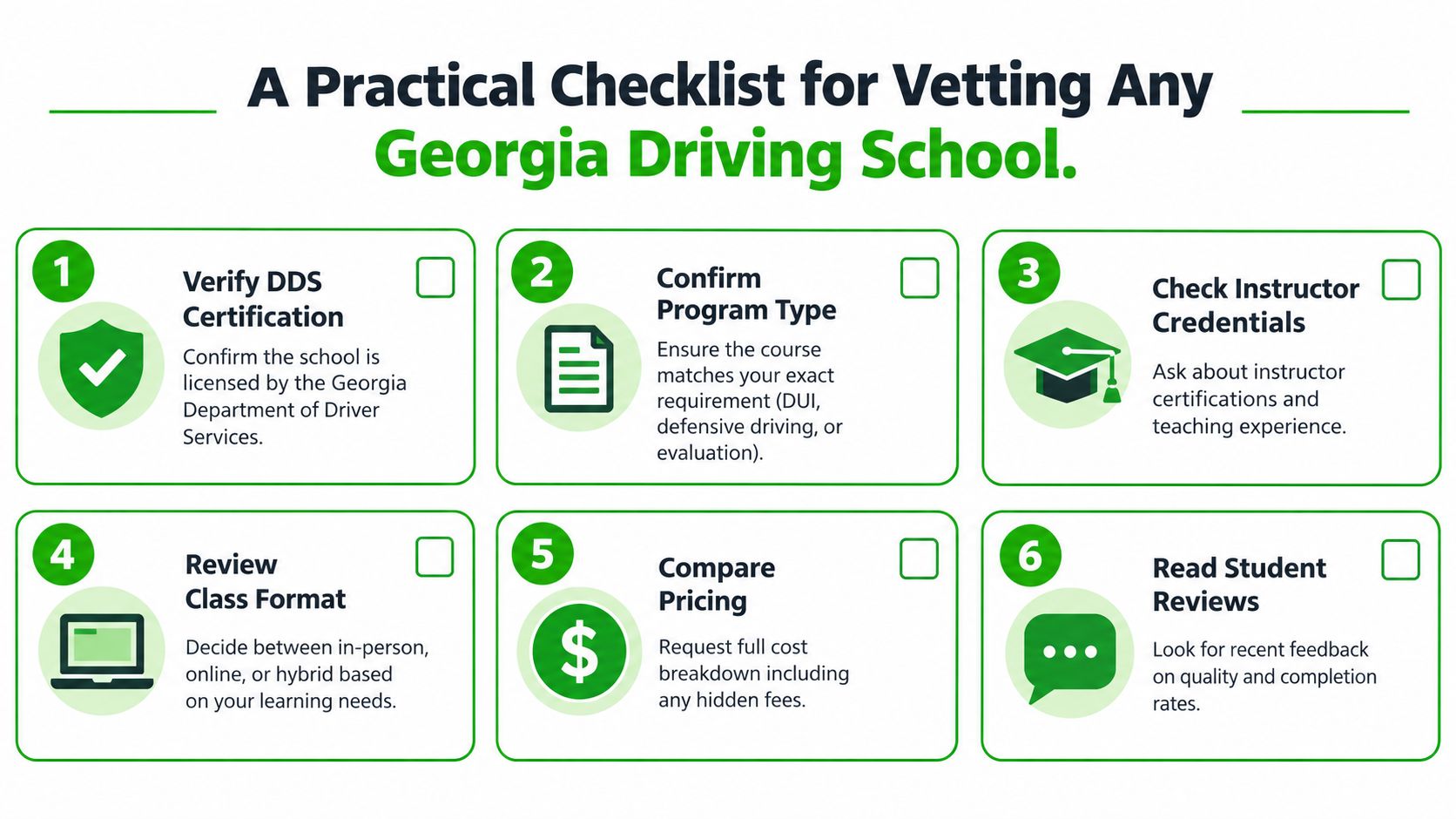
A school can sound polished and still miss the mark. Before you pay, check it the same way a careful driver checks mirrors before changing lanes. You are looking for proof that the program fits your situation, not just a friendly sales pitch.
What to check before enrollment
- Verify DDS certification: Confirm the school is approved by Georgia DDS for the exact program you need.
- Confirm the program type: DUI Risk Reduction, defensive driving, clinical evaluation support, and a Victim Impact Panel are different paths.
- Ask about instructor experience: You want an instructor who can explain behavior, not just recite policy.
- Review the format: In-person, live virtual, and self-paced options do not fit every requirement the same way.
- Check certificate timing: Ask how the school handles the completion certificate window for Risk Reduction.
- Confirm extra services: If you may need a clinical evaluation or Victim Impact Panel, ask whether the provider helps with scheduling.
If a school will not state its certification details clearly, that is a warning sign. The same is true if it promises online DUI Risk Reduction will work for reinstatement when DDS says it will not be accepted for driver-license or driving-privilege purposes.
Before you pay, ask the school to confirm in writing which DDS program code your certificate will be issued under.
Putting It Together and Choosing Your Next Step
First class driving is not a slogan. It's a combination of hazard perception, impairment avoidance, and Georgia compliance done correctly. If you can explain those three pieces, you're already thinking more like a serious driver than someone chasing the cheapest certificate.
For Georgia drivers who need a concrete next move, the path depends on the problem. Risk Reduction fits DUI-related compliance. Defensive driving fits point reduction and insurance-related needs. Clinical evaluation and ASAM Level 1 treatment belong in cases where substance use concerns have to be documented and addressed. Victim Impact Panels fit the educational requirements tied to many DUI cases.
Georgia DUI Schools provides those pathways in a few different formats, including Atlanta-area Risk Reduction classes, online and Zoom defensive driving, and clinical services such as evaluations, ASAM Level 1 treatment, and Victim Impact Panels. If your next step is tied to DUI, point reduction, or a court requirement, choose the program that matches the paperwork instead of guessing.
If you need a Georgia-approved path that lines up with your DUI, Risk Reduction, defensive driving, or clinical-evaluation requirement, Georgia DUI Schools offers those options in classroom, live virtual, and online formats. Visit Georgia DUI Schools to find the course that fits your situation and move forward with the right certification the first time.