

The most common advice about Georgia DUI paperwork is to finish the class fast, keep the certificate somewhere safe, and assume the rest closes itself. That advice fails a specific group of drivers every week: the ones whose sentencing order says clinical evaluation when they booked a Risk Reduction class, or says both. A certificate proves attendance at a state program. It doesn't answer the question a judge or the Department of Driver Services asked.
The mix-up is understandable. Both processes start with questions about drinking, both produce a document, and both get called "the assessment" by whoever is explaining them at the counter. They're different products, written by different people, with different consequences. One is a screening step inside an education program. The other is a clinical judgment by a licensed professional who can recommend treatment, request more records, or conclude that no disorder is present. Knowing which one is on your order is the difference between a closed file and another six weeks of appointments.
Clinical Assessment Is Not the Same as a Diagnosis
Say a driver in Cherokee County finishes the 20-hour Risk Reduction class on a Saturday, pays for the workbook, and picks up a Certificate of Completion the next week. The certificate goes to the probation office. The probation officer reads the sentencing order, finds the phrase clinical evaluation with treatment recommendations, and tells the driver the file stays open. Nothing went wrong with the class. The driver completed the wrong requirement second.
Two terms explain what happened.
Clinical assessment is the organized collection of information: how much a person drinks or uses, in what pattern, over what period, with what consequences, alongside medical history, mental health symptoms, prescribed medications, and the effect on work, family, and driving.
Diagnosis is what a clinician concludes afterward, by applying formal criteria, that a disorder is present, is not present, or cannot be decided yet without more information.
Finishing a screen or a class does not diagnose anyone, and it does not create a treatment plan. Those are separate acts, performed by different people, documented on different paper.
Why the distinction matters in practice comes down to who is holding the file. The Georgia Department of Driver Services tracks one set of requirements for reinstatement. A sentencing judge sets probation conditions that can go further. A treatment provider needs a third thing entirely, a level-of-care recommendation it can admit someone into. Three readers, three documents, and only one of them arrives in the mail after class.
If you've ever wondered why the words assessment and evaluation get used as if they were interchangeable when the paperwork treats them as different products, the difference between a DUI assessment and a clinical evaluation is worth ten minutes before you book anything.
What follows walks the path in order: the four steps from a screen to a care plan, Georgia's first-offense and repeat-offense rules, what a clinician weighs in the room, how findings turn into a level of care, and what to do with the order already in your hand.
Four Steps From a Screen to a Care Plan
Find the document you were told to complete before reading further. The steps below sit in a fixed order, and each answers a narrower question than the one after it. Skipping ahead is how drivers end up with a certificate that satisfies nobody.
| Step | Question it answers | Who or what produces it | A result does not prove |
|---|---|---|---|
| Risk Reduction screening | How alcohol or drug use relates to driving | 130-question comprehensive screening instrument, not pass or fail | A substance-use disorder or a treatment plan |
| Brief clinical screen | Whether use is hazardous enough for a full interview | AUDIT-C or the NIAAA single question | A diagnosis |
| Clinical evaluation | Whether a disorder and a need for treatment are present | DBHDD-approved medical or mental health evaluator | That Risk Reduction or license reinstatement is finished |
| Diagnosis | Whether formal criteria for a disorder are met | Clinician applying ICD or DSM criteria | The right intensity of care |
| Level-of-care recommendation | What intensity can manage the risks found | Multidimensional ASAM review | That risk ended because a class was completed |
Reading the Rows in Order
The Risk Reduction assessment is the first of two mandatory components in Georgia's DUI program, and it comes before the class. The Georgia Department of Driver Services describes it as a 130-question screening instrument that evaluates alcohol and drug use and its effect on driving. It is widely known as the NEEDS assessment. It isn't pass or fail, and no score on it declares that anyone has a disorder.
A brief clinical screen is the smaller tool a physician's office or emergency department uses. It flags who needs a longer conversation. Evidence summarized by the National Academies puts the NIAAA single-question screen for heavy episodic drinking at roughly 0.73 to 0.88 sensitivity and 0.74 to 1.00 specificity in adults, while the three-item AUDIT-C shows comparable sensitivity with more variable specificity, as the National Academies chapter on screening and diagnosis reports. Useful for triage. Not a verdict.
A clinical evaluation is a separate, in-depth appointment with a medical or mental health professional holding DBHDD approval. That clinician determines whether a substance use disorder exists and whether treatment is required. This is the document judges order by name.
Diagnosis comes next, and it means someone applied formal criteria to the whole picture rather than to one answer. A labeled disorder still doesn't tell a court whether the person needs education only or a treatment episode.
A level-of-care recommendation is the final step, built on a multidimensional review of withdrawal risk, medical status, mental health, relapse potential, and home environment.
A positive screen should trigger structured follow-up on consumption pattern, impaired control, consequences, tolerance or withdrawal, daily functioning, co-occurring conditions, and safety risks. Self-report alone can understate frequency and escalation, which is why collateral records, prior incidents, and toxicology when clinically justified improve confidence without any single source deciding the case.
Georgia Rules for DUI Evaluations
Here's the answer most drivers need first. For a first DUI within five years, DDS generally does not require a clinical evaluation or recommended treatment to reinstate under O.C.G.A. § 40-5-63.1. For a second DUI within ten years, that requirement applies. A judge can still order an evaluation or treatment as a probation condition after a first offense, and that order stands on its own. The DDS DUI reinstatement chart lays out the split.
| Situation | Clinical evaluation for DDS | What else still applies |
|---|---|---|
| First DUI within 5 years | Generally not required to reinstate under O.C.G.A. § 40-5-63.1 | Risk Reduction still required; a judge may order an evaluation as probation |
| Second DUI within 10 years | Generally required, plus any recommended treatment | Risk Reduction and treatment documentation |
| Court order after any offense | Required if the judge orders it, even when DDS does not | Completing Risk Reduction does not satisfy the separate order |
| Habitual-violator revocation | Required with recommended-treatment proof | Five years elapsed; Risk Reduction, interlock, testing, and fee documentation |
When the Judge's Order Is the Real Requirement
Most of the confusion lives here. A judge may order a clinical evaluation in addition to the Risk Reduction Program, and completing the program does not satisfy a separately ordered evaluation. Two documents, two purposes, no substitution.
If you're weighing whether to challenge the underlying charge while you sort out the requirements, fighting a first DUI charge in Georgia covers how the charge itself is contested, which is a different question from which evaluation the court wants.
The Habitual Violator File
A habitual-violator revocation runs on its own timeline. Under DDS Rule 375-3-3-.07, five years must elapse before a driver becomes eligible, and the reinstatement packet must contain applicable DUI Risk Reduction documentation, clinical-evaluation and recommended-treatment proof, ignition-interlock records, testing records, and fees. The listed reinstatement fee is $410, or $400 when paid by mail, for revocations imposed on or after July 1, 2009. Send the packet without one of those documents and it comes back.
Read your paperwork for the words clinical evaluation or treatment, not just the words DUI school. If only the school is named, you're likely looking at the Risk Reduction program. If an evaluation or a treatment recommendation appears anywhere on the order, that's a separate appointment with a separate provider, and no certificate from a class will stand in for it.
What Clinicians Weigh Before They Diagnose
An evaluation isn't a grade on a form, and it isn't a personality test. It's a sequence of questions where each answer narrows the next one. Two evaluators can reach different conclusions about the same person without either being careless, which is why the reasoning has to be written down.
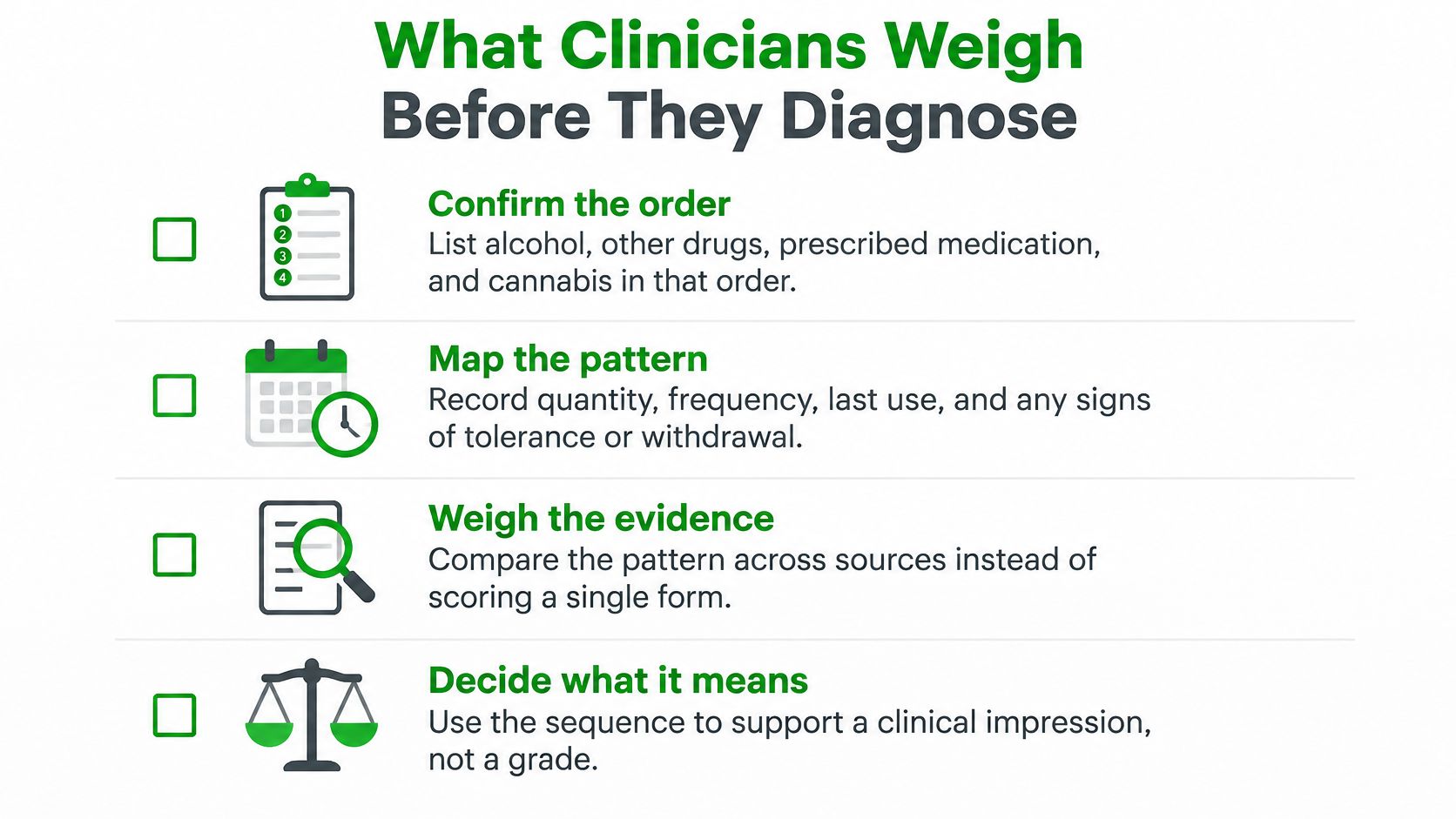
Seven Moves in the Room
- Confirm the order. What did the court or DDS ask for, and by when? Then list alcohol, other drugs, prescribed medication, and cannabis, in that order. Prescribed medication belongs in the record even when it isn't the reason for the visit.
- Map the pattern. Quantity, frequency, time of last use, and any escalation over months or years.
- Test for impaired control and consequences. Have you tried to cut back? What happened? Any blackouts, withdrawal symptoms, tolerance, or mornings that start with a drink to steady yourself?
- Trace the driving and life effects. Prior incidents, license actions, missed work, family strain, and the practical effect on daily functioning.
- Screen for conditions that mimic or worsen substance problems. Anxiety, depression, trauma history, sleep problems, chronic pain, thyroid disease, and cognitive changes can all shift the picture.
- Add collateral where appropriate. Earlier evaluations, court paperwork, treatment discharge summaries, or toxicology already in the file.
- Apply the criteria and write down what remains uncertain. The World Health Organization's International Classification of Diseases is the shared vocabulary here; the WHO classification system notes that the eleventh revision was adopted in May 2019 and came into effect on January 1, 2022.
Why Two Services Can Describe the Same Person Differently
A 2025 systematic review covering 137 studies across 29 nations found that only 17% of studies reported structured assessment approaches, while diagnostic prevalence varied markedly between services, as published in the Australian and New Zealand Journal of Psychiatry. Inconsistent method produces inconsistent labels. It isn't evidence that the person changed.
Take a Cobb County driver whose probation order requires an evaluation. She brings the order, a medication list, and dates for two earlier treatment episodes. The evaluator records a recommendation for education, notes that the cannabis question remains unresolved, and explains what would settle it. That's a complete evaluation. One that says only "recommends treatment" with no reasoning is not.
Confidentiality has limits worth knowing before you sit down. Evaluators typically disclose what the referring court or agency will receive, and written releases cover the rest. Ask at the start who gets the report.
A completed evaluation counts when it produces understandable recommendations and a warm referral, not when the appointment simply ends.
If you disagree with a conclusion, the productive question isn't whether you passed. It's how the evidence was weighed and whether the report says what would change the answer. Questions about what an evaluator will ask, and what to bring, are covered in this guide to drug and alcohol evaluation questions.
Why One Test Score Cannot Diagnose You
A urine result, a breath test, and a questionnaire score all get treated as proof. None of them is a diagnosis. Each covers a different window: a breath test measures a moment, a urine screen measures days, a hair test measures months, and a questionnaire measures what someone remembers and is willing to say. None of them alone establishes impairment at the wheel, severity, causation, or the presence of a substance-use disorder.
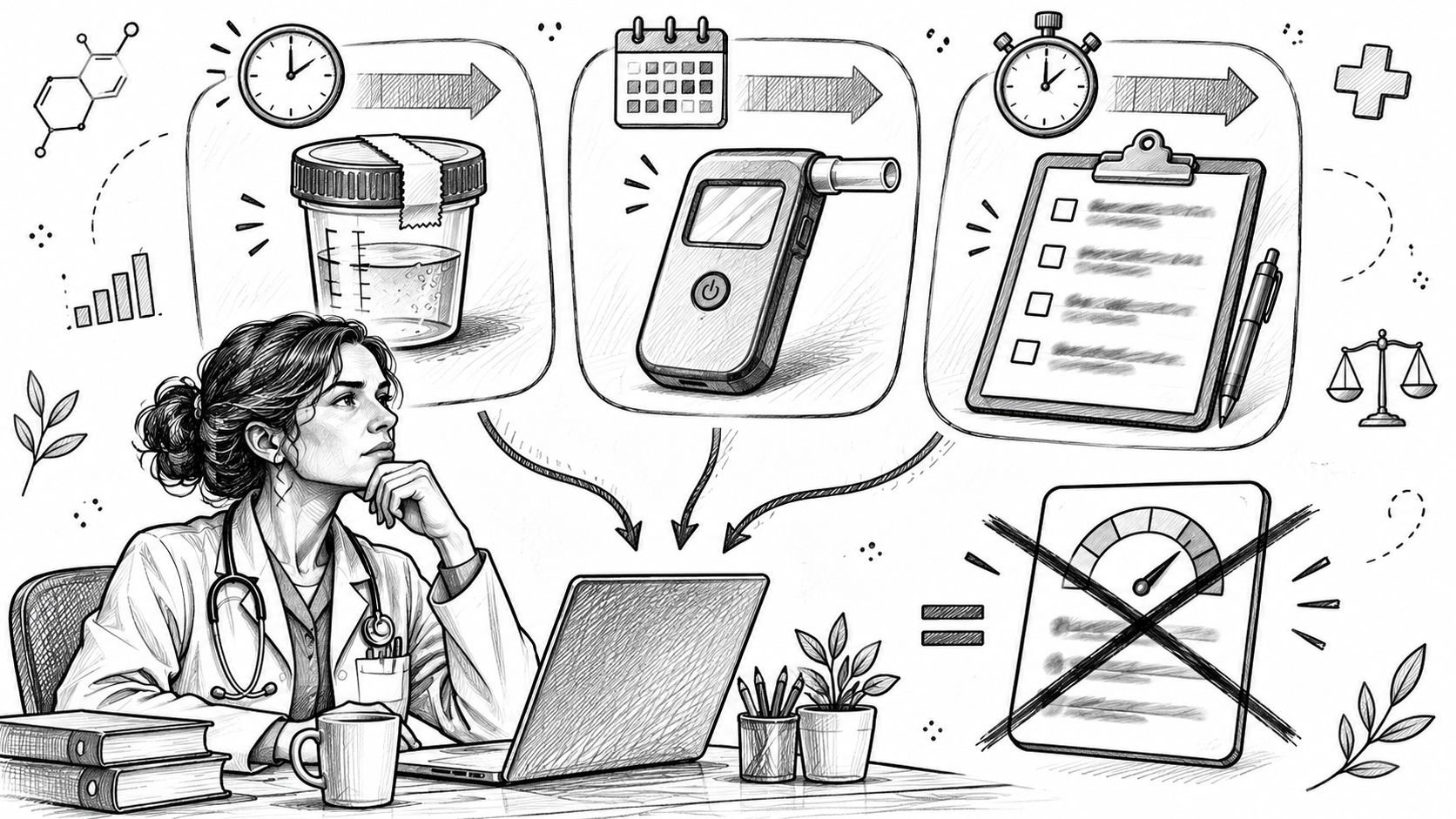
That isn't a reason to distrust testing. It's a reason to use it as one input. A National Academies review of diagnostic error estimated that approximately 5% of U.S. adults seeking outpatient care experience a diagnostic error, which extrapolates to about 12 million adults each year, or roughly 1 in 20, with about half of those errors estimated to have the potential to cause harm. The review calls that estimate probably conservative and specific to outpatient care, so it does not mean 5% of DUI evaluations are wrong. It means a systematic diagnostic process beats a single data point.
Laboratory work has its own error profile. A 2025 study covering 37,680,242 billable results recorded 87,317 errors, affecting 0.23% of results and about 0.79% of specimens, with 98.4% occurring before analysis, according to the published laboratory error analysis. Specimen validity, chain of custody, and collection timing all matter as much as the number printed on the report.
The trap to avoid: a high score on a screening instrument followed by a recommendation for education when functioning is stable, or a minimized self-report followed by a treatment recommendation when consequences and collateral point the other way. Neither is a contradiction. Both are clinicians reconciling evidence.
Three things change how a result gets read. Medication disclosure matters because prescriptions, including stimulants, sedatives, and some pain medications, can appear on a screen and require an explanation the evaluator records. Cannabis carries its own timing problem, since regular use can be detected long after the last impairment. Language and cultural factors change how symptoms are described and how questions land, so a competent evaluator uses a qualified interpreter rather than a family member.
Automated aids, from scoring software to AI-assisted interpretation, still require human review. Their output is an input to clinical judgment, not a substitute for it, and a model that performs well on one dataset doesn't automatically transfer to a different population.
For court-related work, the documentation standard is concrete: instrument, score, recall period, substance involved, and follow-up findings. When uncertainty or clinical complexity remains, the answer is a referral for more assessment, not a confident-sounding guess.
How ASAM Turns Findings Into a Level of Care
Naming a disorder doesn't tell a court whether someone needs education only or a treatment episode. That second decision is a separate piece of clinical reasoning, and ASAM's framework is the standard tool for it. It evaluates six domains rather than a single label or offense history, as the ASAM Criteria set out.
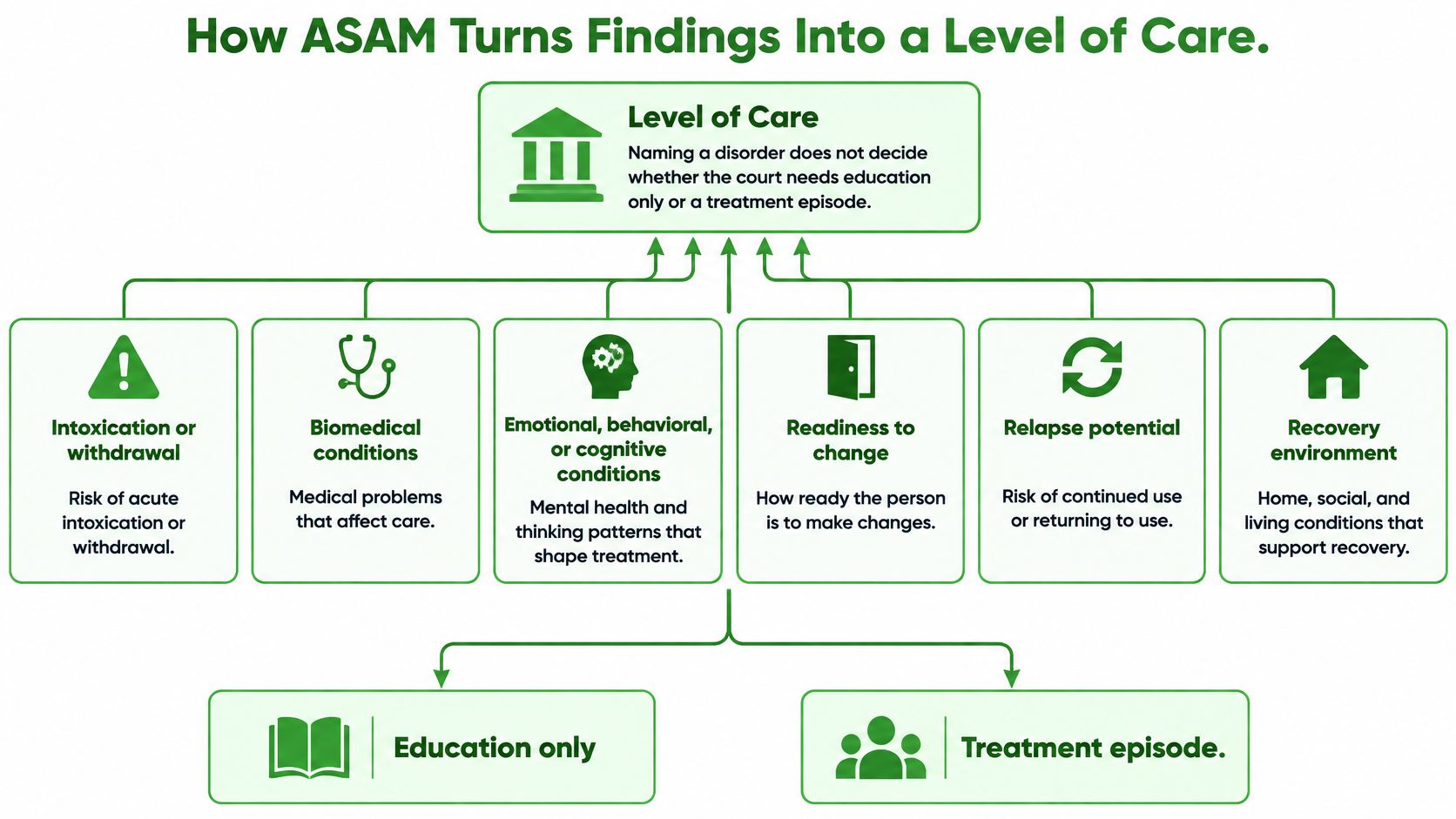
The Six Dimensions in Plain Language
- Intoxication, withdrawal, and medication needs. How risky is the next 72 hours without medical supervision?
- Biomedical conditions. Liver disease, seizures, pregnancy, chronic pain, or unstable medical status change what's safe.
- Psychiatric and cognitive conditions. Untreated severe depression, psychosis, or cognitive impairment limits what outpatient care can hold.
- Substance-use-related risks. What has the pattern already caused, and what is likely next?
- Recovery environment. Is home safe and supportive, or does it reliably undo progress?
- Person-centered factors. Preferences, transportation, work schedule, childcare, motivation, and the barriers that decide whether someone shows up.
Two Cases, Two Placements
Consider a driver with nightly heavy drinking, a seizure history, and a partner who also drinks heavily at home. Withdrawal risk plus unstable medical status plus an unsupportive environment make standard outpatient care a poor fit, even if the offense itself was unremarkable.
Now consider a driver with one high-BAC arrest, stable employment, no withdrawal symptoms, a supportive household, and full attendance at an education program. Low immediate risk and adequate functioning can support a less intensive outpatient placement, such as ASAM Level 1.
What the report should separate: diagnosis, risk formulation, recommended level of care, treatment conditions, and measurable reassessment criteria. Blending them into one paragraph is how a court ends up reading a course completion as if it meant risk had resolved.
Clinicians should name the specific dimensional drivers that can't be managed safely at a lower intensity, and reassess them whenever care changes. Finishing a course is an attendance fact. It is not evidence that clinical risk has resolved. Our own ASAM treatment levels explained walks through what each level involves in practice.
Book the Evaluation Your Order Requires
Match the next appointment to the paper in hand, not to whatever a friend did after their DUI. If the order says clinical evaluation, that means a DBHDD-approved evaluator, and the Risk Reduction assessment is not a substitute for it. If treatment is recommended, ask for the level of care in writing and what completion will look like, because "finish treatment" without a defined level and length is a requirement nobody can satisfy. Georgia DUI Schools provides clinical evaluations, ASAM Level 1 Treatment, and a Victim Impact Panel alongside DUI classes in person or online, so the pieces a court names can line up under one provider.
Three actions close the loop.
- Read the paperwork first. Is it for DDS reinstatement, for probation, or for both? The answer changes which document you need.
- Book the clinical evaluation the moment those words appear. Bring the order, your medication list, and any prior treatment records.
- Keep everything together. The evaluation report, treatment notes, and course certificate belong in one folder for the court or DDS.
Before you book, confirm the evaluator holds DBHDD approval and ask what report format the court or DDS expects. A well-run evaluation that arrives in the wrong format still delays you.
If your order names a clinical evaluation, or you're not sure whether you need one, Georgia DUI Schools conducts DBHDD-approved clinical evaluations with licensed clinicians who review your substance-use history, screening results, and records, then document whether treatment is recommended and at what level. We also provide ASAM Level 1 Treatment and a Victim Impact Panel, so the clinical pieces a judge or DDS requires can be scheduled together instead of pieced together. Start with Georgia DUI Schools and bring the order to your first appointment.