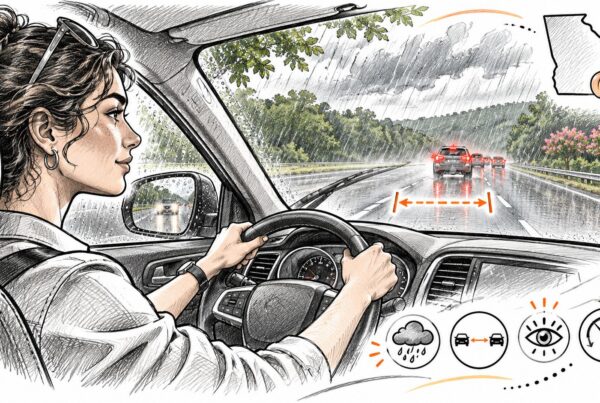
The World Health Organization estimates that road crashes kill about 1.16 million people every year, and its speed research shows how fast ordinary decisions compound: every 1% increase in mean vehicle speed produces roughly a 4% increase in fatal-crash risk (WHO road safety). That second number turns speed from a feeling into arithmetic. Add a little, and the odds against you grow a lot.
Defensive driving is the practice of expecting the other driver to make a mistake, then building enough time and space that the mistake doesn't become your crash. It isn't a personality trait and it isn't fast reflexes. It's a short list of habits you can practice and check on the road you'll drive tomorrow morning.
Seven Defensive Driving Techniques at a Glance
The working definition I give students is this: defensive driving means assuming another driver will do the wrong thing at the worst moment, and arranging your speed, position and attention so you already have an answer ready. Everything below is a version of that answer, organized by what it prevents.
| Technique | What the driver does | Reference value |
|---|---|---|
| Scan far ahead | Watch the roadway 20 to 30 seconds ahead | 2 blocks or signals in cities, about 1/4 mile in rural areas |
| Keep following space | Leave a fixed time gap to the car ahead | 3 seconds on dry, clear roads |
| Match speed to conditions | Drive to visibility, traffic and surface, not only the posted limit | Each 1% rise in mean speed raises fatal-crash risk about 4% |
| Stay off the phone | Keep devices out of reach while the car is moving | Phone users about 4 times more likely to crash |
| Plan an escape route | Know where to go if the car ahead stops suddenly | Check mirrors and sides continuously |
| Buckle up | Wear a seat belt on every trip | Up to 50% lower risk of death for occupants |
| Stay sober | No alcohol and no impairing medication, including prescriptions that cause drowsiness | A DUI can rest on impairment alone |
Take a common Atlanta case. You're northbound on I-285 at rush hour, and brake lights start popping three cars ahead of the pickup in front of you. A driver watching only that truck sees the problem when the truck's nose dives. A driver who scanned 20 to 30 seconds up the road saw the wave begin, lifted off the throttle, and shed 10 mph without touching the brake. Nobody behind has to stab the pedal, and the chain reaction stops with you.
On your next commute: count how many cars ahead you can actually see the road through. If it's one, that's your whole warning system.
Scanning sits first on the list because every other habit depends on it. You can't hold three seconds of following distance if you notice the hazard at the same instant the car ahead does, and you can't name an escape route you never looked for. Work through the list in the order you'd use it on a real trip: what to see, how much room to leave, what to remove from your hands and your head, and what Georgia law adds on top.
How Far Ahead to Scan and How to Cycle Your Attention
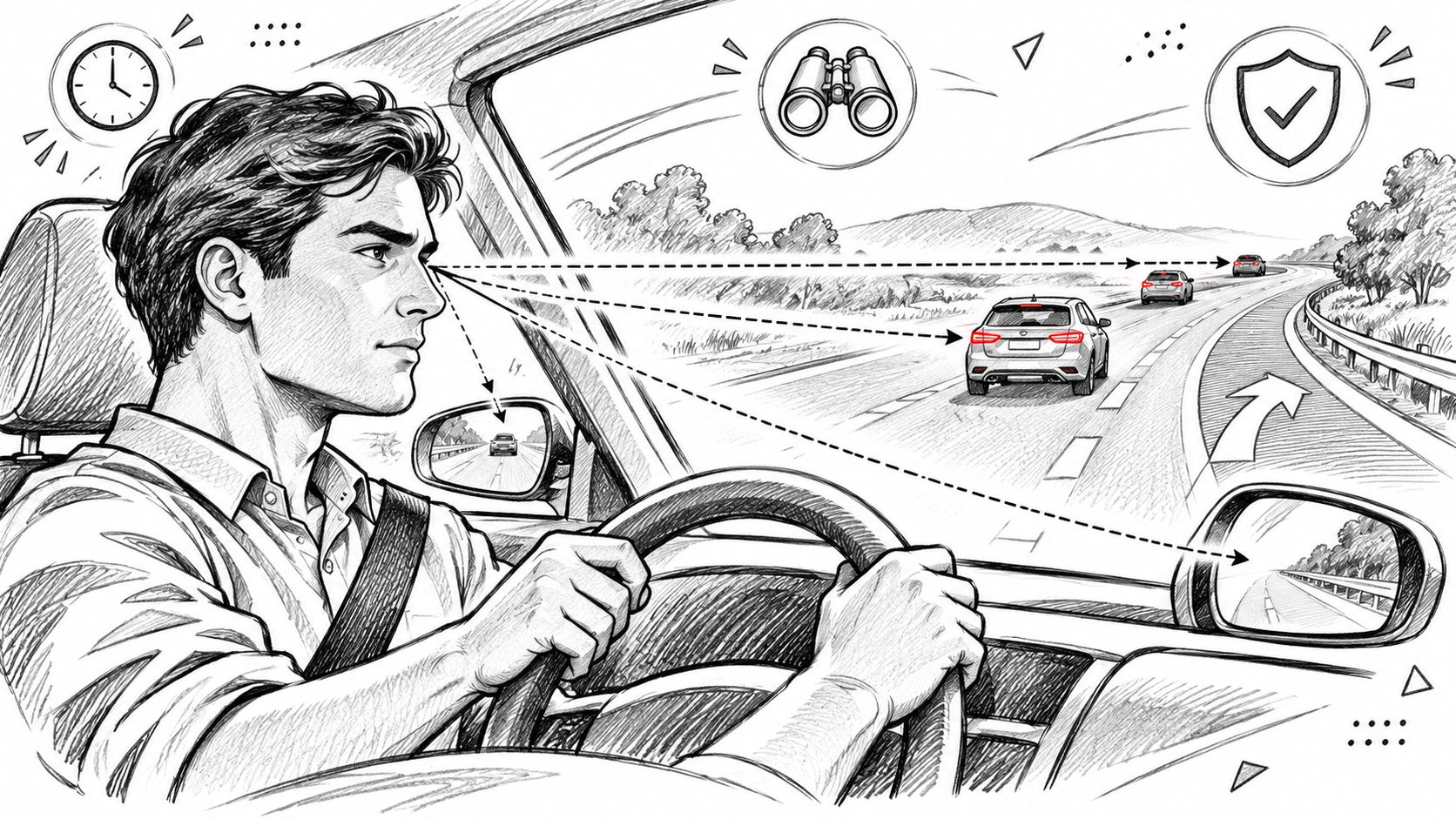
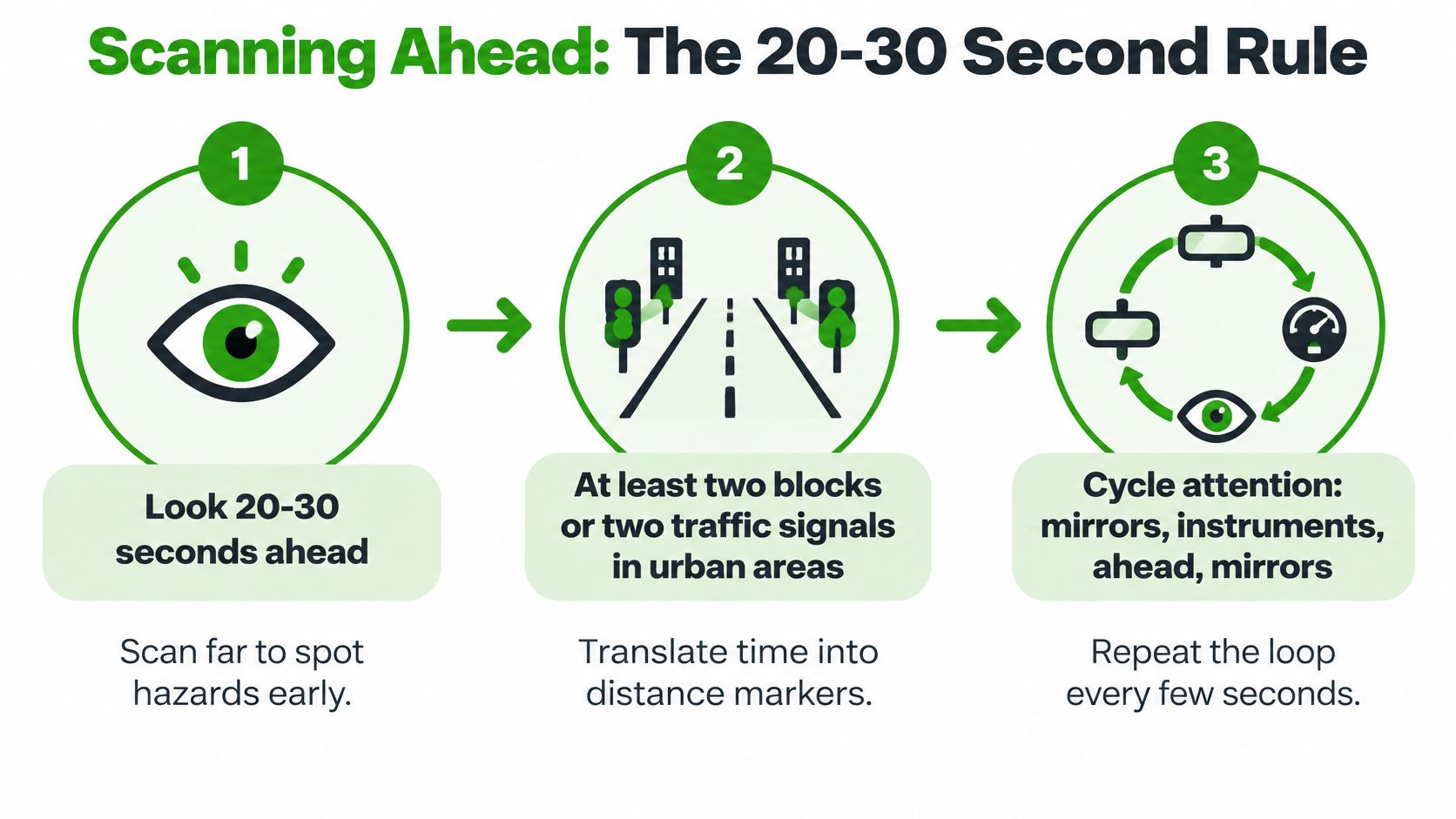
A driver who watches only the vehicle ahead has little time to respond when traffic changes. As a general driving practice, scan 20 to 30 seconds down the road, adjusting the view to your speed and surroundings. In town, that may mean at least two blocks or traffic signals; on suburban roads, three blocks or signals; on rural roads, about one quarter mile. The goal is to spot a queue, a car entering the road, or a pedestrian early enough to ease off the accelerator. Drivers need time to perceive hazards and react, as described in NHTSA's guidance on driver perception.
A Lookup Table for Georgia Roads
| Road type | Scan distance | Georgia example |
|---|---|---|
| Urban streets | At least 2 blocks or 2 traffic signals | Downtown Atlanta streets with signals every block |
| Suburban roads | At least 3 blocks or 3 traffic signals | Busy arterials north of Atlanta with long light cycles |
| Rural roads | About 1/4 mile | Two-lane roads on the outskirts of Athens with hidden curves |
| Highways at speed | 20 to 30 seconds of roadway | I-285 Perimeter during rush hour |
Use these distances as practical guides, not fixed measurements. In downtown Atlanta, look beyond the next light to see queued traffic and crosswalks. On suburban arterials, watch how traffic is building toward the signals. Outside Athens, keep your view open for curves and vehicles entering from side roads. A blocked view means you have less warning, so adjust your scan to what is visible.
The Five-Step Scan Cycle
- Find the far view. Locate the next signal, curve, merge, or interchange.
- Check your lane two to three seconds ahead. Notice what could affect your path soon.
- Sweep mirrors and side streets. Look for cross traffic and vehicles approaching from behind.
- Name an escape route. Identify an open lane, shoulder, or driveway if your path is blocked.
- Adapt when visibility shrinks. Darkness, rain, and a tall vehicle ahead can shorten your view. Scan what remains visible and avoid relying on a distant view you cannot see.
The cycle is a repeated check, not a reason to stare at one point. If a truck blocks your view, for example, check the space around it and the road visible beside it, then reassess as your view changes. The power and towing mirror adjustment tips explain mirror settings for trucks, SUVs, and vehicles towing a load.
Self-check: Can you name the next visible hazard ahead? If not, widen your scan when it is safe, and respond to the limited view by staying ready to slow.
How Much Space and Speed Margin to Leave
Space is the one habit you can measure from the driver's seat without a device. Pick a fixed object the car ahead just passed, a sign or a bridge joint or a discolored patch of pavement, and count one-thousand-one, one-thousand-two, one-thousand-three. If your bumper reaches that object before you finish counting, drop back.
That's the baseline, and it widens with conditions.
| Condition | Minimum following time | Why the gap grows |
|---|---|---|
| Dry, clear road | 3 seconds | Baseline for normal stopping |
| Wet pavement | 4 seconds | Longer braking distance on slick surfaces |
| Night or fog | 4 to 5 seconds | Reduced sight distance and later hazard detection |
| Heavy traffic or large trucks ahead | 4 seconds or more | Limited view past the vehicle ahead |
| Icy or snowy road | 8 seconds or more | Very low grip, much longer stopping distance |
The Three-Second Count Is a Floor
Three seconds is not a target you hit and hold. It's the minimum for ideal conditions, and Georgia rarely offers ideal conditions for long. A summer thunderstorm on I-285 can cut your available grip in half in the time it takes to cross an overpass. Behind a box truck, four seconds buys you the one thing the truck blocks completely: the view of what's happening two cars in front of it.
Speed Is Its Own Decision
Choosing a speed is separate from obeying the posted limit. On a wet afternoon on I-285 near the Perimeter, a driver holding 70 mph needs a lot more road to stop than one who eased off before the overpass, and the difference is a car length or more. Stopping distance grows faster than speed does, so the last few miles per hour are the most expensive ones you carry.
The gap test: if you can't say where you'd steer if the car ahead stopped dead right now, you're following too closely for the speed you're carrying.
When someone tailgates you, braking to teach them a lesson is how rear-end crashes get made. Widen the gap in front of you gradually instead, so any stop you make can be stretched over several car lengths and the driver behind you gets the same courtesy you gave the car ahead. Slow before curves and downhill grades too. Brakes and tires work best when the speed is already set on entry, and the margin you spend inside a curve is the margin you can't buy back.
Keeping Your Attention on the Driving Task
Drivers using a mobile phone are about four times more likely to be involved in a crash than drivers who don't use one, and the WHO road traffic injuries fact sheet explains the mechanics: phone use slows braking and signal reaction, makes lane keeping harder, and erodes the following distance from the section before this one.
Why Hands-Free Doesn't Fix It
The assumption worth challenging is that a hands-free call solves the problem. Hands-free systems are not considered much safer than handheld phones, because the risk doesn't live in your hand. It lives in the part of your brain that's still composing sentences while your car closes on a stopped lane.
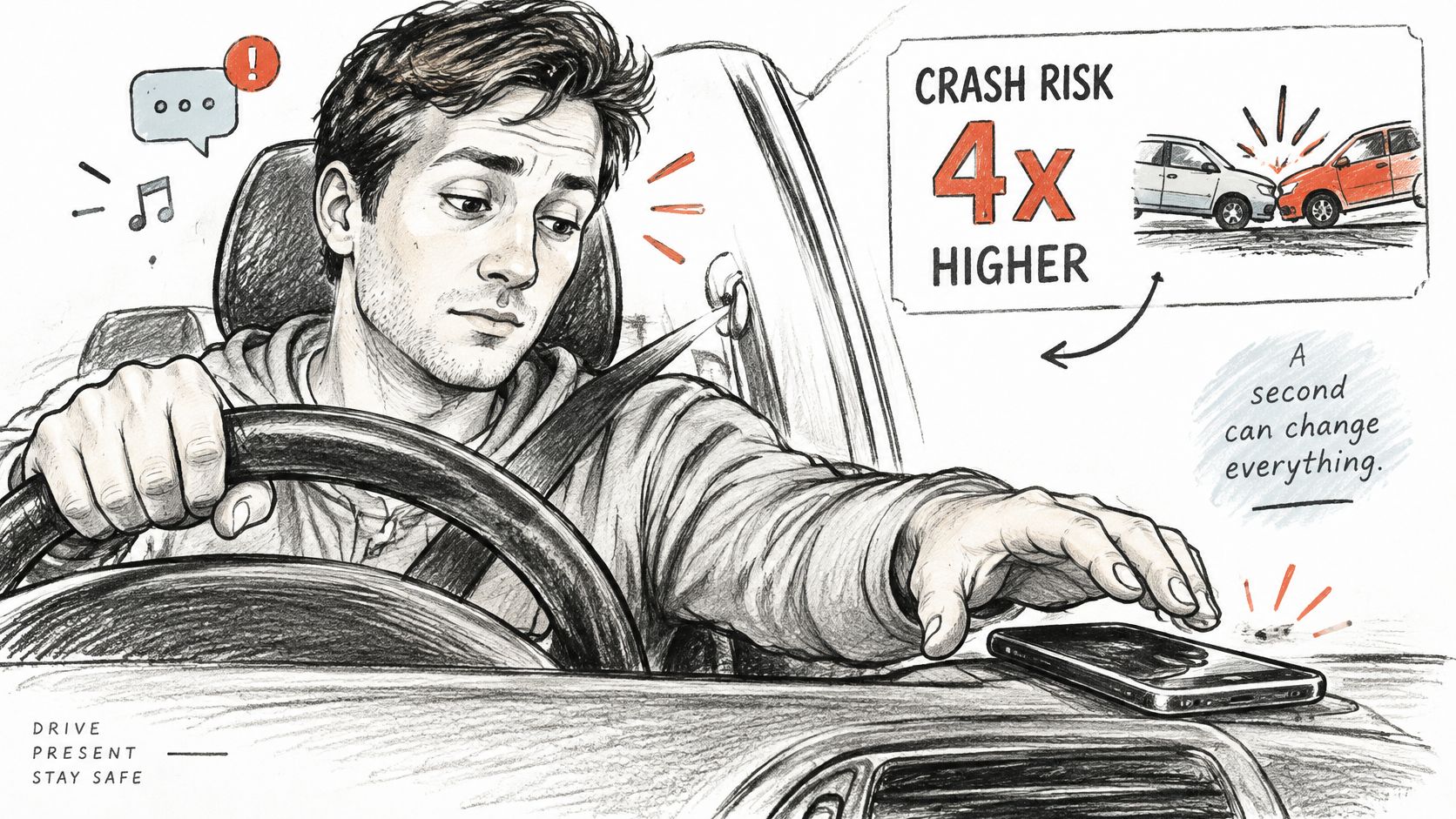
Eyes forward isn't enough either. The Federal Highway Administration's research treats reaction time, following headway, lane tracking, speed maintenance and hazard detection as measurable signs of distraction, and reports that reaction times degrade as mental workload climbs.
The Pre-Drive Setup
- Set the destination before the car moves. Navigation should be a decision you made while parked, not a negotiation at 60 mph.
- Silence what isn't essential. Alerts you'll ignore train you to ignore the ones that matter.
- Stow the phone out of reach. A glovebox or a bag in the back seat beats a phone in a cupholder.
- Finish music and climate in the parking lot. Radio and HVAC adjustments are small, but they cluster right when you merge.
Say you're stopped at the Broad Street light in Athens, checking a delivery app for the next stop. The light turns, you go, and the pedestrian stepping off the curb gets your full attention about a second later than she needed it. Nothing dramatic happens. That's the point: most distraction crashes are a second late, not a wild swerve.
More on building those habits is covered in these distracted driving prevention tips. The rule to keep is simple. If a task needs more than a quick glance, it needs a parking space, not a red light.
Alcohol Limits and DUI Requirements in Georgia
Georgia sets blood alcohol concentration limits because impairment can affect driving before a person recognizes it. A practical check is to separate the legal threshold from how sober you feel. Feeling capable does not change the limit.
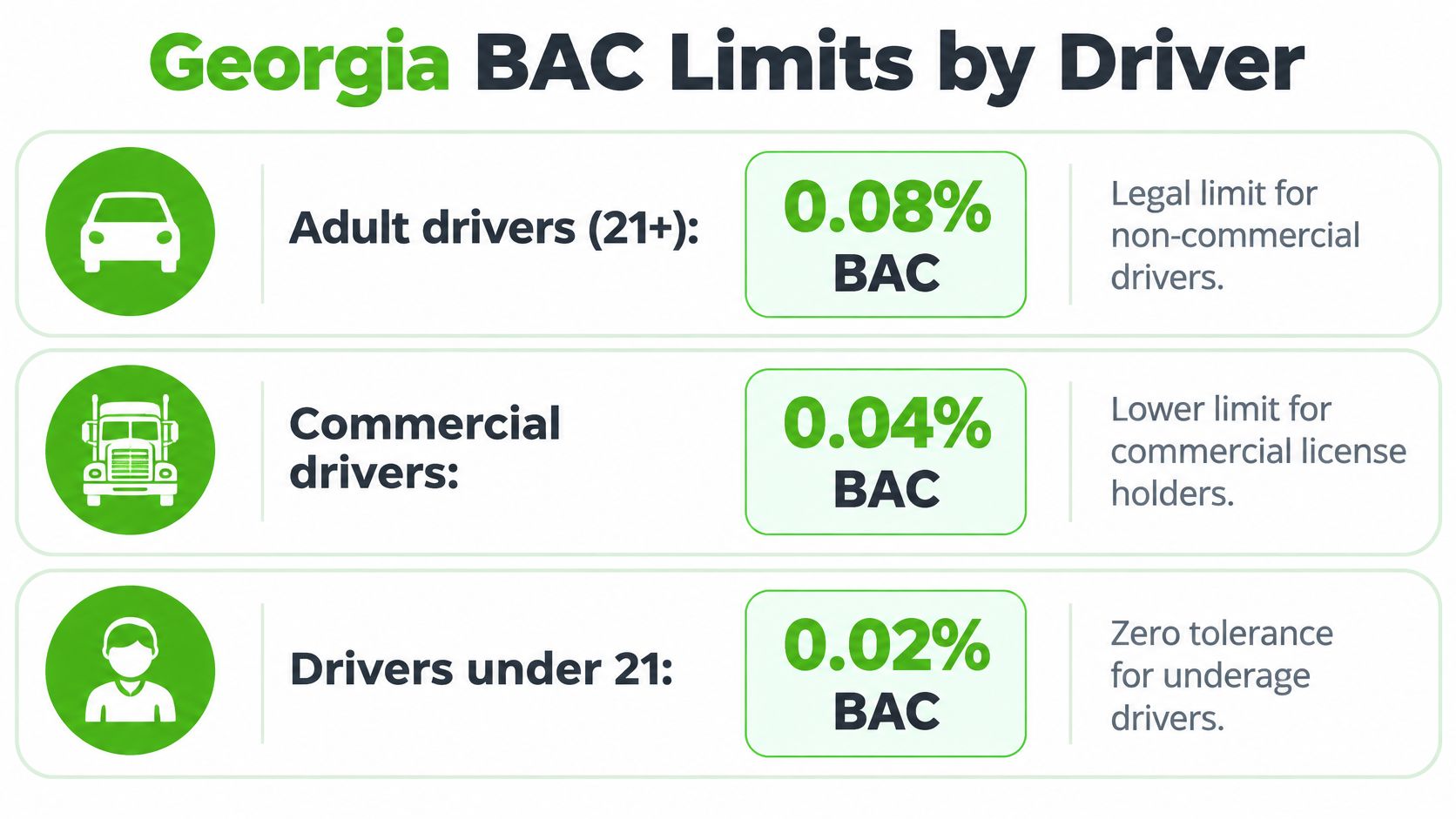
| Driver group | BAC limit or note |
|---|---|
| Drivers age 21 and older | 0.08% BAC |
| Commercial drivers with a CDL | 0.04% BAC |
| Drivers under age 21 | 0.02% BAC |
| Any driver impaired by drugs | Impairment alone can support a DUI charge |
Georgia's BAC thresholds are per se limits. That means a driver may be charged based on a reading at or above the applicable limit, even if they do not feel drunk. The commercial limit is lower than the adult limit, and the under-21 limit is lower still. For drivers under 21, 0.02% is effectively zero tolerance, a level one drink can reach for many people. For example, a 19-year-old in Athens can face arrest at 0.02%, even though that is a quarter of the adult threshold. Review Georgia's legal blood alcohol limit to understand how the limits apply.
The Court-Ordered Path
Alcohol is not the only concern. Drugs and medication can also affect safe driving. A prescription or over-the-counter medicine that causes drowsiness may impair a driver, even when there is no alcohol in their system.
For a DUI charge, the required education follows a separate path. Georgia DDS's DUI FAQs describe the DUI Alcohol or Drug Use Risk Reduction program as two components. First, a 130-question Assessment Component, also called the NEEDS assessment, evaluates alcohol and drug use and their effects on driving. Then, a 20-hour Intervention Component provides group-based therapeutic education and peer counseling. Both components must be completed to receive a certificate of completion.
The assessment helps determine what the group needs to address during the intervention. A first-time offender in Atlanta may proceed from assessment into the 20-hour program, while a driver with a prior offense or clinical referral may have additional steps before receiving a certificate.
Risk Reduction is court-ordered education connected to an impaired-driving charge. Defensive driving is a separate course, which drivers may take for points, insurance or a license reinstatement requirement. Check which course your court or licensing requirement specifies before enrolling.
Defensive Habits for Driver-Assistance Features and Aging Drivers
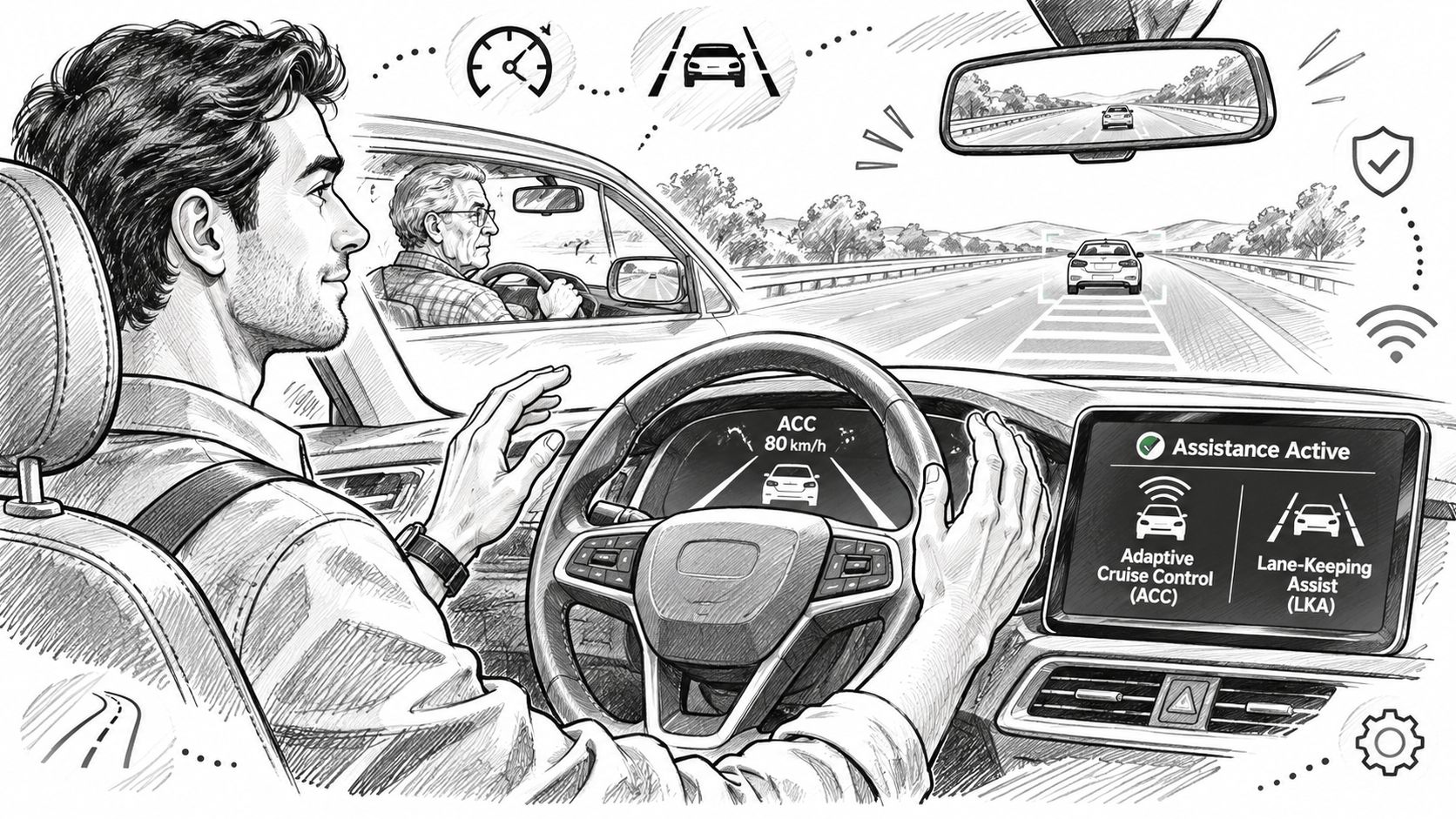
Adaptive cruise control, lane-keeping assist and automatic emergency braking reduce workload, but they don't take over the job. The habit that changes is verification: you check what the feature can see before you let it drive, and you stay ready to correct it.
Research on this is fairly blunt. In a study of 36 drivers, targeted knowledge training improved understanding of system limits, and those drivers used lane-keeping assist and adaptive cruise control 1.4 and 1.45 times as often as drivers who only read the owner's manual, while recognizing more situations that required manual control (PubMed study on ADAS training). The same work reviewed 11 real-world ADAS crash and near-crash incidents and found the technology helped prevent at least two collisions but likely contributed to two others, including unexplained braking and missed lane departures.
What the Systems Can't See
- Read the conditions section of the manual. Most systems list the weather and road-marking conditions where they pause or weaken.
- Learn the disengage move before you need it, so cancelling takes a thumb rather than a search.
- Expect weaker performance in rain, glare, worn lane markings, curves, construction zones, and near motorcycles. Lane-keeping assist tracks painted lines; it doesn't see a rider splitting between lanes.
- Keep hands on the wheel and eyes on the road. This is the one line in every owner's manual that outranks the marketing.
A system that keeps the car centered is not a system that knows what's beside it.
Say you're on I-75 through Atlanta and the rain starts hard enough to matter. Adaptive cruise control set at 70 won't necessarily react to spray, standing water or a car braking hard a few hundred feet ahead, and it may drop out. Your job is to feel that hesitation and brake first.
Adaptation, Not Retreat
Scaling back isn't the goal for older drivers; adapting is. The training study found older participants kept automated features engaged longer, which is exactly the pattern that deserves a second look. Useful adjustments: add a second or two to your following gap, pick a lower-complexity route at a less crowded hour, plan around glare at dawn and dusk, take a break before you feel tired, and confirm every alert is loud enough and worded clearly.
A real adaptation is taking the 10 a.m. route with four turns instead of the 8 a.m. merge. A false safeguard is letting lane-keeping assist stand in for a shoulder check. If you or a parent are weighing that tradeoff, this older driver evaluation walks through the self-assessment questions and when a professional assessment makes sense.
Choose a Certified Defensive Driving Course in Georgia
Georgia caps the benefit, and the cap is worth planning around. DDS lets a certified driver improvement course remove as many as 7 license points, but only once in any 5-year period, and the original completion certificate has to be submitted at a DDS Customer Service Center or by mail (Georgia DDS points and point reduction). Two courses in three years still count as one.
The course itself is standardized. Georgia DDS's Driver Improvement Program page describes the approved course as a 6-hour program focused on safe driving attitudes and behaviors, and warns that only certified schools are acceptable for licensing, reinstatement or court requirements. An uncertified class may not satisfy the obligation you're trying to clear.
Enrolling Without Wasting a Course
- Name the reason first. Points, an insurance discount, a court order, reinstatement or plain personal education each have different paperwork.
- Verify DDS certification before you pay. Check the provider, not the search result.
- Confirm the format your court, insurer or DDS will accept. Self-paced online defensive driving is not accepted by Georgia DDS for point reduction, court orders or license reinstatement, and is generally only good for an insurance discount after your insurer confirms it.
- Complete the whole 6 hours. There's a final exam at the end, and you have to pass it.
- Submit the original certificate, by hand at a Customer Service Center or through the mail.
Our 6-hour defensive driving course is DDS-approved, costs $95 (a fee the state sets), and runs in classroom, live virtual Zoom and self-paced online formats, so the delivery method matches the reason you're taking it.
Georgia DUI Schools teaches the defensive driving course in Atlanta, Athens and online, and our instructors also teach the DUI/Risk Reduction program that Georgia courts order. Whether you're clearing points, satisfying a court, or spending one Saturday on habits that lower your insurance and your crash risk, pick the format that matches your deadline and your paperwork. Visit Georgia DUI Schools to see upcoming class dates and enroll.