
A First Offender sealing change does not make a DUI conviction eligible for ordinary record restriction. The answer depends on the final court disposition, not on whether the charge began as a DUI.
A dismissed DUI charge, a DUI conviction, and a conviction for a different offense are distinct outcomes. Finishing probation or a DUI class does not by itself determine whether a record qualifies for restriction.
Start with the court paperwork. The final disposition can show whether to pursue record restriction, seek a correction to an inaccurate entry, or focus on requirements set by the court and Georgia Department of Driver Services.
What Georgia DUI Expungement Actually Changes
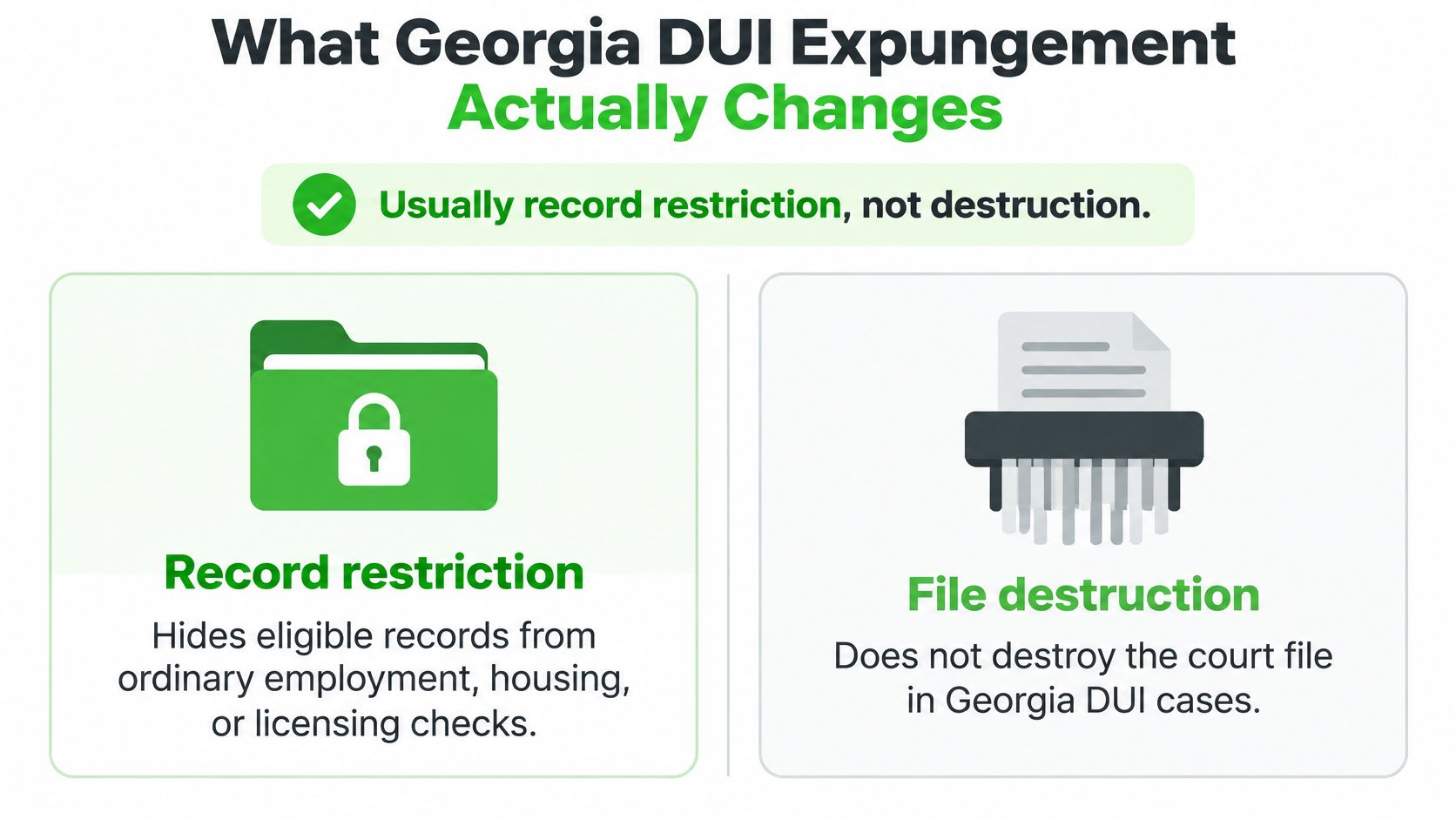
Georgia DUI expungement usually means limiting access to an eligible record, not destroying the file. Georgia's official record-restriction guidance explains that eligible records can be hidden from ordinary public background checks while remaining available to judicial officials and criminal-justice agencies.
Fulton County and Augusta use that same practical distinction: restriction limits public access to eligible criminal-history information, but it doesn't wipe every database.
Georgia DUI outcomes and what restriction can do
| Case outcome | Ordinary restriction | Who can still see it | What to verify first |
|---|---|---|---|
| Dismissal, nolle prosequi, or no prosecution | Often possible if arrest-date and prosecutor requirements are met | Courts, prosecutors, and law enforcement | Certified disposition and GCIC history |
| Acquittal | Potentially eligible; not automatically invisible everywhere | Criminal-justice agencies | Arrest date and exact judgment language |
| DUI conviction | No; DUI is an excluded serious traffic offense | Public criminal-history users and law enforcement | Confirm it's a conviction, not a dismissal |
| Charge reduced to a different offense | Eligibility follows the final offense and procedural history | Agencies and users authorized under the final disposition | Every count on the disposition |
| Several charges from one arrest | Reviewed per arrest, not as a blanket clearing of your history | Authorized agencies; an ineligible count can remain publicly visible | Each charge and its disposition |
A disposition is the court's recorded outcome. It tells you whether the charge ended in conviction, dismissal, acquittal, or another result. A receipt showing that you paid a fine doesn't answer that question.
Likewise, a case marked closed doesn't necessarily mean dismissed. Closed can mean the court finished handling a conviction.
The final outcome matters more than the booking label
Say a Fulton County driver remembers being arrested for DUI but believes the charge was later changed. The arrest label alone won't establish eligibility. The driver needs the signed disposition showing the final offense and what happened to every related count.
A nolle prosequi means the prosecutor formally declined to proceed with a charge. It's a non-conviction outcome, but the surrounding procedural history still matters. Don't assume a dismissed count qualifies without examining any convictions from the same arrest.
An acquittal is different again: the court found the person not guilty. That's not the same as successfully finishing a sentence after a guilty plea.
Probation completion, license reinstatement, and a completed DUI class do not themselves expunge a conviction.
The distinction also explains why the age of a case isn't a reliable eligibility test. If your main concern is whether an old entry should still appear, the guide to how long a DUI stays on your record in Georgia can help separate record visibility from other consequences.
Public access and online exposure are different problems
An official criminal-history report and a commercial website aren't the same system. Before asking a private screening company to correct an entry, identify exactly what it displays: an arrest, an unresolved charge, a conviction, or an outdated outcome.
For a separate look at internet exposure, Digital Footprint Check's guide to remove exposed public records online can help you organize that work. An online removal request isn't a substitute for legal restriction, and removing a search result doesn't change a court disposition.
Get the certified disposition and a current Georgia Crime Information Center, or GCIC, criminal-history report before paying a filing fee or telling an employer that a record is gone. Those documents let you compare what the court decided with what the criminal-history system reports.
How to Request Record Restriction
Start with the case outcome and arrest date. Augusta's record-restriction guidance identifies DUI convictions as excluded serious traffic offenses and describes different filing routes for arrests before and after July 1, 2013. A request applies to a particular arrest and eligible disposition, not every record associated with your name.
Build a file the reviewing office can evaluate
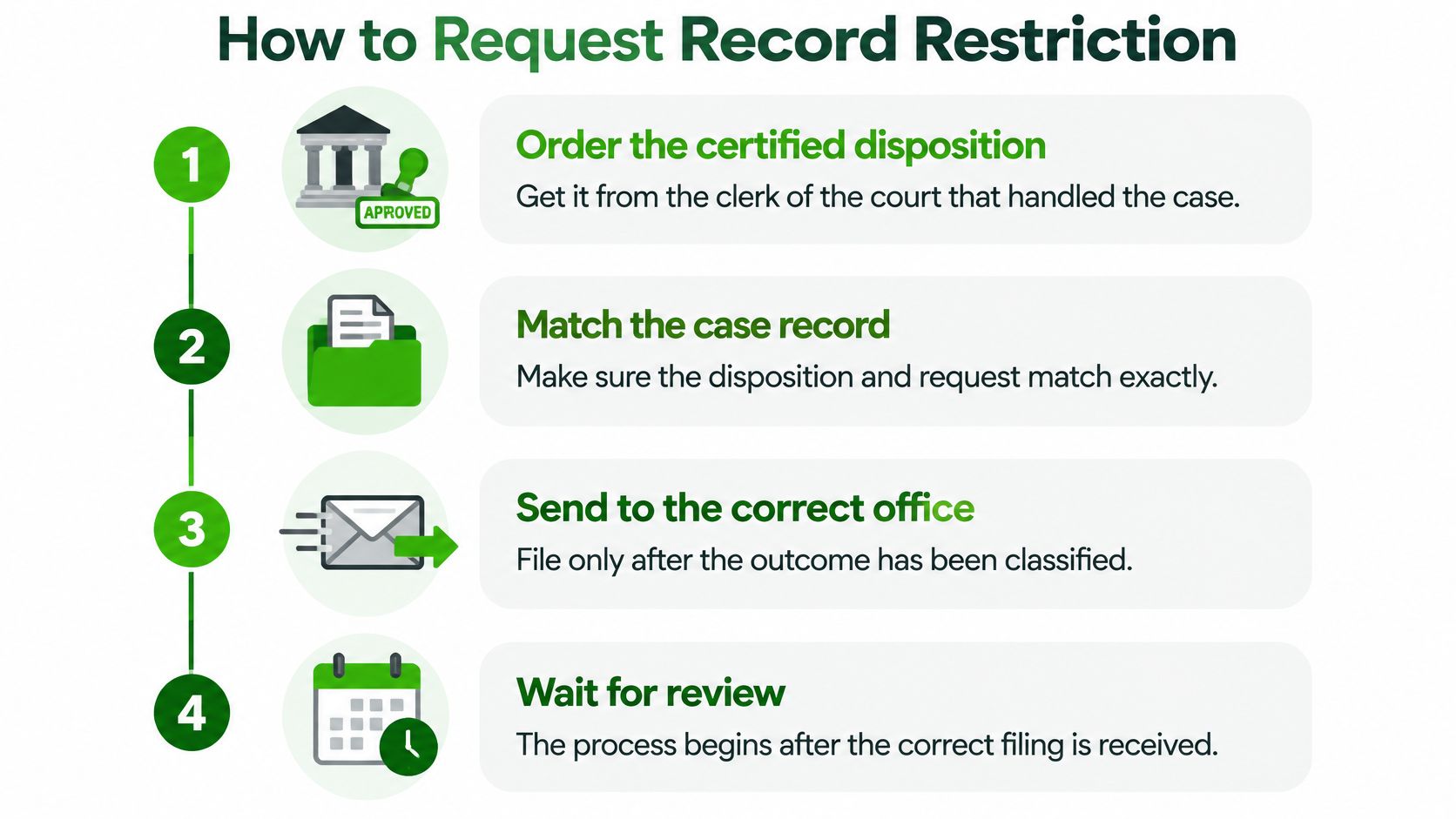
Order the certified disposition from the court clerk. Contact the clerk who handled the case, whether in Fulton County, Athens-Clarke County, or another Georgia jurisdiction. Request the final disposition for every charge. A payment history or docket screenshot may not show the full outcome.
Obtain a current GCIC report and compare the entries. Check your identifying information, arresting agency, case number, charges, and outcomes. If the report shows a charge as pending even though the court dismissed it, flag the mismatch before choosing a filing route.
Identify the correct filing office by arrest date. Keep the certified disposition and GCIC report nearby when you contact the office. Ask for the current form name, required attachments, submission method, and any filing fee.
Submit a request for the relevant arrest. Include the required disposition and keep a complete copy of your submission. Save proof of delivery or an acknowledgment showing when the office received it.
Check that an approval reaches GCIC. Ask how the approved request will be sent to GCIC, then obtain a fresh report after processing. Keep the approval with the court disposition in case a background report still shows outdated information.
Read any denial before applying again. A missing attachment calls for a different response than an excluded conviction. If the reason is unclear, ask the reviewing office to explain it or have a Georgia attorney review the denial and court file.
Track the decision separately from the database update
For arrests on or after the cutoff below, the prosecutor's office sets a decision window. Confirm the current deadline with that office before calendaring a follow-up. Its decision date does not guarantee that every background-check company will display the updated result by then.
Where a Georgia restriction request goes
| Arrest date | Where to file | Decision clock | After approval |
|---|---|---|---|
| Before July 1, 2013 | Arresting agency, using the older application route | Follow that agency's instructions | Confirm the GCIC update |
| On or after July 1, 2013 | Prosecuting attorney's office | Confirm the current decision window with the office | Confirm the GCIC update |
An approval and a completed database update are separate steps. Ask about the status of the criminal-history entry, not only whether the request was approved.
Read application questions carefully, too. Courts, prosecutors, law enforcement, and certain authorized employers in sensitive roles may retain access to information that ordinary public checks do not show. Restriction approval does not resolve every licensing or employment disclosure question.
Calendar a decision follow-up separately from your next background check. If a job or housing application is approaching, keep the certified disposition ready rather than promising that every system will update before the application is reviewed.
First Offender Records After the 2026 Change
The 2026 First Offender sealing change doesn't turn a Georgia DUI conviction into an eligible First Offender case. Fulton County's record-restriction guidance describes the change requiring restriction and sealing of new qualifying First Offender cases at sentencing, with a pathway for some older cases, while DUI remains outside the First Offender framework and ordinary misdemeanor restriction.
That distinction matters because first DUI and First Offender treatment sound similar but describe different things. Being charged with DUI for the first time doesn't mean the court sentenced you under the First Offender Act.
The useful question is which outcome your documents establish:
- A DUI conviction. The First Offender change doesn't create an ordinary sealing route for it.
- A conviction for a different offense. Review that offense's eligibility instead of relying on the original DUI arrest label.
- A dismissed arrest or charge. Evaluate the non-conviction disposition and procedural history.
- A qualifying First Offender case involving another charge. Examine the sentencing order and the applicable sealing provisions.

Read the sentencing order, not the shorthand
The court must have imposed First Offender treatment. A lawyer's request, a conversation about eligibility, or your memory that the judge gave you a chance isn't a substitute for the signed sentencing order.
For a completed older case, check whether the sentence was successfully completed and formally discharged. Finishing payments or supervision and obtaining the required discharge documentation aren't necessarily the same event.
Georgia Courts' record-restriction resources help distinguish ordinary restriction from First Offender treatment. Compare the sentencing order, discharge documentation, court-record status, and GCIC entry rather than treating them as interchangeable proof.
The record review should also establish whether the court file and GCIC information received the sealing or restriction applicable to that case. An eligible legal status and a correctly updated database entry are separate things to confirm.
Restricted or sealed does not mean invisible to every official database.
An Atlanta example with different outcomes
Say an Atlanta driver's paperwork shows First Offender treatment on an eligible non-DUI charge, while another count remained a DUI conviction. The non-DUI count may have a sealing path under the applicable provisions. That doesn't convert the DUI count into a First Offender disposition or clear the entire arrest history.
The driver should bring both counts to the case review. Looking only at the favorable order could lead to an inaccurate statement on a professional-license application.
Disclosure needs its own careful reading. An employer asking about convictions may be asking something different from a licensing board asking about arrests, charges, or sealed records. When the form is unclear, get advice about that form rather than assuming restricted means you can answer no to every question.
Before relying on a generic online checklist, place the sentencing order beside the current GCIC entry. If they don't tell the same story, resolve the mismatch before making a representation about your record.
Mistakes That Stall a Restriction Request
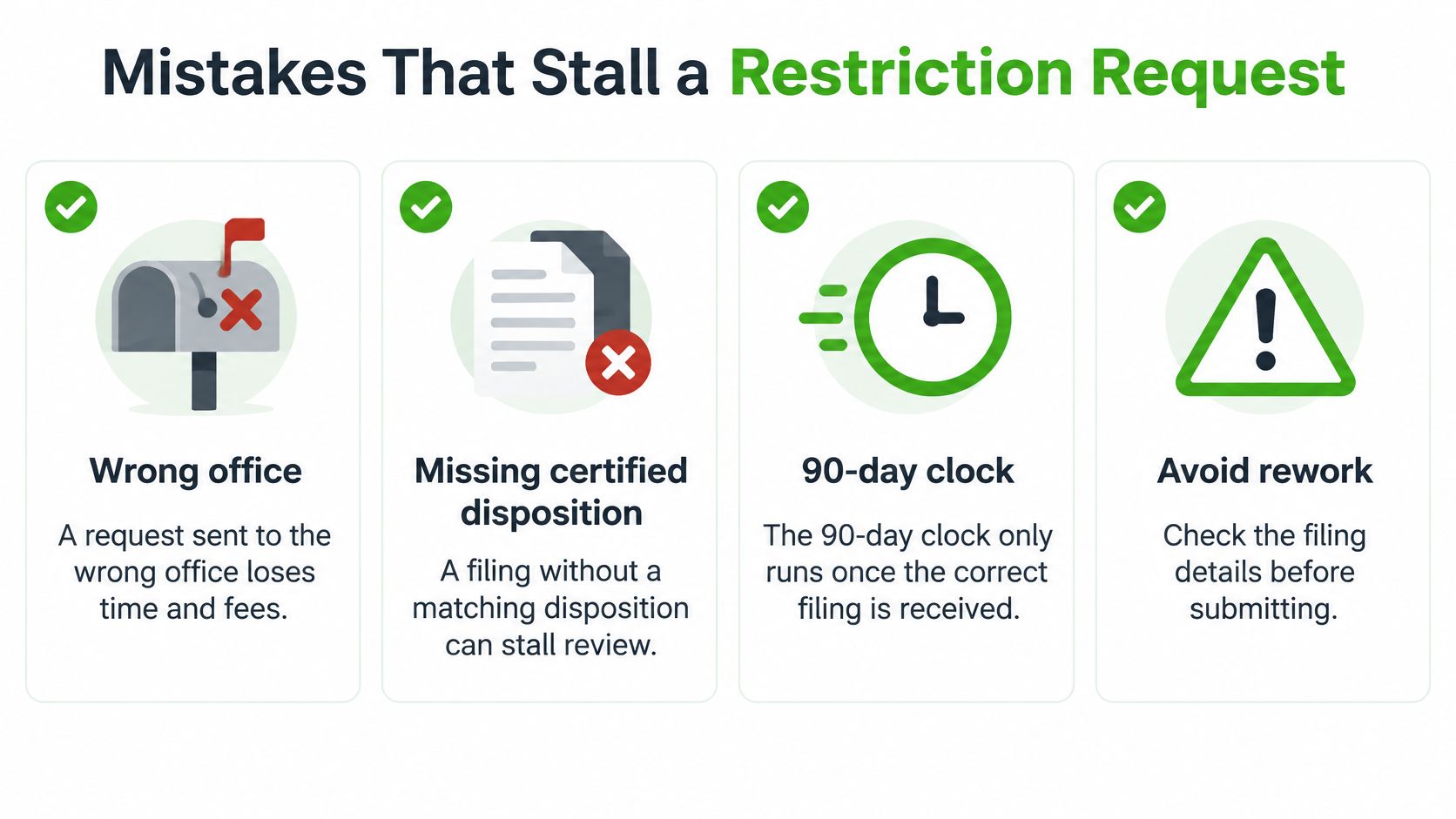
Sending paperwork to the wrong office or omitting the matching disposition can cost time and unnecessary fees. Don't start counting a review period from the day you mailed something to an office that wasn't responsible for the request.
The record-clearing literature summarized in Regulation describes how most eligible people never obtain relief, which makes an accurate, usable filing more valuable than a rushed one.
Paying before checking eligibility. Match every disposition to the GCIC report before paying a fee quoted by an online quiz. A positive screening result isn't a legal determination.
Using the wrong office. Follow the arrest-date routing rules and retain the receiving office's acknowledgment. Record the deadline that applies to your request.
Calling restriction deletion. Describe an approved outcome accurately. Don't tell a housing office or licensing board that the underlying record was destroyed.
Skipping the database recheck. Keep a fresh GCIC printout after approval. A private vendor's old report isn't proof that the official update failed, but it does need attention.
Refiling an ineligible conviction unchanged. Read the denial reason. Another copy of the same form won't change the offense classification.
Moving doesn't change the Georgia requirement
If you were convicted in Georgia but now live elsewhere, the home-state DUI intervention program must be substantially similar, certified there, at least 20 hours long, and verified by Georgia DDS. That course addresses compliance, not record restriction.
Before following up, recheck the disposition language, arrest date, responsible office, decision deadline, and current GCIC printout. Keep course paperwork in a separate compliance file so it doesn't get mistaken for a restriction approval.
Risk Reduction When the Conviction Stays
An unavailable restriction remedy doesn't cancel your license or probation requirements. Work from the DDS reinstatement instructions and the sentencing order, because those documents may require different proof.
The DUI Alcohol or Drug Use Risk Reduction program starts with the NEEDS assessment and continues with the intervention course. Georgia DDS's DUI FAQs list a 130-question assessment, a 20-hour intervention, and a $360 total, divided among the components below.
Risk Reduction components and what each one costs
| Component | Cost | What it covers | Order |
|---|---|---|---|
| NEEDS assessment | $100 | 130-question assessment of alcohol or drug use and its effect on driving | First |
| Intervention course | $235 | 20 hours of group education and peer counseling on alcohol, drugs, and impaired driving | Second, after the assessment |
| Workbook | $25 | Required workbook for the program | Alongside the course |
| Total program | $360 | Certificate issued only after both components are complete | Final |
The certified school issues the official Certificate of Completion only after both the assessment and intervention are finished. That certificate is legal proof of program completion for applicable court or DDS reinstatement purposes. It isn't a court order changing your criminal history.
A course certificate isn't a clinical evaluation
Georgia DDS doesn't accept certificates from self-paced online DUI/Risk Reduction programs for reinstatement or court purposes. Don't confuse an instructor-led live online class with a course you click through whenever you choose.
A clinical evaluation is a separate service with a different purpose. It assesses whether treatment is recommended, rather than certifying that you attended the required educational program.
Under the DDS DUI reinstatement chart, clinical evaluation and recommended treatment aren't required for reinstatement after a first DUI within five years under O.C.G.A. § 40-5-63.1, but the requirement applies to a second DUI within ten years. A court can still order evaluation and treatment as probation conditions even when DDS doesn't require them for that first-offense reinstatement.
Read the sentencing order for additional requirements such as ASAM Level 1 treatment or a Victim Impact Panel. Don't assume the Risk Reduction certificate satisfies a separately named condition.
Keep separate proof: Course completion, treatment compliance, and license reinstatement each require their own documentation.
Habitual-violator cases need a different checklist
DDS safety-responsibility guidance identifies a third conviction for a qualifying combination of specified offenses within five years as the habitual-violator trigger. That designation involves revocation consequences, not an ordinary suspension cured by finishing a class.
An Athens driver handling an isolated conviction and a Fulton County driver with multiple qualifying convictions shouldn't use the same reinstatement checklist. Review the conviction dates and offense combination before assuming a course certificate is the remaining step.
Other financial consequences also need their own planning. The guide to insurance costs after a DUI addresses a different concern from court compliance or criminal-history access.
Keep separate folders for the criminal-history request, the DDS reinstatement packet, and additional court-ordered services. When ordinary restriction isn't available, completing the required program, satisfying any evaluation or treatment order, and maintaining accurate documents are concrete steps you can still take.
Book the Risk Reduction Course That Matches Your Court Deadline
If your disposition confirms a DUI conviction, don't let the search for a deletion form cause you to miss an enforceable deadline. Put the sentencing order and DDS instructions on the table, identify what remains unfinished, and choose a schedule you can attend.
The explanation of what Risk Reduction means can help you distinguish the required DUI program from other classes. Defensive driving is a different course. It doesn't replace Risk Reduction or clear a DUI entry from GCIC.
Choose the schedule around full attendance
- Read the order before registering. Identify any clinical evaluation, ASAM Level 1 treatment, or Victim Impact Panel required beyond the course certificate. Ask your attorney or probation officer about wording you don't understand.
- Protect the entire class schedule. The DUI intervention can't be completed in one day. It's commonly arranged over a weekend or several evenings, so check every session against work, transportation, and family obligations.
- Bring the relevant documents. Have the certified disposition, sentencing order, and DDS notice available. Staff can help distinguish the program requirement from an additional probation condition, but course registration doesn't resolve legal eligibility for restriction.
At our school, late arrival can mean denied entry, no opportunity to make up the missed time, and having to register and pay again to restart. Build a travel buffer for classroom attendance and prepare your connection in advance for live online attendance.
Georgia DUI Schools is a DDS-approved provider serving Atlanta, Athens, and surrounding communities, with live online options for drivers statewide. We offer DUI classes in person or online and can also schedule clinical evaluations, ASAM Level 1 treatment, and Victim Impact Panels.
Choose the format that lets you participate fully, not the one that merely looks fastest. Keep the eventual completion certificate with the correct court or DDS packet, and keep any record-restriction correspondence separate.
Georgia DUI Schools offers instructor-led DUI/Risk Reduction classes and related clinical services to help you complete the requirements that remain even when a conviction can't be restricted. Visit Georgia DUI Schools for support, then use the Georgia DUI course page to match a session to your court deadline and arrange your assessment before intervention begins.