
A first DUI for a Georgia driver age 21 or older requires a 20-hour DDS-approved Risk Reduction program, and the full DDS course cost is $360. Don't treat enrollment as picking the nearest class date. Treat it as proving, before you pay, that DDS and your court will accept the certificate you'll receive.
Why Georgia Requires DUI Risk Reduction Classes
Georgia requires a first-time DUI offender age 21 or older to complete the 20-hour DDS-approved Risk Reduction Program if the offense falls within the five-year period. The driver must submit a Certificate of Completion before license reinstatement. The certificate counts only if DDS accepts the provider and the course format for the driver's license or court requirement.
The program is a legal requirement, not a general driving refresher. Georgia's Risk Reduction Program applies to specified DUI-related offenses, including driving under the influence, certain underage alcohol offenses involving a vehicle, illegal drug possession, and boating under the influence.
What the Program Is Built To Do
The program has two parts: a 130-question NEEDS Assessment that evaluates alcohol and drug use and their effects on driving, followed by a 20-hour Intervention Component with group education and peer counseling.
A completed class and an accepted class are different things. Before enrolling, confirm that the provider is DDS-certified and that DDS and the court will accept the course format for your specific requirement. A certificate from the wrong provider or format may not satisfy your case, even if you attended every required hour.
Who Must Take a Georgia DUI Class and Which Program Applies
A completed class counts only if DDS accepts the provider and the format for your license or court requirement. Start with your court order or DDS notice, then match its exact wording to the cases below. Do not enroll based on a friend's experience or a school's general description.
Georgia DUI class requirements by case
| Case | Program or next step | What to verify |
|---|---|---|
| DUI conviction | The program named in your court order or DDS notice, which may be the 20-hour DUI Alcohol or Drug Use Risk Reduction Program | Whether DDS requires a Certificate of Completion before reinstatement |
| Driver under 21 with an alcohol-related driving case | Follow the requirement stated in the court order or DDS notice | Confirm the applicable requirement for your case. Do not assume it depends only on the BAC or the driver's age |
| Multiple DUI convictions | Follow the program and conditions specified by DDS and the court | Ask DDS whether a clinical evaluation or other documentation is required |
| Underage alcohol possession while operating a vehicle | Follow the program named in your court order or DDS notice | Confirm any additional filing or deadline |
| Possession of illegal drugs | Follow the program named in your court order or DDS notice | Confirm any additional filing or deadline |
| Boating under the influence | Follow the program named in your court order or DDS notice | Confirm any additional filing or deadline |
| Conditional or limited license applicant | Check the applicable DDS requirements before enrolling | Ask DDS what completion status and proof it accepts for your license |
Match the Requirement to Your Paperwork
Your answer depends on four items: the offense listed on your paperwork, your age category, your prior record, and any additional conditions. Read the court order and DDS notice together. If they differ or leave a question open, ask the issuing office to confirm the requirement in writing before you pay for a class.
For a DUI conviction, do not assume that every driver needs the same program or that a particular lookback period applies. Use the program and deadlines stated in your own documents. If the paperwork names the 20-hour Risk Reduction Program, choose a DDS-certified provider and verify that the offered format is accepted for your license or court purpose.
Under-21 drivers should follow the case-specific direction on their notice or order. A Zero Tolerance BAC standard does not, by itself, tell you which class or reinstatement documents your case requires. Confirm the required program with DDS or the court before registering.
Prior DUI convictions can add requirements beyond the class. If your paperwork calls for a clinical evaluation, arrange it separately and confirm what documentation DDS needs. Review the Georgia DUI clinical evaluation process if an evaluation is listed in your case documents.
Confirm Additional Conditions Before You Enroll
For underage alcohol possession while operating a vehicle, possession of illegal drugs, or boating under the influence, follow the program and any added conditions specified in your order or DDS notice. Contact the office named on the document if it does not explain what must be filed or when.
Conditional and limited license rules can depend on the specific license action. Do not rely on a school's general statement that partial completion or a promise to finish qualifies. Ask DDS what program, completion status, and proof it accepts for your license, and get the answer before driving or paying.
A court may also order separate requirements, such as a clinical evaluation, treatment, or a Victim Impact Panel. Treat each listed item as a separate obligation, with its own provider and proof of completion. The court order and DDS notice determine what your case requires.
What the 20-Hour Risk Reduction Program Covers
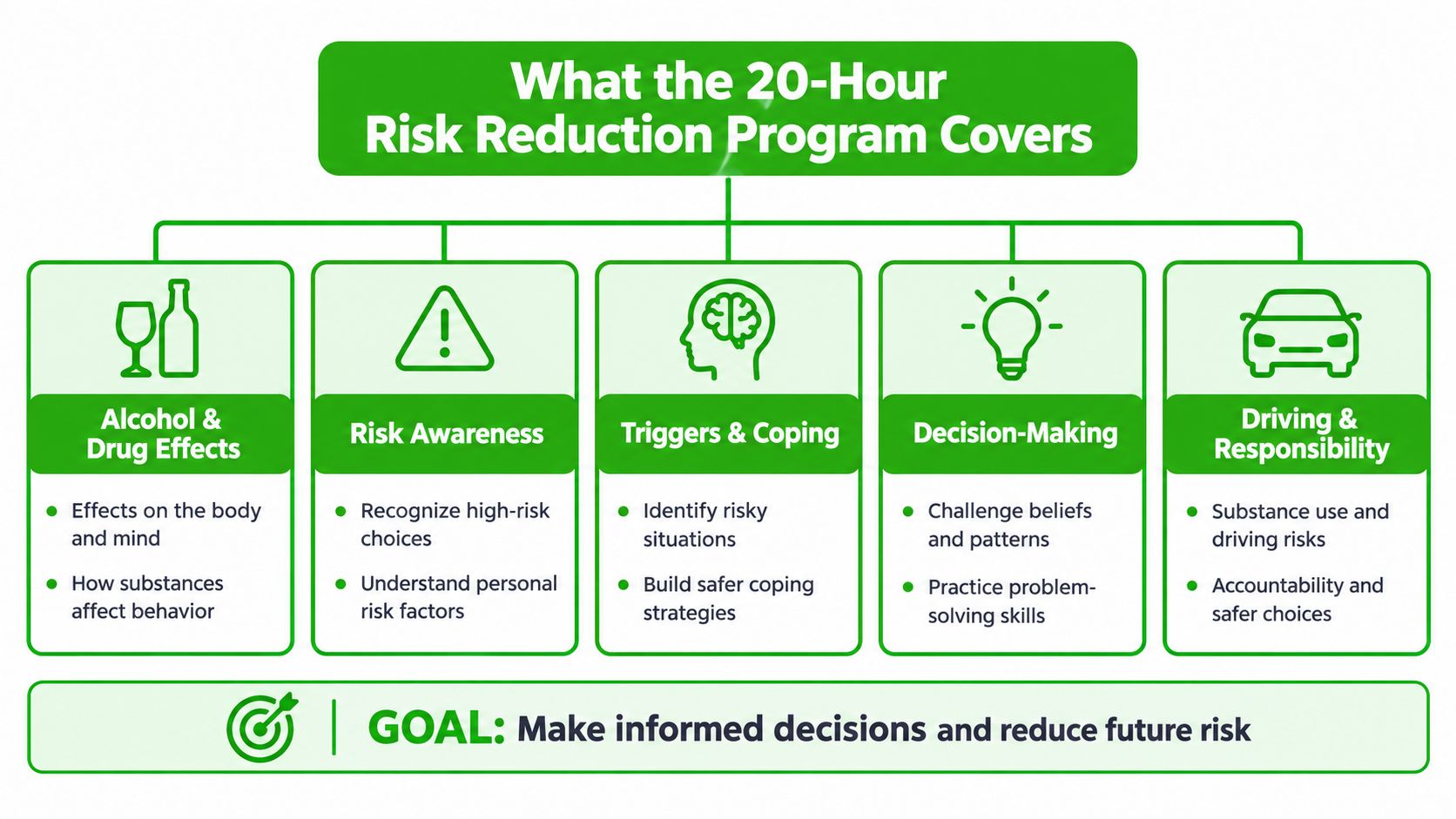
Think of the program as two pillars holding up one certificate. If either pillar is missing, DDS doesn't get the completed Risk Reduction record it requires, and you don't get a usable Certificate of Completion.
Pillar One The NEEDS Assessment
The NEEDS Assessment contains 130 questions covering alcohol and drug use and how they affect driving, as described in the DDS Risk Reduction program policies and procedures guide. Every participant must complete a valid assessment component, and programs must use the assessment provider DDS designates. It isn't an optional intake form the school can waive because you're in a hurry.
Answer the assessment as the screening step it is. Its role is to place your alcohol and drug use, and the driving risk connected to that use, into the program record before the intervention work is treated as complete. If a provider tells you the assessment can be skipped, substituted casually, or handled later without consequence, get that claim in writing and verify it before enrolling.
Don't confuse this step with a clinical evaluation. The NEEDS Assessment belongs to every participant's Risk Reduction sequence. A state-approved clinical evaluation is a separate escalation for the repeat-conviction category covered earlier, and a court may also order separate evaluation or treatment items.
Pillar Two The Intervention Component
The second pillar is 20 hours of intervention delivered through group education and peer counseling. The subject isn't vehicle handling. The work addresses substance use and impaired driving, including how alcohol and drugs affect driving decisions and risk.
That group format is deliberate. You'll hear other participants describe choices, consequences, and patterns you may recognize even when the offense details differ. In a Marietta classroom or an Athens session, the value isn't listening passively for a certificate. It's connecting your own use and driving decisions to the risk the program is designed to reduce.
The required workbook is part of the course material, not an optional souvenir. Bring it as directed, complete the work assigned, and keep it with your course records until your file is closed. If an instructor references workbook exercises during sessions, treat them as part of completion discipline rather than homework you can ignore.
The certificate comes after both pillars are complete. Finishing classroom hours without a valid assessment doesn't create a finished Risk Reduction file.
How The Twenty Hours Are Counted
DDS counts instructional time, not just the span between when you walk into a building and when you leave. Program policy requires every participant to attend the full twenty hours, and the required minimum one-hour meal break must be provided in addition to those hours, according to the DDS policy guide cited for the assessment requirement above.
Use a simple schedule to see the trap. A four-day plan with five instructional hours each day delivers twenty instructional hours. If that same calendar appointment also contains a meal break or other noninstructional scheduling period, you'll be committed for more clock time than the twenty hours named in the requirement.
That's not a provider adding time for no reason. It's the difference between the instructional total DDS requires and the calendar block needed to deliver it. A schedule advertised by start and end times can look longer or shorter than the actual instructional count, so the headline duration isn't enough.
Ask one direct question before registering.
- Get the instructional total in writing: Ask the provider to state that the schedule delivers the full twenty instructional hours required for the Intervention Component.
- Separate breaks from instruction: Ask whether the meal break sits outside the twenty hours, and don't count it toward completion yourself.
- Compare against your notice: Match the provider's written instructional total to the program named in your court order or DDS notice, not to the number of days on a calendar.
This is the point where careful readers avoid paying for a second enrollment. A class can feel finished because you've spent several days attending it, but DDS cares whether the required instructional hours and assessment were completed under an approved program structure.
Choosing an Online, Virtual or Classroom Format
Acceptance comes before convenience. DDS states that certificates from online DUI, alcohol, or drug-use risk-reduction courses are not accepted for Georgia driver-license or driving-privilege purposes, as stated in the Georgia DDS DUI frequently asked questions. If a format fails that test for your purpose, its schedule doesn't matter.
Course formats compared for Georgia DUI reinstatement
| Format | Schedule | Accepted for license reinstatement | Best fit |
|---|---|---|---|
| In-person classroom | Scheduled sessions at local locations, weekday or weekend | Yes, when issued by a DDS-certified provider | Readers who want in-person group discussion |
| Live virtual (Zoom) | Scheduled live sessions with a fixed start time | Confirm with DDS and the provider before paying | Readers who need remote access with a set timetable |
| Self-paced online | Log in and finish on your own timing | No, DDS does not accept online DUI risk-reduction certificates for license purposes | Only where a court or employer confirms in writing that it accepts the certificate |
Format and certification must pass together. An in-person class from an uncertified provider doesn't become acceptable because you sat in a room, and a polished website doesn't make a self-paced DUI class in GA valid for reinstatement. If you're reviewing online DUI class options in Georgia, separate marketing labels from the exact acceptance answer for your license or court purpose.
Take a reader in Athens with a court deadline six weeks away. A weekend in-person class requires travel and fixed attendance, while a self-paced online course looks easier after work. The online certificate fails the Georgia license acceptance test, so choosing it risks paying twice and finishing the wrong product near the deadline.
Metro Atlanta and Athens readers should ask where in-person classroom sessions meet and confirm the current location count with the provider before relying on it. For live virtual sessions, don't accept a verbal assurance. Ask the provider and DDS to confirm acceptance in writing for your specific reinstatement or court purpose, then use the enrollment sequence that follows.
How to Enroll and Verify Your Class
Verification happens before payment, not after you've finished attending. DDS states that only DDS-certified driving schools are approved and that certificates from uncertified providers won't be accepted for licensing, reinstatement, or court requirements, according to the DDS Risk Reduction regulated program page.
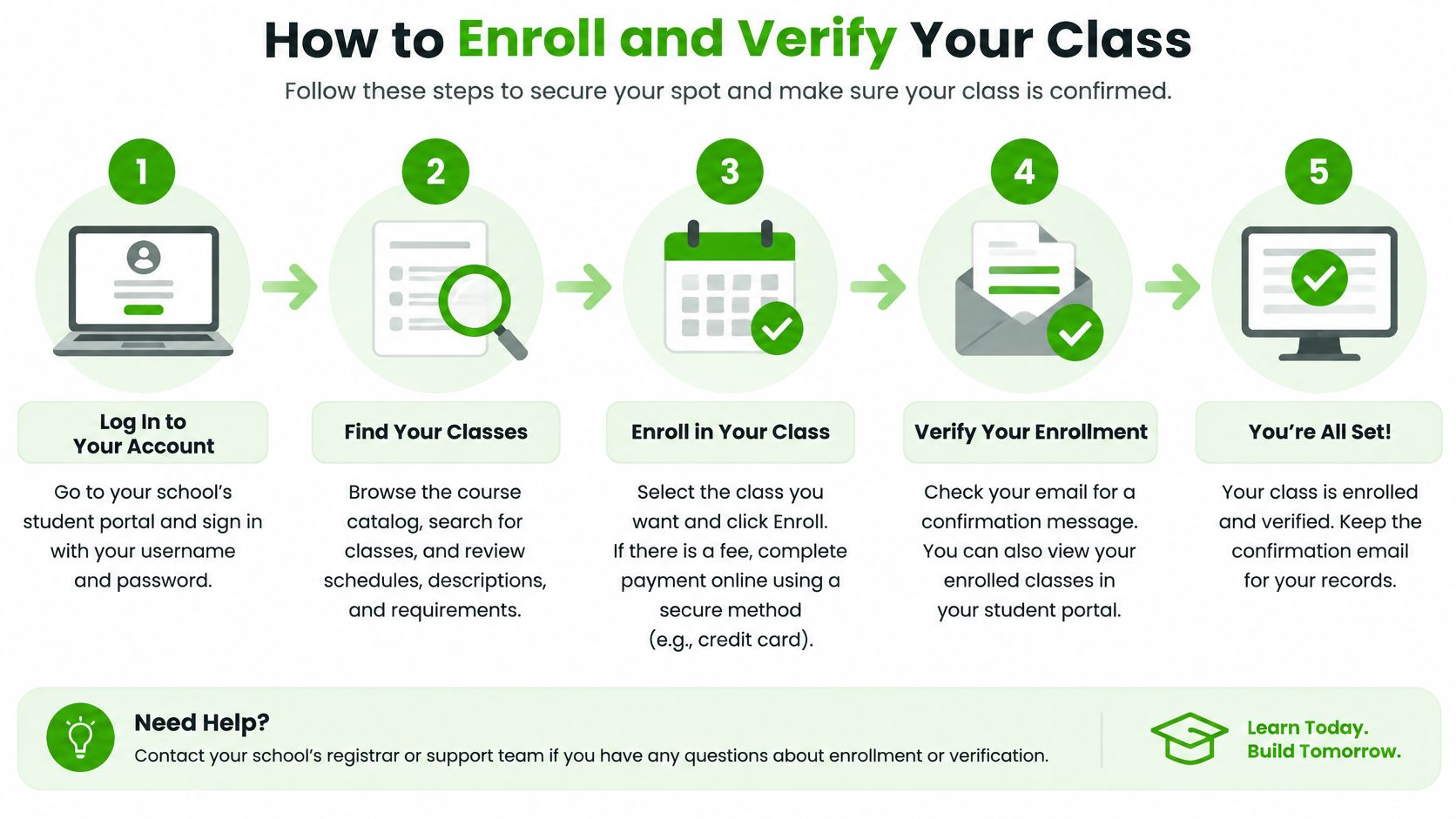
- Pull the court order or DDS notice and confirm the named program. That document drives every later choice. The common slip is enrolling from memory after a court appearance in Cobb County or elsewhere.
- Verify the provider holds DDS certification. Certification is the compliance control that makes the certificate usable. The common slip is checking reviews and price before checking approval.
- Confirm format acceptance in writing for your license and court purpose. A format can exist without being accepted for your file. The common slip is treating "online," "virtual," and "classroom" as interchangeable labels.
- Check whether a clinical evaluation is also required. This applies when you have two or more DUI convictions within the preceding 10 years, under the DDS regulated program rules cited above. The common slip is discovering that separate document after the class ends.
- Request a written fee schedule, then register and pay the assessment and course fees. Written fees prevent surprise add-ons and show what you've purchased. The common slip is paying a deposit before the full schedule is documented.
- Complete the 130-question NEEDS Assessment through the DDS-designated provider. The assessment is a required component, not intake paperwork. The common slip is assuming a general questionnaire from another source will count.
- Attend all 20 instructional hours and complete the workbook. Keep the one-hour meal break outside your personal hour count. The common slip is counting calendar time, breaks, or arrival time as instruction.
- Receive the Certificate of Completion and protect the original. Keep copies for yourself and send the original where DDS and the court require it. The common slip is losing the original after the class feels finished.
Steps one through four usually take one phone call or one email. Do them before a seat sale, a weekend deadline, or a probation appointment pressures you into paying first.
What Georgia DUI Classes Cost and How to Reinstate Your License
Set your budget using the confirmed DDS course total and the reinstatement fee that applies to your case. For a first DUI, DDS lists a $360 course total. The amount a provider charges for separate services or an accepted format may vary, so get those charges in writing before you enroll.
Georgia DUI class and reinstatement costs
| Cost item | Amount | Notes |
|---|---|---|
| DDS Risk Reduction course | $360 | Total course cost |
| Reinstatement fee, first DUI, age 21+, by mail | $200 | Paid to DDS |
| Reinstatement fee, first DUI, age 21+, in person | $210 | Paid to DDS |
| Clinical evaluation, two or more DUI convictions | Request a written quote | Set by the evaluation provider |
| ASAM Level 1 treatment or Victim Impact Panel | Request a written quote | Only when ordered |
DDS lists the first-DUI reinstatement fee for drivers age 21 and older as $200 by mail or $210 in person in its Georgia reinstatement fees and payment schedule. With the $360 course total, the combined known DDS charges are $560 by mail or $570 in person. Confirm that your provider is DDS-certified and that DDS accepts the course format for your license purpose. A completed class does not count if its provider or format fails those checks.
Costs Beyond the DDS Course Total
Keep separate requirements out of the $360 course budget. A clinical evaluation for a driver with two or more DUI convictions is a separate provider service. Court-ordered ASAM Level 1 treatment or a Victim Impact Panel also carries a separate charge. Ask each provider for a written quote tied to your order.
Ask whether your chosen schedule or format adds a charge. Put the answer in writing before you pay. Use the Georgia license reinstatement fee details to separate DDS fees from provider charges. The state fee is not included in what you pay the school.
Budget rule: Record the $360 course total and applicable DDS reinstatement fee separately. Add other requirements only after the provider gives you a written quote.
The Reinstatement Sequence
For a first DUI involving a driver age 21 or older, DDS identifies 120 days as the point when the driver may be eligible to apply for reinstatement, subject to meeting the requirements for the case. It is not a blanket statement that every suspension ends after 120 days. Check your notice and the DDS first DUI violations and suspensions page for the dates and conditions that apply to your record. DDS requires a certificate from a DDS-approved DUI Alcohol or Drug Use Risk Reduction Program before it processes reinstatement.
Follow this order:
- Record the suspension start date from your notice. Use the date shown there, not an estimate.
- Schedule the class early enough to receive your certificate before applying. A missed session can delay completion and your paperwork.
- Complete the required program and obtain the certificate. Keep a copy for your records.
- Submit the certificate and pay the applicable DDS reinstatement fee. Follow DDS instructions for mail or in-person payment.
- Confirm reinstatement before driving. An application receipt does not replace DDS approval or any restrictions on your record.
Put the suspension start date, the 120-day eligibility point described by DDS, and the date on your notice on one calendar. Add your class dates, certificate submission date, and fee payment method. For repeat cases, habitual-offender review, or other added requirements, follow the instructions tied to your record rather than using a first-offense timeline.
Enroll in the Course That Matches Your Case
Your decision is now narrow, and that's good. You've matched your case to a row, separated instructional hours from calendar time, checked format acceptance, and priced the known DDS items without inventing quotes for separate services.
For license reinstatement, choose the in-person classroom course unless DDS confirms a virtual format in writing for your specific purpose. That's the conservative route because it lets you verify both provider certification and certificate acceptance before attendance. A self-paced certificate that DDS won't accept isn't a shortcut. It's a detour that costs you another enrollment.
Georgia DUI Schools offers DDS-approved in-person classroom sessions in Atlanta, Athens, and surrounding metro communities, with weekday and weekend sessions, and it can also arrange clinical evaluations and Victim Impact Panels when a court or evaluation requires them. Confirm the current location count, session schedule, and years of service directly with the provider before relying on those details, because your enrollment decision should rest on current written information.
Bring four items to that enrollment conversation.
- Your court order or DDS notice: It names the required program and any added components.
- Your suspension dates: They show whether the class schedule leaves time to receive and submit the certificate.
- Your prior-conviction timeline: It determines whether a clinical evaluation belongs in the file.
- Your written acceptance answer: It confirms the selected format and certified provider match your license or court purpose.
If any answer is still verbal, pause. Send one email that asks the provider to confirm certification, instructional hours, format acceptance, total fees, and any separate evaluation or panel quote. That message protects you more than a fast payment link.
Readers who've completed those checks can move directly to the course that fits the case at the Georgia DUI Risk Reduction course enrollment page.
Georgia DUI Schools provides DDS-approved DUI Risk Reduction classes for drivers in Atlanta, Athens, and surrounding metro communities who need an accepted certificate for license reinstatement or court compliance. Bring your court order or DDS notice, confirm your exact requirement, and enroll through Georgia DUI Schools in the course format that matches your case.