
You're sitting in your kitchen in Marietta, Decatur, or Athens with a citation on the counter and a court date circled on the calendar. Someone told you to take defensive driving, so you searched for it, and now you're looking at a dozen websites all promising different things. Points off. Fine reduced. Insurance discount. They can't all mean the same thing, and in Georgia, they don't.
What an Approved Defensive Driving Course Actually Means in Georgia
Most drivers picture a generic safety video they can play in the background. Georgia's approved course isn't that. It's a regulated education program with a specific name, a specific length, and a specific regulator watching over the schools that teach it.
The Official Name Behind the Search Term
When you look for Approved Defensive Driving Courses in Georgia, what you're looking for is the Driver Improvement program. The Georgia DDS defensive driving program FAQs define defensive driving and Driver Improvement as the same regulated six-hour course, with a $95 price ceiling for courses used for court, reinstatement, or point-reduction purposes.
That course is designed to change unsafe driving attitudes and behaviors, not just hand you a certificate for showing up. You'll cover risk awareness, decision making behind the wheel, and the habits that lead to citations in the first place. The certificate matters, but DDS designed the program as education first.
Practical rule: If a course isn't described as a DDS Driver Improvement course, don't assume a court, DDS, or an insurer will treat it as one.
The Four Reasons DDS Recognizes the Course
Drivers usually arrive with one problem in mind. DDS recognizes several distinct uses, and naming yours early prevents expensive mistakes later.
- Court orders: A judge has directed you to complete the course for a current case.
- License reinstatement: You need the course as part of getting driving privileges restored.
- Point reduction: You want DDS to lower points already on your Georgia record.
- Insurance premium reduction: You want your insurer to lower what you pay on eligible coverages.
- Voluntary education: You're taking it to become a safer driver, with no agency requiring proof.
Those purposes sound similar because the classroom experience can be identical. The paperwork path after class is where they split. A certificate sent to the wrong place, or taken for the wrong reason, may leave your original problem unsolved even though you finished the class.
That's why the word approved does real legal work here. A general driver safety class from outside this system may teach useful material, but it may not qualify for official point relief, reinstatement, or court purposes. DDS certification is what connects your completion to an outcome the state will recognize.
Before you compare schedules or formats, answer one question in plain language. Who needs this certificate, DDS, a court, or your insurance company? That answer controls every choice that follows.
How to Verify a School Is Truly DDS Approved
Any website can put the words Georgia approved in large type. Your job is to verify that claim before you pay, because DDS won't fix a bad enrollment for you after the fact.
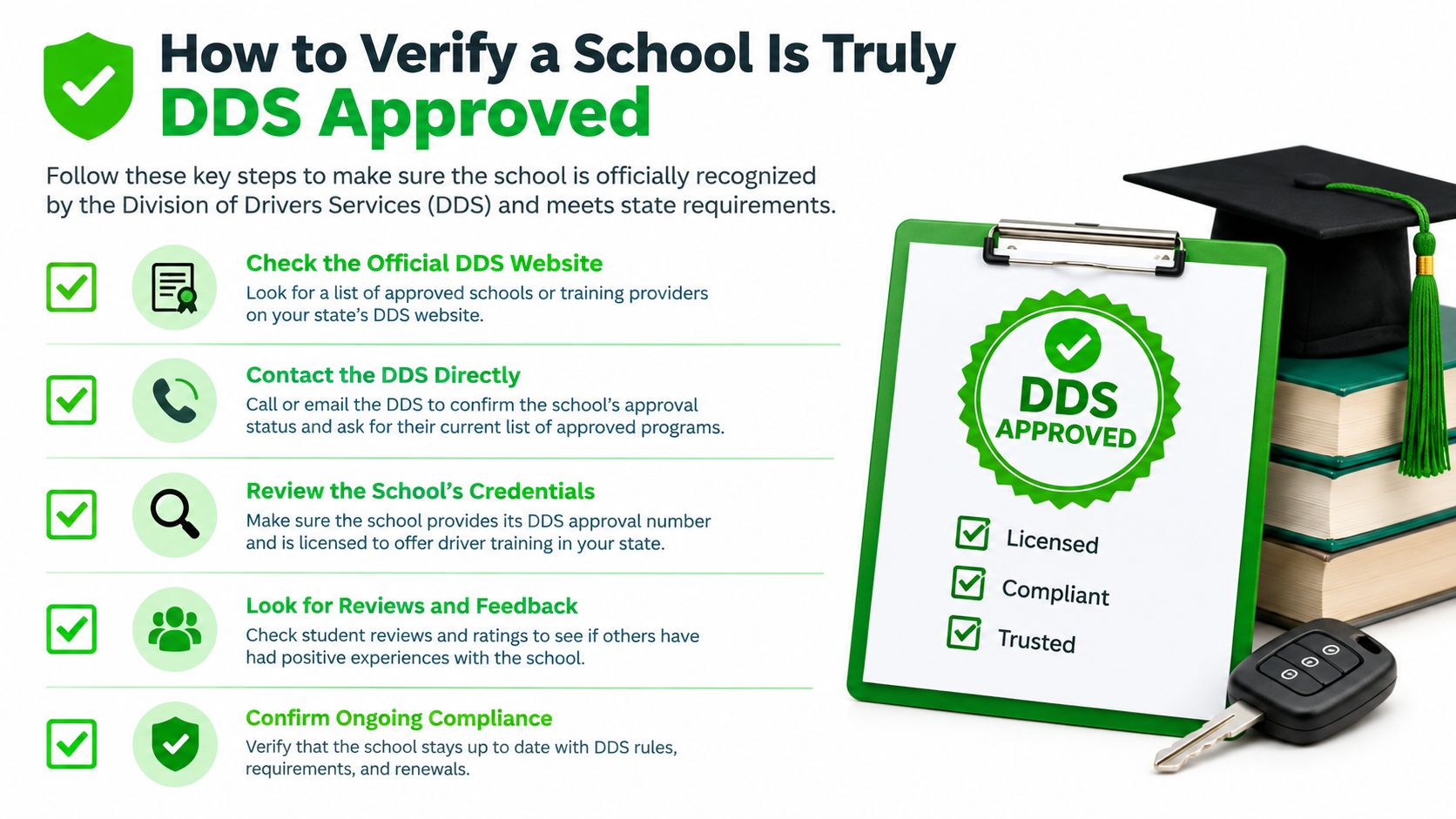
Start with the directory DDS itself maintains. The DDS Driver Improvement program page lists certified Driver Improvement schools separately from certified DUI schools, and only DDS-certified schools are accepted for licensing, reinstatement, or court purposes. If a provider isn't in that directory under the Driver Improvement category, stop there.
Driver Improvement Is Not the Same Listing as DUI School
This distinction trips up drivers every week in Fulton, Gwinnett, and Clarke County. A school certified for DUI and Risk Reduction education isn't automatically certified to teach Driver Improvement, and the reverse is also true. Some providers hold both certifications, but you should confirm the specific one you need rather than assuming one listing covers both programs.
The image below summarizes the verification steps in order, with any graphic text intentionally not presented as a substitute for checking the live DDS directory yourself.
Five Questions to Ask Any Provider
Run these before you enter a card number.
- Are you listed as a certified Driver Improvement school: Ask for the exact name DDS uses so you can find it yourself.
- Will I receive an original completion certificate: DDS and courts care about the original document, not a screenshot of a completion screen.
- Does the course cover the full required length: A shortcut version that's shorter than the regulated program is a red flag, not a bargain.
- What purpose will my certificate support: A good school asks whether you need court, DDS, reinstatement, or insurance credit before enrolling you.
- How and when will I get the certificate: You need a clear answer if a deadline is close.
A legitimate school welcomes verification questions. A school that pressures you to pay before answering them is telling you something important.
Watch for other warning signs too. Be cautious with guarantees about what a judge will do, refusal to discuss DDS certification, or a pitch that pushes the same product for both a DUI requirement and a defensive driving ticket without explaining the difference. Also compare the price against the ceiling covered in the section above for court, reinstatement, or point reduction use.
Verification takes a few minutes. Repeating a course because the first one didn't count takes another full session and may put a court deadline at risk. Check first, enroll second.
The Three Outcomes You Can Actually Get From the Course
A driver comes in with three papers in hand: a DDS notice, a traffic citation with a court date, and an insurance renewal letter. Same course, three different doors. The mistake is paying for the class before deciding which door you need it to open.
Pathway One DDS Point Reduction
This is the administrative route for points already on your Georgia record. The legal basis is O.C.G.A. § 40-5-86: a certified completion can support a DDS reduction of up to 7 points, no more than once every 5 years.
Treat that 5-year limit like a spare key you can use once. If you spend it on a small problem today, it is not available for a larger point problem during the same window. The reduction also requires action after class: DDS needs the proper certificate and a request, and your record will not go below zero. Before you submit anything, review how completion connects to defensive driving and your Georgia driving record so the paperwork matches the outcome you expect.
Pathway Two Court Fine and Points Disposition
A pending citation belongs to the court, not to the DDS point-reduction request. Under the DDS explanation of the court related benefit, when a driver completes a certified course after a citation and before appearing in court, or as ordered by the court, and presents the original certificate, the court is required to reduce the assessed fine by 20% and assess no points for the qualifying violation.
Timing decides whether this door is even open. The benefit is tied to the current case, the right certificate, and the court handling that citation, so a driver in Atlanta Municipal Court, Athens-Clarke County, or another local jurisdiction should confirm the procedure before relying on it.
Pathway Three Insurance Premium Reduction
The insurance route does not ask DDS to erase points and does not ask a judge to change a fine. It asks your insurer to apply the premium reduction required under Georgia law on specified coverages when the eligibility conditions are met, including a record clean enough to qualify and the right drivers listed on the policy.
This is the pathway where your recent history matters most. A completion certificate may help, but the insurer still reads the policy, the drivers, and the lookback period before applying the reduction.
| Outcome | What it changes | Best clue | Decision maker |
|---|---|---|---|
| DDS point reduction | Existing points, within the 7-point and 5-year limits cited above and in the DDS driver manual | A DDS notice or record showing points | DDS |
| Court disposition | The fine and points for a qualifying pending citation | A ticket with a future court date | The court |
| Insurance reduction | Premium on specified coverages when eligibility is met | A renewal notice or policy review | Your insurer under Georgia law |
Read the table like a mailing label. The paper in your hand tells you which recipient has authority. If you want one completion to satisfy two recipients, ask each one what it accepts before class ends.
Before you pay: Finish this sentence: "I am taking this course so that ___ will ___." If the blank is fuzzy, the pathway is too.
The Enrollment and Completion Process From Start to Finish
Once you know your pathway, the rest is a sequence you can follow without guesswork. The problems I see most often come from skipped steps before registration or after completion, rarely from the class itself.
Choose a Format You'll Actually Finish
Georgia DUI Schools lists its defensive driving offerings in three formats: self-paced online, live virtual on Zoom, and traditional classroom. Those three reflect the choices drivers commonly weigh. Self-paced online fits irregular work hours in metro Atlanta, but it demands self-discipline. Live virtual gives you instructor interaction without the commute. In-person learning helps if home distractions make focus difficult.
Pick based on completion, not novelty. The best format is the one you will finish correctly and on time for your DDS, court, or insurer deadline.
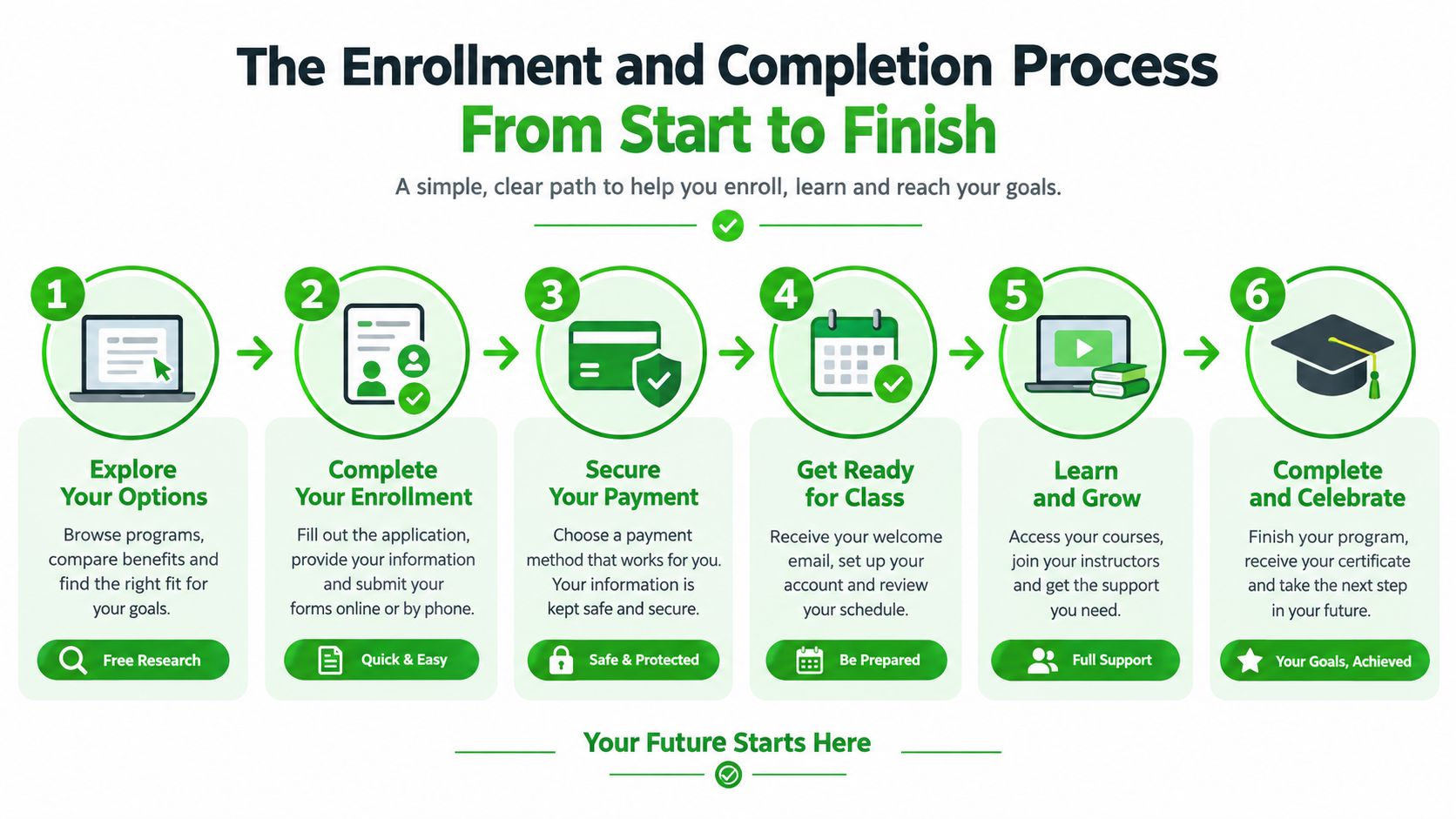
The process image below maps the sequence from research through submission. Use it as a visual overview, then follow the written steps for the official details.
Register With the Right Information Ready
Have these items in front of you before you sign up.
- Bring your license information: Use the name and details exactly as they appear on your Georgia license.
- Bring your court paperwork if applicable: Case details and deadlines affect which certificate you need and when.
- State your purpose clearly: Tell the school whether this is for DDS, court, reinstatement, insurance, or voluntary education.
- Complete the full course and any assessments: Don't treat attendance alone as completion.
- Check your certificate before you leave or log off: Confirm your name, completion date, and course details are correct.
A small mismatch on a certificate can slow down a clerk, DDS, or an insurance agent. Catching it while the school can still correct it quickly saves days of back and forth.
Submit the Certificate to the Right Place
Drivers skip this step more than any other. For DDS point reduction, submit the original completion certificate in person at a DDS Customer Service Center or by mail to the Department of Driver Services, P.O. Box 80447, Conyers, Georgia 30013. That submission rule and mailing address come from the Georgia DDS drivers manual. DDS asks for the original document, so photocopy yours for your own records before you hand it over or mail it.
The other pathways have different recipients. For a court outcome, deliver the certificate to the court handling your case. For insurance, send it to your insurer or agent in the format they request. A perfect certificate sent to the wrong address creates no credit at all.
If a move or schedule change forces you to transfer, call the school before you assume partial progress moves with you. Ask what is documented, what must be repeated, and whether your deadline is still safe. Keep your own copy of everything, and follow up until the recipient confirms receipt.
Real Examples From Atlanta, Athens, and Surrounding Metro Areas
Rules are easier to follow when you can see a person attached to them. These examples reflect common Georgia situations. They're illustrations of how the pathways work, not promises about any individual case.
An Atlanta Driver With a Pending Citation
Consider a mid-career professional commuting into Atlanta who receives a moving violation and has a court date still ahead. Her goal isn't to remove old points through DDS. It's to address the current citation. She verifies a certified school, completes the course before her appearance, and brings the original certificate to court to pursue the court disposition pathway described earlier.
What makes her example work is sequence. Course first, court appearance second, certificate in hand. If she'd waited until after the case closed, she'd be asking about a different pathway with different rules.
An Athens Retiree Focused on Insurance
Now picture a retiree in Athens with a clean recent driving record who isn't fighting a ticket at all. His goal is lower premiums on a personal auto policy. The Georgia insurance premium reduction statute requires insurers to offer a reduction of at least 10 percent on specified coverages when statutory eligibility is met, including motor-vehicle liability, first-party medical, and collision coverage.
That law also sets conditions drivers miss. Applicable named drivers who are at least 25 years old generally must have no traffic offenses and no at-fault claim during the preceding 3 years, and premium reduction eligibility can continue for 3 years if no named driver commits a traffic offense or causes an at-fault claim during that period, under that same statute. In plain English, the course alone doesn't create the discount. His record has to qualify too, so he confirms eligibility with his insurer before enrolling.
Drivers comparing local options can also review information about driving schools in Athens, GA to understand what's available near Clarke County and surrounding communities, while statewide online access helps drivers who aren't near a classroom.
A Metro Driver Protecting a Job That Requires Driving
A younger driver in the metro area with several recent violations faces a different problem. Points are already on the record, and a job depends on keeping a valid license. For this driver, the DDS point reduction pathway may be the relevant one, provided the timing limit discussed earlier hasn't already been used.
He checks his record first, confirms he hasn't already used the benefit in the current window, completes a certified course, and submits the original certificate to DDS with an explicit request. He doesn't assume the school's certificate automatically changed his record while he was driving home.
Notice what wouldn't qualify in these stories. The retiree wouldn't get the insurance outcome if a named driver on the policy didn't meet the record conditions. The Atlanta driver couldn't expect a court outcome from a certificate presented to DDS instead. The metro driver couldn't reuse the DDS benefit inside the restricted window by paying for another class. The pathway, the timing, and the recipient have to line up.
Common Misconceptions That Can Cost Georgia Drivers
Myths persist because they sound convenient. Each one below can cost you money, time, or a missed deadline.
Any online class will satisfy the court. It won't if the provider isn't DDS certified for Driver Improvement. Courts and DDS accept certified schools for official purposes, as covered in the verification section above. A polished website isn't certification.
The point reduction happens automatically when the certificate is issued. It doesn't. For DDS credit, you must submit the original certificate and request the reduction. Finishing class and receiving credit are two separate steps, and drivers who merge them in their heads often discover months later that nothing changed.
The Insurance and Repeat Course Myths
Every graduate gets the insurance discount. That's not how the statute works. Course approval, policy type, driver age, and recent record all matter. If lowering premiums is your main goal, read this explanation of using a defensive driving course to lower insurance, then confirm your own eligibility with your insurer before you budget the savings.
You can repeat the course every year for more point relief. You can retake a course for court or insurance reasons, but DDS point reduction follows its own limited cycle. Retaking early doesn't create a second DDS point benefit before that cycle allows it.
Don't confuse permission to sit in a class again with eligibility to receive the same official benefit again. They're different questions.
Defensive driving and DUI Risk Reduction are interchangeable. They're separate program categories with separate DDS school listings. DUI consequences can also involve more than a classroom course. A Georgia legislative record on DUI sentencing conditions identifies completion of a DUI Alcohol or Drug Use Risk Reduction Program within 120 days after conviction and a clinical evaluation, with substance abuse treatment also required if the evaluation recommends it.
That means a driver with both a DUI matter and a separate defensive driving need may have to complete distinct requirements, plus a clinical evaluation, a Victim Impact Panel if ordered, or treatment where applicable. Habitual violator situations can add further rules. Don't let a school blur those paths into one product without explaining which requirement each course satisfies.
Choosing the Right Course and Taking the Next Step
You don't need to memorize the rulebook. You need a short decision path you can act on today.
- If you have a court date coming: Confirm the court's expectations, complete a certified course in time, and bring the original certificate to court.
- If points are already on your record: Check whether you've already used the DDS benefit in the restricted window, then plan your certificate submission to DDS.
- If insurance savings are the goal: Confirm statutory eligibility and documentation with your insurer first, including the record of every applicable named driver.
- If reinstatement is involved: Ask DDS or the referring authority exactly which certified completion they require.
Then verify the school in the DDS directory, choose online, live virtual, or classroom based on what you'll finish, and keep the original certificate until the recipient confirms credit. For Atlanta and Athens drivers, local classroom access can help. For drivers elsewhere in Georgia, an approved online option can remove travel as a barrier.
The core insight is simple. You're not buying six hours. You're buying a specific outcome from a specific approver, and the course only works when those pieces match.
If you're ready to match your court, DDS, reinstatement, or insurance goal to an approved defensive driving course in online, live virtual, or classroom format, visit Georgia DUI Schools to review the defensive driving options serving Atlanta, Athens, surrounding metro communities, and drivers statewide online. Choose the format that fits your deadline, verify your pathway before you enroll, and keep your original certificate until your credit is confirmed.