

In Georgia, SR-22 insurance usually means a certificate of financial responsibility, not a separate insurance policy, and the insurer files it with the Department of Driver Services to prove you carry required high-risk liability coverage. For a DUI-related suspension, Georgia requires that filing to remain in place for 3 years from the conviction date, while minimum SR-22 coverage averages about $154 per month, compared with $80 per month for a clean-record driver, according to Georgia SR-22 premium analysis.
You may be searching because a suspension notice has arrived, your insurer has canceled your policy, or DDS has told you that reinstatement depends on proof of financial responsibility. The confusing part is that the certificate itself usually isn't the expensive piece. The violation changes how insurers classify your risk, and that classification can make lawful driving far more costly while you complete the reinstatement process.
The practical objective is simple: identify the exact DDS requirement, obtain the correct filing through an authorized insurer, complete every required course or evaluation, and prevent any coverage lapse. A missed payment or incorrect filing can delay reinstatement and create another round of fees, paperwork, and stress.
Understanding the Immediate Impact of a Georgia DUI on Your Driving Privileges
A Georgia driver may leave a traffic stop unsure whether the hardest consequences will come from the court or DDS. Consider a driver in Atlanta who is arrested for DUI, receives a temporary driving notice, and assumes nothing important happens until the criminal case ends. That assumption can be costly. Georgia's administrative license process can affect driving privileges separately from the criminal prosecution, so the driver's license problem may begin before the court reaches a final result.
The driver should first identify which action suspended or restricted the license, the effective date, the hearing or appeal deadline if one applies, and the documents DDS requires for reinstatement. A court disposition alone doesn't necessarily restore driving privileges. The administrative and criminal systems can create separate obligations, including treatment, education, insurance filings, and restoration payments.
For a useful explanation of the difference between administrative vs criminal DUI penalties, look at both systems rather than treating the DUI case as one single process. That distinction helps explain why a driver can have a court matter still pending while already needing to address DDS requirements.

What the suspension means in practice
Once DDS requires financial responsibility documentation, buying ordinary auto insurance isn't enough. The insurer must file the appropriate certificate, and the policy must satisfy Georgia's liability requirements. If the driver doesn't own a vehicle, the right solution may involve a non-owner policy, but the filing still has to match the DDS instruction.
The safest first move is to read the DDS notice line by line and compare it with the reinstatement procedures for the specific violation. Don't rely on an insurer's general statement that you have coverage. Ask whether the SR-22 or SR-22A was filed with Georgia DDS, when it was filed, and whether the policy remains active.
Practical rule: Treat the suspension notice, insurer confirmation, course completion records, and DDS receipt as one compliance file. Keep copies together until the license status is confirmed.
What Is SR-22 Insurance and How Does It Work in Georgia
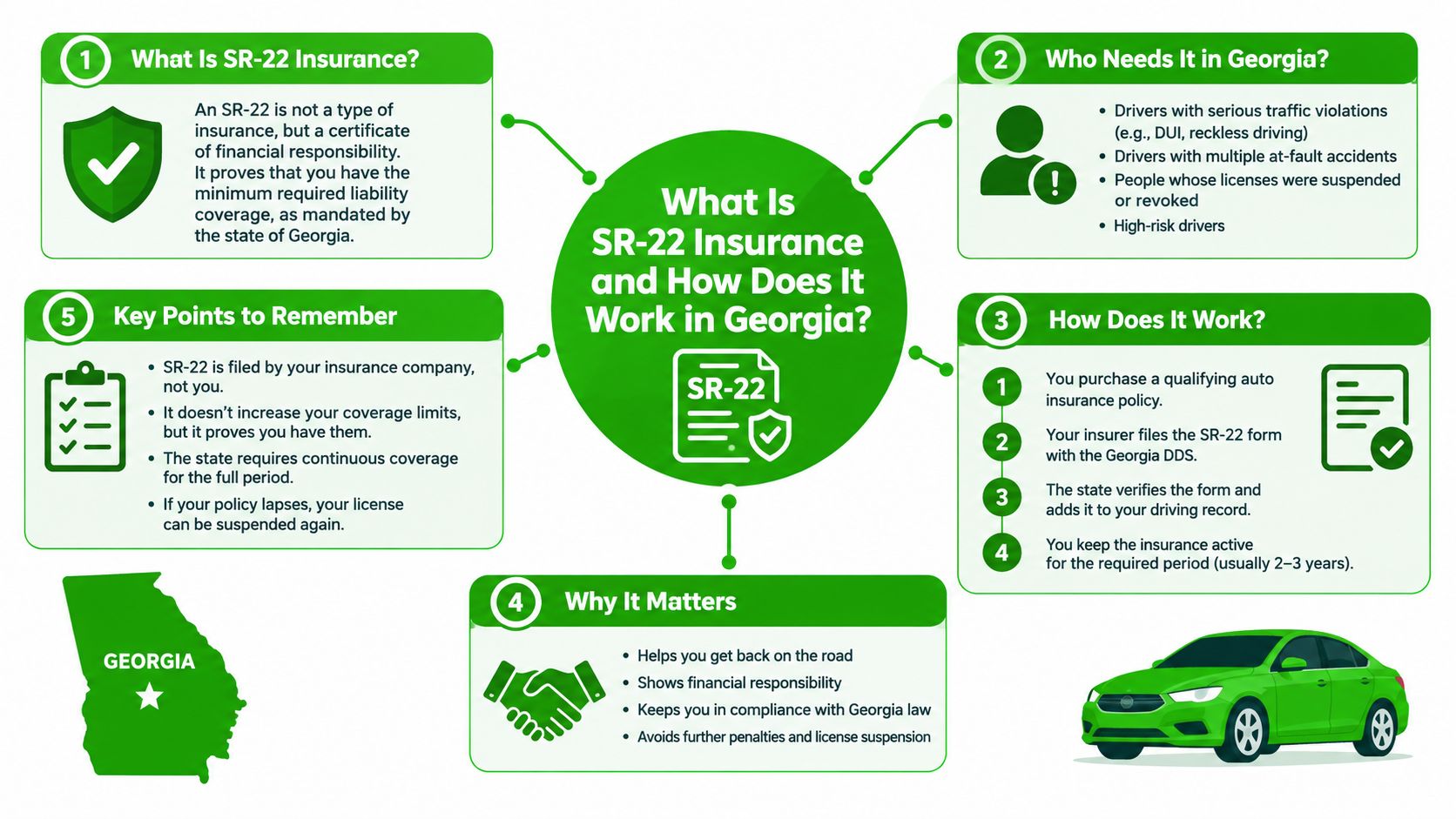
SR-22 isn't insurance. It is an insurer-filed certificate showing that the driver has an underlying liability policy meeting the state's financial responsibility requirements. Georgia DDS requires this filing after certain violations, commonly including DUI convictions, and DDS states that a DUI-related SR-22 under O.C.G.A. § 40-6-391 must be maintained for 3 years from the conviction date. The requirement appears in Georgia DDS DUI reinstatement procedures.
The policy and the certificate perform different jobs:
- The liability policy provides insurance coverage for covered claims, subject to its terms and limits.
- The SR-22 filing communicates to DDS that the required financial responsibility coverage is in force.
- The insurer submits the filing electronically. The driver generally doesn't send the certificate personally.
- The violation history drives the risk rating that usually creates the substantial premium increase.
Georgia's minimum liability structure is 25/50/25, meaning $25,000 for bodily injury per person, $50,000 for bodily injury per accident, and $25,000 for property damage per accident. Those limits are described in Georgia SR-22 coverage guidance from Infinity. The SR-22 doesn't replace those limits or expand them. It confirms that the policy connected to the filing meets the applicable requirement.
Why the filing matters to DDS
The certificate gives DDS an ongoing compliance signal rather than a one-time document. If the policy is canceled or lapses, the insurer can report that change, and the driver's reinstatement status may be affected. This is why paying only the first bill doesn't solve the problem. The policy must stay active for the required period.
Georgia drivers often confuse an SR-22 with an SR-22A. DDS instructions control which form applies, so a driver shouldn't substitute one filing for another based on an online explanation. The exact filing, policy limits, payment evidence, and maintenance period should come from the DDS record and the authorized insurer.
For help understanding the broader reinstatement sequence, review this license reinstatement after DUI guide, then confirm the requirements directly with DDS.
Steps to Obtain and Maintain an SR-22 Filing Correctly
The process works best when you handle it as a sequence, not as a single insurance purchase. Start with the DDS requirement, then make the insurer's filing, then verify that DDS has what it needs.
1. Confirm the filing type and dates
Read the DDS notice and identify whether it calls for SR-22 or SR-22A, the violation connected to the requirement, and the date from which maintenance runs. Don't assume the date is the same as your arrest date, court date, or policy purchase date. For DUI-related suspensions, DDS states that the SR-22 must be maintained for 3 years from the conviction date in the circumstances covered by its procedures.
2. Find an insurer that writes the required risk
Ask your current carrier whether it files SR-22 in Georgia. Some insurers don't write this category of risk, and a carrier may decline to continue the policy after a serious violation. Compare quotes based on the same liability limits and filing type. A low quote that lacks the required certificate isn't a solution.
3. Give the insurer accurate information
Provide your full legal name, Georgia license information, date of birth, and DDS documentation. Georgia rules require the SR-22 to identify the driver's full name, license number, and date of birth, as described in the Georgia administrative rules on financial responsibility filings. Errors can delay acceptance or force a corrected filing.
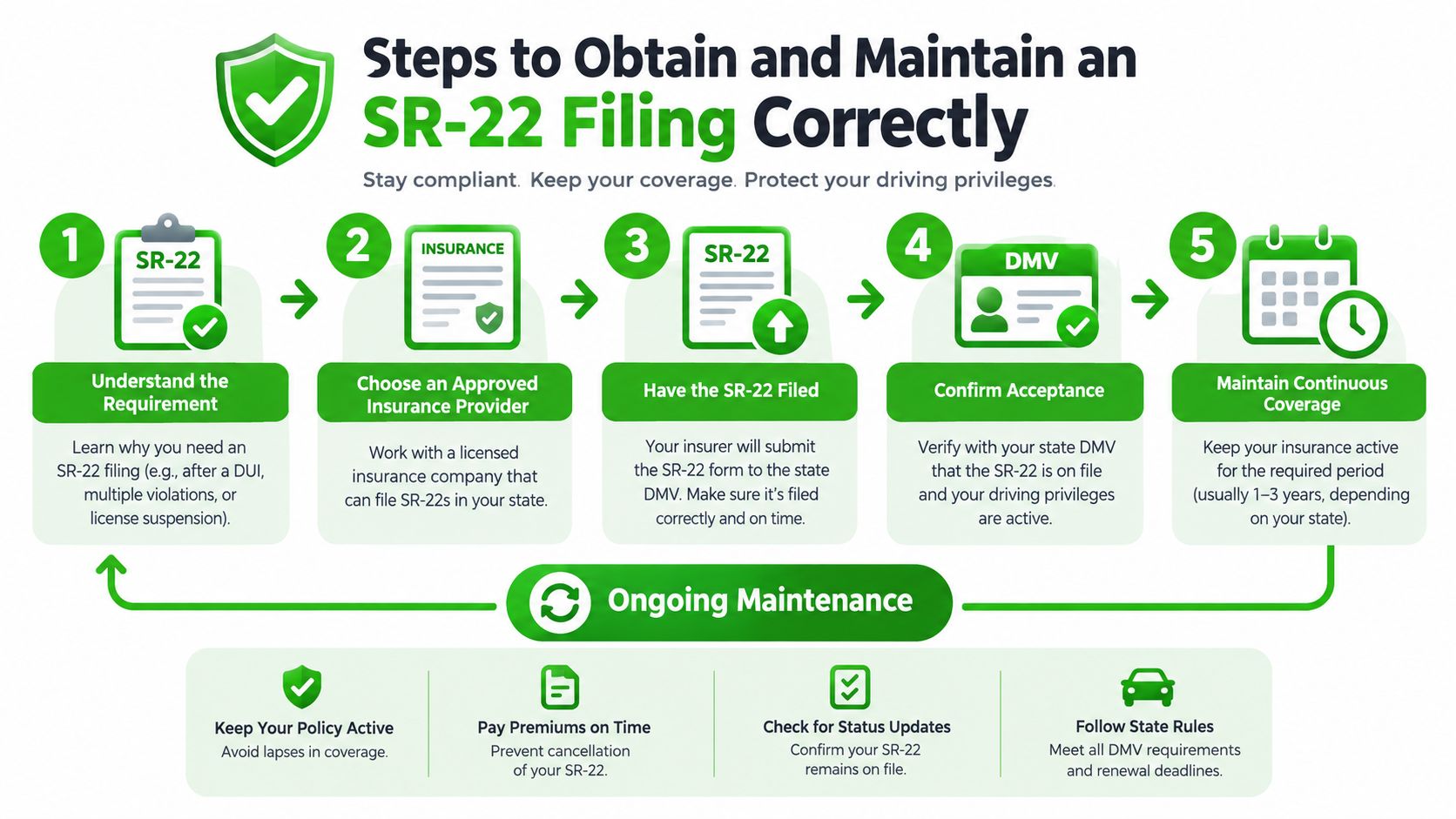
4. Confirm submission and payment
Ask for written confirmation that the insurer submitted the filing electronically to DDS. Pay the policy premium, any applicable filing charge, and the separate DDS restoration fee when required. If you're using an out-of-state policy, Georgia DDS says you must provide proof of payment and evidence that the policy meets Georgia's minimum coverage limits, as explained in the DDS financial responsibility FAQ.
5. Protect the policy from interruption
Set payment reminders, keep a reserve for renewal, and contact the insurer before changing vehicles, addresses, or carriers. A cancellation can trigger a report to DDS. That can cause another suspension or interrupt the reinstatement path, even if the driver has completed every required course.
The certificate is only useful while the underlying policy remains active. Compliance is continuous, not a form you obtain once and forget.
If a carrier won't renew you, arrange replacement coverage before the existing policy ends. Ask the new carrier to coordinate the filing so there isn't an avoidable gap.
Hidden Costs Behind Georgia SR-22 Insurance Beyond the Filing Fee
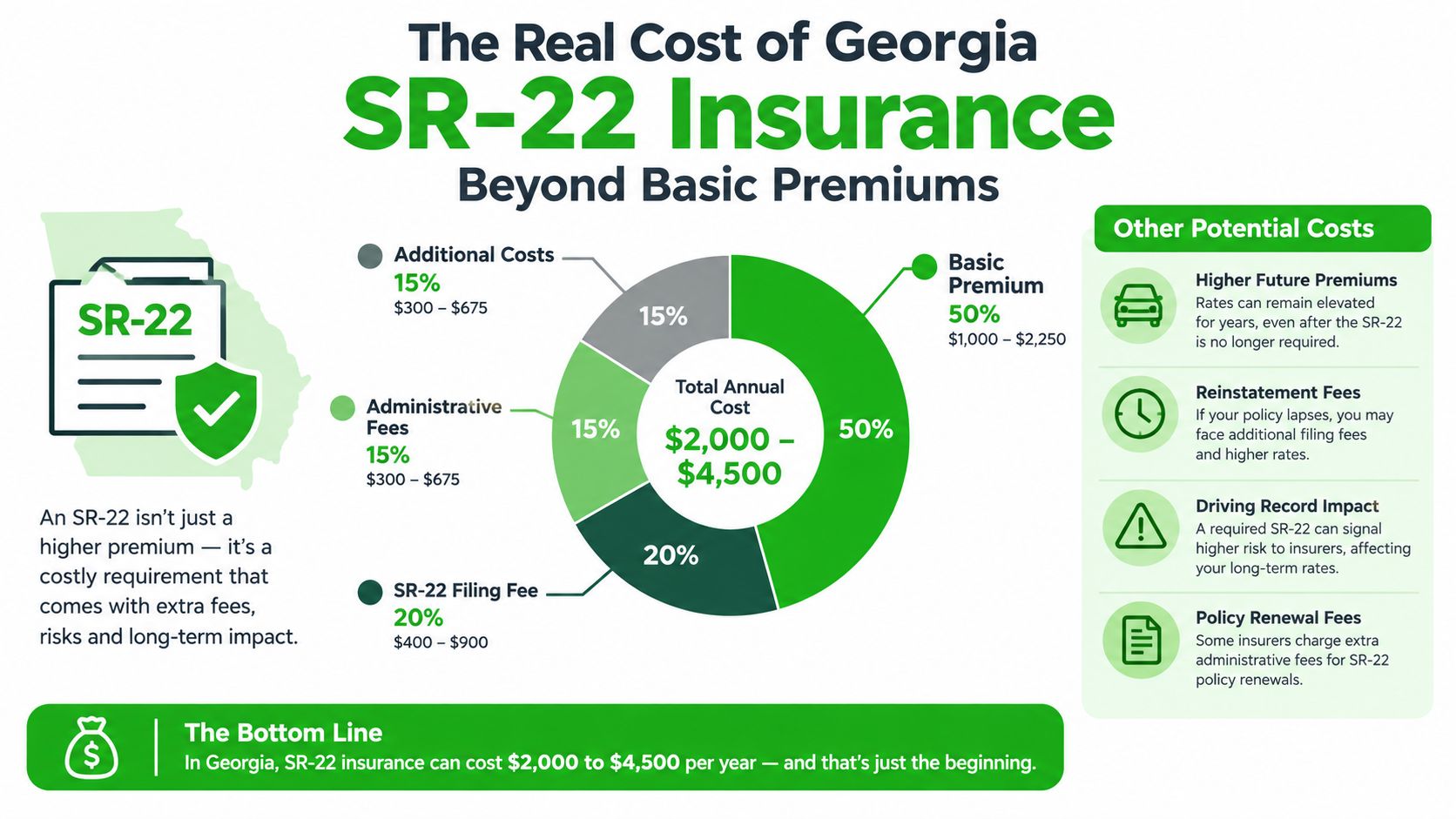
A driver may expect a small certificate charge after a DUI, then receive a much larger insurance quote. The SR-22 is only a filing attached to an active policy. The insurer sets the premium after assessing the violation, driving history, vehicle, location, coverage, and willingness to accept the risk.
One analysis places Georgia's statewide average SR-22 premium at $2,659 per year. A separate comparison reports about $154 per month for minimum SR-22 coverage after a DUI, compared with $80 per month for a driver with a clean record. That is a difference of $74 per month, or about 92.5% higher, according to the Georgia SR-22 cost comparison.
These figures describe market averages, not a guaranteed quote. Rates vary by carrier and personal risk profile. The practical takeaway is clear: the certificate fee is usually a small part of the total bill, while the higher-risk premium can continue throughout the required filing period.
Separate each expense before selecting coverage
| Cost category | What it represents |
|---|---|
| Filing charge | The insurer's administrative cost for submitting the certificate. |
| Insurance premium | The recurring liability-policy cost, influenced heavily by the violation. |
| DDS restoration fee | The state charge required for the applicable reinstatement process. |
| Course and evaluation costs | Expenses for required education, clinical evaluation, treatment, or related obligations. |
Request an itemized quote showing the premium and filing charge separately. Confirm whether the policy uses Georgia's required 25/50/25 limits or higher limits, and verify whether it is owner or non-owner coverage. Comparing different limits or policy types can make one quote appear cheaper while failing to provide the coverage or filing DDS requires.
DUI-related expenses can extend beyond insurance. Review this practical guide to DUI fines in Georgia when calculating the full obligation. The strongest cost-control measures are comparing eligible carriers, keeping coverage active, and completing reinstatement requirements promptly so higher insurance costs do not continue unnecessarily.
Reinstating Your License Through Mandatory Georgia DUI Courses
SR-22 solves only the financial responsibility portion of reinstatement. A driver with a Georgia DUI may also need to complete the state-approved DUI Alcohol or Drug Use Risk Reduction Program, pay the applicable restoration fee, and satisfy any additional court or DDS conditions.
For a first DUI conviction, Georgia requires completion of the Risk Reduction Program and a restoration fee of $210, or $200 when reinstatement is processed by mail. For a second conviction within five years, the suspension period is 3 years, but the driver may seek reinstatement after 1 year by completing the same program and paying $310, or $300 by mail, according to Georgia's statutory reinstatement requirements.
Build the reinstatement file in the right order
- Read the DDS notice. Identify the suspension type, eligibility date, filing requirement, and documents still missing.
- Schedule the Risk Reduction course. Use a DDS-approved provider and confirm whether online, live virtual, or classroom attendance fits the applicable requirement.
- Complete the program and secure proof. Keep the certificate, receipt, and any completion documentation.
- Obtain SR-22 or SR-22A coverage. Ask the insurer to file it directly and confirm submission.
- Complete other ordered requirements. These may include a clinical evaluation, treatment, testing, ignition interlock compliance, or a Victim Impact Panel when required by the case.
- Pay DDS and submit the full packet. Match the payment method and documentation to the instructions in your notice.
The Risk Reduction course isn't a casual driving refresher. Georgia's program rules describe a 20-hour intervention component, so schedule it with enough time to attend every required portion and preserve your completion records.
Georgia DUI Schools offers a DDS-approved Risk Reduction program, along with course formats and related clinical services that may help drivers organize education and evaluation obligations. Whether you choose that provider or another approved school, verify approval and make sure the course documentation matches what DDS and the court require.
Completion is not the same as reinstatement. Don't drive until DDS shows that your privileges are restored or you have received clear confirmation of lawful driving status.
Frequently Asked Questions About Georgia SR-22 Requirements
Do I need a new insurance policy?
Not always. Your current insurer may be able to attach the filing to an eligible policy. If it doesn't file SR-22 in Georgia or won't insure the changed risk, you'll need another carrier. The certificate still isn't a substitute for liability insurance.
What happens if I move out of Georgia?
Moving doesn't automatically erase a Georgia filing obligation. Before relocating, ask DDS and the insurer how to preserve the Georgia requirement, and obtain proof that any out-of-state policy satisfies Georgia's limits and payment documentation rules. Don't cancel the existing policy until replacement coverage and filing instructions are confirmed.
Does a habitual violator case follow the same process?
No. Georgia's habitual violator law is substantially stricter. A third or subsequent DUI-related conviction within five years can result in habitual violator classification. Reinstatement requires 5 years to elapse, an approved Risk Reduction Program, clinical evaluation and recommended treatment, ignition interlock compliance when applicable, required testing, and a $410 reinstatement fee, or $400 by mail for post-2009 revocations, according to the Georgia habitual violator rules.
Can I let the SR-22 lapse temporarily?
Don't assume a short lapse is harmless. DDS requires continuous maintenance for the applicable period, and an insurer's cancellation or lapse report can disrupt your license status. Contact the insurer before a missed payment becomes a cancellation, and keep written confirmation whenever coverage changes.
Georgia DUI Schools offers DDS-approved Risk Reduction and defensive driving courses, with online, live virtual, and classroom options across Georgia, plus clinical evaluations, ASAM Level 1 treatment, and Victim Impact Panels when those services are required. Start organizing your course and reinstatement steps by visiting Georgia DUI Schools.