

You're probably here because somebody handed you paperwork, circled a line, and said you need an anger management class. Maybe it happened after a family argument, a workplace blowup, a road-rage incident, or a court hearing where the judge moved fast and you were still trying to process what was ordered.
That moment creates the same question for a lot of people in Georgia. What exactly is an 8 hour anger management class, and will it count for my case?
That second question is the one that trips people up. An 8 hour class can be the right fit in some situations, but it isn't automatically enough just because it's available. In court-related settings, the number of hours matters. The format matters too. And if you're also dealing with a DUI, license reinstatement, a clinical evaluation, or defensive driving issues in Georgia, it's easy to mix up programs that serve very different legal purposes.
A good way to think about it is simple. An 8 hour anger class is often a compliance minimum. It is not automatically the right treatment dose for every person or every court order. That difference can save you time, money, and a frustrating do-over.
What 8 Hour Anger Management Classes Are Designed to Do
A lot of students come in thinking an 8 hour class is therapy. Usually, it isn't. It's closer to a short, structured educational program built to address a specific requirement and teach practical skills in a limited window.
Independent guidance describes court-ordered anger programs for lower-level situations as commonly falling in the 8 to 16 hour range, especially for first-time offenders, minor misdemeanors, or cases where anger was a secondary factor, as noted by The Foundation of Change's overview of court-ordered anger management length.
What the certificate actually means
If a court, probation office, employer, or attorney asks for an 8 hour class, they're usually looking for proof that you completed a recognized educational intervention. That certificate generally shows that you attended the required number of hours and finished the course assigned.
It does not automatically prove deep clinical treatment, long-term rehabilitation, or that every underlying issue has been resolved.
Practical rule: A completion certificate proves completion. It only satisfies your case if it matches what your paperwork requires.
That's why these classes are often used for the person who had one incident, not the person with a repeated pattern. In many court-facing situations, the 8 hour format became common because it gives enough time to cover the basics without turning the order into an open-ended counseling process.
Why courts often use this short format
Think about a first-time disorderly conduct case where shouting, threats, or loss of control played a role, but the case wasn't built around long-term violence treatment. The court may want a response that is direct, teachable, and easy to monitor.
An 8 hour class can do that by covering:
- Triggers: What sets anger off
- Escalation signs: What happens in your body before you act
- De-escalation tools: What to do in the moment
- Communication skills: How to respond without making things worse
- Behavior tracking: How to notice patterns before they repeat
A separate public guide also notes that short programs commonly run 8 to 16 hours and are often documented with a certificate submitted to the court or probation officer in court-facing cases, according to this court-ordered anger management classes guide.
The part people misunderstand
An 8 hour class is often the starting point, not the universal answer. If your paperwork says 8 hours, that may be exactly what you need. If your paperwork says more, the short class won't fix that problem.
That's where many people get stuck. They search for the fastest class first, and only later discover they enrolled in the wrong length.
Inside the 8 Hour Curriculum and How It Builds Skills
A solid 8 hour class isn't eight random hours of talking about anger. It usually follows a sequence. Each part builds on the one before it, the same way a defensive driving course teaches hazard awareness before reaction choices.
The course usually starts with recognition
Before you can control anger, you have to catch it early. Most short programs begin with identifying personal triggers, warning signs, and the chain reaction between thoughts, body sensations, emotions, and behavior.
A useful comparison is a dashboard warning light. If you only notice the moment you explode, you're already late. The skill is spotting the rise sooner. Maybe your jaw tightens, your breathing changes, your voice gets louder, or your thoughts turn into “they're disrespecting me.”
Then it moves into interruption skills
Once students can recognize the pattern, the class usually teaches ways to interrupt it. These are often simple on purpose, because under stress people don't use complicated tools well.
Common examples include:
- Pause methods: Taking a timeout before the conflict peaks
- Breathing routines: Slowing the physical stress response
- Exit planning: Leaving a heated exchange without escalating it
- Reframing thoughts: Replacing fuel thoughts with more accurate ones
One of the most practical CBT tools here is the idea of tracking what you thought, what you felt, and what you did next. If you want to see how that works in plain language, thought records for anger are a useful example.
The middle of the class focuses on communication
Many people realize the problem usually isn't anger by itself. It's what they do with it.
Someone cuts you off in Atlanta traffic on I-285. Old response: tailgating, horn, yelling, maybe following too closely. New response: notice activation, reduce physical arousal, avoid personalizing it, create space, move on.
At work in Athens, a supervisor corrects you in front of others. Old response: arguing back, muttering, storming out. New response: ask to revisit the issue privately, state your concern directly, and stay on the actual problem.
Most short anger classes work because they turn vague advice like “calm down” into a series of actions you can repeat.
The final stretch ties it together
By the end, participants usually build a personal plan for handling future conflict. That may include a trigger list, timeout steps, people to call, phrases to use, and situations to avoid when already stressed.
A brief program can still feel complete when it's taught in this order:
| Course stage | What you learn | Why it comes here |
|---|---|---|
| Awareness | Triggers and warning signs | You can't change what you don't catch |
| Regulation | Breathing, pauses, timeouts | These lower intensity first |
| Thinking skills | Reframing and self-talk | Clearer thinking works better once calmer |
| Communication | Assertive responses and conflict skills | This is where behavior changes show up |
| Maintenance | Relapse planning and tracking | Keeps the skills usable after class |
That sequence is why a short class can still be meaningful. It's compact, but it isn't supposed to be random.
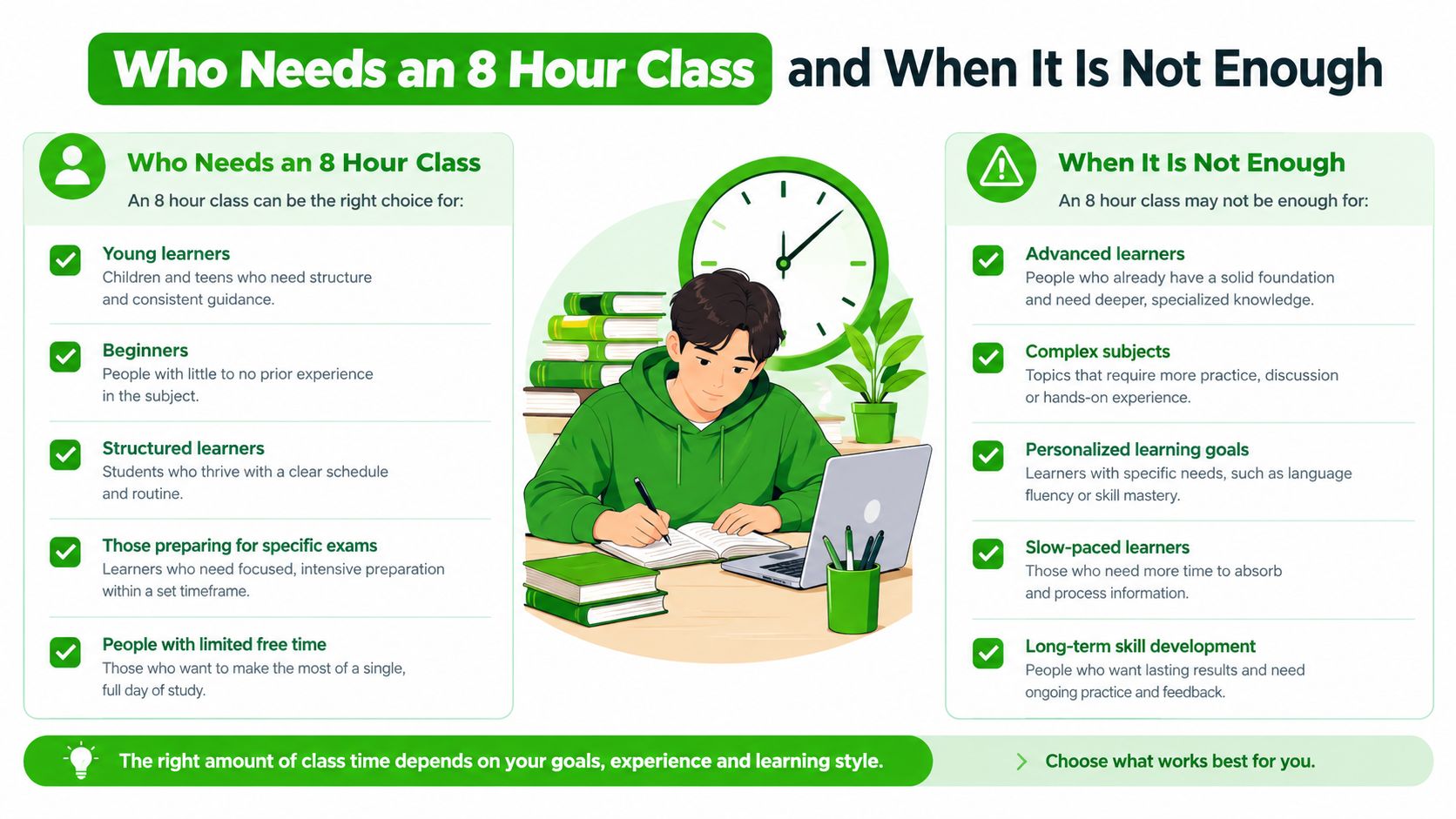
Who Needs an 8 Hour Class and When It Is Not Enough
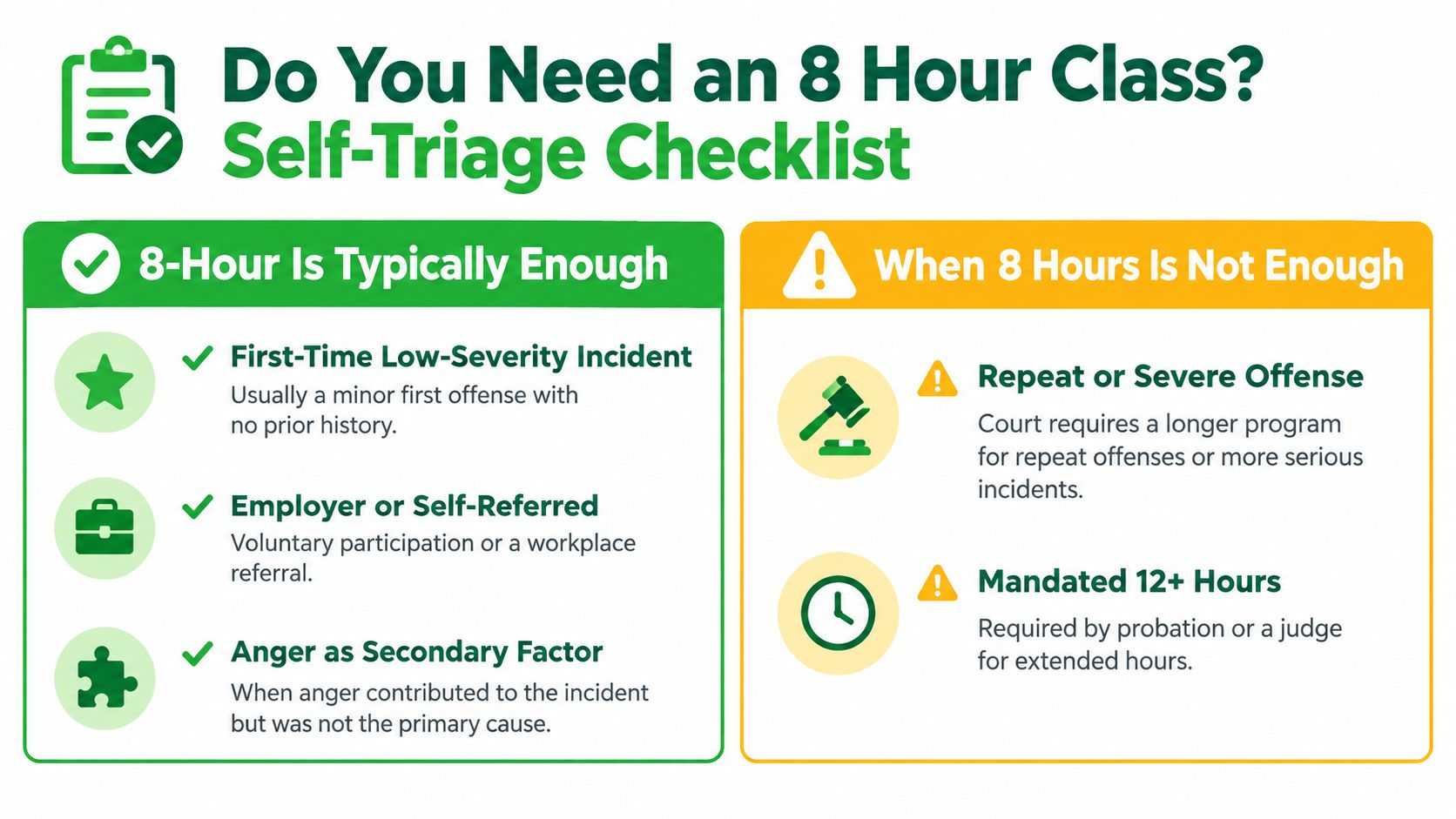
The biggest mistake I see is people treating all anger management orders like they're interchangeable. They aren't. The right course length depends on the legal order, the seriousness of the conduct, and whether the issue looks like a one-time event or a repeating pattern.
A research-oriented summary notes that short court-facing programs commonly fall into the 8 to 16 hour band, while broader court-ordered anger management offerings can range much higher depending on the case, as discussed in this anger management report.
Situations where 8 hours often fits
An 8 hour class is often a reasonable match when the person falls into one of these groups:
- First-time lower-severity case: The incident was real, but the order is educational rather than intensive.
- Employer or school referral: A person needs documented skills training after a conflict or conduct problem.
- Anger as a secondary issue: The main case may involve something else, but anger played a contributing role.
- Assessment points to education-only needs: Some providers use screening to help decide whether a brief educational course is enough. Georgia readers looking at that question can review an anger management assessment option.
These situations tend to line up with the practical role of the short class. It teaches the core skills, creates documentation, and gives the court or referring party a defined completion point.
When 8 hours usually won't be enough
People need to slow down and read every line of the order.
Public guidance repeatedly shows that courts and probation officers may require 4, 8, 12, 16, or longer programs, and that the assigned number has to match the order. If the paperwork says 12 hours, an 8 hour certificate won't satisfy it, as explained in this discussion of hour-count matching and court requirements.
If your order names a specific number of hours, that number controls. Not the ad you saw online. Not the cheapest option. Not what someone else took.
An 8 hour class also may not fit well when there are repeated incidents, violence concerns, close court supervision, or a clear need for more than education alone.
A simple way to check your paperwork
Before you enroll, look for these exact details:
- Hour count required
- Format allowed, such as in person, live online, or another approved format
- Deadline for completion
- Who must receive proof, such as the court, probation, employer, or attorney
- Any extra conditions, including evaluations or ongoing counseling
If any of that is unclear, call the probation officer, clerk, attorney, or referral source before paying. Five minutes of confirmation can prevent enrolling twice.
Choosing Between In Person and Online 8 Hour Options
Don't choose a format based only on learning style. Choose based on what the court will accept, what fits your work schedule, and whether you need accountability.
That's why it helps to separate convenience from fit.
What matters more than convenience
Some people do well with a self-paced course because they only need a straightforward educational requirement completed. Others need live interaction because they interrupt, argue, shut down, or avoid discomfort unless an instructor keeps them engaged.
Research-oriented public summaries report that live online, instructor-led CBT-based anger management can perform similarly to in-person programs on standardized anger measures, retention, and follow-up outcomes, including court-mandated participants, according to this review of online anger management effectiveness.
That doesn't mean every online option is equal. A self-paced certificate course and a live virtual class are not the same experience.
Practical format comparison
| Format | Best For | Court Acceptance Tip |
|---|---|---|
| In Person | Students who benefit from structure, face-to-face interaction, and fewer distractions | Verify the provider's certificate format before class day |
| Live Online | Busy adults who need flexibility but still want instructor oversight | Ask whether your court accepts live virtual attendance specifically |
| Self Paced | Lower-stakes educational use or situations where convenience matters most | Confirm acceptance before paying because some courts may want more oversight |
A local Georgia example
Say you live in metro Atlanta, work weekdays, and need to finish a short anger class while also handling probation check-ins. A live online option may fit better than driving across town twice. If you're comparing formats for that kind of situation, court-approved online anger management classes can give you a concrete starting point for what to verify.
On the other hand, if you know you tune out easily on a screen, a classroom may be the smarter choice even if it's less convenient.
The best format is the one your court will accept and you'll actually complete without cutting corners.
Questions to ask before you enroll
Ask the provider three things in plain English:
- Will this certificate match my required hours
- Is this format commonly accepted for court or probation use
- What documentation do I receive when I finish
If the answers sound vague, keep looking.
How Georgia Requirements Fit Around Anger Management
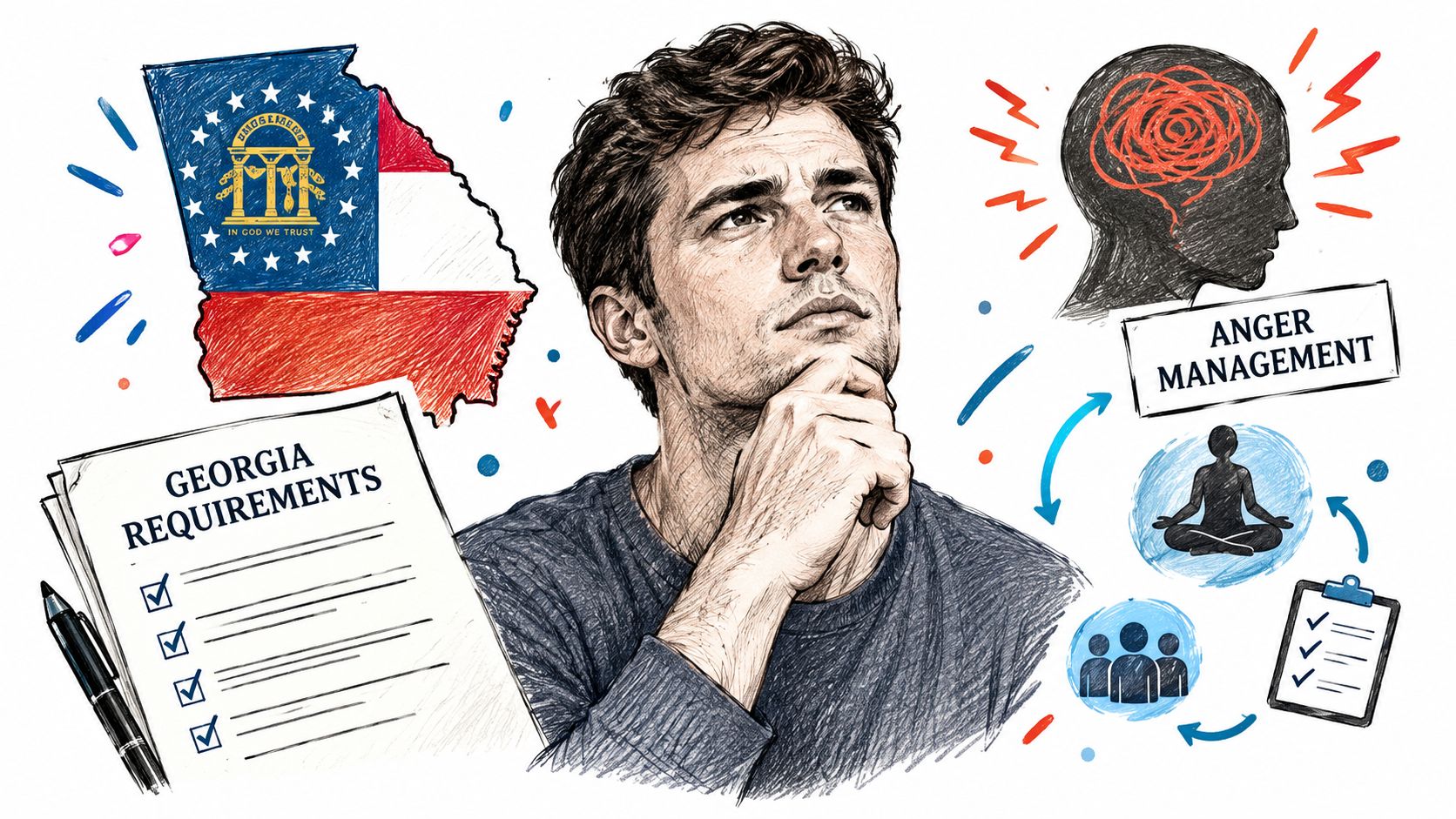
Georgia students often mix together three separate buckets. Anger management, DUI Risk Reduction, and defensive driving can all show up in legal or license-related situations, but they are not substitutes for one another.
Georgia DUI Risk Reduction is its own program
If your case involves a DUI in Georgia, don't assume an anger management certificate can fill that role. It can't.
Georgia's DUI Alcohol or Drug Use Risk Reduction Program includes a standardized screening assessment plus a DDS-approved therapeutic education course focused on alcohol, drug use, and driving, according to the Georgia Department of Driver Services Risk Reduction program page.
That matters in real life. A student in Atlanta might need anger management because of a separate court issue, while also needing Risk Reduction to restore driving privileges after a DUI. Those are two different boxes to check.
The Georgia scheduling rules matter too
Georgia's Risk Reduction course is commonly described as a 20-hour program, and some Georgia providers note that it must be scheduled with limits on hours per day and per session, which affects how the course is split across class days, as explained by this Georgia DUI school scheduling overview.
So if you're in Athens, Marietta, Decatur, or another metro area and trying to juggle work, probation, and transportation, it helps to understand that Risk Reduction follows its own state structure. It isn't a one-day anger class with a different name.
DDS approval and defensive driving are separate issues too
Georgia DDS also keeps an official list of certified DUI schools and states that the list is for identifying approved programs only, which is why state approval matters when you're dealing with Risk Reduction rather than a general certificate, as shown on the Georgia DDS certified DUI schools page.
Defensive driving sits in a different lane as well. Under Georgia law, a driver may reduce 7 points by completing a state-approved defensive driving course, but only once every five years, and Georgia uses a 15-point threshold in 24 months for suspension risk, according to this explanation of Georgia point reduction eligibility.
Here's the clean version:
- Anger management class: Usually tied to behavior, court orders, or workplace concerns
- DUI Risk Reduction: State-required DUI program with assessment plus education
- Defensive driving: Point reduction and safe-driving education under Georgia rules
People get in trouble when they assume one certificate covers all three. It doesn't.
Costs Outcomes and What to Expect After You Finish
People often ask cost first, and I understand why. But the smarter question is whether the class you choose will satisfy the requirement and fit your situation. A cheap class that doesn't count costs more in the end.
What you're usually paying for
The fee for an anger management class often reflects several moving parts:
- Administrative work: Registration, attendance tracking, and certificate preparation
- Format: Live instruction often involves more oversight than a basic self-paced course
- Documentation needs: Court-facing records usually need to be clear and usable
- Location and scheduling: Weekend, evening, online, or in-person options may differ
What completion usually delivers is straightforward. You finish the assigned course, receive the completion documentation, and submit it where required. In many court-facing situations, that means the certificate goes to the court or probation officer.
Be realistic about outcomes
A short class can teach useful skills. It can help someone pause sooner, communicate better, and avoid replaying the same argument the same way.
But it's also important to stay honest. Eight hours is often a compliance minimum, not a proven treatment dose for everyone. If someone has repeated angry incidents, violence concerns, heavy court supervision, or overlapping substance use issues, a longer or more intensive response may fit better than the fastest certificate.
For readers trying to compare local options carefully, an overview of anger management classes in Atlanta can help narrow down what kind of program matches the paperwork.
What to keep after class
Don't leave the process at “I got my certificate.” Keep a small file with:
- Your registration confirmation
- Attendance records if provided
- The final certificate
- Any submission receipt or email trail
- A copy of the original order
Keep your paperwork until the case is closed and your record requirements are fully cleared.
If you found the class helpful, keep using the tools. The students who get the most from a short program are usually the ones who practice one or two techniques right away instead of waiting for the next crisis.
How to Enroll and Get Your Court Documentation in Georgia
The smoothest enrollments happen when people verify first and register second. That order matters.
Start with the exact requirement
Pull out the court order, probation paperwork, employer notice, or attorney instructions. You're looking for the actual hour requirement, not your best guess.
If the document is unclear, contact the person or office that issued the requirement and ask:
- How many hours are required
- Whether online, live online, or in-person is acceptable
- Whether the class needs any special approval
- Where the completion proof must be sent
That short call protects you from taking an 8 hour class when the order requires more.

Choose the provider based on fit, not speed alone
In Georgia, people often need several services around the same time. A DUI case may involve Risk Reduction. A court matter may involve anger management. Some cases also involve a clinical evaluation, a Victim Impact Panel, or other follow-up steps.
That's why it helps to choose a provider that understands the surrounding process and can tell you clearly what the class does and does not satisfy. In the article body, one example is Georgia DUI Schools, which offers anger-related assessment and class information alongside Georgia-focused DUI, Risk Reduction, defensive driving, and related court compliance services.
Finish strong on documentation
Before your class date, confirm what you'll receive at the end and how long documentation takes. After completion, submit the proof exactly how the court, probation officer, or employer wants it submitted.
For many students around Atlanta, Athens, and surrounding communities, the hardest part isn't the class. It's missing a paperwork detail after the class is over.
A simple final checklist helps:
- Confirm hours before paying
- Choose an accepted format
- Attend the full course
- Get the completion certificate
- Submit it to the right place
- Keep your own copy
If you do those six things in order, the process usually stays manageable.
If you need help sorting out whether an 8 hour anger class is enough, or you're also dealing with Georgia DUI, Risk Reduction, defensive driving, clinical evaluations, or related court requirements, Georgia DUI Schools offers Georgia-focused guidance and course options that connect the paperwork to the right next step. Start there, confirm what your order requires, and choose the class or service that matches your case.