
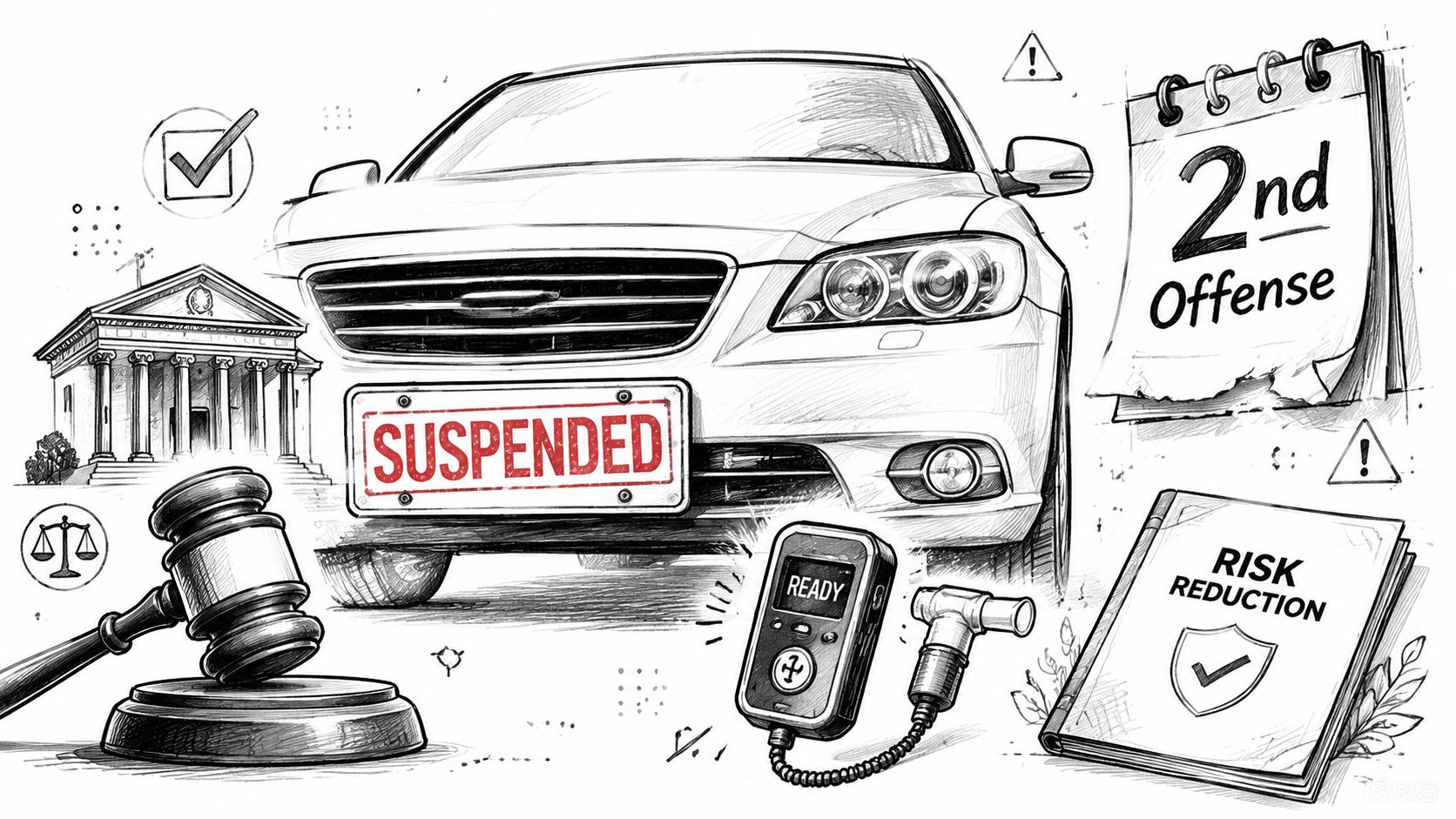
You're three months into a Georgia suspension after a second DUI conviction. Your spouse's vehicle has an ignition interlock device, you assume that makes the situation manageable, and then an officer stops you for a routine traffic matter. The license check changes everything. You're arrested for driving on a suspended license, your vehicle may be towed, and the reinstatement plan you were following now has a separate criminal case attached to it.
That's the reality behind a driving DUI suspended license 2nd offense case in Georgia. The DUI conviction, the DDS suspension, the Risk Reduction requirements, and the new suspended-license charge are connected in your life, but they remain separate legal tracks. Treating them as one problem is how people miss deadlines, drive outside their authority, and turn a difficult reinstatement into a much longer one.
A Georgia Driver's Second-Offense Reality
Three months after his second DUI conviction, Marcus, a Cobb County driver, believed he had found a workable solution. DDS had imposed an 18-month suspension, but his wife's vehicle was equipped with an ignition interlock device. He assumed that equipment allowed him to drive when necessary.
It did not. An interlock is installed in a vehicle. It does not give Marcus permission to operate that vehicle during his suspension or expand the terms of any limited driving authority. During a routine traffic stop, the officer checked his status, arrested him, and arranged for the vehicle to be towed. Marcus left the roadside facing a separate charge for driving while his license was suspended.
Georgia classifies a second offense of driving while suspended within the applicable five-year period as a high and aggravated misdemeanor. Under O.C.G.A. § 40-5-121, the offense carries 10 days to 12 months of imprisonment and a mandatory fine of $1,000 to $2,500. The court will assess the charge history, evidence, and circumstances, but this is not a routine traffic citation.
Marcus now had two court calendars and a separate DDS file. The DUI matter involved sentencing and probation. The suspended-license case required its own arraignment, negotiations, and possible sentence. DDS continued handling the administrative suspension, permit eligibility, and reinstatement conditions. A new conviction could also add pressure to a driving history that already contains repeat offenses. DDS explains in its safety-responsibility guidance that a driver may be declared a habitual violator after a third conviction for specified offenses within five years, including DUI and several serious vehicle offenses. Driving during the resulting revocation can expose the driver to felony habitual impaired-driving charges.
The practical lesson: An interlock in a family vehicle does not create general driving permission. Confirm your own DDS status, permit terms, and authorized vehicle requirements before operating any vehicle.
At booking, Marcus saw how the two tracks collided. His 20-hour Risk Reduction Program, clinical evaluation, treatment referral if required, Victim Impact Panel, insurance filing, and DDS paperwork were still pending. The new criminal charge could disrupt the reinstatement timeline while he defended a separate case. Drivers dealing with both matters should review Georgia guidance on multiple DUI offenses and consult counsel before driving again.
How Georgia Separates the Three Separate Penalties
Marcus's reinstatement problem did not come from one file. A second DUI conviction, the DDS suspension, and a driving-while-suspended charge each followed its own rules. Treating them as one case is how repeat offenders miss deadlines, drive outside permit terms, or assume court paperwork restored a license that DDS still lists as suspended.
The DDS administrative suspension
Georgia DDS controls the driving privilege, suspension record, permit eligibility, and reinstatement file. For a second DUI conviction within five years, the stated penalty is an 18-month minimum license suspension. The first 120 days are a hard suspension with no driving privileges. After that period, limited driving may depend on the required ignition interlock and other eligibility conditions described by Georgia DDS.
The DDS track operates separately from the criminal sentence. A judge may order probation, fines, education, clinical evaluation, or treatment. Those orders do not erase a DDS suspension or create driving permission by themselves.
The second-DUI criminal case
The second track is the underlying DUI prosecution in state or superior court. Its sentence may include court-ordered education, evaluation, treatment, probation, fines, and ignition-interlock compliance. DDS may require proof of related reinstatement conditions as well. Completing one requirement does not automatically satisfy every court or agency requirement.
Repeat offending remains a continuing compliance problem, not an isolated event. California's DMV reported a 6.1% one-year recidivism rate for second DUI offenders arrested in 2020, compared with 5.4% in 2019, in its 2022 DUI Management Information System report. Georgia uses different rules, so use that report for context, not as a substitute for Georgia requirements.
The driving-while-suspended charge
The third track begins when someone operates a vehicle while the DDS suspension remains active. That conduct can produce its own criminal sentence, including jail exposure and a fine. The charge does not merge into the DUI case because the stop occurred during the DUI suspension. A conviction can also create another suspension consequence and extend the path back to lawful driving.
| Track | Authority | Duration / Penalty | Trigger |
|---|---|---|---|
| DDS administrative suspension | Georgia DDS | 18-month second-DUI suspension, including a 120-day hard-suspension period | Second DUI conviction within five years |
| Criminal second DUI | State or superior court | Court-ordered criminal sentence, education, evaluation, treatment, probation, fines, and interlock conditions | DUI conviction |
| Driving while suspended | Criminal court under O.C.G.A. § 40-5-121 | Second offense within five years, 10 days to 12 months in jail and $1,000 to $2,500 fine | Operating a vehicle while suspended |
Florida's rules show why state-specific advice matters. Florida provides a one-year second or subsequent administrative suspension for specified alcohol-concentration cases under Florida's administrative suspension rules. Georgia drivers should follow the status, dates, permit terms, and documentation attached to their own DDS record. Use this Georgia suspended-license DUI guide to organize both the suspension track and the new criminal exposure before taking the wheel.
Court and DDS Processes Working in Parallel
The court and DDS don't wait for each other. Your court file may focus on plea, trial, sentencing, probation, and payment. The DDS file focuses on the legal status of your privilege and whether you have supplied the documents needed for reinstatement or a limited permit.
What DDS needs from you
Build one compliance folder and separate court documents from DDS documents. The agency may require:
- Risk Reduction proof: A certificate or DDS-required completion record, including the DS-1150 documentation when applicable.
- Clinical evaluation: An evaluation completed by an appropriately licensed provider in the format DDS accepts.
- Treatment completion: ASAM Level 1 treatment only when the clinical evaluation recommends it, unless the court imposes an additional requirement.
- Victim Impact Panel: Proof of attendance through Mothers Against Drunk Driving or another accepted provider.
- Insurance filing: SR-22 proof from an insurer able to file the required form with Georgia.
- Reinstatement payment: The applicable DDS fee, including the $210 fee identified in the state reinstatement process materials.
- Ignition interlock evidence: Installation and reporting through a DDS-certified provider when the permit or reinstatement terms require it.
Georgia's first-offense DDS guidance confirms that a DDS-approved Risk Reduction certificate is a direct reinstatement requirement, not merely a suggestion from a judge, in the agency's DUI first-offense FAQ. The second-offense file usually demands even closer coordination because the suspension and interlock conditions are more restrictive.
What the court needs
The court may require a plea or verdict, sentencing order, fines and surcharges, probation enrollment, and treatment beyond the DDS minimum. A judge may order the Risk Reduction Program before DDS is ready to process a reinstatement application. The same completion certificate may matter to both systems, but each office can require its own submission.
A clinical evaluation can also create a collision point. If the evaluator recommends ASAM Level 1 treatment, don't assume you can decline it because the court order is silent. The recommendation can become part of the licensing file, and the judge may impose it separately.
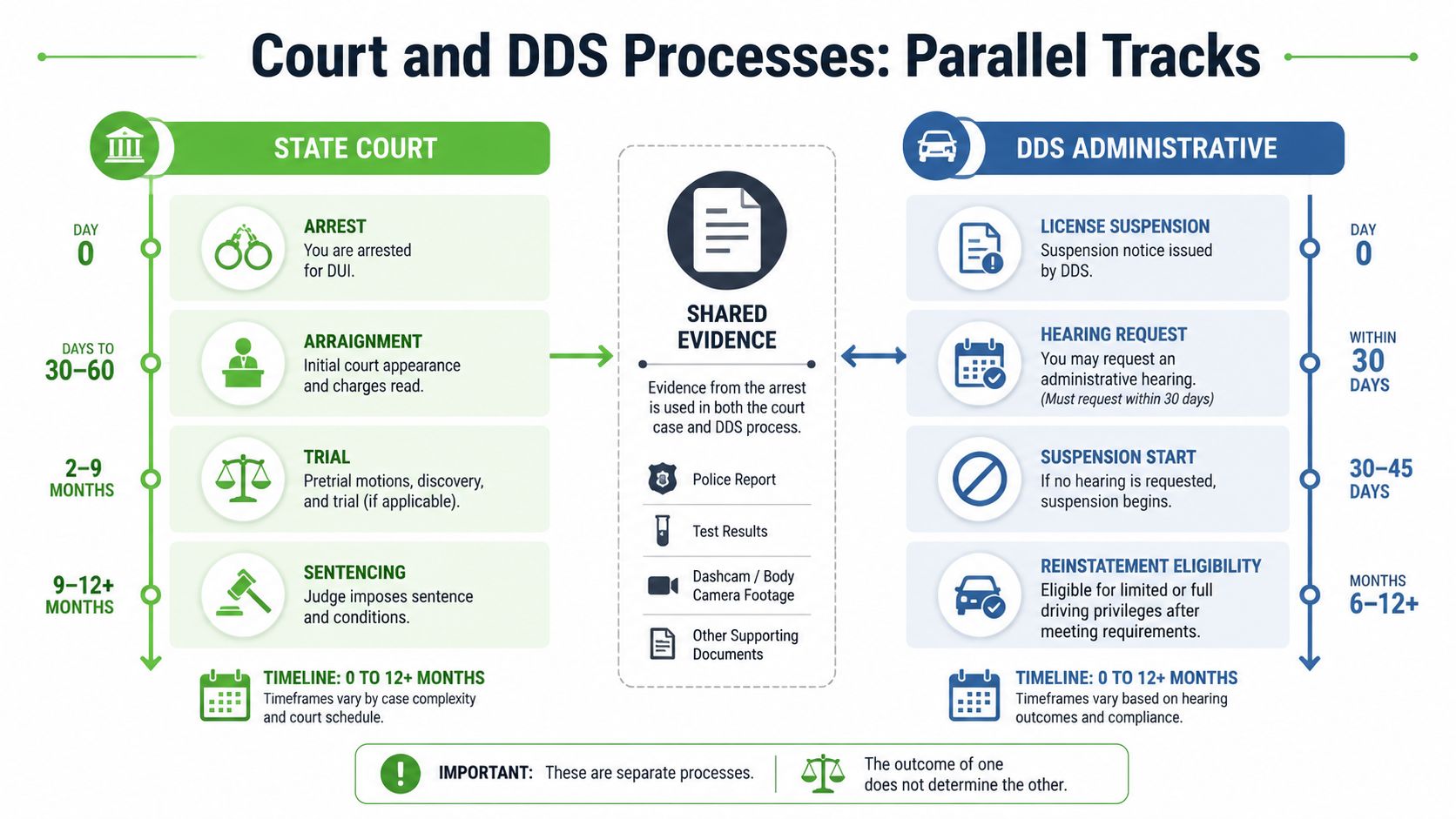
A reliable timeline starts on the arrest date, but the precise eligibility date depends on the suspension order, prior history, hearing activity, court disposition, and DDS record. Don't schedule interlock installation or plan work travel based on a general internet timeline. Have DDS confirm the date and have counsel review the criminal conditions.
Reinstatement Steps From Assessment to Keys
Reinstatement works best as a sequence, not a pile of unrelated appointments. Start with the requirement that determines whether further treatment is needed, then complete the education and compliance items that support both the court file and the DDS file.
Begin with assessment and education
The Georgia DUI Risk Reduction Program has two required parts. Providers describe the process as a needs assessment or evaluation first, followed by the 20-hour classroom component, and identify the DDS-set course fee as $360 in their program information. Use a DDS-approved provider, confirm the course schedule, and preserve every receipt and certificate.
The assessment isn't the same as a clinical evaluation. The first helps place you in the required Risk Reduction course. The second is performed by a licensed treatment provider and addresses whether treatment is indicated.
Complete evaluation and any recommended treatment
Schedule the clinical evaluation early. If the evaluator recommends ASAM Level 1 treatment, complete it and obtain formal proof. ASAM Level 1 isn't automatic for every person, but it isn't optional once the applicable evaluator or court requires it.
Victim Impact Panel attendance belongs in the same compliance file. Mothers Against Drunk Driving and comparable providers issue documentation that can be submitted to the court or DDS when accepted. Confirm the provider before attending because an unrecognized certificate can cost time.
Handle the vehicle and insurance conditions
An ignition interlock device may be required for the limited driving period or as a reinstatement condition. Installation must be completed through a DDS-certified provider, and the provider's reports and calibration records must remain clean and current.
SR-22 filing is separate from ordinary proof of insurance. The insurer files the certificate with the state, and continuous coverage matters. Before purchasing a policy, review this complete guide to SR-22 insurance so you understand filing responsibility, policy continuity, and what happens if coverage lapses.
Submit the final packet
Before asking DDS to process reinstatement, check that the file contains the court disposition, Risk Reduction certificate, clinical evaluation, treatment proof if recommended, Victim Impact Panel record, SR-22 filing, interlock documentation, and the $210 DDS reinstatement fee where applicable. Keep digital and paper copies.
For a broader checklist, review this Georgia license reinstatement guide. The interlock removal date depends on the applicable suspension and prior DUI history. A clean log helps you comply, but it doesn't erase the original suspension period.
Limited Driving Privileges Versus Full Reinstatement
Limited driving privileges and full reinstatement serve different purposes. A limited permit can support essential travel under strict conditions. Full reinstatement restores ordinary driving authority after every legal and administrative condition has been satisfied.
Georgia DDS identifies a 120-day hard-suspension period for a second DUI conviction within five years before the interlock-based limited-driving framework can become relevant, as described in Georgia DDS chapter guidance. The permit may restrict travel to employment, school, medical care, court-ordered appointments, and required programs. Metro Atlanta drivers must pay close attention to route and county restrictions, not just the destination.
| Requirement | Limited Permit, Ignition Interlock | Full Reinstatement |
|---|---|---|
| Driving authority | Narrow, purpose-specific travel | Ordinary lawful driving |
| Interlock | Installed and reported by a certified provider | Removed only when DDS permits removal |
| Travel | Restricted to approved purposes and routes | No special permit route limits |
| Records | Monthly calibration and compliance records matter | Prior compliance still remains part of the file |
| Education and treatment | Required conditions still apply | All DDS and court conditions must be complete |
| Insurance | SR-22 may be required | SR-22 and continuous coverage may remain required |
| Court obligations | Probation and appointments continue | Pending conditions can still block final restoration |
Daily life changes under an interlock permit. You may need to plan trips around work shifts, school schedules, treatment, and court appointments. Parking also matters. The interlock vehicle needs to remain available for authorized travel, and allowing another person to use it can create confusion about logs, reporting, or responsibility.
Full reinstatement requires more than finishing the hard period. DDS must have the required course, evaluation, treatment, panel, insurance, fee, and interlock records. Probation conditions can also delay practical completion if the criminal case remains active or probation has been tolled.
Out-of-state readers often confuse occupational permits with Georgia's limited driving process. For a useful comparison of a different state's occupational-license system, consult the Law Office of Bryan Fagan guide, but don't assume Texas rules apply in Atlanta, Athens, or anywhere else in Georgia.
Misconceptions That Derail Reinstatement
A second DUI suspension creates two connected tracks. The DDS reinstatement file and the new driving-while-suspended case can move at the same time, and completing one does not close the other. Course certificates, treatment records, insurance filings, and court compliance must line up before you drive legally.
“Risk Reduction restores my license”
The 20-hour Risk Reduction classroom program is one DDS requirement, not a license-restoration order. Completing it does not end the hard-suspension period, replace the clinical evaluation, remove an ASAM Level 1 recommendation, satisfy a Victim Impact Panel requirement, or replace SR-22 and interlock conditions.
Georgia DDS requires proof of completion from an approved Risk Reduction provider in DUI reinstatement cases, as explained in the DDS first-offense FAQ. Treat the certificate as one item in the file. Confirm every remaining requirement with DDS and your attorney.
“The suspension will be over quickly”
For a second DUI within five years, Georgia's DDS framework provides an 18-month suspension, including a 120-day hard-suspension period. A limited permit date and a full-restoration date serve different purposes. An interlock vehicle and a clean device record do not shorten the underlying suspension.
“I can ignore the new charge”
Handle the driving-while-suspended case immediately. An unresolved criminal charge can disrupt probation, lead to missed-court consequences, and create another suspension problem if it ends in conviction. The second offense is classified as a high and aggravated misdemeanor, carrying 10 days to 12 months of imprisonment and a $1,000 to $2,500 fine, under O.C.G.A. § 40-5-121.
“The interlock in any family car protects me”
An interlock monitors a vehicle. It does not give you personal authority to drive another vehicle or travel beyond the permit's terms. Confirm the authorized vehicle, permitted trips, reporting duties, and insurance status before driving.
An out-of-state insurance filing is not automatically interchangeable with Georgia's requirements. Ask the carrier to confirm the SR-22 filing with Georgia DDS and keep coverage active without interruption. Complete the Victim Impact Panel and follow treatment recommendations even though neither resembles a driving test. DDS and the court may require those records before final restoration.
Practical Next Steps and Where to Start
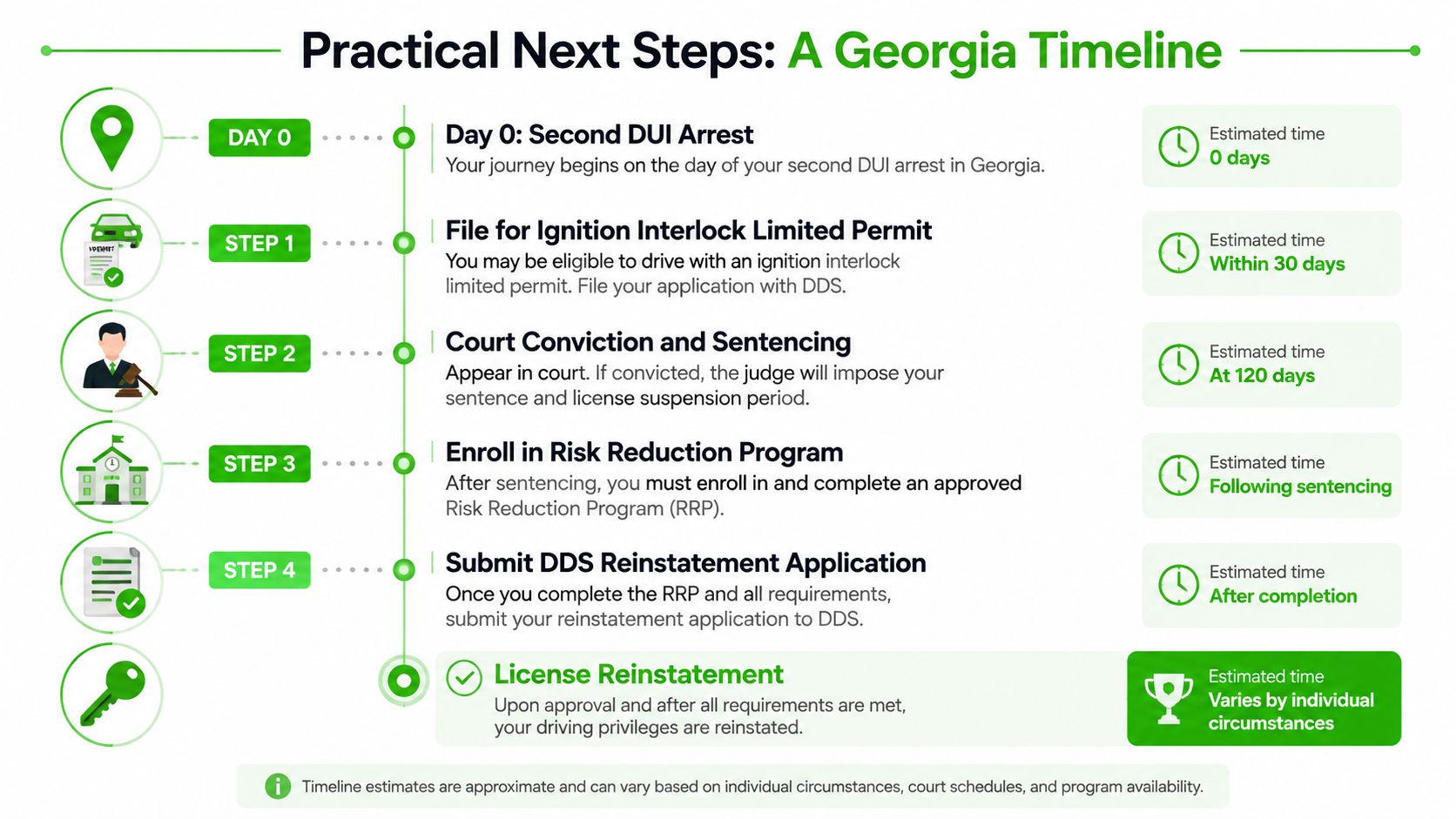
The safest plan begins on the day of the second DUI arrest and treats the criminal case and DDS file as one coordinated project. The dates below are a planning framework, not a substitute for your suspension order or a DDS eligibility determination.
Start immediately
Day 0: Stop driving unless you have confirmed legal authority. Obtain your DDS status, arrest paperwork, court documents, suspension notice, and prior driving record. Give those documents to a Georgia DUI attorney for review, especially if you were charged with driving while suspended.
Within 30 days: Address any available hearing or permit deadlines, and ask DDS whether you qualify for an ignition-interlock limited permit after the applicable hard-suspension period. Begin the Risk Reduction needs assessment rather than waiting for sentencing. A completed assessment can identify whether additional clinical services need to be scheduled.
Within 60 days: Complete the 20-hour Risk Reduction classroom program through a DDS-approved provider, then schedule the clinical evaluation. Keep the original certificate and a scanned copy. If your court has already ordered the course, submit proof according to the court's instructions as well as DDS's process.
Within 90 days: If the evaluator recommends ASAM Level 1 treatment, complete it and secure the completion record. Attend the Victim Impact Panel and arrange SR-22 filing with an insurer that confirms Georgia DDS reporting. Don't cancel or replace the policy without confirming that continuous filing will remain intact.
Prepare for sentencing and reinstatement
Before the court date, assemble a packet containing your course certificate, evaluation, treatment record if applicable, panel certificate, insurance filing confirmation, interlock paperwork, payment records, and correspondence with DDS. A lawyer can evaluate notice, the legality of the stop, whether you were driving, the prior convictions, and the effect of reinstatement before sentencing. No attorney can promise dismissal, reduced charges, or no jail.
The statutory range for a second driving-while-suspended conviction is 10 days to 12 months in jail, with a $1,000 to $2,500 fine, under O.C.G.A. § 40-5-121. That makes early legal review worthwhile. A lawyer should also confirm whether the court's sentence, probation terms, and DDS records use consistent dates and language.
By the applicable reinstatement date: Serve the required second-DUI suspension period, satisfy the hard-suspension restriction, pay the DDS fee, maintain the required insurance filing, and submit the complete reinstatement application. If DDS authorizes interlock driving, use only the approved vehicle and follow every permit condition.
My recommendation is straightforward: enroll in the Georgia DUI Schools Risk Reduction course as your first concrete compliance action today, while an attorney reviews the suspended-license charge and DDS record. Completing education early won't erase the suspension, but it puts a required document in place and gives you a clearer path toward evaluation, treatment, panel attendance, insurance filing, and reinstatement.
Georgia DUI Schools offers the DDS-approved Risk Reduction Program, including the needs assessment and 20-hour course, along with clinical evaluations, ASAM Level 1 treatment, and Victim Impact Panels for drivers managing DUI reinstatement requirements. Start by visiting Georgia DUI Schools to choose an available Georgia course format and begin organizing the compliance steps that support your return to legal driving.