You're probably reading this after one of the worst nights you've had in a long time. Your car was towed, your license may be at risk, and your head is spinning with questions about court dates, breath tests, and whether this charge can somehow disappear.
Start with the truth. If you're searching for how to get DUI charges dismissed in Georgia, don't chase internet fantasy. Instead, focus on building a strong defense. A dismissal can happen, but the people who get the best outcomes usually move fast, protect evidence, stop talking, and start building a serious response right away.
The Reality of Facing a DUI Charge in Georgia
A Georgia DUI arrest feels personal, but the system treats it like routine paperwork unless you act quickly. In Fulton County, Cobb County, and courts across metro Atlanta, prosecutors see these cases every day. They already know the police report. You need to know where the weak spots are.
The hard number to understand is this: full dismissals happen in under 5% of Georgia DUI cases, while reductions to reckless driving happen in about 28% of cases according to Georgia DUI statistics. That matters because it changes the target. You're not looking for a magical excuse. You're looking for a crack in the state's case, plus every practical move that makes a reduction more likely.
What that means in real life
If you were arrested in Atlanta, Marietta, Decatur, Athens, or anywhere else in Georgia, expect the case to move on two tracks:
- The criminal case: What happens in court.
- The license case: What happens with your driving privileges.
Those tracks can hurt you separately.
A lot of people make the same mistake in the first week. They obsess over what they said on the roadside, whether they “failed” the walk-and-turn, or whether the officer seemed rude. Some of that may matter. But your first job is bigger than replaying the stop in your head. Your first job is to get organized.
Practical rule: Don't measure success only by dismissal. In Georgia, a strong result often means protecting your license, suppressing bad evidence, or getting the charge reduced.
That's also why it helps to understand the broader consequences of a DUI in Georgia early. When you know what's at stake, you stop making emotional decisions and start making strategic ones.
The right mindset from day one
Use this framework:
| Focus | Bad approach | Better approach |
|---|---|---|
| Dismissal | Assume it should be easy | Treat it as rare and evidence-driven |
| Reduction | Ignore it as a “loss” | See it as a realistic goal |
| Courses and evaluations | Wait until ordered | Use them proactively |
| Deadlines | Hope the court explains them | Track every deadline yourself |
You don't need false optimism. You need discipline.
Immediate Actions After a DUI Arrest
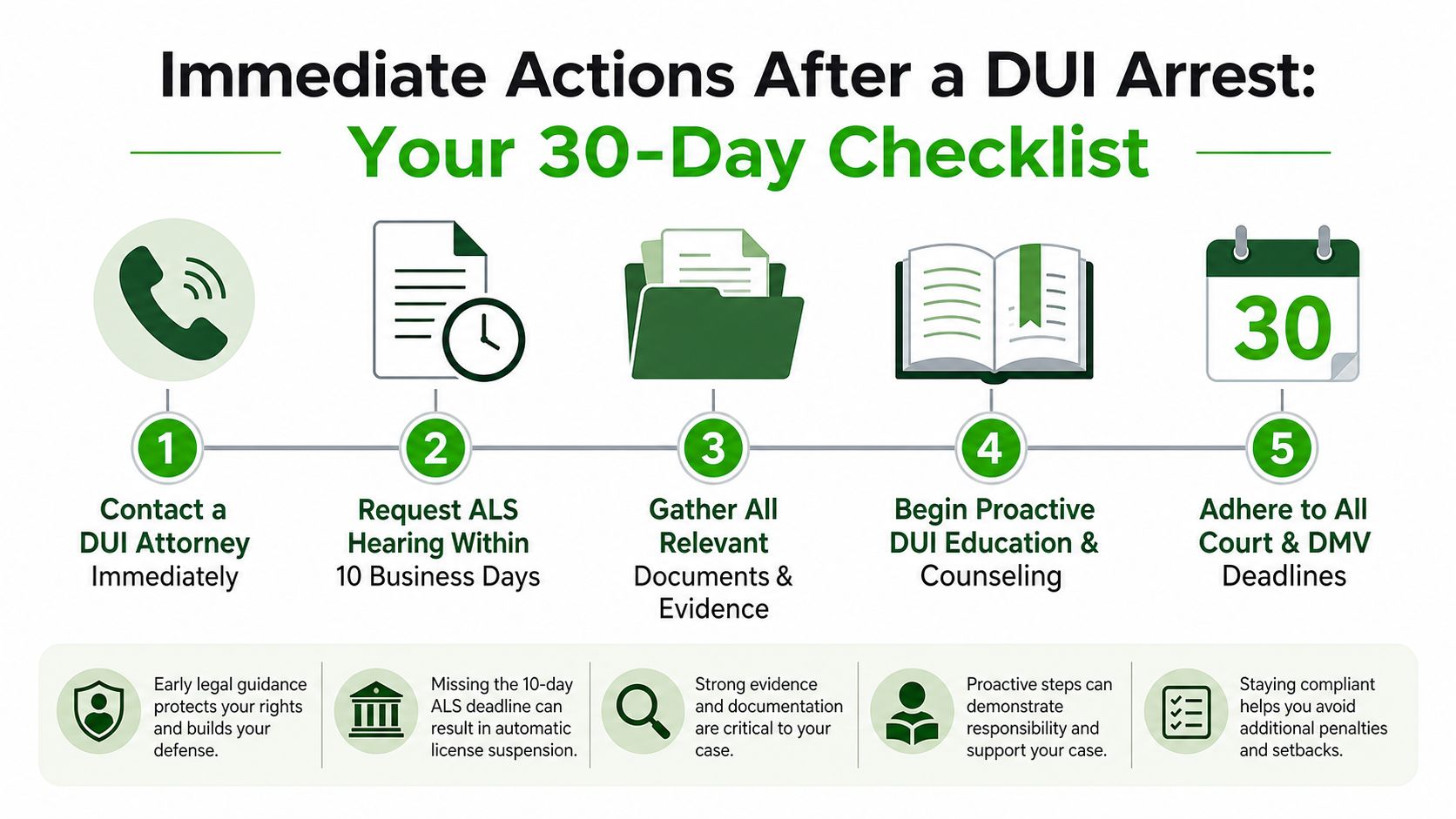
The first month's importance is often underestimated. If you miss key deadlines, you can damage your license situation before your lawyer ever gets into court.
Your first checklist
Contact a DUI lawyer immediately
Don't wait to “see what happens.” The cases that improve usually improve because someone acted early enough to preserve evidence and push for it.Protect your license right away
One defense resource explains that a key early move is requesting the administrative hearing within a short deadline, and then using discovery within 20 to 35 days to gather dashcam, bodycam, dispatch logs, and training records before filing suppression motions. It also notes a 7-day window in that state-specific process, which shows how unforgiving these deadlines can be in DUI cases generally. See the breakdown at Prager Law on motions to suppress in DUI cases.Write down everything you remember
Do this now, not next week. Include where you were, what you drank, when you drank, what the officer said, whether there was dashcam or bodycam, whether you were asked to do HGN, walk-and-turn, or one-leg stand, and whether you heard the implied consent warning clearly.Stop discussing the case
Don't explain it to coworkers. Don't post online. Don't text long defenses to friends. Every loose statement becomes a future problem.Start compliance steps early
If your lawyer agrees, begin lining up the education and evaluation pieces that often matter later in negotiations.
What to gather
Build one folder, paper or digital, with:
- Arrest paperwork: Citation, bond papers, tow paperwork, temporary permit, and any DDS forms.
- Personal notes: Your timeline, medications, health issues, footwear, road conditions, weather, and injuries.
- Video leads: Nearby businesses, parking lots, gas stations, or home cameras that may have captured the stop.
- Witness contacts: Anyone who saw you before the stop or saw the arrest happen.
For people dealing with the release process or trying to understand how misdemeanor bond logistics work in another jurisdiction, this overview from Bada Bing Bail Bonds Ventura gives a practical look at how fast post-arrest decisions can affect the rest of a case.
Don't guess your way through roadside testing issues. Review common sobriety test questions in Georgia DUI cases so you understand what the officer was trying to establish and where those tests often become vulnerable.
What not to do
- Don't miss mail from the court or DDS
- Don't assume first offense means easy outcome
- Don't plead quickly just to “get it over with”
- Don't confuse being polite with helping the prosecution
A rushed plea closes doors. Early preparation opens them.
Common Legal Defenses for a Georgia DUI
Most dismissals come from the same basic reality. The state's evidence isn't as clean as it first appears.
Illegal stop and weak probable cause
A lawful DUI case starts with a lawful stop. If the officer didn't have a valid reason to pull you over, the whole case can wobble. The same goes for the arrest itself. The officer must be able to point to specific facts supporting probable cause, not just a vague feeling.
That challenge usually appears in a motion to suppress. The theory is simple. If the stop or arrest violated your rights, key evidence may be excluded. If enough evidence gets thrown out, the prosecution may not be able to prove the charge beyond a reasonable doubt.
Common issues include:
- Thin stop justification: Drifting inside your lane once, a vague claim of “suspicious driving,” or a report that doesn't match the video.
- Poorly documented arrest signs: Generic references to odor, red eyes, or “admission” without strong impairment detail.
- Missing video support: Dashcam or bodycam that contradicts the narrative, or video that should exist but doesn't.
Field sobriety tests are not automatic truth
Georgia officers often rely heavily on roadside tests, especially HGN, walk-and-turn, and one-leg stand. Those tests are only useful when they're given correctly and interpreted correctly.
According to Georgia Criminal Defense on DUI dismissal chances, 18% of Georgia DUI cases that collapse do so when field sobriety tests deviate from NHTSA protocols, and 32% of DUI dismissals involve unreliable Intoxilyzer 9000 results due to improper calibration.
That's not a technical footnote. That's the case.
Intoxilyzer 9000 and breath test problems
Breath testing sounds scientific. In court, it's only as reliable as the maintenance, calibration, observation, and administration behind it.
A good lawyer will look for:
| Evidence issue | Why it matters |
|---|---|
| Calibration gaps | A machine with poor maintenance records becomes easier to attack |
| Operator errors | The result is only as good as the person administering the test |
| Observation failures | If the pre-test process wasn't done properly, reliability suffers |
| Record inconsistencies | Logs and reports sometimes conflict |
If the machine was the Intoxilyzer 9000, those maintenance and calibration records become especially important.
The police report is not the final version of the truth. It's the first version the state wants the court to trust.
Implied consent and procedural mistakes
Georgia implied consent issues can become serious defense points. If the warning was read incorrectly, unclearly, or under circumstances that created confusion, that can affect what evidence comes in and how persuasive the case becomes.
There's also a quieter but important angle. Officer credibility matters across hearings. If an officer says one thing at an administrative hearing and something different in criminal court, that inconsistency can damage the prosecution's case. Defense lawyers often use discovery to examine training records, testing records, and prior testimony for exactly that reason.
What this means for you
You don't need to master the science or the constitutional analysis yourself. You need to understand that dismissals usually come from documented flaws, not emotional arguments. That's why every scrap of video, every log, and every timeline detail matters.
Why You Cannot Afford to Represent Yourself
People ask this all the time. Can I handle this myself if I'm organized, respectful, and willing to research the law?
No. That's the blunt answer.
The system rewards procedure, not effort
DUI dismissals don't usually happen because a judge feels bad for someone. They happen because somebody filed the right motion, demanded the right records, challenged the right witness, and did it on time.
That's why self-representation fails so often in practice. The evidence challenge may depend on discovery requests, suppression motions, hearing strategy, and cross-examination choices that a non-lawyer won't execute well under pressure.
The point is stated plainly in this Avvo attorney discussion about getting DWI charges dropped, where one attorney says, “The only way… is with a good lawyer,” and the same discussion makes clear that dismissals almost never happen without legal counsel.
What a real DUI lawyer does that you probably won't
A qualified Georgia DUI lawyer can:
- Spot suppression issues: Illegal stop, weak probable cause, implied consent defects, and testing problems.
- Force production of evidence: Dashcam, bodycam, dispatch logs, maintenance records, and officer training materials.
- Cross-check testimony: What the officer said at the roadside, in the report, in administrative proceedings, and in court may not match.
- Negotiate from strength: Prosecutors take organized defense work more seriously than self-prepared theories from a defendant.
The hidden problem with DIY defense
Individuals representing themselves frequently concentrate on whether they were drunk. That's not enough. DUI defense is often about whether the state can prove impairment lawfully and reliably.
Straight advice: If you want the best shot at dismissal or reduction, spend your energy hiring the right lawyer and getting them useful facts early.
A first-time defendant in DeKalb or Gwinnett might think, “I'll just explain that I was tired, nervous, and wearing bad shoes for the one-leg stand.” That explanation may be true. It still won't replace a motion, a record request, or a sharp cross-examination.
If you're serious about how to get DUI charges dismissed, don't make yourself the test case for amateur lawyering.
How Proactive Steps Can Improve Your Outcome
Here's the part too many people get backward. They treat DUI classes, clinical evaluations, and related requirements as punishment for later.
That's a mistake. In Georgia, those steps can become part of your strategy now.

Why early action changes the conversation
Prosecutors and judges deal with a steady flow of DUI defendants who do nothing until they're forced. When someone starts approved education early, gets a clinical evaluation if needed, and shows up with proof of compliance, that person looks different.
That doesn't erase weak facts. It does strengthen your position in plea discussions and sentencing discussions. It shows seriousness, accountability, and lower resistance to rehabilitation.
One Georgia source reports that completing a DDS-approved Risk Reduction Program boosts the chance of a DUI charge being reduced to a lesser offense by 22%. I'm not linking that figure here because the source was already cited earlier in the article, but the takeaway is clear. Taking the course early can help.
What these programs actually signal
A proactive file often includes some combination of:
- Risk Reduction completion
- Clinical evaluation
- Treatment follow-through if recommended
- Victim Impact Panel attendance when appropriate
- Clean documentation showing every step was finished properly
That package tells the court something important. This person isn't waiting to be dragged through the process. This person has started correcting the problem.
Use mitigation, not denial
There's a difference between defense and mitigation. Good outcomes often use both.
| Approach | What it does |
|---|---|
| Defense | Challenges the stop, tests, officer conduct, and admissibility of evidence |
| Mitigation | Shows responsibility through education, evaluation, and compliance |
The strongest cases sometimes combine them. Your lawyer attacks the weak evidence. You build a record that makes reduction easier to justify if dismissal doesn't happen.
A completed course certificate won't fix a bad legal defense. But it can absolutely strengthen negotiations when the case lands in the middle ground.
Timing matters
If you wait until the judge orders everything, you lose part of the strategic value. Early completion works because it's voluntary and visible.
That matters in metro Atlanta courts, suburban courts, and smaller county courts alike. Whether the case is sitting in Fulton, Cobb, Hall, Clarke, or another Georgia court, proactive compliance gives your lawyer something useful to put in front of the prosecutor.
What to be careful about
Don't enroll blindly in random programs. Use Georgia-compliant courses and evaluations that satisfy DDS and court expectations. Keep every receipt, certificate, and attendance record. If a clinical evaluation recommends more steps, take that recommendation seriously.
This is not about checking boxes for appearances. It's about building credibility before the court decides what to do with you.
Navigating a Charge Reduction and License Reinstatement
For many first-time defendants, the practical victory isn't total dismissal. It's a reduction. In Georgia, less than 5% of DUI cases are dismissed entirely, while about 28% are reduced to lesser charges like reckless driving, according to this Georgia analysis of DUI dismissal and reduction odds.
That's why you should understand what happens next if the case resolves favorably but not perfectly.
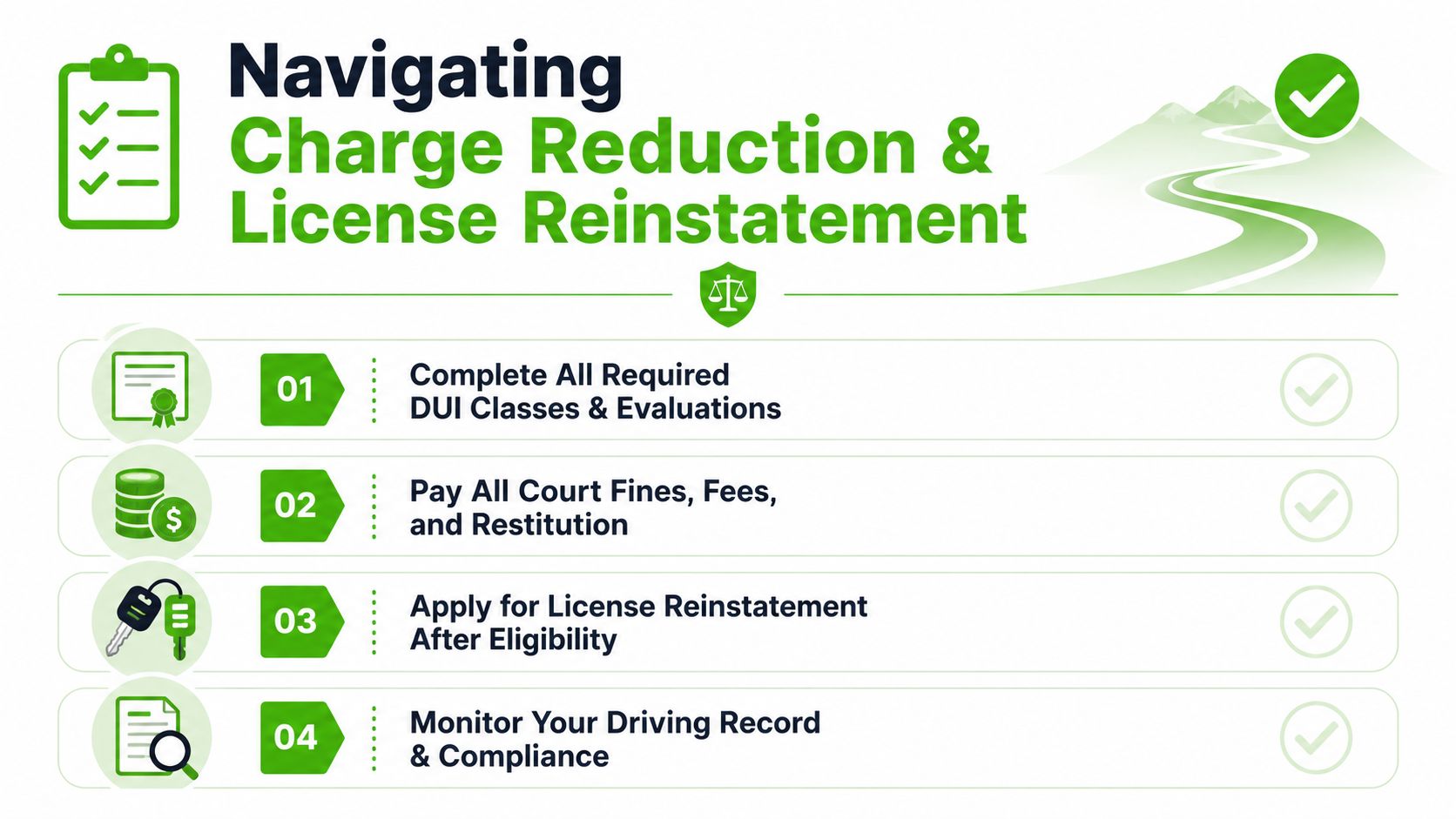
What a reduction changes
A reduction to reckless driving can affect your record and future differently than a DUI conviction. It may also put you in a better position on licensing, employment concerns, and the long tail of the case.
That doesn't mean you're done. It means you need to finish strong.
The practical path forward
Use this checklist:
Complete every required class and evaluation
Don't leave anything open. If the court, probation, or DDS requires a Risk Reduction course, clinical evaluation, treatment step, or panel attendance, finish it and keep proof.Pay what the court requires
Fines, fees, and any other obligations need to be cleared before you assume your case is behind you.Handle reinstatement directly
Follow the Georgia DDS process carefully. This Georgia license reinstatement guide is a useful starting point for understanding the paperwork and completion steps involved.Monitor your record
Don't assume the system updates instantly or correctly. Check your status and keep copies of everything submitted.
For readers comparing how other states approach reductions and dismissals, this guide to dropping Minnesota DWI is a useful contrast. The laws are different, but it shows how much outcomes often depend on procedure, evidence, and early strategic action.
Don't waste a decent outcome
A charge reduction helps. It is not permission to become careless with compliance. I've seen people earn a favorable result and then create new problems by delaying classes, missing probation terms, or assuming the license will sort itself out.
Finish every requirement. Keep your paperwork. Confirm your reinstatement. Then move on with a cleaner record and a better understanding of what the system demands.
If you need to complete the course work that often matters after a Georgia DUI arrest, start with the Georgia DUI Risk Reduction course from Georgia DUI Schools. It's Georgia DDS-approved, available with flexible options, and built for people who need to meet court or license requirements without wasting time.