A lot of Washington drivers land here in the same moment. You got a ticket in Seattle, Spokane, Tacoma, or another local court. Or you opened mail from the Department of Licensing and realized this isn't something to guess your way through. You need a defensive driving course online in Washington State, but the bigger question is whether the course you choose will count.
That's where people get stuck. One website says it's approved. Another says it's accepted everywhere. A third offers a fast certificate, but never clearly says who accepts it. If you enroll in the wrong course, you can lose time, waste money, and still have to start over.
The safest approach is simple. First find out why you need the course. Then confirm who must approve it. Only after that should you pay for anything. If you follow that order, the process gets much easier.
Your Guide to Washington Online Defensive Driving
If you're dealing with a traffic issue in Washington, the phrase “defensive driving course” can mean different things depending on your situation. For one driver, it's tied to a local court. For another, it's connected to a Department of Licensing requirement. For someone else, it's just a voluntary step they hope will help with insurance.
That difference matters more than many realize.
A course can be perfectly legitimate as an educational product and still be the wrong course for your court, your insurer, or your licensing issue. That's why the first question isn't “Which website is cheapest?” The first question is “Who is asking me to take this course?”
Start with the document in your hand
Look at the exact paperwork you received.
- Court notice: Check the name of the court, the deadline, and whether the judge or clerk gave any instructions about traffic school, a safe driving course, or a completion certificate.
- DOL notice: Read the reinstatement language carefully. If the Department of Licensing requires a course, the approval standard matters.
- Insurance question: If you're taking a course only to ask for a discount, your insurance company decides whether your certificate helps.
What most drivers want to avoid
People usually want to avoid one of three problems:
- Taking a course that isn't accepted.
- Missing a deadline because they assumed the provider would handle everything.
- Paying for a class before checking whether it matches their reason for taking it.
Practical rule: Never enroll until you know whether your approval comes from a court, the Washington DOL, or your insurance company.
Washington drivers often think “online” means anything goes. It doesn't. Online courses can be flexible, but the acceptance rules are still specific. If a court clerk in King County wants one kind of proof and your provider sends another, flexibility won't help.
The right mindset
Treat this like a compliance task, not just an online class. You're not shopping for entertainment. You're choosing a course that has to fit a legal or administrative purpose.
That small shift in mindset saves people from the most common mistake. They stop asking, “Does this site look good?” and start asking, “Will the right authority accept this certificate?”
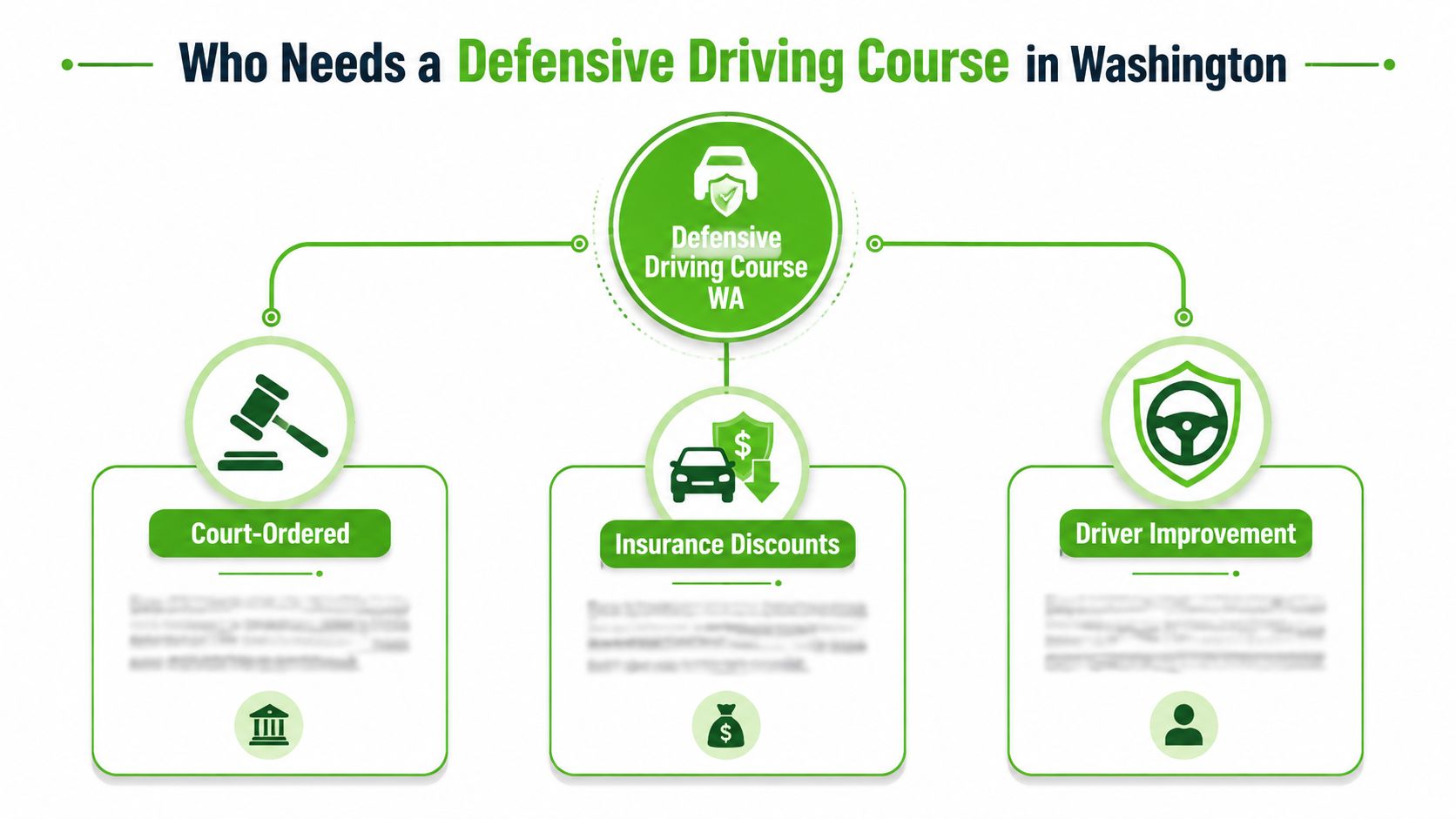
Who Needs a Defensive Driving Course in Washington
Some Washington drivers take a course because they want to. Others take one because a court or agency says they must. Those are very different situations, and they lead to different approval rules.
Court-related reasons
A local court may allow or require a driving course in connection with a traffic matter. This situation often confuses many drivers in places like Seattle Municipal Court, Spokane Municipal Court, or a county district court. They assume any Washington course will do.
Sometimes the court has a specific list. Sometimes the court gives broader instructions. Either way, the deciding voice is the court handling your case, not the course website.
If you're trying to compare how driving penalties differ across places, it can help to look at another jurisdiction's rules. For example, Ontario careless driving penalties show how much local law shapes the consequences of traffic offenses. The same basic lesson applies in Washington. Always match your response to the exact court and rule set involved.
Some drivers also look for broader traffic-school guidance before choosing a class. A useful comparison point is this overview of a defensive driving course for a speeding ticket, especially if you want to understand how courts often treat course completion as a compliance step rather than just a driving refresher.
DOL reinstatement requirements
This is the clearest example of a course being more than optional education. In Washington, an approved safe driving course can be required before reinstatement of a license suspended for repeated moving violations. One Washington rule cited by NSC says a driver suspended for 60 days after committing a traffic infraction on three or more occasions within one year or four or more occasions within two years must complete the course before reinstatement, according to Washington safe driving course guidance.
That's not a suggestion. It's a defined legal trigger.
If your license issue is tied to reinstatement, don't assume a general traffic class will satisfy the requirement. The course must match the DOL-related approval standard.
Voluntary driver improvement
Some people take a course with no pending court issue at all. They want a skills refresher, they're concerned about their driving record, or they're asking an insurance company whether a certificate could help. In that setting, the course is still useful, but the acceptance question shifts.
The insurer decides whether the course matters for your policy. A provider can advertise defensive driving, but your carrier decides whether that certificate has any practical value for you.
How to Verify an Approved Online Course Provider
The phrase approved course gets used too loosely online. In real life, approval always depends on who needs to accept your completion. That's the whole game.
If you skip verification, you can finish every lesson, pass the quizzes, download the certificate, and still learn it doesn't count for your situation. That's the mistake to avoid.
Match the provider to the authority
Use this quick reference before you enroll.
| Reason for Course | Approving Authority | How to Verify |
|---|---|---|
| Court-related traffic matter | The specific court handling your case | Check the court website or call the clerk and ask whether the provider is accepted |
| DOL-related reinstatement issue | Washington Department of Licensing or the agency standard tied to reinstatement | Review the official DOL guidance for your notice and confirm the provider matches that requirement |
| Insurance discount or policy benefit | Your insurance company | Call your agent or carrier and ask whether they accept that provider's certificate |
What to ask before paying
When you contact a court clerk, DOL office, or insurance representative, keep your questions short and direct.
- For a court: “Do you accept this specific online provider for my case?”
- For DOL-related issues: “Does this course satisfy the requirement listed in my notice?”
- For insurance: “If I complete this exact course, will you recognize the certificate?”
Write down the date, the name of the person you spoke with, and what they told you. If the website later says something different, your notes matter.
Warning signs on course websites
Some sites sound official without being clear. Slow down if you see any of these:
- Broad promises: “Accepted everywhere” is not the same as accepted by your court.
- Missing specifics: If the site never explains whether it is for court use, DOL compliance, or insurance purposes, that's a problem.
- No certificate details: You need to know what proof of completion you'll receive and how it's delivered.
A legitimate provider should make it easy to understand what the course is for, how long you have to complete it, and what documentation you'll receive at the end.
One more practical check
Before you click “buy,” compare the provider's claims against the instructions in your own paperwork. If your notice sounds narrow and the website sounds broad, trust the notice first.
That simple habit keeps Washington drivers from turning a fixable issue into a second problem.
The Online Course Enrollment and Completion Process
Once you've confirmed the right provider, the process usually feels much less intimidating. Most Washington online defensive driving courses follow a familiar pattern. You register, pay, verify your identity if required, complete the lessons, and receive a certificate.
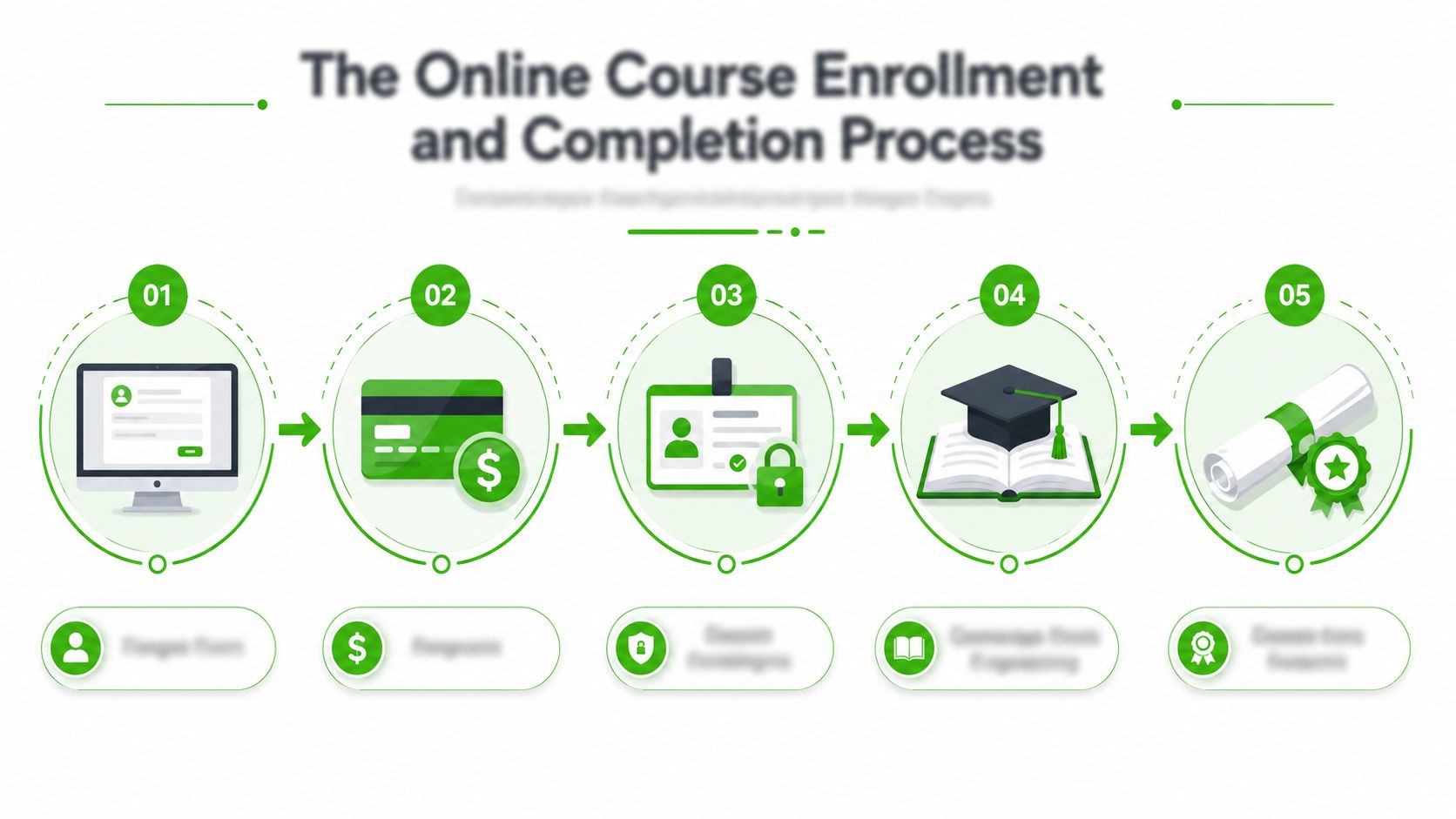
The biggest surprise for many people is that online doesn't mean unlimited. Washington online defensive driving courses are typically self-paced and available 24/7, and students are often given up to 90 days to finish. The material is commonly structured as a 4-, 6-, or 8-hour program depending on the requirement, according to Washington defensive driving course details.
What enrollment usually looks like
Registration is usually straightforward. You create an account, enter your contact information, and select the course format tied to your requirement. If the provider offers multiple Washington options, double-check that you chose the one your court, insurer, or licensing issue requires.
Payment comes next. After that, many providers send a confirmation email with login details and course instructions. Save that email. It often includes the deadline rules and certificate information people later need.
Some providers also use identity checks during the course. That can include security questions or periodic verification prompts. It may feel annoying, but for approved education, that kind of accountability is common.
What the course itself feels like
Most drivers don't need special technical skills. If you can use email and browse a website, you can usually handle the class.
Expect a self-paced sequence of reading, videos, or lesson screens about topics like:
- Hazard recognition: spotting trouble before it becomes a crash
- Traffic law review: refreshing rules drivers often forget
- Safe decision-making: following distance, speed choices, lane changes, and impaired or distracted driving awareness
The course may pause your progress at certain points or require you to complete sections in order. That doesn't mean something is wrong. It's often built that way so the provider can document completion properly.
Don't wait until the last night before your deadline. Self-paced courses are flexible, but deadlines still control whether your completion helps you.
Final quizzes and your certificate
Many courses include short quizzes during the lessons and a final exam at the end. Read the provider's retake policy before you start so there are no surprises if you need another try.
When you finish, the provider typically issues a certificate electronically, by download, by email, by mail, or through some combination of those methods. Many drivers, however, make a costly assumption about how this proof is handled. Some schools send proof directly to a court or insurer. Some don't. The provider's process is not universal.
Your safest move is to ask two questions before enrollment:
- How is the certificate issued?
- Who is responsible for sending it to the court, DOL, or insurance company?
If the answer is “you are,” put that submission task on your calendar immediately.
Costs vs Benefits of Washington Online Driving Courses
Individuals inquiring about a defensive driving course online in Washington State often want to know one practical thing. Is it worth paying for?
The honest answer is that it depends on why you're taking it. If a court or licensing authority requires the course, the benefit is compliance. In that situation, the course isn't really optional, so the better question is whether the provider is legitimate and accepted.
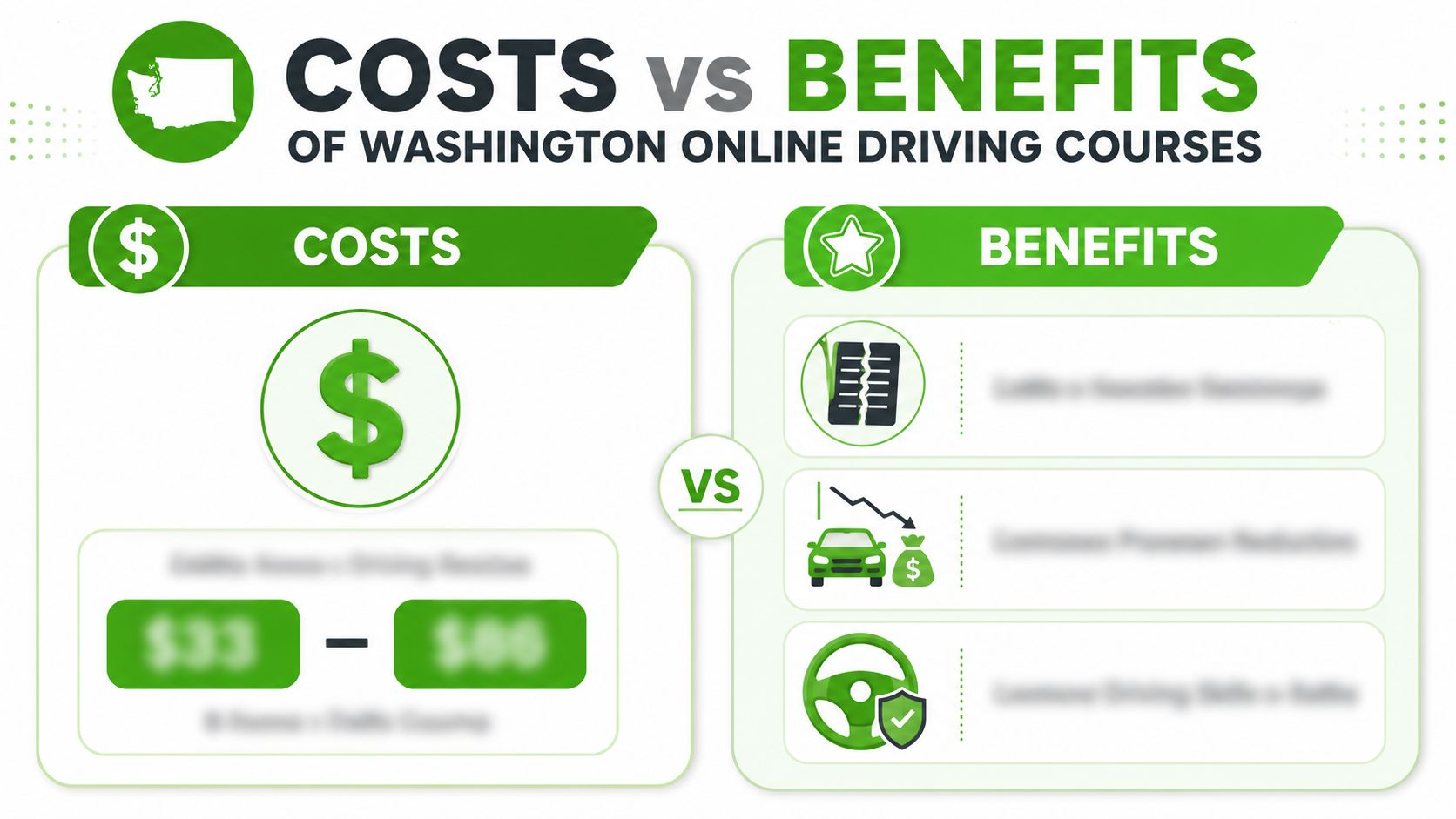
If you're taking it voluntarily, the value is broader. You may refresh important habits, improve your confidence, and possibly gain an insurance-related benefit if your carrier recognizes the certificate.
What you're really paying for
You're not just paying for course content. You're paying for a documented completion process that another party may rely on. That includes the provider's tracking system, identity controls, certificate handling, and compliance format.
A bargain course that doesn't count is more expensive than a properly accepted course that works the first time.
Benefits that matter in real life
The benefits usually fall into three groups:
- Administrative benefit: The course helps satisfy a court, reinstatement, or other formal requirement.
- Practical benefit: You review situations that drivers deal with every day, including poor weather, merging, distraction, and reaction time.
- Potential insurance benefit: If your insurer accepts the course, the certificate may support a policy discount or another underwriting benefit.
For many drivers, the best financial move is avoiding the cost of doing it twice.
Compare the tradeoff clearly
| Cost side | Benefit side |
|---|---|
| Enrollment fee and time commitment | A course that fulfills the right requirement can prevent delays and repeated filing problems |
| Need to finish by a deadline | Flexible online access makes it easier to complete around work and family schedules |
| Risk of choosing the wrong provider | Careful verification protects your money and gives your certificate a real purpose |
A good way to think about it is this. The course has value only when it matches your exact reason for taking it.
If you're also comparing broader safety and financial advantages, this guide to the benefits of defensive driving gives a helpful overview of why many drivers see these classes as more than a one-time obligation.
Common Pitfalls and How to Avoid Them
The drivers who have the smoothest experience usually don't know more law than everyone else. They just avoid a few repeat mistakes.
Picking a provider first and checking later
This is the most common error. A site looks polished, the price seems fair, and the registration page is easy. None of that proves acceptance.
Fix: Verify with the court, DOL, or insurer before you pay.
Missing the deadline
Online learning feels flexible, so people push it off. Then work gets busy, family schedules take over, or they run into a login issue at the worst possible time.
Fix: Enroll early and set your own completion date well before the official one.
Assuming the provider sends everything for you
This catches people all the time. They finish the course and believe the matter is handled. Later they find out the certificate was available for download, but no one submitted it.
Fix: Ask in advance who submits proof of completion, and if it's your job, do it immediately after finishing.
Courts and agencies care about proof received, not just work completed.
Not reading the exam and retake rules
Some drivers click through enrollment without checking how the testing works. If they struggle on the final, they panic because they never looked at the provider's retake policy.
Fix: Review the testing rules before you begin, not after you hit a problem.
Using the wrong course for the wrong purpose
A course chosen for insurance may not be the same one needed for a court matter. A general driving refresher may not satisfy a reinstatement requirement.
Fix: Match the course to the reason you need it. Don't rely on the label “defensive driving” by itself.
Forgetting to keep records
Even when everything goes right, paperwork can get misplaced.
Fix: Save your registration email, payment confirmation, certificate, and any messages from the court, insurer, or DOL in one folder until the matter is fully closed.
Washington Defensive Driving Course FAQs
Is traffic school the same as defensive driving in Washington
People often use the terms interchangeably. What matters isn't the label. What matters is whether the course is the one your court, insurer, or licensing issue requires.
Can I take a Washington course for an out-of-state ticket
Maybe, but don't assume it will work. The state or court handling the ticket decides what it accepts. Check there first.
How fast will my completion be recognized
That depends on the provider and the receiving agency or company. Some completions are processed quickly, while others take longer. Ask both sides what their timeline looks like and whether you must submit the certificate yourself.
What if I fail the final exam more than once
Every provider has its own policy. Read the retake rules before you start so you know what happens if you need extra attempts.
For drivers focused on policy savings rather than court compliance, this article on how to lower car insurance rates covers other practical steps to ask your insurer about.
Taking the Right Step for Washington Drivers
The most important part of this whole process isn't speed. It's verification.
A defensive driving course online in Washington State only helps if the right authority accepts it. For court matters, that means the court handling your case. For reinstatement issues, it means following the applicable DOL-related requirement. For insurance questions, it means getting a direct answer from your carrier before you enroll.
That's how you avoid wasted time, duplicate fees, and a certificate that doesn't solve the problem you have.
If you need to get this done correctly, use your notice, ticket, or policy information as your roadmap. Then look for official guidance tied to that exact issue. A strong starting point is to search for the Washington State Department of Licensing approved traffic safety schools list and compare it against the instructions you were given.
If you're outside Washington and need a state-specific option in Georgia, Georgia DUI Schools offers Georgia-focused defensive driving and related compliance courses, including options for drivers handling court, license, or insurance-related requirements.