

You open a court paper in Atlanta, skim a few lines, and one phrase jumps out at you: anger management class required. Or maybe your probation officer said you need a program before your next check-in. Or your lawyer told you not to sign up for the first online class you find because the wrong certificate can create a new problem.
That confusion is normal.
I’ve worked with plenty of people who weren’t asking for a perfect life plan. They just wanted straight answers. What kind of class is this? Is it therapy? Is it court-approved? Will Fulton or DeKalb accept it? Does virtual count? What if the issue came up after a DUI case, road rage stop, or a clinical evaluation?
If you’re looking for anger management classes in atlanta, the biggest mistake is assuming every class serves the same purpose. Some programs are educational. Some are therapeutic. Some are designed for court compliance. Some are useful personally but won’t satisfy a judge, probation officer, or evaluator.
What helps is breaking this down into practical steps, the same way an instructor would explain a Georgia requirement to someone under stress. You need to know what the class teaches, how legal compliance works in metro Atlanta, what formats exist, and how to avoid paying for a certificate that gets rejected.
Navigating Anger Management Requirements in Atlanta
A lot of people land here after a tense week. They’ve had a court date in Fulton County, a probation meeting in DeKalb, or a hard conversation with an attorney after an incident that involved conflict, threats, reckless behavior, or a family dispute. They aren’t trying to become experts in behavioral health. They’re trying to stay compliant and move forward.

In Atlanta, the phrase anger management can mean different things depending on who sent you. A judge may want a structured educational class with a certificate. A probation officer may care about the provider’s credibility and whether the paperwork is verifiable. A clinical evaluator may recommend anger work as one part of a larger plan after a DUI or substance-related case. A private therapist may focus more on long-term treatment than legal documentation.
That difference matters.
Practical rule: If a court or probation office is involved, never assume that “online” and “accepted” mean the same thing.
People also get tripped up by the Atlanta market itself. There are group classes, workshops, live virtual options, self-paced programs, and providers connected to state-recognized systems. Some are built around personal growth. Others are built around legal accountability. You need the right fit for your situation, not just the cheapest or fastest listing.
Here’s the good news. Once you know what your paperwork requires, the process becomes much easier. Many individuals only need to answer four questions:
- Who required it. Court, probation, attorney, employer, evaluator, or personal choice.
- What proof is needed. Certificate, attendance record, progress report, or direct reporting.
- What format is allowed. In-person, live virtual, or self-paced.
- Whether Georgia-specific credibility matters. In many cases, it does.
That’s the map. The rest is making sure your class matches the requirement.
What Atlanta Anger Management Classes Actually Involve
Many people hear “anger management” and picture a room where people just talk about being mad. That’s not how most structured classes work. A better way to think about it is emotional first-aid training. You learn what happens before anger spikes, what to do in the moment, and how to handle conflict without making the situation worse.
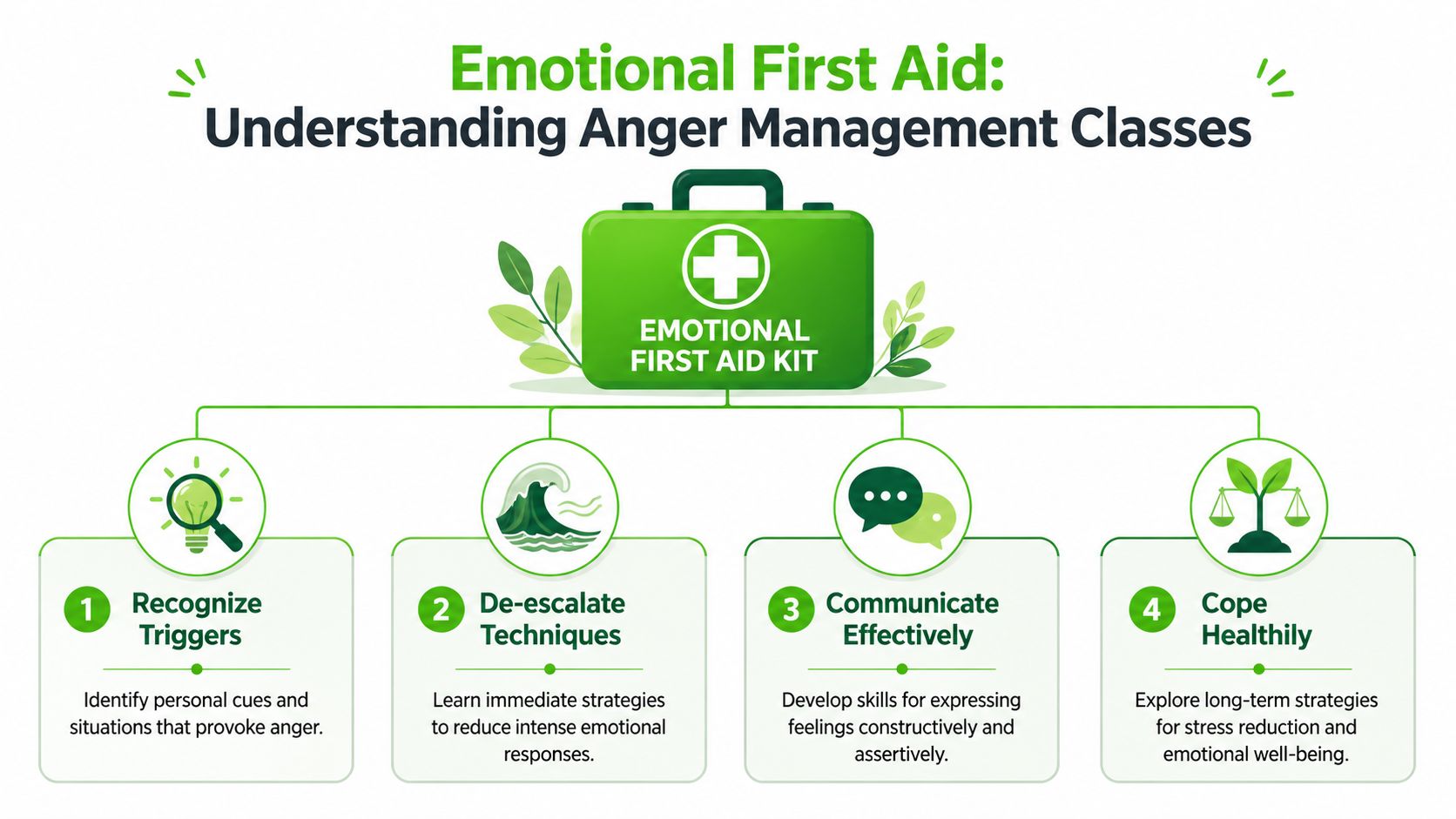
The skills most classes try to build
A solid class usually starts with trigger awareness. That means identifying the situations, thoughts, and physical warning signs that show up before an outburst. For one person, it may be criticism from a supervisor. For another, it may be traffic, disrespect, custody disputes, or conflict at home.
Then comes de-escalation. This is the practical part people often need most. You learn how to pause, slow the reaction, and interrupt the pattern before words or behavior go too far. Some providers in Atlanta also use role-playing and real-life scenarios to practice this in a structured setting.
Another common piece is communication training. Instead of yelling, threatening, shutting down, or escalating, participants practice saying what they feel in a controlled and direct way. That sounds simple, but under stress it’s hard. The class gives you a repeatable method.
A useful anger class doesn’t teach you to “never feel anger.” It teaches you what to do next.
How the Atlanta format usually looks
In Atlanta, providers offer several class designs. According to Psychology Today’s Atlanta anger management listings, anger management classes are often structured as 6 to 12 week programs, with some formats offered as 1-day classes of 6 or 8 hours. The same listings note that costs can range from $25 to $200, depending on whether you’re taking a shorter session or a full-day intensive.
That range explains why people get confused. A short workshop and a multi-week class may both be called anger management, but they don’t serve the same need in every case.
Class is not the same as open-ended therapy
This part is worth slowing down for. A structured class is usually educational and skills-based. Therapy is more individualized and may go deeper into family history, trauma, depression, anxiety, or relationship patterns. Both can be helpful. They just aren’t interchangeable.
If your anger is affecting a marriage or dating relationship, you may also benefit from reading practical guidance on strategies for managing anger in relationships. That kind of resource can support what you learn in class, especially when the primary struggle shows up at home rather than in a courtroom.
What you’ll probably experience in session
- Group discussion about common triggers and conflict patterns
- Behavior exercises that help you rehearse a calmer response
- CBT-based techniques that challenge fast, distorted thinking
- Homework or reflection work so the skill carries into daily life
If you walk in expecting punishment, you may be surprised. The better programs are structured, firm, and practical. They’re built to help you respond differently when pressure hits.
Court-Ordered vs Voluntary Enrollment Explained
The reason you’re taking the class changes everything.
Some people enroll because a court, probation office, attorney, or evaluator told them to. Others sign up on their own because they’re tired of arguments, discipline issues at work, family conflict, or the feeling that their reactions keep creating damage. Both groups may sit in similar classes, but the stakes are different.

If the class is court-ordered
Court-ordered participants usually need more than personal improvement. They need proof. That often means documented attendance, a completion certificate, and a provider that looks credible when the paperwork lands on a judge’s desk or in a probation file.
A common Atlanta example is the driver who had a road rage incident on I-285, then got pulled into a criminal or traffic-related case. Another is the person whose DUI or substance case led to a clinical evaluation, and that evaluation recommended anger work as part of the follow-up plan. If that’s your situation, the recommendation isn’t casual. It can affect probation compliance, court review, and how your case moves forward.
If you’re not sure whether your requirement came directly from the court or from an evaluator connected to the court process, it helps to understand what an anger management assessment usually addresses and how that recommendation can fit into a larger Georgia compliance path.
If you’re enrolling voluntarily
Voluntary enrollment is different. You have more flexibility. You may choose a provider based on comfort, schedule, therapy style, or whether you want a group setting versus a one-on-one clinical approach.
People in this group often say things like:
- “I’m not in legal trouble, but I get too reactive.”
- “My partner says I escalate every disagreement.”
- “My employer suggested I work on communication and impulse control.”
That’s a valid reason to attend. In fact, voluntary students often do very well because they aren’t there just to satisfy paperwork. They’re trying to change a pattern.
If a judge ordered the class, treat the provider choice like a legal decision, not a wellness purchase.
The main difference in one sentence
Voluntary students ask, “Will this help me?”
Court-ordered students must also ask, “Will this count?”
That second question is where most expensive mistakes happen.
Georgia's Legal Standards for Court Acceptance
In Georgia, the phrase court-approved sounds simple, but in practice it’s not. A provider may advertise a certificate, but that doesn’t automatically mean every Atlanta-area court, probation office, or evaluator will accept it. The legal side turns on credibility, documentation, and whether the program fits the purpose of the order.
Why generic certificates create problems
One of the biggest misunderstandings is assuming any anger management certificate will work anywhere in metro Atlanta. Courts often look beyond the paper itself. They may want to know whether the class was live or self-paced, who taught it, whether the provider is established in Georgia, and whether the program connects to recognized standards.
That’s especially important when anger issues appear alongside other legal concerns such as substance use, family violence allegations, probation conditions, or recommendations from a clinical evaluation. In those situations, the court may expect a program with stronger local legitimacy.
Where FVIP enters the conversation
According to Atlanta Anger Management’s Georgia-focused information, anger management classes in Atlanta often integrate with Georgia’s certified Family Violence Intervention Programs, or FVIP, and the Georgia Commission on Family Violence lists certified providers serving counties including Fulton, DeKalb, and Cobb. That matters because FVIP is a state-recognized framework tied to court-ordered cases involving anger-related offenses.
An anger management class is not automatically the same thing as FVIP. They are separate concepts. But when a provider operates in that compliance environment, it often gives courts more confidence that the program is structured, documented, and aligned with Georgia expectations.
How this connects to DUI and DDS-related cases
A lot of people searching for anger management classes in atlanta are also dealing with a DUI, drug-related charge, reckless incident, or another case where the Georgia DDS process is part of the background. In those cases, anger work may show up after a clinical evaluation rather than as a stand-alone first step.
That’s where people get mixed up. A DDS-approved Risk Reduction course serves one legal purpose. A clinical evaluation serves another. Anger management may become part of the recommended follow-up depending on the facts of the case and the evaluator’s findings. They work together in some cases, but they are not substitutes for each other.
What to verify before you enroll
If legal compliance matters, ask direct questions:
- Was this class designed for court documentation?
- Is the provider connected to Georgia-recognized compliance systems or referrals?
- Will the certificate clearly state completion details?
- Can the provider explain whether this is anger management, FVIP, therapy, or a combination?
That last point is often the most important. The right class is the one that matches your exact order, recommendation, or probation condition. Not just a class with a nice website.
Choosing the Right Class Format in Atlanta
Once you know what type of program you need, the next issue is format. In Atlanta, individuals typically choose between in-person classes, live virtual classes, and self-paced online courses. The best option depends on two things. Your legal requirement and your real life schedule.
Three formats, three very different use cases
In-person classes work well for people who need structure. You show up, participate, and leave with a clear attendance record. That can be helpful if your case is sensitive or if you know you do better in a room than on a screen.
Live virtual classes are often the middle ground. They give you a scheduled class and live interaction, but you don’t have to fight Atlanta traffic to get there. For many busy adults, that’s the most realistic option if the court allows it.
Self-paced online courses offer convenience, but they carry the most risk when legal acceptance is uncertain. They can be useful for personal education or broad compliance situations, but if your court paperwork is specific, self-paced may not be the safest first choice.
Anger management class formats in Atlanta
| Format | Best For | Court Acceptance | Flexibility |
|---|---|---|---|
| In-person | People who want strong structure and direct accountability | Often a stronger fit when the court wants clear local documentation | Lower |
| Live virtual | Busy adults, students, and workers who need scheduled access from home | Often better than generic self-paced options when live participation matters | Medium to high |
| Self-paced online | Voluntary learners or people whose requirement specifically allows it | Can be uncertain if the court or probation office expects local or live verification | High |
How to choose without overthinking it
Start with the legal side, not your preference. If your order says virtual is allowed, live virtual may be the simplest path. If your attorney or probation officer warns you away from generic online certificates, listen to that warning.
Then look at your daily reality.
- Work schedule matters if you can’t miss shifts or need evening access.
- Transportation matters if getting across metro Atlanta is likely to make you late or inconsistent.
- Learning style matters because some people only absorb this material when they can ask questions in real time.
The most flexible class isn’t always the best class. The best class is the one you can finish and use.
Some readers also need a broader treatment plan because anger is tied to substance use, relapse risk, or repeated legal trouble. In those cases, a higher-support service such as an IOP program in Atlanta may be part of the larger conversation, depending on the recommendation you’ve received.
For many people, the smartest move is simple. Choose the format that gives you the strongest chance of acceptance with the least chance of delay.
How to Find a Compliant Atlanta Provider
You don’t need the “best” marketing. You need the lowest-risk choice.
That means looking past polished claims and asking the questions that expose whether a provider understands Atlanta court expectations. A lot of providers say they’re accepted. Fewer will answer clearly when you ask about a specific county, a specific court, or the difference between a general certificate and one that stands up under review.

The checklist that protects you
According to a Psychology Today listing focused on court-approved Atlanta classes, a common issue in Atlanta is the rejection of generic online anger management certificates by courts such as Fulton and DeKalb, with some reports suggesting rejection rates as high as 30% for non-local or unverified providers. That’s why a provider with a physical presence and state-integrated services is often the safer option.
Use that reality as your filter.
- Ask county-specific questions. “Has your certificate been accepted for cases in Fulton County or DeKalb County?”
- Ask how the class is delivered. “Is this self-paced, live virtual, or in-person, and does the certificate show that?”
- Ask about documentation. “Can you provide attendance records or verification if my probation officer requests them?”
- Ask what the class is not. “Is this anger management only, or is it being presented as therapy, FVIP, or something else?”
- Ask who to verify with. A trustworthy provider won’t mind if you check with your attorney, probation officer, or court clerk first.
Watch for vague language
Some websites are excellent at promotion but weak on compliance detail. If you’ve ever looked at how businesses build visibility online, you’ve seen this in other industries too. Articles on local online business marketing explain how strong web presence can shape what people click first. That’s helpful to understand, but for legal classes, visibility is not proof of acceptance.
A provider should make your next step easier
A compliant provider should reduce confusion, not increase it. You should be able to get a straight answer about location, reporting, scheduling, certificate format, and whether the program fits a legal requirement.
If you need a starting point for in-person options in the city, reviewing an established Atlanta location for Georgia DUI-related services can help you compare what a locally rooted program looks like in practice.
When you’re under court pressure, “probably accepted” is not good enough.
The safest path is the one that can be verified before you pay.
Frequently Asked Questions About Atlanta Classes
A common Atlanta scenario goes like this. You have paperwork from court, a probation deadline, and three different people telling you three different things about what class will count. That confusion is normal. The key is to match the class to the exact legal requirement, the same way you match the right key to the right lock.
Is anger management the same as FVIP in Georgia
FVIP and anger management serve different purposes in Georgia. FVIP is a state-regulated program used in family violence cases, while anger management is usually an educational class focused on triggers, responses, and behavior change. If your order says FVIP, a general anger management certificate usually will not satisfy it.
Can my therapist write a letter instead of me taking a class
A therapist’s letter may help explain treatment history, but courts and probation offices often want the specific class or program named in the order. Therapy and a legally recognized class are not always interchangeable. One addresses personal treatment. The other documents completion of a defined requirement.
Are virtual classes accepted in Atlanta
Some are. Acceptance depends on what your judge, probation officer, or referring agency will approve and how the provider delivers the course.
Live, instructor-led virtual classes usually carry more weight than a self-paced course with an instant certificate. If your case is active, verify approval before you pay.
How long do anger management classes in atlanta usually take
The length depends on the requirement, not just the provider’s schedule. Some people need a short educational course. Others are directed to a longer program because of court language, probation terms, or an evaluation recommendation. Read your paperwork line by line and confirm the expected hours before enrolling.
How much do classes usually cost
Prices vary based on format, length, and whether documentation is included. A lower price can look appealing when you are under stress, but the main question is whether the class will be accepted. Paying twice because the first certificate does not meet the requirement usually costs more than choosing carefully the first time.
What if my anger issue is connected to a DUI case
That happens more often than people expect. In Georgia, a DUI case can lead to separate steps such as education, clinical evaluation, treatment recommendations, or anger-related classes. Those are different lanes of the same road. Finishing one does not automatically satisfy the others, so keep each requirement documented on its own.
What’s the safest first move if I’m unsure
Start with the document that created the requirement. Look for the exact name of the class, any hour requirement, whether virtual attendance is allowed, and who must receive proof of completion.
Then call the court, probation office, your attorney, or the referring agency and confirm what will be accepted. That five-minute check can prevent the most common problem in Atlanta. Taking a class that sounds right but does not match the order.
If you need a Georgia-based path for court, DDS, evaluation, or related compliance concerns, Georgia DUI Schools offers instructor-led programs, clinical services, and local support designed for real-world Georgia requirements. If your next step involves an evaluation or anger-related recommendation tied to a legal case, start with their anger management assessment information.