
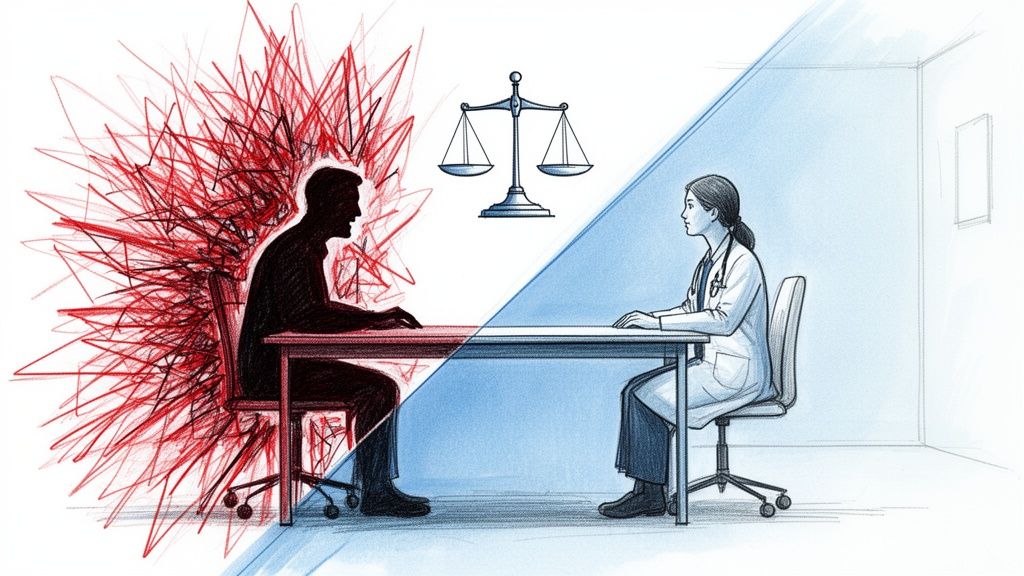
So, you’ve been told you need an “anger management assessment” by a court in Georgia. It’s a phrase that can sound pretty intimidating, and it’s easy to let your mind race. Is this a test? Can I fail? Are they going to judge me?
Let's clear the air. First, take a deep breath. It's not as scary as it sounds.
An anger management assessment isn't a test you pass or fail. Think of it more like a conversation with a trained professional—a tool they use to get a clear picture of how anger shows up in your life, what triggers it, and how it impacts your behavior.
What Is an Anger Management Assessment in Georgia?
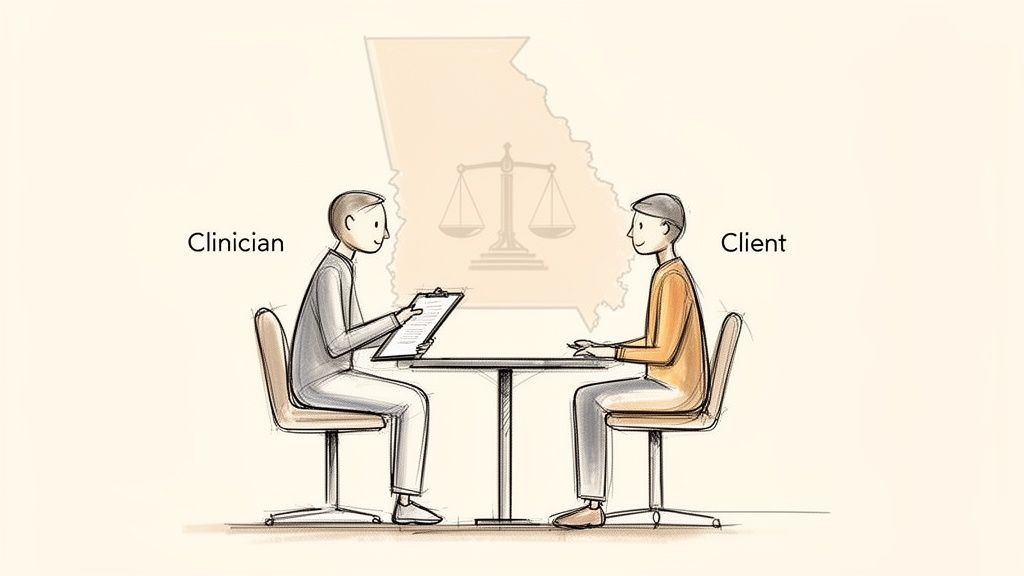
Imagine you're dealing with a court in Fulton County after a DUI or a domestic dispute. When a judge orders an anger management assessment, they aren't looking to punish you further. They’re looking for a professional opinion to help them make a fair and informed decision.
This isn't about judging your character. It’s a clinical process designed to understand the nature, frequency, and intensity of your anger, especially in situations that led to your current legal troubles.
The True Purpose of the Assessment
The main goal here is clarity, not blame. An assessment serves a few key purposes for everyone involved—you, the judge, and your probation officer in places like Gwinnett or DeKalb County.
For you, the assessment is a chance to:
- Identify Personal Triggers: Pinpoint the specific people, places, or thoughts that set off your anger.
- Recognize Behavioral Patterns: See the cycle of how your anger builds up and how you express it.
- Assess Impact: Understand how your reactions are affecting your life, your relationships, and your legal situation.
- Determine Needs: Figure out the best path forward. This might involve anger management classes, but it might not. The assessment determines what’s right for you.
Essentially, this is the official first step you need to take to satisfy the court's requirements. It gives them the professional documentation they need and gives you a clear plan to move on.
An anger management assessment is essentially a roadmap. It helps a clinician see where you are, understand how you got there, and chart the most effective course toward a healthier destination—all while satisfying the court's need for a professional evaluation.
Why It Is Often Court-Ordered
It's not personal. Judges, probation officers, and even your own lawyer might request an assessment for very practical reasons. It has become a standard part of the legal process in Georgia for certain offenses.
For example, if a road rage incident on I-285 in Atlanta leads to a DUI charge, the judge needs to know if uncontrolled anger was a key factor. The assessment helps them understand the root of the problem.
This is about rehabilitation and prevention, not just punishment. The court wants to be sure that whatever led to the offense is addressed so it doesn't happen again. The assessment provides a neutral, expert recommendation on how to make that happen. It’s a constructive process that provides clarity and a path to putting this all behind you.
Completing an anger management assessment is often the first requirement you need to fulfill. If you’ve been instructed to get one, you can start the process today by scheduling a confidential clinical evaluation. Learn more about the Clinical Evaluations offered by Georgia DUI Schools.
Who Is Typically Required to Get an Assessment
Most people don't seek out an anger management assessment for fun. While some do it for personal growth, the vast majority are required to be there, usually because of a legal situation.
Think of it this way: a judge needs a professional, unbiased opinion to make the right decision. An assessment is like that expert opinion, giving the court a clear picture of what’s really going on before deciding on the next steps.
Court-Mandated Assessments in Georgia
A court order is the most common reason you'd need an anger management assessment. This happens all across Georgia, from courtrooms in Athens to probation offices in Atlanta.
Judges often order an evaluation for individuals facing charges like:
- Driving Under the Influence (DUI): Especially if road rage or aggressive driving was involved.
- Disorderly Conduct: For situations where a loss of temper led to a public disturbance.
- Assault or Battery: In any case where physical aggression is a key part of the charge.
- Domestic Disputes: To get a better handle on conflict patterns within a family.
For these offenses, completing the assessment is a mandatory step toward resolving your legal troubles and satisfying the court’s requirements.
Problematic anger is more widespread than you might think. A 2015 study found that around 4.29% of adults admitted to having frequent temper outbursts where they completely lost control. This is a big reason why assessments are so critical, especially when the impaired judgment from a DUI is part of the picture. You can read the full research on anger prevalence in the U.S. community for more context.
Referrals Beyond the Courtroom
It's not just the legal system that can require an assessment. Other groups might also mandate one to address safety or behavioral issues.
These referrals often come from:
- Employers: A company might require an assessment after a workplace incident, like a heated argument with a colleague or a blow-up with a customer. It’s a way for them to ensure a safe environment for everyone.
- Family Members: A spouse, partner, or parent might urge a loved one to get an assessment after seeing how uncontrolled anger is damaging relationships. It’s a proactive step toward healing.
Whether it’s a judge in Savannah ordering an evaluation or a concerned family member in Augusta suggesting it, the goal is always the same: understand the role anger is playing and find a clear path forward.
No matter who sent you, the assessment is the first step. The results give us an objective foundation to recommend the right level of education or treatment, making sure the solution fits your specific needs.
Getting this done can feel like a heavy lift, but it’s the most direct way to meet your requirements and get back in control. If you have a court order or another referral to satisfy, the next move is to get your confidential assessment on the books.
Take the next step toward resolution by scheduling your Anger Management Assessment.
Walking Through the Assessment Process Step by Step
Being told you need an anger management assessment can feel overwhelming, but knowing what to expect during the appointment can make a world of difference. To help you feel prepared, we’ll walk you through the exact process you’ll experience with our clinicians, whether in Gainesville or at any of our other 17 Georgia locations.
The whole process is a clear, direct path from a legal requirement to a professional recommendation.
This journey often starts with a specific incident that leads to a court order, which then requires the assessment. The visual below lays out this common sequence of events.
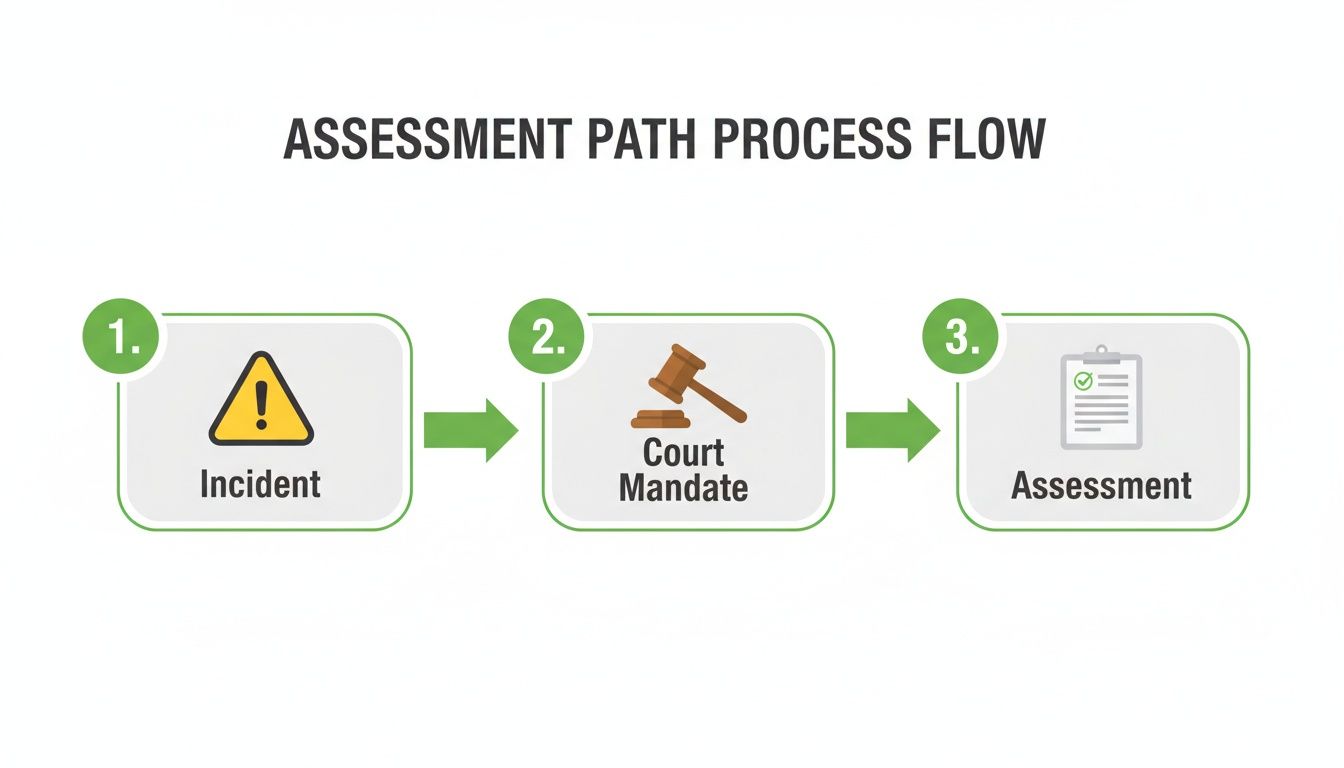
As you can see, the assessment is a structured response to a legal mandate. It’s the bridge between what the court has ordered and the next steps you need to take.
The Initial Confidential Interview
Your appointment kicks off with a confidential initial interview. This is simply a one-on-one conversation with a licensed clinician in a judgment-free environment.
Think of it like a first visit with a new doctor—they need your history to understand the full picture. The clinician will ask about:
- Your Personal History: General background information to get to know you.
- The Specific Incident: A factual discussion about the event that led to the assessment.
- Your Substance Use History: Questions about alcohol or drug use, which is often a factor in court-ordered evaluations.
This conversation is the foundation of the entire assessment. The more open and honest you are, the more accurate the clinician’s report will be. If your evaluation is specifically for substance use, you can learn more about what to expect on our drug and alcohol evaluation process page.
Standardized Questionnaires and Tools
Next, you’ll complete one or more standardized questionnaires. It’s important to know these are not pass-fail tests. There are no right or wrong answers.
These questionnaires are scientifically validated tools that give the clinician objective data about your emotional patterns. Instruments like the State-Trait Anger Expression Inventory (STAXI-2) are widely used to provide standardized insights into how you experience and express anger.
Using these tools ensures the final recommendation is built on professional standards and objective information, not just the interview alone. They provide a solid, reliable baseline for your anger management assessment.
Reviewing Collateral Information
In some situations, particularly for court-ordered cases, the clinician may need to review outside documents. This is known as gathering collateral information.
With your written consent, the evaluator might review materials like:
- Court documents or official orders
- Police reports related to the incident
- Notes or letters from a probation officer
This step gives the clinician a complete, 360-degree view of the situation. It adds credibility and thoroughness to the final report, which is exactly what the court wants to see.
Synthesis and Final Recommendation
Finally, the clinician puts all the pieces together. They analyze everything from the interview, the questionnaires, and any supporting documents to form a professional opinion.
The outcome is a formal report that includes a clear summary and a specific recommendation. This recommendation will detail the next steps you need to take to satisfy the court’s requirements, giving you a clear roadmap to move forward.
Understanding Your Assessment Results and Next Steps
Getting your anger management assessment report is a big step. Think of this document less like a final grade and more like a professional roadmap—one created to help you move forward. Let’s walk through what the results mean and what happens next.
The report pulls together all the information gathered during your assessment into a straightforward summary. It will lay out the clinician's findings and, most importantly, give you a specific recommendation for the education or treatment you need to satisfy the court and get back on track.
Decoding Your Personalized Recommendations
Your recommendation is a lot like a prescription from a doctor. It’s a plan targeted to your specific situation, based on a professional evaluation. This isn't a punishment; it's a structured path designed to help you resolve the issue.
For most people, especially those dealing with a court order in Georgia, the recommendation will point to a specific "level of care." These levels are standardized across the board to make sure you get the right amount of support—no more, no less.
What Are ASAM Levels of Care?
You’ll likely hear the term ASAM (American Society of Addiction Medicine) Levels of Care. This is a framework clinicians use everywhere to match people with the right intensity of treatment. While it was originally designed for substance use, its principles are widely used for other behavioral health services, too.
- ASAM Level 0.5: Usually involves early intervention or prevention-focused education.
- ASAM Level 1: This means outpatient services, which is the most common recommendation.
- Higher Levels (2, 3, 4): These involve more intensive outpatient or even inpatient residential treatment for more complex needs.
For the majority of court-ordered anger management cases, the recommendation will be ASAM Level 1. This typically means short-term, outpatient classes that are easy to fit into your week. It's a highly effective, low-intensity way to address specific behavioral patterns.
In some situations, an evaluation might also include a referral to a professional for a Substance Abuse Professional (SAP) assessment. You can learn more about that process in our guide on what the SAP program entails.
These programs work. Studies show that anger management interventions based on cognitive behavioral therapy (CBT) have a 76% success rate in reducing aggressive behaviors. Even general programs can slash anger outbursts by 50-70%. You can learn more about anger statistics and their impact online. These numbers should give you real hope—they confirm that a clinical evaluation is the first step toward meaningful change.
A recommendation is a personalized plan, not a one-size-fits-all solution. It's like physical therapy: a minor strain might just need a few guided sessions, while a bigger injury requires a more structured, intensive program.
The goal is to give you the tools you need in the most efficient way possible. It ensures you meet the court's requirements while also learning practical skills to handle anger triggers for good.
Common Assessment Outcomes and Next Steps
Once your assessment is complete, the clinician’s recommendation will guide your next steps. The table below breaks down the most common outcomes and what they mean for you.
| Recommendation Level | What It Typically Involves | Common Scenario in Georgia | Georgia DUI Schools Solution |
|---|---|---|---|
| No Recommendation | No further action required; assessment fulfills the requirement. | The assessment shows no clinical need for anger management classes. | We provide you with the completion paperwork for the court or probation. |
| Education Only | A short, one-time educational class (e.g., 4-8 hours). | A minor incident where education is seen as a sufficient preventive step. | We offer a range of educational programs to meet these requirements. |
| ASAM Level 1 | Weekly outpatient classes, typically for 8-24 weeks. | The most frequent outcome for court-ordered anger management needs. | Our state-approved 8-week and 12-week anger management classes. |
| Higher Level of Care | A referral for more intensive therapy or specialized treatment. | The assessment identifies more complex needs requiring specialized support. | We provide a direct referral to a trusted, qualified provider in our network. |
This structured approach makes it clear what you need to do to move forward and put this behind you.
From Assessment to Action Seamlessly
Once you have your recommendation, the next step is simple: follow it. The good news is that Georgia DUI Schools offers a seamless path from your assessment directly into the program you need.
If your report recommends ASAM Level 1 classes, you can enroll in our state-approved anger management program immediately. We offer these classes at our 18 locations across Georgia and in convenient online formats. This integrated approach saves you time and stress, giving you a clear, supportive path from your initial evaluation right through to your final completion certificate.
How to Prepare for a Successful Assessment
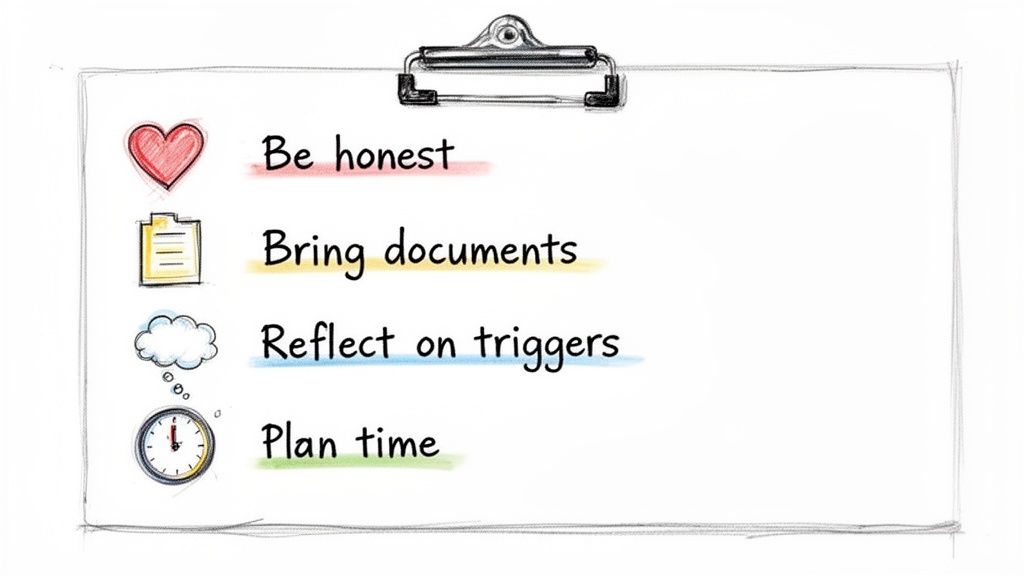
Getting ready for your anger management assessment isn't like studying for a test you can pass or fail. Instead, it’s about preparing for an important conversation.
The goal is to make the process smooth so the outcome is as accurate and helpful as possible. A little bit of planning makes the appointment much less stressful and far more productive, giving the court what it needs while setting you up with a clear path forward.
Your Honesty Is the Most Important Tool
Let's be direct: the single most important part of this process is your commitment to being open and honest. The accuracy of your anger management assessment completely depends on the information you provide.
Your clinician is there to help, not to judge. Trying to hide details or paint a rosier picture than reality will only lead to a report that doesn't reflect your actual situation. That can cause major headaches with the court later on. Honesty is what gets you a recommendation that truly fits your needs and satisfies your legal requirements.
Gather Your Essential Documents
To make the appointment as efficient as possible, it’s a smart move to gather all the relevant paperwork before you show up. Having these documents ready gives the clinician a complete view of your circumstances right from the start.
- Court Order: Bring the official document that requires you to get the assessment.
- Police Report: If you have it, the report from the incident provides critical context.
- Referral Letter: If your employer, probation officer, or lawyer referred you, bring that letter.
Organizing these documents ahead of time proves you're taking this seriously. It also helps your clinician complete all the necessary paperwork for the court, whether it’s in a metro-Atlanta county or another jurisdiction in Georgia.
Reflect on Your History with Anger
Before your appointment, take some time to think about your own experiences with anger. You don’t need to write an essay, but organizing your thoughts will help you communicate more clearly.
Consider these questions:
- What situations or people tend to trigger your frustration or anger?
- How do you typically react when you feel that anger rising?
- What have been the consequences of these reactions in your life, relationships, or legal situation?
Doing this self-reflection makes the interview part of the assessment much more focused and effective.
Preparation for an assessment isn't about trying to 'beat' the evaluation. It's about ensuring you provide the clear, honest information needed to get the most accurate and helpful outcome for your situation.
Finally, plan for the time. Most assessments take between 1.5 and 2 hours. Make sure you’ve blocked out enough time in your day so you don't feel rushed. This simple step helps you stay present and focused.
Feeling angry is a normal human experience. Despite this, few seek help. Programs designed to address these issues have high success rates, which is why preparing for your assessment is such a great first step. You can find more anger statistics and their impact online.
By following these simple steps, you'll walk into your anger management assessment prepared, confident, and ready for a productive session.
When you're ready to schedule your evaluation, our team is here to get you started. You can book a confidential appointment by learning more about our Clinical Evaluations service.
Take Your Next Step with Georgia DUI Schools
Getting through a court order for an anger management assessment can feel overwhelming. But now that you know what the process looks like, from the first meeting to the final report, you can take control of the situation.
At Georgia DUI Schools, we offer a straightforward, one-stop solution. Our state-approved anger management assessments are run by licensed clinicians who know the system inside and out. If your evaluation recommends ASAM Level 1 treatment, you can start our classes right away—no need to search for another provider.
Your Partner in Fulfilling Court Requirements
For nearly 40 years, we've helped over 100,000 Georgians get through the state's legal and educational requirements. We’ve earned the trust of courts, probation officers, and lawyers across Georgia because we get the job done right.
We make it simple to get this handled:
- 18 Convenient Locations: With offices from the Atlanta metro area all the way to Savannah, finding an in-person appointment that fits your schedule is easy.
- Secure Online Options: We also provide both clinical evaluations and anger management classes through secure, state-approved virtual sessions.
It doesn’t matter if your order came from a busy Atlanta court or a smaller local court in a place like Valdosta. We have the approved programs you need to move forward. Our entire goal is to help you meet your obligations and put this behind you for good.
Don't let confusion or worry stop you from moving on. The first and most important step is scheduling your confidential assessment. It’s how you take back control.
Don’t wait. Take action today to handle your court order and get your peace of mind back. Our team is here to guide you, from the first call to your final completion certificate.
Take charge of your future by learning more about our state-approved Clinical Evaluations and scheduling your confidential appointment today.
Georgia Anger Management Assessment FAQs
If you've been told you need an anger management assessment, you probably have a lot of questions. We get it. Dealing with court requirements can feel confusing.
Here are some straightforward answers to the questions we hear most often.
How Long Is the Assessment and What Does It Cost?
You should plan for your assessment to take between 1.5 and 2 hours. This gives our clinicians enough time to conduct a detailed interview and have you complete the necessary questionnaires without feeling rushed.
Costs can vary depending on your specific situation. The best way to get accurate pricing is to give our office a call. We’ll give you a clear breakdown and answer any financial questions you have.
Is My Assessment Confidential?
Yes, 100%. Your privacy is our top priority. The entire assessment is completely confidential and follows all HIPAA guidelines, just like a private visit to your doctor's office.
We will only share your results with a third party—like a court in Cobb County, your Athens probation officer, or your lawyer—if you give us your explicit written consent. You are in complete control of your information.
This setup ensures you can prove you’ve met your legal requirements while keeping your personal information private. We only provide the official documents to the court after you give us the green light.
What If I Don't Agree with the Recommendation?
It's completely normal to have questions about your results. After the assessment, the clinician will sit down with you and explain the findings and their professional recommendation. This is the perfect time to ask questions and discuss anything you're unsure about.
If you disagree with the outcome, you can talk it over with the clinician right then and there. It helps to know that the recommendation isn’t a personal opinion—it’s based on standardized, objective tools used across the industry to ensure fairness and consistency.
Can I Do My Assessment and Classes Online?
Yes. We offer both the clinical evaluation and any required anger management classes completely online. Our virtual sessions are secure, state-approved, and designed to be as convenient as possible.
This is a great option if you have a packed schedule, face transportation hurdles, or just prefer doing things from home. Our online programs meet the exact same standards as our in-person services, so you can be confident you’re satisfying your court order.
Whether you’re ready to schedule your assessment or need to sign up for a class, Georgia DUI Schools is here to help you move forward. Our state-approved services are designed to get you through this process efficiently.
Take the next step. Learn more about our Clinical Evaluations and schedule your confidential appointment today.