
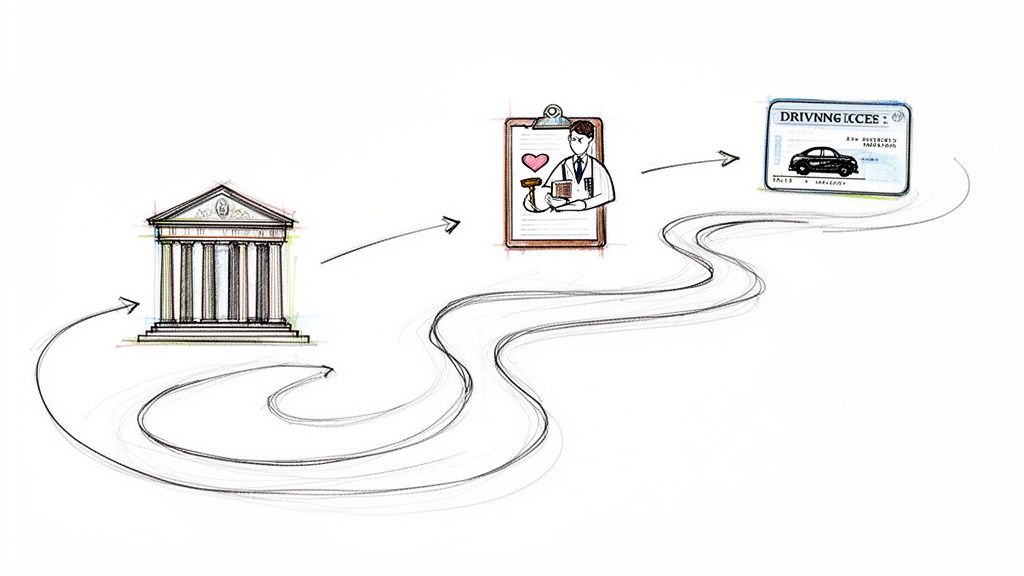
If you hear the term "SAP" after a DUI in Georgia, it's easy to get confused. No, we're not talking about the big software company. In the world of court and DDS requirements, SAP stands for Substance Abuse Program or Substance Abuse Professional.
This is a serious, state-required clinical process that some drivers must complete to get their license back after a significant DUI offense.
Decoding the SAP Program in Georgia

When you're dealing with a DUI, it's tempting to think of the SAP requirement as just another class you have to take. But it’s much more involved than that.
Think of it this way: a standard DUI/Risk Reduction course is like a general safety seminar that many drivers might attend. The SAP program, however, is a personalized clinical evaluation ordered for a very specific reason, much like a doctor sending you to a specialist for a targeted diagnosis.
The main point of the SAP program is to have a state-approved Substance Abuse Professional (SAP) conduct a detailed clinical evaluation of your substance use habits. This isn't meant to be a punishment; it's a diagnostic tool. The goal is to figure out the right level of education or treatment needed to keep the public safe and help you address any underlying issues.
The Role of the Substance Abuse Professional
The Substance Abuse Professional is a highly qualified, state-credentialed clinician who acts as the gatekeeper for this entire process. It’s their job to be thorough and objective.
Here’s what they do:
- Conduct an in-depth, face-to-face clinical assessment.
- Review your driving history and the specifics of your DUI case.
- Use standardized clinical tools to recommend the next steps.
This recommendation isn't a mere suggestion—it’s a formal directive for a specific level of education or treatment you must complete.
The SAP program is a critical clinical step on the path to license reinstatement. Its function is to provide an objective, expert assessment of risk and recommend a tailored path forward that satisfies court and Georgia Department of Driver Services (DDS) requirements.
For example, a driver in Fulton County with a second or third DUI will almost certainly be required to see an SAP. The professional's evaluation will then determine whether that person needs a short educational program or a more intensive outpatient treatment plan. This ensures the recommendation truly fits the individual, moving past a one-size-fits-all solution.
To get a better handle on the first step of this journey, you can learn more about clinical evaluations and see how they form the foundation for the entire SAP process.
Who Is Required to Complete a SAP Evaluation in Georgia
So, you’ve been charged with a DUI in Georgia. Does that automatically mean you have to go through the Substance Abuse Program (SAP)? Not necessarily.
This evaluation is a more intensive step reserved for specific, higher-risk situations defined by the state. Think of it as a separate requirement from the standard DUI/Risk Reduction course that almost everyone has to take. Knowing if your situation falls into this category is key to getting your license back without delays.
Key Triggers for a Mandatory SAP Evaluation
The Georgia Department of Driver Services (DDS) and the courts don't leave this up to chance. They have clear rules that trigger a mandatory SAP clinical evaluation. If your case involves one of these scenarios, you can expect to get an official notice requiring you to complete this step.
The most common triggers are:
- Multiple DUI Convictions: If you have two or more DUIs on your record within the last ten years, your case is automatically flagged for a clinical evaluation.
- Chemical Test Refusal: Refusing to take the state's breath, blood, or urine test when arrested is another automatic trigger for the SAP requirement.
- DUI with a Minor: Getting a DUI while a child under the age of 14 is in the car will also require you to complete the SAP evaluation.
For example, a driver in Cobb County convicted of their second DUI in five years will be ordered by both the court and the DDS to get this evaluation. It becomes a non-negotiable part of their path to license reinstatement.
The SAP requirement isn't random. It’s a legal response to high-risk scenarios defined by Georgia law. The state wants a clinical professional to assess anyone whose history points to a greater potential risk to public safety.
Here’s another common situation. Imagine a University of Georgia student in Athens who gets pulled over and refuses the breathalyzer. Even on a first offense, that refusal alone kicks off the SAP requirement. This shows it’s not just about repeat offenses—your actions during the arrest matter, too.
These rules are applied consistently across the state, from the Atlanta metro area to the smallest towns in Georgia. It’s all part of a structured system to ensure driver safety. The first step is figuring out if you fall into one of these categories so you can start taking the right steps.
Your Step-by-Step Guide to the SAP Journey
Going through the Substance Abuse Program (SAP) in Georgia can feel overwhelming, but it's a very structured process. Once you know the steps, the path to getting your license back becomes much clearer.
Think of it as a checklist. The entire journey is a clinical process designed to make sure you satisfy all state requirements from the court and the Georgia DDS.
Step 1: Receiving the Official Notice
Your journey starts with an official order. You’ll get a notice from either the court that handled your DUI or directly from the Georgia Department of Driver Services (DDS). This isn't a suggestion—it's a formal requirement to get a clinical evaluation.
Step 2: Finding a DBHDD-Approved Clinical Evaluator
Next, you need to find the right professional. You can't just see any therapist; the state is very specific about this. Your evaluation must be done by a DBHDD-approved Clinical Evaluator.
The Department of Behavioral Health and Developmental Disabilities (DBHDD) keeps an official list of all state-certified evaluators you can use.
Step 3: Undergoing the Initial Clinical Evaluation
The clinical evaluation is a one-on-one interview. The evaluator will ask you about your personal history, your substance use patterns, and what happened during your DUI. It's critical to be honest and open here, because what you discuss determines the next steps.
This infographic shows the most common reasons someone is required to complete this evaluation.
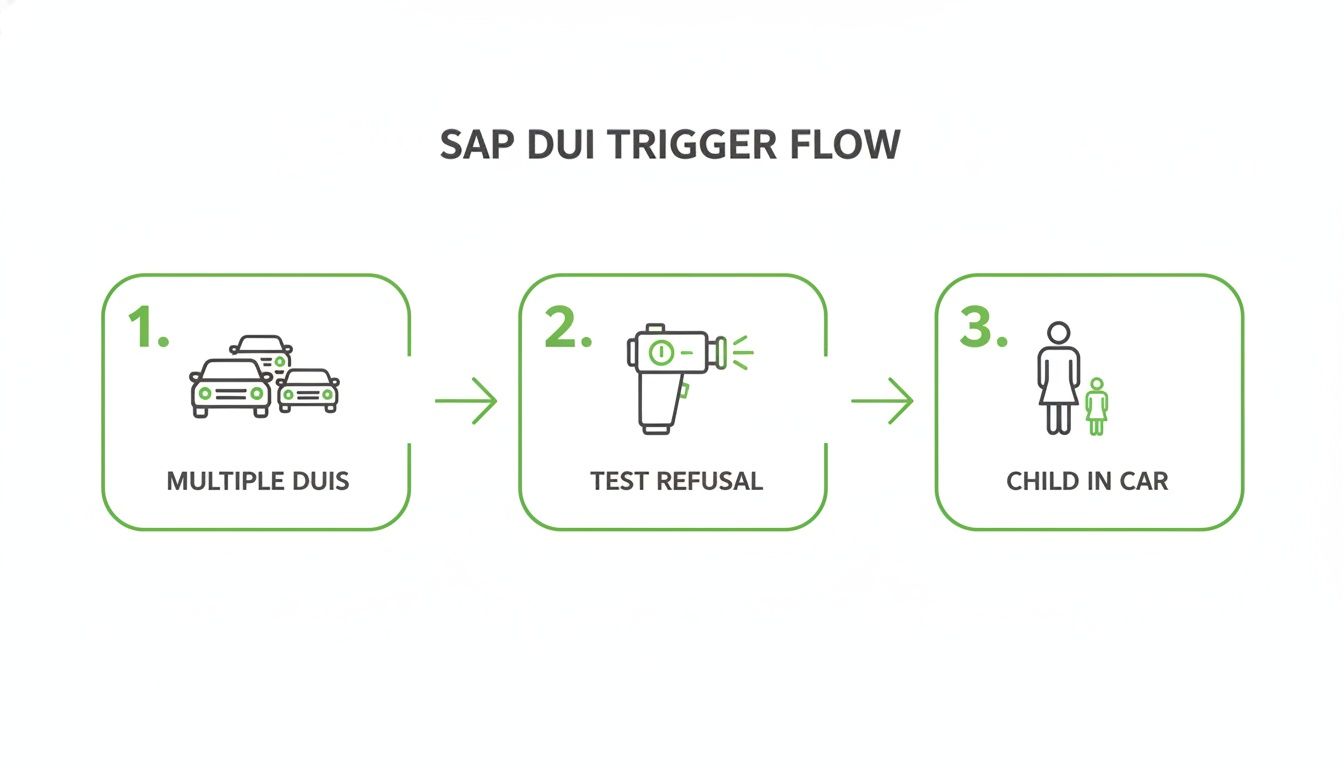
As you can see, things like refusing a breathalyzer or having multiple DUIs will automatically trigger this process. The state takes these offenses very seriously.
Step 4: Receiving the ASAM Level Recommendation
After your evaluation, the SAP will give you a formal recommendation for a specific level of treatment. This isn’t random—it’s based on the American Society of Addiction Medicine (ASAM) criteria, which is the national standard for these situations.
The clinical evaluation isn't a test you can pass or fail. It is a diagnostic tool used to determine the appropriate level of care needed to meet state requirements and promote public safety.
Step 5: Completing the Recommended Program
Now, you have to enroll in and finish the treatment program you were assigned. For most DUI cases in Georgia, this is ASAM Level 1 Outpatient Treatment. This usually involves a few weeks of group or individual counseling sessions.
Step 6: Obtaining the Certificate of Completion
Once you successfully finish your treatment program, you’ll get the most important piece of paper in this whole process: the Certificate of Completion. This is your official proof that you’ve done what the state required. You’ll need to submit copies to the DDS and the court to clear this major hurdle.
To help you keep track, here's a quick summary of what to expect at each stage.
Navigating Your SAP Journey in Georgia
| Stage | What Happens | Key Outcome |
|---|---|---|
| Initial Notice | You receive an official letter from the court or DDS. | You are formally required to get an evaluation. |
| Find Evaluator | You locate and schedule with a DBHDD-approved provider. | Your evaluation appointment is set. |
| Evaluation | You attend a one-on-one interview with the evaluator. | The evaluator assesses your situation. |
| Recommendation | The evaluator assigns a treatment level (e.g., ASAM Level 1). | You have a clear plan for your required treatment. |
| Treatment | You attend and complete the recommended counseling program. | You fulfill the clinical requirements of your case. |
| Certification | You receive an official Certificate of Completion. | You have the proof needed for the court and DDS. |
Knowing these steps puts you back in the driver's seat. You can tackle this one stage at a time and get closer to putting it all behind you.
Ready to get started? The first step is to find a state-approved evaluator and book your Clinical Evaluation.
Understanding ASAM Levels and Treatment Plans
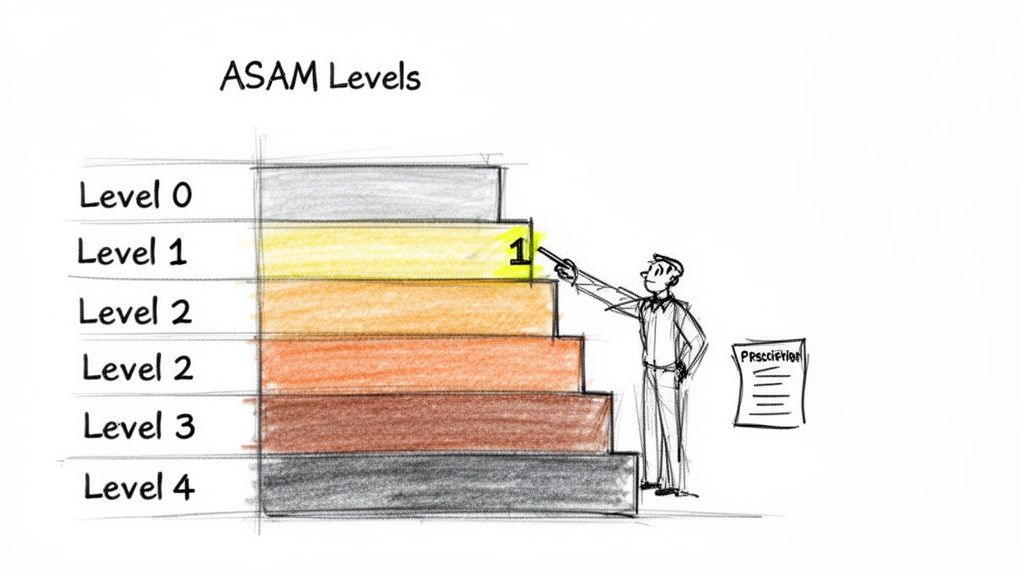
Once your clinical evaluation is complete, the Substance Abuse Professional (SAP) is going to assign you something called an "ASAM Level." It might sound like a bunch of technical jargon, but it’s really just a straightforward, national system used to place people in the right level of care for their situation.
Think of it like getting a prescription from your doctor. A doctor doesn't just guess what you need; they diagnose you first and then prescribe a specific medication at the right dose. In the same way, the ASAM criteria give your evaluator a clear framework to recommend the right "dose" of treatment for you.
What Are ASAM Levels?
The American Society of Addiction Medicine (ASAM) created these levels to make sure everyone in the treatment field is speaking the same language. The levels go from Level 0.5 (early intervention) all the way up to Level 4 (medically managed intensive inpatient care), making sure the recommendation truly fits your needs.
For a lot of drivers in Georgia going through the SAP program for a DUI, the most common outcome is a recommendation for ASAM Level 1 Outpatient Treatment. This level is perfect for people whose habits call for some structured support but who don’t need to be in a more intense, live-in program.
The whole point of the ASAM Levels is to have a state-approved, objective professional—not you, and not the court—decide your treatment plan. It’s all based on a structured assessment, which guarantees the recommendation is clinically sound and checks all the boxes for the Georgia DDS and court.
For example, a person from Augusta who has to complete the SAP program after refusing a DUI test will be assessed across six different dimensions of their life. This includes things like their history of substance use, their physical health, and how ready they are to make a change.
What ASAM Level 1 Treatment Involves
So, if you get recommended for ASAM Level 1, what does that actually look like? It’s not just a single class. It’s a full-on structured program with both counseling and education that takes place over a specific period.
Here’s what you can typically expect:
- A Set Number of Hours: The program has a required number of hours for either group or one-on-one counseling.
- A Clear Timeframe: Those hours are usually spread out over several weeks, which makes it easier to fit into your schedule without turning your life upside down.
- Focus on Education and Preventing Relapse: The main goal is to help you understand substance use, pinpoint your personal triggers, and build a toolkit of strategies to avoid another incident.
A driver from Savannah, for instance, might be required to attend group sessions for three hours a week for eight weeks. The idea is to give you consistent support and accountability while teaching you the skills you need to make safer choices down the road. This structured plan helps prove to the court and DDS that you’ve taken the steps to address the issues behind your DUI.
If your clinical evaluation points to this recommendation, knowing what to expect is half the battle. You can find more detailed information about ASAM Level 1 Treatment to get fully prepared for this next step.
What to Expect: SAP Costs, Timelines, and Paperwork in 2026
When you’re facing a mandatory Substance Abuse Program (SAP), two big questions always come up: How much is this going to cost, and how long will it take?
Knowing the answers upfront helps you plan and takes away some of the stress. Let's break down what you can expect in 2026.
Expected Costs for the Georgia SAP Program
The first thing to know is that you'll have two main expenses: the initial clinical evaluation and the treatment program that follows.
The evaluation is usually a flat fee, but the treatment cost can change depending on what the evaluator recommends for you.
- Clinical Evaluation: This is your first step. It's a required assessment in Georgia to figure out which treatment level is right for you.
- ASAM Level 1 Treatment: If you're assigned to ASAM Level 1, you can expect the cost to be somewhere between $800 and $1,200. This can vary a bit from one provider to another.
Think of these costs as an investment in getting your license back. A DUI can also affect other finances, like your insurance. We have a separate guide on how to lower car insurance rates after a DUI that you might find helpful.
Program Timelines and DDS Processing
Getting through the SAP program takes time. You won’t be done in a day. The ASAM Level 1 treatment program alone typically runs for six to eight weeks.
Don't forget—your timeline isn't over just because you finished your last class. The Georgia Department of Driver Services (DDS) needs time to process everything, which can add more days or even weeks before your license is officially updated.
Essential Documentation Checklist
Keeping your paperwork organized is one of the best things you can do to avoid headaches and delays.
Once you’ve finished the program, you’ll need to give the court and the DDS proof that you’ve met all the requirements. Here’s what you’ll need to have ready:
- Court or DDS Order: The official document that required you to get a clinical evaluation in the first place.
- Clinical Evaluation Report: The summary from your SAP evaluator that shows your recommended ASAM Level.
- Treatment Completion Certificate: This is the most important one. It’s your official proof that you successfully finished the program.
Having these three documents in order makes the final steps much, much smoother. Our programs offer flexible schedules to help you get this done without turning your life upside down.
Got Questions About the Georgia SAP Process? We’ve Got Answers.
Going through the SAP process after a DUI can feel confusing, and it’s normal to have a lot of questions. We hear them all the time. Let’s clear things up and walk through some of the most common questions we get about the program.
Can I Choose My Own SAP Evaluator?
Yes, you can absolutely choose your own evaluator. But there’s a catch—and it’s a big one.
The person you choose must be on the official Georgia Department of Behavioral Health and Developmental Disabilities (DBHDD) list of approved Clinical Evaluators. You can’t just go to any therapist down the street. For the evaluation to count, they have to hold that specific state credential.
What if I Disagree with My ASAM Recommendation?
If you feel the recommended ASAM Level is wrong, you do have the right to get a second opinion.
Keep in mind, you’ll have to pay for this second evaluation out of your own pocket, and it must be with another DBHDD-approved evaluator. It's also important to know that both evaluation reports will be sent to the DDS. This can sometimes complicate things or slow down your reinstatement process.
Your best first move is often to talk directly with the evaluator who gave you the recommendation. They can walk you through the clinical criteria they used and explain exactly why they landed on that specific ASAM Level.
How Is the SAP Different from DUI School?
This is probably the biggest point of confusion we see. The SAP and DUI School are two totally separate requirements from the state. They are not the same thing.
DUI/Risk Reduction Program (DUI School): Think of this as a required 20-hour educational course. Almost everyone with a DUI in Georgia has to take it. The goal is to teach broad strategies for reducing risky driving behaviors.
The SAP Program: This is a much more intensive clinical process. It’s only required for specific, higher-risk cases. The SAP involves a one-on-one clinical evaluation that results in a personalized treatment plan.
Does Completing the SAP Guarantee My License Is Reinstated?
No. Finishing the SAP is a huge and necessary step, but it’s just one part of a bigger process. It does not automatically get your license back.
To restore your driving privileges, you have to satisfy all the other requirements from the court and the Georgia DDS. That means paying all your fines, completing your separate DUI/Risk Reduction course, and paying any license reinstatement fees. Only after everything is checked off can you get your license back.
At Georgia DUI Schools, our state-approved programs are here to guide you through these requirements clearly and without the confusion. If you're ready to take the next step in your SAP journey, we can help you get back on the road. Find a state-approved ASAM Level 1 program and get on the road to reinstatement.