If you're sitting in Georgia wondering whether driving is still possible after an injury, a diagnosis, a surgery, or a change in balance, strength, or reaction time, you're not alone. For many people, the key question isn't whether they want to drive, it's whether there's a safe path from “I used to” or “I'm not sure” to “I can do this again.”
That path usually starts with the right evaluation, not with a car key or a guessing game. In Georgia, driving schools for the disabled sit inside a much bigger mobility system, one that includes licensing, adaptive equipment, training, and the confidence to leave home for work, medical care, education, and daily life. Federal transportation data shows why this matters, because millions of disabled Americans still drive or want to drive, but their travel patterns are different and more limited than those of nondisabled adults, which makes specialized instruction and rehabilitation a practical need, not a niche one (BTS travel patterns with disabilities).
If you've been sorting through paperwork, appointments, or mobility concerns, a useful outside reference on paperwork that can stay valid without repeated renewal is démarches RQTH sans renouvellement. The situations are different, but the underlying lesson is similar, accessibility works best when the process is clear and durable instead of confusing and constantly reset.
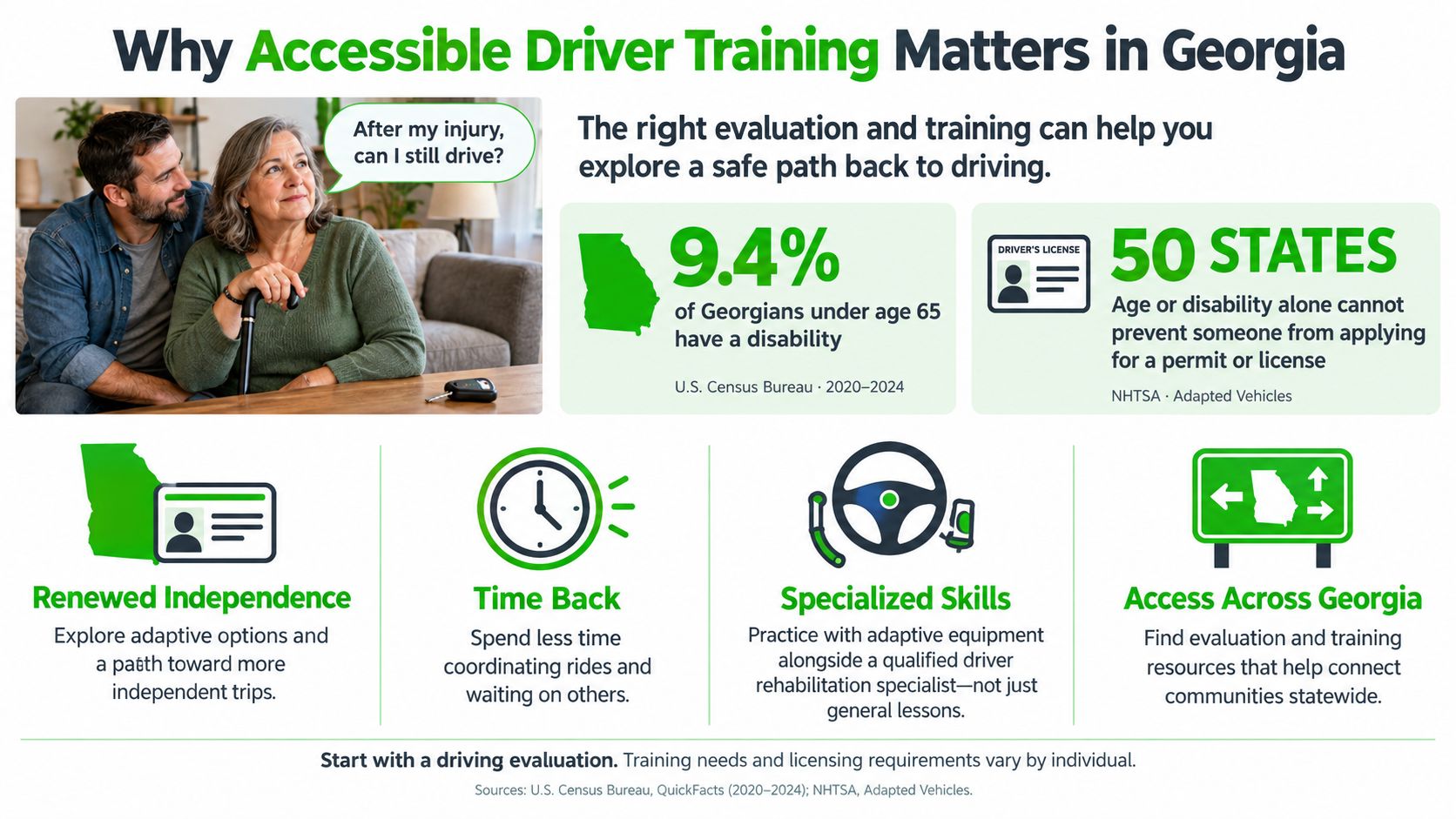
Why Accessible Driver Training Matters in Georgia
A lot of people picture driving instruction as a teenager learning how to stay in the lane and parallel park. That's not what a disabled learner needs. A Georgia adult recovering from surgery, managing a progressive condition, living with a sensory loss, or using a wheelchair may need a path that begins with a mobility question, not a lesson plan.
Federal transportation data makes the scale of the issue plain. A U.S. Department of Transportation Bureau of Transportation Statistics survey reported that more than 3.5 million Americans never left home, including approximately 1.9 million people with disabilities, and about 528,000 disabled people who were homebound also reported transportation difficulties (BTS executive summary). Personal vehicles were still the most used mode for local travel, but disabled people relied on driving less often for work-related trips, which is why the training process has to be more deliberate.
Practical rule: if the person, the vehicle, and the control setup don't fit together, the lesson is too early.
Georgia residents also deal with the same basic problem many disabled travelers face everywhere, the trip doesn't happen unless the driver can get in, fit comfortably, see clearly, control the vehicle, and repeat that safely day after day. That's why accessible driver training is more than a normal road lesson with a few accommodations. It often combines behind-the-wheel instruction, individualized evaluation, advice about vehicle modifications, and scheduling that respects medical fatigue, therapy visits, or transport dependence.
A useful way to think about it is this, a standard school teaches driving rules. An accessible program helps someone answer a deeper question, what exact version of driving is safe for me now?
What Adaptive Driving Instruction Actually Is
Adaptive driving instruction starts where a regular lesson stops. A general instructor usually assumes a standard seat, standard pedals, standard steering, and a student who can learn within that setup. An adaptive program starts by asking what the learner can do comfortably, what causes strain, and which controls need to change before training begins.
The lesson starts with the person, not the car
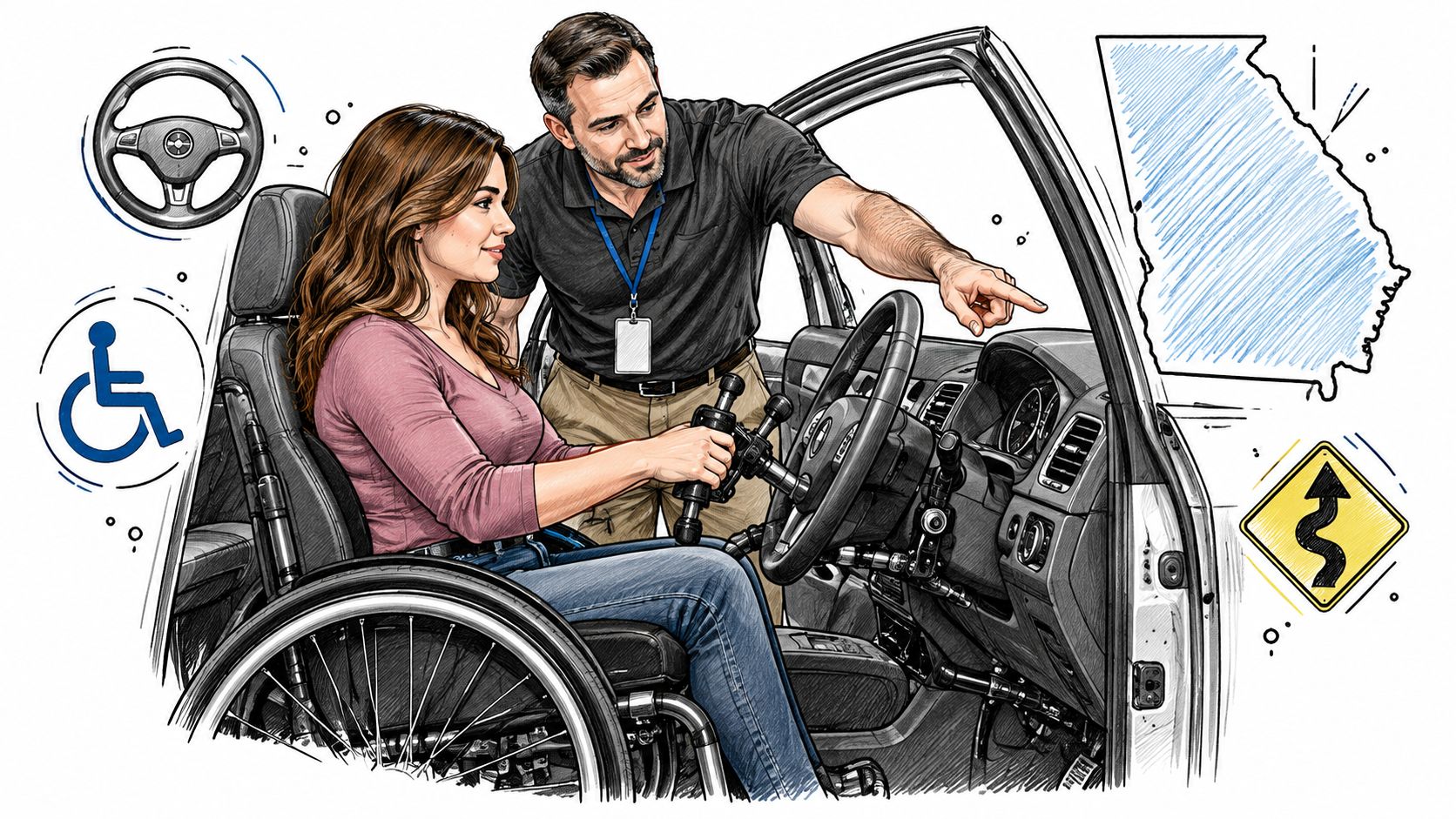
In practice, that means the instructor or specialist looks at seat position, transfer needs, mirror placement, blind spots, and the way the learner reaches, turns, presses, or stabilizes their body. A person with limited leg function may need hand controls, while someone with upper-limb weakness may need a different steering aid or a different entry and transfer strategy. The point is not to force the learner into a standard vehicle, it's to fit the vehicle to the learner.
A driver-rehabilitation specialist is different from a general driving teacher because the specialist works from a functional baseline. That baseline becomes the map for the rest of the training. In other words, the first question is not “Can you pass the route today?” It's “What control setup lets you drive without creating avoidable strain or unsafe compensation?”
The adaptive control system is taught together, not piecemeal. If the equipment is introduced late, the learner can end up relearning habits that don't match the modified vehicle. That's why the equipment, the body mechanics, and the driving task have to be taught as one unit.
A good adaptive lesson feels less like being corrected and more like being fitted for the right tool.
A learner might spend one session learning how the seat angle affects transfers, another session on how the steering input changes with hand controls, and another session on how to recover from a low-speed mistake without overcorrecting. The training isn't simpler than ordinary driving. It's just more exact.
How a Driver Rehabilitation Evaluation Works
A driver rehabilitation evaluation usually feels closer to a clinical checkup than a road test. The evaluator is not looking for failure. The goal is to find the safest path to driving, or to confirm that another option is the better fit.
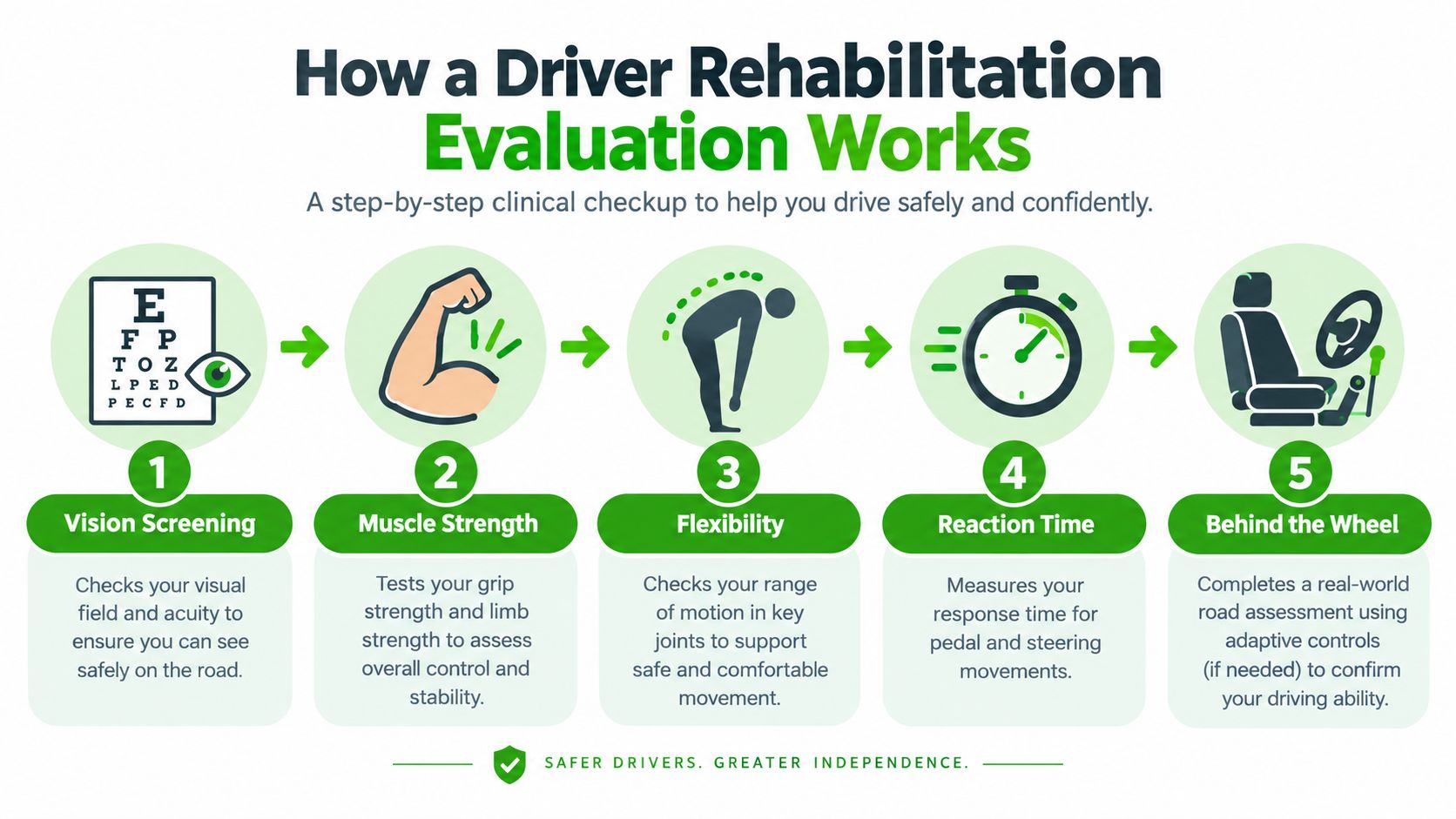
What the evaluation looks at
NHTSA recommends screening vision, muscle strength, flexibility and range of motion, coordination and reaction time, judgment and decision-making, and the driver's ability to use the proposed adaptive equipment (NHTSA adapting guide). That mix matters because driving is not one skill. It is several skills working at the same time, while the body, the car, and traffic keep changing.
One person may have enough strength to steer, but not enough range of motion to use a control without pain. Another may have solid physical control and slower reaction time, which changes the kind of instruction or equipment that makes sense. NHTSA also notes that evaluators should account for future medical or functional changes and the repetitive stress an adaptive control can place on a muscle group. A setup that looks fine on paper can still lead to fatigue or unsafe compensation in real driving.
The written report should spell out the licensing restrictions, vehicle requirements, modifications, and whether on-road training is needed. That report matters because it turns the evaluation into a clear set of instructions instead of leaving the learner to interpret the results alone.
A certified driver rehabilitation specialist often carries that process, and the evaluator's role is to connect medical limits, vehicle setup, and driving performance into one picture. A learner may have a solid path forward, but the details still need to line up. Does the recommendation match how the body actually moves, or does it only sound convenient?
For the learner, the pace can feel slow and detailed. That is usually a good sign. A rushed evaluation can miss a transfer problem, a blind-spot issue, or a control mismatch that later shows up as pain, fatigue, or panic behind the wheel.
Common Vehicle Modifications and Adaptive Controls
A driver who needs adaptive equipment is not just adding a gadget to the car. The modification changes how the whole driving process works, from getting in and settling the body to braking, turning, and recovering if something feels off. If those steps are not considered together, the setup can feel clumsy and can create safety problems.
Matching the tool to the body
NHTSA identifies examples such as hand controls, steering controls, and joystick steering, and also notes that specialized adaptations can alter braking, acceleration, steering, seating, transfers, or wheelchair loading (NHTSA adapted vehicles). The right device depends on the learner's actual functional profile, not on what sounds simplest to buy.
| Adaptive Modification | Primary Functional Need | Typical Driver Profile |
|---|---|---|
| Hand controls | Brake and accelerate without using the feet | Driver with limited leg function or lower-limb loss |
| Steering aids or steering controls | Turn the wheel with reduced grip or arm fatigue | Driver with reduced hand strength or limited dexterity |
| Joystick steering | Combine multiple driving inputs in one control system | Driver needing a highly customized control setup |
| Left-foot accelerator | Shift pedal use to the left side | Driver who can use one leg more reliably than the other |
| Modified seating or transfer support | Enter, position, and exit the vehicle more safely | Driver with transfer difficulty or balance concerns |
| Wheelchair loading options | Load mobility equipment before or after driving | Driver who travels with a wheelchair or scooter |
Training must match the equipment in the same vehicle setup the learner will use. That means practicing emergency braking, steering recovery, low-speed maneuvering, mirror and blind-zone checks, transfers, and pre-drive inspection in that exact configuration. A common mistake is buying equipment first and hoping training will sort everything out later. That can waste time and money, because the right modification depends on the person's condition, the vehicle, and the intended use.
A few drivers only realize what matters once they sit behind the wheel and try to make a left turn or back into a parking space. The control may work in theory, but the true test is whether it can be used smoothly under pressure without extra strain.
For readers who want a plain-language look at how interior changes support daily mobility, regain driving independence is a useful phrase to keep in mind. The goal is not the device itself. It is the freedom the device makes possible.
Georgia Licensing and DDS Medical Review Steps
Georgia drivers with disabilities often move through the system in a sequence, not a single appointment. First comes the functional question, then the equipment question, then the licensing question, and finally any required course or reinstatement step. That sequence matters because DDS decisions depend on what the evaluator recommends and what the driver can safely use.
The path usually runs in this order
A driver who has medical, sensory, or cognitive limitations may need a medical review or a functional evaluation before training moves forward. If the evaluation calls for restricted licensing or adaptive equipment, the driver then works within those limits, rather than ignoring them and hoping a standard license works out. For some drivers, especially those dealing with DUI-related reinstatement issues, DDS also requires completion of a certified program before paperwork is accepted.
Georgia's DDS-certified program rules are strict. DDS states that only certified driving schools are approved for DUI, defensive-driving, or driver-education programs, and that classes completed at uncertified schools will not be accepted for licensing, reinstatement, or court requirements (DDS regulated programs). That certification issue matters because a certificate from the wrong provider can leave a driver thinking a requirement is done when DDS won't recognize it.
Georgia's DUI Alcohol or Drug Use Risk Reduction Program has two required parts, a 130-question NEEDS assessment and a 20-hour intervention course delivered across several sessions, and DDS lists the total program cost as $360 (DDS DUI FAQs). The key point for drivers with disabilities is that the paperwork and the physical training often have to move in step, not separately.
If a driver is dealing with more serious DUI consequences, Georgia DDS says a third DUI suspension can trigger habitual violator status and a five-year revocation, along with a 12-month ignition-interlock requirement once eligible for reinstatement (DDS habitual violator summary). A separate DDS summary for a third DUI offense within five years of the second also lists a minimum 15-day jail sentence, a fine of at least $1,000 and up to $5,000, five-year revocation, and at least 30 days of community service (DDS section 2).
How to Choose an Accessible Driving School in Georgia
A real accessible school is easy to spot once you know what to look for. It doesn't just say it “helps disabled drivers.” It can explain who evaluates the learner, what vehicle setup is available, how adaptive equipment is taught, and how the program fits with Georgia licensing needs.
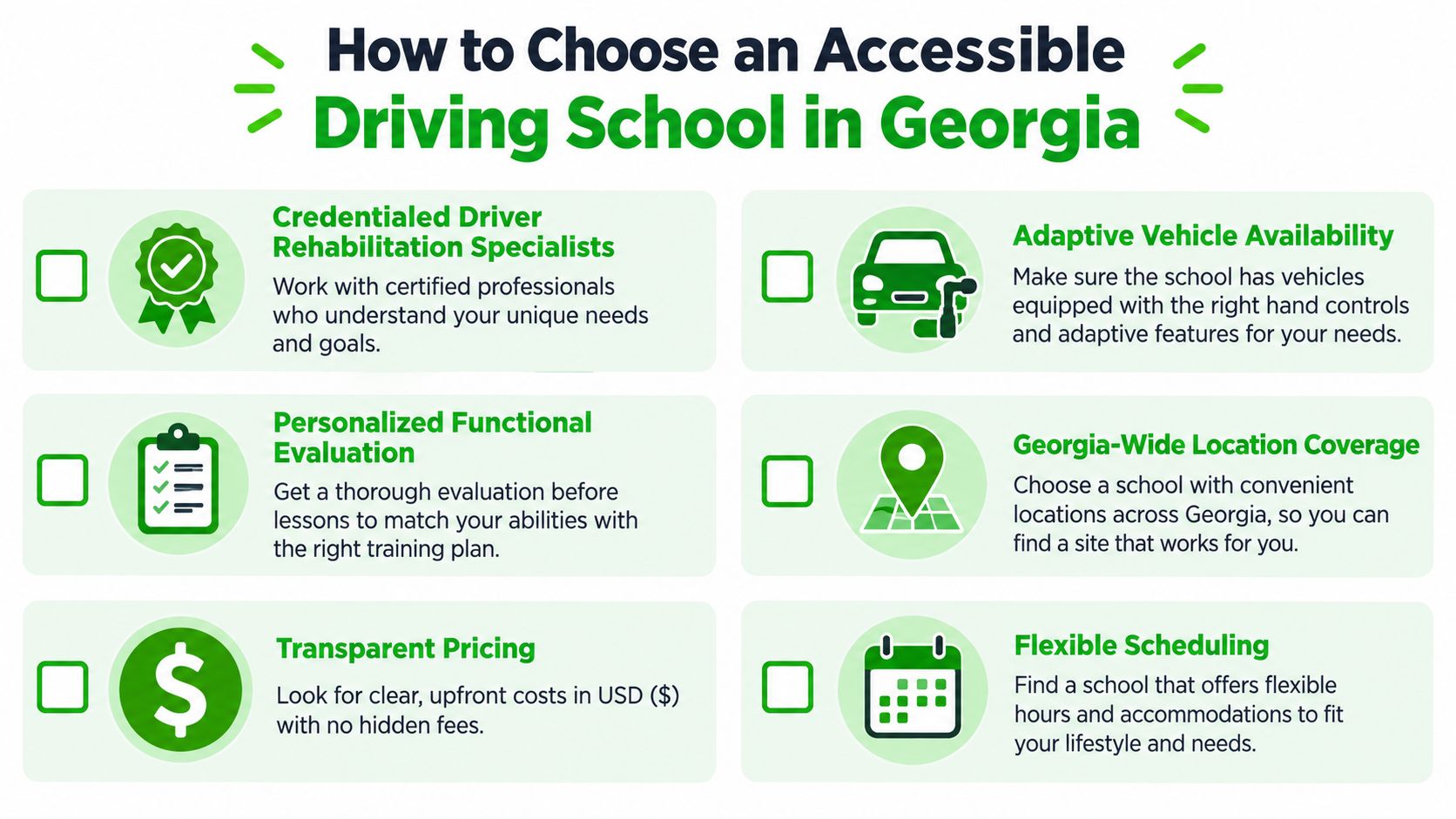
What separates a good fit from a generic school
Start with credentials. Ask whether the school works with a driver-rehabilitation specialist or coordinates with one. If the answer is vague, that's a warning sign, because the assessment and the training need to line up.
Then ask about the vehicle. If the school has no adapted training car, or if the instructor seems unsure about hand controls, transfer aids, or other equipment, the fit probably isn't right. The same goes for scheduling. A disabled learner may need slower pacing, medical-friendly timing, or repeat practice in the same exact setup.
One more thing matters in Georgia, and it's easy to overlook. If the school also offers DUI-related classes or defensive driving, verify that any such program comes from a DDS-approved provider. The credential only matters if DDS accepts it.
| What to Ask | Why It Matters |
|---|---|
| Who performs the evaluation? | You need a qualified baseline before training begins |
| What adaptive vehicle is available? | The training car should match the control setup |
| Do you coordinate with medical review? | Georgia licensing may depend on the report |
| Do you teach on the exact adaptive equipment? | Practice has to match the licensing vehicle |
| Is the provider DDS-certified for required courses? | Unapproved classes may not count |
| Can sessions be scheduled flexibly? | Medical fatigue and transport limits are real |
If you want to see how a school presents disability-related instruction in real markets, where Deaf students thrive academically is a reminder that accessibility works best when the environment is built around the learner, not when the learner is asked to adapt alone.
For readers comparing local options, it also helps to check any Georgia-based listing of disabled driver training against those same criteria instead of choosing by location alone. In Atlanta, Athens, and surrounding communities, the right question is not “Who's closest?” It's “Who can train this body in this vehicle under Georgia's rules?”
What to Expect From Adaptive Driving Classes
A first adaptive lesson usually feels less like a drive and more like a controlled rehearsal. The instructor may begin in a parking lot, not because the learner isn't serious, but because the first job is to make the controls feel familiar before traffic gets involved.
The shape of a typical session
A class often starts with a short review of the equipment, seat position, and the day's goal. Then the learner tries one control at a time, first at low speed and then with more complexity added. If hand controls are new, the lesson may begin with smooth braking and acceleration in a quiet space before any route with intersections or lane changes.
What gets documented matters too. The instructor notes what felt easy, what felt awkward, and where the learner needed correction. That feedback loop is important because progress in adaptive driving is usually individual, not calendar-driven. One person may be ready to move quickly, while another needs several repetitions before the movement becomes automatic.
A safe lesson ends with clearer habits, not with a tired driver trying to “push through” one more drill.
Adaptive classes usually include emergency-response drills, low-speed maneuvering, mirror and blind-zone work, transfer practice, and pre-drive inspection. Those are not extras. They're the tasks that keep the driver from discovering a problem later on the road, when there's less room to fix it.
If you're comparing programs, a helpful internal starting point is the Georgia overview for driving lessons for disabled drivers, because the lesson structure should make sense before you enroll. Defensive-driving habits still matter here too, since scanning, spacing, and calm correction help every driver, not only those using adaptive equipment.
Putting the Pieces Together and Taking the Next Step
A good Georgia process starts in order. First comes the evaluation, then the equipment decision, then the training, and then the licensing or reinstatement step that follows DDS rules. That sequence keeps the work tied to the driver's actual needs, instead of forcing the driver to fit a setup chosen too early.
Funding questions fit into the same sequence. State vocational-rehabilitation departments and workers' compensation may cover driver education and training in some situations, but each case still turns on paperwork, eligibility, and review. The practical questions are straightforward: who pays for the evaluation, who pays for fitting the equipment, who pays for training, and what happens if the first setup does not fit well enough.
Do not buy equipment before the evaluation. The right controls depend on medical and functional status, and a mismatch can create safety problems and wasted expense. Once the setup is chosen, training should happen in that exact vehicle, with those exact controls, before anyone treats the driver as ready for road use.
For Georgia drivers who also need a DDS-recognized course, certification has to come before enrollment. That matters because the certificate may need to be accepted by DDS or by a court, and a wrong choice can send the driver back to the starting point.
If you need a Georgia-approved path for DUI/Risk Reduction or defensive-driving requirements while you work through mobility questions, Georgia DUI Schools offers DDS-approved programs, flexible online and classroom options, and related clinical services that can fit alongside the licensing process. Visit Georgia DUI Schools to find the next step that matches your situation and keep your Georgia requirements moving in the right order.